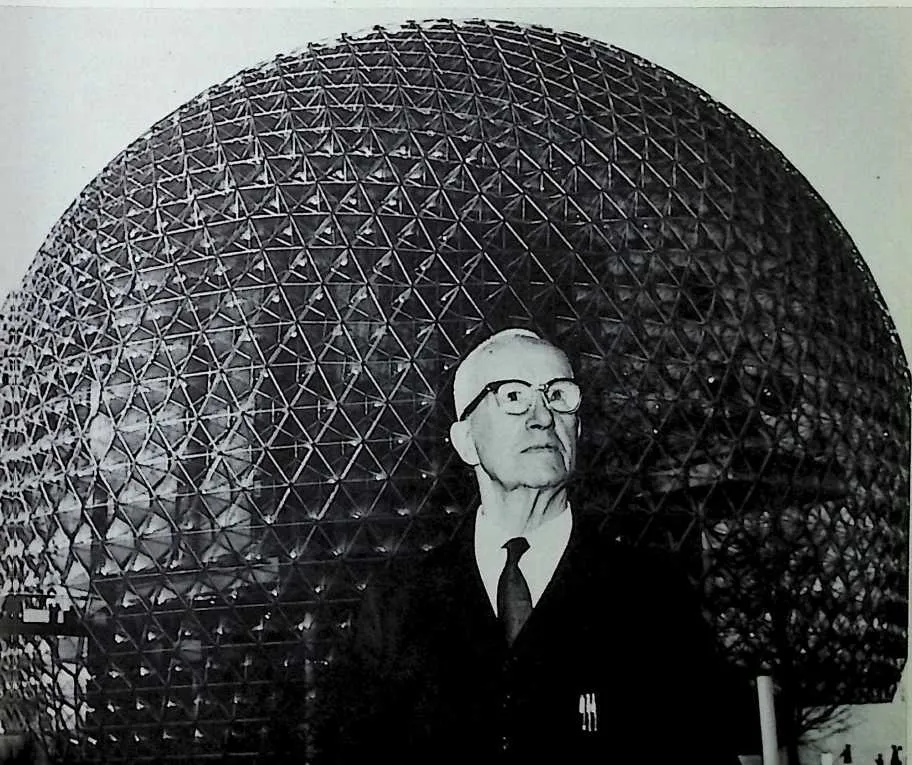
13 13
2Bucky Fuller still puzzled the world. At seventy-two surely he would sit back, slow down, and enjoy the fruits of his labor. After all, the domes were ‘‘perking along nicely,’’ as Bucky put it, and they had earned for him a prize that could not be bought with money. The Harvard chapter of Phi Beta Kappa, the honor society, had voted him a membership with the right to wear the famous golden key. Bucky Fuller, however, persisted in working far out on the frontier.
3 He expects domes to be used as ‘‘environment valves’’ to cover whole sections of cities. For midtown Manhattan, he proposed a superdome to stretch from river to river and cover the area between 21st and 63rd streets. The dome would soar three- quarters of a mile above the Empire State Building but contain less steel than an ocean liner. It would be almost invisible.
4 What possible use could a ‘‘cover’’ be to a city?
5 Temperature and humidity could be controlled. The savings in energy costs alone would be tremendous. Additionally, the snow removal that costs New York City so much money each year would be eliminated. From the heated skin of the dome, melted snow would run off into gutters and be piped into reservoirs for future use instead of being wasted.
6 Despite the success of the domes, some things had not changed in this world. Bucky’s proposal was too much like science fiction for the city officials, who refused to buy it.
7 Even more startling was his design for foldable buildings that could be used on the moon. Like exploding seed-pods, these would pop open to erect themselves, thus providing instant shelter.
8 ‘‘If I did not know better, I would swear that R. Buckminster Fuller was the figment of somebody’s imagination, possibly my own,’’ said one person.
9 A very real, very alive Bucky continued to circle the globe. He kept up his hectic pace of travel and work but became worried at one point about his flagging energy. Was age finally slowing him down? Or was it perhaps all that extra weight that
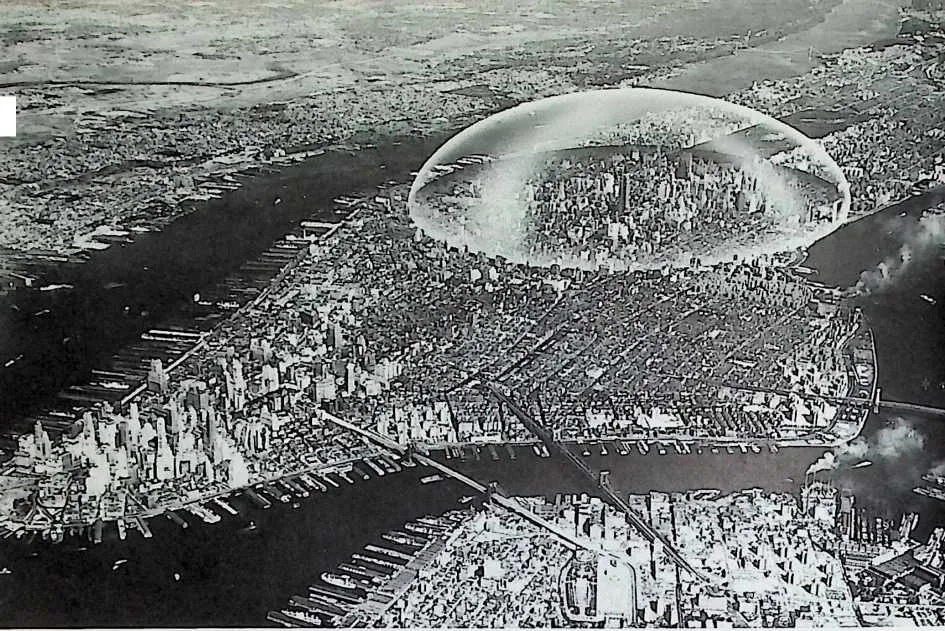
11 A composite picture shows how a dome would cover the midtown Manhattan area of New York City he was carrying around? Too many banquets, too much rich food had made his stocky figure a very round one indeed.
12 Bucky solved his problem simply. Every day thereafter, for breakfast, lunch, and dinner, he ate only steak and applesauce. To keep track of time on his constant flights, he wore three watches. One was set at the time in his home office, one for the place in which he was at the moment, and the third for the place that he was going to.
13 In his travels, Bucky met a man whose vision matched his own. Matsutaro Shoriki, a Japanese multimillionaire, wanted Japan to make a really great contribution to the world. He felt, as Bucky did, that the greatest problem is how to house people and give them a standard of living that really means something. Mr. Shoriki hired Bucky to develop plans for a city of a million people.
14 Bucky tackled the colossal job very scientifically. He fed statistics into the computer, examined facts and figures. Each phase
15 took months of study. There had been planned communities before, but nothing like what was emerging from Bucky’s study.
16 His vast city would float like a ship on the waters of Tokyo Bay. Anchors would keep it from rolling and pitching. Although it might be connected to the land by bridge-ways, the floating city would be completely independent, providing all its own services, wasting nothing, recycling everything.
17 What shape did this floating city take? Naturally, it would be a tetrahedron, providing the greatest possible surface area for the space that it enclosed. The sloping outside surface would give occupants their own private terraced garden homes. Shopping centers and common-purpose areas would be located on the inside. Tennis, athletic fields, recreation areas would be on the top deck.
18 This city would start small, perhaps with two hundred thousand people. By adding tetrahedrons, just as a crystal does in
19 Model of Triton City, Fuller's -proposed floating city
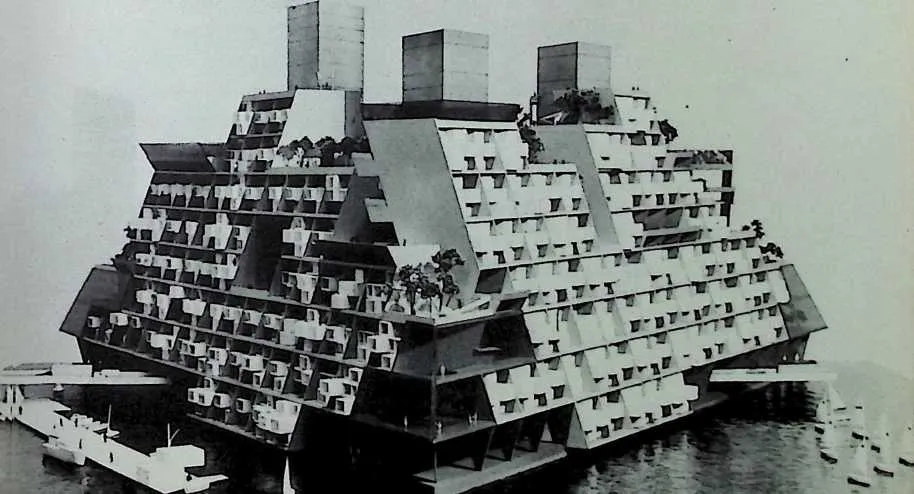
21 Nature, the city would grow to a height just under a mile and contain a million people.
22 Bucky has described this great dwelling machine as a ‘‘sort of large bookcase.’’ Imagine the dwelling units (mass-produced, of course) raised and lowered mechanically to the terraces. It would be like placing boxes on a shelf. While parts such as the power plant would remain fixed, others could be detached to float elsewhere. Going on vacation, an occupant might remove his apartment and put it in one of those breakaway sections to sail around the world. The possibilities stretch endlessly.
23 Before the study could be completed, Mr. Shoriki died. When the U.S. government asked Bucky to complete the full design and make a model, he felt hopeful about his floating city. Such a gigantic project would require the cooperation of the federal as well as the state and local governments. And the city of Baltimore was considering anchoring one in Chesapeake Bay.
24 Unfortunately, the fall elections of 1968 brought a change in government. New officials scrapped the plans. Lyndon Baines Johnson, retiring from the Presidency, took the models of Triton City for his library in Texas. Although the project died, the idea lives on. Tourists at Expo ‘75 in Okinawa saw ‘‘Aquapolis,’’ a small working prototype of a floating city. It offers one answer to the housing and environmental needs of the future.
25 More and more often, Bucky was expressing his concern about our environmental needs. One important fact had emerged from the charts which he kept. By harnessing technology and energy to use the world’s resources, more people were living better than ever before. In 1900, only 1 percent of humanity had adequate shelter and food. By the middle of this century, over 40 percent enjoyed more physical comforts and conveniences in shelter, food, transportation, and communication than in all history.
26 With the population increasing constantly and resources decreasing, how was this possible?
27 By doing more with less, said Bucky’s charts. For example, farmers were producing more food from fewer acres and doing it with less labor.
28 In his own boyhood, the mechanics of living required a great many structures and outbuildings. Gradually, the woodshed became a furnace, the ice house became a refrigerator. Today bulky radio tubes have been replaced by tiny transistors. A communications satellite weighing about a ton carries more messages than 175,000 tons of transoceanic cable.
29 ‘‘I am absolutely convinced that we have enough,’’ says Bucky. ‘‘Our planet earth can successfully support all humanity for generations to come. We do not have an energy crisis. We have a crisis of ignorance.’’
30 Bucky’s World Game which he began in 1969 was designed to overcome this crisis of ignorance. The game includes an inventory of the world’s resources and uses scientific means, including computers, to explore the efficient use of these. In Bucky’s game, everybody wins, for the object is to help everyone live better than ever before. In workshop meetings each year, amateurs and experts together look for the critical path. When the world is ready to look for sensible solutions, the World Game will have information and strategies ready.
31 Always ready for new experiences, full of optimism and a zest for living, Bucky never could resist either a challenge or a joke. In Colorado, a seventy-two-year-old Bucky put on skis for the first time in his life. He maneuvered a bit on those long, awkward, curved slats.
32 ‘‘What do you think of it?’’ his host asked.
33 With a perfectly straight face, Bucky answered that he had unlocked the secret of the sport. After all, it was simply ‘‘angular valving of gravity.’’
34 In Canada, Bucky once shook a whole room full of dignified, important guests into laughter. At Carleton University, the fancy dinner with people in formal dress had gone on for a very, very long time. Introduced as a man who ‘‘operates spontaneously’’ and never prepares a speech, Bucky opened his remarks with: ‘‘The first thing I have to say spontaneously is that I have to leave for the men’s room.’’
35 From Canada to Australia, to Greece, to Iran, to England, to Israel went Bucky, crisscrossing the United States in between. In 1970 alone, he delivered over eighty speeches. After a Fuller speech in India, the government leaders, much impressed, asked Bucky to design three new airports at New Delhi, Bombay, and Madras. Along the way that year, he picked up the Gold Medal of the American Institute of Architects, that same group that had rejected his offer of patents forty-one years ago. (The state of New York, too, recognized his genius, finally granting him an architect’s license in 1974.)
36 Anne shared his pleasure in this award and shared, too, in his travels. The Delos Symposium held every summer combined both business and pleasure perfectly. Constantinos Doxiadis, a Greek city planner, organized these floating conferences. Distinguished thinkers sailed on a yacht through the Aegean visiting historic sites. In an exhilarating mix of past, present, and future, the group discussed solutions to world problems.
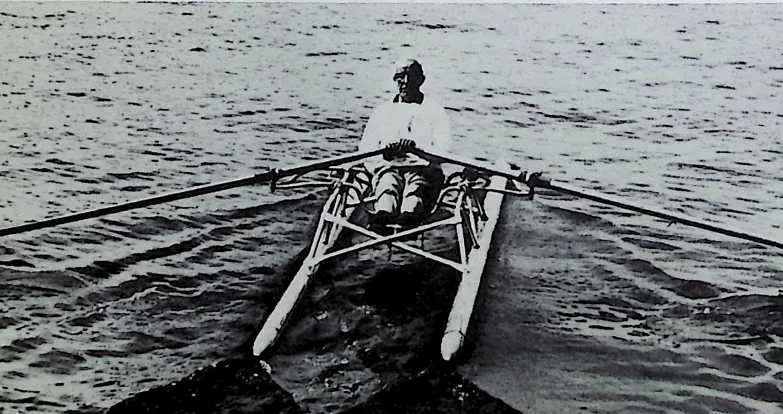
37 But always Bucky reserved August for Bear Island. That young boy who had invented a push-pull pole for his boat had grown up, but he still tinkered with better ways of rowing. One of his patents in 1970 was for a rowing device. A friend, Don Moore, built a prototype of this ‘‘Rowing Needle’’ and a picture shows Bucky testing it in the water at Bear Island.
38 Bucky on the prototype of the ‘‘Rowing Needle,’’ Bear Island, ipyo
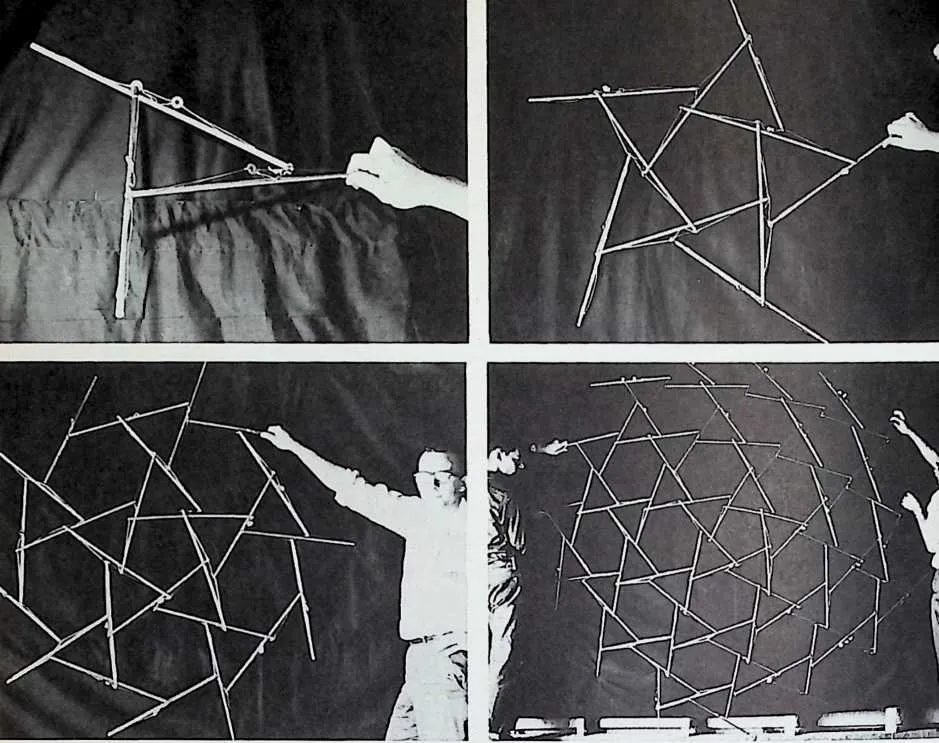
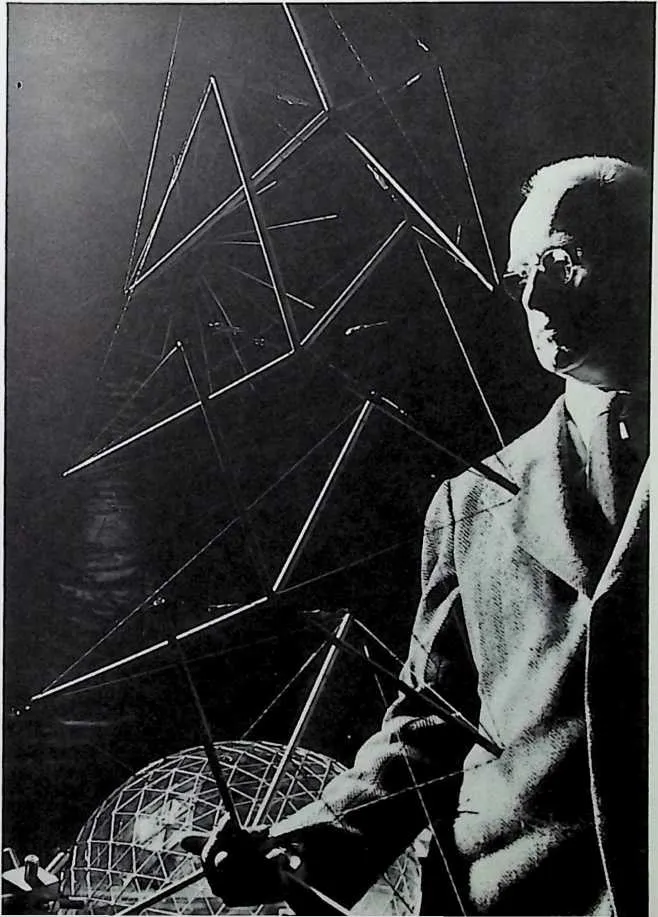
40 The reservoir of ideas never ran dry. And the breakthroughs that proved Bucky’s theories correct continued to arrive almost on a schedule. Tensegrity structures, frail-looking but tough, are another offshoot of Bucky’s work in Synergetics. Contracting two words, tension and integrity, Fuller created a new one, tensegrity, to describe a principle of building relationships. He saw the possibility of having a spherical building in which the struts or ‘‘bricks’’ (the compression parts) did not touch one another anywhere. In this rounded structure, the compression struts are like islands, separate and alone. ‘‘Rubber bands’’ or tension parts interlaced keep the struts in place. The ends of each compression member connect only with the tension network at various points. In basic tensegrity structures, the spheric-tension network system is completely continuous. Fuller is convinced that all structures, properly understood, from the solar system to the atom, are tensegrity structures.
41 He found surprising behaviors in the tensegrity structures that he experimented with. If you just tighten one point in his tensegrity system, all the other parts of it tighten evenly. In 1949, Kenneth Snelson, a student of Bucky’s, demonstrated a tensegrity system by building what he called a Tensegrity Mast. Ever since, Bucky had been looking for a way to put tensegrity principles to work. In theory, there was no limit to the uses; in practice, there were continuing problems.
42 Don Moore brought still another version of a tensegrity sphere to Bear Island in 1972. Fully relaxed, the tensegrity structure could be crumpled together without hurting it. It was much like a string net shopping bag which can be stuffed into a small space. This latest design introduced rectangular ‘‘door’’ and ‘‘window’’ sections while keeping the triangles which made the structure so fantastically strong. Moore threaded clothesline rope (the tension part) through short hollow rods (the compression parts) and tied knots. Finally, as the clothesline tensed, the jumbled heap of rods and rope blossomed into an erect sphere.
43 Bucky’s niece Leslie Gibson and her husband, Dana, were there that memorable day. Dana Gibson recalls the look on
4546I
47 Assembly of a tensegrity sphere
48 Bucky’s face when this sphere succeeded in standing up to all the pressures and rough handling given it. ‘‘There was an explosion of pleasure. …I imagine Newton must have looked like that when he was hit on the head with the apple.’’
49 Tensegrity spheres have a special characteristic. Incredibly light, their strength multiplies tremendously as they are made larger. Tensegrity structures are lighter-weight refinements of the rigid geodesic dome.
50 Another major event in 1972 was the Fullers’ move to Philadelphia. Four colleges (Bryn Mawr, Haverford, Swarthmore, and the University of Pennsylvania) combined their resources to offer Bucky a place in the University City Science Center. Luring Bucky away from Illinois seemed like a great victory to the newspapers, which headlined his arrival: ‘‘Man of Tomorrow Is Ours Today.’’
51 Philadelphians got a good look at what the man of tomorrow had done in his seventy-seven years on earth when the Franklin Institute was host to an exhibit, ‘‘The Design Science of R. Buckminster Fuller.’’ The show, prepared by the Museum of Science and Industry in Chicago and sent around the country, included an actual Dymaxion Car. The show opened to the public on March 1, 1974.
5253Fuller with a Tensegrity Mast made by Kenneth Snelson, 1949
55 Roped off by itself, the freshly painted black beauty drew the attention of two small boys.
56 ‘‘That’s some car. Wow!’’
57 ‘‘No, you dummy. That’s a plane.’’
58 ‘‘Oh, yeah? Where are the wings?’’
59 ‘‘Folded up somewhere, I bet.’’
60 A quick look around to see where the guards were and then both of them slipped past the ropes. On tiptoe they tried to see through the windows. Then they flopped down on their backs, sliding under the car to look at the underside. When the uniformed guard pulled them out from under, the boys had reached an agreement: ‘‘That’s the land of car 1 want.’’
61 Young people everywhere seem to want what Bucky offers, particularly his vision of how to make the world work.
62 ‘‘We must stop burning fossil fuels,’’ Bucky warned the students at Buffalo in February 1975. In a week-long series of lectures, he developed this point.
63 Fossil fuels—coal and oil—might be called a fossil savings account. It’s all right to use a little of it, but only as a selfstarter to link in with the main engines of Universe. (Automobiles use storage batteries to power self-starters. These then start the main engines which in turn restock the storage batteries.)
64 If, however, you continue to draw out of the savings account, there is nothing left to live on. We should be using our energy ‘‘income.’’ Like the interest in a savings account, it is constantly being added into the account. Energy income can be drawn from such sources as the sun, the tides, and the wind.
65 Since you can’t put a meter on the wind, big business had ignored such an energy source. And, as Bucky says with a wry smile, ‘‘Sunlight has been called wealth only by poets.’’
66 But the sun doesn’t always shine and the wind doesn’t always blow. What do you do then? Why, you work as Bucky was working even then at designing windmills that can capture and store the power more efficiently.
67 Finally, there was an answer, too, for all the mathematicians who had been waiting almost ‘‘prayerfully’’ for Bucky’s master work, the book explaining his geometry. Fifty years in the making, it seemed as if the book would never be completed. In E. J. Applewhite, Bucky found a friend who could work and rework the pages with him. It took the combined efforts of the two men and seven successive editors at Macmillan to get the book into print. Titled, simply, Synergetics, the book was hailed as the ‘‘distilled wisdom of a lifetime’’ when it was published in the spring of 1975.
68 There was scarcely time to celebrate this major event and no time to celebrate Bucky’s eightieth birthday and fifty-eighth wedding anniversary. Once again, and as usual, Bucky was flying to a far part of the world, this time to an archaeological dig in Malaysia.
69 The party postponed until August turned into a triple celebration marking Allegra’s birthday as well. It seemed particularly fitting that the party should be held in the house at Sunset, Maine, which had for years belonged to his brother, Wooly. The people who bought it after his death had lived in it through the sixties. When the house was again offered for sale, Bucky bought it.
70 Friends, relatives, and neighbors came streaming in for the party on that moonlit night. Jim Quinn who ran the mail-boat was there with his wife. Marian Billings, the postmistress at Sunset, Anne’s sisters Hope and Lolly, members of the Hardie family—it was a good-sized crowd that had collected. Surrounded by those he loved best—Anne, Allegra, the two grandchildren Alexandra and Jaime—Bucky beamed constantly. Musicians were tuning up, the table was piled high with food.
71 His sister-in-law was urging a small boy to have some potato salad.
72 ‘‘It came from Bear Island.’’
73 ‘‘I know. I made it but I don’t recommend it,’’ the young boy’s voice rose clearly above the noise of the crowd.
74 156
75 Bucky’s niece Leslie smiled. Voices rose and fell, murmuring and remembering other days, other nights. ‘‘…remember that awful storm when Bucky bailed and bailed …that poem he used to read, ‘Don’t Shoot, Boys, The Poor Devils Are Dying….’ ’’ Fiddles played and the caller sang out the tune for a square dance. Bucky never could resist an invitation to dance. His tapping feet did a jig. Time now to open the presents.
76 What kind of presents do you give to an explorer of mathematics, one who has also traveled more miles around the world than Marco Polo, Columbus, and Magellan combined?
77 A necktie, some beautiful shells, from Rosy a biography of their famous great-aunt Margaret Fuller. A grinning Bucky said each was just what he had wanted.
78 One night off and tomorrow Bucky would be back at work. The checklist of future projects drawn up by Ed Apple white was already two pages long. There were mountains of letters waiting to be answered. Archaeologists in Mexico had found a relationship between his Synergetics and the positioning of the pyramids. Some mathematicians wanted to explore the teaching of Synergetics in regular school courses. Perhaps the tensegrity structures could be used as cable pylons for high-voltage electrical transmission nets?
79 Bucky Fuller was still exploring designs and solutions for the tomorrow that is coming. He wasted no time on memories of past triumphs. Did he perhaps have regrets or feel dismay when news of a fresh disaster came?
80 On May 21, 1976, the wire services flashed the shocking news: ‘‘DOME MEETS DOOM.’’ Newspapers and television reported that the former U.S. Pavilion in Canada, renamed the Biosphere and housing ecology exhibits, had caught fire. Two welders working with torches to seal an opening had set off the fire. Although the plastic skin was fire-resistant, the torch flame striking directly on it had turned the plastic into a burning liquid. The dome became a blackened skeleton within minutes. Fifteen fire trucks and eighty-five firemen arriving just twenty
81 157 minutes later could do nothing more than be sure the fire was out before they left.
82 Friends around the world called and wrote letters of sympathy to Bucky; strangers wept at the sight of the smoke-blackened steel frame that was left. Shocking as it was to others, Bucky simply expressed gratitude and relief that no one had been caught inside by the fire. Only the skin was destroyed; the dome itself survives unharmed. A stark frame for enclosing space, it remains a triumphant symbol of the true wealth that Bucky has uncovered for the world. By his definition, wealth is made up of two parts: energy which transforms and knowledge which always only grows. His discoveries have added immeasurably to man’s knowledge and turned the energies of the universe to the advantage of all humanity, now and future.
8384Bucky outside his Expo '67 dome