
12 12
2At one time or another, every child starts a collection of some kind. Stamps, rocks, autographs or coins, perhaps. When Bucky Fuller was four years old, he chose to collect paper. Any and every scrap of paper that was written on by him, about him, or to him went into his collection. From a shoe box full of paper, the collection has grown to six tons of records stored now in the Science Center at Philadelphia. Papers are filed by the year in filing boxes; cans of film, tapes, and videotapes of lectures and interviews fill the shelves of a room. In still another room, masses of slides and architectural drawings are slowly being sorted out. His Chronofile is possibly the most complete record ever kept of a human life. Studying this model of one fife, future historians may better understand the patterns or trends of what was happening to people around the world in the twentieth century.
3 In the year 1958, Bucky’s Chronofile records a sharp swing upward in printed material by and about him. Thanks to the domes, people everywhere wanted to hear what R. Buckminster Fuller had to say. That year he took the first of his many trips around the world, delivering dozens and dozens of lectures along the way.
4 Domes made Bucky world-famous, yet he emphasizes that they were simply one result of the bargain he had made with himself years ago. He had hoped to discover the principles operating in the Universe and use them to make mankind a success. Instead of domes, Bucky points out that he could well have ended up with ‘‘flying slippers.’’
5 For Bucky, the design revolution had only just begun. He organized several companies to handle his many activities. Geodesics, Inc. handled the patents and farmed out the licenses for the domes. These licenses gave construction and other companies the right to manufacture domes. For every dome built, Bucky received a royalty of 5 percent.
6 Hundreds of thousands of dollars poured into his offices. Just as promptly, thousands and thousands of dollars poured out into
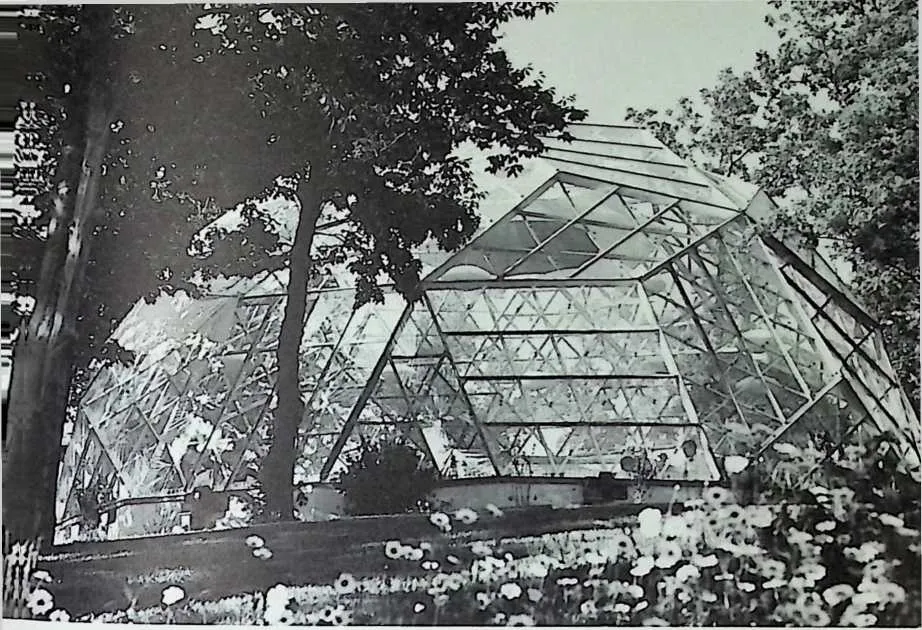
89A geodesic restaurant in Woods Hole, Mass.
10 his research projects. The only use Bucky had for money was to buy materials and time for his work.
11 Money did buy for Bucky one very real pleasure. He used some of his new wealth to become the owner of the finest boat he could find. When Bucky sailed the sleek Nagala into the deep waters of Bear Island’s harbor, he was a child whose Christmas dream had come true.
12 ‘‘Uncle Bucky, Uncle Bucky. It’s Uncle Bucky.’’
13 The shrill welcoming cries of the children floated out from the shore across the water. Always, it seemed, there were children playing on Bear Island. First it had been the Fuller children, the caretaker Hardie’s children, and the King cousins from Chicago. Now their children’s children piled up pebbles on the beach, splashed in the water, and scattered outside the Great House for hide and seek. Allegra, married to film director Robert Snyder in 1951, had two little ones now: a daughter
14 I32 named Alexandra, and a son, Jaime. Bucky took great pleasure in them and the host of great-nieces and great-nephews.
15 Whether Bucky was their uncle or not, all the children seemed to regard him as one. He was one adult who never talked down to them, who never told them to run away and play.
16 ‘‘A child wants to understand the whole thing …Universe,’’ says Bucky. ‘‘Children draw pictures with everything in them …houses …trees …and the sun AND the moon.’’
17 He points out that grownups then criticize and tell the child not to put the sun and the moon in the sky at the same time.
18 ‘‘But, the child is right! The sun and moon are in the sky at the same time.’’
19 Bucky believes firmly that a child is born competent and capable of treating large quantities of information right from the start. Then and now, Bucky gives a child’s every question the most serious attention.
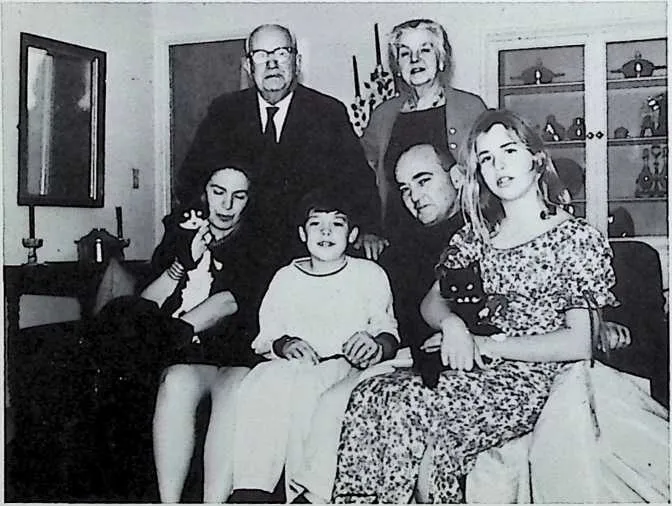
20 Bucky and. his family in 1963; Allegra, Jaime, Robert Snyder and Alexandra are in the front row, with Bucky and Anne behind
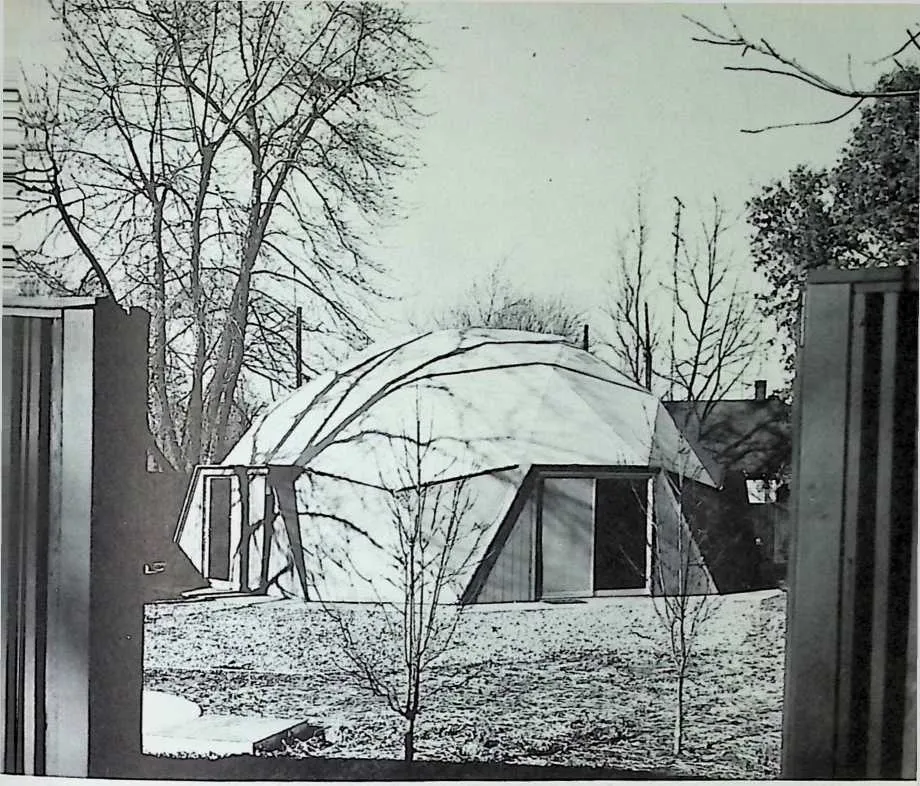
2324Bucky’s home in Carbondale, III.
25August on Bear Island recharged Bucky’s energies for the year ahead. From being a college dropout, R. Buckminster Fuller had moved up to become a University Professor at Southern Illinois University. Carbondale, Illinois, became home base where he touched down briefly. The Fullers lived on the campus—in a small dome, of course—but Bucky Fuller traveled constantly, teaching students all across the country.
26Some of these invitations to talk led Bucky to strange places. The Semantics Studies Group consisted of 140 members, all of them convicted criminals in San Quentin prison.
27At seven o’clock in the morning, Bucky Fuller sat on a bare stage watching these young men with bowed heads filing in one by one to take a seat.
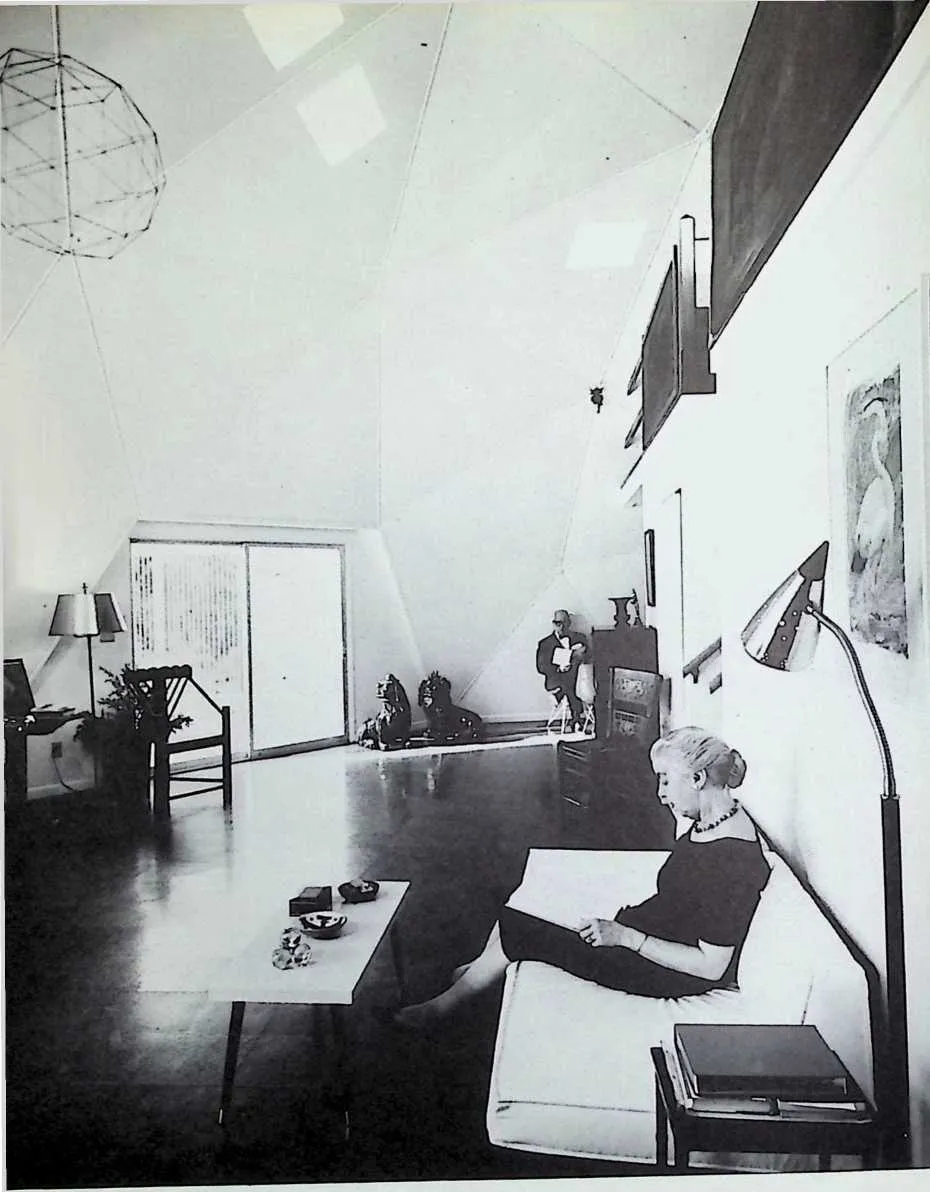
2930Bucky and Anne at home in Carbondale
31 What had prompted these men to invite him to speak? What should he say to such a group? What would concern them?
32 Bucky remembered his own mother’s constant worry that her son would end up in the penitentiary some day. Only a tiny hair of luck separated him from them. Eyes closed, his hands held together in a steeple, he concentrated on reviewing with them every single thing that he knew. Like a Pied Piper of the mind, he led them down the paths that he had explored to understand Universe.
33 Suddenly, he realized that it was mid-afternoon. He had been talking for nearly eight hours. He stopped.
34 In a quick dash, the prisoners were jumping onto the stage. The men grabbed his hand, shaking it hard; they clapped him on the back.
35 ‘‘Bucky, this is the greatest day of my life,’’ one called out.
36 The men jumped down from the stage, racing to the door. Within minutes, the room had emptied completely. It was already 3:30, time for the head count of prisoners which took place before locking up. If anyone missed the head count, he was placed in solitary confinement for a week. Yet every man there had risked that punishment. Not one would leave until Bucky had finished talking. Tears still come to Bucky’s eyes when he recalls that moving tribute.
37 Almost as surprising was the call that came from Harvard University. Would R. Buckminster Fuller accept an appointment as the Norton Professor of Poetry? As a visiting professor, he would spend two months on the campus giving a series of lectures.
38 Bucky Fuller a poet? R. Buckminster Fuller had been labeled many things: an inventor, an architect, an engineer, a mathematician. But a poet?
39 Once a little girl had asked: ‘‘Bucky, why is the fire so hot?’’
40 Bucky reminded her of the time when the tree from which the log came was growing in the sunlight and ended with, ‘‘what you see now is the sunlight, unwinding from the log.’’
41 i36
42 Describing environment, he wrote:
4344Environment
45To each must be
46All that is
47That isn’t me.
48Universe
49In turn must be
50All that is
51Including me.
52The only difference between
53Universe and
54Environment is me—
55The experiencing observer.
56 If a poet can be defined as someone who puts things together, then Bucky has earned that title, too. Later, publishers agreed with Harvard when they printed his Intuition, a book-long poem.
57 Whatever the label, students jammed Bucky’s lectures. Was there a grin on Bucky’s face when he compared this stay at Harvard with his earlier ones? Forty-seven years ago he had been sent home from that campus in disgrace. Now he served as an invited, honored member of the faculty. He had been awarded medals and honorary doctor’s degrees from more than a dozen universities. Bad Bucky Fuller who had failed to graduate with his class had come a long way. Bucky’s busy pen added to his achievements. Five of his books were issued in 1963.
58 New evidence that same year pointed up the unique discoveries and importance of his Synergetics. While U.S. astronaut John Glenn sailed out into the vast new ocean of outer space, scientists with the new powerful electron microscope were exploring the tiniest form of life on earth, the virus. They examined the outside protein shells of viruses. What they found sent them to Fuller’s books. The shape of one virus was identical with the officers’ quarters dome in Korea. The chicken-pox virus matched the structure of the geodesic on top of Mt. Wash-
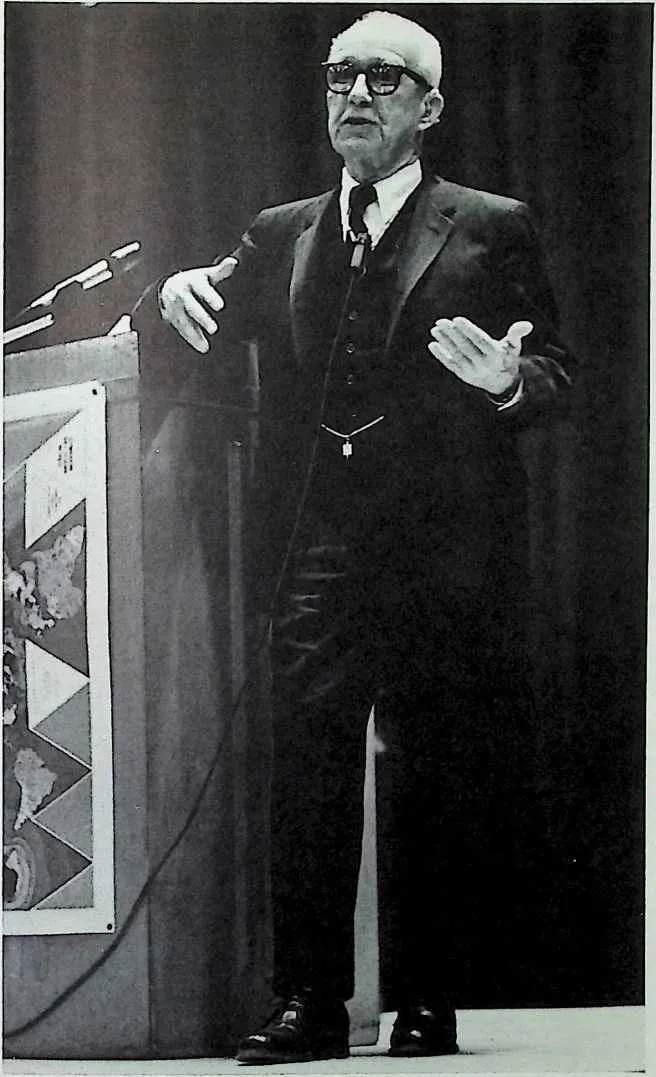
60 Bucky lecturing
61 ington. His radome in the Arctic was like an infectious hepatitis virus.
62 Bucky’s mathematical formula for the design of the geodesic dome had predicted and explained perfectly the architectural structure of the protein shell surrounding many viruses.
63 On January io, 1964, Time magazine put R. Buckminster Fuller on its cover. Like Fuller’s inventions which were painted into the background, the portrait of Bucky was a modern fantasy. The artist could not resist turning Bucky’s balding dome into a geodesic. Breaking up the top of Bucky’s head into the famous tetrahedrons, he nevertheless got a good likeness. Bucky laughed at the result and wrote a letter to Time expressing his delight with the cover.
64 At sixty-nine, Bucky’s face now had some lines etched into it. His crew-cut white hair had thinned. Light shining through it made it look like a fuzzy halo around the back of his head. Although he could hear some single sounds well enough, his hearing had failed. In crowds he stood with his head cocked like an expectant sparrow trying to strain out those sounds that he could still hear. But Bucky’s bounce and eagerness to share ideas had not lessened one bit.
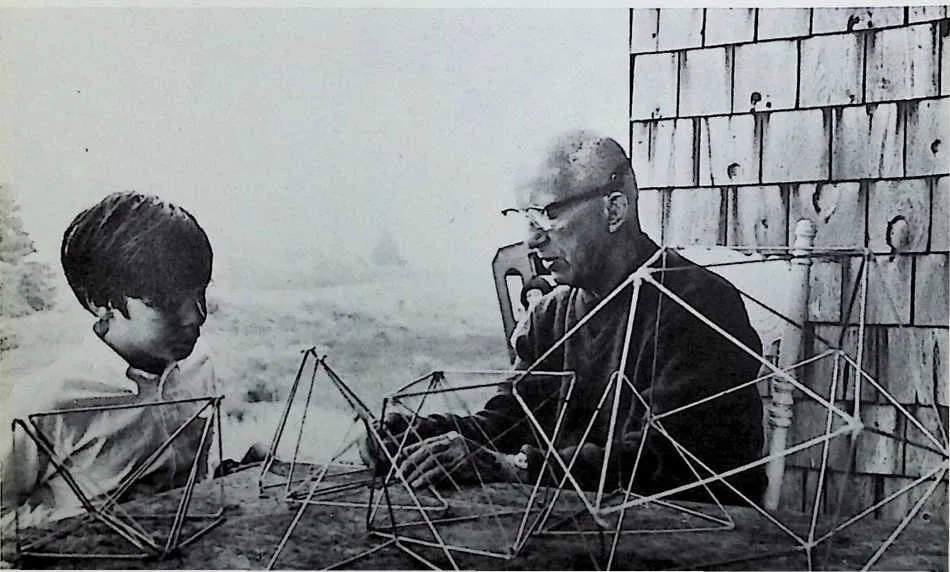
6566Bucky and his grandson, Jaime, on Bear Island in 1968
68 When his niece Kariska’s school asked him to be the graduation speaker, he willingly squeezed in one more lecture. To the young graduates, Bucky presented his description of planet Earth.
69 ‘‘Young people are always wondering what it’s like to be on a spaceship. …’’
70 Bucky’s answer to that question was to ask another question.
71 ‘‘Well, what does it feel like? Because that’s what you’re on. The earth is a very small spaceship hurtling through space. It’s only eight thousand miles in diameter and the nearest star is ninety-two million miles away. .. . This spaceship is so superbly designed that we’ve had men on board here for about two million years reproducing themselves, thanks to the ecological balance …all the vegetation is breathing up all the gases needed by the mammals and all the mammals are giving off all the gases needed by the vegetation. …’’
72 Bucky’s phrase ‘‘Spaceship Earth’’ captured the imagination not only of those young graduates but also the imagination of the world. People use it commonly today. More importantly, our view of the earth, our planning and direction for the future, and our understanding of the universe have all been influenced significantly by this use of Bucky’s concept.
73 A helicopter landing on the lawn put a dramatic end to Bucky’s speech. He had to hurry away to the next talk. By plane, boat, and car Bucky continued giving lectures on an ever-more crowded schedule. He wrote articles for magazines and still found time to explore new designs. The list of patents to his credit grew longer: Aspension, Monohex, the Laminar Dome, the Star Tensegrity.
74 When Americans were chosen for the Dartmouth Conference, Bucky was asked to be a delegate. The Dartmouth Conference brought together leading American and Soviet citizens in fields ranging from science and medicine to literature. They discussed what nations must do for successful survival on earth. As private citizens, they could talk freely and frankly about any and all problems.
75 That August of 1964, the group met for six days in Leningrad, U.S.S.R. They sat in the huge, crystal-chandeliered ballroom of an old mansion. Each person had earphones so he could hear an instant translation of what was being said. On the last day, each side presented its thoughts about life in the future. The Americans, naturally, chose Bucky to give their views.
76 Through the morning Bucky sat, head cocked, listening to the Russian speaker. A thick black elastic band circled the back of his head and hooked on to the end of his glasses. It saved him from having to push his heavy glasses back up on his nose, and helped him to focus through the right part of his lenses. Bucky had the whole afternoon to present the American side. As always, he had no prepared speech. He stood up and began:
77 ‘‘I don’t know why I’m talking to you here because you’re all so ignorant.’’
78 Startled surprise. The murmurs buzzed more loudly around the room as the meaning of what he said dawned on the Russians. Bucky himself was a little surprised at what he had said. But he proceeded to think out loud.
79 ‘‘Many of you think of yourselves as scientists …you see a beautiful sunset…and you actually see the sun setting, going down. You’ve had four hundred years to adjust your senses since you learned from Copernicus and Galileo that the earth wasn’t standing still with the sun going around it.’’
80 Bucky shook his head in mock despair.
81 ‘‘But you scientists still see the sun setting. And you talk about things being ‘up’ or ‘down’ in space when what you really mean is ‘out’ in space or ‘in.’ ’’
82 Da! Da! By this time, the Russians were laughing in agreement.
83 Bucky had serious points to make. Eyes closed as he concentrated deeply, Fuller talked for an hour and a half.
84 ‘‘We must recognize what we don't know… . Either war is
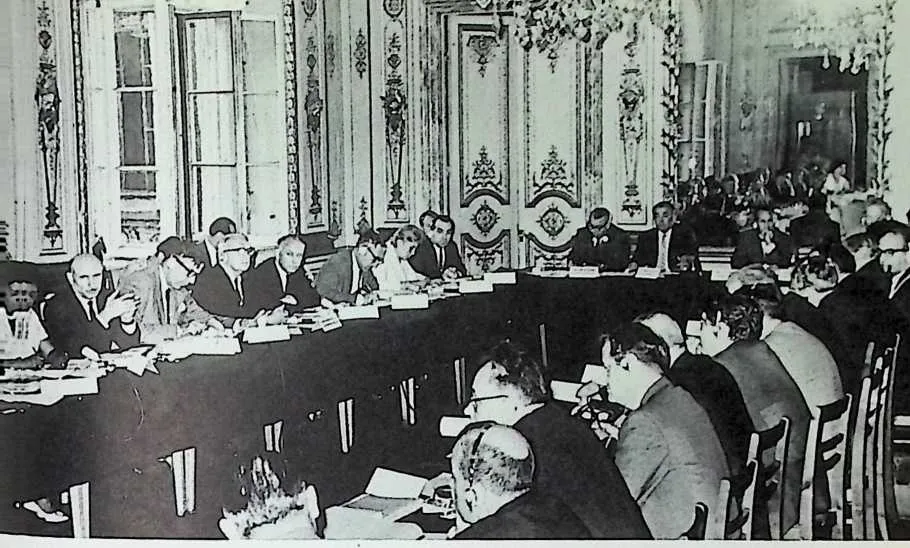
8687The Dartmouth Conference in Leningrad, 1964; Fuller is fourth from left at the table
88 obsolete or men are…. Man must be very responsible in the future. . .
89 At the end, the man who had spoken for the Russian side turned to an American editor. ‘‘The Americans win. No question about it. Mr. Fuller was magnificent.’’
90 With all his triumphs, with all his prizes and awards, Bucky Fuller still had no license to practice as an architect. To make contracts and build his structures, he needed a licensed architect. He took as his partner Shoji Sadao, a brilliant graduate of the Cornell School of Architecture. (The two men had become fast friends when Shoji worked on Bucky’s geodesics at Cornell.) Fuller and Sadao, Inc., was the firm chosen to design the U.S. Pavilion for Expo ‘67, the Canadian World’s Fair.
91 For anyone else, designing the pavilion might have been a full- time job. For Bucky, it was one more project to be squeezed into his whirlwind schedule. Every day he drank gallons of tea and worked twenty or more hours. When he finished, the plans looked like a math textbook. Instead of the usual pages of blueprints and drawings, there were tables and tables of figures.
9293‘‘A 20-Story Bubble by Fuller to Hold U.S. EXPO ‘67 Display’’ was the headline telling the public what to expect.
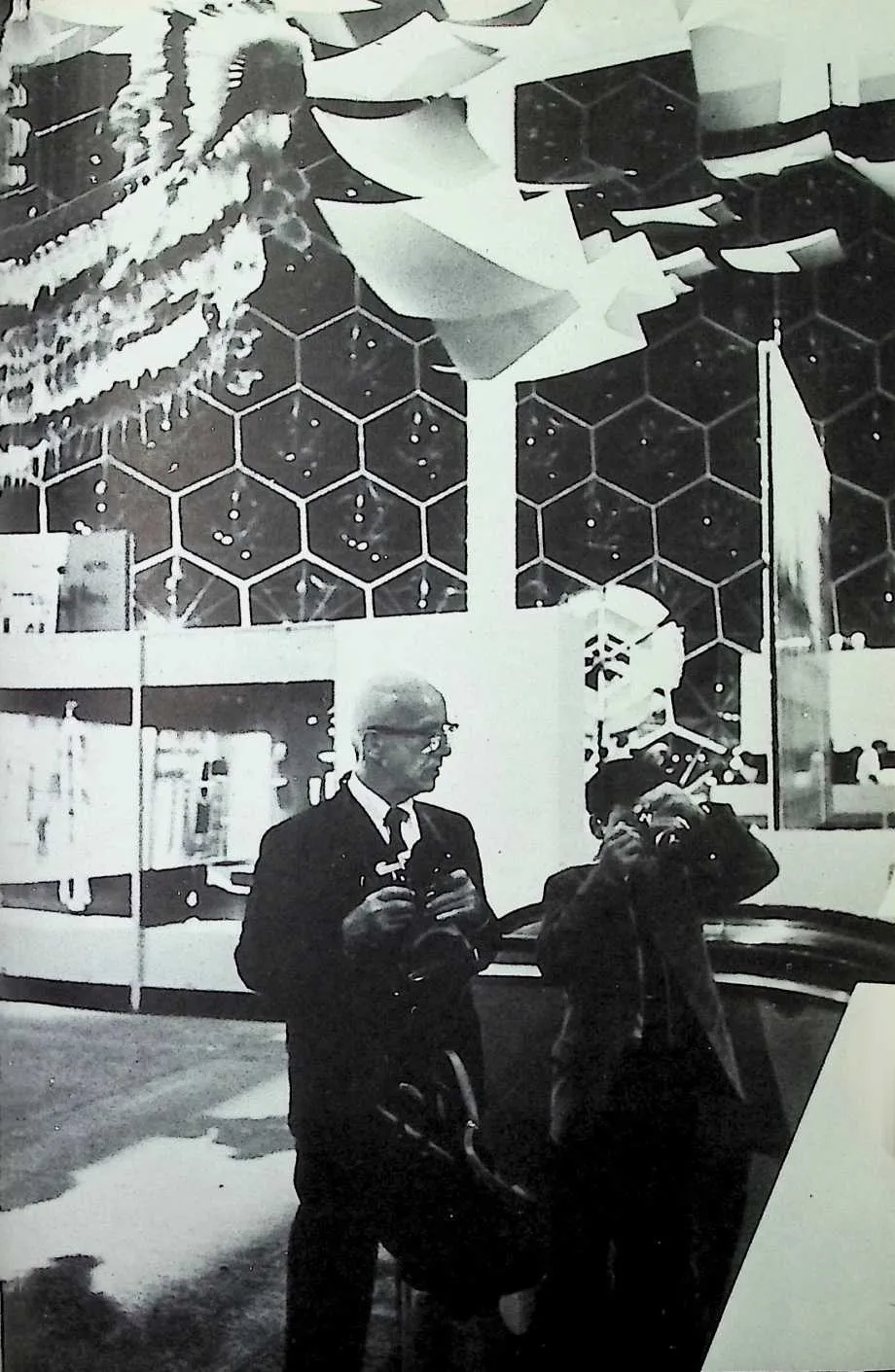
94Bucky’s Bubble, a transparent geodesic dome, rose a spectacular 187 feet into the air to provide six million cubic feet of exhibit space. Thousands of separate plastic hexagons covered the steel frame. Because they could turn individually, these panels made a live, breathing skin for the dome. Electric motors programmed by a computer opened and closed these panels according to the weather. Some had valves to control the amount of fresh air inside. Others had light sensors which responded to the sun. As the sun rode through the sky, the sensors directed the raising and lowering of shades. Sometimes the shimmering dome was transparent, sometimes it was silver-colored. Lit up at night, the dome glowed like a jewel.
95Every visitor who rode on the elevated monorail train passed directly through the Bubble. The exhibit, ‘‘Creative America,’’ was displayed on a series of platforms set at different heights. Escalators linked the different platforms which filled the dome. While people might argue about the quality of the exhibits, there was no debate about the quality of the pavilion. The wit who called it ‘‘Buckminster Cathedral’’ was not far off the mark. It was truly one of the most beautiful creations of the human mind.
96About a month after the opening of Expo ‘67, Bucky and Anne flew up to Montreal to see the fair. They walked through the dome slowly. What a wonderful fiftieth wedding anniversary present for them both to hear the awed, enthusiastic, and admiring comments of the fairgoers.
97When they returned to New York, their pleasure came to an abrupt end. The taxi in which they were riding home crashed into the back of a truck. Both were thrown against the windows and bruised. A minor accident, everyone decided after they took stock of the damage.
98Bucky and Jaime inside the U.S. Pavilion at Expo ’67 in Montreal
100 i44
101 Within days, it became clear, however, that something was terribly wrong. Anne, who had hit her head, suffered horrible headaches and dizzy spells. At the hospital, tests showed the damage—massive bleeding inside the brain. A leading surgeon ordered an operation immediately. No one knew whether the operation could repair the damage.
102 Would she live or die? Would she regain consciousness or remain an unseeing, silent vegetable for the rest of her days?
103 For Bucky, who had asked questions all his life, these were the most agonizing, unbearable questions he had ever faced. Without Anne, his loving partner of fifty years, the fame, success, and the respect of the world meant nothing.
104 In the end, the surgeon’s skill, Anne’s own inner strength, and Bucky’s love were rewarded. Anne recovered completely.