
2 2
2At the turn of the century, the world was exploding with new knowledge. Science and industry would bring more changes in the next twenty-five years than had occurred in the two hundred years before.
3 Discoveries like Wilhelm Roentgen’s x-rays and Marconi’s wireless for sending messages were swiftly transformed into practical tools and machines. In 1895, the year of Bucky’s birth, Charles Duryea produced the first American gas-engine car. Eight years later, three hundred cars were entered in a race from Paris to Bordeaux. Their average speed was 66 miles an hour.
4 Even in Milton, Bucky could see for himself some of these rapid changes. A Dr. Tudor received the very first automobile license given by the state of Massachusetts. By the time Bucky was ten years old, Americans had already spent $400 million on automobiles.
5 Meanwhile, the Wright Brothers managed to do the impossible. They actually put a machine heavier than air into flight at Kitty Hawk, North Carolina. Everyone’s imagination was in the clouds now. A Count Zeppelin raised four thousand dollars to renew his experiments with aerial flight.
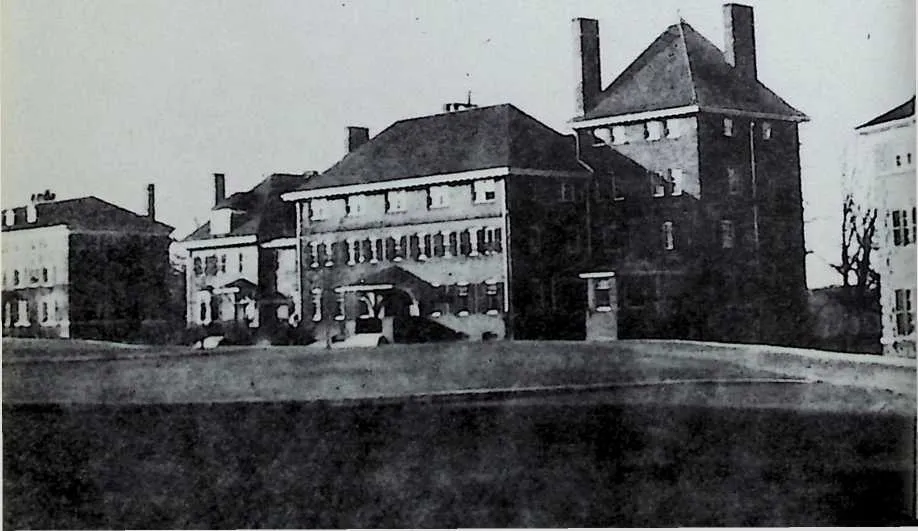
6 English, history, geography—the schoolbook lessons had not yet caught up with these events. Milton Academy, a private boarding school, drew students from all over New England. Bucky, like many who lived in Milton, attended the Academy as a day student. With Line Pierce and a dozen others in the Sixth Form, Bucky wrestled with the same old questions: ‘‘At eight cents a foot, what will two yards of ribbon cost?’’ ‘‘Tell why Samuel Morse and Robert Fulton were famous men.’’ Dutifully, Bucky filled his papers with answers.
7 Then without warning, the everyday routine and world of Bucky Fuller turned upside down. His father suffered a crippling stroke. No longer could he make trips to the Argentine and India to buy fine leathers and scented teas. Mr. Fuller became an invalid. The first stroke was followed by others, each leaving him more helpless than before. The family nursed him with love, but no one did more for him than Bucky.
8 ‘‘Who would have believed it of that young rascal Bucky?’’ asked Dr. Pierce, Line’s father. He shook his head in wonder. ‘‘Why, he sits for hours fanning Mr. Fuller. The way he leads his father by the hand and spends whole evenings reading aloud to him…. I’ve never seen a young boy show so much loving patience and care!’’
9 While Dr. Pierce talked on about ‘‘compassion’’ and ‘‘pity,’’ Bucky was choked with anger. Why couldn’t medicine do something to prevent illnesses? Instead, the best that it could do was prescribe care afterward. It was like locking the barn door after the horse is gone. At the end of three long years, the strokes had stolen Mr. Fuller’s mind and sight. On Bucky’s fifteenth birthday in 1910, he first faced the pain of losing someone he loved, for Mr. Fuller died that day. One last time, Bucky, miserable and tear-stained, followed his father out of St. Michael’s Church. This trip ended in Mt. Auburn Cemetery.
10 Now Mrs. Fuller found the family pocketbook much thinner. Money no longer came in from the importing business. But money went out constantly to feed four children, pay off medical bills, and keep up the house. An independent, strong-willed woman, she took the necessary steps to economize. The handyman who did the heavy chores was dismissed.
11 The very full load of a man’s work around the house as well as the routine boy’s chores rested on Bucky’s shoulders now. Sifting the ashes was a dirty, unpleasant job but a necessary one. Clinkers, those unburned impurities, had to be thrown out. Halfburned coals left in the ash basket went back into the furnace to be thoroughly burned. Raking the driveway, carrying out the garbage—what an enormous amount of work it took to keep up that big wooden house that he called home! Strange how architects worked so hard to make every house look different. And yet the people inside those different-looking houses were all doing the same things: washing themselves, washing the clothes, cleaning out the dust. Why, almost every hour of each day in a house was spent cleaning up yesterday’s dirt. ‘‘Why couldn’t the house do the work?’’ was a simple question, but no one except Bucky asked such questions in 1911.
12 Work in school sometimes seemed almost as exasperating as his chores at home. In geometry class, the teacher drew points and lines on the blackboard and said they were imaginary. Two parallel lines made a plane and that didn’t exist either. Then she stacked the planes one on top of the other to make a cube and that did exist, she said. It seemed unreasonable to Bucky. His hand shot up in the air.
13 ‘‘Please, I have some questions. If that cube exists, how much does it weigh? What is its temperature? How long has it been there?’’
14 There were no answers.
15 ‘‘Don’t try to be funny, Richard Fuller. You are impertinent!’’ the teacher snapped.
16 Bucky Fuller’s love of mathematics had tripped him up. He had forgotten the rules of the game. Rules in those days
17 Milton Academy in 1913
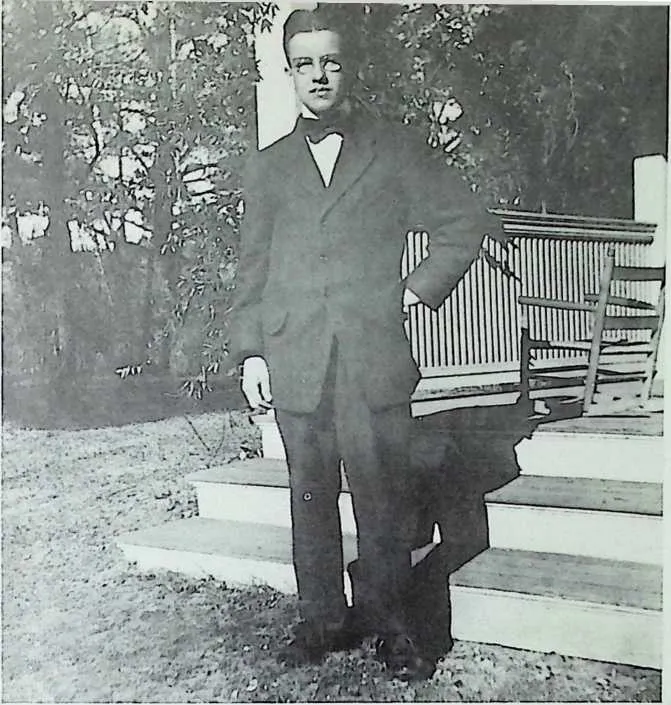
20 Bucky in Milton, 1911
21 said that adults know all the answers; children are supposed to keep their mouths shut and listen. He shrugged his shoulders, reminding himself to keep questions and doubts to himself. Years later he found the answers to this unsatisfactory geometry of imaginary lines and planes by discovering his own geometry of forces.
22 No matter if Bucky got put down. With his mind and spirit, he always came back up like a yo-yo. His science teacher, Homer Le Sourd, encouraged students to explore and experiment. A special section newly glued into the back of the physics book gave them facts about the expanding field of electricity. And Milton Academy had a laboratory complete with electric motor power to drive the tools for working with metal and wood. Few schools in the country were so well equipped. Like many boys, Bucky must have made at least twenty triplanes that he
23 sent gliding out the attic window. Like many adults, Mrs. Fuller saw it all as nonsense. Her voice would float up to the attic: ‘‘Bucky, enough of playing games. Stop wasting your time. Get back to work!’’
24 One adult at least continued to play games with these foolish airplanes. W. Starling Burgess, a Milton graduate, came back to school to deliver a lecture. In 1910, Burgess had made the first airplane flight in New England, going almost ten miles from Plum Island in Massachusetts to Ipswich, Massachusetts. Eagerly, the boys watched the lantern slides that showed Burgess’s experiments on Plum Island. Bucky hardly dreamed then that one day Burgess would be working for R. Buckminster Fuller to engineer a new land of transport.
25 Bucky did very well indeed in any field that he cared about. With ferocious energy and enthusiasm, he tried out for the football team and won the desired spot of quarterback. He also won the respect of his classmates, particularly since they knew he couldn’t see much on the field without his glasses.
26 ‘‘How do you do it, Bucky? How can you tell who is who and where to pass?’’
27 ‘‘Shapes. Outlines, patterns.’’ Bucky shrugged.
28 Because Bucky hated being ‘‘different,’’ he suffered every time he went out on the field to play. All the other boys wore regulation leather helmets. Bucky wore a cheap, funny-looking thing that his mother had bought. A helmet was a helmet to Mrs. Fuller and she could not understand Bucky’s desperate wish to have the same helmet as everyone else.
29 Shoulders squared out from hours of rowing, his stocky figure looked even shorter on the ball field. Opponents from St. Mark’s and Groton who came to play might smile at the sight of him. By the end of the play, they looked at him with new respect.
30 ‘‘It’s like trying to tackle a greased keg shooting over Niagara Falls.’’
31 In the classroom, Bucky. used his energy to master the Latin verbs which he hated and to sing for the Glee Club with gusto.
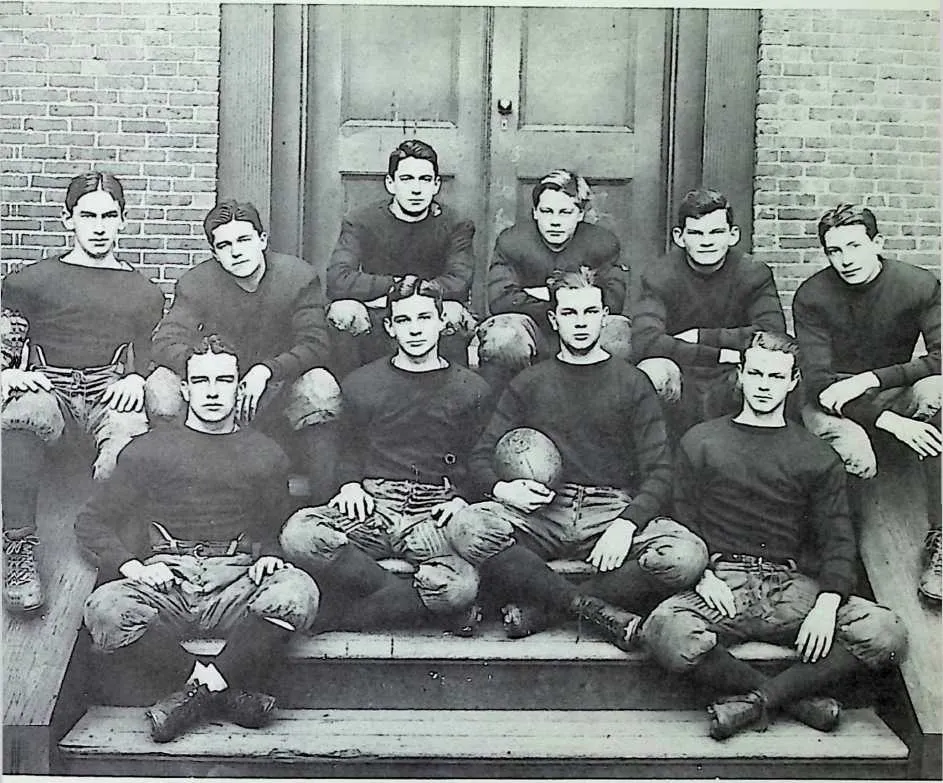
33 Milton Academy football team, 1911; Bucky is first on the left in the front row
34 School records show that he got passing grades in Classics and Latin but earned honors in science and mathematics.
35 When Bucky graduated from Milton Academy in 1913, there was no question about what he would do next. With all the family helping, Mrs. Fuller scraped together enough money for Bucky’s college tuition and board. There was no money for extras, but Richard Buckminster Fuller would enter Harvard University as so many Fullers had before him.