
9 9
2Once again, Bucky was flat broke. His ‘‘successful’’ Dymaxion had taken everything he owned.
3 Even his share in the ownership of Bear Island went to pay debts. But the Dymaxion also had earned him a widespread reputation in engineering circles. The Phelps Dodge Corporation, an industrial group dealing in metal products, offered him a job in the department of research. In this department, everyone’s full-time work was exploring ideas and producing new products. If Bucky had to work at a regular nine-to-five job, this one was certainly suited to his talents.
4 Mornings, Bucky and Allegra would leave the apartment on 88th Street. Bucky would head for downtown Manhattan. Lucky Allegra had only to walk around the block to school, for her father had planned it that way. Bucky did not want Allegra’s natural curiosity and abilities squashed by traditional ways of learning. Why should every child in a classroom have to learn the geography of Venezuela at exactly the same hour of a day? So when the Fullers moved back to New York, they rented a place around the corner from the Dalton School where the teachers used new and different ways to teach children. (Some years later, Aunt Rosy, too, was at the Dalton School working in the office.)
5 At Phelps Dodge, Bucky used metals in new ways to solve old problems. He designed a new type of brake drum. Made of solid bronze, it eliminated the worrisome problem of ‘‘grab’’ and ‘‘fade’’ in ordinary brakes. The inventive way in which he used metals then made possible the disc brakes used on heavy bombers today.
6 Fuller also persuaded the company to produce a new version of the Dymaxion bathroom. His whole bathroom—completely finished and furnished—weighed less than an ordinary bathtub alone. During 1937 and 1938, twelve models rolled off the assembly line. Two of them went out to the Long Island house of a friend, Christopher Morley.
7 Bucky, as usual, found dramatic ways to draw attention to his
8 work. According to one friend, he placed the complete bathroom on an open flat-bed truck and drove it out to Long Island. Besides the bathroom, the truck carried a load of Hewletts, his in-laws. While Bucky drove slowly through quiet village streets, the assorted Hewletts flung streaming rolls of toilet paper from the truck. Few people who saw that parade could forget the Dymaxion Bathroom.
9 Twenty-five years later, more than half of these models were in ‘‘as-good-as-new’’ condition. Despite the bathroom’s merits, Phelps Dodge decided not to produce any more models. Too many of their customers, too many plumbers were afraid of this new-style bathroom. One way or another, they thought it would cut into their business. Bucky was satisfied that he had proven his point. It was possible to mass-produce lightweight complete bathrooms that could be installed anywhere quickly.
10 Accustomed to working twenty hours a day, Bucky had more than enough time and energy to spare for his own projects. He tackled the job of arranging his beliefs, knowledge, and experience in an orderly fashion on paper.
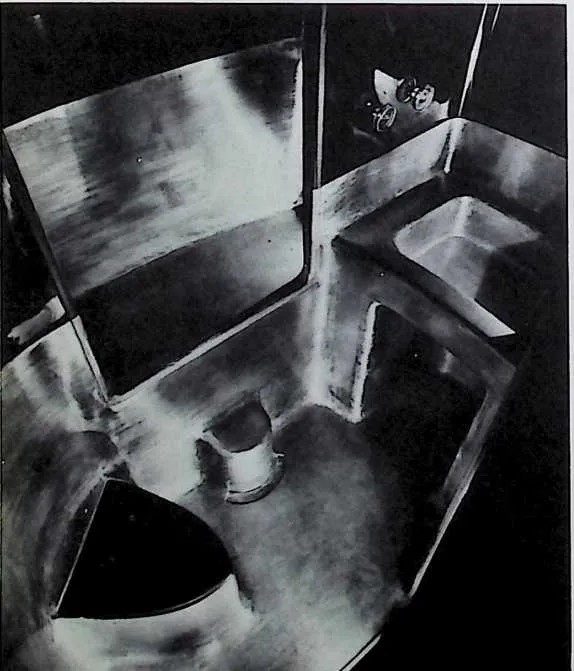
12 The first Phelps Dodge Dymaxion bathroom, 1931
13 To the world at large, Bucky Fuller seemed a brilliant, odd thinker who produced unconnected ideas and inventions: houses on poles, articles on pollution and energy, flying cars. Underneath those seemingly scattered ideas, however, was a constructive large-scale pattern. All of his efforts had been and were directed toward that resolution he had made years ago by the lake shore in Chicago: finding ways to do ‘‘more with less’’ so that more people everywhere can have more of everything. By weaving his thoughts into a book, Bucky hoped to show people that pattern.
14 Fuller titled the book Nine Chains to the Moon. In the introduction, he pointed out:
1516If …all the people of the world were to stand upon one another’s shoulders, they would make nine complete chains between the earth and the moon. If it is not so far to the moon, then it is not so far to the limits,—whatever, whenever or wherever they may be.
17 Bucky’s friend, Christopher Morley, was a famous author and he persuaded his publisher to take Fuller’s manuscript. When Bucky opened a letter from the publisher later, however, he had a rude shock.
18 ‘‘With regret,’’ the publisher said it would be ‘‘an act of fraud’’ to publish Bucky’s manuscript.
19 One part of Bucky’s book dealt with the famous scientist Albert Einstein and his work. Bucky not only explained Einstein’s ideas but also claimed that there could be practical applications of these to real life. At that time, Einstein’s theories were considered so difficult that supposedly only ten people in the whole world understood them. Looking at that list, the publishers had not found Bucky’s name on it.
20 Dismayed, Bucky shook himself into action. He wrote the publisher: Einstein was then living in Princeton, New Jersey. Why not send the manuscript to him and ask him if the work was satisfactory?
21 Months passed. Bucky heard nothing more from the publisher. When the phone finally did ring, it was a Dr. Fishbein who was calling. Fishbein’s friend, Dr. Einstein, planned to spend that weekend in New York City. If Bucky was free Sunday evening, Dr. Einstein wanted to discuss the manuscript with him. Could Bucky come to the Riverside Drive apartment of the Fishbeins to meet Einstein?
22 ‘‘If Bucky was free …1’’
23 For a meeting such as this with the world’s greatest scientific thinker, Bucky would do anything and everything to be sure that he was free.
24 Surrounded by people in that high-ceilinged apartment, Dr. Albert Einstein looked even smaller than he was. As Bucky came forward to be introduced, he was impressed by the man’s air of gentle goodness. Einstein rose promptly and led Bucky into Fishbein’s study where the two could talk privately. In the study, Bucky saw his manuscript lying on a table.
25 ‘‘Youngman,’’ began Dr. Einstein.
26 What would he say about Bucky’s explanations and writings? Would he criticize, condemn, or scold him for his boldness?
27 ‘‘I’ve been over your book and am notifying your publisher that I am pleased and satisfied with your explanation,’’ said Dr. Einstein.
28 He added that Bucky had in fact amazed him. Einstein had never thought that his work could have any practical applications. Rather, he thought that his theories might simply help scientists to a better understanding of the Universe.
29 Years later, scientists applying Einstein’s formula unlocked the secret of atomic energy and developed the most devastating bomb known to mankind. Bucky thought often of the pain that the peace-loving Einstein must have felt at this use of his work.
30 When Bucky left that study, every word that Einstein had uttered was carved into his memory. It mattered little to Bucky that the world called him a ‘‘charming nut’’ or ‘‘crackpot,’’ for he had had a unique and unforgettable satisfaction. The world-famous Nobel Prize winner had not only approved of what Bucky had written but also credited him with adding to man’s understanding of the Universe.
31 When Nine Chains to the Moon was published in 1938, Newsweek magazine said: . a dream book of the future …this
32 ruddy-faced, gray-haired inventor is no nut. Great stuff!’’ But few people bought it then. It was to be a book of and for the future.
33 When Phelps Dodge asked Bucky to forecast the future use of copper, he looked naturally to the past. Huge amounts of copper had been mined for use in World War I. Bucky knew that metals are not eaten up like strawberries; nor do they disappear forever. Rather, they are melted down and come back on the market as scrap. Looking for patterns, Bucky discovered the cycle for recirculating copper occurred every twenty-two and a half years.
34 Three years after his study, Bucky answered the phone and heard the voice of the research director at Phelps Dodge.
35 ‘‘Bucky, it’s happened.’’
36 Just as Bucky had predicted, the copper producers of America found themselves in 1939 drowning in a flood of copper scrap. They had neither expected nor wanted this flood. Greater profits came from mining new copper than from using copper scrap. (The unfortunate result was that they sold the scrap to German and Japanese companies. Within a year this scrap was being used for weapons against America in World War II.)
37 By then, Bucky was working for Fortune magazine where he continued to map trends and patterns for readers. He invented or worked out a unit of measurement which he called ‘‘energy slaves.’’ With these energy slaves for measuring, he could show how much power was available to serve the people of each country. His World Energy Map published in the tenth anniversary issue of Fortune in February 1940 made clear the terrible gap between the ‘‘haves’’ and the ‘‘have-nots.’’ As late as 1950, the half-century mark, Asians still had only 2 energy slaves per person, while North Americans had 347 such units to serve each person’s needs.
38 Although he did not write many articles himself, Bucky was a valuable resource for the magazine. He had more ideas than he could explore in two lifetimes and was generous in sharing them. The other editors picked his brain for ideas like people collecting the produce from a flourishing vegetable garden.
39 One design that he whipped up in that period was the Mechanical Wing. The Wing, containing a kitchen, energy unit, and bathroom, could be carried easily on Fuller’s A-frame trailer to any campsite or vacation home. Although the Wing was never manufactured, millions of boat owners today use the A-frame trailer to haul their boats from home to lakes and rivers.
40 This drawing of Fuller's Mechanical Wing appeared in The Architectural Forum, October 1940
41 Not all of Bucky’s ideas were geared to a far-off future. In 1940, he took a summer vacation trip with Christopher Morley. Driving through Missouri, the two men passed field after field of waving wheat. The wheat fields shimmered under the hot sun. Suddenly, Bucky’s eyes fit on a row of steel grain bins. Pointing to the glistening cylinders, he developed an idea that was both practical and immediately useful.
42 A cylinder encloses more space than a cube of the same wall area. The grain bin, a most efficient form of engineering, could be a unit for housing—fireproof and much cheaper than anything on the market. Steel cylinders for housing could be as easily produced in a factory as the grain bins were.
43 At the end of his explanations, Bucky shrugged his shoulders. As always, he had no money to carry out the idea. Morley, caught by Bucky’s enthusiasm, made a proposal. He had just written a novel called Kitty Foyle. If the book became a best seller, he’d use some of the money to back Bucky’s idea.
44 Kitty Foyle was a smashing success. So Fuller redesigned the grain bins for living purposes and took his plans to the company which made the original bins.
45 Like the Dymaxion House, the Dymaxion Deployment Unit (his name for the bin) was built from the top down. The roof, which Fuller designed with curved joints, was assembled on the ground first and then hoisted up. The body sheets, too, were put together on the ground and then raised to join with the roof. With this method, no scaffold was necessary to build the shelter.
46 The first unit was assembled on the testing grounds of the Butler Company in Kansas City. The president of the company as well as the engineers came to inspect the Dymaxion Deployment Unit. That day the temperature was one hundred degrees in the shade. Sitting out under the noon sun, the metal walls of the building had become scorching hot. When the president wanted to go inside, the engineers shook their heads and advised him not to go in.
47 ‘‘You’ll burn up,’’ one of them predicted.
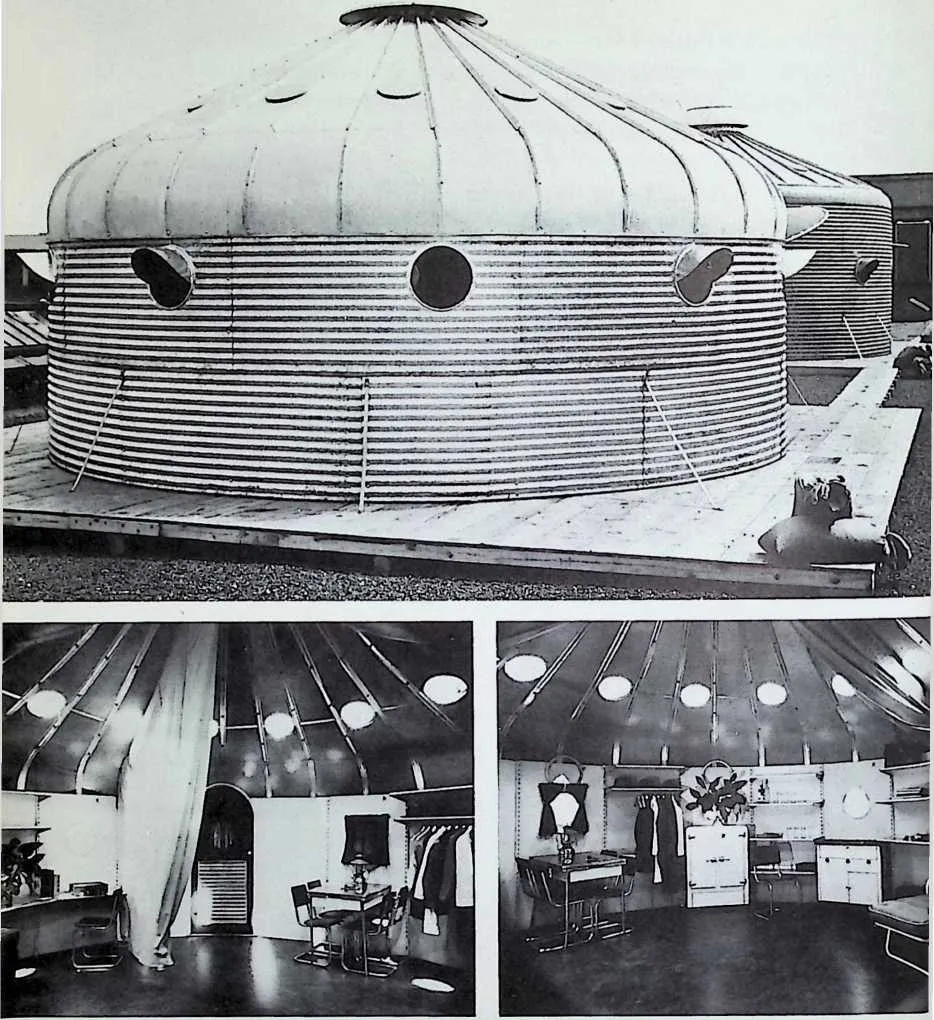
49 Above: the exterior of a Dymaxion Deployment Unit; below: two views of the interior of a D.D.U.
50 A stubborn man, the president insisted on entering the unit. A minute later, he called out:
51 ‘‘Hey, it’s air-conditioned in here.’’
52 Although the others thought he was joking, they followed him in. To the amazement of all, it was cool inside. How could it be? There was no machinery for air conditioning in that building. When the men lit cigarettes, the smoke patterns told them that a cold down-draft was operating inside.
53 Long ago, Fuller had worked on the idea that there were purely ‘‘local’’ patterns in the movements of air, energy, and heat levels. One local pattern is the Gulf Stream, whose waters are much warmer than the surrounding ocean waters.
54 Everyone knows that hot air rises. Just so, the hot air surrounding the outside of the cylinder rose in a column. Through little openings around the base, stale air from inside rushed out to join the rising air. The pressure inside dropped. Cooler air was sucked down through the center of the column to fill the vacuum. By providing the right shape and venting controls (top and bottom), Bucky cleverly took advantage of a natural pattern. The hotter the sun shone, the cooler it was inside. He had created ‘‘sun-powered air conditioning.’’
55 The D.D.U. was born in time to fill a pressing need. In September of 1939, German armies had invaded Poland. Almost all of Europe plunged into the most terrible war in history. Great Britain looked across the Atlantic to the United States for support.
56 ‘‘Give us the tools and we will finish the job,’’ promised Winston Churchill, Britain’s Prime Minister.
57 Sympathetic America responded. President Roosevelt declared that America must become the ‘‘arsenal of democracy.’’ Tanks, trucks, planes, and D.D.U.S rolled off the production lines. Lightweight, easily assembled, the D.D.U. could be flown to any part of the world where shelter was urgently needed.
58 Each D.D.U. package included a tool kit with the tools commonly used by carpenters and mechanics. Some officials had objected to including the tools. They argued that the kits would be stolen as soon as the units were assembled.
59 ‘‘That’s what I expect, too,’’ Fuller answered.
60 Yet he insisted that the kits be included. He figured that the workers would put up the buildings in a hurry so that they could make off with the tools. It was a cheap way to get people to build the units quickly. It worked.
61 Hundreds of D.D.U.s serving as radar shacks dotted remote corners of the world. On the Persian Gulf, they served as dormitories for the mechanics and airmen who were assembling and transferring planes to the Allies. As the President had said, this was an ‘‘emergency as serious as war itself.’’
62 While American eyes and hands were turned toward helping Europe, the flash came from Hawaii:
63 ‘‘Enemy air raid—not a drill.’’
64 The Empire of Japan had attacked Pearl Harbor. By the end of that day, December 7, 1941, more than two thousand servicemen were dead.
65 Angry and determined, America’s energies turned toward defending herself. No more D.D.U.S were produced. Every bit of steel and metal was necessary for the actual weapons of war. Manufacturing guns, tanks, and airplanes ranked at the top of the list now, and shelter ranked low. Armies—if they stopped at all —would take cover in trenches and tents.