
7 7
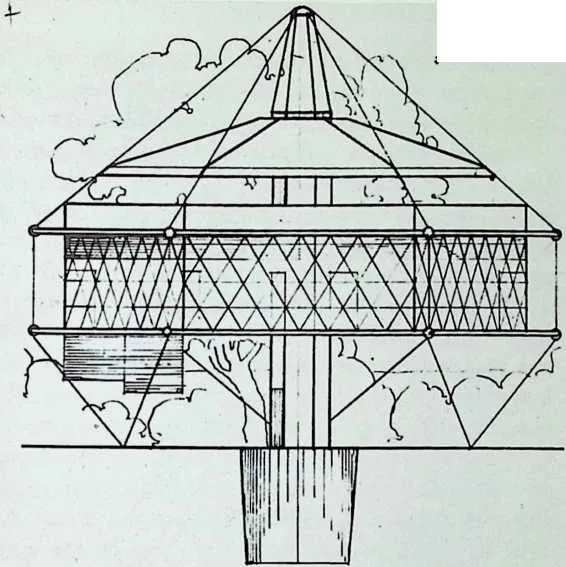
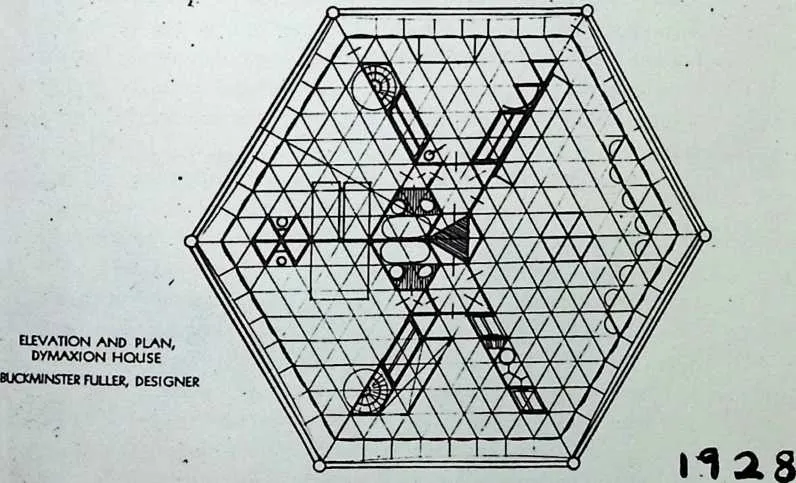
2Meanwhile, in April 1928 Bucky completed his designs and applied for patents to protect his ideas.
3 Besides publishing the book 4D, he built a three-foot model of his ‘‘scientific dwelling machine.’’ Thanks to the newspaper articles and the exhibit, people were beginning to talk about R. Buckminster Fuller.
4 Now at last Bucky was ready to start talking. A short, chunky figure carrying his model in a bulky suitcase, he went eagerly anywhere and everywhere that he was invited. Would Mr. Fuller show his model at the Chicago Home Owners’ Exhibition? Gladly. Appearances there marked the beginning of his lifelong series of lectures. Some say that to make up for his long silence, Bucky Fuller hasn’t stopped talking since. He has been clocked at speaking seven thousand words an hour and has been known to lecture for six hours at a time.
5 The 4D House—in fact all of Fuller’s designs in that period of time—came to be known as ‘‘Dymaxion’’ designs. Oddly enough, that trademark was invented by someone else. When the Marshall Field department store in Chicago set up a display of modern furniture, a store official remembered Fuller’s ‘‘house of the future.’’ What better way to draw attention to their modern furniture and to make it look less startling than to show Fuller’s model alongside?
6 The advertising man who came to discuss the display with Bucky shook his head over the name ‘‘4D House.’’ It could mean anything from a failing grade in school to a room number in a hotel. Bucky was reluctant to give up the name ‘‘4D’’; he had chosen it to represent the fourth dimension. But he could see the advertising man’s point. To catch people’s attention, a more dramatic name was needed. While Bucky explained his designs and the ideas behind them, the advertising man listened and made notes. From these notes, he took certain words that kept appearing over and over. Then, using syllables from those words, he created a series of synthetic words. Together, the two men went over the list discarding, recombining, and agreeing finally on one word as the most attractive. The winner,
78‘‘Dy-max-i-on,’’ was a combination from the words: ‘‘dynamic,’’ ‘‘maximum,’’ and ‘‘ion.’’ Since the trademark was registered in Fuller’s name, the right to use that word belongs to him alone. Today in people’s minds everywhere, the names R. Buckminster Fuller and Dymaxion are linked together like salt and pepper. They cannot think of one without the other.
9Despite Fuller’s lack of training as an architect, a few young architects were willing to listen to him. One of these young men had a car. In June of 1929, Bucky and this friend drove down to St. Louis. The American Institute of Architects was holding its convention there. His friend managed to set up the house model on the convention floor. In keeping with his principles of helping humanity, Bucky had planned to make a gift of his patent rights to the Institute. Most of the delegates walked away from his exhibit and some denounced him with an angry storm of words. The Board of the Institute of Architects not only rejected his generous offer but also voted to put itself ‘‘on record as …opposed to any peas-in-a-pod designs.’’
10No one objects to mass-produced books or mass-produced cars. Why did these architects reject even the idea of mass- produced houses? Did they think perhaps that people living in identical houses would be forced to live identical lives? Many people in a city, have identical pianos, but they do not all play the same piece of music at the same time on their pianos.
11In those supposedly different-looking or ‘‘individual’’ houses that architects designed, people were in fact all tied to doing the same housekeeping jobs over and over. In Bucky’s Dymaxion House, the house and its machines did those jobs. People freed from silly daily chores would have the time and the choice of what to do.
12Perhaps the architects saw the Dymaxion House as a threat to their earnings. The most basic 4D design would provide more conveniences and luxuries at less cost than any architect-designed house. In any case, the final victory was Bucky’s, for in 1970 this same Institute awarded its highest prize, a gold medal, to that nonarchitect, R. Buckminster Fuller.
15 MAY
16 While the award recognized his contributions, the housing industry has yet to accept his scientific approach. As Bucky had observed in 1927, society accepts new ideas and uses the highest technology only for military or defense purposes. When the United States engaged in a race against the Soviet Union to land men on the moon, the people in charge of the project followed Bucky’s footsteps. The spaceship architects aimed at lightness rather than heaviness and worked with the laws of nature. Instead of starting with existing materials, they first designed the spaceship and then hunted for and developed new materials to carry out the design. Self-contained, malting its own heat and light, pumping its own water and disposing of its own waste, the spaceship is a scientifically planned shelter that takes care of every physical need of a human. Perhaps another forty years will see Bucky’s vision of the scientifically planned shelter come true for men on earth as well as on the moon.
17 In July of 1929, an article in the Chicago Evening Post summed up the results of Bucky’s effort. The director of the Academy of Fine Arts wrote, ‘‘Chicago has in the mass disregarded that very latest development, the house hung from a central mast …a design which upsets all our ideas of period styles in design.’’ He predicted, however, that the world would hear more of that model.
18 Two years of hard thinking, writing, and explaining had left Bucky more than ready for a vacation. So the Fullers joined the other members of the family on Bear Island for the summer. Nothing on the island had changed from his boyhood days; only the trees had grown taller. Bucky took great satisfaction in the unchanging way of life on the island and welcomed the hard work that went with it. On the beach little Allegra played with a crowd of cousins, while on the boats Roger Hewlett, Anne’s brother, lent a hand with scrubbing down the decks. From the plunges into the cold bay waters to the wind whistling down the fireplace chimney at night, Bucky enjoyed every minute of each day. Once again, Bear Island gave Bucky the chance to use his body and mind to the fullest and he found himself refreshed and renewed. At the end of the summer he, Anne, and a toddling, talkative Allegra moved to New York. With his wife and daughter settled out on Long Island, Fuller tackled New York City. Surely in New York he could find a marketplace for his ideas.
19 Few people caught the hints or saw the clues pointing to the disaster that was coming in the fall of 1929. For the last part of the twenties, people from all walks of life had turned to the stock market as a way of getting rich quickly. Using savings and borrowing money, they bought stocks or shares in companies at low prices, waited briefly for the price to rise, sold at a profit, and then bought still more stocks. The center for this trading and buying was on Wall Street in New York City.
20 In October of that year, the ‘‘Great Crash’’ occurred. Banks, companies, and people had lost confidence in the value of the stocks that they were buying and selling. Everyone tried to sell at once. Prices went down and still nobody would buy; the shares of stock became worthless pieces of paper. Banks called in their loans and people could not repay. In the panic that followed, the whole system of business and industry broke down. Factories closed; banks shut their doors; people lost their savings and jobs. America was in a great business depression.
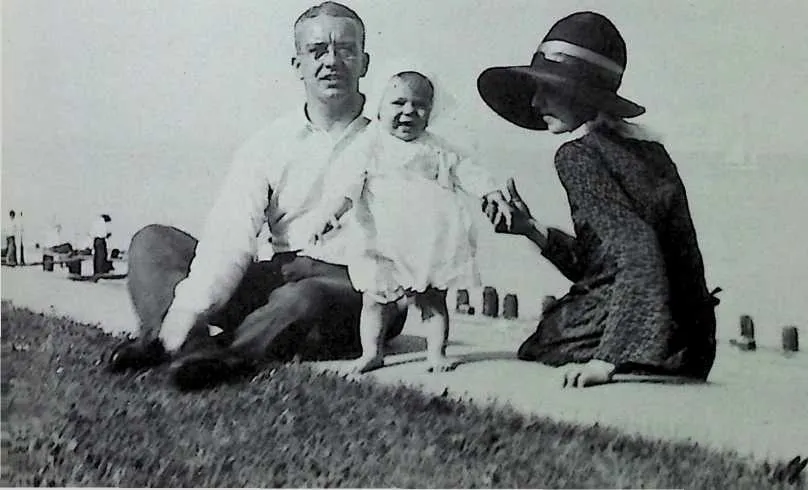
21 Bucky, Allegra and Anne in Lincoln Park, Chicago, 1928, when Allegra was learning to walk
23 Recalling those Depression days after the Crash, Bucky says, ‘‘Those were the days when hordes [of people] slept on the floors of subway stations. Some restaurants were down to one- cent meals. You could buy a suit of clothing for a dollar. Even then, nobody could sell anything; nobody had any money [to buy with].’’
24 Like many others in those extraordinary times, Bucky Fuller had no regular business and no regular income. For himself, he needed very little money. The little that he earned from lecturing and showing his Dymaxion House model went to support Anne and Allegra. He lived a wandering, gypsylike life and, oddly enough, the place where he spent much of his time was at a gypsy’s restaurant, Romany Marie’s in that part of New York City known as Greenwich Village.
25 At Romany Marie’s, thinkers, artists, and authors all came together to talk. When Romany Marie had to move her restaurant, she asked Bucky to decorate the new place on Minetta Lane. Not surprisingly, Bucky created an imaginative modern design with huge aluminum cones throwing a bright indirect light. Bucky not only planned the decoration, he also made every bit of the new furniture with his own hands.
26 Romany Marie could not afford to pay Bucky in cash. Instead she promised, ‘‘I’ll give you a meal every day.’’ On the stove she kept a big soup pot cooking all the time. Adding vegetables, little pieces of meat from time to time, a little more water made the taste-base well seasoned, thick, and delicious.
27 Bucky still remembers those meals: ‘‘The soup and black bread were wonderful and you finished with a stewed-fruit compote and Turkish coffee.’’
28 Who could ask for anything more? But Bucky did not want to take advantage of Marie’s offer. With typical independence and stubbornness, he tried to eat there only every other day. Often he would stay all evening long with only a cup of coffee. As a ‘‘table sitter’’ in Romany Marie’s, Bucky drew in customers who came just to hear him talk. Then, as now, it did not matter to Bucky whether there was a crowd or only one person listening to him. He talked just as intently for any size audience.
29 ‘‘It was there,’’ Bucky points out, ‘‘that I learned to think out loud in public.’’ He adds that this ‘‘thinking-out-loud’’ produces sudden and unexpected truths. Perhaps this explains why so many people come in such numbers and stay so many hours at his lectures today.
30 He walked everywhere, from Greenwich Village over the Brooklyn Bridge and back to uptown Manhattan, delivering lectures to any and all who would listen. The world was both hearing about and seeing more of his Dymaxion House, just as had been predicted.
31 In those moneyless times, he landed one steady job that lasted for six months. The president of the American Radiator and Standard Sanitary Company liked Fuller’s ideas enough to test them for practicality. He gave Bucky money and staff to turn out a real working model of the bathroom designed for the Dymaxion House. Bucky produced a one-piece bathroom that could be made in a factory and hooked up in a house just like a stove or refrigerator. Although the model was a success, the company never manufactured it.
32 In Fuller’s own words: ‘‘The manufacturer was convinced that the plumbers’ union would refuse to install the bathroom.’’ By his own calculations, it would take another forty years before the building industry would be willing to accept such a revolutionary idea. The experiment remained just that, and Bucky’s temporary job came to an end.
33 Neither the loss of his job nor lack of money bothered Bucky. As far as he is concerned, real wealth is not money or the gold buried under Fort Knox. Real wealth is energy which never leaves the Universe and knowledge which can only increase always. And he was happily busy increasing his own and the world’s knowledge.
34 In the spring of 1930, Bucky and his sculptor friend Isamu Noguchi loaded a station wagon for a trip to Chicago. Noguchi
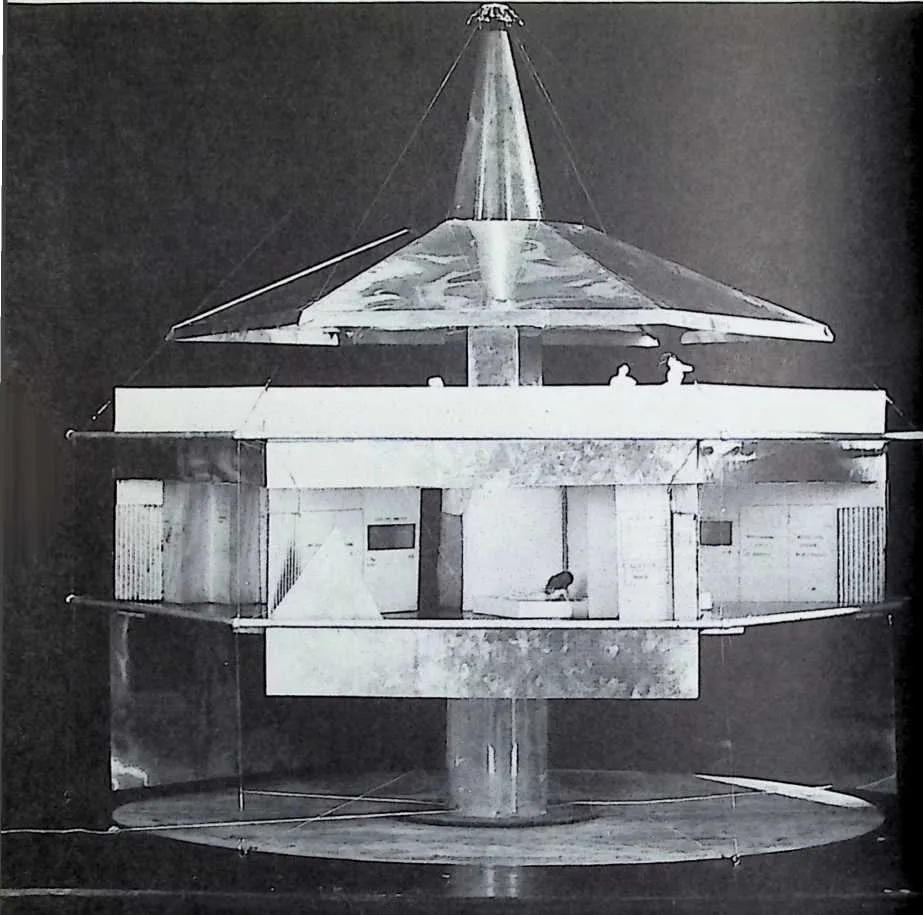
3637Above: Fuller with a model of the Dymaxion House. At right, top: the kitchen of a Dymaxion house that was built later (1941); bottom: a Dymaxion bathroom, shown with the top half removed (1938)
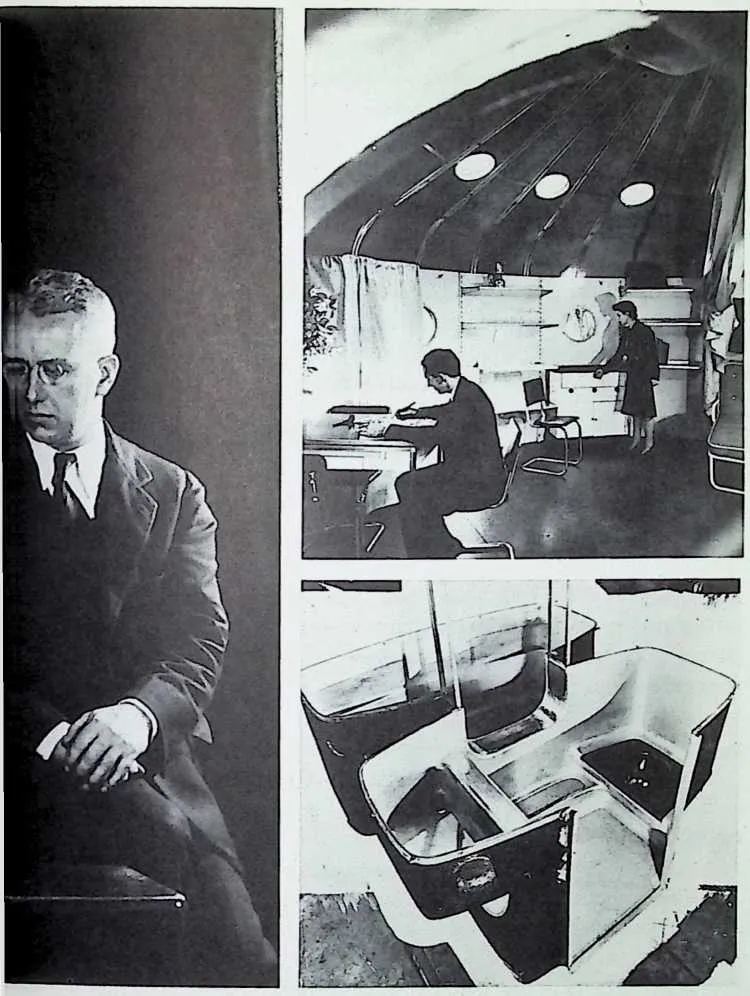
39 had been invited to show eighteen pieces of sculpture at the Arts Club, while Bucky planned to exhibit his Dymaxion House at the annual show of the Architectural League. Stuffed as it was with bronze heads and a ‘‘hanging house,’’ the station wagon presented a strange sight for other drivers on the road.
40 Although the weekend was cool and rainy, the reception of their work was warm and enthusiastic. Describing Noguchi’s exhibit of bronze heads, one reporter called it a ‘‘knock-out show.’’ And the architecture writer for the Chicago Evening Post called Fuller’s house a ‘‘very beautiful thing.’’ That reporter commented on the safety as well as the beauty of the house:
4142If little Willie falls out of bed for instance, he won’t hurt himself, because the floor will be pneumatic [airfilled like a balloon] and he’ll bounce.
43 She added the hope that there would be a life-sized Dymaxion House at the Chicago World’s Fair in 1933.
44 The architecture committee had, indeed, approached Bucky with the idea of featuring his house at the Fair. Fuller agreed on the condition that the display would not be just another larger size model or ‘‘mock-up.’’ Rather, he wanted to develop a true ‘‘prototype’’ (the first working house), fully engineered and ready to roll off the assembly line.
45 ‘‘How much will it cost?’’ the World’s Fair committee asked.
46 ‘‘I will have to recheck my figures and let you know,’’ Bucky replied.
47 A prototype—the first of its kind—is always fantastically expensive. The high cost of making the first one includes the high cost of learning how to do it. To manufacture a prototype, machinery for making it has to be developed as well. When ball-point pens were first made in quantity thirty years ago, they sold for thirty dollars each. Now they are so cheap to make that they are given away free to advertise businesses or candidates.
48 Fuller worked out his costs the way the automobile industry did—by what it cost per pound. If his house could be mass- produced, the price would be twenty-five cents a pound or at a total cost to the customer of fifteen hundred dollars. (Fords and Chevrolets at that time sold for twenty-two cents a pound.) For a house like Fuller’s, fully equipped, this was a sensationally cheap price. Since he had made his first estimates, new discoveries and materials had been developed. So his new figures would be considerably less than his original billion-dollar figure.
49 Meeting again with the promoters, Bucky told them, ‘‘The basic cost today is a hundred million dollars.’’
50 One of his friends has said that Bucky could ‘‘persuade a silkworm that nylon is better,’’ but in this case his persuasive powers failed. To these men, who wanted simply an exhibit for the Fair, Fuller’s figures were a jolt. They did not understand that Bucky Fuller was offering them a whole new industry. Bucky’s idea was so sane as to seem insane to most. Certainly the World’s Fair people thought they were dealing with a lunatic, and they promptly abandoned the idea of a Dymaxion House.
51 Bucky wasted no time in regrets. What was done was done. He concentrated now on getting people to think about the merging of science and architecture. Some young architects were listening to him, but he needed to reach a wider audience. Cashing in his insurance policies in 1930, he scraped together enough money to buy a magazine which he renamed Shelter.
52 Bucky’s approach to the business part of publishing was startling, to say the least. He canceled all the contracts for paid advertising. In fact, he refused to print any ads at all. Since magazines make their money from the advertisements that appear in them, Bucky and Shelter were clearly headed for disaster.
53 But Bucky Fuller was very clear in his own mind about what he was doing and why. Advertising contracts require the publisher to bring out regular issues on regular dates. This means meeting deadlines. Bucky felt that ‘‘thinking’’ has its own timing and cannot be hurried to meet editorial deadlines. He notified all subscribers that they would receive issues when he felt deeply in need of saying something. Then he told them that for the luxury of saying what he thought needed to be said when he needed to say it, they could pay him two dollars a copy! (The most expensive magazine at that time charged one dollar a copy.)
54 People argued about Shelter, criticized its editor and his ideas, but they also bought it. Within months, the number of subscribers had multiplied incredibly. Even the well-established Architectural Forum could not boast of having more subscribers than Shelter did.
55 In Shelter, Bucky provided a place for creative architects, like Frank Lloyd Wright, to air their ideas. Bucky himself wrote, not just about shapes and lands of shelter, but about the whole environment. His first ‘‘chapter’’ dealt with ecology, a word and subject that few people had heard or understood in the 1930’s. Even today, when we accept the importance of ecology in our lives, Bucky’s points startle the listener into new thinking.
56 ‘‘Earth is a tiny planet where energy is supposed to be stored and saved,’’ says Bucky. He points out that pollution is really a resource that is out of place and argues that the resource of pollution should be ‘‘harvested.’’ All the sulfur dioxide escaping from smokestacks equals the amount of sulfur being mined from the ground. Why not ‘‘mine’’ the smokestacks to reclaim the sulfur? In Shelter, pictures of smokestacks belching black clouds into the sky underlined his points.
57 Meanwhile, the country continued to suffer from the Great Depression. The stale, defeated air of the Depression clung to every business effort and every government proposal to create more jobs and money. But the brisk November winds of 1932 blew a new hope of change around the country. Franklin Delano Roosevelt, elected to the presidency of the United States, pledged himself to a ‘‘new deal’’ for the American people. The new President reminded all that the only thing they had to fear was fear itself.
58 To everyone’s astonishment, just at this point, Bucky abruptly chose to shut down his magazine. ‘‘But why?’’ asked some peo- pie. Why close down just when the magazine was on its way to becoming a success? (What they really meant was why stop when Shelter was about to make money and a profit?) There should have been no surprise. Buckminster Fuller was the man who had chosen to ignore the need to earn a living in 1927; he was no different in 1932. Bucky’s concern was for ideas, useful ones. With the election of F.D.R., he felt confident that the new government would concern itself with the needs of homes, new industry, and jobs for people. If so, it was time for him to push off in a new direction.
59 And the last issue of Shelter in November of 1932 showed the new direction that he wanted to explore. In that issue, readers saw the detailed drawings for a new kind of transport, an eye-catching transport with the streamlined shape of a raindrop.