
5 5
2To send the glad news on November n, 1918, Bucky needed only two words: ‘‘War’s over!’’ On land, bells clanged; at sea, ships’ whistles blew. People everywhere danced in the streets, hugged and kissed one another in joyous relief. The signing of the Armistice signaled the end of the war. It meant also that the work of building peace had to begin. When President Wilson announced his plan to sail for Europe, the news had a special importance for Bucky Fuller. His latest assignment was to the George Washington, the very ship chosen to carry the President to Europe.
3 Workers swarmed over the ship repairing, repainting, and redecorating it. Stepping over the boards and around the buckets, Bucky made his way to the gangplank to greet the man coming aboard. Dr. Lee DeForest, who had invented a new kind of radio tube in 1907, had come to oversee the installation of special radio equipment. The two men greeted one another as old friends. Earlier, DeForest had carried out his experiments in radio telephony on a small ship that Bucky commanded. The inventor had devised a radio set so light yet powerful that it could be used in an airplane to communicate with land and sea.
4 The pioneers of the West had disappeared, but Bucky had the chance to work with a pioneer on the frontier of technology. The system being installed on the George Washington would be the first successful attempt to carry voices beyond seventy miles. Men miles apart could talk both instantly and wireless-ly. Drawing on his experiences, Bucky once again saw a larger pattern. In the notebook which he kept, he observed that the world was moving ‘‘from the track [of trains and trolleys] to the trackless [to trucks and airplanes for moving goods and men].’’ ‘‘We’re going from the wire to the wireless, the visible to the invisible.’’ True progress, he concluded, means ‘‘doing more with less.’’
5 While Bucky was on active duty, Anne had moved back to live with her family. She, too, had important news for Bucky. On December 12, 1918, a tiny, fragile baby girl, Alexandra Willets Fuller, was born. Hurrying ashore for that event, Bucky
6 3<S looked into the cradle with awe and delight. What an extraordinary privilege it was to be given this gift of new life! And what a marvel of design!
7 Anne Fuller needed all the help and support that her family could give her that winter of 1919. The great, killing influenza epidemic which had begun the year before continued to sweep through the United States. Alexandra caught it and struggled to survive. With loving care and around-the-clock nursing, she pulled through. Before they could rejoice, the Fullers were stunned by new disaster. Alexandra fell ill with spinal meningitis, an almost always fatal disease. Miraculously, she survived that, too, only to be stricken later with infantile paralysis. How much can the human body endure, parents and doctors wondered helplessly. The baby more or less overcame this last attack. There were traces of paralysis left, but Bucky and Anne were grateful to have her alive.
8 Bucky knew a vital decision must be made. From the day he entered the Navy, Bucky had felt at home. The sea and ships had been his earliest teachers and love. He wanted to remain in the Navy. But in the Navy, a man cannot pick and choose his assignments. He must go wherever he is sent. It might be a tropical, mosquito-infested base or a barren, cold, storm-swept station. How could Alexandra survive such conditions? Her fragile, match-thin body still needed constant care and nursing. Much as he loved the Navy, he loved his infant daughter more. Lieutenant (j.g.) Richard Buckminster Fuller transferred to inactive or reserve status on August 28, 1919, and returned to work for Armour and Company.
9 Despite the pain-filled days, there were intervals when Alexandra was better. Then Bucky’s optimism and high spirits took over. Packing up, the whole family caught the night boat to Boston to attend Line Pierce’s wedding on June 30, 1920. Fog delayed the boat so that they scooted up the aisle of the Unitarian Church after the service had begun. Too late for Bucky to play his part as an usher but in plenty of time to congratulate Line and kiss his pretty bride, Ada. Greeting old friends at the
10 reception, the Fullers put aside their worries and cares for the moment.
11 It would seem as if Bucky should no longer have any money worries. His job at Armour now paid him fifty dollars a week, a very good salary for that time. But nurses and medicines used up almost all of the money. In 1922, when an old Navy friend offered a new job with more pay in a company manufacturing trucks, Bucky took it gladly. He tackled the job of national sales manager for Kelly-Springfield Truck Company with his usual ferocious energy. New business rolled in steadily for three months. In the middle of his success, he heard the unbelievable news. The owners of the company, which also made tires, had decided to close down the truck-making part of the company. Dismissed! Out of a job almost before he had begun. How could a man have confidence in himself and his efforts? How was he to meet the expenses of his family?
12 Fortunately, Bucky still had his position as a reserve officer in the Navy. He returned to active duty on a ship that was being used for summer training of men.
13 A depressed Bucky stepped on board the Eagle Boat zy. The feeling of a deck under his feet again brought a small smile to the corners of his mouth. He saw sailors saluting smartly and hurrying to carry out commands. The small smile widened into his typical toothy grin. It was impossible to continue feeling depressed when he was once again on board a ship. Once more —as always in the Navy, at least—Fuller’s luck held up, for the commander of the squadron took an instant liking to him. Vincent Astor was as tall and thin as Bucky was short and stocky, but the two young men shared the same love for ships and flying. In fact, Vincent Astor was a multimillionaire who owned his own seaplane, a five-seater. This ‘‘flying boat,’’ as it was called, had all the latest technical discoveries and improvements. Usually a full-time pilot was at the controls, but often Astor let Bucky take a turn as copilot. In the pleasure of piloting that plane, Bucky could forget momentarily his joblessness and debts.
14 When the summer training program ended, the friendship between the two men continued. Astor, who was leaving on business for Europe, proposed to Bucky that he continue using the seaplane. After all, the plane would just be sitting in the hangar while Astor was gone. Everything—fuel, hangar space, pilot—was paid for through the end of October. He concluded by saying, ‘‘The more you fly it, the better.’’
15 Who could resist such an opportunity? Who would want to resist? With wholehearted enthusiasm, Bucky took up the offer. Since planes were still a novelty that made news, the newspapers reported these flights solemnly, talking about the value of seaplanes in coast defense and scout work.
16 Meanwhile, Bucky and Anne planned a vacation for the middle of September. No chug-chugging on dusty roads for the Fullers; they would take their vacation like birds—in the air. If Bucky thought Anne might be nervous about flying, there was no clue or sign of it on her face. Gazing out the windows which were set at the passenger’s elbow height, she looked as calm and comfortable as a lady going for a drive in her limousine.
17 Tilting in great circles, the plane began to climb into the sky. Through smoky wisps of clouds, they could see the land below in rifts and patches. They put down at Newport, Rhode Island, for lunch and paid a call on Admiral Gleaves, Bucky’s old wartime commander. By dinnertime they were in Wiscasset, Maine, and visiting with Bucky’s mother. On Thursday they flew up to Bear Island, where they had three glorious days of crisp, clear Maine air and the golden sunshine of Indian summer.
18 Bucky made countless short hops each day around Penobscot Bay. Jim Hardie, caretaker of the island, did not trust this strange air-sea machine. When he went up with Bucky, Hardie carried an oar with him. Whatever might happen, he at least was prepared to paddle. A shrewd fisherman, he did more than marvel at the clear view of the bottoms of the shoals and reefs. He spotted new sites to put lobster pots and dredge for scallops. Everywhere the flying boat landed, it was a magnet drawing
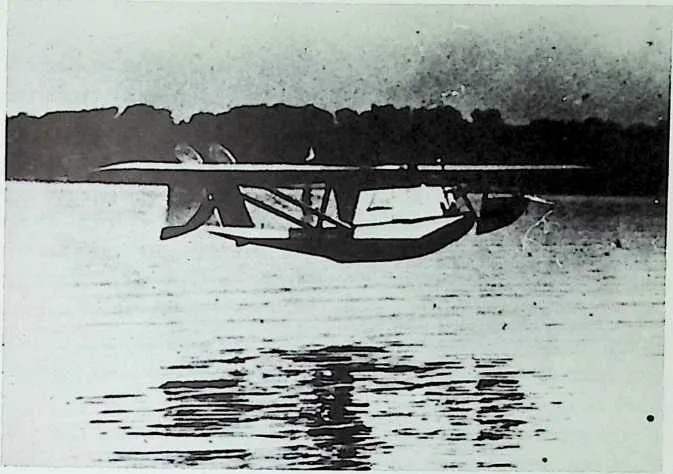
20 A New York Herald -photograph shows Bucky flying Vincent Astor's seaplane on the 1922 vacation trip hundreds of curious sightseers, summer visitors, and native fishermen.
21 Leaving Bear Island on Monday, the Fullers took to the air again. They began their leisurely return trip, making stops at Bar Harbor and Boston. Skimming over the top of the surf, the plane climbed up to ride over Great Head and Schooner Head, the highest bluffs on the Atlantic coast. Bucky charted his speed. The plane did 120 miles an hour with no difficulty at all. Cutting the motor, he let the plane glide in silence for a moment. A wave of his hand called Anne’s attention to the panoramic view framed in the window. Below, the waters lapping an island were tinted red by the sun’s rays. They were gliding over Isle au Haut where Nathaniel Bowditch wrote his book, The New American Practical Navigator, the sailor’s bible for navigating the seas.
22 While the seas had been mapped and charted, man sailed now in a new ocean, an unbroken air ocean with land as the bottom. For traveling through the air over our curving earth, he needed a new kind of geography. The old flat maps would never do; there was too much distortion as you moved away from the equator. Someone would have to map new routes through this air ocean.
23 Riding high in the sky, Fuller could see the need but did not realize then that he would be the one to fill it. A sudden bump of air brought him back to the needs of the moment. With the motors switched on and wind at their back, they were reaching their highest speed yet—130 miles an hour. Gliding down to the hangar at Port Washington, Bucky gave a satisfied sigh. They had covered seventeen hundred miles all told without a single hitch or repair needed.
24 It was to be the last satisfied moment the Fullers had that fall. Cold November winds blew new illness into their household and a chill into their hearts. Alexandra came down with pneumonia. Could they dare to hope that she might overcome this as she had so many other ailments? But her frail body could stand no more. Her lungs clogged by bronchial pneumonia, she died on November 14, 1922, just before her fifth birthday.
25 Her death threw Bucky into a deep depression from which he could not seem to pull out. He felt a crazy sense of personal guilt for her death and was convinced that it need not have happened. Raging against her fate, he felt that there should have been a way to prevent it. If the world had adequate shelters, houses that weren’t drafty and overcrowded. …Our environment is really a hodgepodge of ignorance, he concluded.
26 For the first time in his life, Bucky could not bounce back. In that dark, gloomy autumn, he seemed to have lost everything: his daughter, his job, his zest for living. It was his father- in-law, J. Monroe Hewlett, who opened a new window of interest for Bucky. An architect as well as a painter, Mr. Hewlett had been tinkering with a new kind of building block. He asked Bucky to look at the result. The big block looked something like a giant shredded-wheat biscuit, the kind people eat for breakfast. Mr. Hewlett had taken loose straw, soaked it with cement, and molded it into a block.
27 Explaining the advantages of his ‘‘brick’’ in construction, Mr. Hewlett pointed out that it was almost impossible to break or crack it. It was tough but light, weighing just two pounds. Stacked up, such blocks could serve as molds for building a concrete-framed wall. Another advantage lay in the two holes at each end of the block. If you lined the blocks up and poured concrete down the holes, you gave the concrete frame added strength and support. Used in this way, the blocks also acted as insulators against cold and moisture.
28 Bucky thought it was an extremely clever, good design. Mr. Hewlett, who had great respect for Bucky’s creative ability and talents, was encouraged by his interest. Hewlett had one last question. Would Bucky be willing to work on translating the brick idea into a whole system of construction? Some way had to be found to produce the bricks in quantity. Factory location would be important—it should be near good transportation for distributing the bricks. Patents had to be applied for. Hewlett’s faith in Bucky’s ability to solve the problems restored Bucky’s own confidence. With respect and love, the two men shook hands firmly on the deal and the Stockade Building System company was born.
29 As president of the company, Bucky had more than enough work to fill the days now. He set about inventing machinery to mold the bricks in quantity. Drawing upon his business experience with Armour, he worked out costs and ways to sell the bricks. He used his experiences in the Canadian factory to lay out the machinery in his new factory. What he didn’t know about the building industry itself, he pushed himself to learn.
30 What he learned about the ‘‘shelter tailors’’ of our world caused him to shake his head in amazement. The business of building seemed to be stuck somewhere in the Dark Ages. Certainly he found it to be the slowest industry in the world to accept new ideas (Portland cement had been known and available for forty-two years before anyone dared to use it in buildings). Despite the slowness of the industry and unions to accept new ideas, some customers decided they wanted the Stockade Build-
31 Above: a garage wall made of Stockade Blocks; below: two drawings from the Stockade Block manufacturing patent
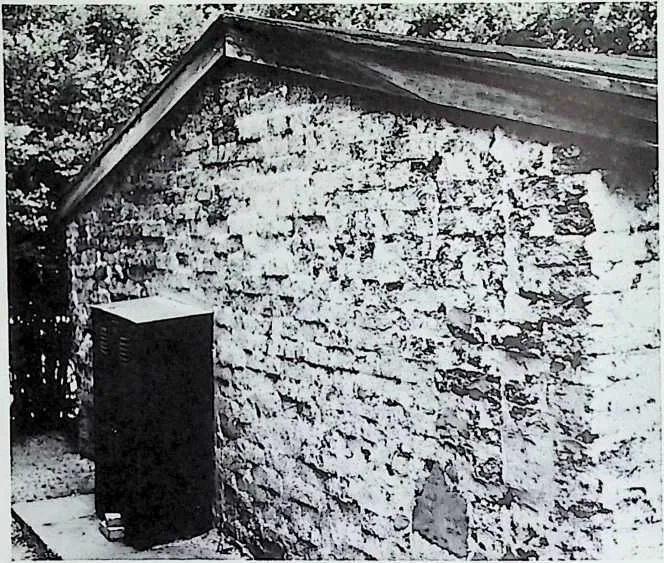
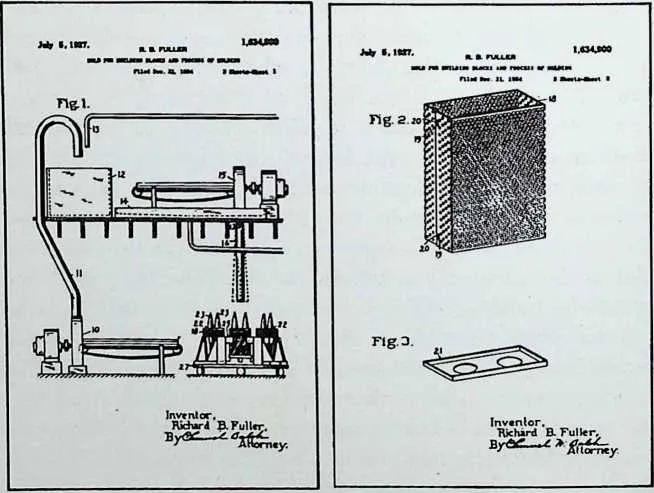
33 ing System for their structures. Houses built with the fibrous bricks cost less than others and yet were stronger and better insulated. The business grew and Bucky moved from place to place building new factories.
34 Anne, too, was busier than ever. With the death of her mother in 1923, she took on the care of the younger ones in her family. While the days were full with work, the nights were too long and empty for Bucky. When he was far from the Hewlett home and Anne, the depression over Alexandra’s death would keep him awake. Often, he drank steadily all night long to blot out his pain and sorrow. With his incredible energy he could still go to work the next day. He worked twelve, fourteen hours a day and did a good job.
35 When Bucky had to supervise the building of a new factory in Illinois, he took an apartment in Chicago. His loneliness ended in 1926 when Anne, finally free from her family obligations, joined him. The apartment, located in one of the tall hotels on the shores of Lake Michigan, was a pretty and spacious one. From the windows Bucky could look down on the handsome yachts in the basin below.
36 Who would have dreamed that he would end up in Chicago, very near where Grandma Andrews lived as a girl? What would those head-shaking, disapproving uncles say if they could see him now? Even they would have to admit that the wild Fuller boy had come a long way. Only thirty-one years old, he headed a company with five factories. An inventor, he held two valuable patents: one for the system of framing the blocks, the other for the machinery that molded them. He had built over two hundred buildings already. (The University of Illinois used Fuller’s blocks in the walls of one of its buildings.) He was meeting and dealing with important businessmen and powerful bankers. Only one faint worry nagged at him now. Mr. Hewlett had had financial problems. To get some needed cash, his father-in-law had sold his shares in the Stockade Building System to outsiders. But no one had interfered yet with Bucky’s running of the business.
37 When Anne told him her good news, Bucky’s spirits went sky-high. A new baby was due in August. Through the spring and summer of 1927, Bucky could feel the awful depression of the last five years begin to fade away. He worked harder than ever, ignored the stifling summer heat, and waited impatiently for August. The month had come almost to an end when, at last, on August 28, a small but perfect baby girl was born to the Fullers.
38 Walking into the Chicago Lying-In Hospital, Bucky was the happiest of men. That popular song, ‘‘Happy Days Are Here Again,’’ might have been written just for him. As he looked down at Anne, a soaring joy and love filled his heart. Her long hair was loose on the pillow, framing her face and the brilliant smile on it. Anne proposed Allegra for the new baby’s name.
39 Al-le-gra. It rolled musically from the lips. An Italian word, it means joyful, gay. In both sound and meaning, no better name could describe what the baby’s coming meant to Bucky and Anne. Her birth seemed like a miracle, a second chance for happiness.