
8 8
2In World War I, the winged flying machine had been transformed from an entertaining new toy to a serious weapon of war. Some naval officers, like Bucky’s commanding officer, were early supporters of airplanes. Lt. Commander Patrick Bellinger, one of the Navy’s first pilots, had traveled to Europe in 1914 to study the superior French and Italian planes.
3 Talking with Bellinger in 1917, the ever-curious Bucky had discussed the future uses and kinds of planes that would be developed in the years ahead. Clearly, the ships of the air would be navigating over the high seas just as the surface ships had. Which would be speedier and more stable, seaplanes or land planes? Or would there be some new kind of plane as yet undreamed of? The two men explored possibilities in long talks. Both the talks and the germ of an idea stayed in Bucky’s mind for ten years.
4 Even as he sketched his Dymaxion House in 1927, Bucky Fuller asked himself more questions. If his Dymaxion House was to be planted anywhere in the world, on mountain tops or in deserts, how would people reach the house or leave it? Any vehicle a family used had to be independent of roads, rail lines, or runways. It should be able to taxi on both land and water. Again, Bucky looked to Nature for the principle which he would use.
5 Like a soaring sea gull, a moving airplane has the ability to create a low pressure area above its wings. This low-pressure area has the effect of a partial vacuum which must always be filled. As a result, the plane or gull gets ‘‘sucked skywards’’ or, in other words, gets a ‘‘lift.’’ This same lift is what keeps gliders up in the air. But the duck has too small a wing to create enough of this kind of lift to support its weight. To rise up, the duck uses a kind of jet principle. Each thrust of its wings pushes out a powerful air jet between the wing and the body. Beating its wings furiously, the duck vaults skyward and forward on its own jet stream.
6 When he published the 4D essay in 1928, Bucky included a sketch of his new transport idea. Later, for Allegra’s benefit,
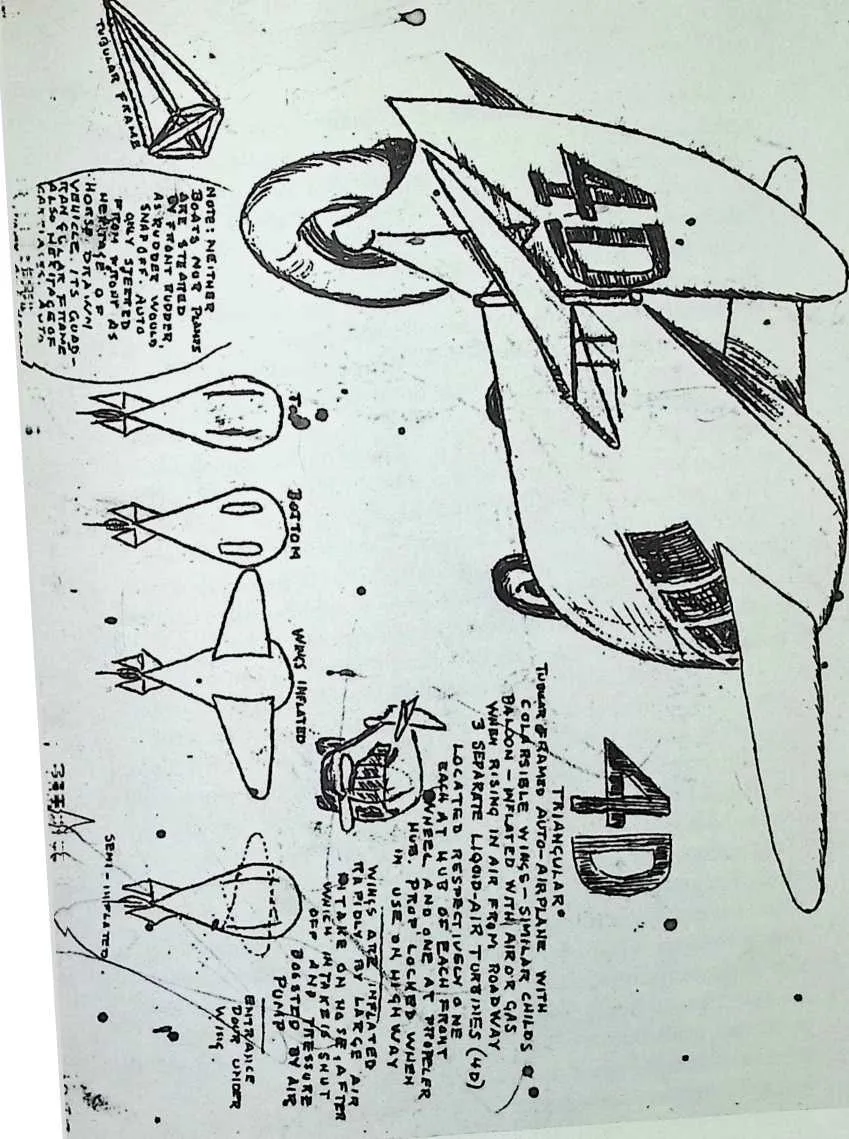
8 Fuller's sketches and notes on Us »
9 Mmobile,or4DtranstOTt,m1}21
10 he explained his invention as a ‘‘zoomobile.’’ In Fuller’s zoo- mobile, the power to lift and move the transport came from twin combustion plants, consisting of gas turbines, jets, and rocket thrusts. The zoomobile had all the freedom of a wild duck. An auto-airplane, it had collapsible wings which would inflate like a balloon as the vehicle rose into the air. It could take off from an airport, fly over fields and towns, and slip down again into the mainstream of highway traffic.
11 As with the house, the technology to make the transport possible did not yet exist. There were no metals or alloys of metals strong enough for his engines. The liquid fuel he proposed using created such intense heat that the engines would melt. And Bucky certainly did not have enough money then to carry out experiments or build a prototype.
12 Bucky knew that in time new metal alloys would be developed and could more or less predict the schedule. He knew, too, that the problems of maneuvering in the air would be solved more easily than other problems. Actually, the greatest unknowns and difficulties lay in the use of his wingless fish on the ground.
13 Having pinpointed the key problem, he bombarded it with questions: How would it taxi? …What would the winds do? .. . On icy fields would it…?
14 Sketching steadily, Bucky created a design for the transport in its ground or car stage. Finally, he was ready to have the world look at it.
15 Travelers and tourists, businessmen, housewives, lawyers flowed in great streams in and out of New York’s Grand Central train station. The crowds swelled even more in December. If they looked up over their heads, they could see the glorious murals of the heavens painted by Monroe Hewlett, Bucky’s father- in-law. If they stopped scurrying and looked around, they could see Buckminster Fuller’s work, too, for the Engineer’s Bookshop had sponsored a display.
16 Christmas shoppers might be too busy to look, but in January at the National Automobile Show everyone’s attention focused on the new cars and trucks displayed temptingly throughout the four floors of the Grand Central Palace. Brilliantly illuminated, the shining cars revolved slowly on turntables while pretty girls stood at the side explaining the new features. Newspapers reported on what drew the largest crowds: a bouncing, single cylinder 1902 Cadillac, and the ‘‘one car sprung as a surprise …designed along radical aerodynamic lines.’’ With his models displayed in a featured booth at the show, Bucky Fuller needed nothing else to draw the crowds’ attention.
17 Milling around, the crowds chattered excitedly:
18 ‘‘Is that what we’re coming to?’’
19 ‘‘Yes, so they say….’’
20 ‘‘It’s gorgeous!’’
21 ‘‘It doesn’t seem like a car at all, does it?’’
22 ‘‘We’ve come a long way, brother.’’
23 Shortly after, one of Bucky’s friends and supporters offered him some money to test his Dymaxion ideas. Bucky accepted cautiously. He insisted on one condition: that he should be totally free to use the money in any way that he chose.
24 ‘‘If I want to use all of it to buy ice cream cones, that will be that, and there will be no questions asked,’’ he said.
25 So it happened that Bucky Fuller in the midst of the Depression found himself holding several thousand dollars in cash.
26 For once, Bucky Fuller could pick and choose. What he chose to do was build a 4D transport to test its capabilities on the ground. Bucky began to line up the resources that he needed: a factory site, workers, tools. In Bridgeport, Connecticut, he found an ideal location. The old Locomobile Company had gone out of business, leaving an empty building for rent at a small sum. He found there also many skilled mechanics and craftsmen who had been left unemployed. A thousand or more men applied for the twenty-eight jobs that Bucky offered. In hiring, Bucky considered both a man’s skill and his needs. Fuller picked those who needed work the most, those who had wives and children to feed. More than one of these men burst into tears of relief when hired.
27 To make the plaster models, he had called on his sculptor
28 8o friend Isamu Noguchi. Bucky then persuaded W. Starling Burgess (that fellow Milton Academy alumnus who had lectured there years ago) to become his chief engineer. Burgess brought with him the special experience of pioneer work with both boats and planes. He had invented the Delta-winged plane and designed the big yachts which won the America’s Cup races.
29 In return for Burgess’s help, Bucky promised to work with him on the building of a new kind of sloop. This project was added to the work of building the second transport: Both projects shared the same building space, workers, and the attention of the two men. According to Bucky, he worked on the stern, while Burgess took care of the bow. (Up at Bear Island, Bucky’s sister Rosy was involved with the building of a new boat at the same time. Perhaps it was an example of the loving bond between these two. Perhaps it was ESP. Whatever it was, each, unknown to the other, chose the name Little Dipper.)
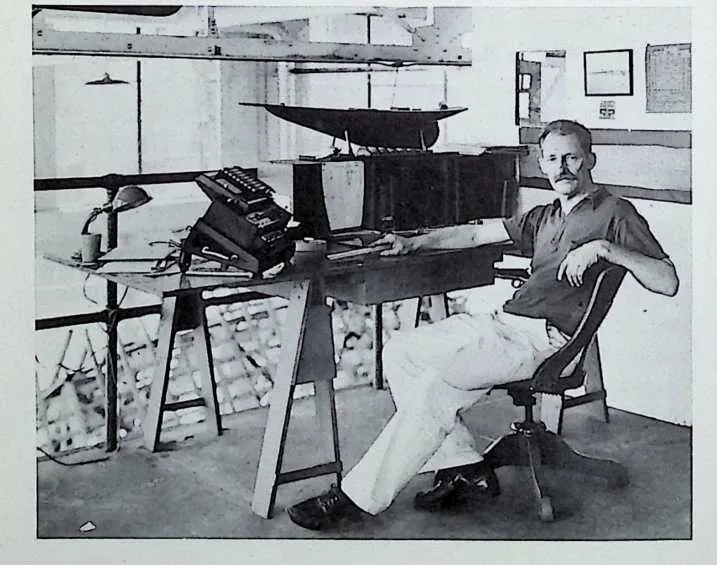
3031W. Starling Burgess at work on the 4D transport
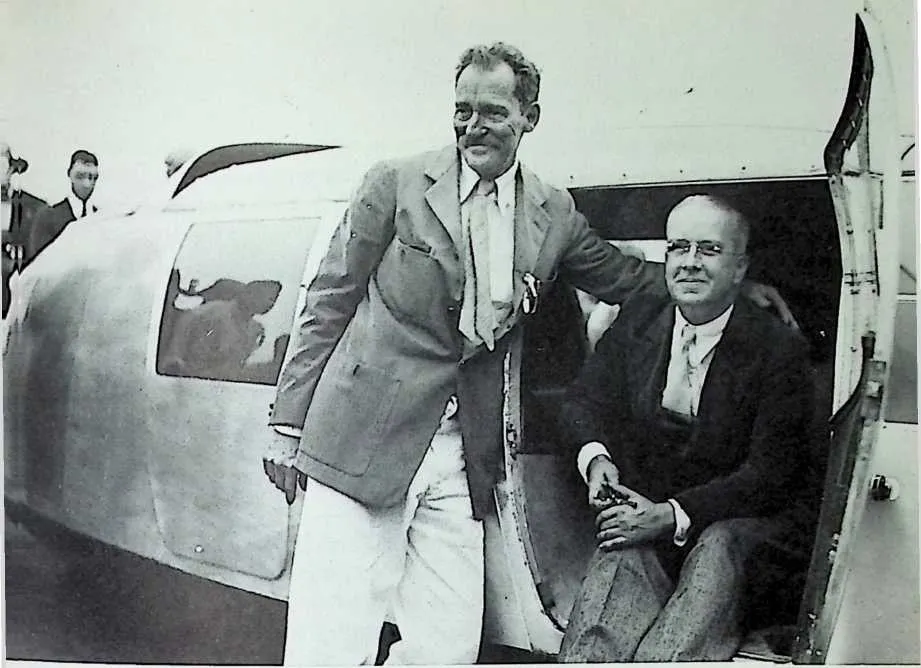
3435Burgess and Fuller with the first Dymaxion car, July 12, 1933
36 On March 4, 1933, President Roosevelt took both his oath of office and action to restore confidence in the business and government of America. That same week, Bucky Fuller began the production of his 4D transport. Although he and Burgess might disagree on some engineering solution or design, they did share a certain point of view: ‘‘Never turn out a prototype that just works and proves a point. It must be magnificently executed …that is a pioneer’s responsibility to society.’’
37 Italian machine-tool men, Polish sheet-metal experts, Scandinavian craftsmen—each worked with fine care to produce a perfectly finished piece. When the first working transport rolled out of the factory doors on July 12, 1933, excitement and pride soared even higher. Bucky Fuller was thirty-eight years old that day. Surely the sight of that gleaming aluminum, bulletshaped object was the best birthday present Bucky had ever had!
38 Looking something like a submarine which has come up from the sea and something like a dirigible which has come down from the air, his creation resembled nothing ever seen on a road before. In his transport, the driver sat right up against the front of the car. There was no long hood to block his view. Aircraftglass (shatterproof) windows wrapped around the front to give the driver the widest possible view of the road. Sticking up through the roof, the rear-view periscopes gave him an equally good view behind.
39 The low-bellied wingless fish rode on just three wheels, two in the front and one in the rear. Like the rudder on a ship, the single rear wheel did the steering. The two front wheels provided traction and braking, an important new safety feature. Fuller demonstrated to reporters with a toy baby carriage. With rear wheels locked, the baby carriage sliding along the floor skidded badly. When the front wheels were locked, the skidding was eliminated. ‘‘She was the most stable car in history,’’ says Fuller.
40 The running gear was enclosed in the streamlined belly of the fuselage. This allowed all the interior space of the car to be used for the roomy comfort of the passengers. (The useful space inside was double that of the average car, and his second model could carry eleven people.)
41 So many new ideas went into that transport: front-wheel drive, air conditioning, recessed headlights, a rear engine.
42 The public had its chance to see how some of these new ideas worked, or in fact whether they worked at all. Nine days later, three thousand people packed the test track of the old Locomobile Company. Important people—a brigadier general, a major general from the Army Air Corps, the motor vehicle commissioner of Connecticut—came for the unveiling and test run.
43 Would the transport be able to reach the high speed which the designer predicted? Had the center of gravity been lowered enough? Would the car tip over at high speeds? Moments before the test run began were filled with anxious unspoken questions.
44 Bucky Fuller, as always, looked confident. The Dymaxion darted out onto the track. As smoothly as any airplane in the air, she sailed along on the ground at a speed of seventy miles an hour. Actually, the Dymaxion could easily do 120 miles an hour. Bucky, worried about the crowds hedged along the track, did not want to run her at top speed that day.
45 How could the Dymaxion travel so fast? To reach that speed an ordinary 1933 sedan would need an engine of over three hundred horsepower. Yet the Dymaxion did it with a regular Ford V-8 engine rated at ninety horsepower. The secret lay in the design.
46 Until the Dymaxion appeared, the shape of most cars was similar to the outline of a horse and closed wagon, with the motor taking the place of the horse. The old horse-drawn wagons moved so slowly that the problem of ‘‘air resistance’’ did not exist. Automobiles, however, move faster and come up against this problem in trying to speed through the air. Just as a person uses more energy to walk into a strong wind, a car’s power gets used up trying to push through the air. Millions of invisible air particles rub against everything that moves through them. This rubbing is called friction and friction is a force that slows down moving objects.
47 At high speeds, almost 80 percent of an engine’s power goes into fighting friction or ‘‘air resistance.’’ Only 20 percent is left to provide speed. Most designers at that time tried to increase a car’s speed simply by piling more and more power into the engine.
48 Bucky Fuller does not believe in conquering one force by using another force. He prefers to yield, coax, and adapt Nature’s forces to go in the directions he prefers. By streamlining the Dymaxion’s shape to resemble the fish which moves so easily through water, he reduced friction and increased the car’s speed.
49 Everywhere the Dymaxion went, it created a sensation. Before Bucky’s mother died in 1934, she had the pleasure of hear-
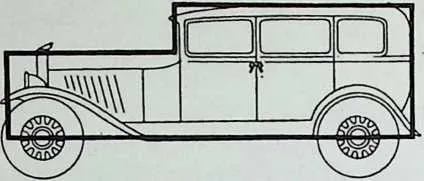
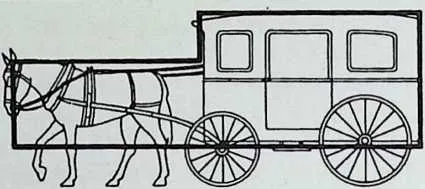
52 The shape of a standard 1932 automobile resembles the outline of a horse and closed wagon
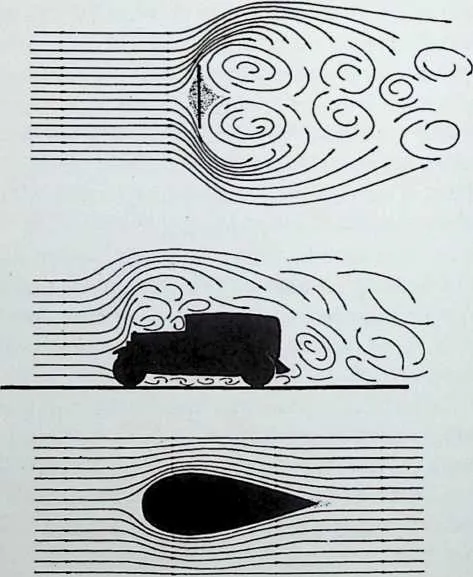
54 Fuller’s sketches show the flow of air around a conventional car and around a streamlined form
55 ing the world praise her son’s ‘‘genius.’’ Engineers applauded his design and technology; reporters wrote admiringly of the smooth, floating ride and comfort.
56 Bucky could not resist the temptation of showing off the Dymaxion’s advantages and specialties. One day he drove down Fifth Avenue with ten magazine editors as passengers. In those days, New York had traffic policemen rather than traffic lights on the corners of main streets. A puzzled policeman whistled the Dymaxion to a stop, asking what the heck this thing was. A mischievous Bucky not only explained the principles of the transport, but also gave him a quick demonstration of its ability to make tight turns. While he was talking, he rotated the car completely around the astonished policeman. Every policeman along Fifth Avenue stopped him to ask for a similar demonstration. That day it took over an hour for the Dymaxion to travel one mile! Traveling between New York and Washington, D.C., Bucky was stopped fifty-two times. Using different excuses, state and city policemen kept arresting him so they could haul the car into the station for a good look.
57 ‘‘She was able to behave in very spectacular ways,’’ Fuller recalls with a smile.
58 The Dymaxion demonstrated its ‘‘ways’’ at the 1933 Chicago World’s Fair. In the Wings of Century parade, every form of American transportation, from cowboys on horseback to puffing steam engines, passed in review. Last in the parade, a Dymaxion model would zoom across at forty-five miles an hour. When the car braked suddenly and spun around, the crowd in the stands would stand up with a gasp of horror. Each and every audience was convinced that the car would roll over on itself. Each and every time, the Dymaxion made the ‘‘impossible’’ turn, pivoting smartly around to the relieved cheers of the audience.
59 In every test, the car proved its superior design. The average car then needed twenty and a half feet of space in order to park. Even though the Dymaxion was four feet longer than average, it used only twenty feet to park. Instead of backing into a parking space, the car pointed its nose into the curb and the tail then whipped in sideways. This stunning beauty had another practical advantage: she got forty miles to a gallon of gas.
60 Why aren’t there Dymaxions everywhere on the road today?
61 The spectacular car suffered a spectacular piece of bad luck. In 1933, the first Dymaxion model was in an accident just outside the Chicago World’s Fair. The driver died and the passengers suffered serious injuries. When reporters arrived at the scene, they saw only the blood and wreckage of the Dymaxion and its passengers. The result was screaming headlines: ‘‘Freak Car Crashes’’ or ‘‘Dymaxion Car Kills Driver.’’ Every article gave the impression that the car had some fatal fault; no article mentioned another car.
62 Disturbed, Bucky immediately flew to Chicago. A thorough examination of the Dymaxion showed nothing the matter with the car, either in the design or the construction.
63 When a hearing was held thirty days later to investigate the accident, the injured passengers had recovered enough to testify. Another car owned by a minor politician had tried to race the Dymaxion and rammed into it. Because of this politician’s power and influence, the other car had been removed immediately. Although the truth came out at the hearing, the damage had been done by those first screaming headlines. The truth—an irresponsible driver crashing into another car—was too ordinary a happening to be considered ‘‘headline news.’’ If any newspapers printed this evidence, the articles were too small and buried for anyone to notice.
64 An English company that had been interested in the Dymaxion backed away from putting any money into it.
65 With his strong sense of responsibility, Bucky felt obliged to remove the blame mistakenly attached to the Dymaxion. He plowed every bit of money from his mother’s estate into building two more models to prove the car’s complete reliability. Each model showed still more improvements in design. But it was not enough. Not even the pictures of Eleanor Roosevelt and Amelia Earhart riding in the Dymaxion could offset the bad publicity.
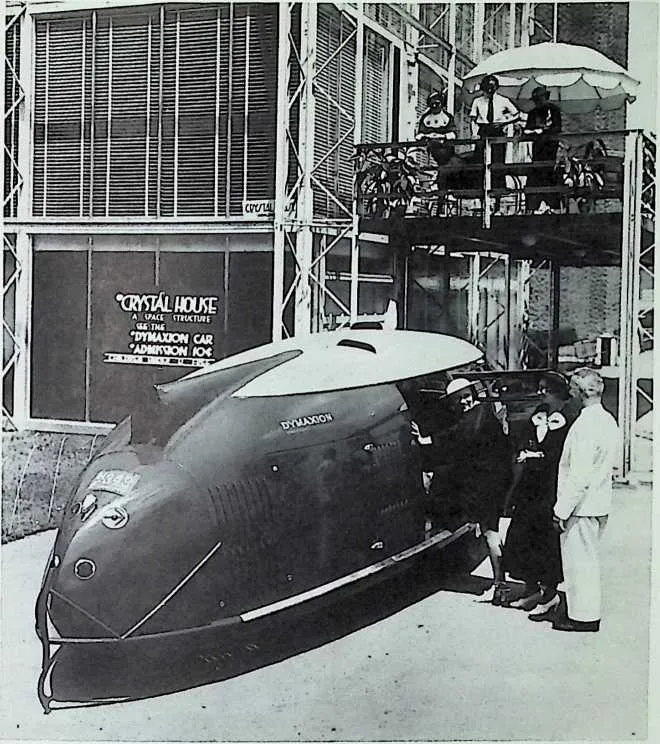
67 Dymaxion Car No. 3, completed in 1934
68 American car manufacturers had additional reasons for ignoring the Dymaxion. That year, Chrysler introduced its Air Flow model, supposedly a streamlined design. Next to Bucky’s model, the Air Flow looked like a bad joke. With millions of dollars tied up in the new model, Chrysler took steps to avoid looking foolish. The company pressed officials of the Auto Show to exclude Bucky from his reserved space in the show. Bucky never backed away from a challenge of any kind. Driving his Dymaxion around the block, he parked it at the curb directly in front of the Grand Central Palace. There, it attracted more crowds and attention than anything inside the building.
69 Meeting with Fuller, Walter Chrysler, president of the company, admitted that Bucky had ‘‘designed the car that ought to be built.’’
70 But its revolutionary design would require the automobile industry to scrap almost every tool and die it had. Millions of dollars would have to be spent changing the equipment and assembly lines. In addition, both car dealers and manufacturers depend heavily on the sale of used cars for income. Such a revolutionary model as the Dymaxion would make old cars obsolete and depress all other sales. No manufacturer would attempt its production, especially in a Depression when each one was barely able to keep his business going.
71 There are those who have said to Bucky, ‘‘I’m very sorry your car was not a success.’’
72 ‘‘Why, what do you mean?’’ asks Bucky.
73 ‘‘Well, they didn’t make it and you didn’t make any money.’’
74 Bucky shakes his head. He wasn’t trying to make any money. He was testing out a very special vehicle, the prototype of a ‘‘road-plane,’’ and by every standard it was, in fact, a success.
75 Some of the new ideas which Bucky used in his Dymaxion have become standard equipment in today’s cars. Perhaps, as parking space becomes increasingly scarce, as gasoline prices soar, the world will take another look at the Dymaxion’s design.