10 10
2In the first sixteen days after the attack on Pearl Harbor, the railroads moved 600,000 troops across the country. Change and movement were in the air for everyone. Men and women went into the armed forces to fight, into defense plants to build weapons of war.
3 Bucky Fuller, too, put aside his peacetime job to take one that helped the war effort. Moving to Washington, D.C., he became the director of the mechanical engineering section of the Board of Economic Warfare. Anne remained in New York until Allegra finished her school year at Dalton.
4 Now Bucky Fuller made another one of his surprising decisions. In a time and a town where overworked, anxious people turned to cocktail parties to relieve pressures, fun-loving Bucky stopped drinking completely. He also stopped smoking, and has done neither since.
5 ‘‘The war was something serious,’’ explains Bucky.
6 He had found too that if he was drinking, people tended to write off his talk about the design revolution as drunken gibberish. Despite his decision, Bucky still was greeted at planning meetings with such remarks as: ‘‘We don’t want any of that house- by-air nonsense.’’ And everyone at the meeting would laugh.
7 An old proverb says: He who laughs last laughs best. Eleven years later, this ‘‘house-by-air nonsense’’ made front page news in the New York Times. The Marine Corps demonstrated delivery by air of a Fuller-designed shelter. Hailing it as the beginning of a new era in shelter, the Times editorial praised the domed haven that would keep a platoon of men ‘‘from freezing their noses and toes, keep them dry and human….’’
8 Those early days of the war were anxious ones, filled with news of defeats and deaths. New words entered every American’s vocabulary: radar, bazooka guns, Molotov cocktail. Zippers disappeared; the metal went into weapons. Silk stockings disappeared; the material went into parachutes. People worked at two jobs or long hours of overtime, tumbling exhausted into bed in the early hours of the morning. For energetic Bucky, such a fast pace of doubled-up work was simply normal.
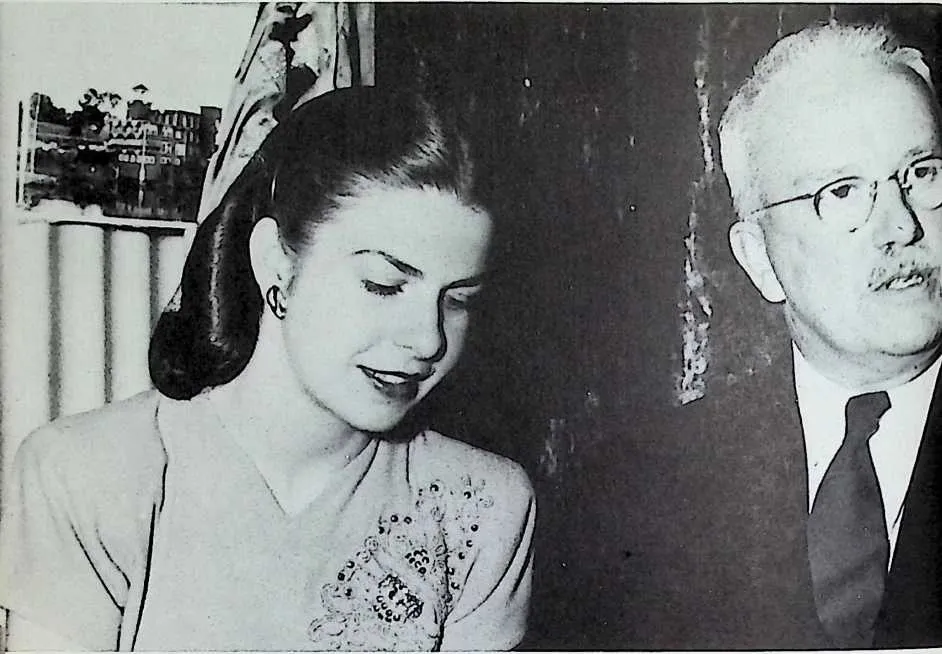
1011Allegra and Bucky in Washington, D.C., 1944
12 His home life, too, became normal when Anne and Allegra joined him in Washington. Allegra may have missed seeing Aunt Rosy’s familiar face in the Dalton School office, for she was enrolled now in the Madeira School. At fifteen, Allegra seemed to be a blend of both sides of the family. Short and sturdy like Bucky, she carried herself very straight and moved gracefully. She had something of Anne’s personality, too. Sensitive to the feelings of others, she was a tactful girl who did not like to gossip. Anne and Bucky could be proud of their bright, graceful daughter.
13 They had something more to celebrate in 1942. Years ago, Bucky’s mother had warned Monroe Hewlett that Bucky would make an ‘‘irresponsible’’ son-in-law. Yet a quarter of a century
14 later, Bucky and Anne were still together, marking and enjoying their silver wedding anniversary.
15 Through all those years, Bucky had continued to search for the single system that Nature used to build her structures. In his Navy days, he had been much impressed by vectors, those lines that mapped forces or energies. A vector had definite length. It didn’t go on absurdly forever to the nowhere of infinity. As he investigated the mathematical behavior of these energy events, Fuller felt that he was on the right track. In those days, it was just a hunch. He needed still to work out the supporting network of arithmetic and geometry.
16 For more than twenty years Bucky had studied, learned, and explored. Many of the facts that he rediscovered in his experiments had been long known in mathematics. But the questions that Bucky asked after making his discoveries led him into new directions. He had discussed his work with Homer Le Sourd, formerly at Milton Academy and then a teacher of mathematics at Harvard. Much to the two men’s surprise, they found that Bucky had traveled far afield from the known and usual concepts in mathematics.
17 ‘‘Should I go on with it?’’ a questioning Bucky said to Le Sourd.
18 Le Sourd hesitated. He could not answer one way or the other. There was nothing in Bucky’s work that wasn’t logical or that was contradicted by the work of others. Certainly, his was ‘‘elegant’’ work. But Le Sourd could not then see where these explorations had significance or what their final meaning might be.
19 As usual, Bucky settled that question by asking himself still another question.
20 ‘‘Could Nature have developed this entrancing cul-de-sac [or blind alley] just for me?" Bucky asked himself. ‘‘No,’’ he decided. ‘‘I can’t be that important!’’
21 So, late at night and into the early morning hours, Bucky scribbled and experimented with an unshakable optimism. Bucky
22 at work was an energy happening in himself. His short, thinning, white hair bristled, his dark eyebrows climbed high, his hand with the pencil flew over the paper. When Bucky put down his pencil, he turned often to a huge pile of ping-pong balls in a corner of the room.
23 What did ping-pong balls have to do with mapping energy and Nature’s geometry?
24 They were Bucky’s building blocks as he attempted to build a model of the energy lines in Nature.
25 Starting with one ball as a center, Bucky packed a layer of as many others as he could possibly fit around this one (figure i). Carefully, he built up more layers (figure 2). He saw that the outline of all these ping-pong balls formed a polyhedron (figure 3). His fourteen-sided figure had faces of six equal squares and eight equal triangles. Each triangle touched four squares, each square touched four triangles. All edges were equal in length. No matter how many layers he added he always got this same many- sided figure.
26 Now he settled down to mapping the vectors of his polyhedron: those lines of force which had a direction and a length that could be measured. Remembering the way a part of a hoop works to hold a barrel stave in place, Bucky imagined a similar band sweeping around the outside of his figure. The force vector along each edge equaled the force vector from the center of the polyhedron to the corners of each square or triangle. That is to say, the distance from the center of the polyhedron to the corner of each square or triangle was the same as the length of each side of those shapes. All the lines of force equalized one another. He called this beautifully balanced figure a Vector Equilibrium (figure 4).
27 What would happen if he took out the center ball?
28 The balls shifted and formed now an icosahedron or twentysided figure. By removing still more balls from the center, the figure shrank down to an octahedron (eight sides). A count showed that there were six balls making up this octahedron. Finally, he reduced his ping-pong balls to the simplest solid form
29 Figure i
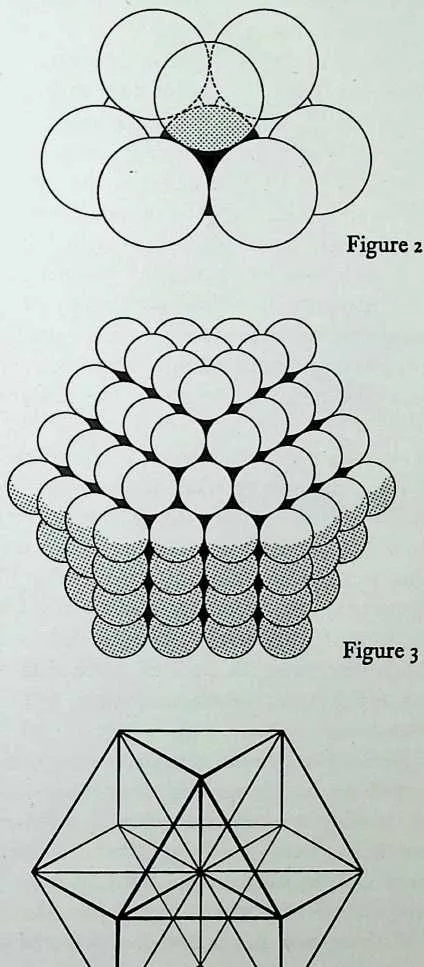
3132Figure 4
33 that could stand by itself. He got a tetrahedron, a pyramid with three sides plus its base. The tetrahedron consisted of four balls.
34 The South Sea islander piling his coconuts and the fruit dealer piling up his oranges for display had practiced this ‘‘closest packing of spheres,’’ but few scientists had investigated or paid attention to this nest of tetrahedrons.
35 Nature, Bucky knew, uses certain geometric shapes over and over to build her structures. These basic shapes are like the letters of her special alphabet. Combining them in different ways, she makes the words—or more elaborate forms—of the environment. Circles are found in the shapes of flowers, berries, planets. Triangles make the shape of insect wings, crystals, bats.
36 Now Bucky drew some conclusions from his experiments and formulas. Nature always chooses the most economical method to build her structures. In reducing the ping-pong balls, he had demonstrated that the stable or rigid tetrahedron represented the shortest, most economical energy network. This remarkable figure was the smallest possible ‘‘system’’ that could be identified.
37 Going one step further, he decided that all of Nature’s building and patterning must be based on this one. Any and all other shapes found in Nature are simply different forms of the tetrahedron. Put simply, the tetrahedron then was Nature’s first basic event. It might be described as something like a least common denominator, one from which she started her structuring.
38 Slowly, from this discovery, he began developing a system of mathematics describing the lines of force that occur in atoms, molecules, and crystals. It took many years and more discoveries to convince others.
39 What pleased Bucky most was that in mapping lines of force and energies, he had been able to make a visible, touchable model. A century ago, scientists dealing with energy felt that they were dealing with something invisible, something that could not be explained or demonstrated with models. They used algebraic formulas to express for themselves the relationships of energy. Without models, the rest of the world could no longer
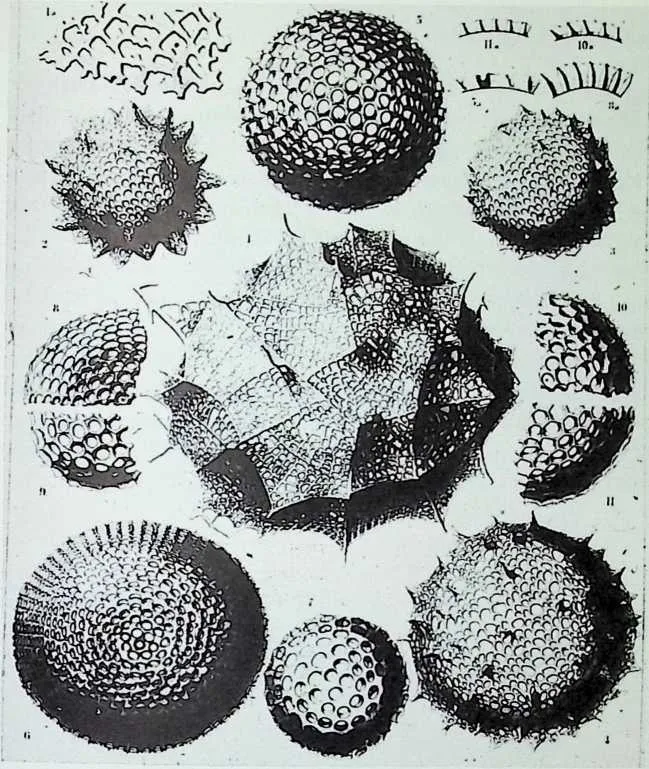
41 Drawings made almost a century ago from microscopic studies of marine protozoa show shapes based on the tetrahedron, the octahedron, or the icosahedron
42 see, touch, or understand scientists’ work. (Using paper, rope, ping-pong balls, Bucky continually ‘‘models’’ his ideas to make them understood in public lectures.)
43 Fuller’s work suggests that this gap need never have existed. From the earliest Greek thinkers on, those who accepted the static geometry of lines and points had been using the wrong model, the cube. If you make a cube with little sticks and rubber joints, the cube always collapses. No wonder then that scientists could not make models of energy events.
44 Although his system of Energetic Geometry was by no means completed, Bucky found an immediate practical use for his triangles and arithmetic.
45 Years before, while flying in Astor’s plane, Bucky had sensed the need for a new kind of map. How can any flat map show an exact picture of a round world? he wondered. To show some areas accurately, others must be distorted. A commonly used map, the Mercator, is very accurate in the center, at the equator. But as you move away from the equator toward the North or South poles, lands and distances get stretched out of their true shape and size. Greenland appears six times bigger than it really is. At the North Pole, points that measure one mile apart show up as being thousands of miles apart. In many maps, the tops of the continents don’t join together; Antarctica is totally missing.
4748Even on a world globe, you cannot see the whole at one time. You can read only a part of the globe and then must spin it around to see the rest of the world. And, of course, airplane pilots cannot carry a globe very conveniently with them. Bucky, who always liked to look at ‘‘wholes,’’ could not accept such incomplete, distorted tools.
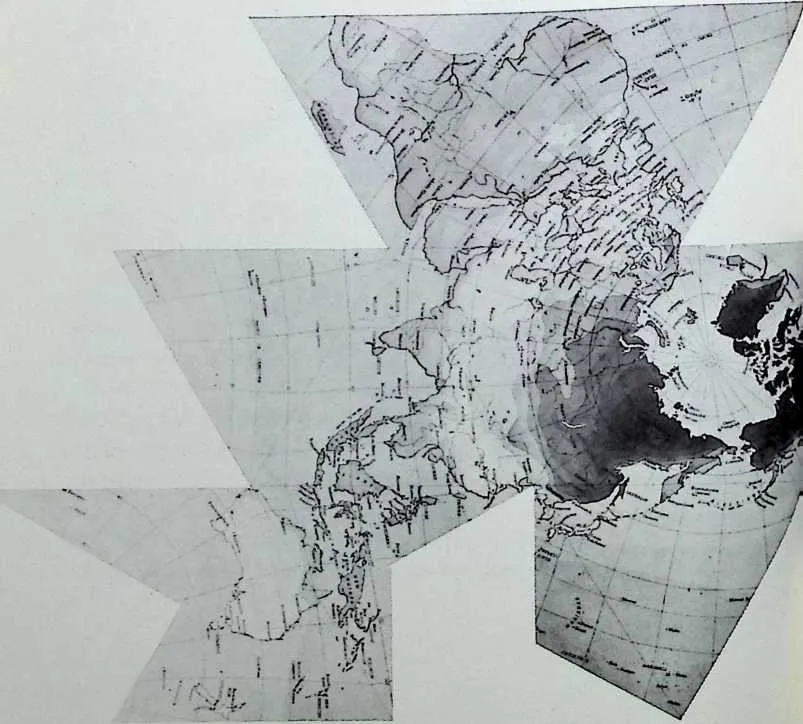
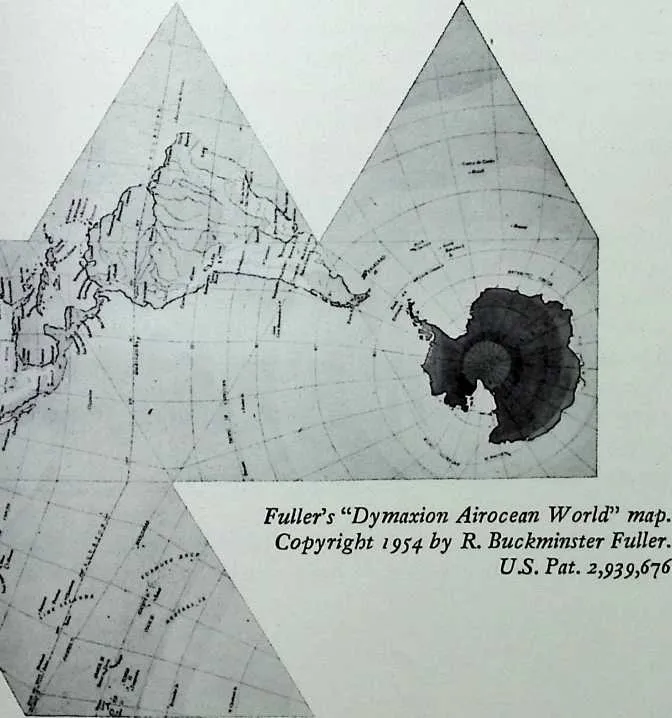
49Now, he used neat, stark, and very accurate mathematics to carve up the globe into perfect triangles. He transferred these triangle systems to the equal triangles of his Vector Equilibrium, or polyhedron. Then, just like taking the skin off an animal, Bucky unpeeled the skin of this solid polyhedron to produce a single, continuous surface. To flatten out the skin, he had to make cuts or ‘‘sinuses’’ around the outside edges. He called this flattened-out globe skin the Dymaxion Map.
51 What had he achieved?
52 He had taken all the information off the world globe and made it accurately available in a flat map. Europe and Asia were no longer split in two. Since all the cuts or sinuses occurred in the oceans, the continents for the first time were shown linked together without breaks in their outlines.
53 In Bucky’s map, the chain of continents appears as a single island in a single ocean, a fact well known, perhaps, but not easily seen before. No one area of distance is more distorted than another.
54 There is no ‘‘right side up’’ in Bucky’s map. The perfect triangles can be cut out and assembled in many different ways. In one assembly, you see the world as it looks from the North Pole. Putting them together in still another way, you see the world as it looks from the tip of South America. All kinds of geographic facts suddenly show on Bucky’s map with a new and dramatic sharpness.
55 Most people think that the world always gets colder as you go north. Using the spectrum of color to chart the coldest and hottest spots, the Dymaxion Map points out a contrary fact. Europe gets colder as you head east. (Napoleon could have profited from Bucky’s map when he invaded Russia in 1812. His plans did not take into account the relentless cold which bogged down his army and finally defeated him.)
56 Encyclopedias had said no flat map projection could keep the proportion true, while the U.S. Patent Office declared that all the possible mathematics of projections or map-making had been exhausted in 1900. Some mathematicians pooh-poohed Fuller’s method and figures, calling them ‘‘pure invention.’’
57 Bucky turned these criticisms to his advantage. If, indeed, these were pure invention, then he argued that his invention deserved a patent. Finally, the Patent Office agreed with him and granted Bucky a patent, the first ever given for a method of projection.
58 In early March of 1943, two exciting and happy events took place. One was the wedding of Rosy, Bucky’s sister, to a naval officer, Alphonse Kenison, who shared her interests and her love of boats. The other was the Dymaxion Map’s public appearance in Life magazine.
59 More people bought that issue of Life than any other in its history. Professors from Harvard and Princeton wrote, praising Life for making the map available. Thousands of Americans, following directions, used a glue pot, scissors, and patience to cut out and ‘‘marry the segments of Buckminster Fuller’s world’’ into a solid polyhedron. One very funny letter writer gave ‘‘Orchids to Life and Mr. Fuller …for keeping Americans at home’’ that weekend. By staying home to work on the map, he pointed out, Americans had saved thousands of gallons of precious gasoline.
60 Gasoline, sugar, meat—all lands of goods were rationed now. Every family could buy only a limited amount each week. America was helping to feed, clothe, and arm almost all the free world as well as its own citizens. By the end of 1942, the factories had turned out 48,000 military planes, 56,000 combat vehicles, and 670,000 machine guns.
61 Wichita, Kansas, had become a center for producing bombers, and the population there doubled in one week from 100,000 to 200,000. Workers in the Wichita plants led a miserable crowded life. Up to three people shared a single room and used the beds in eight-hour shifts around the clock. Wichita workers had still another worry to trouble them: Would there be jobs for them in the airplane industry after the war ended?
62 Few could see the need for any great numbers of planes in the postwar world. Many quit to look for jobs where there might be a more secure future. In fact, more people were quitting each week than were hired.
63 What would persuade workers to stay on the job? How could this alarming trend which threatened production be reversed? Someone in Washington remembered Buckminster Fuller’s talk about mass production of houses. Perhaps workers might stay if they thought the aircraft industry could convert later to producing houses.
64 I IO
65 Labor leaders visited Bucky to explore with him this idea. Bucky was confident that it could be done. There was really no great difference between malting parts for his Dymaxion House and parts for B-29 bombers. The labor leaders asked Bucky to fly to Kansas where the president of Beech Aircraft made a deal with him: The company would lend him space, engineers, and workers to develop his plans.
66 Bucky promptly resigned from his government job and moved to Kansas. There the industry was buzzing with news of Fuller’s house project, and he was invited to speak with workers at all fourteen companies in the Wichita area.
67 Suddenly the worried government officials studying those alarming charts spotted an unbelievable change. In a few short weeks after Bucky’s talks, the trend of workers quitting had reversed itself completely. The industry was both keeping its employees on the job and gaining new ones steadily. There was no question about it. The credit for this upward swing belonged to R. Buckminster Fuller.
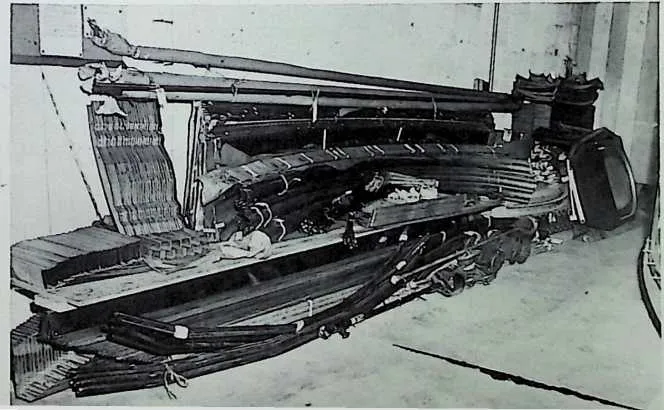
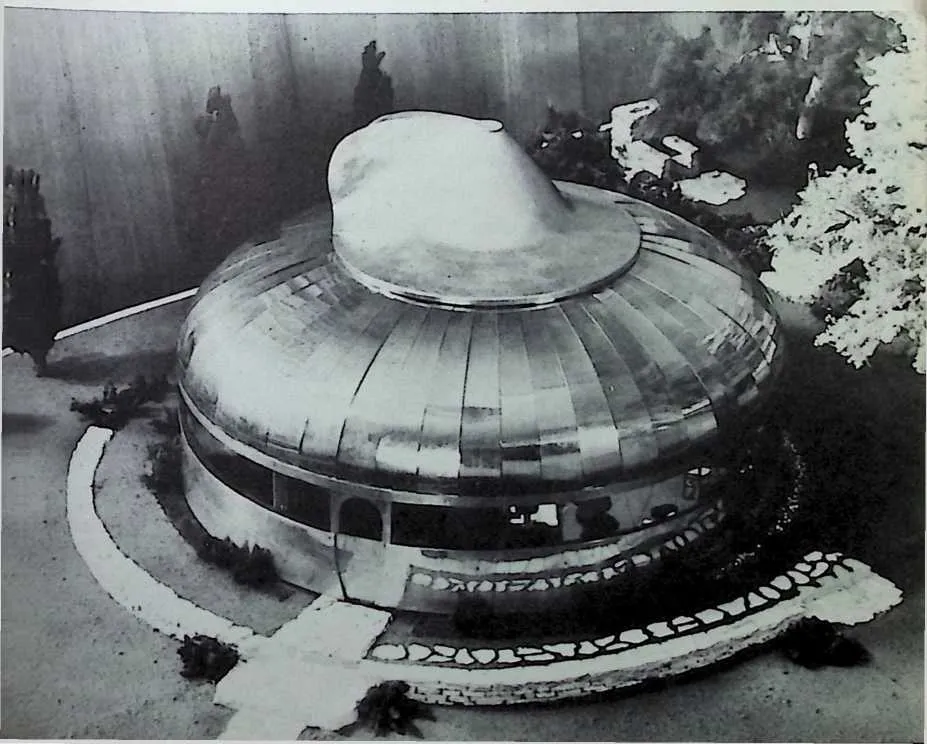
68 Drawing up new plans for what became the Wichita House, Bucky blended in parts of his earlier Dymaxions, the 4D House, and the Deployment Unit. This house, too, hung from a mast and was supported by cables which anchored it to the ground. In outline, the circular house with its cone-shaped roof looked somewhat like a turnip. The house weighed three tons, just what Bucky had estimated in 1927. (Most houses that size weighed one hundred and fifty tons.) Yet no one piece by itself weighed more than ten pounds. A man could lift or hold a piece in one hand while his other hand was free to fasten or bolt the piece in place. All the parts could be packed into a crate on a conveyer belt, the lid nailed down, and the whole house shipped anywhere in the United States at a shipping cost of less than $100.
69 With an order from the Air Force in his pocket, Bucky started production on two prototypes. He designed new dies to stamp out the gleaming aluminum sheets that would become the walls of the house. Now, side by side, the assembly lines were turning out airplane parts and Wichita House parts.
70 The war ended in August of 1945. Less than two months later, the completed Wichita House was opened for viewing. People hungry for new housing came in droves to see it. Outside, the aluminum walls seemed to match the sky; the curving plexiglass windows caught and reflected the sun. On top of the roof, a tall ventilator on ball bearings provided both air conditioning and safety. When Kansas tornadoes blew, the ventilator lifted like the safety valve on a boiler to equalize air pressures and keep the house from being blown apart.
71 Inside, the domed ceiling soared to sixteen feet, creating a sense of space and luxury. Practical as always, Bucky had simplified the housekeeping chores. Motor-driven revolving shelves put everything within quick, easy reach of the housekeeper. Women estimated that they could clean the whole house in half an hour.
7273The Dymaxion Dwelling Machine (Wichita House)
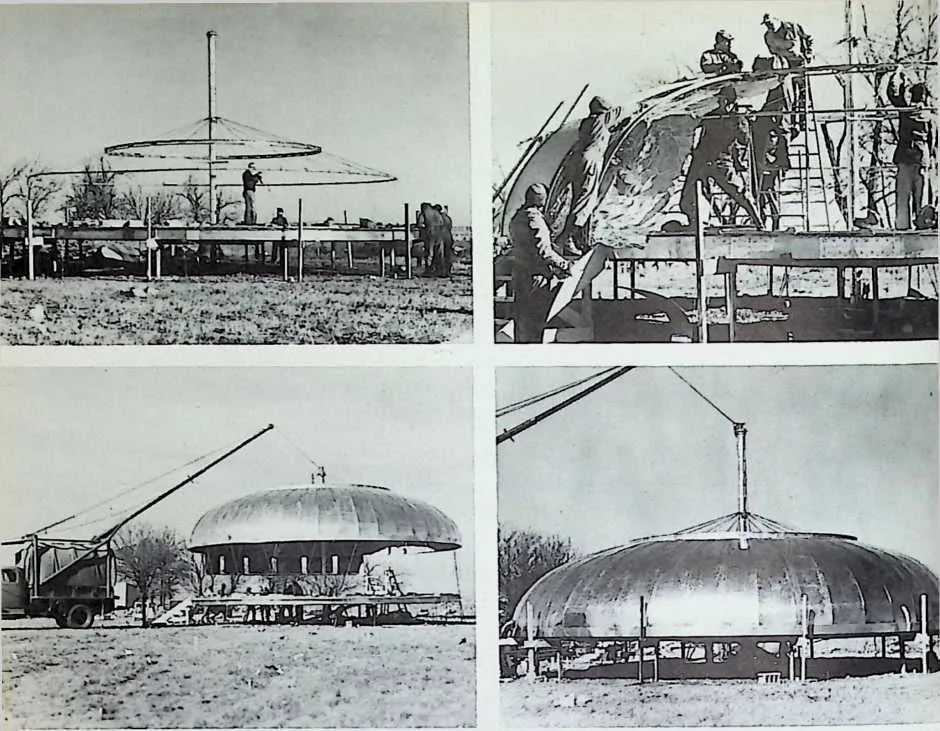
7677Steps in the assembly of the Wichita House
78 Beech Aircraft, figuring costs and allowing for profit, settled on a price of $6,500 for the house.
79 ‘‘I’ll buy it,’’ was the immediate enthusiastic response of the public. Over thirty-seven thousand letters (many with checks) came pouring in to prove it.
80 All signs pointed to a smash success. The demand for housing was great. People had money from wartime jobs and couldn’t wait to spend it. Here was a product that promised to make millions of dollars for its backers. Because Beech Aircraft had chosen to stay in the airplane business, a new company was formed. Ten million dollars had to be raised to start this exciting new industry. Shares of stock were sold and resold.
81 In all this excitement, enthusiasm, and cheerful expectation of riches, one person smiled less and less often. Bucky Fuller was shaking his head.
82 ‘‘It’s premature,’’ he declared. Too soon, too early for this new industry to get off the ground. Making a single house for an exhibit did not mean that the conditions or tools were ready for making thousands of houses.
83 To deliver and assemble houses on the sites, a very special kind of truck was needed, one with a great boom attached to it. There were no such trucks. Nor was there any network of dealers to sell and distribute the houses. Even if the houses could be delivered, the building industry could not agree on who should install them. Already the unions were squabbling among themselves as to who should hook up which part.
84 Bucky and his backers could not agree. The backers wanted to gamble that the very real problems could be solved. Bucky’s conscience would not let him continue. He could not bring himself to sell people something that could not be delivered.
85 Who was right, Bucky or the backers? Could the problems have been overcome?
86 No one will ever know. For R. Buckminster Fuller reluctantly but firmly shut down the whole effort. Fuller Houses, Inc., died as quickly as it had been born. Furious stockholders denounced Bucky as a bungler. Bucky Fuller had turned his back on a fortune and the world turned its back on him. The leading business magazine of the time announced that Buckminster Fuller was all washed up.
87 Total parts for a Wichita House; no single part weighs more than ten pounds