10 Proportion and Symbolism in Polyhedra
2Rene Motro
10.1 INTRODUCTION
3The task of understanding the ‘‘architecture’’ of polyhedra can be made easier by the study of proportion and symbolism in polyhedra, which gives access to some fundamental meanings. Since ancient times, polyhedra and their associated symbolism were a matter of thinking and contemplation: Readers can refer to the major works of Plato1 and Fra Luca Pacioli.2 Papers concerning the symbolic approach have been recendy published by Critchlow,3,4 Meu-rant,5–7 and Lawlor8 among others. Concerning proportion and specifically the golden one, a major contribution was made by Ghyka.9 Coxeter and Hilbert are the authors of comprehensive studies that give the necessary mathematical basis.10,11 As far as the golden proportion is concerned in relation to architecture, Le Corbusier’s work The Modular plays a major role.12 Moreover, Lal-vani paid attention to hyperspaces based on polyhedra.13
4 In such a context, we only present here the main features of proportion and symbolism in polyhedra, and focus on the five so-called Platonic or regular polyhedra, which can be related to one another in geometric and symbolic terms.
5 Beyond the Cube: The Architecture of Space Frames and Polyhedra, edited by J. Francois Gabriel ISBN 0–471–12261–0 © 1997 John Wiley & Sons, Inc.
6 □ 281
7 PROPORTION AND POLYHEDRA
8 It may be necessary to recall some elementary definitions regarding polyhedra before we proceed. Most of these developments are included in the previously cited references with more details, but they are given in this chapter in order to allow an easier reading for people who are not familiar with this topic.
9 A polyhedron is a closed surface composed of plane polygons assembled by their edges in such a way that each edge is common to two of them. It is convex if it is entirely positioned on one side of the planes that form the faces. Only the first three regular polygons, the equilateral triangle, the square, and the pentagon, can be assembled to make a regular polyhedron, which is characterized by the fact that all of its faces, edges, and apices are identical. While the geometrical construction of the first two polygons can be achieved simply with a ruler and a compass, knowledge of the golden proportion is necessary for the pentagon. This proportion also plays a major role in the geometrical construction of regular polyhedra and their relative inscription. We introduce it now in relation to the pentagon.
10 The Golden Proportion and the Pentagon
11 The Golden Proportion
12 Mathematically speaking, a proportion is the equality of two ratios and can be understood as a comparison and, furthermore, as an analogy. It is not surprising to learn that Jamblique used the Greek word ‘‘avaXo'yia’’ (analogy) for the golden proportion that establishes a specific relation between three numbers or, if extended to a symbolic approach, between three concepts. The value of the ratio in this specific case was called the ‘‘golden number’’ and was designated by the letter 4>; in reference to the architect Phidias who used it in his architectural works.
13 According to historical evidence, the ‘‘golden number’’ was related to the observations made by the Greek astronomer Meton: Every 19 years, the moon’s cycles were identical at the same dates (related to the motion of the earth around the sun). This discovery allowed for improvement of the calendar. This 19-year period, known as ‘‘Meton’s cycle,’’ was adopted in 453 B.C. and inscribed in golden letters on the columns of Minerva’s temple; the rank of any year of the cycle was its golden number. Later on, a golden number designation was conferred on the whole cycle. The relation between this historical explanation and the mathematical value of the golden number is not obvious. Perhaps it could be found in the proportions of Minerva’s temple.
14 Only three terms, a, b, and c, are necessary to establish a proportion. One of them, say b, will be considered as the ‘‘middle term’’ (|xe8i6Te in Greek) between the two others. In the same way, one idea can relate the two others, allowing a better understanding of their relationship.
15 From the algebraic point of view, three main kinds of proportions are known. In the case of the arithmetic proportion, the three terms are related by the equality
16 a-b= b-c
17 where b is the arithmetic mean between a and c:
18 a+ c
19 2
20 The harmonic proportion is governed by
2223a-b _a
24b-c~ c
25 A specific case of this proportion occurs when
26 c= a+ b
27 which leads to
2930b=a-/2
31 The golden proportion is a special case of the geometric proportion characterized by
3334c_ b
35b~ a
36 or
37 b = yj a-c
38 where
4041c= a + b
42 If we write
43 the governing equation becomes
44 <|>2 + 4> -1 = 0
45 This equation has two roots
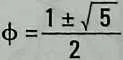
47 The approximate absolute root values are 1.618 and 0.618 and they are both known as ‘‘golden numbers.’’ Many mathematical developments have been made based on the golden number and specifically in terms of the Fibonacci series. However, if we are interested in the symbolic approach, then it can be noted that, c being the result of the combination of a and b, ‘‘b is to c as a is to b.’’ Establishing in such a way a continuous relationship between the whole and its parts, the division in mean and extreme ratio for a segment is such that the ratio of the smaller segment to the larger is the same as that of the latter to the whole. It is of great importance when c is considered as the ‘‘principle,’’ the ‘‘primal unity,’’ the ‘‘one’’; and it is interesting to notice, as did Ghyka, that this irrational number can be reached with calculations made only with the number 1. It can be demonstrated that
48 1
49 = lim ;
50 and

52 In symbolic studies, the number 1 has a great importance; it is the principle from which all things are derived, and expressions of <±> based on this value attest to its direct filiation with unity, known as the key to harmony in many fields, particularly in architecture.
53 Besides the algebraic approach, the geometrical approach can also be used and two geometrical constructions are traditionally described. We give these two constructions next.
54 For a given segment AB (Figure 10.1), the division must be done in such a way that ‘‘the smaller part be to the greater what this last one is to the initial segment,’’ achieving by geometrical means the specific case of geometric proportion.
55 On the straight line perpendicular to AB at B, we transfer a segment BC =
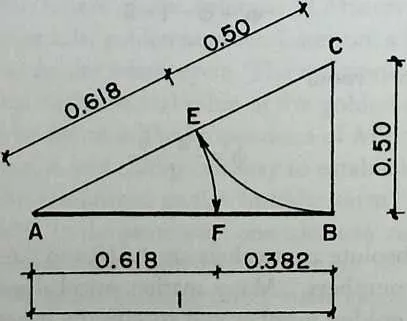
57 Figure 10.1 First geometrical construction of the golden proportion.
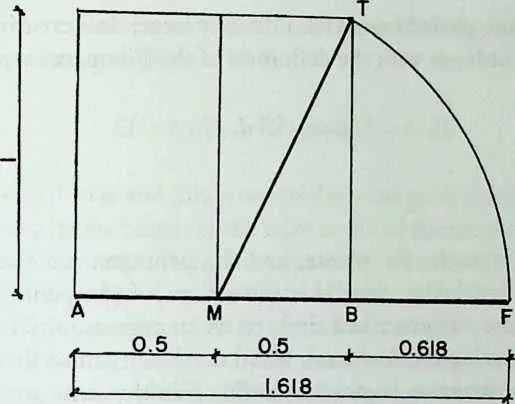
59 Figure 10.2 Geometrical construction of the golden proportion based on a square.
60 AB / 2. On CA we plot point E defined by CE = CB and on AB a point F such that AF = AE. This point produces the required division and it can be verified, by calculation of the different lengths, that
61 1.618
62 rD
63 The other geometrical construction commonly used is as follows: A square with unity-length edge AB is first divided into two equal rectangles (Figure 10.2). M being the middle point of AB, pointFis taken on the line AB and its position is defined by MF = MT (MT being the diagonal of either one of the two rectangles).
64 These two constructions are based on the division of the initial segment AB into two equal parts and the drawing of a square angle, which can be done with a compass. They can be grouped together in a single diagram (Figure 10.3). When it is repeated again and again, the first construction leads to the
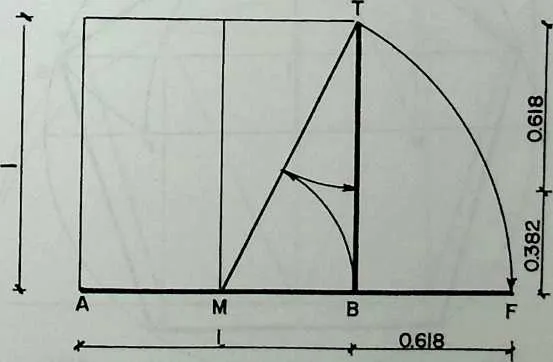
66 Figure 10.3 Geometrical construction of the golden proportion: synthesis.
67 infinitely small, the second one to the infinitely large, thus creating a sequence of lengths in accordance with the definition of the Fibonacci series for which
68 un=un_1+un_2
69 The Pentagon
70 The equilateral triangle, the square, and the pentagon are the constitutive faces of regular polyhedra. Several constructions of the pentagon are used, based either on the circumscribed circle or on an edge as initial data.
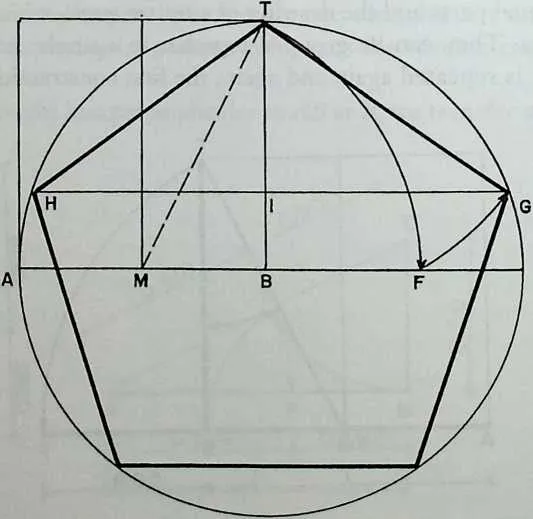
71 When considering the first kind, based on the circumscribed circle (Figure 10.4), the construction begins by plotting F in the same way as in Figure 10.3, AB being the circle radius. It can be verified that TF is the required edge of the pentagon. The resulting value is
72 7F = Vl + 0.6182 =1.176
73 which is in accordance with the algebraic value calculated with trigonometry, that is,
74 7F=2-sin (tt/5) = 1.176
75 It is interesting to notice that the pentagon apex angle is equal to 108°, and that sin (54°) = 0.809 = <j> / 2
7879Figure 10.4 Pentagon inscribed in a circle.
80 which allows the calculation of the ratio between the edge TG and the diagonal GH in the pentagon (Figure 10.4):
81 GH = 2-IG = 2-TG -sin (54°) = c|>-TG
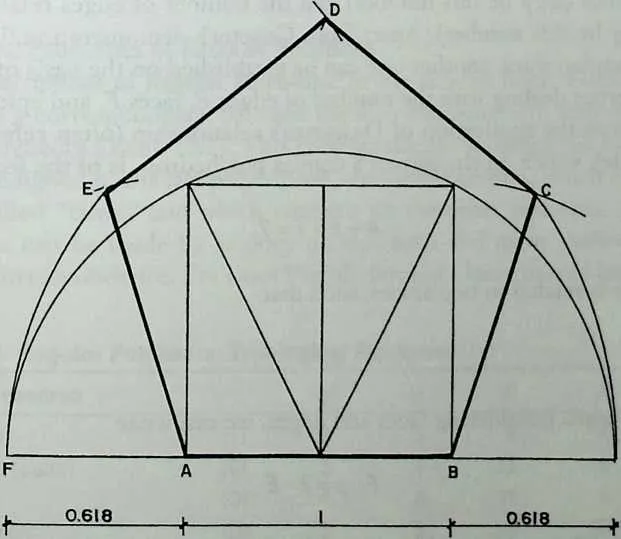
82 This ratio is equal to <f> and this is one of the pentagon’s significant properties. Two constructions based on the edge as initial datum are described next. The first construction using the edge as basis rests on this property (Figure 10.5). AB is the edge of unit value, and Fis defined as in Figure 10.2. Then AF = <b and a first pentagon apex E is found at the intersection of two circles: one of center A and radius AB = 1, the second of center B and radius BE = c{). Other apices are simply obtained from a similar construction.
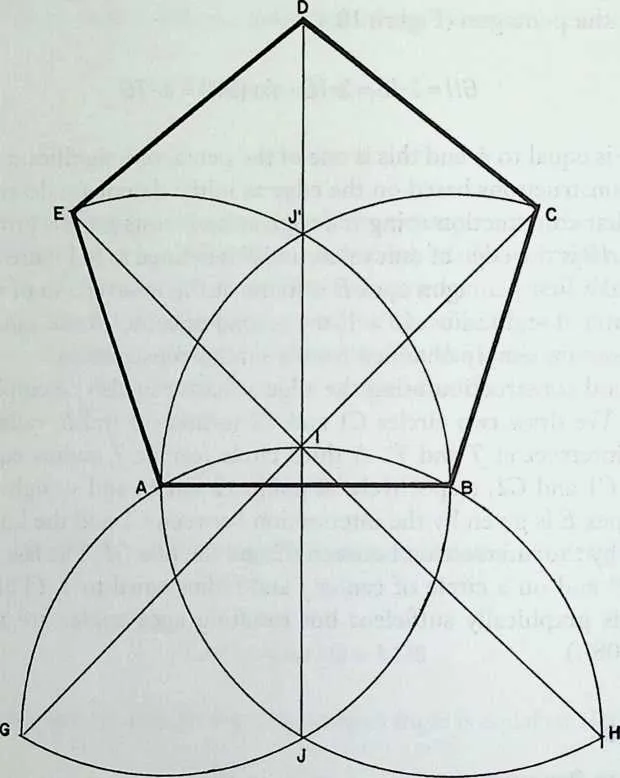
83 A second construction using the edge as basis can also be employed (Figure 10.6). We draw two circles Cl and C2 (centers A and B, radius equal to AB) that intersect at J and J'. A third circle (center J, radius equal to AB) intersects Cl and C2, respectively, at points G and H, and straight line at point I. Apex E is given by the intersection between Cl and the line HI. Apex C is given by the intersection between C2 and the line GL The last apex D Res on line JJ’ and on a circle of center f and radius equal to 1. (This last construction is graphically sufficient but resulting apex angles are not strictly equal to 108°.)
84 Polyhedra
85 Five Regular Polyhedra
86 There are five regular polyhedra and only five. For each of them, faces, edges, and apices are identical. The faces are regular polygons characterized by their
8990Figure 10.5 Pentagon of a given edge, exact construction.
9394Figure 10.6 Pentagon of a given edge, approximate construction.
95 edge number (let p be this number) and the number of edges related to one apex (let q be this number). Apart from Coxeter’s demonstration,10 based on the apex angle values, another one can be established on the basis of topological properties dealing with the number of edges E, faces F, and apices A. It is derived from the application of Descartes’s relationship (often referred to as Euler’s rule), which, in the case of a convex polyhedron, is of the form:
96 A-E+F=2
97 Each edge is related to two apices, such that
98 A-q=2-E
99 Similarly, when considering faces and edges, we can write
100 F-p = 2-E
101 Descartes’s relationship can be expressed only in terms of E, p, and q in the following form:
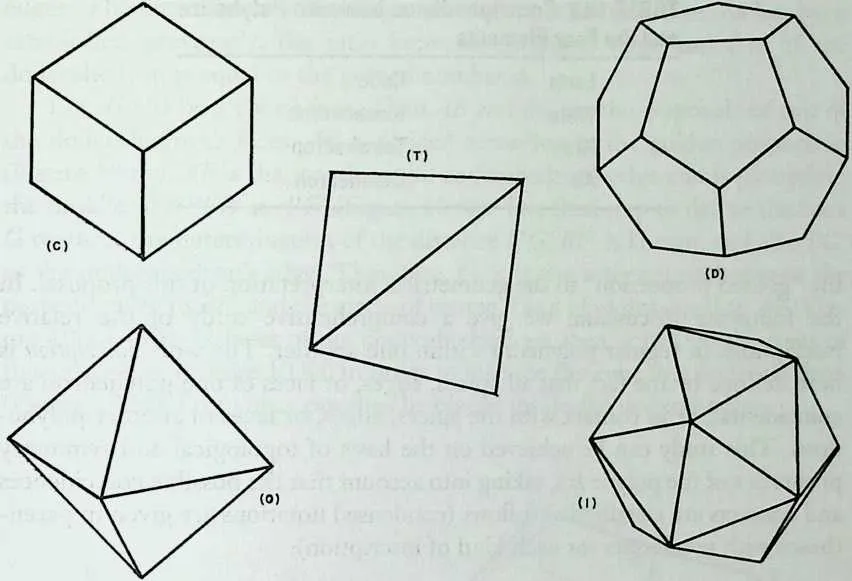
103 Figure 10.7 The five regular polyhedra: (C) cube, (0) octahedron, (T) tetrahedron, (I) icosahedron, (D) dodecahedron.
104 Taking into account that p and q, which are integers, must satisfy
105 p>3, q>3
106 because faces are at least equilateral triangles, there are only five admissible values for the couple {p, q}. Denomination and topological characteristics of these five regular polyhedra (Figure 10.7) are fisted in Table 10.1.
107 Geometrical Properties of Regular Polyhedra
108 Relative Inscriptions of Regular Polyhedra. In his famous book Timaeus, Plato establishes a correspondence between the four elements with four of the five regular polyhedra (Table 10.2). This correspondence is completed by the specific role assigned to the last polyhedron, the dodecahedron, which represents what is called ‘‘ether’’ and which contains all the other elements. Symbolic derivations can be made by analogy on this basis and many authors agreed with this correspondence. Fra Luca Pacioli devoted a large part of his book on
109 TABLE 10.1 Regular Polyhedra: Topological Properties
|
113Regular Polyhedron |
9
|
114P |
115E |
116A |
117F |
|
|
118Tetrahedron |
119(T) |
1203 |
1213 |
1226 |
1234 |
1244 |
|
125Hexahedron (cube) |
126(C) |
1273 |
1284 |
12912 |
1308 |
1316 |
|
132Octahedron |
133(0) |
1344 |
1353 |
13612 |
1376 |
1388 |
|
139Dodecahedron |
140(D) |
1413 |
1425 |
14330 |
14420 |
14512 |
|
146Icosahedron |
147(1) |
1485 |
1493 |
15030 |
15112 |
15220 |
159 TABLE 10.2 Correspondence between Polyhedra
|
and
the
Four
Elements
| |
|
163Earth |
164Cube |
|
165Water |
166Icosahedron |
|
167Fire |
168Tetrahedron |
|
169Air |
170Octahedron |
177 the ‘‘golden proportion’’ to the geometrical interpretation of this proposal. In the following discussion, we give a comprehensive study of the relative inscriptions of regular polyhedra within one another. The word inscription is here defined by the fact that all apices, edges, or faces of one polyhedron are coincidental, or in contact with the apices, edges, or faces of another polyhedron. This study can be achieved on the basis of topological and symmetry properties of the polyhedra, taking into account that the possible coincidences and contacts are classified as follows (condensed notations are given in parentheses with two letters for each kind of inscription):
- an apex with an apex (AA)
- an edge with an apex (EA)
- a face with either an apex (FA) or an edge (FE)
178 From the systematic study of mutual correspondence between one polyhedron and the other four, the inscriptions given in Table 10.3 can be estab-fished. Table 10.3 shows that only the dodecahedron can ‘‘receive’’ the other four polyhedra in accordance with the geometrical interpretation given by Plato. Simultaneously, the tetrahedron is inscribable in the other four. These geometrical properties will be subsequently exploited at the symbolic level. The relative inscriptions of the four polyhedra in the dodecahedron will first be described in detail. No calculations are given here in terms of angles and length ratios: They have been carried out on the basis of spherical and Cartesian coordinates in order to obtain the appropriate size required for display.14
179 Dodecahedron and Cube.The cube’s construction is very well known and is not presented here. Proceeding ‘‘Beyond the Cube,’’ we begin with a description of the drawing procedures for the dodecahedron.
180 Each of the dodecahedron’s 12 faces is related to corresponding cube’s
182183TABLE 10.3 Relative inscriptions of regular polyhedra
|
188Tetrahedron |
189Cube |
190Octahedron |
191Icosahedron |
192Dodecahedron |
|
|
193Tetrahedron |
194— |
195— |
196EA |
197— |
198— |
|
199Cube |
200EA or FE |
201— |
202FE |
203— |
204— |
|
205Octahedron |
206EA |
207EA |
208— |
209— |
210— |
|
211Icosahedron |
212FA |
213FA |
214— |
215— |
216FA |
|
217Dodecahedron |
218AA |
219AA or FE |
220EA |
221FE |
222— |
229 edges: The latter become the diagonals of the pentagonal faces. As has been established previously, the ratio between the cube’s edge and that of the dodecahedron is equal to the golden number <£>.
230 Let ABCD be a cube’s face. Then AB and BC are the diagonals of two of the dodecahedron’s faces. AB is divided according to the golden proportion (Figure 10.8/z). AF is the length of the dodecahedron’s edge and is plotted on the middle of ABCD as A'F' (Figure 10.Sb). The final step to define the apex G requires the determination of the distance F'G; BF' is known, and also BG, as the dodecahedron’s edge. Therefore, G is at the intersection between the perpendicular to BF' and the circle of center B and of radius equal to AF (Figure 10.8c). The 12 faces of the dodecahedron are then drawn on the basis of this procedure (Figure 10.8d) in order to inscribe the cube in a dodecahedron (Figure 10.8c). Five cubes can thus be placed inside the dodecahedron.
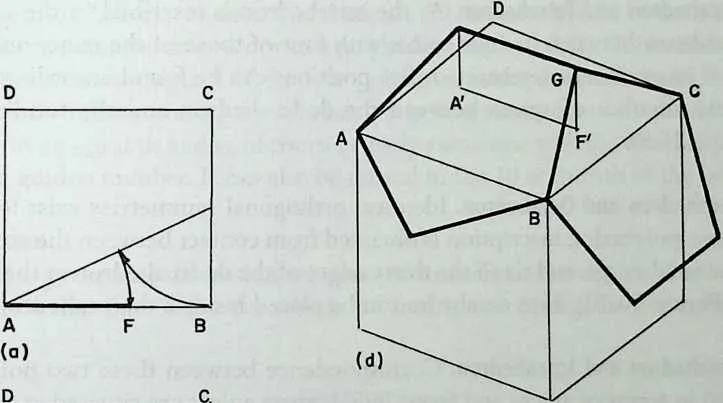
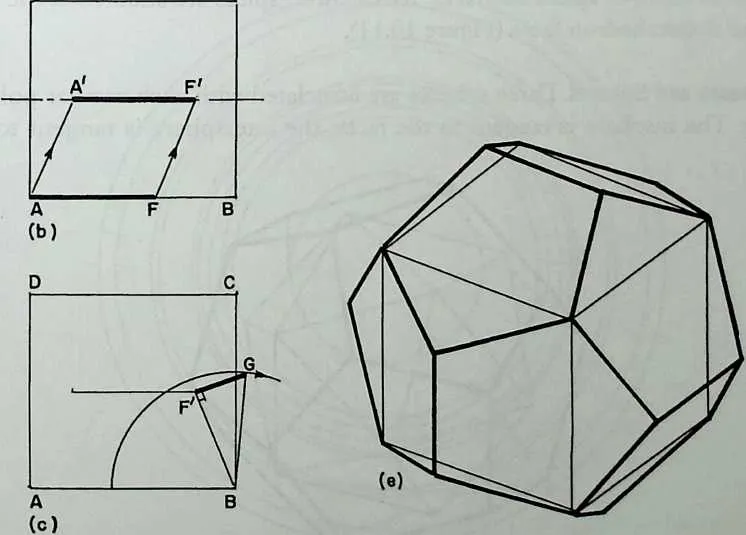
233 Figure 10.8 Dodecahedron and cube: (a) determination of dodecahedron's edge length; (b) plotting A' F', projection of dodecahedron's edge on ABCD; (c) determination of F'G; (d) two dodecahedrons' faces on the cube; (e) cube inside a dodecahedron.
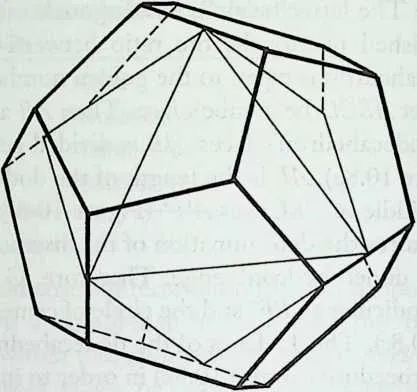
235 Figure 10.10 Dodecahedron and octahedron.
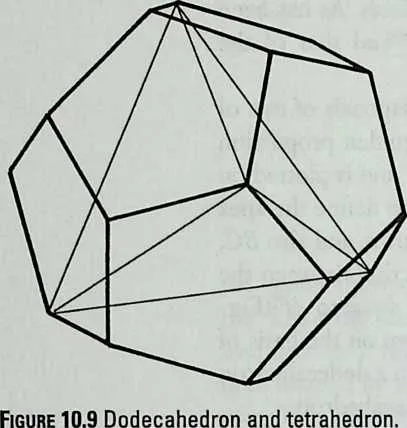
236 Dodecahedron and Tetrahedron. As the tetrahedron is inscribed in the cube by coincidence between its four apices with four of those of the cube, one position is immediately determined (five positions can be found according to the relative number of apices between the dodecahedron and the tetrahedron) (Figure 10.9).
237 Dodecahedron and Octahedron. Identical orthogonal symmetries exist for both of these polyhedra; inscription is obtained from contact between the six apices of the octahedron and six of the thirty edges of the dodecahedron at their middle (Figure 10.10). Five octahedra can be placed inside a dodecahedron.
238 Dodecahedron and Icosahedron. Correspondence between these two polyhedra is dual in terms of apices and faces: Icosahedron apices are situated at the centers of dodecahedron faces (Figure 10.11).
239 Polyhedra and Spheres.Three spheres are associated with each regular polyhedron: The insphere is tangent to the faces, the intersphere is tangent to the
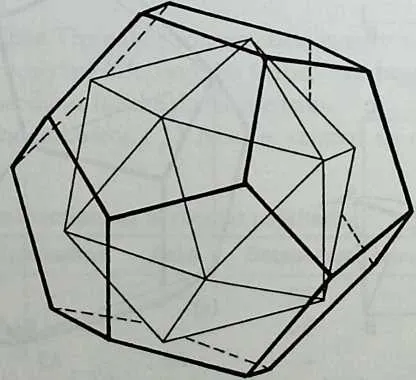
241 Figure 10.11 Dodecahedron and icosahedron.
243244TABLE 10.4 Radii of Associated Spheres
|
248Polyhedron |
249Circumsphere Radius |
250Intersphere Radius |
251Insphere Radius |
|
252Tetrahedron |
2531.732 |
2541 |
2550.577 |
|
256Octahedron |
2571.618 |
2581.144 |
2590.934 |
|
260Cube |
2611.732 |
2621.414 |
2631 |
|
264Icosahedron |
2651.376 |
2661.171 |
2671.094 |
|
268Dodecahedron |
2691.732 |
2701.618 |
2711.376 |
278 edges, and the circumsphere contains all the apices of a regular polyhedron. This a geometrical characteristic of regular polyhedra.
279 Corresponding radii have been calculated (Table 10.4) for the inscription situation of all polyhedra inside a dodecahedron. As a basis, we chose an edge cube equal to 2. It can be seen that there are 10 distinct spheres because some of them are common to two or three polyhedra (Figure 10.12). Table 10.4 corresponds to the inscription of the four polyhedra in the dodecahedron (Figure 10.13). In symbolic terms, the number 10 is important; it recalls the famous Pythagorean tetraktis and is, of course, closely associated with the number 5 and also the golden number. It can also be related to the 10 sephiroth of the cabala.
10.2 CONCLUSION
281From the preceding discussion we want to underline, among the important properties that have been described, the inscription of regular polyhedra in
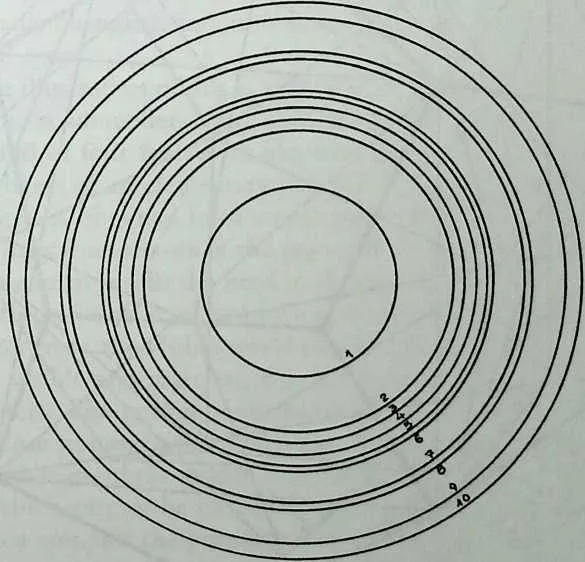
283 Figure 10.12 Ten spheres.
284 the fifth one, the dodecahedron (Figure 10.13), and the number of associated spheres.
10.3 SYMBOLISM AND POLYHEDRA
286Introduction
287 Because this book is concerned with architecture, in the following discussion we will give some landmarks that relate geometrical properties and symbolic meanings for polyhedra which are inherent in architecture.
288 The purpose of this section is necessarily humble because of the very subject under discussion: We only hope to indicate a pathway or two for research in the visible and the invisible. The guide to these pathways can be the symbolism of polyhedra, which is as present in polyhedral architecture as it was in Plato’s cosmogony in his Timaeus.
289 On Symbolism
290 The symbolic approach is rare enough in these days to justify a few reminders concerning this procedure. The essence of the ‘‘symbol’’ is that it cannot be
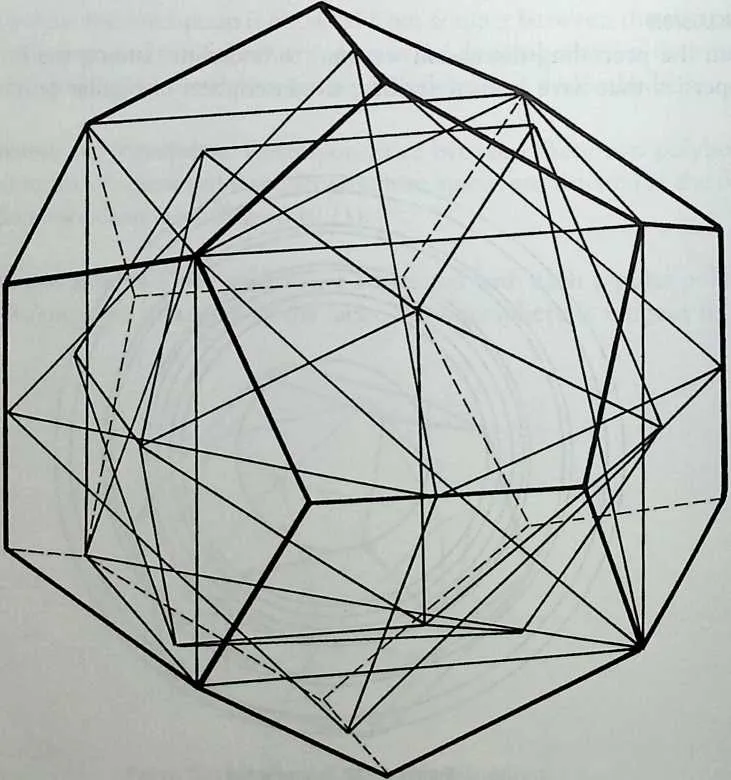
293294Figure 10.13 Inscription of the four elements inside a dodecahedron
295 defined without being mutilated, limited, deformed, or even eliminated. Indeed, the question is not to define ‘‘a’’ specific symbol but to determine what is found under the heading ‘‘symbol.’’ ‘‘The’’ symbol is a collective singular—simply indicating symbolism that must be investigated from a multiplicity of angles. It is usually accepted that the origin of the word is the Greek symbolon, which was a sign of recognition formed by two halves of a broken object; joining two members of the same brotherhood. The verb symballein also implies the idea of togetherness through the prefix ‘‘sym’’ but includes the idea of throwing or projection. A symbol is an image presenting an analogical representation of its object. It consists of three elements: the outward, that is, the visible, perceptible, concrete, and rational representation, the word; what is represented, that is to say, the invisible, the irrational, the idea represented by the symbol; and, finally, the relation between the outward and the idea. The symbol moves from the visible and rational to the hidden and irrational. The symbol requires both comprehension from analysis of each of its components and intuitive perception. However, although the symbol expresses an idea—or enables it to be expressed—it does not provide an explanation because the visual image given by the symbol is only the reflection of what is not known. It awakens, suggests, and provokes.
296 The symbol underlines the connections between the various parts of the cosmos. It reveals the harmony of the world and the bonds that join what is separated, or that which seems to be separated. It gives homogeneity of meaning to what is represented. It reveals by veiling and achieves while destroying. As a prism between body and spirit, the symbol returns light and image in a different manner depending on the illumination that it is given and depending on the direction from which it is regarded. In this, it is a living, perpetually changing, and moving image, which remains constant in its metaphysical span.
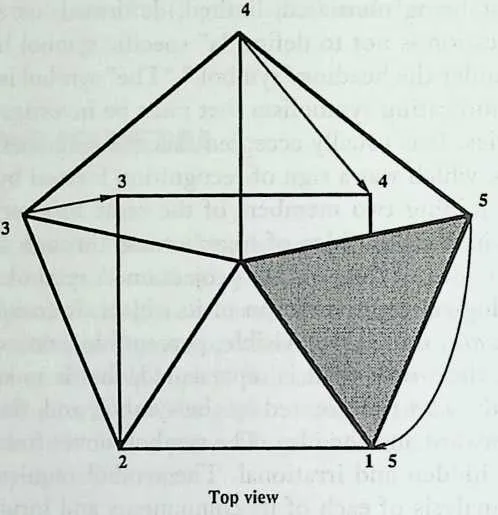
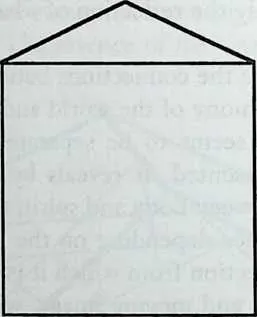
297 A simple illustration of this is what Vieux15 called ‘‘le Pavilion des Can-tonniers’’ (the roadmenders’ hut), consisting of a cube topped by a squarebased pyramid of four faces with identical slopes (Figure 10.14).14 We are here at the heart of an elementary polyhedral construction. The layout of the four slopes is obtained from a pentagon whose side is equal to that of the square; only four sectors of the pentagon are used. The symbol associated with this form recalls the need to divide the pentagon. This construction, consisting of a cube topped by a pyramid, symbolizes a call for spiritual elevation from the visible world (the cube corresponds to the quaternary of the visible and material, e.g., to Plato’s four elements: earth, air, fire, and water). The notion of ascension is suggested by the slopes of the pyramid, whose summit is the final point. The outline of this pyramid contains the symbolism of the golden number. It requires the construction of a pentagon, which cannot be obtained, as we previously remarked, without tracing with a compass the proportion of the golden number. As such, this structure contains the elements required to awaken consciousness and acts as a catalyst on the imagination. It acts as any symbol in leading from the concrete to the idea.
300 Elevation
301 Figure 10.14 Roadmenders' hut: geometrical construction.
302 Plato’s Cosmogony in Timaeus
303 The Four Elements
304 The symbolic role of polyhedra reaches its full dimensions in Plato’s cosmogony.1 Plato’s writings are not analyzed here—interested readers can profitably consult Critchlow’s work.4 In brief, three ideas should be stressed: harmony, duality, and ternary. The first idea is that of harmony in the Greek sense of the term, the idea being that any and all manifestations of the principle must preserve a harmonious relationship between the elements created and must be complete. This idea is discussed in the following quotation:
305 The Platonic Cosmos, then, in the words of Timaeus, was created by a ‘‘maker’’ who, wishing to make this world most nearly like that intelligent thing which is best and in every way complete, fashioned it as a single visible creature, containing within space itself all living things, whose nature is of the same order space. (Timaeus 30d)
306 Now that which comes to be must be bodily, and so visible and tangible; and nothing can be visible without fire, or tangible without something solid, and nothing is solid without earth. Hence the god, when he began to put together the body of the universe, set about making it of fire and earth. (Timaeus 31b)
307 These two elements cannot be satisfactorily united without a third; for there must be some bond between them drawing them together. And of all the bonds the best is that which makes itself and the terms it connects a unity in the fullest sense; and it is of the nature of a continued geometric proportion to effect this most perfectly. (Timaeus 31c)
308 …The ‘‘maker’’ set water and air between fire and earth, and made them so far as was possible, proportional to one another, so that as fire is to air, so is air to water, and as air is to water, so is water to earth, and thus he bound together the frame of a world visible and tangible. (Timaeus 32b)
309 The world is then a living being, whole and complete, of complete parts …and he turned its shape round and spherical, equidistant every way from center to extremity—a figure the most perfect and uniform of all; for he judged uniformity to be immeasurably better than its opposite. (Timaeus 33b)1
10.4 The Constitution of Polyhedra and Their Interrelations
311Recall that the regular polyhedra that symbolize the four tangible elements are: the tetrahedron for fire, the octahedron for air, the cube or hexahedron for earth, and the icosahedron for water. A fifth and last regular polyhedron, the dodecahedron, is taken to represent the ether—the quintessence of which the heavenly bodies are made and in which the four other elements are impregnated.
313314…To the tetrahedron they ascribed the fire, for that it is ascendeth upward according to the figure of the Pyramis. To the ayre, they ascribed the Octohedron for that through the subtle moisture which it hath, it extendeth it selfe every way to the one side, and to the other, accordyng as the figure doth. Unto the water, they assigned the Ikosahedron, for that it is continually flowing and moving, and as it were makyng angles on every side according to that figure. And to earth they attributed a Cube, as to a thing stable, firme and sure as the figure signifieth. Last of all a Dodecahedron, for that it is made of Pentagons, whose angles are more ample and large than the angles of the other bodies, and by that meanes draw more to roundnes, & to the forme and nature of a sphere, they assigned to sphere, namely, to heaven. Who so will read Plato in his Timeaus, shall read of these figures and of their mutual proportion, straunge matters, which here are not to be entreated of, this which is sayd, shall be sufficient for the knowledge of them and for the declaration of their definitions. …16
315 The geometrical inscriptions of the four elements in the dodecahedron, described in the previous section, are in total agreement with the symbolic approach described by Plato.
316 We know that there cannot be other polyhedra satisfying the definition of regularity. It is fundamental to note that these five polyhedra, together with the thirteen Archimedean polyhedra and all those subsequently studied by scholars, form part of a continuum, which makes it possible to return to the source by simple geometrical transformations of truncation, duality, similitude, and so forth. Numerous authors have discussed this question using different approaches but displaying a common desire to return to the principle. Noteworthy research includes that of Pacioli,2 with the collaboration of Leonardo da Vinci, and more recently the works of Critchlow,4 Lalvani,13 and Pearce.171 beg to be forgiven for only mentioning a few bibliographical landmarks, knowing that, as with symbols, one idea leads to another.
317 The symbolism of polyhedra cannot be dissociated from the symbolism of numbers. This relationship is illustrated, for example, by distinguishing three classes among the regular and semi-regular polyhedra. One class consists only of the tetrahedron and the truncated tetrahedron; the second comprises the cube, the octahedron, and their Archimedean derivatives; and the third consists of the icosahedron, the dodecahedron, and their Archimedean derivatives. This classification reveals a symbolic analogy. Through rotational symmetries, the first class can be linked with the number 3; the second with the number 4, the outwardness number, and the third with the number 5, representing the quintessence and the proportion between mean and extreme ratio characterized by the golden number. This series 3, 4, 5 is reminiscent of the Isiac triangle dear to the Egyptians, and at the same time shows which geometrical procedure can be used to move from one of these classes to another. It is known, for example, that obtaining the volumes of the icosahedron class requires the truncation of a polyhedron edge with a ratio of 4>.
10.5 CONCLUSION
319Many architects design their projects in accordance with the proportions of the human figure, which are close to the golden proportion. Ancient temples were built on the basis of man’s measurements; it was sufficient to use a 13-node rope to trace a double square and the Isiac triangle. Builders knew the golden proportion, which is present in numerous constructions. With his Modular Le Corbusier tried to put together the double square and the golden proportion and generated a human scale of measurements. Symbolism gave meaning to architecture by using suitable proportions, which are inherent in polyhedra. Today, proportion and symbolism in polyhedra are a way, among others, to give sense to architecture ‘‘beyond the cube.’’
10.6 NOTES
- 1.
- Platon, Sophiste-Politique-Philebe-Timee-Critias, Gamier Flammarion, Paris, 1969.
- 2.
- Fra Luca Pacioli di Borgo san Sepolcro, La Divine Proportion, reprinted by Librairie du Compagnonnage, Paris, 1988.
- 3.
- K. Critchlow, ‘‘The Platonic Tradition on the Nature of Proportion,’’ Lindisfarne Letter on Geometry and Architecture, Lindisfarne Association, 1980.
- 4.
- K. Critchlow, Order in Space, Thames and Hudson, London, 1971.
- 5.
- R. C. Meurant, ‘‘A New Order in Space-Platonic and Archimedian Polyhedra and Tilings,’’ International Journal of Space Structures, Vol. 6, No. 1, 1991.
- 6.
- R. C. Meurant, The Aesthetics of the Sacred, a Harmonic Geometry of Consciousness and Philosophy of Sacred Architecture, 3rd ed., Opoutere Press, Boulder and Auckland, 1989.
- 7.
- R. C. Meurant, ‘‘The Myth of Perfection of the Platonic Solids,’’ Proceedings of the Conference on Myth Architecture History Writing, University of Auckland, New Zealand, July 1991.
- 8.
- R. Lawlor, Sacred Geometry—Philosophy and Practice, Thames and Hudson Art and the Imagination Series, London, 1982.
- 9.
- Matila C. Ghyka, Le nombre dlor. Gallimard, 1959.
- 10.
- H. S. M. Coxeter, Regular Polytopes, Dover, New York, 1973.
- 11.
- D. Hilbert and Vossen S. Cohn, Geometry and the Imagination, Chelsea, New York, 1952.
- 12.
- Le Corbusier, Le Modular, Editions de 1’Architecture d’Aujourd’hui, 1965.
- 13.
- H. Lalvani, ‘‘Non-Periodic Space-Filling with Golden Polyhedra,’’ First International Conference on Lightweight Structures in Architecture, SLA 86, V. Sedlak, ed., Vol. l,pp. 202–211.
- 14.
- R. Motro, ‘‘Etude geometrique et symbolique des polyedres reguliers,’’ Note de recherche 95–1, LMGC Universite Montpellier II, July 1995.
- 15.
- M. Vieux, Les Secrets des Batissettrs, Collection les Enigmes de 1’Univers, Robert Laffont, ed., Paris, 1975.
- 16.
- S. K. Heninger, Touches of Sweet Harmony—Pythagorean Cosmology and Renaissance Poetics, The Huntington Library, San Marino, CA, 1974.
- 17.
- P. Pearce, Structure in Nature Is a Strategy for Design, MIT Press, Cambridge, MA, 1978.
- 18.
- R. Motro, ‘‘The Symbolism of Polyhedra in Space Structures,’’ International Journal of Space Structures, Vol. 6, No. 4, 1991.