
15 Quasicrystal Architecture: The Space of Experience
2Tony Robbin
15.1 INTRODUCTION
3Whatever else architecture is, it is also geometry. If the geometrical concepts of a designer are old-fashioned, then no matter how elegant a building is in its details, it cannot help but look a bit recycled. We live in an era of marvelous new geometries, and it is the purpose of this chapter to demonstrate to architects and engineers the value of considering these modem geometries as the basis of new architecture.
4 GEOMETRY AND ARCHITECTURAL SPACE
5 It is a human capability to see the fourth dimension; exotic geometries such as three-dimensional hyperbolic manifolds and quasicrystals can become natural, effortless models of experience. Indeed, they must become so because
6 Beyond the Cube: The Architecture of Space Frames and Polyhedra, edited by J. Francois Gabriel ISBN 0–471–12261–0 © 1997 John Wiley & Sons, Inc.
7 human experience at the turn of the 21st century is far too complex and omni-attentive to fit comfortably in an old-fashioned model of three-dimensional rectilinear space. We designers of spaces that people inhabit—artists, architects, and engineers—owe it to our audience to make spaces that enhance our capability to visualize the four-dimensional, hyperbolic, fractal, and quasicrystalline world that we are really living in.
8 Consider engineers first. Most engineers would reject such a directive; their duty is not to make mathematical spaces visible and comprehensible but primarily to be efficient and only secondarily to be artistic, a goal considered to have nothing to do with esoteric geometries. (It goes without saying that public safety is the foremost duty of engineers and architects.) However, do engineers really act as though efficiency is more important than aesthetics? As Ariel Hanaor has pointed out, space frames, tensegrity systems, and other popular engineering concepts are not necessarily the most efficient solutions in either labor or materials.1–3 Membrane combinations can easily cost more than $100 a square foot of installed coverage; some nodes of the tensegrity roof in Atlanta weigh two tons; and free-form shells require troublesome single-use formwork. Is it possible that engineers select options on the basis of aesthetics first and efficiency second? From my experience talking with many of the world’s great engineers at engineering conferences in Copenhagen, Surrey, and Atlanta, I am convinced that tastes drive engineering as surely as the science of new materials and new engineering systems drive architecture. Therefore, it is important for engineers to understand that a great source of new aesthetics, I believe it is the only true source, is the idea of space found in contemporary mathematics (including morphology studies) and physics. Designers should feel permitted to explore the aesthetics of mathematical space, how the subjective space of experience and the objective space of contemporary physics and mathematics mutually reinforce each other, and substitute this sophisticated understanding for the knee-jerk minimalist aesthetic still popular among engineers but abandoned by almost everyone else.
9 Architects and artists also resist such a directive. They fear that to explore the intellectual world of mathematics and physics is to submerge sensibility; or (they might say) that to submit to the rigors of geometry is to resign one’s creations to a boring repetitive simplicity that is totally out of character with the self-referential, ironic, and mock-heroic styles now in fashion. These assumptions are false. The new geometries are not repetitive, nor rectilinear, nor simplistically grasped by the mind. Instead, they promote a sensual involvement, an intriguing, intuitive relationship with space. Furthermore, the mock-heroic may be fun at first, but a building is an expensive way to tell a joke and most jokes do not bear revisiting. Architects love theory; they should perceive new geometries as the liberating theories they are, rather than the constraining rectilinear boxes they most certainly are not.
10 Two examples from history may demonstrate that space in art, space in architecture, and coeval space in mathematics are alike. Alberti’s St. Andrea in Mantua, built in 1470, was an astoundingly original building, capturing the imagination of patrons and architects for centuries, and becoming the model for such divergent buildings as St. Peter’s in Rome and Grand Central Station
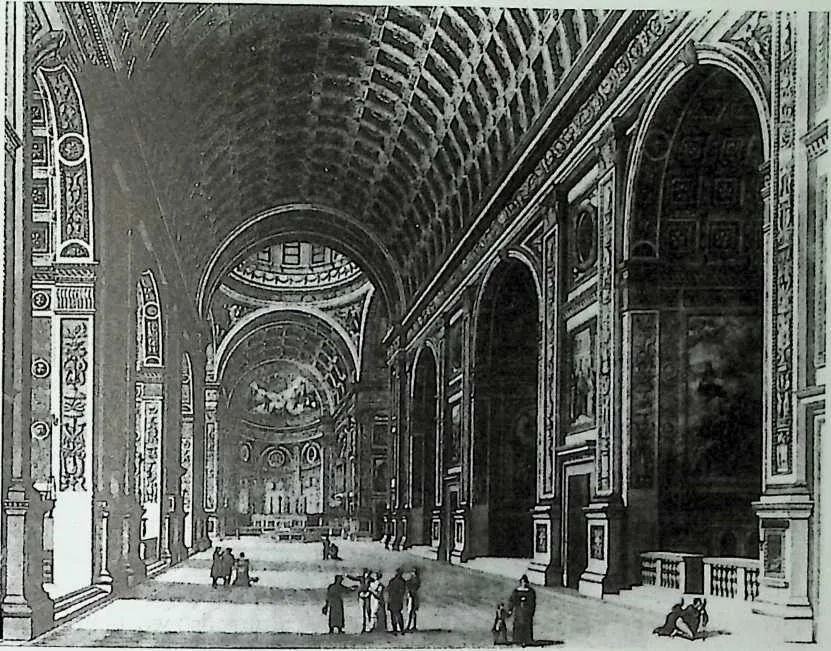
12 Figure 15.1 With St Andrea in Mantua, Alberti revolutionized architecture by using the conception of space created by the mathematics and science of his time.
13 in New York. The concept that so excited onlookers was that both mass and void could be sculpted: Both building and air had substance, both were plastic elements that could be manipulated, interlocked. This was very different from the planar and linear Gothic architecture where tracery planes prop each other up. In both Gothic and Renaissance architecture, the detailing of the walls and facade reinforce the concept of space; the flat patterns of the stained glass or colored marble of the Gothic contrast with the blocks and hollows of the Renaissance. Alberti formed his new building space when ideas of space, in general, were changing. Masaccio’s paintings put humans in space, in the same space as gods, and Leonardo (a few years later) first studied air as material capable of filtering light. Space was no longer the zero-density symbol and body of a god, but earth-bound stuff under human control, defined by the very new, human-oriented, instantaneously fixed projective geometry, also pioneered by Alberti.
14 The Eiffel 'lower (1889), too, was a work of mathematical space as much as a work of iron. Eiffel depended on new calculation techniques to sum over the forces of so many members in so many directions in three-dimensional space, but more than that, mathematics and physics presented Eiffel with a concept of space as a force field that he could use in a more conceptual way. Maxwell’s field equations of 1864, made part of popular culture in the famous 11th edition of the Encyclopedia Britannica (1875–1889), demonstrated how small local forces could aggregate to effect action at a distance, like metal filings on a sheet of paper over a magnet. Indeed, it was suggested that all the space of the world was filled with field: an active multidirectional ether capable of inducing powerful forces on test particles: ‘‘…that there is an ethereal medium filling space and permeating bodies, capable of being set in motion and of transmitting that motion….’’4 To build his tower to the sky, Eiffel had only to select and stack elements of this force-field space, confident that a solid core to the top of the tower would not be necessary.
15 In his paintings of the period, van Gogh abandoned the delicate atmospheric perspective of the French naturalists and even the more robust atmospherics of the impressionists to construct instead a space packed with texture, color, and brush strokes freed from their role of describing objects, free to act on their own and influence one another. His Night Cafe (1888) presents space as a pressure chamber with tilted-up floor and pressed-in walls, thick with radiation powerful enough to overwhelm the inhabitants. Thus the space-as-field that was created by science at the end of the 19th century became the space of both architecture and painting.
16 The ‘‘two cultures’’ hypothesis is incorrect: Even if art and science no longer study each other directly, reciprocal influences and the sharing of basic paradigms are inevitable. Practitioners often think they are in a private tradition: Mathematics comes out of mathematics; architects work from the example of other architects. However, mathematicians and architects are both in culture, liberated and constrained by the same cultural constructs; it never happens that Gothic architecture is developed in a culture also working on the physics of relativity.
17 THE FOURTH DIMENSION
18 To begin the study of space in our culture, we must first realize that the fourth dimension is not time; it is another dimension just like the other ones. On a pool table the third dimension is time. On a map the second dimension is north. We must not confuse the applications of geometry with the geometry itself. Think not of space-time, but of four mutually perpendicular fines intersecting at a point, the axes of a grid on which space and time dimensions could be plotted, or on which any other four scalar variables could be plotted. Points in the four-dimensional grid can be connected to make regular geometric figures, analogous to the Platonic solids: As the square begets the cube, the cube begets the hypercube; as the triangle begets the tetrahedron, the tetrahedron begets the four-simplex. For over a hundred years, mathematicians have studied these four-dimensional figures, the four-dimensional polytopes, and have been stimulated by efforts to visualize them.
19 Now the effort is far more manageable. Computers can show us the projections, the shadows, of the four-dimensional polytopes and show us how the projections deform when the polytopes are rotated in four-dimensional space. Henri Poincare repeatedly suggested that successive models of the projections of four-dimensional figures when seen in sequence could lead to a vision of the fourth dimension, a geometry no more or less true or sacrosanct than any other ‘‘convenient’’ geometry. Since the late 1960s, numerous researchers have written computer graphics programs that carry out Poincare’s suggestion, some in real-time motion and with binocular vision (including one such useful program written by the author). As a result, this once arcane branch of
20 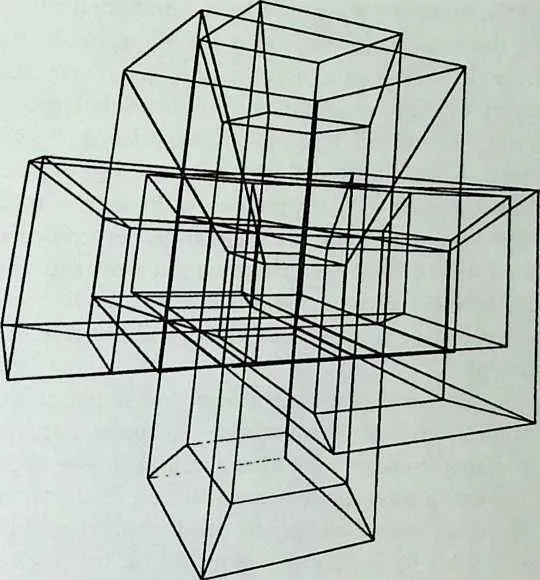 Figure 152 Eight hypercubes are stacked around a central hypercube and drawn in
perspective. All the cells of all the hypercubes are the same size and shape; those farthest away
are shown to be
Figure 152 Eight hypercubes are stacked around a central hypercube and drawn in
perspective. All the cells of all the hypercubes are the same size and shape; those farthest away
are shown to be
21 smaller.
22 mathematics is accessible to all. Often misunderstood and filled with romance and mysticism, the idea of the fourth dimension has inspired artists, writers, and philosophers since the early part of this century. Now that nonmathematicians can know the real—the geometric—fourth dimension, much more profound inspirations await us.
23 It is important to realize how pervasive four-dimensional geometry is in contemporary mathematics and physics. Relativity, cosmology, and quantum physics take place in varieties of four-dimensional space. Few problems in modern geometry, such as linear programming or three-dimensional topology, can avoid reference to a higher-dimensional space. Like calculus, higherdimensional geometry is part of the basic conceptual tools of mathematics, part of the furniture. I suppose individuals differ in the degree to which they take these higher-dimensional spaces to be literal spaces as opposed to abstract bookkeeping devices, but to be efficient, to gain an intuitive and insightful mastery, some sense of the reality, the objecthood, of these higher-dimensional structures and spaces is necessary and inevitable.
24 SEEING THE FOURTH DIMENSION
25 For the last 25 years, my painting and sculpture have been dedicated to the principle that four-dimensional geometry can be and should be the operating model of the space of our experience. In Fourfield, a 27-foot wall relief completed in 1981,1 used two-dimensional and three-dimensional elements working together to provide the visual information of four spatial dimensions, the space defined by four mutually perpendicular lines.
26 It is true that we possess no biological organ capable of seeing the fourth dimension directly; however, that is not such a limitation as one might imagine, considering that we have no organ capable of seeing the third dimension directly either. By the time that a three-dimensional object reaches our eyes, it is a flat wavefront of light, a changing two-dimensional pattern that we nevertheless experience as three dimensional, an experience primarily due to cultural conditioning. Two-dimensional projections of three-dimensional structures, say a lattice cube, are full of paradox. As the cube is rotated, the shadows swim through each other; lines we know to be perpendicular to two other lines instead bisect them; lines of constant length grow and shrink; lines hide whole faces. It is precisely these paradoxes that give us the visual information that we are seeing a three-dimensional object and not just an intricate two-dimensional pattern.
27 Changing characteristic projections from four-dimensional space are as effectively communicative of four-space as are projections of three-space. However, only planar rotations are characteristic in this way: A plane can rotate around a point; a three-dimensional cell can rotate around a line; only an object in four-dimensional space can rotate around a plane, a particular action best revealed to us by Thomas Banchoff in his pioneering film The Hypercube, Projections and Slicings (1979). It is precisely this planar rotation that I have captured with the simple formal device of using welded steel rods the same color and dimension as painted lines that are made with half round skeins of thick paint. As one passes by Fourfield, the three-dimensional elements parallax, but the painted lines do not, yet both are perceived to be part of the same rigid object. All the paradoxes of planar projection and rotation are present in Fourfield. Parts of rigid three-dimensional objects move relative to one another and pass through each other without interference (two objects are in the same place at the same time); cells grow, shrink, and disappear altogether, hidden behind lines. It is precisely these paradoxes that prove that we are witnessing a four-dimensional experience and not merely an intricate three-dimensional one. With practice, that four-dimensional visual experience
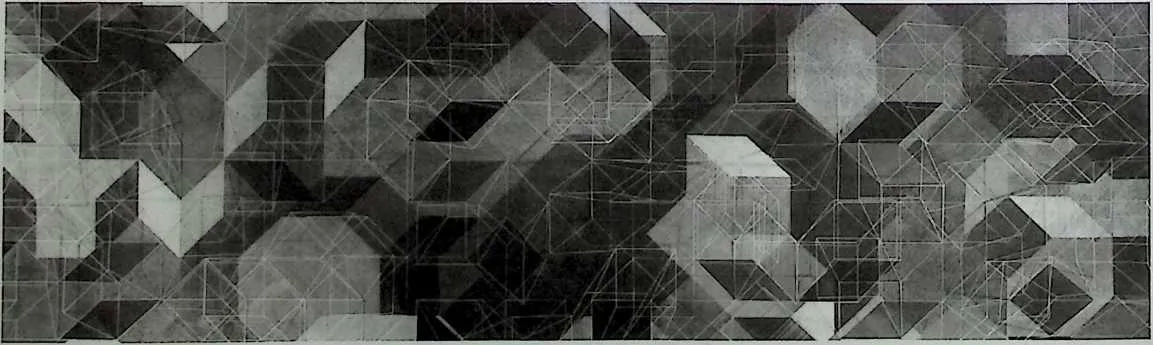
3031Figure 15.3 Fourfield, based on four-dimensional geometry, replicates the experience of a four-dimensional planar rotation as the viewer walks by. (Acrylic on canvas with welded rods, 8.5x27x1.5 feet. Collection: The General Electric Company, Fairfield.)
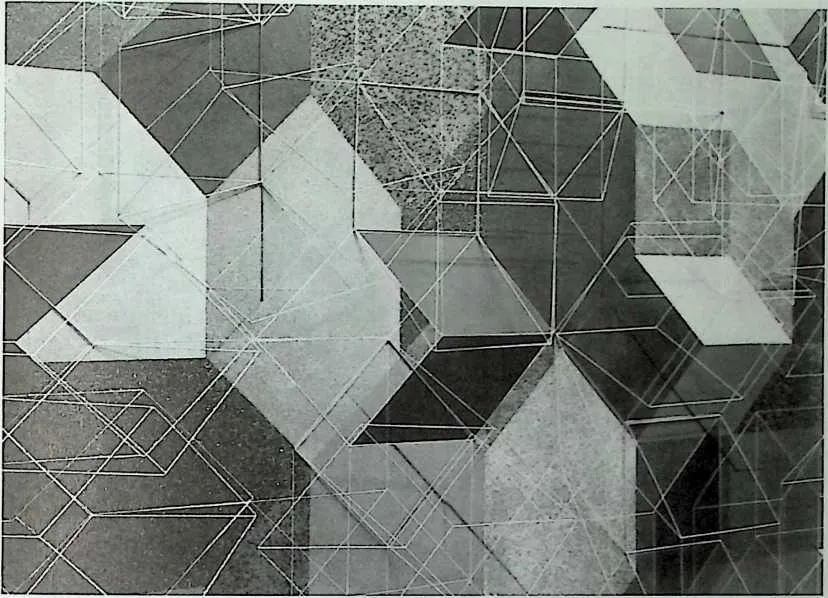
33 Figure 15.4 A detail of Fourfield shows that the image is composed of three-dimensional elements, welded steel rods, and two-dimensional elements, painted lines, that work in concert
34 can become as natural, as automatic, as the seeing of three-dimensional space.5 In my light pieces of the late 1980s, I have pushed the same formal strategy a step further. Because both the three-dimensional elements and the two-dimensional elements of the rod/canvas pieces are shadows from the fourth dimension, it is elegant to have the two-dimensional elements be the actual cast shadows of the three-dimensional elements. We still walk around the three-dimensional welded steel rods, and still the two-dimensional elements are unaffected by our movement, being a function of the fixed fights and the fixed rods. However, now, two lights, one red and one blue, illuminate the piece, and where they shine together they make white light, and where a rod blocks the red light, a blue line is created, and vice versa. The different colored lights are each filtered separately by assorted Plexiglas plates. The simple piece is filled with various colored planes and colored lines, two-thirds of which are only light—a painting of light. Three-dimensional glasses can be worn, and the two-dimensional elements of red-and-blue shadows fuse to become a three-dimensional structure more present and closer to the viewer than the welded steel boxes; the paradoxes of planar rotation are dramatically and unmistakably created.6
35 A QUASICRYSTAL FOR DENMARK’S COAST
36 As Haresh Lalvani and Koji Miyazaki have separately pointed out, quasicrystals are the three-dimensional projections of higher-dimensional objects. In fact, they are regular and rational in their original space and only take on quasicrystalline properties as a result of their projection to three-dimensional
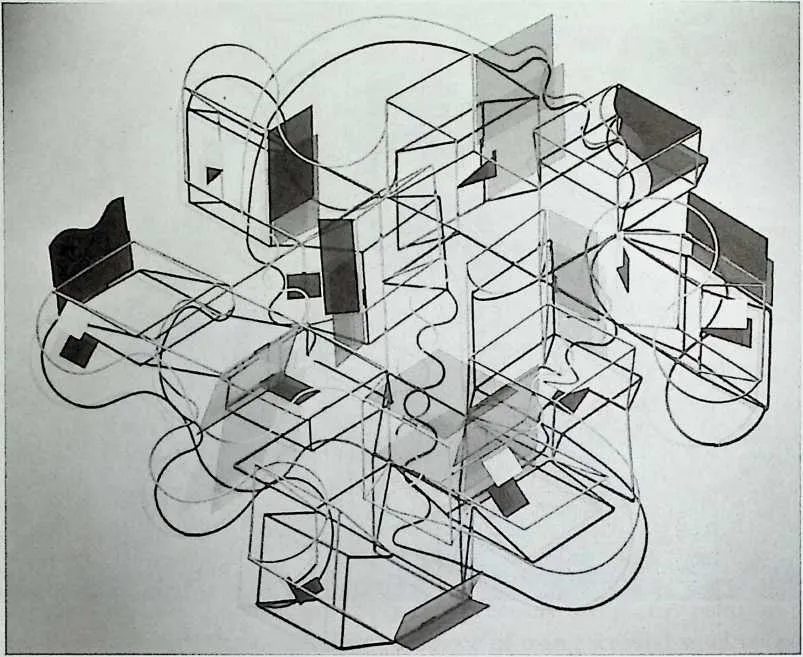
38 Figure 15.5 In the light pieces the two-dimensional components of the image are the colored cast shadows of the three-dimensional elements. The shadows are colored because the work is lit by strongly colored blue and red lights. (Untitled #1,1986, welded steel, acrylic, and colored light, 35 inch diameter.)
4041space.7–9 All the visual richness of four-dimensional geometry is here: multiple objects in the same place at the same time, objects appearing and disappearing by rotation, objects passing through one another without interference. Thus quasicrystals can be seen as an application of four-dimensional geometry, and, for us three-dimensional beings, a way to experience and communicate a greater awareness of four-dimensional space.
42In 1993 I made a large sculpture based on quasicrystal geometry for the Center of Art Science and Technology at Denmark’s Technical University. This new geometry is only 15 years old and has four interesting properties that make it fundamentally different from all previous patternings. First, a quasicrystal is nonrepeating; although it fills space with standard elements, it confounds our expectations by repeating elements only at irregular intervals. Second, it has simultaneous fivefold, threefold, and twofold symmetry, which means that sometimes it appears to be made up of right angles, other times of triangles, and from still other vantage points it appears to be made up of star pentagons. This multiplicity of image results, in part, from using dodecahedra for nodes, as Steve Baer first did in the early 1970s, followed soon after by Miyazaki. Third, a quasicrystal is assembled from intermediate groupings; the four golden zonohedra (a skewed cube, a rhombic dodecahedron, a rhombic icosahedron, and a rhombic triacontahedron, all with faces whose diagonals are in the golden ratio). These geometric solids float in the quasicrystal. Finally, the components of a quasicrystal subdivide into smaller self-similar elements, something like a fractal foliation. There are two such deflations in the sculpture: one with the golden ratio, 1:t, and another l:r3.
43The three-story atrium of the Danish Technical University is an ideal set
ting for such a quasicrystal sculpture. Open stairs and two bridges allow the viewer to pass under, over, around, and through the work, and to happen upon the many and unexpected occurrences of fivefold, threefold, and twofold symmetry. In winter, sunlight is caught by mirrored plates and reflected down into the room and into the sculpture. Half mirrors on the bottom of the work reflect crisp moving colored light paintings onto the walls and the ceiling of the space. In summer, direct sunlight passes over the sculpture, casting direct shadows onto the floor that transform from fivefold to threefold to twofold images as the sun passes overhead. Finally, on cloudy days, six strong artificial lights illuminate the morning, noon, and afternoon patterns.
44 The sculpture is in four parts, each of which illuminates one of the special qualities of the quasicrystal. First is the dome: From above the fivefold symmetry of this structure is apparent, but from below we see the near chaos that is inside. A large pinwheel shape is opposite the dome. There are 15 ways that a rhombic dodecahedron can be oriented in a quasiciystal, and this spiral pinwheel is composed of those 15 dodecahedra. The snake is a curvaceous, linear section that connects the dome and the pinwheel. It is based on three five-petal flower shapes, and from above it presents a perfect Penrose pattern.10 Finally, there is the large-scale section, based on the 1:t5 deflation discovered by the Japanese physicist T. Ogawa. Like a fugue, the geometry breaks apart and appears to run wild, only to converge again at key nodes.
45 Imagine a quasicrystal architecture. When approaching the structure from the east, squares and cubes are seen; when the car passes by to the north, the structure has the fivefold symmetry of a Penrose pattern with star pentagons; moments later looking back from the northwest, the structure is not only a different overall shape but appears to be made up of triangles, hexagons, and 60° parallelograms. The structure as kaleidoscope is never more apparent than when the sun casts shadows through the structure; truss systems make triangular nets that slide across the floors and walls, while quasicrystals transmute to an astounding variety of shapes all through the day. This kaleidoscope is the protean space of our experience of the world, suggested to us by our understanding of the objective world, reinforced in us by the multiplicity of images and media imploding on us. Why insist on a mechanistic, repetitive structur-
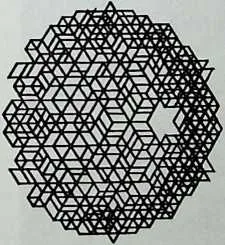
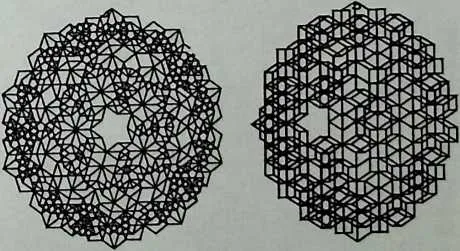
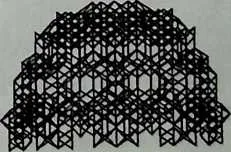
4950Figure 15.6 A computer drawing of a quasicrystal dome shows the patterns of the dome on the floor as they change from morning, to noon, to afternoon.
51 Figure 15.7 Shadows at noon from a model of a quasicrystal space frame make a two-dimensional quasicrystalline pattern—sometimes called a Penrose pattern.
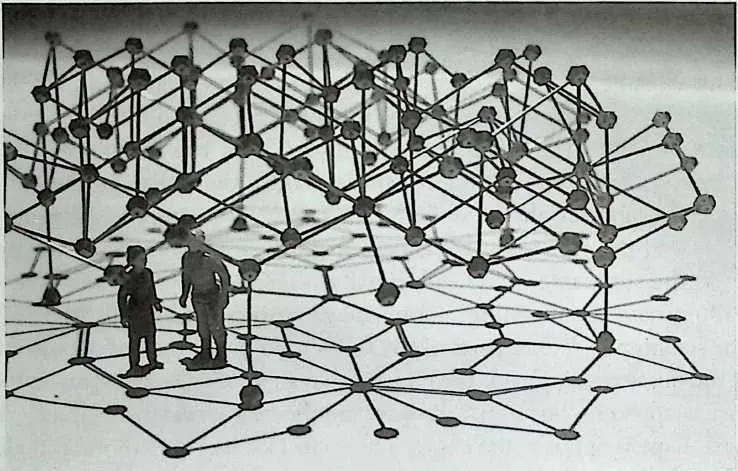
53 al pattern? Why nudge toward this vision with little, ironic architectural gambits when the tools are at hand to master such a vision.11,12
54 Because engineers make design decisions on the basis of their aesthetics, they owe it to us all to become more conscious of their aesthetic choices. Because architects live in culture, they owe it to us all to help us experience the spaces we mentally inhabit. Problems arise when the idea of beauty is anachronistic; if the public feels that its built environment is less vital than its conceptual environment, then buildings become a drag on consciousness. It is as if the engineers of France were to present the people of the United States with a full-scale replica of the Statue of Liberty, only one made with inflated
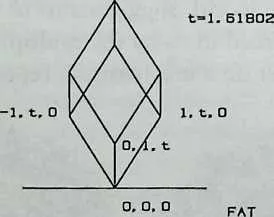
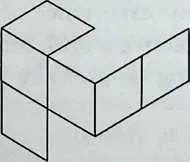
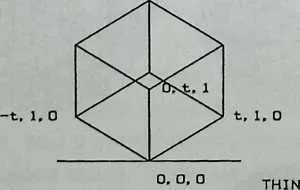
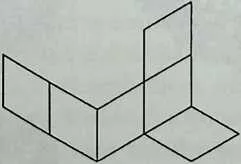
56 Figure 15.8 The plans for the two cells that make up all three-dimensional quasicrystals. By photocopying, cutting, and folding the patterns to the right, the reader can begin to build quasicrystals.
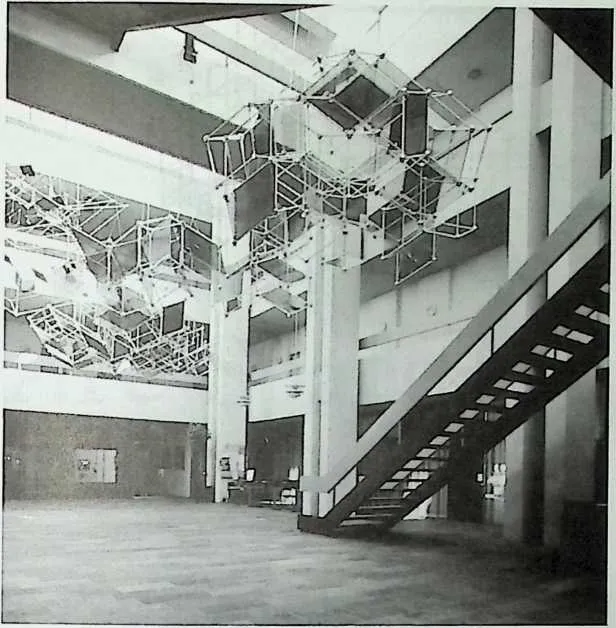
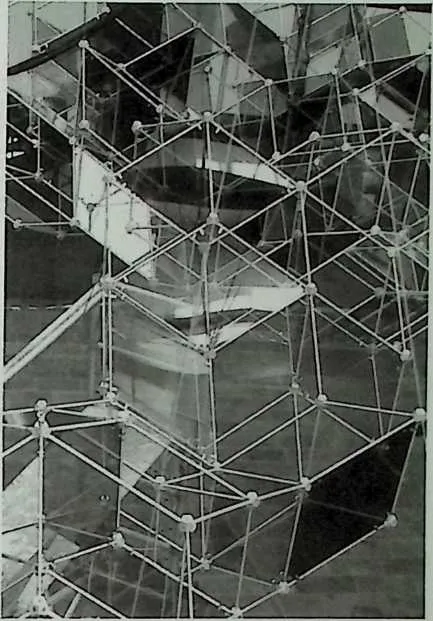
58 Figure 15.9 Quasicrystal at COAST. A view of the dome and snake from the first floor. (Aluminum and acrylic, 17 x 10 x 8 m, 1993. Collection: COAST at the Danish Technical University. Photo: Poul lb Henriksen.)
59 Figure 15.10 View from the back of the large-scale section of the COAST sculpture. (Photo:
60 Poul lb Henriksen.)
61 plastic sheeting. A technological marvel perhaps, but one that mocks history and mocks the current audience. Such a joke would not be funny for long; but what would linger is a sense of the abdication of designers to make culture new. Three-dimensional geometric space frames of the Eiffel Tower variety are a similar abdication; they come from another time and were fresh in a context long past. We have our own discoveries of space to make, based on the mathematics and physics of our own time.
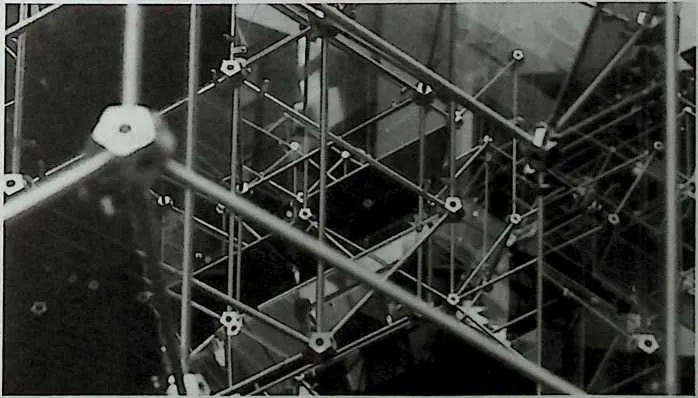
63 Figure 15.11 A detail of the dodecahedral nodes and standard-length rods that make up the nonrepeating patterns in quasicrystal space frames.
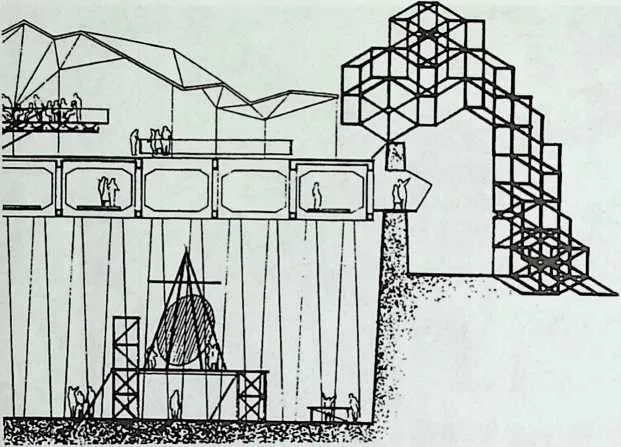
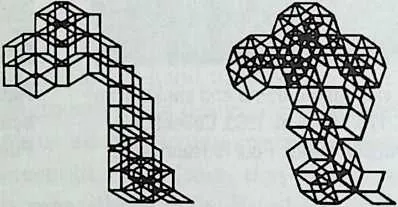
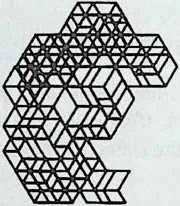
65 Figure 15.12 The first proposal for COAST was an exterior structure, a canopy that appeared to change its shape as one passed by.
66 northwest
15.2 NOTES
- 1.
- Ariel Hanaor, ‘‘Engineering Properties of Double-Layer Tensegrity Grids,’’ Proceedings of the IASS, Copenhagen, 1991.
- 2.
- Ariel Hanaor, ‘‘Aspect of Design of Double Layer 'Tensegrity Domes,’’ Journal of Space Structures, Vol. 7, No. 2, 1992.
- 3.
- Ariel Hanaor, private communication.
- 4.
- James Clerk Maxwell, ‘‘A Dynamical Theory of the Electromagnetic Field,’’ Philosophical Transactions, Vol. 155, 1865, p. 459.
- 5.
- Tony Robbin, Fou?field: Computer, Art and the Fourth Dimension, Bulfinch/Little Brown, Boston, 1992, Chap. 1.
- 6.
- Ibid., Chap. 3.
- 7.
- Haresh Lalvani, ‘‘Non Periodic Space Structures,’’ Space Structures, Vol. 2, No. 2, 1986–1987.
- 8.
- Haresh Lalvani, ‘‘Hyper-Geodesic Structures: Excerpts from a Visual Catalog,’’ Proceedings of the IASS, Atlanta, 1994.
- 9.
- Koji Miyazaki, An Adventure in Multidimensional Space, Wiley, New York, 1986.
- 10.
- Roger Penrose, The Emperor’s New Mind, Oxford University Press, New York, 1989.
- 11.
- Tony Robbin, ‘‘A Quasicrystal for Denmark’s COAST,’’ Proceedings of the IASS, Atlanta, 1994.
- 12.
- Tony Robbin, Engineering, New Architecture, Yale University Press, New Haven; 1996, Chap. 7. See also Architectural Body having a Quasicrystal Structure, U.S. Patent 5.,603,188, Feb. 18, 1997.