5 Polyhedral Structure
2Lawrence Davis
5.1 INTRODUCTION
3Philip Johnson and John Burgee’s Garden Grove Community Chapel is one of the more enigmatic buildings of its time. Better known as the ‘‘Crystal Cathedral’’ and constructed between 1978 and 1980, its curious nature has not only to do with its purpose, form, and treatment but includes the often puzzling intent and ultimate behavior of its polyhedron structure. The distorted geometry of the building causes a transformation of the tectonic system referred to ubiquitously as a ‘‘space frame.’’ Because there is little consensus regarding a precise definition for the term, many structural specialists often prefer the term ‘‘space truss.’’ Most architects and engineers use ‘‘space frame’’
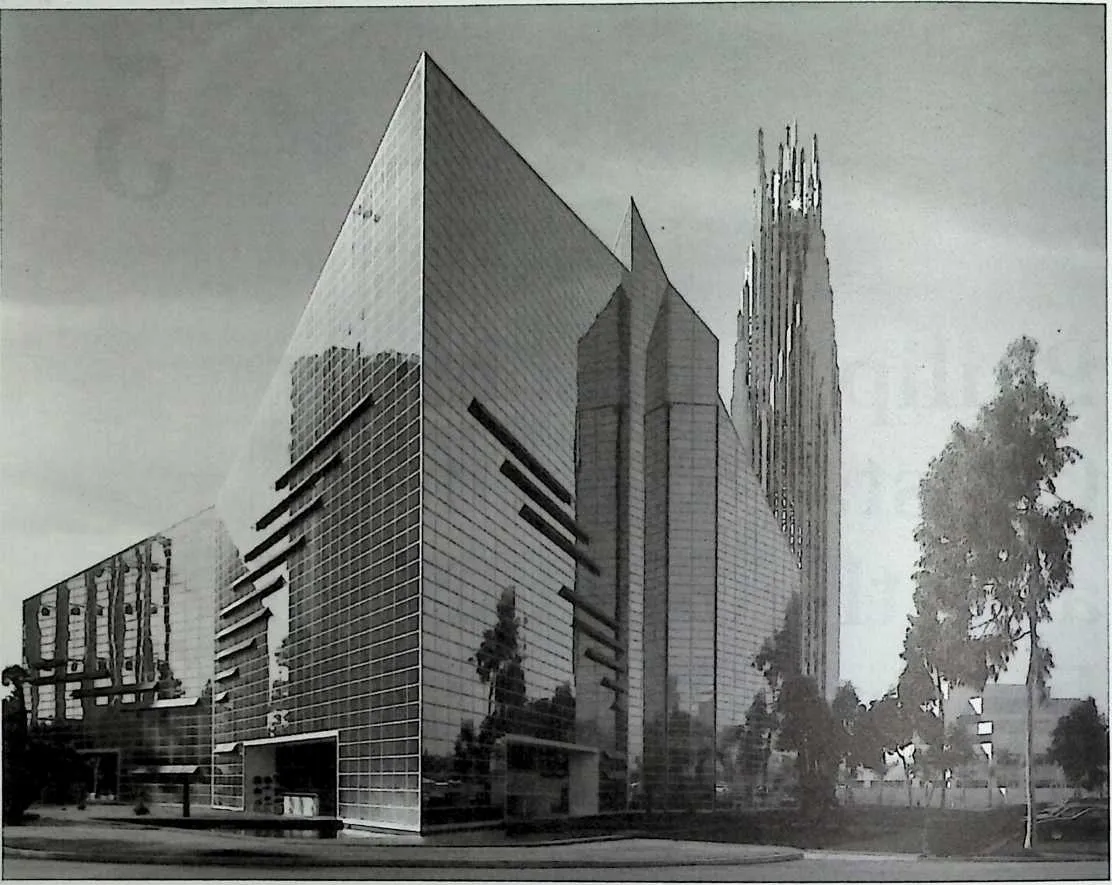
5 Figure 5.1 Exterior: carillon and small chapel in base completed in 1990. (Photo: Richard Payne, F.A.I.A. Reproduced with permission.)
6 as a catch-all to describe a multi-directional structural system made up of linear elements that are exclusively in compression or tension. Nearly all descriptions of the system type make no explicit reference to it in relation to a Platonic and rigorous geometry. Yet it is intriguing that widely held perception suggests that ‘‘space frames’’ ally themselves and represent a rigorous geometric and mathematical logic and arrangement.
7 It is precisely the departure from such expectation that allows the structure of the Crystal Cathedral to materialize physically Philip Johnson’s expressive vision for the building. The ‘‘free form’’ of the building suggests that the rhetoric of the system’s surface and the volume it creates are more compelling than the internal control of a geometric order. (See Color Art 2.) The building delineates a paradox common to many contemporary buildings and reflects a number of society’s present architectural expectations. In late-20th-century America, the meaning of geometry as a metaphysic and organic order influencing the composition of building components and programmed space
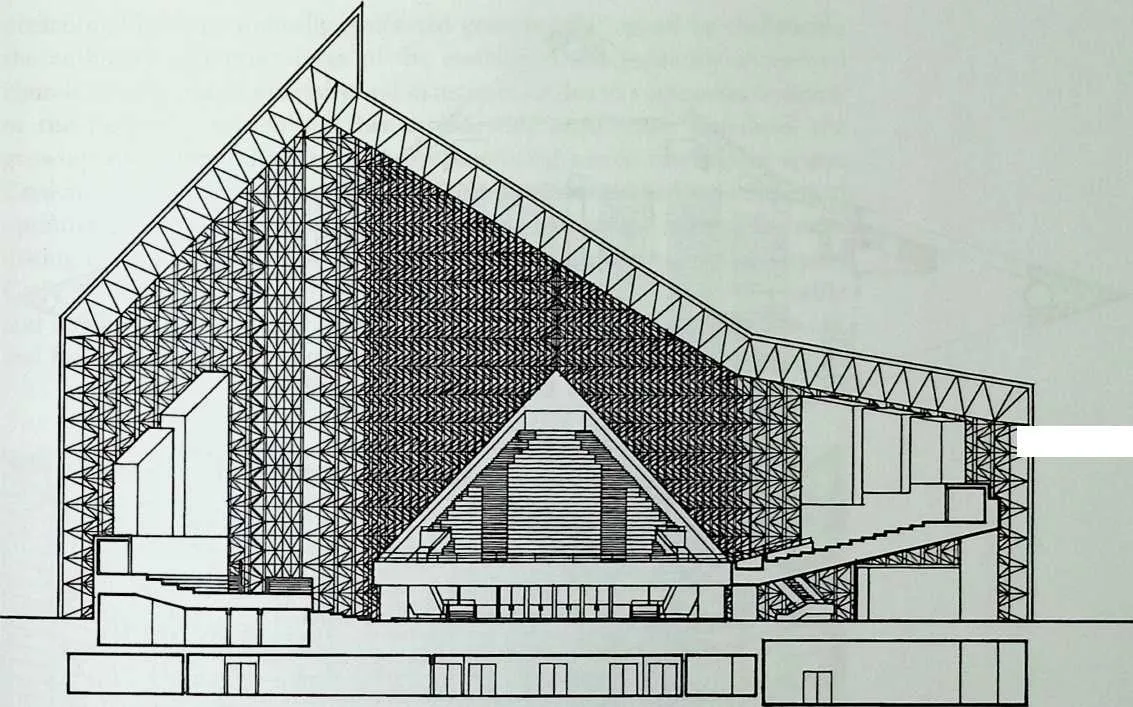
9 Figure 5.2 Section toward east. (Illustration: Kristin Simonson.)
10 is, if not decreased, at least transformed in value. In many instances strict Euclidean geometry is replaced by an architecture of easily recognizable and ‘‘consumable’’ emblematic shapes and objects. The Crystal Cathedral is embedded in a common negotiation in the built environment between a representation of rigorous geometry and expressive form. This dialogue demands an acceptance of the often mercurial readings that come from such work. Indistinct and frustrating indicators seem characteristic of much of postwar building. At the same time the potential richness of such inconsistent interpretations suggests a device through which to observe an era of considerable social conversion. In addition to an architectural description of the Crystal Cathedral and its structure, a comparison of the elements to historic influence and evolving societal circumstance can position the building within a set of intrinsic contemporary myths and values that sustain them.
5.2 AMERICAN EVANGELISM: IMPROVISED RITUAL AND SPACE
12The Crystal Cathedral is not only the product of a mix of common contemporary social conditions, the visions of the architect and client, but a little documented history of the evangelistic built environment in the United States. Exported from Puritan Britain, the informality and inventiveness of ‘‘gospel
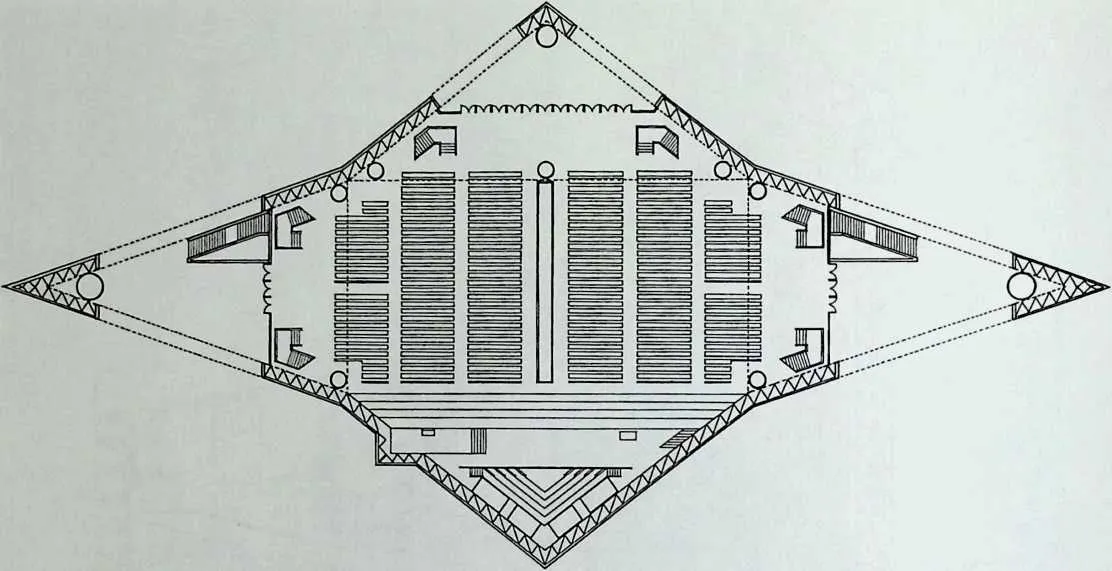
1516Figure 5.3 Ground floor plan. (Illustration: Kristin Simonson.)
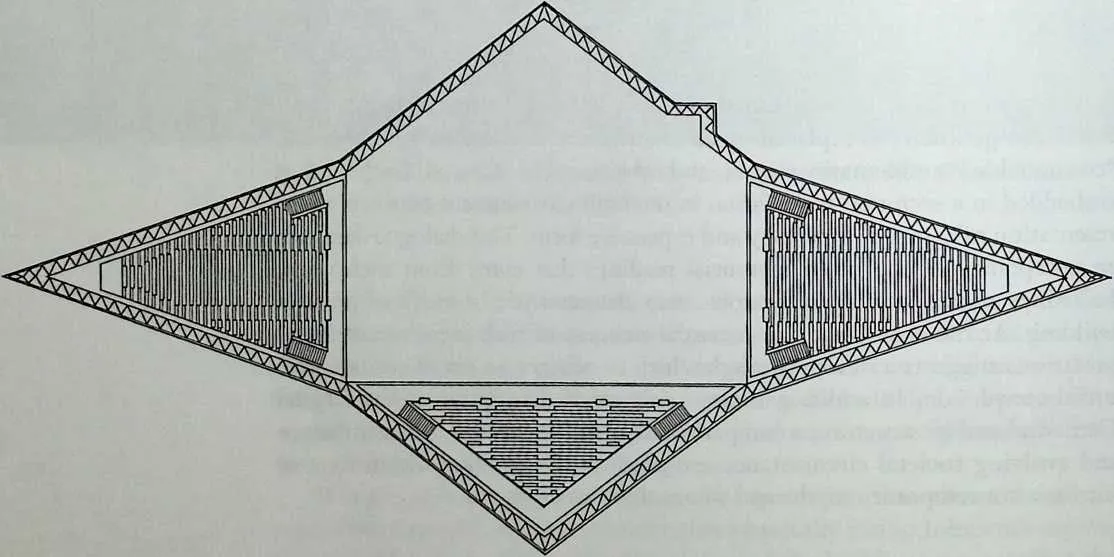
1920Figure 5.4 Balcony floor plan. (Illustration: Kristin Simonson.)
21 preaching’’ have periodically generated great popular appeal by challenging the authority and procedures of the established and politically authorized church.1 Partly out of necessity and in many cases due to a conscious rejection of the instituted symbolism that ecclesiastical architecture contained, the growing movement threatened the preconceived notion of religious space. Particularly in the rural South and West, the emotional and antiintellectual optimism of evangelical revivalism has evolved into what is perhaps the most distinguishing quality of America’s common spiritual heritage. The Crystal Cathedral, and its principal client, Dr. Robert Schuller, are a part of a fertile and resourceful revivalist tradition that includes D.L. Moody, Billy Sunday, and Billy Graham and stretches back to what many religious historians agree
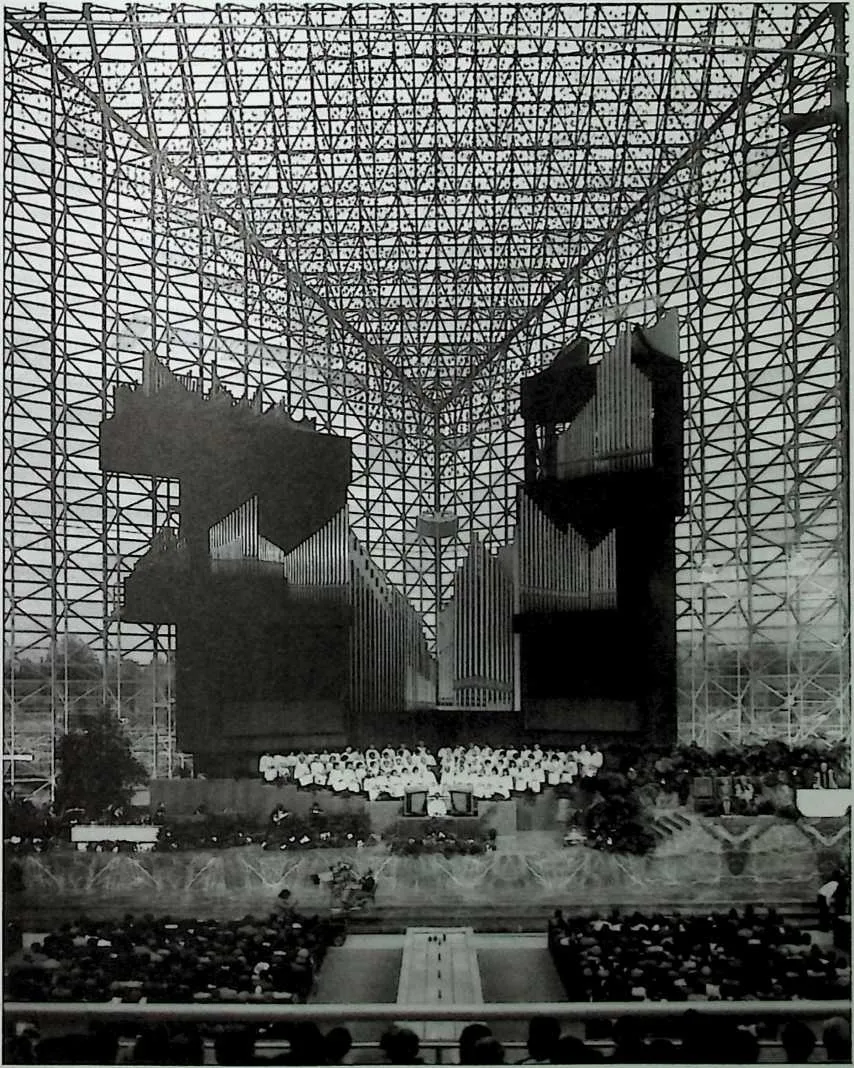
23 Figure 5.5 Interior of pulpit and organ, looking north. (Photo: Richard Payne, F.A.I.A. Reproduced with permission.)
24 was the seminal Cane Ridge, Maryland, ‘‘Camp Meeting’’ organized by Barton Warren Stone in 1801.
25 Revivalism in the United States has always benefited from at least the appearance of spontaneity. In most cases the representation of informality is highly planned. This dexterous character allows revivalism to transform as society changes. Examples of this include the early circuit ministries of the Methodists who were able to follow the frontier, D.L. Moody’s use of big business money and methods to preach ‘‘old time religion’’ in large 19th-century cities, the vaudevillian and ethically questionable tactics of Billy Sunday in the early 20th-century circuit, and, after World War II, Billy Graham’s highly organized manipulation of all forms of media within a given city during his crusades.2 Like Graham, Schuller’s evangelical message gives a charismatic voice to conservative Protestants frustrated with the increasingly progressive social agenda followed by mainline Protestant churches. Although their followings are often characterized as ‘‘nondenominational,’’ they do not embrace the ecumenical movement, which is supported by established churches and is seen to broaden the civil rights movement to include religious plurality.
26 Because of its often consciously peripheral political position, revivalism has historically been transient, moving from place to place. The camp meetings of the young nation were often in rural and socially developing locations. The newness of the tents, like the land itself, became a symbol of rebirth and salvation. As society industrialized, revivals moved to the larger cities. D.L. Moody and Billy Sunday both conducted successful urban crusades, filling to capacity large auditoriums and exhibition halls. In the late 20th century, revivalism has continued the temporal theme by using the ephemeral ‘‘space’’ of broadcast media versus the established power of a particular location. Recalling the traveling revivals of frontier and rural America, but using the media’s expanding influence, Billy Graham established a national reputation with his enormously successful 1949 ‘‘tent meeting’’ in Los Angeles, California? Originally using the Hollywood Bowl, Graham would frequently utilize the large spaces of stadiums and auditoriums.
27 From the start of his ministry, Dr. Schuller has been part of the non traditional spirit of the American evangelical tradition. Unlike his counterparts, he seldom, if ever, embarks on physically mobile campaigns. Delivered from a single location, Schuller’s ministry nevertheless relies on the itinerant character of revivalism. As with physically mobile campaigns, Schuller uses television to diffuse questions about the relevance of physical and established ritual that plagues traditional religion. Schuller is among those who understood the gaining influence of broadcast media in the daily lives of common Americans. Aware of its effect on social and intellectual change, he takes advantage of television as an efficient means for capturing the public’s attention.
28 In 1970 Dr. Schuller began to televise his weekly service, ‘‘The Hour of Power.’’ Through television he offered a populist spiritualism for what Peter Rowe, author of Making a Middle Landscape, paraphrasing Robert Wood, describes as, ‘‘ . . the hardworking corporate yeoman, who while materially
29 consumptive wants both economic security without risking personal ambition.’’4 One might speculate that this ‘‘inner-directed man’’ from the ‘‘19th century’’ might be seeking spiritual security as well. The often corporate style of Schuller’s message differentiates his sermons from those of other evangelists. He often laces his message with a marriage of ‘‘self-help’’ psychology and the terminology of a motivational retreat for middle-and high-level managers. It is often argued that what John Pastier described in a 1979 article as Schuller’s ‘‘I’m O.K., You’re O.K.’’ approach is a means for caressing further financial support from his strong associations with big business.5
5.3 THE REPRESENTAT8ON OF MORALITY: THE CATHEDRAL AND THE HISTORICAL AVANT-GARDE
31The Crystal Cathedral, like other recent evangelical structures, is a large arena-like auditorium. In addition, the scale, technical spirit, and function of this relatively new building type are oddly reminiscent of the self-promoting qualities of Tatlin’s 1919–1920 Monument to the Third International. Both are used for administration and for the dissemination of information through a broadcast theater. In expression, construction, and purpose, the Crystal Cathedral is part of a new breed of large-scale churches that in themselves become enormous metaphors bepraising a new evangelical social order. As with the difference in Schuller’s corporate preaching style, the uniform character of the polyhedron structure distinguishes the Crystal Cathedral from other structures in this emerging class of church architecture. The cathedral’s space truss is indicative of the industrial power and prestige of American corporate culture. Its homogeneous texture and transparency are similar to much of the architecture of postwar big business: a language codified best in the later work of Mies van der Rohe, simultaneously referring to the diaphanous and optimistic compositions of the suprematists as well as to the stable heritage and order of Roman classicism.6
32 The surface and space of the cathedral connect it to a mythic and transitory religious building tradition associated with evangelism. The white translucent scrim of the entire space truss system recalls the light and space of revivalist tents. The naturally fit tentfike space suggests a connection to Le Corbusier and Pierre Jeanneret’s Pavilion de Temps Nouveaux in the Paris World Exposition of 1937: a pavilion advocating the ethicacy of the industrialized aesthetic. More to the point, in Towards a New Architecture, Le Corbusier identifies the tent as an essential temple paradigm. Although he is using the example primarily to discuss the virtues of geometric regulation, Le Corbusier discusses the instinctive and sophisticated act of inhabiting a location, regardless of the modesty of the means for doing so.7 The use of structure as the prime generator of architectonic form connects Le Corbusier’s example with a Franco-structuralist tradition that includes Viollet le Due and originates in Gothic architecture. There is no evidence that Johnson intended the Crystal Cathedral to recall this specific legacy. What is more certain is that the simple nature of the building’s tentlike interior suggests a compelling reference to the informal structures of American evangelism. The structure’s ephemeral symbolism can be read to intentionally challenge established theological authority often enclosed in the heavy, dark, and '‘‘enduring’’ buildings. The transparent polyhedron structure of the Crystal Cathedral continues to express the improvisational and resistive nature of evangelical spirituality. As in the revivals of early America, which offered an exhilarating social and spiritual occasion to break from the lonely and monotonous life of the frontier, Schuller’s intention seems to create a crystalline ‘‘tent’’ as an analogous inspiring experience for the deserted souls of the grueling uniform world of postmodern America.
33 As well as connecting it to the history of evangelical space, the white color of the cathedral’s interior structure bespeaks of an ethicacy found in much of the modern movement. This is particularly true of the cubistic architecture of Le Corbusier. In The Decorative Arts of Today, written to protest the 1925 Decorative Arts Exposition in Paris, Le Corbusier discusses ‘‘The Law of Ripolin: A Coat of White Wash.’’ Finding beauty in the functional and rational forms of the Machine Age, Le Corbusier wrote that every citizen should be required to paint everything on the interior of their homes with a coat of white ripolin. This ‘‘moral act’’ would establish a sense of ‘‘inner cleanliness’’ that would ‘‘improve conditions.’’8 Le Corbusier seems to feel that the decorative nature of most interior spaces was overly sentimental and undermined its rational beauty as a functional object. He also considered the prevalent use of ‘‘white wash’’ in the built environments of the less industrialized cultures to be an agent that bound all segments of the society. He describes the socially objective spirit of white wash in a metaphor: ‘‘bread, milk and water are the wealth of slave and king.’’9
34 Although Johnson’s selection of white for the color of the structure is useful in reflecting natural light, it also refers to an idealized and moral side of early modem architecture with which the architect is well acquainted. The connection between the salvation found in the machine and that of ‘‘The Word of God’’ becomes an association that reconciles the conservative politics of Schuller’s congregation with a common technical and corporate representation found in today’s society. As with Le Corbusier’s recommendation of the use of ‘‘white wash’’ in preindustrial society, the vast white field of structure in the Crystal Cathedral unifies an electronically connected multitude of individuals, frequently of different economic and social backgrounds. This consensus by structure strengthens the universal intentions of the nondenomina- tional organization of Schuller’s ministry.
35 Philip Johnson has stated that the nave on the short axis of the deformed star shape of the plan is inspired by Bernini’s San’ Andrea al Quirinale in Rome. This exposes a difference in background and intention with regard to the essential geometry of the building. Whereas Johnson, albeit randomly, appropriates from the history of European architecture, he seems less impressed with this pedigree and sees a plan that falls clearly within the evangelical spatial tradition that brings the congregation closer to the speaker. Whereas older, more liturgical faiths emphasize the mystery of ritual associated with the Eucharist performed from the altar, the evangelical Protestant tradition emphasizes the spectacle of the sermon about the ‘‘Gospel’’ performed from the pulpit. This influences the nature of the service and very often the shape of the space in which it is performed. In many cases American Protestant sanctuaries have shorter, less hierarchical naves, frequendy containing a semicircular arrangement of pews facing a central pulpit. Along with the pulpit, the altar and choir become part of a tabernacle-like stage that faces, and is surrounded by, the audience. This more intimate relationship allows the sermon and service to be easily experienced by the congregation and represents a God that is accessible to the common man.
36 Perhaps because of the tradition of a less formal relationship between minister and audience, many evangelical ministers found radio and television uncompromising to the sacred nature of the ‘‘Gospel.’’ The very definition of evangelical ministry implies an emphasis on the importance of preaching, as contrasted to ritual. Whereas rejection of established ceremony was a means for challenging the authority of mainstream churches, the evangelical movement would create its own unofficial power base through the media. Many found the emerging broadcast media the most efficient means for projecting their message and influencing as many as possible.
37 Dr. Robert Schuller was among those who had been willing to innovate in his ministry and to pioneer new techniques for relating to and enlarging his congregation. Because a traditional, or even enclosed, structure was unattainable at the time, he began preaching to people on Sunday mornings in 1955 from the roof of the concession stand of an Orange County drive-in theater.10 What he discovered was an untapped audience in need of spiritual inspiration who felt more at home in their automobiles than in a conventional church setting. When, in the late 1950s, Schuller commissioned Richard Neutra to design his first chapel in Garden Grove, California, the sanctuary was arranged to house both a congregation within the building and an audience seated in an adjacent ‘‘amphitheater of cars.’’ Presumably because of his experience with his ‘‘drive-in’’ ministry and the pioneering ministry of such leaders as Billy Graham, Schuller recognized and embraced the power of television, too. Like the car, it presented a comfortable and familiar setting to experience the service. The eventual broadcast of the service allowed him to reach an increasingly larger audience. Today the services are televised to an estimated audience of two million viewers each week across North America and Australia.11 The success of the televised ministry meant that Schuller could not only spread his message to more people but appeal to a much larger audience for the funding of his growing organization and its projects. Additionally, television allowed the Crystal Cathedral to become an important focal point in Orange County. Schuller’s cathedral is an additional stop on the constellation of Southern California tourist destinations as well as a contemporary pilgrimage church attracting religious travelers from across the United States, Canada, and Australia.
38 Different from the evangelical movements of the 19th and early 20th centuries, many of which were located in destitute urban areas and had strong social service components to their missions, Schuller’s broadcast ministry is based in the relatively affluent suburb of Garden Grove. Many criticized Dr. Schuller’s organization for channeling the bulk of its fund raising toward ever more extravagant and expensive broadcasts. The flexibility and openness of the structure and volume support transforming spectacles that match the circus-like ‘‘theater of action’’ proposed in Walter Gropius’s unrealized Total Theater project of 1927.12 Although arguably these productions create a new consciousness in the congregation, critics of Schuller contend that the economic energies of the organization might focus more on the disadvantaged. The theatrical broadcast format has the net effect of cultivating a rather passive congregation, one that is not physically active in the day-to-day pursuits of the church. Questions arise regarding the intentions of the message, means, and mission of the cathedral. The facile manipulation of perceived purpose is arguably a distinctive trait of the evangelical movement in particular and postmodern society in general.
39 The appeal of experiencing what had traditionally been a physically public event, namely, the church service, from, at first, one’s automobile and later from one’s television transforms the idea of ‘‘space’’ through which ‘‘public’’ dialogue is maintained. The allure of this spatial type represents a perceived anxiety toward an increasingly uncontrollable and misunderstood public realm. Schuller seems to understand that the automobile and television are tools that allow people to experience culture without having to contend with many of the daily problems of society. The car and the television have become controllable capsules from which to observe the volatile production of culture and a selective portrait of society.
40 One suspects that Schuller also recognizes that the television and automobile are artifacts that are part of what David Harvey has identified as basic changes in contemporary human psychology, emerging in large part from the volatility and ephemeral nature of culture and contributing to the swift change of values and a breakdown of consensus.13 Schuller might propose a contrary argument: that television and the auto instead of eroding society actually assist in coping with disorienting contemporary conditions. Both ‘‘spaces’’ allow people to be selective about what they experience and at what distance they choose to experience it. Because of their limitations, the automobile and, in particular, television contribute to culture’s oversimplification. As suggested previously, Schuller and the Crystal Cathedral take advantage of this. On the other hand, many think, as David Harvey, that the television and the auto appear to reinforce a sense of denial of problems that exist outside one’s immediate experience. This significantly contributes to a general blase attitude in society at large.14
41 Schuller, at least intuitively, understands both the negative and the positive effects of the television and car. Regarding the design of the Crystal Cathedral, he knows how they influence the character of contemporary built environments. As with the television and car, a sense of security, contentment, and choice is the principal goal of most contemporary common commercial
42 spaces. Schuller has claimed that the Crystal Cathedral is a ‘‘22 acre shopping center for Jesus Christ.’’ Shopping malls and privately owned urban atria are prosaic spatial paradigms that block out uncontrollable stimuli, simplify the meaning of the message in order to appeal to a larger audience, and often restrict access to marginalized segments of the population. This last quality, in particular, contributes to what Harvey has described as a ‘‘collective sense of denial’’ toward the unpleasant aspects of society. The refusal to respond to the full range of circumstances, including those that are lamentable, changes the nature of public space.15
5.4 THE GLASS CHAIN BORN AGAIN
44Schuller’s attempt to connect with the common built environment may begin to explain why he rejected the first scheme proposed by Philip Johnson. Dr. Schuller felt the initial proposal was too dark and introverted. The second scheme was inspired, according to Johnson’s own account, by the early expressionist work of Bruno Taut and the glass office tower projects of the early 1920s proposed by Mies van der Rohe.16 In particular, Johnson was intrigued by the free form plan of the Friedrichstrasse, Berlin Project of 1921 and the instinctive and emotional character of Taut’s ‘‘Stadtkrone,’’ or City Crown.17 Taut’s crystalline universal paradigm for religious buildings simultaneously connected the building to the tradition of cathedral making as an urban and cultural centerpiece (see Color Art 3). Taut’s commitment to a new architecture of glass allowed the tectonic vision to respond to and exaggerate the potential of contemporary transparent construction materials. For Taut this position is epitomized by his 1914 Werkbund Exhibition Pavilion. Has articulation of the idea additionally influenced a broader audience of emerging designers who were beginning to experiment with transparent construction of skin and frame, among them Mies van der Rohe.
45 In a recent interview Johnson claims that he has always been an ‘‘expressionist’’ and not a ‘‘structuralist’’ architect.18 It is not clear if this assertion is made retroactively. It does seem to connect this particular work with the instinctive factions of the earfy-20th-century avant-garde. It can also be argued that such an expressive streak is consistent with some of Johnson’s earlier work and explains Kenneth Frampton’s observation that his work is many times ‘‘determined to obscure structure through surface manipulation.’’1’ There was, in fact, an additional motivation for referring to Taut’s Stadtkrone. The promotion by Taut and ‘‘The Glass Chain’’ of an architecture of individually asserted and expressive ‘‘will to form,’’ or ‘‘Kunstwollen,’’ offers a further ideological justification for Johnson’s historically conscious architecture. The terse and optimistic text Glasarchitektiir of 1914 by Paul Scheerbart, a member of Taut’s expressionist group ‘‘The Glass Chain,’’ advocates a new crystalline architecture that has the potential of ‘‘restructuring society.’’20 It is unknown whether Johnson referred to Scheerbart’s position when presenting the second scheme to his client. However, one can imagine that the connec-
47 tion between the inspirational qualities of ‘‘The Glass Chain’’ and Schuller’s ministry is more than coincidental. It is also intriguing to note that the Stadtkrone character appears to have migrated into the design of a number of glass office towers that were erected around the time of the Crystal Cathedral, placing the church in a larger body of corporate work executed by Johnson and Burgee in the 1970s and 1980s: among them the PPG Headquarters in Pittsburgh and the Transco Tower in Oak Park near Houston.
48 More to the point of this chapter, understandingjohnson’s position is critical in evaluating the architect’s means for realizing the Crystal Cathedral’s idea. The free-form interpretation of the polyhedral structure of the building allows the architect to disregard the collective expectation of the normative and Euclidean configuration of the ‘‘space frame.’’ Johnson’s expressionist position no longer obliges him to represent the scientifically and mathematically driven spatial agenda begun in the Enlightenment. The architect is able to engage in a new and dexterous organization of form and meaning that not only recalls the beginnings of the modern movement but, because of its varied and simultaneous readings, positions the building as representative of the postmodern condition. The intuitive crystalline form permits the work to become both historically grounded and, at the same time, a volatile and ephemeral piece of ‘‘fashion en masse’’ that scholars such as David Harvey and Jean-Frangois Lyotard describe as essential to the palette of characteristics ascribed to postmodernism.
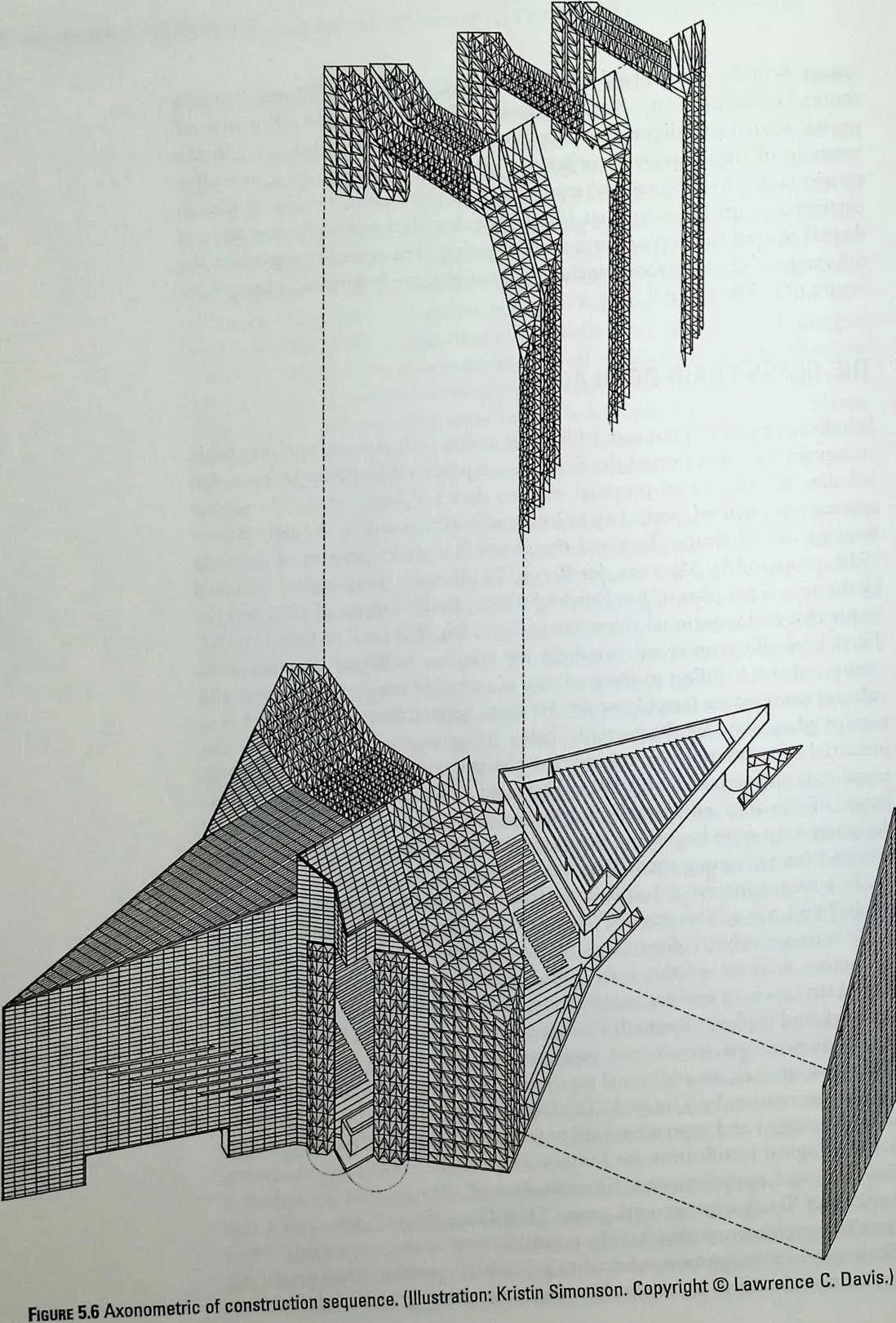
49 It was Johnson’s initial intention to use a space frame to accommodate the crystalline form without ‘‘posts or beams.’’21 The scenographic program is enclosed in a vast interior landscape that includes a large tabernacle stage with space for the altar, pulpit, choir, and organ. These iconographic elements are set against the suburban Southern California landscape viewed through the lattice of the polyhedron structure and the transparent skin that clads it. Because of the distorted geometry of the building volume, Johnson was forced to abandon the use of a common multidirectional polyhedral system.22 The varying spans caused by the shape of the building in plan and section demanded that increasingly greater depths be generated toward the center of the building’s longer dimension.23 Johnson and his structural engineer, John Muller of Severud—Perrone-Szegezdy-Strum, designed a system of parallel ‘‘space trusses.’’ These were intended to be a series of parallel and coincident one-way structural systems.24 Because of the structure’s height and relative thickness, stiffness is achieved through a diaphragm action created by the parallel trusses acting together as a shear wall. This wall of combined space trusses, when tied to the independent balcony structures at the lateral comers, creates a stiff homogeneous ‘‘beam-like’’ unit.25 Each 5-foot-wide space truss was assembled off site, driven on flatbed trucks, and erected in prefabricated segments of two and three space trusses each. Two rows of shoring were used to stabilize the structure during construction.26
50 The compositional emphasis on the vertical dimension of the interior suggests a similar emphasis found in Gothic interiors. The outside surface of the assembled structure comprises horizontal and vertical members. The inside
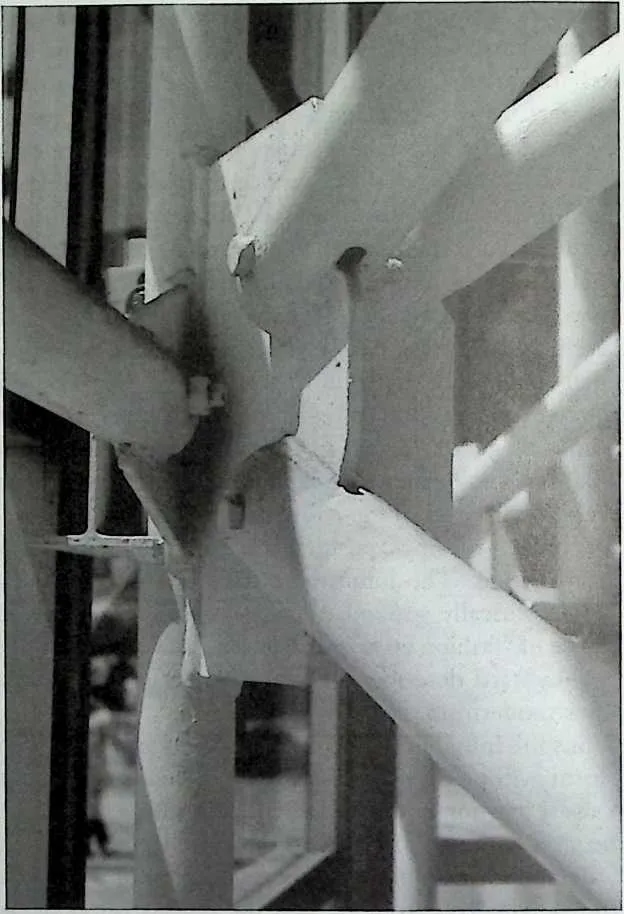
52 Figure 5.7 Detail of space truss. (Photo: J. Frangois Gabriel. Reproduced with permission.)
53 surface has no primary horizontal or diagonal members.27 Like the Gothic interior, the vertical members express structure as a series of one-way systems. The compositional difference between the inside and the outside also separates the building’s structure from a common plate-like structural system, typically a means for transmitting loads on both interior and exterior surfaces. It is a fortuitous irony that the combination of many one-way space trusses in the Crystal Cathedral results in what structural engineers often refer to as ‘‘space effect’’: The shedding of the loads laterally creates a two-way behavior that shares the essential characteristics of a normal ‘‘space frame.’’28
54 Ideally, to have each element and node support the loads equally, a space frame should be a flat plate of a geometrically pure shape and have supports on all sides at each node.29 When support conditions are not consistent, as is usually the case, all loads on all members are different. Support conditions are more important than the overall shape of the surface or volume when sizing individual elements and designing connections. In most cases the rhetoric of a continuous and uniform system requires that the system’s members be sized to carry the largest load. This means that many of the members are often oversized and redundant. In some cases, in order to achieve an apparently uniform diameter of all members, their actual wall thickness is varied to address different loading conditions. In extreme cases members are solid where loads are highest. This technique is relatively expensive because of the retooling required to create the different casts for the various wall thicknesses necessary to maintain consistent diameters.
55 More than most polyhedral structures, the unusual shape of the Crystal Cathedral generates a number of different loading conditions. This problem is addressed by varying the depth of the space trusses to accommodate the various moments created by the increasingly larger spans toward the center of the plan. This solution produces a large number of diameter types for the individual pipe sections. This also demands a complex and idiosyncratic set of joints.30 This strategy is opposite to the techniques that manipulate the wall thickness of members to retain uniform diameters. The diameters of the members of the Crystal Cathedral vary from 2 to 5 inches to accommodate inconsistent loading conditions throughout the structural network.31 One suspects the relatively modest project cost, $10 million, required that the space truss system comprise a modified ‘‘off the shelf’ system, in this case, tubular sections from preexisting stock. This frugal strategy eliminates the option of varied tube wall thickness as a technique for accommodating dissimilar loads. The irregularity of the member sizes and the complex geometry produced a widely varied set of joint conditions. Johnson and Muller’s solution contrasts greatly with the typical space frame, which attempts to minimize the number of joint conditions as a method for achieving a consistent or uniform surface treatment. The architect and engineer devised an arrangement of connections that call for the pipe members to be welded at their slotted ends onto gusset plates.32 Owing to the distorted geometry, these are often complicated because as many as 11 members come into one joint. Where the roof meets the wall, castings are added to the gusset plates.33 The castings themselves were so complex that George Kent, a steel detailer and consultant to the structural engineer, had to model them with rubber balls and cardboard tubes in order to understand their configuration.34
56 Although somewhat compromised with regard to a typical space frame, there is an effort by the architect to minimize the heavy visual impact of gusset plates, service ladders, catwalks, and fighting fixtures by burying them deep within the truss system.35 In addition, ventilation is achieved through natural means. The glass itself is tinted to allow only 8 percent of the daylight and heat into the interior. A series of glass panels on the exterior skin are mechanically operable and comfortably modify air movement and the interior temperature.36 By using the depth of the space truss as a service zone, Johnson produces a discrete version of Kahn’s ‘‘served and servant’’ space idea. The structure becomes a tectonic and rhetorical object containing mechanical and electrical systems whose regularized surface dominates the character of the interior. Simultaneously, the frame supports a singular exterior glass wall whose smooth, reflective, and atectonic surface comes from a world of contemporary industrial production and the glossy veneers of many modern consumer goods.37 The atectonic exterior recalls the nearby Los Angeles Pacific Design Center built in 1971 by Cesar Pelli. The dialectic between the glazed exterior and the skeletal interior is part of a rhetorically industrialized tradition that includes buildings such as John Paxton’s Crystal Pavilion of 1851 and Norman Foster’s Sainsbury Centre of 1978.
57 Each of these examples is informed by industrial lofts. Kenneth Frampton has labeled such restatement of the uninterrupted volume typology as ‘‘productivism.’’ Specifically, the term is used to describe a class of innovative commercial and office structures built since the mid-1960s. It is closely allied to the original modernist idea of the building as ‘‘an elegant act of engineering.’’38 The Crystal Cathedral is representative of the American branch of productivism that demonstrates little concern for the elegantly detailed and revealing tectonic language of its British counterpart, led by such figures as Sir Norman Foster and Sir Richard Rodgers.39 Because of its reductive form and deemphasized detail, Johnson’s cathedral can also be placed at the end of a line of postwar American minimalists who include Eero Saarinen, Kevin Roche, Gunnar Birkerts, and Cesar Pelli. Often monumental in scale and institutional or corporate in purpose, the work of this group frequently places an emphasis on the making of a refined abstract shape: The taut quality of the building’s language makes it difficult to manipulate in a manner that signifies such familiar architectural moments as building entry and individual window.
58 The transparent skin as well as its romantic framing of the sky and landscape connect the Crystal Cathedral to a second species of modernism specific to Southern California. Predominantly domestic in function and thus vastly smaller in scale than the cathedral, work by Richard Neutra and Charles and Ray Eames and the buildings of the Case Study House Movement share some tectonic characteristics and existential themes. The lightweight cladding and steel frame construction of this group derive inherent tectonic qualities from a concern for an improved programmatic and spatial relationship with natural elements. The California architects felt that the building should take advantage of the psychological and physiological benefits of the mild arid climate of the region.40 In particular, Frampton has characterized the works of Eames and the Case Study Movement as possessing a concern for standardization and mass production. This suggests a connection with the work of the later, albeit more heroic, productivist agenda. Using a more lyrical and personal formal vocabulary, the work of the Los Angeles architect Rudolf Schindler offers a vocabulary more intuitive and far less committed to standardization than other California modernists of the era. Johnson has never claimed to be influenced by Schindler’s work in the design of the Crystal Cathedral. In fact, Johnson has been accused of being indifferent to Schindler, a criticism that has its roots in the California architect’s absence from the 1932 Museum of Modem Art’s exhibition on the International style. What is striking is that many of the California projects by Schindler and the Crystal Cathe-
59 dral share an instinctive character that modifies normally standardized systems of construction to create expressive form.
60 The Crystal Cathedral corresponds to a set of larger attitudes that reveal values and conditions peculiar to postindustrial America: one of a technological monument emblematic of a productivist postwar economy and another of a building that engages in the changing American mythology of nature. In addition, the Crystal Cathedral can be connected with the previously described American tradition of temporary and makeshift environments in which religious revivals were staged.
5.5 FROM BOULLEE TO OLDENBURG: THE STRUCTURE IN A POSTMODERN CONTEXT
62Philip Johnson claims that the enormous geometric volume of the cathedral alludes to an expressionist utopia. Others have found the Crystal Cathedral to be similar to the architecture of the Enlightenment and more recently much of pop art. The building’s boldness and heroic scale recalls the projects by Boullee and Ledoux. This courageous yet eccentric architecture from the Enlightenment, among other things, spoke in confident terms of the power of reason and a comprehension of natural laws of the universe. American society has been a principal descendant of this legacy because of (1) the society’s commitment to capitalistic production, (2) its historically strong individual work ethic, and (3) its view that the natural environment is a resource meant to be transformed through the laws of nature for the good of society. In particular, the Anglo-American Enlightenment was the parent of a number of evangelical and reform movements. These two sets of offspring have often radically alternated between being mutually supportive of or distincdy at odds with each other. Albeit for vastly different reasons, they both currendy participate in a broader contemporary critique of America’s philosophical commitment to science and technology.
63 A departure from the ‘‘reasoned’’ spirit of the Enlightenment appears to contradict a primary reading of Johnson’s polyhedral structure: a group of evangelical Christians being housed in a system that symbolizes a secular heritage. This apparent discrepancy makes sense when one considers that Dr. Schuller’s ministry is unique in that it is not part of the ‘‘creationist’’ branch of the modern evangelical movement. The rhetoric of technology is compatible with Schuller’s rejection of the common evangelical belief of ‘‘original sin.’’ Schuller contends that ‘‘sin’’ is the primary source of ‘‘guilt,’’ a principal inhibitor of human potential. For Schuller, technology becomes a symbol of the material, psychological, and spiritual maximization of human nature. This positions him on the edge of more familiar reactionary strains of evangelism, placing him closer to moderate contemporary American belief.
64 In addition to its compatibility with a secular society, the building is also part of a 19th-and 20th-century tradition that embraces the revelatory nature of technology. This mystic optimism is epitomized in the exhibition structures
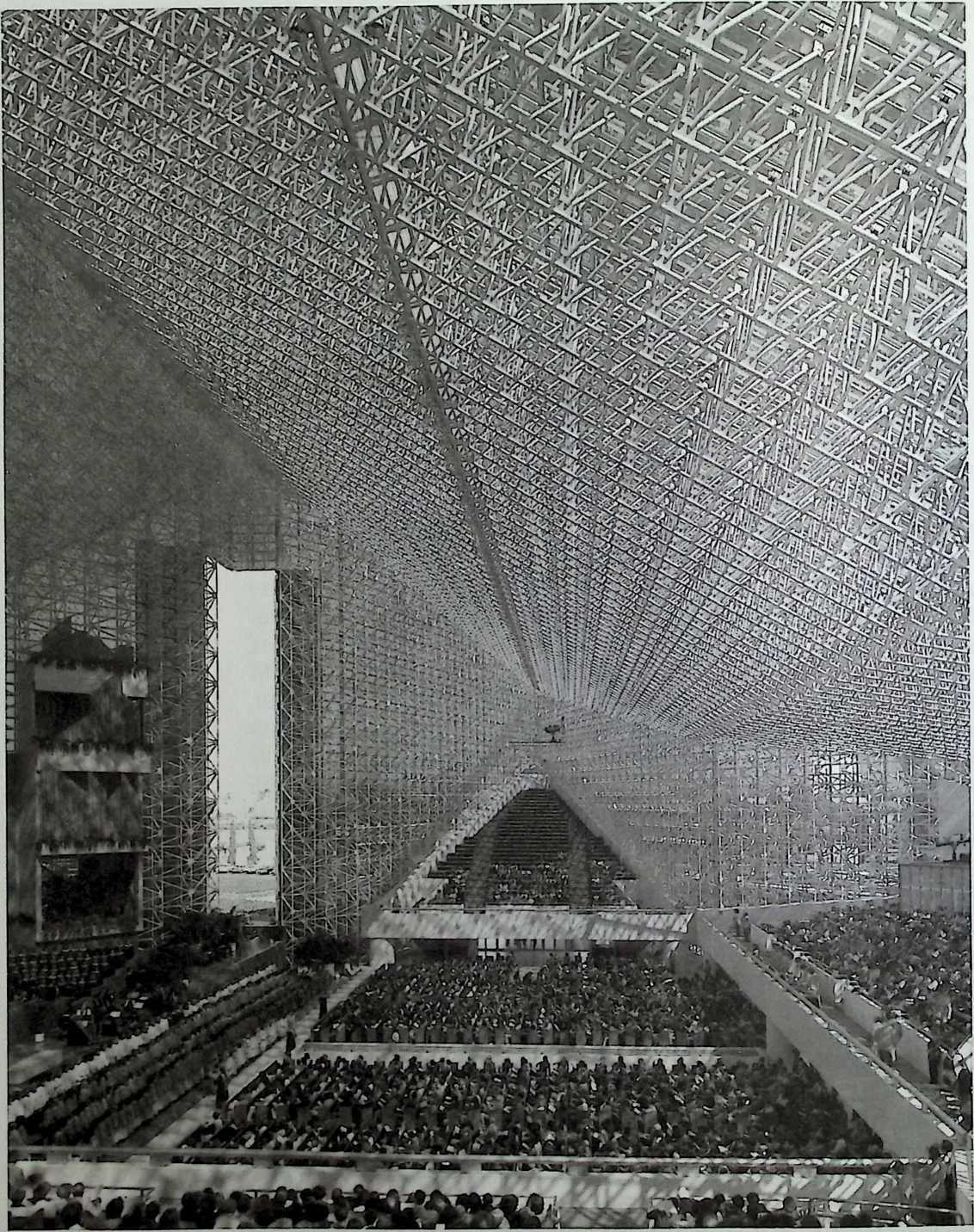
66 Figure 5.8 Interior toward east across nave. (Photo: Gordon H. Schenck, Jr. Reproduced with permission.)
67 of the 19th century, the reconsideration of architectural language of the 20th century, and the built artifacts of the space program of the 1960s and 1970s. Ironically, it is the social upheaval of this last period that most recendy called into question the credence of this shared faith in science.
68 The overt representation of technology in the Crystal Cathedral can be interpreted as nostalgia for America’s historic leadership and prestige in the first two-thirds of the century in science, technology, economics, and politics. Many have interpreted the structure’s white tubular members and the intricate shadows they produce as connoting the assembly building and launch towers of Cape Canaveral. According to the architect, the cathedral’s large 70-foot-high doors, which, when open, connect the pulpit to the audience in their cars in the parking lot, were inspired by the poetics of the structures at NASA’s Florida rocket-launching facility.41 The large doors require a motor the size of that needed to operate a washing machine to open; ironic because their motion alludes to the incomprehensible nature of a powerful cybernetic apparatus (Color Art 4).
69 On first inspection, the inspirational reading of the structure and doors seems consistent with what Manfredo Tafuri describes as the ‘‘mystic transparency’’ pursued by the ‘‘Glasarchitektur’’ of the early modem movement in Germany.42 Conversely, Tafuri has also suggested that the building’s lack of technical development, manifest in the crudeness of its detail, keeps it from truly achieving its revelational potential. The large scale and the undiscriminating character of the structural connections deny a specific identity that reduces both the interior and the exterior surface to an indifferent quotation free from a profound reading of the relationship between material, craftsmanship, and gravity. The lack of differentiating inflection of the building’s structure to its external context, which includes Richard Neutra’s most recognized works, or the internal context of specific programmatic or technical requirements implies that the building is emblematic of the passive, casual, and overly inclusive nature of the contemporary built environment: a set of qualities shared with much of current culture and the media in particular.
70 It is tempting to read Johnson’s design as an intentional and subtle critique of common life, a highly considered piece of ‘‘culture en masse,’’ that is, at the same time, as Schuller claims, a ‘‘22 acre shopping Center for Jesus Christ’’ to be inhabited by the common man. Its bluntly assembled off-the-shelf building system has the ability to be a powerful icon of contemporary times. The generic nature of the structure recalls the mechanical and serial form making of pop art (Color Art 5). As with pop art, the nondiscriminating nature of Johnson’s work, particularly the Crystal Cathedral, has attracted both a critical and a popular following. The boldness of the imagery and candor of the overall statement can be considered more consequential than a classically inspired elaboration of a glass-and-steel construction. It is often argued that such technical bluntness distinguishes American art and architecture from that of Europe.43 This rejection of the seriousness of ‘‘high culture’’ and its art has been described as characteristically ‘‘American’’ as well.44 These contentions become difficult to defend when one considers that the ‘‘anti-art’’ segments of dadaism began in Europe. On the other hand, its descendant, American pop art, simultaneously embraces and critiques the popular culture of postwar America as well as both historical and contemporary avant-garde. For the inhabitant and viewer the Crystal Cathedral, like much of pop art, can be impersonal, monotonous, banal, lonely, disturbing, and oddly at the same time, glorifying.
71 Ultimately, comparing the Crystal Cathedral to pop art becomes problematic. Missing from the Garden Grove Chapel is the intentional wit or derision of Warhol, Lichtenstein, Oldenburg, and others of the movement. One senses that Johnson is not consciously iconoclastic in the design of the church. In fact, Johnson’s stated reference to the architecture of expressionism and the optimistic reading of technology suggest that the building is very traditional in that it is conspicuously heroic. It is precisely the underarticulated character of the building systems that undermines this reading, reinforcing instead the mechanical and potentially ‘‘senseless’’ ritual of viewing a televised service.
5.6 THE STRUCTURE AND AMERICAN MYTHOLOGIES OF NATURE
73The nation’s transforming relationship to nature and spirituality is arguably of greater metaphysical significance to American society and culture, and the Crystal Cathedral in particular, than the pragmatics of pop. The American connection to nature and God gives the building its serious dimension. Understanding changes in the American mythology of nature is useful in comprehending the relationship of the cathedral to the contemporary natural environment.
74 Leo Marx’s paradigm and the title of his influential text published in 1964, The Machine in the Garden, describes a set of important models for grasping the historic relationships of American society and the landscape. Initially, the New World was understood by Europeans through a set of conflicting views of the vast unsettled continent: one as a terribly untamed and savage realm; the other a pure unspoiled opportunity to recast and reform European civilization. This perception would significantly change with the rise of industrialism. In no small part due to the 19th-century romantic movement in Britain, the philosophical debate about nature in America centered around a pair of attitudes that saw the natural environment, on the one hand, as an endless resource in service to the accumulation of commercial wealth and, on the other, as a finite and diminishing realm, aiding individual initiative and prosperity.
75 In his book The Machine in the Garden, Leo Marx describes this conflicting set of 19th-century views about the utility of nature as ‘‘pastoralism.’’ In Making a Middle Landscape, Peter Rowe contends that, ‘‘Pastoralism,’’ as defined by Marx, is ‘‘a cornerstone of American intellectual and artistic experience….’’4S In the 19th century the politics and culture of the pastoral ideal evolved to serve simultaneously the symbolic interests of the individual and the collective interests of industry. Small property owners and big
76 business both saw the natural environment as an energetic and inspiring mythology coming from wilderness and a means to exchange and generate wealth. The 19th-century landscape painter Thomas Cole, in particular, depicts the unique relationship Americans have with nature.4* His work often juxtaposes cultivated landscapes with wild landscapes. Cole’s somewhat didactic paintings frequently imply a Biblical narrative that propounds the transformation of a raw and sublime wilderness to a productive garden because of the persistent and virtuous progress of civilization. These portrayals place American nature myths with the future, or at least the here and now. This is in contrast to the conventional European mythology about nature, which often cultivates cultural relationships with the past.47 It is interesting to compare Cole’s work with the views of nature portrayed by European, and classically romantic, painters such as William Turner. Turner’s atmospheric work depicts a less optimistic image, indicating that nature and culture are both cast as a sublime, terrifying, and ultimately incompatible dichotomy. This melancholic view is often described as being nostalgic toward a perceived ‘‘semiprimitive’’ time before industrialization. Selected works of George Inness represent an important shift in the 19th-century American pastoral metaphor. His painting The Lackawanna Valley creates an idyllic pastoral setting but moderates the scene by introducing the dialectical promise of technology: a railway locomotive pulling a train of freight cars in the middle ground. In contrast to the dominant British view of technology, later placed in architectural terms by John Ruskin, William Morris, and others, that enslaves the individual, Inness portrays the machine as something that can free the individual and tap into a new constructive potential for the benefit of society. This is consistent with the American proclivity to place industry in a visionary light. Peter Rowe describes this as an accommodation in American pastoralism that allows the coexistence of nature and technology.48 This historically has allowed society the material advantages of industry and the moral benefits of honest social values associated with a Virgilian rural existence.49 Over the course of the nation’s life, this contention becomes an important element of the complex imprecise environment of the American suburb, a cultural and social condition critical to understanding the character of the Crystal Cathedral.
5.7 THE CONTEMPORARY PASTURE: A CATHEDRAL IN A PARK
78In coming to terms with the contemporary state of pastoralism in the city and suburb, Peter Rowe describes a fundamental difference between the pastoral ideal and society’s technical alignment: the former prescribing a state of being and the latter, a means for doing things. He submits that contemporary society awkwardly attempts to quantify the pastoral condition. This occurs in such practices as describing the qualitative social benefits of open space and parks in empirical terminology.50 Rowe suspects that the tendency to measure conventionally qualitative criteria has to do primarily with the modem and universal means of production, the technocratic method of managing things, and the scientific manner of interpreting the world. He also describes how a technocratic orientation has the unfortunate characteristic of bypassing the ‘‘symbolic realm of human experience,’’ favoring instead limited but empirical modes of measurement.51
79 In the postindustrial context, although transformed, the pastoral ideal still has much to do with explaining the character of the suburb, particularly in the domestic setting. Rowe describes the current state of the natural myth as becoming a nostalgic presentation of a bucolic landscape framing ‘‘kitsch’’ period-style structures. The image of moral superiority of the 19th-century pastoral ideal over the tainted traditions of European society is transferred to the 20th-century American suburb. The lower-density parldike setting of suburbia represents the perception of a more virtuous environment compared to the decay of the inner city.52 Corporate and commercial suburban environments are often just as committed to a dialogue with nature. These nonresi-dential types usually have an architectonic vocabulary and site strategy that are less nostalgic toward historic styles and are often more overtly expressively ‘‘rational’’ and ‘‘functional’’ in nature.55
80 More than most buildings that are open to a large segment of the public, the Crystal Cathedral engages in the two themes of modern pastoralism. First, its sheer transparency, informed by the expressive architectural language of the early-20th-century avant-garde, connects the interior with the suburban landscape, one that, through decentralization, portrays a socially natural and ideal terrain. Recalling the work of Thomas Cole, the view of the contemporary pastoral setting suggests a Biblical reference to the ‘‘Garden of Eden’’ and American mythology, which romanticizes the cultivation of the frightening wilderness. In the case of Orange County, California, a prototypical suburban version of a ‘‘New Jerusalem,’’ one suspects that the definition of ‘‘wilderness’’ includes not only the historic vision of undeveloped land but, more importantly, the chaotic and threatening nature of ‘‘Babylon’’ in the form of America’s contemporary urban and threatening inner-city ‘‘wilderness.’’54
81 Second, the use and reading of nature and the garden as a recreational diversion is now significantly different from what it was in the 19th century. Today, nature and God are seen to be therapeutic resources. In an age of overstimulation and a proliferation of morally undifferentiated choice, the white structure and transparent skin of the cathedral open to the sky and to an idealized landscape suggest a soothing, if not semiconscious, state separate from the profane nature of the everyday environment. The diversion of idyllic nature becomes a remedy for dealing with the estrangement caused by the fragmentation of daily rituals, necessary where international and regional affiliations have become more important than local relationships. As the traditional separation between city and country becomes blurred, nature becomes a more exceptional experience. Green space becomes a distinct realm, readily available to be manipulated by those who control their environments.
82 In the Crystal Cathedral nature is highly controlled and is used to represent the rehabilitative effects of Christian spiritual salvation. In addition to the panorama of suburban Garden Grove, the resplendent interior houses a row of gentle fountains lined in a pool that is on axis with the altar, itself overgrown with tropical ferns and flowers. Between services, a bath of religious Muzak further acoustically tranquilizes the interior. As well as recalling the integrated environment of a shopping mall, these attributes further strengthen the perception of the cathedral as a suburban ‘‘Garden of Eden.’’ The Crystal Cathedral becomes a condensed and collective version of the ideal Southern California backyard comprised of house, pool, and lawn. David Hockney portrays this emblematic personal space in his 1967 painting?! Lawn Being Sprinkled. Peter Rowe describes the work as representing a paradigmatic space of the postmodern condition, a realm supporting the ‘‘blank good life…loaded with intriguing cliches that are simultaneously surreal, energetic, alienating and filled with a deep sense of ennui.’’ ’’ The contemporary view of nature is distinct from the traditional separate character of city, suburb, and countryside of the past. It is now part of the synchronic ubiquitous matrix of the urban/suburban metropolis.
83 The coincident usage of the contemporary city structure suggests an alternate reading of the Crystal Cathedral’s polyhedral structure. The articulated and non-rectangular frames refer to the uniform texture of the endless metropolitan environment. Like Jennifer Bartlett’s famed Rhapsody, which uses the grid as a symbol and means for creating semiautonomous image fragments from a larger image, Johnson’s white lattice structure creates a pictorial quilt of the exterior landscape’s segregated and diverse functions stitched together by a relentless system of high-speed roadways. Unlike in the 19th century, nature is no longer a civilized and separate pastoral ground. Today, nature is a set of figures woven into an uneven context with an indistinct purpose. At the scale of an individual plot, nature’s figural function takes the shape of the autonomous suburban backyard. At the scale of the metropolis, nature is formed in city, regional, or national parks; the latter being a paraurban destination intended psychologically and physiologically to separate people from their customary environment, thereby refreshing the mind from its fatigued condition. It is easy to contend that nature’s commodified and isolated image is itself compromised and itself ‘‘un-natural.’’ At its best nature is rewoven into the placeless space of the metropolitan terrain. At its worst it becomes a nebulous decoration used as a green skirt for industry, recreational facilities, residential districts, and commercial zones.
84 In addition to engaging with a transformed pastoral ideal found in the contemporary decentralized city, the Crystal Cathedral is participating in a traditional, though no less converted, relationship between technology and a natural context. To many architects and urban designers, most suburban residential architecture presents a discrepancy between its practical purposes, which are often arranged in a highly functional manner by accommodating the most sophisticated consumer technology, and its use of decorative styles, which are firmly entrenched in the often quasihistoric or pseudorustic pretensions of the architecture that society desires. Along with a body of his smaller-scale work in the 1950s and 1960s, Johnson’s Crystal Cathedral through its transparent glazing and its polyhedral shape begins to imply a 20th-century pastoralism for contemporary suburban culture. Particularly given the historicist nature of the work he and John Burgee designed and built shortly after the Garden Grove Chapel, it would be inaccurate to portray Johnson as a utopian committed to reshaping the nature of the American pastoral tradition. Although smaller and more private in function, the Glass House in New Canaan, the Roofless Church in New Harmony, and the Underground House in suburban Cincinnati offer a body of conceptually imaginative work in parklike settings. More than most works of this century, these are very close to Leo Marx’s ‘‘machine in the garden’’ paradigm. In all three buildings and the cathedral, the visual and often spatial movement between a modem building and the landscape is uninterrupted, highly contemplative, and ultimately intensely poetic.
85 What separates the Crystal Cathedral from Johnson’s earlier body of work is its somewhat more frightening and indifferent relationship to the landscape. Whereas its transparency connects the inside with the outside world, its large scale, reflective treatment, and prismatic form seem to render a sense of imposition and disengagement with the scale of its surroundings. This may have much to do with the fact that Reverend Robert Schuller did not retain Johnson and Burgee to plan or coordinate the landscape immediately surrounding the building. It may also have to do with an intention, or at the very least a reading, that links the building to the pandemonium of signs and visual stimuli of the local suburban environment.
86 The directness of the building creates an ironic contrast to the bucolic character of its suburban setting. The chapel’s graphic vitality recalls a suburban ‘‘Babylon,’’ a ‘‘city of vice’’ found in the ‘‘architecture of the strip’’ that Robert Venturi and Denise Scott Brown describe in their studies of highway iconography. In the case of the Crystal Cathedral, the form and treatment together recall the figurative, though no less symbolic, quality of the surrounding suburban office parks and the mysterious tinted glass of limousines slipping by on the nearby Santa Ana and Garden Grove highways. Like other buildings in the suburban realm, the client priorities often reduce the design of such landscape elements as parking lots to their most basic level to keep the cost of the entire project down. This places most of the emphasis on the more efficient symbolic reading of the building’s form and materiality. Such subtraction denies the possibility of developing an architecture that is sensitive to many scales. By spatially modulating the building’s surroundings, a more concentric and intimate set of scales could have been introduced. By not adequately dealing with the leftover spaces, namely, the parking lots, the Crystal Cathedral contributes to the unfortunate perception that most modem architecture is indifferent to the scale of human occupation and that the rhetoric of the frame and massing dominates the conceptualization of the project, precluding any attempt to foster an intimate relationship between humans and architecture.
87 SOME
5.8 CONCLUSION
88S
89 The paradoxical structure and space of the Crystal Cathedral represent the religious organization that uses the building and are emblematic of many rich inconsistencies found in American society. Through monumental form and mannered geometry, the expressive and unorthodox character of Johnson’s design addresses not only a desire for informality but the need for validation of a historically controversial and spiritually conservative segment of the nation’s population. The cathedral’s glass skin and structure both frame the idealized suburban Southern California context: a part of the United States that, more than most, romanticizes the benefits of civil fiberties and unlimited choice. The building’s overt embrace of the television and the automobile, two of the most important postwar technological influences of contemporary culture, adds ammunition to the project’s ability to accommodate an additional and, one suspects, an increasingly authentic set of myths. Its transparency and polyhedron construction connect the Crystal Cathedral to the familiar atria of malls and shopping centers to reinforce: (1) the reading of the American terrain as a cultivated palimpsest of public and private gardens dedicated increasingly to diversionary activities; and (2) the nation’s historic and characteristic attachment to standardized technology, which appears to encourage corporate capitalism as long as it serves the concept of unlimited consumer choice.
90 The geometric distortion of Philip Johnson’s polyhedron structure is both intriguing and banal because it is the result of, and at the same time exemplifies, contemporary circumstances. Johnson and Burgee’s structure was never intended to position itself in the long line of geometrically precise structuralist designs that historically and intellectually owe much of their existence to the philosophical traditions of Europe. It is easy to contend that, although Johnson has been strongly influenced by European architecture, his appropriations have favored an, at times, random and expressionist set of architectural projects and movements. If there is a consistency in Johnson’s work it is that Euclidean geometric order, particularly with regard to structure, is of little metaphorical concern. This indifference toward intellectual precision and cosmologic arrangement, while troubling to many of the profession’s theoreticians, is of no small importance because it seems that the American public does not often care either. What this chapter attempts to suggest is that such apathy to external order is part of the American cultural and social legacy and goes a long way to explain the dearth of representational geometric space in the Crystal Cathedral, Johnson’s work, and in the current built environment.
5.9 NOTES
- 1.
- Sydney F. Ahlstrom, A Religious History of the American People, Yale University Press, 1972, p. 263.
- 2.
- Ibid., general references, pp. 743–957.
- 3.
- Ibid., p. 957.
- 4.
- Peter Rowe, Making a Middle Landscape, MIT Press, Cambridge, MA, 1991, p. 36.
- 5.
- John Pastier, ‘‘An Evangelist of Unusual Architectural Aspirations,’’ American Institute of Architects Journal, May 1979, p. 52.
- 6.
- Kenneth Frampton, Modern Architecture: A Critical History, Thames and Hudson, New York, 1980, p. 232.
- 7.
- Le Corbusier, Towards a New Architecture, Dover, New York, 1986, pp. 69–71.
- 8.
- Le Corbusier, The Decorative Arts of Today, MIT Press, Cambridge, MA, 1987, p. 188.
- 9.
- Ibid.
- 10.
- Pastier, ‘‘An Evangelist of Unusual Architectural Aspirations,’’ p. 49.
- 11.
- Doctor Robert Schuller, ‘‘The Hour of Power,’’ Television Broadcast, Dec. 2, 1995.
- 12.
- Frampton, Modem Architecture, p. 139.
- 13.
- David Harvey, The Condition of Postmodemity, Basil Blackwell, Cambridge, MA, 1989, p. 286.
- 14.
- Ibid.
- 15.
- Pastier, ‘‘An Evangelist of Unusual Architectural Aspirations,’’ p. 52.
- 16.
- Philip Johnson, Author’s interview, New York, Nov. 13, 1995.
- 17.
- Ibid.
- 18.
- Ibid.
- 19.
- Frampton, Modem Architecture, p. 240.
- 20.
- Ibid., p. 116.
- 21.
- Johnson interview.
- 22.
- Johnson interview.
- 23.
- Ibid.
- 24.
- Robert E. Fisher, ‘‘The Crystal Cathedral: Embodiment of Light and Nature,’’ Architectural Record, Nov. 1980, p. 82.
- 25.
- John Muller, Author’s telephone interview, Syracuse, NY, Nov. 21, 1995.
- 26.
- Fisher, ‘‘The Crystal Cathedral,’’ p. 82.
- 27.
- Ibid.
- 28.
- Muller interview.
- 29.
- Fisher, ‘‘The Crystal Cathedral,’’ p. 82.
- 30.
- Ibid., p. 83.
- 31.
- Ibid.
- 32.
- Ibid.
- 33.
- Ibid., p. 82.
- 34.
- Ibid.
- 35.
- Ibid.
- 36.
- Ibid.
- 37.
- Frampton, Modem Architecture, pp. 302–303.
- 38.
- Ibid., p. 304.
- 39.
- Ibid., p. 303.
- 40.
- Ibid., p. 249.
- 41.
- Fisher, ‘‘The Crystal Cathedral,’’ p. 82.
- 42.
- Manfredo Tafuri, ‘‘Subaqueous Cathedral,’’ Domus, No. 608, 1980, p. 12.
- 43.
- Barbara Rose, American Painting: The Twentieth Century, Rizzoli, New York, 1969, p. 89.
- 44.
- Ibid.
- 45.
- Rowe, Making a Middle Landscape, p. 226.
- 46.
- Ibid., p. 222.
- 47.
- Ibid.
- 48.
- Ibid., p. 225.
- 49.
- Ibid., pp. 225–226.
- 50.
- Ibid., p. 232.
- 51.
- Ibid., p. 233.
9352.Ibid.
94 53.Ibid.
- 54.
- Ibid., p. 245.
- 55.
- Ibid., p. 54.
5.10 BIBLIOGRAPHY
97Ahlstrom, S. E.: A Religious History of the American People, Yale University Press, 1972.
98 Engh, M. E., SJ.: Frontier Faiths: Church Temple and Synagogue in Los Angeles, 1846–1888, University of New Mexico Press, 1992.
99 Fisher, R. E.: ‘‘The Crystal Cathedral: Embodiment of Light and Nature,’’ Architectural Record, Nov. 1980, pp. 77–83.
100 Frampton, K.: Modern Architecture: A Critical History, Thames and Hudson, New York, 1980.
101 ‘‘Garden Grove Community Church, Garden Grove, California,’’ Global Architecture Document, No. 3, A.D.A. Edita, Tokyo, 1981, pp. 22–32.
102 Gaustad, E. S.: A Religious History of America, Harper and Row, New York, 1966.
103 Goldstein, B.: ‘‘New Crystal Palace: Crystal Cathedral, Garden Grove California,’’ Progressive Architecture, December 1980, pp. 76–85.
104 Habermas, J.: ‘‘Modernity—An Incomplete Project,’’ The Anti-Aesthetic: Essays on Postmodern Culture, H. Foster, ed., Bay Press, Port Townsend, WA, 1983.
105 Harvey, D.: The Condition of Postmodernity, Basil Blackwell, Cambridge, MA, 1989.
106 Huyssen, A.: After the Great Divide: Modernism, Mass Culture, Postmodernism, Indiana University Press, 1986.
107 Jacobs, J. M.: Philip Johnson, Braziller, New York, 1962.
108 Johnson, P.: Johnson/John Burgee: Architecture, Random House, New York, 1979.
109 Johnson, P.: Johnson/John Burgee Architecture 1979–1985, Rizzoli, New York, 1985.
110 Johnson, P.: Philip Johnson: In His Own Words, Rizzoli International, New York, 1994.
111 Le Corbusier: The Decorative Arts of Today, MIT Press, Cambridge, MA, 1987.
112 Le Corbusier: Towards a New Architecture, Dover, New York, 1986.
113 Lyotard, J. E: The Postmodern Condition: A Report on Knowledge, University of Minnesota Press, 1979.
114 Marx, L.: The Machine in the Garden: Technology and the Pastoral in America, Oxford University Press, 1964.
115 Miyakawa, T. S.: Protestants and Pioneers: Individualism and Conformity on the American Frontier, University of Chicago Press, 1964.
116 Pastier, J.: ‘‘An Evangelist of Unusual Architectural Aspirations,’’ American Institute of Architects Journal, May 1979, pp. 48–55.
117 Perez-Gomez, A.: Architecture and the Crisis of Modem Science, MIT Press, Cambridge, MA, 1983.
118 Rose, B.: American Painting: The Twentieth Century, Rizzoli, New York, 1969.
119 Rowe, P.: Making a Middle Landscape, MIT Press, Cambridge, MA, 1991.
120 Schulze, E: Philip Johnson: Life and Work, Knopf, New York, 1994.
121 Tafuri, M.: ‘‘Subaqueous Cathedral,’’ Domas, No. 608, 1980, pp. 8–15.