8 Deconstruction of the Cube
2Arthur L. Loeb
8.1 INTRODUCTION
3The arbitrary assumption that a cube having unit edge length has unit volume has given the cube an undeserved fundamental significance. This notion is a superstition in the sense that it has been handed down for many generations without ever having been subjected to experimental verification: It is, in point of fact, an assumption that cannot be experimentally proven or disproven. The cube is a space filler but, then, so are other forms such as the rhombic dodecahedron and the truncated cube, each of which is more fundamental to an understanding of crystal structure than is the cube.1 Although it is true that the edges of a cube define a forward-backward/up-down/left-right system of reference in which we move, Rudolf von Laban in his time-motion and dance notation actually preferred the icosahedron to the cube as a frame of reference. Unfortunately, he found that dancers are culturally conditioned to the cube as a reference frame, whereas von Laban’s choreography stressed diagonal motions.2
4 The cube has six square faces, twelve edges, and eight vertices. It is unstable, that is to say, when eight flexible joints at the vertices of a cube are joined by twelve struts along that cube’s edges, this structure will collapse, because it has six degrees of freedom.3,4 It will be stabilized by joining the vertices by six additional struts. There are many ways of accomplishing such stabilization,
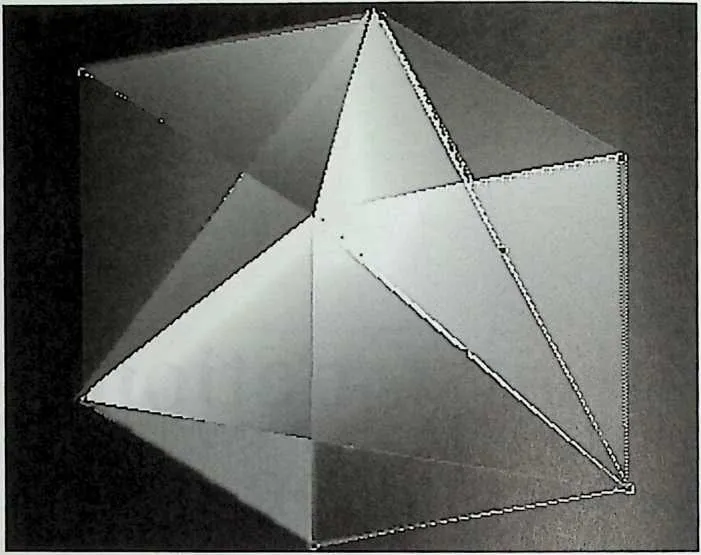
78Figure 8.1 Tetrahedron inside a cube.
9 one being the creation of a tetrahedron inscribed inside the cube in such a manner that the six edges of the tetrahedron constitute the face diagonals of the cube (Figure 8.1). The inscribed tetrahedron occupies exactly one-third of the volume of the cube.5
8.2 THE REGULAR TETRAHEDRON AND OCTAHEDRON
11A regular tetrahedron may thus be considered as a truncation of the cube: Four comers of the cube are completely removed. These four corners may be juxtaposed to form a square pyramid whose four lateral faces are equilateral triangles (Figure 8.2). This pyramid constitutes one-half of a regular octahedron: Its volume equals exactly two-thirds of that of the original cube. Accordingly, this regular octahedron has a volume exactly four-thirds of that of the cube. We may therefore conclude that the volume of a regular octahedron equals exactly four times that of a regular tetrahedron having the same edge length. The portions truncated from the cube to produce a regular tetrahedron are called octants of an octahedron: Eight of them constitute a regular octahedron. The regular tetrahedron is the polyhedron with the smallest number of vertices and the only one in three-dimensional space in which all vertices are equidistant from each other. It is also the most resistant to compression.
12 The cube does not occur much in nature,6 nor does the right angle occur in the art and architecture of peoples much in touch with nature. It is, however, a convenient reference solid; as we have just noted, it may be deconstructed into an inscribed tetrahedron and half of a regular octahedon. I shall
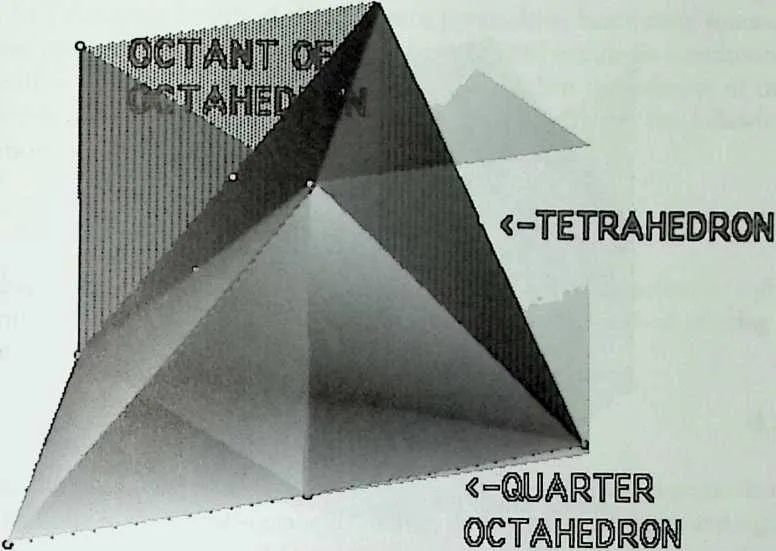
14 Figure 8.2 Cube deconstructed into a tetrahedron and half an octahedron.
15 call this tetrahedron the reference tetrahedron and assign it a unit volume; then the cube circumscribed around it (the reference cube} has volume 3, and the octahedron having the same edge length as the tetrahedron (the reference octahedron) has volume 4. (For a discussion of units of volume, see Chapter 4.) The cube is a space filler; that is, it and its clones may fill all of a space without gaps or overlaps. Therefore, its components, the regular tetrahedron and half-octahedron, which individually are not space fillers, may together fill a space in the ratio of one tetrahedron per half-octahedron, which amounts to two tetrahe-dra per octahedron. Structures that have the same symmetry as the cube, and that includes all polyhedra considered here (with the possible exception of the regular tetrahedron whose symmetry is a subsymmetry of the cube), may be built out of octahedra sharing faces with tetrahedra only and of tetrahedra sharing faces with octahedra only.
8.3 THE CUBOCTAHEDRON
17The cube may also be truncated as far as the midpoints of its edges (Figure 8.3); eight octants of an octahedron are removed, leaving a polyhedron having eight triangular and six square faces, called the cuboctahedron. The octahedron thus removed from the cube has half the edge length of the reference tetrahedron; its volume therefore equals one-eighth the volume 4 of the reference octahedron, that is, 1/2. Because the reference cube has a volume equal to 3, the volume of the cuboctahedron that remains after the truncation equals one-half less, that is, 5/2.
18 In Figure 8.4 we note that the cuboctahedron has four hexagonal cross
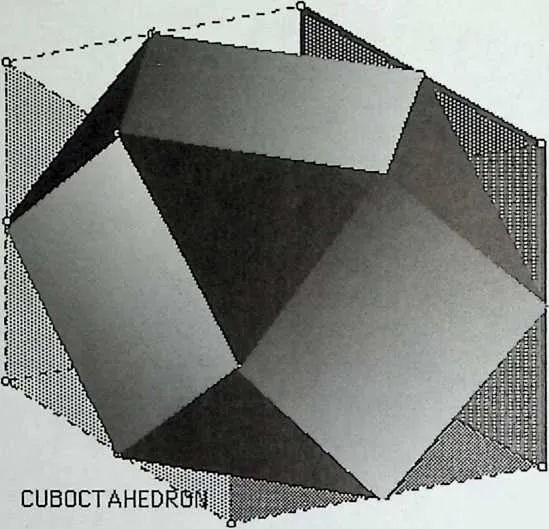
20 Figure 8.3 Truncation of a cube to form a cuboctahedron.
21 sections: Each vertex of the cuboctahedron functions as a vertex of two of these regular hexagons. Accordingly, the cuboctahedron has 12 vertices, each at the center of one of the edges of the reference cube. The distance between the center of the cuboctahedron and each of its 12 vertices equals exacdy the edge length of the cuboctahedron, a characteristic that led R. Buckminster Fuller to name the cuboctahedron vector eqtiilibrium.
22 The cuboctahedron may itself be constructed out of regular octahedra and tetrahedra. As neither of these constituent forms has square faces and the cuboctahedron has six of these, the regular octahedra need to be bisected, so that their equatorial cross sections may supply the square faces for the cuboctahedron. The tetrahedra and octahedra constituting the cuboctahedron all
23 have half the edge length of the reference tetrahedron; hence their volumes are, respectively, 1/8 and 1/2. If we call the number of tetrahedra constituting the cuboctahedron x and that of the octahedra y, then the volumes of the cuboctahedron and its constituent polyhedra are related by the following equation:
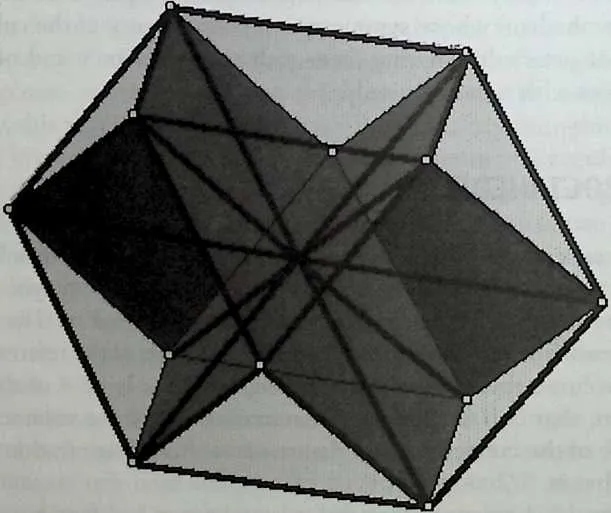
25 Figure 8.4 Four hexagonal cross sections of a cuboctahedron.
26 (1/8) x+(1/2) y= 5/2 or x+4/=20 (8.1)
27 Furthermore, since the cuboctahedron results from the subtraction of eight octants of the octahedron from the cube, it is one octahedron short of being a space filler. Hence
28 x=2(y+1) (8.2)
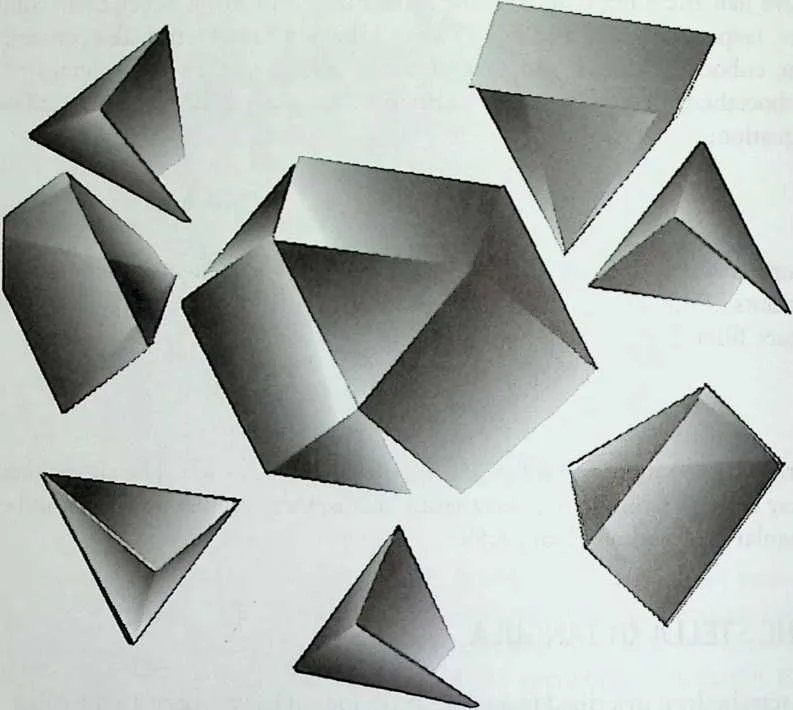
29 From Equations (8.1) and (8.2) it follows thatjy = 3, x = 8: The cuboctahedron may be built from six half-octahedra, that is, three regular octahedra and eight regular tetrahedra (Figure 8.5).
8.4 THE STELLA OCTANGULA
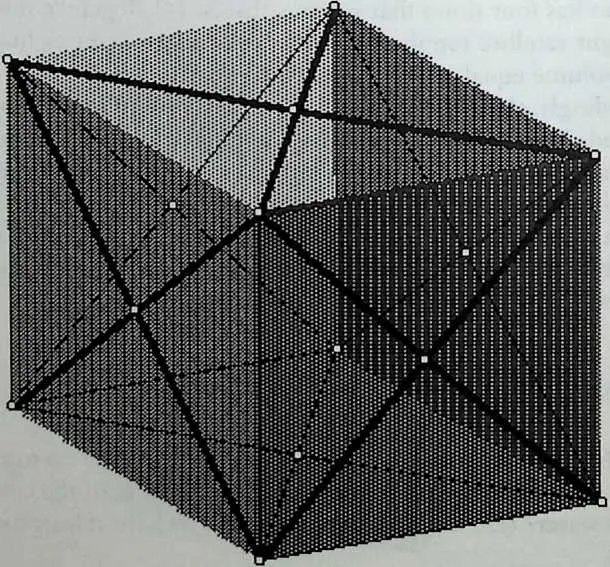
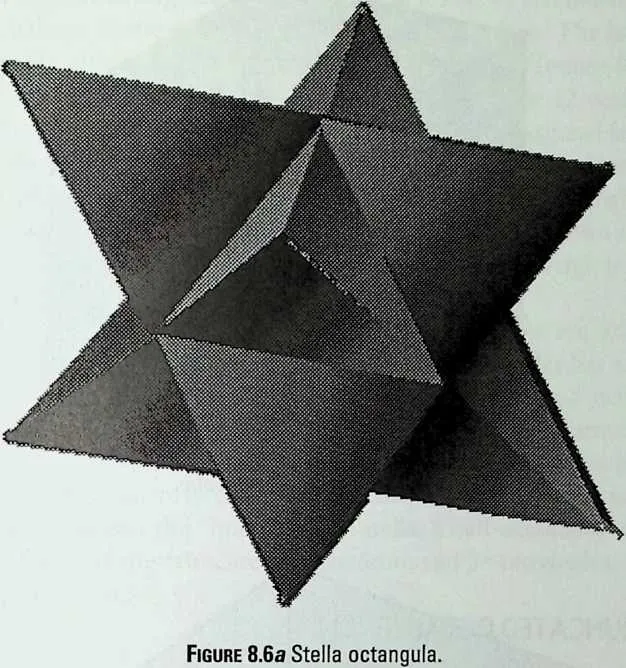
31A tetrahedron inscribed in a cube shares four of its vertices with the cube. The remaining four cube vertices could be shared by a second tetrahedron (Figure 8.6), whose six edges are each perpendicular to one of the edges of the first tetrahedron. The two tetrahedra overlap: The space shared by them is occupied by a regular octahedron. The space not shared by the two overlapping tetrahedra is constituted of eight tetrahedra having an edge length half that of the reference tetrahedron; their volumes are therefore 1/8 each. The central octahedron has four times that volume, that is, 1/2. Together, this octahedron and its eight satellite tetrahedra form a Stella octangula, or eight-pointed star, having a volume equal to 3/2 (Figure 8.6/z).
32 Accordingly, the Stella octangula occupies one-half of the cube in which it is inscribed. Nevertheless, it is not a space filler, because it is constituted of one regular octahedron and eight tetrahedra, six tetrahedra in excess of the ones required for space filling. For the purpose of filling space, these six excess tetrahedra would require three additional octahedra; indeed, 12 quarter-octa-hedra at the edges of the cube will exactly fill the space between the inner walls of the cube and the external faces of the Stella octangula.
33 THE TRUNCATED OCTAHEDRON
34 A Riddle: Imagine a hollow cube partially filled with water up to a level where the water surface is a regular hexagon. What fraction of the cube volume is filled with water? (Do not turn the page until you have at least considered the question.)
8.5 CUBOCTAHEDRON WITH CONSTITUENT TETRAHEDRA AND OCTAHEDRA
36Figure 8.5 Exploding cuboctahedron.
37 Figure 8.6 Two tetrahedra inscribed in a cube.
40 The answer is one-half: The cube was placed with one vertex on a table and its body diagonal vertical, or, as our editor asserts, hanging by a thread attached to one of its vertices. The cube can thus be bisected into two halves (Figure 8.7) having one hexagonal, three triangular, and three irregularly pentagonal faces, which, of course, are space fillers as well. These half-cubes are themselves octants of a truncated octahedron (Figure 8.8), that is, a regular octahedron with its six vertices amputated. If we consider the truncated octahedron inscribed in the reference cube, the volume of the cube will be 3. Hence the volume of the truncated octahedron equals 3/2, exactly the same as that of the Stella octangula inscribed in the cube. The truncated octahedron may itself be constructed out of tetrahedra and (half) octahedra; at least six half-octahedra are needed to provide the six square faces. These octahedra and tetrahedra have an edge length one-quarter that of the reference octahedron and tetrahedron, so that their respective volumes are 1/16 and 1/64. Once again, if x is the number of tetrahedra and y the number of octahedra in the truncated octahedra:
41 (1/64) x + (1/16) y= 3/2 or x+4/=96 (8.3)
42 and
43 x=2y (8.4)
44 Therefore, x= 32 andy= 16: The truncated octahedron maybe built from 32 tetrahedra and 16 octahedra. Of the latter, three need to be halved. Because
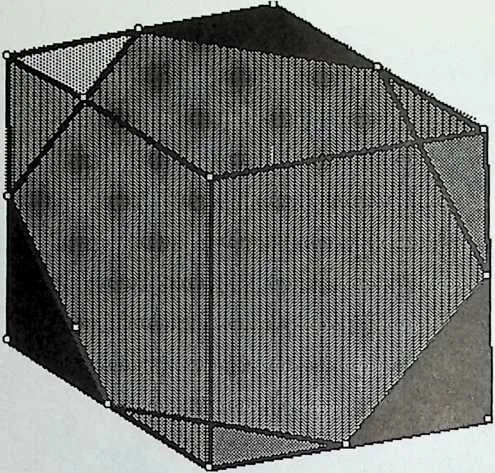
46 Figure 8.7 Bisection of the cube.
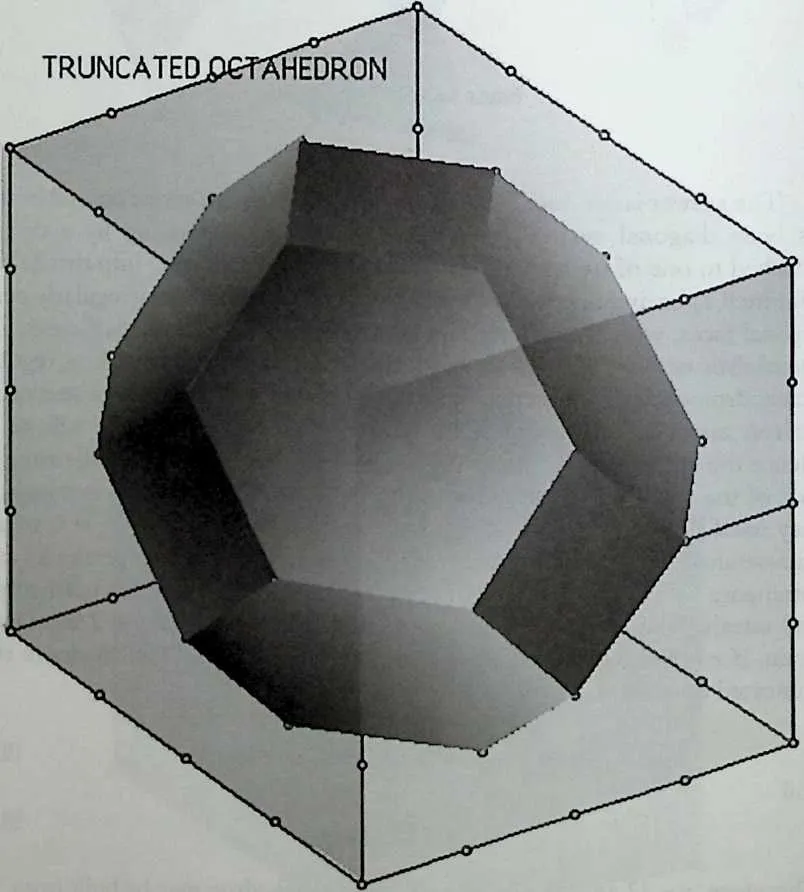
48 Figure 8.8 Truncated octahedron.
49 the number of remaining octahedra, 13, is odd, it follows that one of these 13 octahedra will go in the center of the truncated octahedron. The latter polyhedron has 36 edges, of which 24 bound the square faces. Twenty-four tetrahedra are configured adjacent to the six square faces. The 12 octahedra all have the same dihedral angles as the angles between the hexagonal faces of the truncated octahedron, for these hexagons and their adjoining edges are what is left of the faces of the original truncated octahedra. Accordingly, the 12 remaining octahedra will be situated at the intersections between hexagonal faces, of which there are just 12, namely, the edges of the large octahedron from which the truncated octahedron was generated.
50 This leaves eight tetrahedra unaccounted for. These are attached to the faces of the central octahedron; each of these tetrahedra has a vertex in the middle of one of the hexagonal faces of the truncated octahedron. Together, the central octahedron and the eight tetrahedra attached to it constitute a small Stella octangula inside the truncated octahedron. The truncated octahedron may therefore be constituted of a Stella octangula, 12 octahedra between the ‘‘horns’’ of the Stella, 6 half-octahedra to provide the square faces of the truncated octahedron, and 24 tetrahedra, three for each hexagonal face.
8.6 THE RHOMBIC DODECAHEDRON
52We shall show now that this form may be considered as a special stellation of either the cube or the regular octahedron. There are [?z(?z-l)]/2 connections between n points. There are, accordingly, 28 connections between the eight vertices of a cube. Of these, 12 are edges of the cube. Another 12 are the diagonals of the six faces of the cube, constituting the edges of the two tetrahedra inscribed in the cube. The remaining four connections pass through the center of the cube; they are the four body diagonals of the cube.
53 These body diagonals intersect at the center of the cube, at angles arc- cos±(l/3) to each other. The cube may be subdivided into six mutually congruent square pyramids whose lateral edges run along the body diagonals of the cube. Two of these pyramids may be joined along their square faces to form an octahedron; because the triangular faces of the pyramids are not equilateral, this octahedron is not regular. However, because the cube is a space filler, this octahedron will also fill space by itself: Three of such octahedra may be bisected into six square pyramids, which may then be reassembled into a cube and thus fill space.
54 When the six constituent square pyramids of the cube are each positioned with a square face contiguous with one of the faces of a second cube, the result (Figure 8.9) is a rhombic dodecahedron,7 which, accordingly, may be considered a special stellation of the cube. Of the 12 rhombic faces the 12 short diagonals are the 12 edges of the reference cube from which it was generated. Because the volume of the reference cube is 3 and the dodecahedron was generated from two such cubes, the volume of the rhombic dodecahedron equals
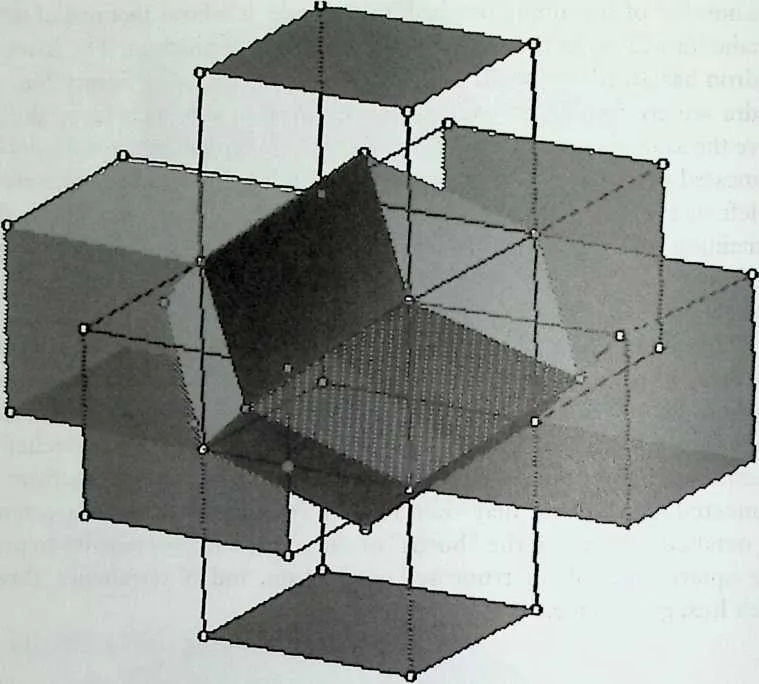
5758Figure 8.9 Rhombic dodecahedron in an array of cubes.
- 6.
- The edges of the dodecahedron correspond to the body diagonals of the cube; the surface angles of the rhombic dodecahedron are therefore arc-cos±(l/3).
60 The 12 long diagonals of the faces of the rhombic dodecahedron constitute the edges of a regular octahedron, which is equal in size to the reference octahedron: Its volume equals 4. The space between this octahedron and the outer shell of the rhombic dodecahedron has a volume equal to 2; this space will just accommodate eight quarter-tetrahedra, of which one is shown in Fig-
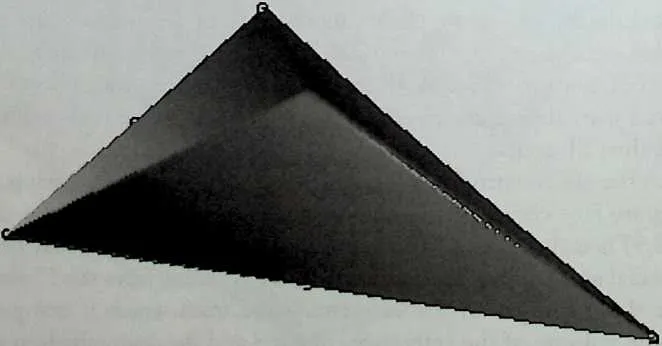
6364Figure 8.10 Quarter-Tetrahedron.
65 ure 8.10, supplying just the two needed volume units. The rhombic dodecahedron may therefore be considered as well as a regular octahedron stellated by eight quarter-tetrahedra.
66 DUALS
67 The valency of a vertex of a polyhedron is defined as the number of edges meeting at that vertex. The valency of a face equals the number of edges around that face. Two polyhedra are each other’s duals if to each face of one there corresponds a vertex of the other, and vice versa. A cube has eight trivalent vertices and six quadrivalent faces, whereas an octahedra has eight trivalent faces and six quadrivalent vertices: Cube and octahedron are a pair of duals. The rhombic dodecahedron has twelve quadrivalent faces and eight trivalent and six quadrivalent vertices. Its dual should have twelve quadrivalent vertices and eight trivalent and six quadrivalent faces: We have seen that this is the cuboctahedron. The tetrahedron has four trivalent faces as well as four trivalent vertices; it is self-dual. Duals always have the same number of edges.
8.7 CONCLUSIONS
69The term deconstruction, which is being used by historians of art and architecture in a figurative sense, has been applied here in its original literal sense of taking apart. The cube can be deconstructed in many different ways, but stronger, more stable, and more fundamental building blocks to be retrieved from it are the regular tetrahedron and octahedron. These fill space in a ratio of two tetrahedra per octahedron. In turn, the regular tetrahedron and octahedron may be combined in a diversity of ways to construct semi-regular solids: truncated octahedron, cuboctahedron, Stella octangula, rhombic dodecahedron, and others. Conversely, the cube may be constructed out of its component parts; these component solids may be combined in various ways to fill space.
70 When these various forms are juxtaposed so that their three fourfold axes of rotational symmetry are aligned, their volumes are found to be related by simple rational numbers. Such ‘‘nesting’’ is possible because the numbers of vertices, edges, and faces of these polyhedra are all products of their rotational symmetry values 2, 3, and 4, as shown in Table 8.1.
71 In Table 8.1 all volumes are normalized with reference to their circumscribed or inscribed cube. When the vertices, edges, or faces are of two different kinds, their numbers are shown as a sum, for instance, the truncated octahedron has 6 square and 8 hexagonal faces, and the Stella octangula has 12 edges corresponding to its internal octahedron and 24 edges corresponding to the 8 corner tetrahedra.
72 In three-dimensional design it is useful to know how diverse numbers may be represented spatially by means of polyhedra. These numbers are obtained from Table 8.1 and listed in Table 8.2.
73 TABLE 8.1 Parameters of Diverse Polyhedra Having Cubic Symmetry
|
77Polyhedron |
78Number of Number of Number of 79Vertices Edges Faces Volume |
|
80Cube 81Tetrahedron 82Octahedron 83Truncated Octahedron 84Cuboctahedron 85Stella octangula 86Rhombic dodecahedron |
878 12 . 6 3 884 6 4 1 896 12 8 4 9024 12+24 6+8 3/2 9112 24 6+8 5/2 926+8 12+24 24 3/2 936+8 24 12 6 |
100 Note that for each of these forms Euler’s relation holds: The sum of the number of faces and vertices is two units greater than the number of edges.
101 In summary, then, in spite of the cube’s use as a space filler and because its faces may be aligned parallel and perpendicular to gravitational forces, the tetrahedron and octahedron and their symmetrical subdivisions are stable and offer an expanded view of the possibilities of three-dimensional forms, their interrelationships and transformations, and their ability to fill space in an attractive diversity of permutations and combinations.
103104TABLE 8.2 Polyhedral Representation of Numbers
|
110Equals the Number Of |
|
|
113Vertices of a tetrahedron 114Faces of a tetrahedron |
|
|
126Vertices of a cuboctahedron 127Edges of a cube 128Edges of an octahedron 129Faces of a rhombic dodecahedron |
|
|
138Vertices of a truncated octahedron 139Edges of a cuboctahedron 140Edges of a rhombic dodecahedron 141Faces of a Stella octangula |
|
152 ACKNOWLEDGMENTS
153 The author gratefully acknowledges the comments and suggestions from Professors Thomas Banchoff and Anne Tyng, which have been incorporated into the final draft of this chapter.
8.8 NOTES
- 1.
- A. L. Loeb, ‘‘A Systematic Survey of Cubic Crystal Structures,’’ Journal of Solid State Chemistry, Vol. 1, 1970, pp. 237–267.
- 2.
- Juana de Laban, private communication.
- 3.
- A. L. Loeb, ‘‘Vector Equilibrium Synergy,’’ InternationalJournal ofSpace Structures, Vol. 1, 1985, pp. 99–103.
- 4.
- A. L. Loeb and W. Varney, ‘‘A Stabilized Cuboctahedron Frame,’’ International Journal of Space Structures, Vol. 7, 1992, pp. 83–90.
- 5.
- A. L. Loeb, ‘‘Remarks on Some Elementary Volume Relations Between Familiar Solids,’’ The Math Teacher, Vol. 58, 1965, pp. 417–419.
- 6.
- A. L. Loeb, ‘‘The Architecture of Crystals,’’ in Vision and Value: Module, Proportion, Symmetry, Rhythtn, Gyorgy Kepes, ed., Braziller, New York, 1966.
- 7.
- A. L. Loeb, Space Structures, Their Harmony and Counterpoint, Addison-Wesley Advanced Book Program, Addison-Wesley, Reading, MA, 1976, Birkhauser, Basel/Boston/Berlin, 1991, pp. 147–162.