
4 Buckminster Fuller and the Relevant Pattern
2Arthur L. Loeb
4.1 INTRODUCTION
3In the early sixies R. Buckminister Fuller and I discovered that we were using the same coordinate system, based on tetrahedral-octahedral space filling, the former for the design of architectural trusses, the latter in order to understand why minerals have the structure they do. We both rejected the cube, Fuller because of its instability, myself because it concealed the natural design of crystals, rather than rendering it obvious.
4 This chapter explains this coordinate system, explores Fuller’s discomfort with irrational numbers and continuous structure, and relates my role in the writing of Synergetics. The five-fold way of dome structures and its influence on recent molecular physics and on the metallurgy of alloys is stressed.
4.2 THE RELEVANT PATTERN
6Spinel is a mineral and semiprecious stone. Its chemical formula is MNX, where M and N represent small, positively charged metal ions and X stands for large, negatively charged ions such as oxide or sulfide. The chemical formula indicates that there are one M ion and two N ions for each pair of X ions. Over 35 years ago, it was my task1 to investigate the mechanism by which information in the form of a magnetic flux could be held in materials having a spinel-like configuration of oxide and magnetic metal ions.2 The magnetic flux results from the interactions between the various types of ions in the spinel, and especially from their spatial interrelations.
7 The configuration of the ions in spinel is apparently complex; a ball-and-rod model of the ‘‘cubic unit cell’’ was forbidding and did not reveal any mechanism explaining why nature would have chosen to arrange these ions in such a perversely complicated manner. This configuration was revealed experimentally by means of X-ray analysis; X-ray crystallographers traditionally index the locations of ions in a solid like spinel relative to a cube, creating the so-called unit cell.
8 I decided that the first step in developing an understanding of the interactions of the ions in spinel was to see what sort of structure each of the metal ions would separately form in conjunction with the oxide ions, in other words, what the structures of the individual oxides would be. In spinel, the oxide ions occupy the vertices and the centers of a cubic unit cell, as shown in Figure 4.1. However, a slight but useful change in perspective results if we abandon the traditional unit cell, remembering that the crystal is made up of stacked unit cells. If, instead of slicing out the cube of Figure 4.1, we move over half a cube edge length, we can slice out a different cube, as shown in Figure 4.2: Now
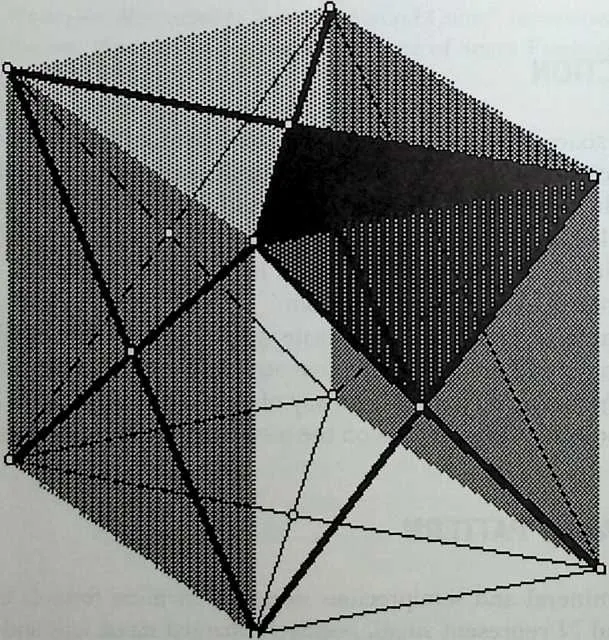
1112Figure 4.1 Face-centered cubic unit cell.
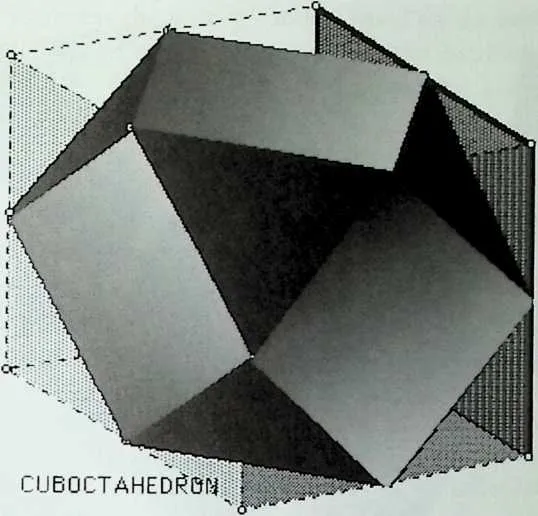
1516Figure 4.2 Cuboctahedron in a cubic cell.
17 the oxide ions occupy the centers of the new cubes as well as the centers of each of its 12 edges. The oxide ions are now seen to occupy the vertices of a polyhedron known as the cuboctahedron, called by R. Buckminster Fuller the ‘‘vector equilibrium.’’
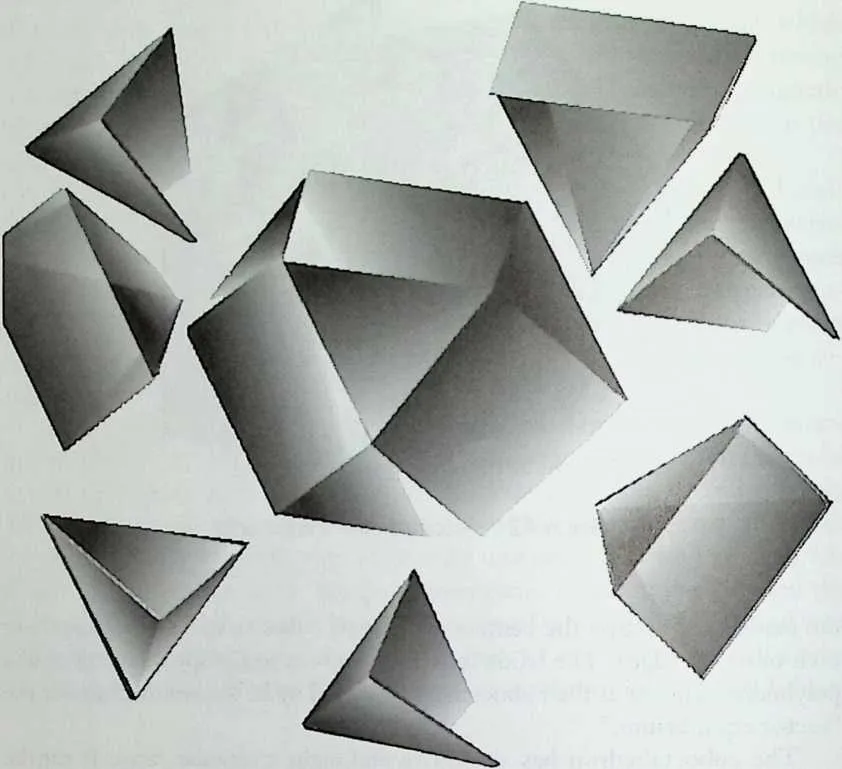
18 The cuboctahedron has six square and eight triangular faces. It can be constituted of eight regular tetrahedra and six square pyramids, each of which is half of a regular octahedron (cf. Figure 4.3). Accordingly, the large oxide ions, located at the center and the vertices of the cuboctahedron, have octahedral and tetrahedral interstices in between, which may be occupied by the smaller metal ions. Once one knows whether these metal ions occupy tetrahedral or octahedral ions in their simple oxide crystals, one has a clue as to where these ions would go in composite oxides containing several different kinds of metal ions.
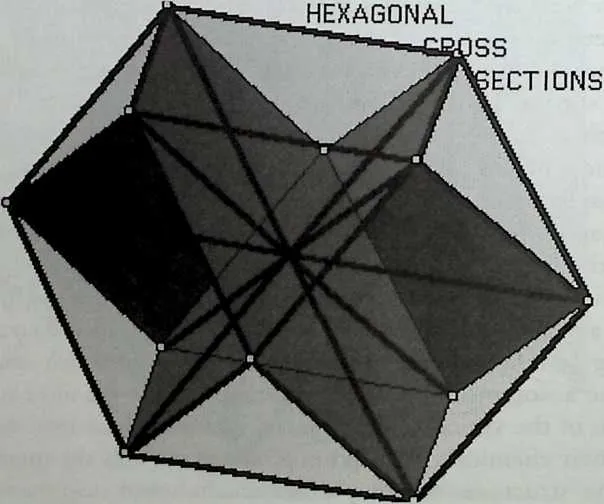
19 In Figure 4.4 four different hexagonal cross sections through a cuboctahedron are shown. The center of the cuboctahedron is surrounded by six vertices in each of four regular hexagonal cross sections; that is to say, of the twelve vertices of the cuboctahedron, six form a regular hexagon around the center, three He on one side, and the remaining three He on the opposite side of that hexagon. In the crystal each oxide on a vertex of the cuboctahedron is in turn the center of a cuboctahedron, the original center being one of twelve vertices of this new cuboctahedron. Thus we have come by a series of steps from a unit-cell model to one of stacked, closely packed layers of oxide ions having tetrahedral and octahedral interstices in which smaller metal ions may be accommodated. It then turned out that the most symmetrical distribution of the various types of metal ions over these interstices consistent with their chemical composition produces not only the spinel structure but also the structures of many other minerals and man-made materials
20 Figure 4.3 Cuboctahedron made up of regular tetra- hedra and half-octahedron.
21 Figure 4.4 Four hexagonal cross sections through a cuboctahedron.
22 CUBOCTAHEDRON WITH
23 CONSTITUENT TETRAHEDRA
24 AND OCTAHEDRA
26 (Figure 4.5). Whereas the unit-cell model based on the cubic unit cell was obscure and did not offer any explanation for the distribution of ions in a crystal, the octahedron/tetrahedron model provided a simple geometric insight into crystal structures.
27 In 1960 the International Congress of Crystallography took place in Cambridge, UK. I felt like a real iconoclast in presenting an alternative to the cubic unit cell so sacred to the crystallographer. When I had finished my presentation, I saw Elizabeth Wood, head of the U.S. delegation, charging toward me. Somewhat apprehensive, I was surprised to hear her say: ‘‘All my life I have wanted to say ‘TO HELL WITH THE UNIT CELL!’, and now you have done it.’’
28 To implement my systematic ordering of crystal structures, I designed four types of modules,3 two tetrahedral and two octahedral (Figure 4.6), which, in various combinations and permutations, could represent a multitude of crystal structures (Moduledra). Two of these polyhedra contained a colored sphere in the center, representing a metal ion; the other two were empty.
|
322=CUBIC: |
Fraction filled of
|
332=HEXAGONAL: |
|
|
35octahedra: |
36tetrahedra: |
||
|
39All |
40None |
41Niccolite 42BX |
|
|
451/2 |
46None |
||
|
502/3 |
51None |
52Corundum 53B2X3 |
|
|
54Spinel 55AB2X4 |
561/2 |
571/8 |
|
|
61None |
621/4 |
||
|
66None |
671/2 |
68Wurtzite 69AX |
|
|
70Antifluorite 71A2X |
72None |
73All |
|
|
MIXED:
| |||
|
78Carborundum 79AX |
80None |
811/2 |
|
9192Figure 4.5 Systematic overview of common crystal structures.
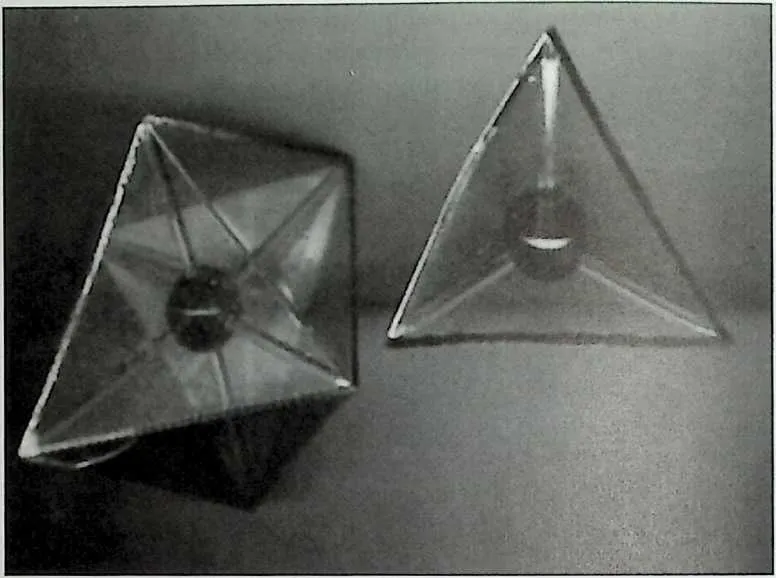
9596Figure 4.6 Moduledra™ crystal building blocks.
97 Because regular tetrahedra and octahedra together can fill all of space in a ratio of two tetrahedra per octahedron, it was possible to arrange these modules without fasteners. The vertices of the modules represent the centers of the large ions, whereas the spheres in the centers of the modules represent metal ions. The empty modules represent unoccupied interstices; if for no other reason, these modules were unique in that there was an explicit representation of an empty space. I had designed these modules to be attractive and pleasant to handle, with the result that they were exhibited here and there.
98 In 1962 the Educational Network was making a television series on Richard Buckminster Fuller. William Wainwright, an associate of Fuller’s, had seen my Moduledra on exhibit and suggested that these should be included in the films. Accordingly, the authors of the films interviewed me and invited me to meet Fuller. At lunch Fuller told me that he had hoped to find in nature, and specifically in crystals, building blocks like tetrahedra, octahedra, cuboctahedra, and others, but not cubes, which are inherently unstable. All the crystallographers whom he had met, however, referred to the cube as the basic building block, the unit cell that was encountered previously. Fuller felt encouraged to learn from my work that a model based on tetrahedra and octahedra gave a clearer understanding of crystal structure than one based on the unit cell.
99 Since that first meeting, I have always been impressed with Fuller’s genius in recognizing the relevant pattern and rejecting the trivial one. Although known primarily for his lightweight structures capable of spanning large areas with a minimum of matter, he had also studied the very opposite, namely, the densest packing of spheres.4 The cuboctahedron and its deconstruction into eight tetrahedra and six half-octahedra were basic to his understanding of sphere packings.5 The fact that the distance between adjacent vertices of the cuboctahedron equals that of each vertex to the center of that polyhedron caused him to call the cuboctahedron vector equilibrium: If there is an optimal distance between the centers of two interacting objects, then the cuboctahedron is an optimal configuration of such objects, conserving an optimal number of such optimal distances.
100 Fuller kept wrapping layers of spheres around the 12 constituting the vertices of the inner cuboctahedron and counted the number of spheres in each successive layer. He noted that these numbers, successively 12, 42, 92, 162…, could be written as the squares of successive integers followed by the digit 2. I am told that the renowned geometer H.S.M. Coxeter first greeted this observation with disbelief, but by that time I had already written a proof for Synergetics.6 Fuller’s preoccupation with numbers found an outlet in Chapter 1200 of Synergetics, called Numerology. In all this work Fuller plays with numbers, delighting in the patterns that turn up. When, in the preface to Synergetics, I wrote: ‘‘…Fuller…discerns patterns and accepts their significance on faith. His is not the burden of proof: the pattern is assumed significant unless proven otherwise.’’ Fuller expressed surprise, because he thought that he had provided a proof.
101 Some of my students similarly feel that a demonstration is actually a proof; when mathematics is transformed into an experimental science, proofs become inductive rather than deductive. A proof then consists of a generalization encompassing as many diverse phenomena as possible. Very few physics theorems have withstood the test of time: Even Newton’s laws of motion eventually were found to be approximations valid only at sufficiently large scales. The proof of a theorem will, however, offer an insight into the constraints within which the theorem is valid. I offer two instances in design science as an illustration:
102 William Varney was working at Fuller and Sadao’s architectural office in Cambridge while finishing the requirements for his bachelor’s degree at Harvard through a tutorial on design science with me. I had shown him that a necessary, but not sufficient condition for the stability of polyhedra is that
103 (4.1)
104 3I/-F<6
105 where V equals the number of vertices and E the number of edges of the polyhedron.7 For tensegrity structures, if C is the number of compression members and T the number of tension members8:
107108£= 7+ C
109T=4C
110V=2C
111 Hence
112 (4.2)
114115C<6 Varney had noted that tensegrities having more than six compression members, although holding together on a small model scale, tended, when constructed on a large scale, to sag more than the classical six-strut tensegrity, and was delighted to see that a mathematical analysis actually proved the fundamental stability of the six-strut tensegrity.
116 Some years later, Varney was teaching the design science seminar-workshop with me. We were examining the rhombic triacontahedron, a structure related to domes, having 30 rhombic faces.9 He related to me that Shoji Sadao, Buckminster Fuller’s partner, was using arctan 2 as a convenient approximation for the surface angle of the triacontahedron. Because the ratio of the lengths of the diagonals of each of the faces of this polyhedron exactly equals the golden fraction 4>, defined by the equation
118119<|) = 1/(1 + <b) (4.3)
120 it seemed unreasonable that the surface angle of the triacontahedron should be independent of the golden fraction. Wasma’a Chorbachi,10 moreover, had discovered medieval Islamic design manuals giving rules of thumb for geometrical constructions, which work well on a moderate scale, but which we could prove to be approximations. Accordingly, I decided to calculate the tangent of the surface angle of the triacontahedron, which is also the angle between the diagonals of a golden rectangle. It turned out that the sine of that angle equals 2cf>/(2-d>), the cosine of <J>/(2-<h). Their ratio, the tangent of the surface angle of the triacontahedron, accordingly equals exactly 2, and Sadao’s ‘‘approximation’’ was, in point of fact, no approximation at all, but rigorously correct, and thus valid at any scale! It was not until May of 1995 that I was able to give Sadao this proof of the exactness of his ‘‘approximation,’’ which still surprised him.
121 Fuller was uncomfortable with irrational numbers11 and would have been delighted with the elimination of the irrational golden fraction from the expression for the surface angle of the triacontahedron. This discomfort relates to his discrete rather than a continuous view of matter: a circle is not the locus of all points equidistant from a given point, but rather a polygon with a great many, but a finite number, of sides, and the number it should therefore be rational.
122 Following our first meeting, Fuller sent me two books about his work. Although I had myself written two books by then, I did not think that their subject matter, the electric double layer around spherical lyophobic colloid particles and wave mechanics, would hold the slightest interest for Fuller. Therefore, I decided to send him a book on the Dutch graphic artist M.C. Escher instead. At the same international congress in Cambridge, where I had presented my Moduledra crystal building modules, Escher had been invited to deliver an address, and our meeting there turned into a lasting friendship. Fuller was so impressed with Escher’s art that I decided to organize a symposium to introduce these two pivotal figures in design science to each other.
123 In the fall of 1964, a small number of scholars gathered at the Ledgemont Laboratory of the Kennecott Copper Corporation in Lexington, Massachusetts, for a symposium on structure systematics. Both Fuller and Escher were scheduled to be among the speakers, but at the last moment Escher became ill in Canada, so that I had to read his paper. When Fuller began his own contribution, he characteristically squirmed, complained about the heat, and removed his jacket for the first five minutes, then launched into a brilliant survey of design science and fascinated, charmed, and entertained his sophisticated audience for hours.
124 My young colleague Eric Haughton, a psychology graduate student of behaviorist Fred Skinner, delivered a paper on his work with programmed instruction. Instantly, some of the scholars turned into parents, interrupting the speaker with their concerns. Suddenly, Fuller said: ‘‘I am amazed. I thought this was an audience of scientists, yet you keep a scholar from presenting you his quantitative data.’’ The parents sobered up, and Haughton continued without further interruption.
125 Fuller had been with us for the entire week but had to leave early Friday afternoon to get a flight at Logan Airport. The next Monday my phone rang. It was Buckminster Fuller. ‘‘Where are you?’’ I asked. ‘‘At Logan Airport’’ was the answer. ‘‘Did you spend the whole weekend there?’’ was my reaction. No, it turned out that he had gone home to California over the weekend and happened to be passing through Logan again on his way elsewhere. He graciously thanked me for including him in the symposium and invited me to collaborate with him on the forthcoming synergetics book.
126 Eleven more years were to pass before the actual publication of Synergetics. Fuller invited Escher to contribute some illustrations to his volume, which the artist agreed to do. Unfortunately, completion of Synergetics was delayed until well after Escher’s passing, so nothing came of that collaboration. It was interesting to compare the working methods of these two geniuses. Interestingly, Fuller, the architect and inventor, appears to have been the more intuitive (Fuller even named one of his boats as well as one of his books Intuition), whereas Escher, the artist, was very precise and analytical. Both became icons of the 1960s counterculture, yet each was very traditional in demeanor and dress.
127 In 1972 Buckminster Fuller invited us to his island off Camden, Maine. As I had just joined the Department of Visual and Environmental Studies at Harvard, which was having a faculty meeting the day following our visit to Bear Island, I decided, knowing Fuller’s propensity for long conversations, that it would be the better part of valor to spend the night on the mainland so that we could get an early start the next morning. On the appointed day a boat was to meet us at the dock in Camden. I wondered how we would recognize the boat, or be recognized, but I need not have worried, for Fuller was navigating the Intuition himself. When we first met, Fuller quickly noted that I had done a lot of sailing in my day. Indeed, growing up in Amsterdam, I had been a Sea Scout; accordingly, Fuller entrusted the rudder to me.
128 As we neared a cruising windjammer, Fuller instructed me to pull up beside her because there was a person aboard with whom he desired to speak. The passengers looked rather anxious, apparently fearing piracy, but the party was found quickly and invited to Bear Island with a promise that he would be restored to his cruise in due time. The surprised man took a few minutes to collect his wife and some baggage and then joined us on the Intuition. Fuller told me that he had a group of students working on a dome on Little Bear Island who were anxious to talk with me, so after lunch we adjourned there, painted the floor of the new dome being built so that it could survive the next winter before being completed, and then returned to Bear Island itself for dinner and one of Fuller’s famous roundtable discussions about the state of the whole earth. Fuller showed me the various islands in the distance where his relatives and friends from Milton, Massachusetts, had summer houses; clearly, this world citizen still felt that his real home was right there. His grasp of the relevant pattern clearly harks back to his roots in New England transcendentalism, notably to his great aunt Margaret Fuller. Late at night Fuller himself was kind enough to take us back to Camden.
129 Peter Pearce was to be the editor of Synergetics, and we met several times during the next few years. Fuller’s original intention had been to have my contributions interspaced in a different typeface as running comments between his text. This did not appear practical, however, and so I wrote a preface and a number of chapters. I recall a gathering at our house on a very wintry day, including Fuller, Pearce, and a number of associates. We had had snow and frost, then a sudden thaw accompanied by a torrential rain. Suddenly, one of our guests felt wet, and we discovered water leaking through the living room ceiling. The bathroom upstairs was flooded with backup from the gutters, and soon the whole house was leaking like a sieve. There was nothing to do but to place whatever buckets we had in crucial locations and to continue with whatever we had been doing, which was madrigal singing in the music room, an investigation of Fuller’s A-and B-modules in the living room, and the refilling of the buffet in the kitchen.
130 Fuller suggested installing electric wires on the roof to melt the snow when it started to accumulate on the roof. We thought that this Yankee architect would be the best expert we could hope for, but after the installation, the first snow, upon being melted, slid down the roof, taking the wires with it. Fuller had not realized that we still had a slate roof, which was too slippery to hold on to the wires!
131 After Peter Pearce had spent two years on Synergetics, subsidized by a grant, Fuller did not feel the volume was ready for publication, and the project lapsed. Some time in the early 1970s, I received a call from EJ. Applewhite, who introduced himself as the editor of Buckminster Fuller’s next book. Applewhite requested from me a reprint of my article in the Journal of Solid State Chemistry11 of which I had sent Buckminster Fuller a copy because it dealt extensively with the vector equilibrium. I gathered during our conversation that Applewhite had a background in security, for he asked me a great deal of questions but was reluctant to reveal any information about the book. I found out, however, that indeed the new book was Synergetics, and Ed Applewhite told me later that he realized then that the few bits and pieces from my contributions that he had come across were but the tip of an iceberg. Fuller had apparently rather indiscriminately distributed my contributions, but I, being apprehensive about having unpublished results so generally accessible, had bundled them into a copyrighted technical report, which I could then send to Applewhite.
132 In the mid-1970s I was working on my Space Structures." Concerned about the fate of my contributions to Synergetics, I wrote Fuller that regretfully I would need to withdraw these contributions and instead include them in my own forthcoming book if Synergetics were not published by 1975. Ed Applewhite told me that the letter built a fire under Fuller, with the result that Synergetics did appear with my contributions in 1975, followed by my Space Structures in 1976.
133 One of the first, and probably one of the few, people to read Synergetics from cover to cover was Amy Edmondson, who did so as an undergraduate student at Harvard-Radcliffe during a junior tutorial under my direction. Fuller would often state that a bicycle wheel is actually a tensegrity structure, a statement that Amy checked out as her senior thesis. I proposed that she construct a bicycle wheel in which the spokes were strings instead of metal bars and test out its strength. Although it is sometimes believed that the spokes in a bicycle wheel are compression members, they are actually tension members, with the hub suspended from the rim by the spokes. She actually built a tensegrity cart supported by a set of tensegrity wheels, positioned her brother in the cart, and then proceeded to cut the spokes one by one, until the inevitable catastrophe occurred. Interestingly, none of the remaining string spokes snapped, but the rim eventually collapsed; the function of the spokes is indeed to distribute the load over the rim. In that sense the wheel is a tensegrity structure.
134 Upon graduation, Amy Edmondson went to work with Buckminster Fuller in his Philadelphia office. Just before Harvard Commencement 1983, she called me to say that Fuller had decided to attend and asked whether we could have dinner with him the night before. We had a delightful evening, joined by Gyorgy and Juliette Kepes and my father, who had come over from his home in the Netherlands to celebrate his 90th birthday with us. Fuller, Amy, my wife, and I made a date to meet in Maine for a working session, but that dinner turned out to be the last time we met, for early in July we learned of the passing of both Buckminster and Anne Hewlett Fuller. After the interment in the Fuller family lot, near great aunt Margaret, in Mount Auburn Cemetery, Amy and I decided that the best tribute to Fuller would be a book explaining his ideas in more traditional language than Fuller’s own, which I proposed to Birkhauser for the Design Science Collection. The result was Amy’s A Fuller Explanation.
135 Already before Buckminster Fuller’s death, materials scientists began to recognize the importance of fivefold rotational symmetry.14 The geometer H.S.M. Coxeter lectured at Harvard on a range of virus structures having fivefold rotational symmetry; I wrote Fuller afterwards that Coxeter had declared that the viruses most resembling miniature Fuller domes were also the most deadly. Characteristically, Fuller replied that he was not surprised, because those would be the most stable and hence the most virulent viruses. Because fivefold rotational symmetry15 is incompatible with translational symmetry, crystals, which do necessarily have translational symmetry, cannot also be fivefold symmetrical.
136 Fivefold rotational symmetry occurs frequently in organic structures (plants, flowers, shells, viruses), which have a single symmetry axis, but not in crystals. Crystallographers were therefore surprised to find alloys whose X-ray diffraction patterns were fivefold symmetrical. After a characteristic period of denial, they had to abandon the superstition that fivefold symmetry in the X-ray pattern implies fivefold symmetry in the crystal. When the ions in a crystal diffract X-rays to generate the pattern from which crystallographers deduce the location of these ions in the crystal, they do so through the interaction between close neighbors in the crystal. If the immediate vicinity of each ion appears to be fivefold symmetrical, then, regardless of the fact that the entire crystal lacks fivefold rotational symmetry, the diffraction pattern will have fivefold rotational symmetry. Materials having this special structure are called quasicrystals.
137 With his dome structures, Buckminster Fuller introduced fivefold rotational symmetry into our visual culture. The U.S. Pavilion at Expo ‘67 in Montreal was a Fuller dome; altogether, the exposition was rich in untraditional polyhedral forms. The three-dimensional theme icon was a truncated regular tetrahedron, and Moshe Safdi’s Habitat abounds in space-filling poly-hedra. When Smalley and Kroto identified a molecule consisting of 60 carbon atoms, (C60), one of them used the dome kit he had bought for his young son to construct a possible model for this new structure.
138 Much successful science is a matter of pattern recognition, and one cannot recognize that with which one is not already familiar. Buckminster Fuller familiarized us with many unconventional structures, among them the truncated icosahedron, already familiar as the soccer ball but less so as the Fuller dome. That Fuller selected the relevant structure on the basis of its stability is borne out by his reaction to the Coxeter lecture. When C60 was named Buckminsterfullerene, popularly known as Buckyball, the attribution was a proper one because Fuller knew that the structure is stable and because his dome kit provided the means of constructing a stable structure having 60 mutually equivalent atoms.
4.3 NOTES
- 1.
- A. L. Loeb, ‘‘The Architecture of Crystals, or Simplicity in Design,’’ in Vision and Value: Module, Proportion, Symmetry, Rhythm, Gyorgy Kepes, ed., Braziller, New York, 1966.
- 2.
- J. B. Goodenough and A. L. Loeb, ‘‘A Theory of Ionic Ordering, Tetragonal Phase Formation, Magnetic Exchange and Lamellar Precipitation due to Covalent Forces in Spinels,’’ Physical Review, Vol. 98, 1955, pp. 391–408. A. L. Loeb,
142143‘‘A Systematic Survey of Cubic Crystal Structures,’’ Journal of Solid State Chemistry, Vol. 1, 1970, pp. 237–267. A. L. Loeb, ‘‘Hierarchical Structure and Pattern Recognition in Minerals and Alloys,’’ Per., Mineralogia, Vol. 59, 1990, pp. 197–217.
- 3.
- A. L. Loeb and G. W. Pearsall, ‘‘Moduledra Crystal Models,’’ American Journal of Physics, Vol. 31, 1963, pp. 190–196.
- 4.
- R. Buckminster Fuller, Synergetics, Macmillan, New York, 1975, pp. 33–37.
- 5.
- Ibid., Fig. 222.30.
- 6.
- Ibid., p. 857.
- 7.
- A. L. Loeb, ‘‘Vector Equilibrium Synergy,’’ International Journal of Space Structures, Vol. 1, 1985, pp. 99–103. A. L. Loeb and W. Varney, ‘‘AStabilized Cuboctahedron Frame,’’ International Journal of Space Structures, Vol. 7, 1992, pp. 83–90.
- 8.
- Fuller, Synergetics, Chap. 700.00.
- 9.
- A. L. Loeb, J. C. Gray, and P. R. Mallinson, ‘‘On the Icosahedron, the Pentagonal Dodecahedron and the Rhombic Triacontahedron,’’ Symmetry, Vol. 1, 1989, pp. 29–36. A. L. Loeb and W. Varney, ‘‘Does the Golden Spiral Exist, and if Not, Where Is Its Center?’’ in Spiral Symmetry, Istvan Hargittai, ed., World Scientific, Singapore, 1992, pp. 238–305.
- 10.
- W. K. Chorbachi and A. L. Loeb, ‘‘A Pentagonal Seal (from Scientific Manuscripts of the Geometry of Design), in Fivefold Symmetry, Istvan Hargittai, ed., World Scientific, Singapore, 1992, pp. 283–305.
- 11.
- A. L. Loeb, ‘‘R. Buckminster Fuller Versus the Irrational, a Double Entendre,’’ International Journal of Space Structures, to appear.
- 12.
- Loeb, ‘‘A Systematic Survey of Cubic Crystal Structures.’’
- 13.
- A. L. Loeb, Space Structures, Their Harmony and Counterpoint, Addison-Wesley, Reading, MA, 1976, Birkhauser, Basel/Boston/Berlin, 1991.
- 14.
- N. G. de Bruijn, ‘‘Algebraic Theory of Penrose’s Non-periodic Tilings of the Plane,’’ Kon. Nederl. Akad. Wetensch., Proc. Ser. A, Vol. 88,1981, pp. 38–66. A. Katz, and M. Duneau, ‘‘Quasiperiodic Crystals and Icosahedral Symmetry,’’ Journal de Physique, Vol. 47, 1981, pp. 181–196. A. Mackay, ‘‘Crystallography and the Penrose Pattern,’’ Physica A, Vol. 114, 1982, pp. 609–613.
- 15.
- An object has ra-fold rotational symmetry if it appears unchanged when turned 360/tz degrees. It has translational symmetry if it appears unchanged when moved a given distance parallel to itself, maintaining its orientation but not its position. Translational symmetry characterizes patterns infinite in extent. Because crystals contain so many millions of ions, they are essentially infinite in extent.
145Philip Johnson’s
146 Crystal Cathedral
147 and the Rhetoric of
148 II