
10 Multiplication by Division: In Search of Cosmic Hierarchy
2It may seem that we have strayed from Fuller's "operational mathematics" while investigating the symmetrical properties of various polyhedra in the previous chapter. Recall that "operational" indicates an emphasis on procedure and experience: what to do to develop and transform models or systems. "Multiplication by division" brings us back to experience, introducing an operational strategy, which will add new meaning to Fuller's term "intertransformabilities". We thus elaborate on the shared symmetries among shapes while discovering new transformations from one to another, and this time previous experience allows us to anticipate results.
3 Multiplication by division describes Bucky's journey through our expanding polyhedral inventory. Previous exposure to both Loeb's work and the IVM sets the stage, making us so familiar with these shapes that additional results can be immediately placed in context. The transformations explored in this chapter occur within the IVM frame of reference, adding volume relationships to our accumulated information about topology and symmetry. You may be surprised to find that many statements seem obvious at this point; resist the temptation to dismiss them as trivial. Appreciate instead the implication—which is that we cannot take a wrong turn. Each step is inherently tied to the shape of space; we can only uncover what is already there.
10.0.1 Volume
4The use of ratio is an inherent part of quantifying volume, and yet not everyone is aware of the implicit comparison. As with measuring distance, our conventional units can seem like a priori aspects of volume.
5 Once again, Fuller calls our attention to Avagadro's discovery that a given volume of any gas, subject to identical conditions of temperature [143/144]and pressure, always contains the same number of molecules. "Suddenly we have volume clearly identified with number", declares Bucky.
6 Actually, volume is intrinsically related to number. When we ask, "what is the volume of that swimming pool?" we expect an answer expressed in terms of some number of "cubic feet". What this answer tells us is how many cubes with an edge-length of one foot could fit into the pool. Whether the situation calls for feet, inches, or centimeters, a cube of unit edge length is conventionally employed as one unit. The word "volume" may evoke an image of a continuum; however, it is quantified in terms of discrete quanta.
7 We so uniformly express spatial quantity in terms of cubes that we are simply not aware of the invisible framework of "ghost cubes" incorporated into our concept of volume. We conceptualize space cubically: length, width, and depth seem absolutely fundamental directions. Again Bucky points out that this conceptual cube is a remnant of flat-Earth thinking. Myopic in cosmic terms, humanity readily adopted the orthogonal box as the correct shape with which to segment space.
8 Results: Volume Ratios
9 Volume has to be measured relative to something, so why not experiment with the tetrahedron? We are so used to using the cube, the suggestion seems blasphemous—a violation of basic laws of volume. Nevertheless, given our growing list of the tetrahedron's unique properties, such an experiment might be worthwhile.
10 Accordingly, we allow a tetrahedron of unit-edge length to be called one unit of volume. The results are astonishingly rewarding. Perfect whole-number values describe the volumes of most of the polyhedra covered so far, and all of those contained within the IVM and IVM' combined. (Some exceptions are found in transition shapes—those that fall in between IVM vertices—as we shall see in the next chapter.)
11 In contrast, the volumes of these familiar polyhedra, relative to a cube as the unit shape, are strangely cumbersome values—often irrational (never-ending) decimal fractions.
12 Table 10-5 displays the results, which we shall derive below. It compares the volume ratios generated by three different polyhedra successively adopted as one unit of volume. Five different systems are compared first with the unit-edge cube, then with the unit-diagonal cube, and finally with the unit-edge tetrahedron.[144/145]
13 Table 10 5 Volume Ratios
15 Remember that these polyhedra arose as a consequence of spatial symmetry; we simply located vertices within the unique isometric array of vectors. Recalling this origin, it is again clear that the various shapes and sizes of the polyhedra in question are not the product of deliberate design. Their whole-number volume ratios are not contrived; we stumble onto them after the fact.
16 Why investigate two different cubes? Primarily, to demonstrate that neither choice yields the elegant results disclosed by the tetrahedron.
17 All factors considered, the unit-diagonal cube is a better choice, for it arises naturally out of
the IVM network—that is, out of the shape of space!
Further justification for this choice will be developed below.
18 Imagine building a cube out of the requisite twelve struts. The topological recipe, which simply calls for 3-valent vertices and 4-valent faces, in no way indicates precisely what the finished product should look like. Without deliberate shaping into a perpendicular form by a knowing hand, the configuration does not favor any particular surface angles. Which version of this hexahedron of quadrilaterals is the desired result? This ambiguity must somehow be resolved. Chapter 5 revealed that an orthogonal "cube"—as defined by mathematics—cannot be reliably created without diagonal braces. (Refer back to Fig. 5-20.)
19 Compare this experience with building an octahedron out of the same twelve struts. Following the recipe of 4-valent vertices and 3-valent faces. the octahedron builds itself. The interior shape is precisely specified by its topology; in other words, the procedure leaves no room for choice. In order for the cube to have that kind of integrity, or exactitude, six face diagonals must be inserted. An inscribed tetrahedron solves the problem in a single step.[145/146]
20 The above comparison reinforces our previous experience of how the right-angled cube fits into spatial symmetry. Fuller's "operational mathematics" prescribes learning by procedure: pick up a box of toothpicks (pre-cut unit-vector models) and start building. Space will let you know what works.
21 The satisfaction gained from feeling the cube hold its shape draws attention to its supporting diagonal members, and thus unit-vector diagonals seem an appropriate choice for comparing volumes.
22 As volume is always a matter of ratio, we want to insure that our comparisons make sense, in this case, remain consistent with space's isotropic vector matrix. That the vector-diagonal cube is contained within this hierarchy adds to the advantages established by its stability.
Shape Comparisons: Qualities of Space
24Once again, we take advantage of the ease of working with planar configurations, before tackling space. We thus start by comparing the characteristics of triangles and quadrilaterals, and then we shall attempt to apply our conclusions to tetrahedra and cubes. We begin by drawing an irregular version of each polygon, and observe the following. If we bisect the edges of the two figures and interconnect these points as shown in Fig. 10-72.a, both shapes are divided into four regions. However, the triangle and quadrilateral exhibit a strikingly different result.
25 A triangle, no matter how irregular, automatically subdivides into four identical triangles—all geometrically similar to the original, that is, the same shape but a different size. Observe in Fig. 10-72.a that this is not true for the quadrilateral. Excluding the special case of a parallelogram, the four small quadrilaterals will not be similar to their framing shape.
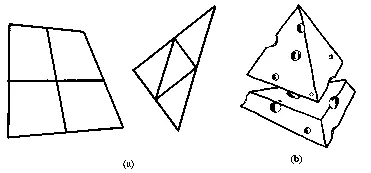
27 Fig. 10 72 Self-similarity in subdivision of triangles and tetrahedra.
28 Now, on to space! A tetrahedron (of any shape or size) carved out of firm cheese can be sliced parallel to one of its faces, removing a slab of any thickness, to produce a new smaller tetrahedron with precisely the same shape as the original (Fig. 10-72.b). This does not work with the cube, or for that matter, with any other polyhedron, regular or not. The ability to "accommodate asymmetrical aberration" without altering shape, observes Fuller, is unique to the minimum system of Universe.
29 We add this observation to a growing list of special properties of the tetrahedron. (Appendix C.)
30 Similarly, as will be demonstrated below, an irregular tetrahedron can be subdivided to create smaller identical tetrahedral shapes, whereas an irregular hexahedron will yield dissimilar hexahedra, in the same manner as its planar counterpart, the quadrilateral.
31 Evidence thus gradually accumulates to support using the tetrahedron (instead of [146/147]the cube) as the basic unit of structure—or mathematical starting point.
32 Volume: Direct Comparison
33 Before looking more closely at volume ratios, we review the following mathematical generalization. No matter what unit of measurement is employed, the volume of any container is mathematically proportional to a typical linear dimension raised to the 3rd power. This means that if we have two geometrically similar polyhedra, one with twice the edge length of the other, the larger will contain exactly 8 times the volume of the smaller. (Having the same shape, the two systems will share a common "constant".)
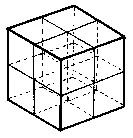
35 Fig. 10 73 2-frequency (2v) cube consists of 8 unit cubes
36 To bring this mathematical law into experiential grasp, we consider two familiar shapes. It is easy to visualize that a cube of edge length 2 consists of eight unit cubes (Fig. 10-73).
37 Now imagine a tetrahedron of edge length 2. Observe in Fig. 10-74 that, just like its cubic counterpart, the altitude of a 2-frequency tetrahedron is 2 times [147/148]that of a unit tetrahedron, and similarly that each face subdivides into four unit triangles. The latter observation indicates that the area of the large tetrahedron's base is 4 times that of the small tetrahedron's unit-triangle base.
38 Emulating the approach employed by Loeb in his "Contribution to Synergetics"31, we can deduce the following, simply by utilizing traditional geometric formulae.
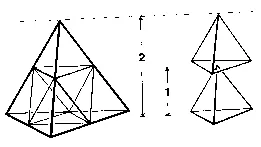
40 Fig. 10 74 2-frequency (2v) tetrahedron has altitude of 2 tetrahedra
41 Let VolT and Volt represent the volumes of the large (2-frequency) and small (unit-length) tetrahedra; AT and At, the areas of their bases: and HT and Ht, their altitudes.
42 According to the formula
43 volume of pyramid = constant x (area of base) x height.
44 So
45 VolT = KATHT and Volt = KAtHt,
46 and since we observed in Fig. 10-73.b that the base of the large tetrahedron is divided into four triangles, each of which is equal to the base of the small one, it is clear that AT = 4At.
47 Similarly, the altitude of the larger pyramid is twice that of the smaller, or HT = 2Ht.
48 Substituting, we have
49 VolT = K × 4At × 2Ht,
50 or
51 VolT = 8KAtHt,
52 and since
53 Volt = KAtHt,
54 it follows that
55 VolT = 8 Volt,
56 or, in words, that the volume of the big tetrahedron is 8 times that of the little tetrahedron.
57 The constant K cancels out of the [148/149]expression when the two equations are compared. This conclusion will be useful in deriving the volume ratios displayed in Table 10-5.
10.0.2 Multiplication by Division
58"Multiplication occurs only through progressive fractionation of the original complex unity of the minimum structural systems of Universe: the tetrahedron." (100.102b)
59 "Instead of starting with parts—points, straight lines, and planes—and then attempting to develop these inadequately definable parts into omnidirectional experience identities, we start with the whole system in which the initial 'point'…inherently embraced all of its parameters…all the rules of operational procedure are always totally observed." (488.00)
60 Deeply impressed by Arthur Eddington's definition of science as "the systematic attempt to set in order the facts of experience", Fuller constantly sought meaningful organizations for groups of experiences or events. "Multiplication by division" is one such effort. ("Events" of course includes structures and almost anything else; in energetic Scenario Universe, things are events.)
61 Essentially, "multiplication by division" derives volume relations through the straightforward logic of direct observation, rather than by rote application of traditional formulae—which lead us through awkward values before revealing the underlying simple relationships. As will be seen below, this direct observation is accomplished by comparing given polyhedra to the unit-length tetrahedron.
Tetrahedron as Starting Point
63Fuller's organizing strategy begins with the tetrahedron, because as the "topologically simplest structural system", it is a logical starting point. Consistent with his emphasis on "whole systems", the ultimate reference point in synergetics is "Universe".
64 The tetrahedron thus acts as an appropriate "whole system" for the procedure described below, in that it is "the first finite unitarily conceptual subdivision of…Universe." (987.011b)
65 More complicated systems are developed through subdivision of this tetrahedral starting point, so that a progression is contained within (and organized by) the whole:
66 "In respect to such a scenario Universe multiplication is always accomplished only by progressively complex, but always rational, subdivisioning of the initially simplest structural system of Universe: the sizeless, timeless, generalized tetrahedron." (986.048b)[149/150]
67 Onward! We seek to develop a variety of polyhedra through subdivision of the "whole" and in so doing provide the "experimental evidence" to verify the results shown in Table 10-5.
68 We imagine a single regular tetrahedron, and then bisect each edge to create the two-frequency tetrahedron shown in Fig. 10-74. One by one, we remove a single-frequency tetrahedron from each of the four corners, unwrapping the hidden octahedron (Fig. 10-75).
69 Chopping off four unit tetrahedra subtracts four units of volume from the initial total of eight (the value determined earlier for a double-edge-length tetrahedron), indicating that the octahedral remainder has a volume of exactly four. In other words, an octahedron has 4 times the volume of a tetrahedron of the same edge length. We thus begin to derive the values in Table 10-5.
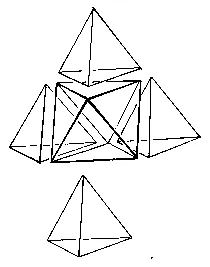
71 Fig. 10 75 "Unwrap" a hidden central octahedron
72 Removing the four unit-tetrahedra corners of a 2v tetrahedron "unwraps" a hidden central octahedron
73 Cube
74 Next, we split the octahedron in half, separating the two square-based pyramids. Two additional perpendicular slices divide each pyramid into quarters (Fig. 10-76), producing eight sections, or "octants", each with a volume of ½ (a volume of 4, divided by 8, is equal to ½). Each octant is an irregular tetrahedron with a unit-length equilateral base and three right-isosceles-triangle sides. The perpendicular corners of the eight octants meet at the octahedral center of gravity, an orthogonal relationship first noted in the previous chapter when IVM' vertices (body center) were added to the cells of the IVM.[150/151]
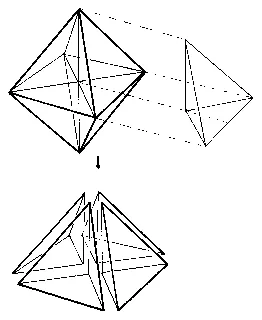
76 Fig. 10 76 Derivation of an octant: 1/8-octahedron.
77 To reconfirm the octahedron-tetrahedron volume relationship, we place an octant (with its equilateral face down) next to a regular tetrahedron on a flat surface and observe that the altitude of the octant is exactly half that of the tetrahedron. (A second octant can be put on top of the first to check: the height of both octants together is equal to the altitude of the tetrahedron, as shown in Fig. 10-77.) An octant, therefore, has the same base and half the altitude as a regular tetrahedron, reconfirming that its volume exactly half the volume of the tetrahedron.
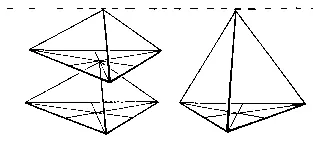
79 Fig. 10 77 One octant altitude is equal to ½ the altitude of the tetrahedron
80 In "Structure and Pattern integrity" we discovered that a regular tetrahedron fits inside a cube, and subsequently we learned that each of the four "leftover" regions is equivalent to the portion of an octahedron from one face to its center of gravity (Chapter 9). We now take advantage of the recently disassembled octahedron for an experiment.
81 Having equilateral triangles in common, octants can be superimposed on each face of a unit tetrahedron. One by one, four octants surround and thus obscure the tetrahedron. Lo and behold, a [151/152]perfect cube emerges (Fig. 10-78). Four octants, with a combined volume of 2 units, have been added to the unit-volume tetrahedron, for a total volume of 3.
82 Compared again with the irregular volumes listed in Table 10-5, generated by the unit-edge cube, these whole-number ratios for the cube and octahedron seem especially remarkable.
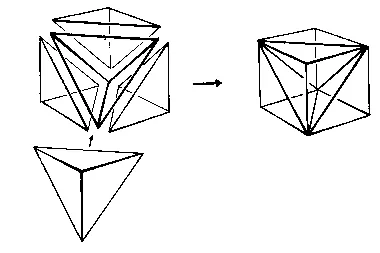
84 Fig. 10 78 Four octants added to one tetrahedron produce one cube
85 Vector equilibrium
86 The volume of the VE can be quickly determined through direct observation. Recall that twelve unit-length radii outline eight regular tetrahedra and six ½-octahedra. This fact, combined with our newly generated volume data, provides a conclusive value for the vector equilibrium: six ½-octahedra, each with the tetrahedron volume of two, plus eight unit-tetrahedra yields a total tetrahedron [152/153]volume of twenty: 12 + 8 = 20. This simple breakdown supplies further evidence of a natural order of precise volume relationships, and it is especially reassuring that a unit-length vector equilibrium—the conceptual foundation of Fuller's energetic mathematics—falls into place with its own whole-number volume ratio.
Rhombic Dodecahedron
88To begin with, our recently disassembled octahedron must be put back together. Octants are thus lifted away from the composite cube shown in Fig. 10-77, and their right-angled comers are again turned inward to meet at the octahedron's center. Next, we divide two tetrahedra into quarters. Each tetrahedron yields four shallow pyramids, encompassing the region from an outside face to the center of gravity (Fig. 10-79). As before, the equilateral base of each shallow pyramid allows the ¼-tetrahedra to fit directly onto an octahedral face, and as soon as eight ¼-tetrahedra are attached to the octahedron, a rhombic dodecahedron emerges (Fig. 9-71). Two units of volume have been added to the octahedral four, for a total of exactly six.
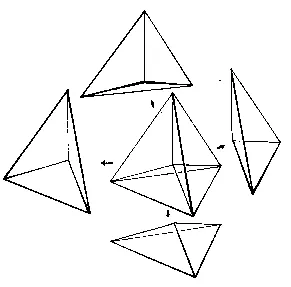
90 Fig. 10 79 Subdivision of tetrahedron into 4 shallow pyramids
91 Looking at the shape of the rhombic dodecahedron, with its strange angles and facets, the perfection of this whole-number volume [153/154]relationship seems particularly remarkable. Because both shape and topological characteristics of the tetrahedron and rhombic dodecahedron appear utterly dissimilar, the discovery of this orderly relationship between the two polyhedra adds significantly to our growing sense of an underlying spatial order.
92 Again, the considerable flexibility of the IVM framework enables us to plot all of the above polyhedra with IVM and IVM' vertices. The rationale for using the unit-diagonal cube also applies to the rhombic dodecahedron, which arises naturally out of the interaction of IVM and IVM' cells. Recall that every octahedron in the matrix is surrounded by ¼-tetrahedra, thereby defining rhombic dodecahedra with unit-length diagonals.
93 We discovered many shared symmetries in the previous chapter by dissecting the IVM, and we now develop the significance of these observations with the discovery of the rational volume relationships inherent in this framework. Bucky was not the first to discover these ratios, but he may have been their most visible spokesman. He brought this esoteric information to the attention of countless packed lecture halls, as one of the more satisfying indications of the fallibility of our coordinate system. (Such sublime disclosures by nature must not go unheralded!)
94 These volume ratios provided Fuller with a powerful source of confidence in the legitimacy of pursuing synergetics, and indeed their significance is worth our serious consideration.
95 What accounts for the lack of attention paid to these simple mathematical facts? Loeb offers the following explanation:
96 When these relations are derived with the aid of the usual formulae for the volume of a
pyramid, V = 1/3Ah, a good many irrational numbers are involved, and the simple
integral ratios emerge almost incidentally. Somehow, these simple integral values of the
volume ratios of common solids are not part of our scientific culture, and a lack of
familiarity with them frequently leads to unnecessarily cumbersome computations. It
appears that a bias of our culture to orthogonal Cartesian coordinates has obscured these
relations.
[My (A.C.E.) italics.] 32
Multiplication by Division
98Bisecting the edges, as before, we take special note of the tetrahedron's square cross-section. This fourfold symmetry was a significant factor in previous discussions, notably in the sphere-packing demonstration, in which two sets of spheres came together at 90° and unexpectedly produced a tetrahedron. However, this aspect of the tetrahedron is easily overlooked; as a triangular pyramid, with its preponderance of 60° angles, this shape is easily perceived as a completely triangular affair.[154/155]
99 Suppose we ask the following question: how much of our cheese tetrahedron would be chopped off when the newly exposed surface (created by the slice) is a perfect square? Without a certain amount of previous exposure to the tetrahedron, your reaction would probably be that the slicing-plane could never be square. It might be a very small triangle, or any number of larger triangles as you position the knife closer to the base. But a square?!
100 Wait. The tetrahedron has four faces. Do they somehow outline a square? Anyone who has read this far knows the answer, but countless students challenged to find that hidden square have been stuck. Handicapped by the perpendicular bias of mathematics, they are unable to find the square cross-section in the exact center of the tetrahedron, which—once seen—is unmistakable (Fig. 10-80.a).
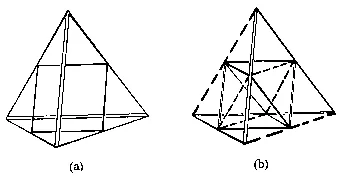
102 Fig. 10 80 2v tetrahedron with octahedron core
103 Four square cross-sections subdivide 2v tetrahedron to form central octahedron.
104 The square in Fig. 10-80.a is parallel to and between two opposing edges, which themselves are perpendicular to each other. Delineating the square cross-sections corresponding to each of the three sets of opposite edges, this aspect of the tetrahedron's symmetry is exhausted, and the 2-frequency subdivision is complete. A total of twelve new edges outline the octahedron, and by now this relationship is quite familiar (Fig. 10-80.b).
105 We continue inward. This time, bisect and interconnect the edges of the octahedron. The process is equivalent to Loeb's "degenerate truncation" and outlines the edges of a vector equilibrium hiding inside the regular octahedron (Fig. 10-81.b).
106 We could continue, by joining the midpoints of VE edges, to produce a "rhombicuboctahedron"; however, Fuller's sequence comes to an end at the vector equilibrium. The final lines, which are one-quarter the length of the edges of the original tetrahedron and the smallest vectors in the model, are thus designated as unit vectors.
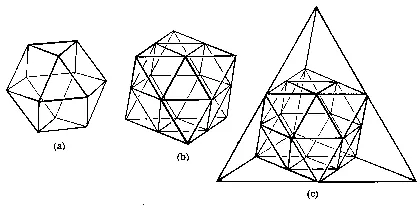
108 Fig. 10 81 2v octahedron with cubocahedron (VE) core
109 Subdividing the tetrahedron's central octahedron to 2v creates a central cubocahedron (VE).
110 We quickly run through the sequence in reverse to review the geometric relationships. A 4-frequency tetrahedron, in which each [155/156]edge is equivalent to four unit vectors, is the smallest tetrahedron to contain a complete VE in its center, and so it acts as the ultimate "whole system" (Fig. 10-82). The review starts in the center: a unit-length ½-octahedron is tacked onto each square face of the nuclear VE, thereby forming a 2-frequency octahedron, which in turn has 2-frequency tetrahedra added to four of its eight faces to create the large tetrahedron. Fig. 10-81 illustrates this transition, and Fig. 10-82 shows the complete 4-frequency tetrahedron [156/157]and its implied hierarchical system, employing progressively thicker lines to emphasize the three different polyhedra.
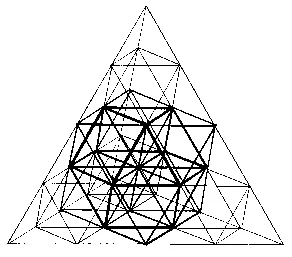
112 Fig. 10 82 Hierarchical nest within 4v tetrahedron
10.0.3 Cosmic Hierarchy (of Nuclear Event Patternings)
113"The Cosmic Hierarchy is comprised of the tetrahedron's intertransformable interrelationships." (100.403b)
114 Fuller's curious description is now clear, for we have become familiar with most of these "intertransformable relationships" and how they fit into the IVM context—as well as with the simple operations that transform one shape into another.
115 The order of this polyhedral hierarchy is determined by complexity, from least to most. It is worth noting that the ladder can extend inward indefinitely by progressive subdivision; edges can be continually bisected to generate higher frequency systems. Notice how convenient it is to have "conceptuality independent of size". We do not have to specify the size of the initial tetrahedron, for Fuller's use of frequency to designate length provides a means to specify the system's geometric characteristics precisely, without recourse to "special case" examples. Ratios remain consistent; like conceptuality, they are independent of size.
116 In summation, "cosmic hierarchy" pertains to volume ratios as well as to complexity and frequency, and its relationships are uncovered through "multiplication by division". In this way, Fuller describes the order inherent in space.
117 Volume Reconsidered
118 Fuller attaches considerable significance to volume ratios and cosmic hierarchy. The subject suggests a number of philosophical implications, concerning both reasons why these orderly relationships go unnoticed and also the potential benefits of a mathematics that emphasizes systems and the relationships of parts to wholes. The first aspect is best summarized by Loeb in his "Contribution":
119 Uncritical acceptance of geometrical formulas as fundamental laws, particularly in systems that do not naturally fit orthogonal Cartesian coordinates, frequently leads to unnecessarily clumsy calculations and tends to obscure fundamental relationships. It is well to avoid instilling too rigid a faith in the orthogonal system into students of tender and impressionable age! 33
120 Overdependence on the cube is the culprit. Fuller attributes much of our attachment to this building block to an understandable desire [157/158]for "monological" solutions, or single answers to complex questions.
121 Blissfully unaware of the "inherent complementarity" of Universe, he cautions, humanity naturally sought one "building block" with which to understand space, a single unit to be the basis of all mathematics. Even without considering the concept of "inherent complementarity", there are significant advantages to using the tetrahedron instead of the cube as the basic unit in quantifying volume.
122 Bucky would complete his argument by reminding us that the cube is inefficient. Having demonstrated the respective volumes of this traditional shape compared to nature's minimum system, he would summarize by saying, "if you use cubes, you use 3 times as much space as necessary". And, once again, "Nature is always most economical".
123 Finally, he hypothesizes that the irrational volumes of simple polyhedra, inherent in cubic accounting, tended to reduce the importance of these basic systems in the eyes of mathematicians. Shapes with such troublesome volumes could not possibly be relevant to natural order:
124 Though almost all the involved geometries were long well known, they had always been quantized in terms of the cube as volumetric unity…; this method produced such a disarray of irrational fraction values as to imply that the other polyhedra were only side-show geometric freaks or, at best, "interesting aesthetic objets d'art". (454.02)
125 The exclusive adoption of the cube thus served to inhibit sustained serious attention to the other polyhedra.
126 Back out to the big picture. To understand Universe, Fuller argued, we must think in terms of the synergetic principles governing the relationship of parts to whole systems. Multiplication by division is one of many exercises to encourage the development of a habitual orientation toward solving problems in context.
127 If our early mathematics training encourages us to isolate and consider parts separately, rather than as components of a larger system, then, Fuller thought, our natural inclination throughout life would be to view problems myopically.
128 In Fuller's view, we have been blinded to a whole family of rational order by an initial (90-degree) wrong turn—itself a result of humanity's early perception of an up-down platform Earth.[158/159]