
6 Angular Topology
2Our study so far has primarily examined the conceptual foundation of synergetics. Except for occasional reference to volume and symmetry, the emphasis has been on numbers of elements rather than on shape. It's now time to look at the rest of the picture. Fuller's appreciation of the MIT definition of mathematics ("the science of structure and pattern in general") led him to ponder the appropriate tools and methods. "Science" is a systematic endeavor, requiring exact procedures for its description of structure and pattern.
3 A coordinate system describes the shape and location of a body in space by specifying the position of a sufficient number of that body's components. But a position can only be specified by its relationship to some other known location, or coordinate-system origin. In essence, mathematics functions by locating points relative to an agreed-upon frame of reference, such that the mathematician can say there is a point here and a point there and they are related by this kind of trajectory, and so on, until there is enough information to describe the entire system. Fuller points out that this information can be broken down into two aspects: shape and size.
4 What does shape consist of?
5 "Shape is exclusively angular" (240.55)
6 A simple but powerful observation. It's easy to envision identical shapes of completely different scale: for example, an equilateral triangle is a precisely defined concept, yet it contains no indication of size. It may be 2 miles or 2 centimeters in edge length, but its angles must be 60°. Shape is influenced only by angle, and
7 "an angle is an angle independent of the length of its sides" (516.02).
8 The word "triangle" by itself (without further modification) does not describe a specific shape but rather a concept—three interrelated events without specific length or angle.
9 What does size consist of?
Measurement, or dimension. In synergetics, these parameters are always expressed in terms
of "frequency". The word is aptly applied, serving as a reminder of the role of time.
Fuller dwells on the point: every real system ("special case") [065/066]involves time and
duration.
10 Real Systems are events, and it takes time for an event to occur. He bases his objection to purely static concepts in mathematics on the fact that they are incompatible with 20th-century scientific thought:
11 Since the measure of light's relative swiftness, which is far from instantaneous, the classical concepts of instant Universe and the mathematicians' instant lines have become both inadequate and invalid for inclusion in synergetics. (201.02)
12 Since Einstein, Bucky reminds us, we can no longer think in terms of an "instant Universe", that is, a single-frame picture. Because even light has been found to have measurable speed, every aspect of physical Universe from the smallest tetrahedron to life itself involves the passage of time. Quite simply, "it takes time to get from here to there".
6.0.1 Frequency and Size
13He insists upon nothing more adamantly than this distinction—between real ("experimentally demonstrable") phenomena and imaginary concepts. "Size" relates to real, time-dependent systems, whereas "shape", influenced only by angle and therefore independent of time, is a factor in both real and conceptual systems.
14 "Angles are…independent of size. Size is always special-case experience" (515.14).
15 But how does "frequency" apply to size and length? Frequency connotes number: the number of times a repeating phenomenon occurs within a specified interval—ordinarily an interval of time, but Fuller extends the concept to include space. Length is measured in synergetics in terms of frequency to underline the fact that the "distance from here to there" involves time and can be specified in terms of number: number of footsteps across the room, or number of heartbeats during that interval, number of water molecules in a tube, number of inches, number of photons, number of somethings. The choice of increment depends on what is being measured, but frequency (and hence size) is inescapably a function of time and number.
Units of Measurement
17Fuller explains frequency as subdivisions of the whole, suggesting another advantage of the term: it provides a built-in reminder that there is no absolute or single correct unit of measurement; rather, [066/067]distance is measured relative to arbitrarily devised units. It is not a minor challenge to perceive distance this way; our conventional units—like inches or kilometers—are such an integral part of awareness that they seem a priori elements of size. The teacher in Fuller will not let us accept such useful conventions blindly, and so he employs tools such as "frequency" to keep us on our toes—aware of the nature of distance.
Time and Repetition: Frequency versus Continuum
19Just as length cannot exist without time, there also could be no awareness without time. Time, inseparable from all other phenomena, cannot be isolated.
20 "Time is experience" (529.01).
21 The concept of time is inextricably tied to awareness; appropriately it is measured in terms of the frequency of detectable repeating events. Periods of daylight reliably alternating with darkness gave us a unit we call a "day". Heartbeats might have defined the "second", planting the awareness of that tiny increment in long-ago human beings. The predictable repetition of days growing longer and shorter with their accompanying weather changes defined a "year". To conceive of time requires repetition.
22 However, the limits of perception prevent recognition of the periodicity in very high-frequency patterns such as light waves or repeating molecules in a toothpick. If repetition is too frequent, we perceive a continuum rather than segmented events. Fuller's use of "frequency" to specify size draws attention to the nonexistence of continuums. Here, as always, his goal is to develop a mathematical language which accurately represents reality.
23 Shape and size are thus replaced by angle and frequency.
24 Fuller's principle of design covariables summarizes by stating that two factors are responsible for all variation.
25 "Angle and frequency modulation exclusively define all experiences, which events altogether constitute Universe" (208.00).
26 In short, "structure and pattern in general" are described completely by only two parameters: angle and frequency—another way of saying that the differences between systems are entirely accounted for by changes in angle and length. Again the goal of such simplification is the demystification of mathematics.
27 Remember that Fuller's overall goal was to isolate "nature's coordinate system"—by which he meant the simplest and most efficient reference system to describe the events of nature. We gradually narrow in on his solution.[067/068]
6.0.2 Topology and Vectors
28Fuller has declared his scope:
29 "Synergetics consists of topology combined with vectorial geometry". (201.01)
30 Topology in essence analyzes numbers of elements. (Euler's law is topological, involving neither symmetry nor size.) And now we must again think about vectors, for they are the key to this combination.
31 Vectors provide an ideal tool for representing velocity, force, and other energetic phenomena. As you may recall, the concept is actually quite simple—despite its lack of popularity among high-school students. A vector is a line with both specific length and angular orientation. It's the ultimate simplification of actions or forces, presenting only the two most relevant bits of information: magnitude and direction. Mathematics defines this tool and the accompanying rules for its manipulation, just as it defines the set of real numbers and the rules for addition and multiplication. The mechanism as a whole enables us to predict the results of complex interactions of forces and bodies in motion.
32 Surveying classical geometry, Fuller decided that "there was nothing to identify time, and nature has time, so I'd like to get that in there".
33 Vectors seemed to provide the solution. "I liked vectors. A vector represents a real event of nature…. I wondered if I couldn't draw up a geometry of vectors; that would mean having the elements of experience." (EIK video)
34 Back to synergetics: What is meant by a combination of topology and vectorial geometry? And how does it fit into the search for "nature's coordinate system"? By viewing polyhedra as vector diagrams, Fuller integrates the two subjects (vectors and topology) in a deliberate attempt to develop one comprehensive format to accommodate both the inherent shape of space and the behavior of physical phenomena. Polyhedra with vectors as edges necessarily incorporate both shape and size.
Vector Polyhedra
36The spectrum of possible forms of polyhedra is certainly informative about the shape of space; polyhedra are systems of symmetry made visible. Any configuration allowed by space can be demonstrated by vertices and edges, and, as noted earlier, experimentation quickly reveals that the variety of possible forms is limited by spatial constraints. Furthermore, the shape of space is fundamental to the events of nature. Fuller believed that mathematics, the science of structure and pattern, should be based on these principles.[068/069]
37 So Fuller coined the rubric "angular topology" to express what he saw as the principal characteristic of synergetics: integration of the static concepts of geometry with energetic reality. These may not have been the words he used back then, but the desire for such a system dates back to Bucky's early school days. Or at least that's how the story goes. Such myths evolved over time to convey the spirit of the child's inquisitive confusion through concise anecdotes. Fuller's lectures and writings incorporate a full repertoire of autobiographical moments in which the young Bucky has startlingly complete and rich realizations. The process is beautifully described by Hugh Kenner, who relieves us of the burden of asking, "Did that really happen, just like that, one morning"?
38 Not that he deceives. He mythologizes, a normal work of the mind…to embrace multitudinous
perceptions, making thousands of separate statements about different things [into] summarizing
statements…
What a myth squeezes out is linear time, reducing all the fumblings and sortings of years to an
illuminative instant. We can see why Bucky needs myth. The vision that possesses him eludes
linearity…. The myth is anecdotal. 21
39 We return to the geometry lesson: the grade-school teacher has put a drawing on the blackboard and said, "This is a cube". Young Bucky wonders aloud, "How big is it, how much does it weigh, what is its temperature, how long does it last"? The teacher says, "Don't be fresh", and "You're not getting into the spirit of mathematics". Again, the implication is that mathematics does not deal with real things, but only with absurd constructs and arbitrary rules.
40 It's not hard to accept the message behind the story—that something about the teacher's lesson was profoundly disturbing to the child. It seemed to Bucky that mathematics was a serious enterprise and it should limit itself to "experimentally demonstrable" phenomena. That meant no fooling around in the fringe area of sizeless points, infinite planes, and weightless cubes. We reconsider these early musings in the new context of "angular topology" to see where they led, and recall that Fuller was later to attribute mathematics' lack of popularity to the perfectly natural discomfort people felt with those elusive concepts. Explanations ought to be in terms of tangible experience.
41 But then what are we to make of such claims as:
42 Synergetics permits conceptual modeling of the fourth and fifth arithmetic powers; that is, fourth- and fifth-dimensional aggregations of points or spheres in an entirely rational coordinate system that is congruent with all the experimentally harvested data of astrophysics and molecular physics… (202.01)
43 Under the heading "Angular topology", [069/070] this statement is found too early in Fuller's Synergetics to be easily understood. One might wonder if a page was left out of that particular copy; but the root of the confusion is not that easily located. With some additional background material, we can begin to understand Fuller's assertion. The word "dimension" has been lurking behind the scenes in this entire discussion, and must now be brought out into the open.
6.0.3 Dimension
44(1) A measure of spatial extent. (2) Magnitude, size, scope. (3) The number of factors in a mathematical term. (4) A physical property, often mass, length, time, regarded as a fundamental measure. (5) Any of the least number of independent coordinates required to specify a point in space uniquely.
45 The above is a sampling of what you will find in English-language dictionaries under "dimension". As you can see, there are a few distinct meanings—essentially falling into three categories:
46 (1) Physical extent or measurement, as in "what are the dimensions of this room"?
47 (2) Orders of complexity, in the most general sense, as in "the many dimensions" of an issue or problem. This meaning is as common as it is widely applicable.
48 (3) The specifically mathematical application: the number of independent terms required to specify a point in space.
49 Our conventional system utilizes three independent, mutually perpendicular axes in space to accomplish this task. This is often the first meaning to occur to people, especially when already thinking about geometry. "Space is 3-dimensional."
50 However, this assignment—treating the third category as an exclusive definition—seemed unacceptably limited to Fuller. Exposure to the ordered polyhedra of mathematics and also to organic structures and crystals found in nature makes an orientation toward perpendicularity seem quite arbitrary. Although right angles are sprinkled throughout geometric shapes, they are by no means dominant. And, more often than one might expect, 90° coordinates provide an awkward framework with which to describe both naturally occurring and conceptual formations.
51 Fuller viewed the Cartesian coordinate system with its three perpendicular axes, conventionally labeled X, Y, and Z, as a remnant [070/071]of "flat-Earth thinking". Early man, finding himself on a huge fiat expanse, assumed that up-and-down and back-and-forth were the fundamental directions of his universe. Ninety degrees was the obvious natural angle with which to segment and measure space. Humankind has had more and more evidence of nature's radial and spherical bias throughout history—from the discovery of the shape of planets to the behavior of radiation and cellular growth. But neither Copernicus's spherical Earth nor the vast array of biological and physical phenomena, all suggesting that angles other than 90° would provide more "natural" or convenient standards, succeeded in reorienting the perpendicular bias of mathematics.
52 The "three dimensions" of mathematics—length, width, and height—became part of an unshakable convention. That space cannot accommodate a fourth perpendicular direction is just one of its many intrinsic constraints, and yet this limitation is too often seen as the only characteristic of space. While mathematicians postulate hypothetical "hypercubes" in their attempt to describe a spatial fourth dimension, and physicists refer only to "time" as the fourth dimension, Bucky preferred to call attention to the "4-dimensional" tetrahedron. Time is certainly a dimension, but the physicists' progression "x, y, z, and t" seemed not to emphasize sufficiently that time—permeating all space and all experience—is qualitatively unlike the other "three dimensions".
53 As we develop an awareness that space has shape, right angles gradually seem less "natural". The XYZ coordinate system often serves to obscure rather than illuminate spatial characteristics. It is a valuable tool, which we can recognize as one alternative superimposed by human minds, not as a framework organic to the shape of space itself. The word "dimension" is used without contradiction to describe the maximally symmetrical arrangement of three lines in space; likewise it can be applied to time, but it's not the end of the story.
54 One of the above dictionary definitions refers to the number of coordinates required to specify the location of a point in space. Assuming the existence of a previously specified origin, the number of coordinates happens to be three.
55 Does this result reinforce the exclusive use of the XYZ axes? No, for the three coordinates required do not have to be Cartesian; another option is spherical coordinates, in which the location of any point is fixed by specifying two angles and a radial distance. Cartesian coordinates, on the other hand, describe a location as the intersection of three lines originating at given distances along three perpendicular axes. (See Fig. 6-23 for [071/072]a comparison of the two methods.)
56 The spherical approach is more suited to Fuller's radial ("converging and diverging") Universe; its emphasis on angular coordinates encourages thinking in terms of "angle and frequency modulation".
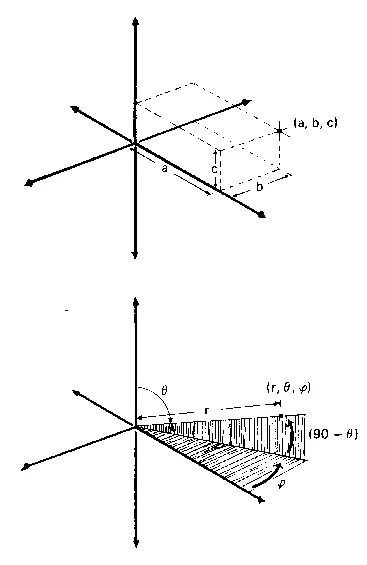
58 Fig. 6 23 Cartesian vs. spherical coordinates.
59 Dimension is a widely encompassing term, and can legitimately refer to numbers of factors in a variety of geometric phenomena. Considerable time can be devoted to unraveling Fuller's different uses of "dimension" in Synergetics, and we shall continue to cite examples throughout our investigation.
Size
61Fuller's book takes a firm stand in the opening sections:
62 "Synergetics originates in the assumption that dimension must be physical." (200.02) meaning size.
63 The declaration is soon reinforced:
64 "There is [072/073]no dimension without time." (527.01)
65 Firmly imbedded in reality now: it takes time to embody a concept. Everything ties together, so far.
66 It would be uncharacteristically clear-cut if that were Fuller's only use of dimension. Synergetics may start with dimension as size, but other applications of the multifaceted term are sprinkled throughout the book. (Identification of space as 3-dimensional is not one of them.) Keep in mind that this mathematical convention has a firm hold; it's difficult to think otherwise about space—and consequently not easy to view Fuller's material objectively.
Planes of Symmetry
68Both the tetrahedron and the octahedron—two of the simplest structures—incorporate four nonparallel planes. The faces of the tetrahedron present four distinct directions, just as the faces of the cube provide three. The octahedron has four pairs of opposing parallel triangles, and it can be demonstrated that they are parallel to the tetrahedral faces (Fig. 6-24).
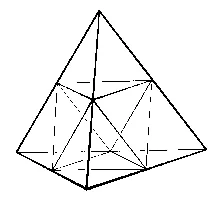
70 Fig. 6 24 "4D": Tetrahedron / octahedron embody four distinct directions
71 Octahedron's 4 pairs of opposing parallel triangles within tetrahedron's 4 face planes.
72 Fuller refers to this geometric trait as "dimension", and through repeated observation places considerable emphasis on the inherent fourness of the "minimum system in Universe".
73 "The octahedron's planar system is four-dimensionally referenced, being parallel to the four symmetrically interacting planes of the tetrahedron…" (527.31)
74 The icosahedron, on the other hand, exhibiting various 5-fold symmetries, embodies "5-dimensionality" (527.50) in Fuller's unorthodox appropriation of terms.[073/074]
Other Applications of Dimension
76Another twist: Fuller also refers to the three structural parameters—vertices, edges, and faces—as different dimensions of structure. In a later section covering the concept of dimension, Fuller reintroduces "constant relative abundance" (as explained in Chapter 4) under the heading "(527.10) Three Unique Dimensional Abundances"—namely, vertices, edges, and faces. This and other ambiguous—if not contradictory—usages of certain terms can often obscure the mathematical statement being made. In this case, Fuller's point about the consistent arithmetic relationships between vertices, edges, and faces in closed systems is lost amid confusion about the meaning of "dimensional abundances".
77 Another unorthodox usage involves pairs of opposites. At one point in Synergetics, for example, a magnet, with its positive and negative poles, is called a 2-dimensional system. Along the same lines,
78 Polar points are 2 dimensional: plus and minus, opposites.(527.21)
79 Finally, "dimensional aggregations" in the opening quotation of this section refers to numbers of layers in certain clusters of closely packed spheres. We shall explore these patterns in Chapter 8. Fuller's different uses of "dimension" may be confusing, but they are not, strictly speaking, incorrect—at least not in terms of the dictionary. Mathematical convention is another issue.
80 Fuller does mention the historical precedent for conceiving of space as exclusively "3-dimensional", thereby explaining his license to reevaluate our concept of dimension; however, the reference is too late in the book to clear up early confusion:
81 …The Greeks came to employ 90-degreeness and unique perpendicularity to the system as a basic…dimensional requirement for the…unchallenged 3-dimensional geometrical data coordination. (825.31)
82 So, while he does justify his usage with this reference to the word's flexibility, the clarification is obscured by the book's sequence. The reader seeking a quick reason to dismiss Synergetics might focus on Fuller's extravagant citation of other dimensions early in the book. His apparent familiarity with "the fourth dimension" provides just cause for suspicion; however, a simple change of article—from "the" to "a fourth dimension"—gives the term a very different effect.
83 Like most subjects in synergetics, "dimension" cannot be neatly presented in one complete package; boundaries are never that clearly [074/075] defined. In addition to the fact that different subjects overlap, there can always be new twists. The trick is to leave ourselves open to exploration, free to evaluate each new application without bias.
6.0.4 Angular topology
84Once in a long while, a ‘‘generalized principle’’ takes recognizable shape and emerges out of the vast sea of man's cumulative findings. For Fuller, these principles—characterized as true in every case—are the real wealth of society. Applications may not always be immediately clear, but if an inventory of "generalized principles" is made accessible, he reasoned, humanity will put them to use sooner or later.
85 The "principle of angular topology" was recognized by the mathematician and philosopher René Descartes (1596–1650), but the title of course is Fuller's. Perhaps by giving Descartes's remarkable discovery a new title, Bucky hoped to excite the kind of attention he felt it deserved.
86 In every polyhedral system, the sum of the angles around all the vertices is exactly 720° less than the number of vertices times 360°, or (360° × V) - 720°. True for the tetrahedron, true for the crocodile. In Fuller's words, every system has exactly 720° of "takeout".
87 If this principle seems complicated, it is only because the words are hard to follow, but the following image should make it easier. Picture a paper cone—the shape of an ice-cream cone without the ice cream. Notice that a cone, having an opening at the base, is not a closed system. Now, split the paper cone open by slicing a straight line from its pointed tip to the circular hole, and then spread the piece of paper out fiat on the floor like a rug (Fig. 6-25).
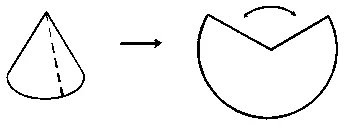
89 Fig. 6 25 A cone: sliced and flattened
90 There is now an angular gap left by the paper, where the floor shows through. That gap is the "takeout angle", the angular difference between a flat map and a cone.
91 In the same manner, you can slice open some number of edges of a polyhedron until its surface can be spread out like a rug. The resulting map, similar to a dressmaker's pattern, is called in geometry a polyhedron's net.
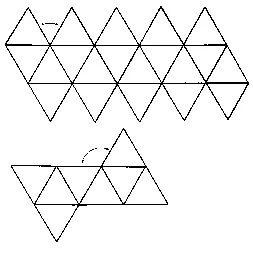
93 Fig. 6 26 Nets of icosahedron and octahedron
94 A net contains all faces of a polyhedron, some of them separated by angular gaps; it is a flat pattern which can be folded along the edges, and taped together to generate its polyhedron. Fig. 6-26 shows nets of an icosahedron and an octahedron. [075/076]The principle of angular topology states that the sum of the angular gaps, no matter how simple or complex the system, will be exactly 720°.
95 Or go through these procedures in reverse: start with flat paper and cut out one pie-shaped segment to make a cone. Then keep going, cutting out more slices, just until the point at which the paper [076/077]can be closed off into a system. This point is reached when you have taken out exactly 720°. It's a prerequisite to closure; there is no leeway. To check, you can measure all the scraps that have been taken out; the results are always the same: however irregular your cuts or strange your resulting closed system, the total takeout must be 720°. This consistent total presents a generalized principle for closed systems.
96 The surface angles of any tetrahedron (regular or not) also happen to add up to 720°. (Four triangles: 4 × 180° = 720°.) Fuller certainly isn't going to let that one slip by!
97 The "difference between the visibly definite system and the invisibly finite Universe [i.e., plane] is always exactly one finite invisible tetrahedron…" (224.10).
98 Consider once again the variety of systems. This principle—a first cousin of Euler's law—describes an extraordinary consistency. The "720-degree-excess" is an appropriate parallel to Euler's "constant 2" in that there are 720° in two complete revolutions. Both are counterintuitive: Euler's law reveals that the number of edges is always exactly 2 less than the vertices plus faces, no matter how complex the system, just as the angular "takeout" is 720° whether the surface angles themselves add up to a total of 720°, as in the tetrahedron, or to 57,600 degrees, as in the "4-frequency icosahedron". (Don't worry, that structure will be explained below.) Table 6-3 shows the results for a few different polyhedra, verifying the constant "excess" of 720°.
99 Table 6-3 reveals another notable consistency: the sum of the surface angles in every polyhedron is a multiple of the tetrahedron's 720° (column 5). This calls to mind our earlier observation that the number of edges in many ordered polyhedra is a multiple of the tetrahedron's six. (Refer to Chapter 4.)[077/078]
100 Table 6 3 "Structural quanta":
polyhedra edges in even multiples of the tetrahedron's 6
Angular Takeout: An Example
104A complicated system such as the 4-frequency icosahedron provides an especially good illustration of this remarkable consistency. The structure is an irregular polyhedron with 320 triangular faces, and is based on the symmetry of the icosahedron. Each icosahedral triangle is replaced by 16 new smaller triangles, producing the total of 320 faces of this more or less spherical structure. Chapter 15 will describe the origin of high-frequency icosahedral enclosures in detail, but for now, we can understand that the faces are irregular triangles. As shown in Fig. 6-27, most vertices join six triangles, and we recall from Chapter 4 that if six 60-degree angles meet, they create a flat surface. Therefore, if six faces are to surround a convex vertex of a polyhedron, their angular total must be less than 360°—which produces the "angular takeout". Those interested in exploring how to calculate individual edge lengths and surface angles can refer to "Chord Factors" in Appendix A: Trigonometric Calculations, and to "Other resources" (p.309) for a list of additional information sources; other readers should simply be aware that the values will be highly irregular numbers. Having noted that, to assure convexity, the surface angles must add [078/079]up to less than 360° at each vertex, we can reflect on how extremely small the gaps at each vertex in this structure will be.
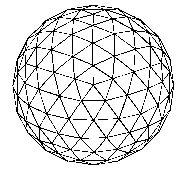
106 Fig. 6 27 4-frequency icosahedron
107 If all 162 vertices are equally distant from the structure's center, the average total of the surface angles at each will be 355 degrees, 33 minutes, and 20 seconds—(355°33'20")—or 355.5556 degrees. Thus, the "takeout" angle—instead of being concentrated at a few points, with 60° removed from each of twelve vertices—is distributed among many component triangles. Imagine cutting open this system and spreading out its multifaceted net. Each angular gap would be very narrow, averaging 4°26'40" (4.4444 degrees.) If we were to draw this net, the pencil thickness itself would be a nuisance. Supposing each edge is approximately one inch (25mm) long, the outermost or widest part of each gap will be less than 1/12 inch (2mm).
108 In addition to being minuscule, these numbers are typically quite irregular, not at all simple fractions of degrees. Nevertheless, these gaps, calculated (say) to 6 decimal places, add up to exactly 720.000000 degrees, no matter how many vertices in the system, or how irregular the distribution.
109 One interesting implication of the principle of angular topology is further demonstration of the impossibility of the traditional sphere as defined by mathematics—an unreachable planar 360° around every one of an infinite number of vertices.
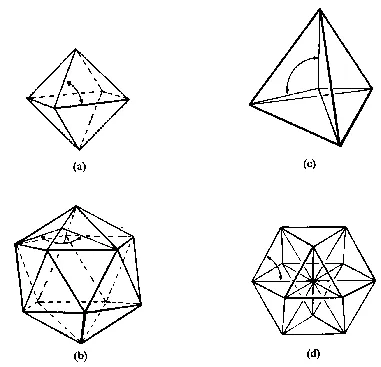
110 "The calculus and spherical trigonometry alike assume that the sum of the angles around any point on any sphere's surface is always 360°" (224.11).
111 Fuller goes on to point out that in order to achieve a closed system, there must be 720° taken out, distributed throughout the vertices, thereby invalidating this assumption.
112 "The demonstration thus far discloses that the sum of the angles around all the vertexes of a sphere will always be 720°—or one tetrahedron—less that the sum of the vertexes times 360°—ergo one basic assumption of the calculus and spherical trigonometry is invalid." (224.11)
113 In other words, since the 720° takeout is a prerequisite to closure, even a sphere has to have infinitesimally less than 360° around any given point on its surface. (We are forced to conclude that "infinitesimal" times "infinite" here equals 720°.)
Angle Types
115Finally, knowing the different types of angles in geometry will be helpful. The nomenclature is straightforward.
116 Surface angle is by [079/080]now familiar, referring to a comer angle of a polyhedral face (Fig. 6-28.a).
118 Fig. 6 28 Angle types
119 (a) Surface angle; (b) dihedral angle; (c) central angle; (d) axial angle.
120 Dihedral angles are the angles between adjacent faces, on the inside of a system. (Fig. 6-28.b).
121 An axial angle is the angle between the edge of a polyhedron and an adjacent radius (Fig. 6-28.d).
122 A central angle corresponds to a polyhedral edge and is measured from the exact volumetric center of a system to each end of the edge (Fig. 6-28.c).
123 Central angles provide a way to find exact edge lengths of a given system for any desired radius. (See "chord factors" in Appendix A: Trigonometric Calculations.) Central angles provide an effective way to record relative lengths, for remember, an angle is independent of the lengths of its sides.
124 This means that we can list the complete set of edge lengths for a complex polyhedral or geodesic system in terms of the central angles corresponding to each edge, and then directly calculate exact lengths for any desired radius, with the help of a simple trigonometric equation. This process might sound complicated at first, but is more expedient than the alternative, which is to specify one set of edge lengths, applying to only one [080/081]"special-case" system. Data for any different size would then have to be completely recalculated, step by step, from scratch.
125 Central angles give us data for the general case, applicable to any particular realization of the same shape. In architecture, this allows us to build a geodesic dome of any size from one set of central-angle calculations.
126 A pocket calculator is all that is required to simply multiply the desired radius by twice the sine of ½ the central angle (see Appendix A, "chord factors").
127 That finishes this chapter, but the subject of angle is never far removed from any discussion in synergetics.[081/082]