
9 Isotropic Vector Matrix
2The isotropic vector matrix has already been introduced; we just didn't know its name.
3 If you can visualize the space-filling array of spheres in "cubic packing" described in the previous chapter, that's half the picture. Now, imagine interconnecting the centers of all spheres—and then eliminating the spheres. Two colinear radii meeting at the tangency point between adjacent spheres form one unit vector—the length of which is equal to the sphere's diameter (Fig. 9-60). The resulting array of vectors is the "isotropic vector matrix", a space-filling network of continuously alternating octahedra and tetrahedra. Reviewing the characteristics of cubic packing, we shall not be surprised to find that all the newly formed vertices (the spheres' centers) are identically situated. Two types of cells, one type of vertex.
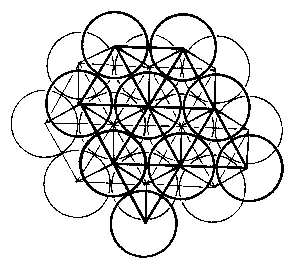
5 Fig. 9 60 Unit-vector matrix within closepacked sphere cluster
6 Unit vectors interconnect centers of adjacent unit-diameter closepacked spheres.
7 It's not hard to see how Fuller's search for a geometry of vectors led him to the isotropic vector matrix.:
8 "Since vectors…produce conceptual structural models of energy events, and since my hypothetical generalization of Avogadro's law requires that 'all the conditions of energy be everywhere the same', what does this condition look like as structured in vectorial geometry?"
9 His answer is ready:
10 "Obviously all the vectors must be the same length and all of them must interact [sic] at the same angles". (986.131b)
11 The isotropic vector matrix, or IVM, takes the VE a step further, consisting of identical lengths and angles, not for vectors surrounding just one point, but surrounding every point in an indefinite expanse. In Fuller's words, the IVM is:
12 "a multidimensional matrix in which the vertexes are everywhere the same and equidistant from one another" (222.25)
13 It is not correct to conclude that the IVM consists of many vector equilibria packed together, for the VE by itself cannot fill space. To understand why not, we look at isolated sections of the IVM. As difficult as it is to visualize the overall matrix, a single row of [127/128] alternating tetrahedra and octahedra, or even a planar expanse, can be easily envisioned (Fig. 9-61.a, Fig. 9-61.b).
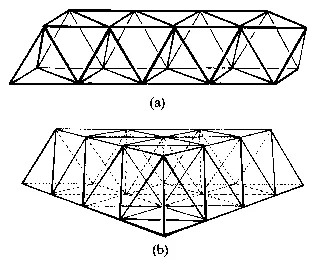
15 Fig. 9 61 Alternating tetrahedra and octahedra
16 (a) Single row of alternating tetrahedra and octahedra.
(b) Planar expanse of alternating tetrahedra and octahedra
17 Separate planar layers are then stacked together in such a way that every octahedron is adjacent to a tetrahedron and vice versa.
18 Fig. 9-62 shows three layers of the resulting matrix.
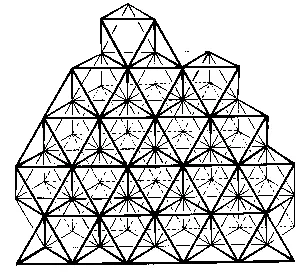
20 Fig. 9 62 Isotropic vector matrix and Octet Truss
21 Every node in the IVM—as the origin of twelve unit vectors radiating outwardly—is the center of a local vector equilibrium. The ends of these unit vectors define the twelve vertices of the VE. [128/129]However, this does not mean that adjacent cuboctahedra pack together to produce a space-filling expanse. A symmetrical array can be created by bringing the square faces of adjacent vector equilibria together, but they are necessarily separated by octahedral cavities—framed by the triangular faces of eight converging VEs.
22 The unavoidable octahedra between adjacent VEs provide yet another manifestation of the specificity of the shape of space.
23 This array can be readily understood by observing in Fig. 9-63 that a packing of vector equilibria is equivalent to a framework of cubes in which the corners have been chopped off, thus automatically carving out an octahedral cavity at every junction of eight boxes.
24 The above observations provide information about the shapes and angles of the IVM—the most symmetrical arrangement of points in space—and therefore about the shape of space itself.
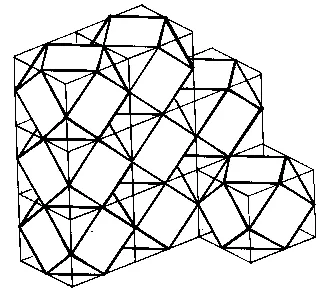
26 Fig. 9 63 Octahedral cavities between adjacent VEs
27 These characteristics reveal the basis for the term "isotropic vector matrix": in Fuller's words,
28 "'isotropic' meaning 'everywhere the same', 'isotropic vector' meaning 'everywhere the same energy conditions'.… This state of omnisameness of vectors…prescribes an everywhere state of equilibrium." (420.01–420.03)
29 He calls the IVM "multidimensional" because it "accommodates" (or occupies) all spatial dimensions, and—consistent with his unorthodox interpretation of dimension—space is "multi-" rather than [129/130]"3-dimensional". Vectors are directed in every possible direction, while deliberately maintaining equivalent lengths and angles. This equivalence is necessarily determined by the symmetry of space:
30 "This matrix constitutes an array of equilateral triangles that corresponds with the comprehensive coordination of nature's most economical, most comfortable, structural interrelationships employing 60° association and disassociation." (420.01)
31 As seen in the earlier development of vector equilibrium, spatial "omnisymmetry" incorporates four planes of symmetry: four unique directions of equilateral triangles. Recalling the way cookies fit most economically on a baking sheet, we can feel quite comfortable with the triangular symmetry of the plane. The implication is that the shape of space can be described through four such continuous planes.
A Quick Comparison: "Synergetics Accounting"
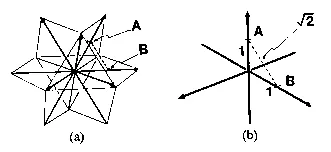
33Imagine one vertex within the IVM framework, which will be called O—for origin. A unit vector (L = 1) pointing in any of the twelve directions away from O ends at a vertex which we shall call A. [130/131]A second unit vector emanating from O is given a different orientation, in a direction 60° away from vector A, and arrives at vertex . The distance between A and B is also unit length (Fig. 9-64.a). As simple and repetitive as this observation might seem, it is the essence of "synergetics accounting", as opposed to "algebraic accounting".
35 Fig. 9 64 60° framework vs 90° framework
36 (a) 60° axes (b) 90° axes
37 The same procedure applied to a 90° framework, also using unit vectors, places vertices A and B an irrational-number distance apart. Unit increments along the x and y axes create points labeled simply {(0,1) and (1, 0)}, which are separated by a (not so simple) irrational 2 or 1.41421… units.
38 Furthermore, if pathways between vertices are to follow along the network of vectors, the square grid disallows the shortest route between A and B. Observe in Fig. 9-64.b that to get from A to B along the prescribed grid requires traveling two units, despite the fact that they are separated by only 1.414… units. As energy always takes the shortest route, argues Fuller, the XYZ system clearly does not serve to illuminate the events of physical reality. In contrast, the most expedient route from A to B in the triangular grid happens to be directly along the unit-length vector connecting the two points.
39 Irresolvable numbers do exist within the IVM, as there are square cross-sections (corresponding to the square faces of the VE); however, the irrationals are not part of the fundamental orientation of the system. To Fuller, a simple procedure, like the one described above, ought to yield simple ("omnirational") results. If a frame of reference is itself convoluted, its ability to describe and measure other phenomena will be all the more so.
Cells: "Inherent Complementarity"
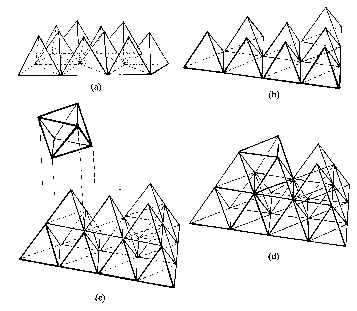
41Let's back up and start again. The goal is to establish a symmetrical and complete spatial array of vectors, and one logical approach might be to start with space's minimum system. We gather a number [131/132]of unit-vector tetrahedra and place them on the ground side by side, and it is immediately apparent that they will not pack together to produce a continuous expanse (Fig. 9-65.a).
43 Fig. 9 65 Tetrahedra and octahedra team up to fill space
44 (a) Tetrahedra do not fit together.
(b) Tetrahedra rearranged vertex to vertex.
(c) A second row of tetrahedra is placed above the first, such that all tetrahedra meet vertex to
vertex; the arrangement automatically creates octahedral cavities.
(d) Alternating tetrahedra and octahedra can fill space indefinitely.
45 Awkward gaps between adjacent tetrahedra cannot be filled by regular, or symmetrical, shapes, precluding an isotropic array. This constraint is not new: we saw in the previous chapter that tetrahedra cannot fill space; however, vector models display the shapes more clearly than sphere packings.
46 Still in pursuit of a space-filling array, we now rearrange the tetrahedra so that they meet vertex to vertex, each with one edge along a continuous line, in multiple adjacent rows (Fig. 9-65.b). Notice what happens when we interconnect the tetrahedral peaks (as would be the result if a second layer of tetrahedra were placed on top of [132/133]the first): precise octahedral cavities emerge in between all tetrahedra, automatically completing the isotropic vector matrix with its alternating two shapes (Fig. 9-65.c, Fig. 9-65.d).
47 The reverse is also true: octahedra cannot themselves fill space, but when arranged edge to edge (not face to face or vertex to vertex) the emergence of by-product tetrahedra reconfirms the persistent pairing. The developed matrix with its unit vectors and equivalent points of convergence thus depicts the inherent complementarity of space—meaning inevitable co-occurrence of octahedra and tetrahedra. Fuller draws a parallel between this and other inseparable pairs such as electron-proton, concave-convex, male-female, and tension-compression. "Inherent complementarity of Universe" applies to the entire phenomenon of interdependent partners, whether atomic constituents or polyhedral space-fillers. (Chapter 12 will further elaborate on Fuller's interpretation of the significance of "inherent complementarity".)
48 In conclusion, the development of both the VE and the IVM—whether through closest packing of spheres or by symmetrical arrangement of vectors—supports a sense of the balance of octahedral and tetrahedral symmetries inherent in space. Both configurations build themselves—in response to spatial constraints.
9.0.1 A Complete Picture
49We now step inside the IVM to complete our investigation of this omnisymmetrical network of vectors. The centers of closepacked spheres constitute the vertices of most regular and semiregular polyhedra. We looked at some of them in the previous chapter, and with the use of toothpicks instead of ping-pong balls, the outlines of these shapes can be more easily discerned.
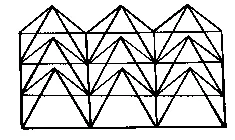
50 We have already observed that vertices in the IVM fall into triangular patterns in four distinct planar directions. Through our experience with cubic packing, we know to look for an additional three planes of symmetry, characterized by a square distribution of vertices. Neighboring octahedra share the edge between them, and thus the cross-sections of individual octahedra join together, forming the square pattern of graph paper in three orthogonal directions. Fig. 9-66 highlights an IVM squared plane, by omitting certain lines; ½-octahedra shown without tetrahedral edges clarify the square aspect of the omni-triangulated matrix.[133/134]
52 Fig. 9 66 Octahedral "egg-crate"
53 ½-octahedra without tetrahedral edges, to emphasize a square cross section of the IVM
Angles
55The combination of these two simple shapes in the IVM yields surprisingly many different angles and potential shapes. Our attention tends to be focused on the surface characteristics of the tetrahedron and octahedron, and so we observe only triangles and 60° angles. However, the interior structure introduces distinct new elements, such as the square octahedral cross-sections discussed above. The next step is to list other interior angles, for a sense of the range of possible shapes contained within the matrix.
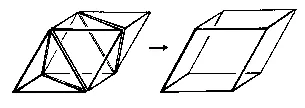
56 The dihedral angle (angle between two faces) in a regular tetrahedron is approximately 70°32'. The tetrahedron is unique in that any two edges at a given vertex are part of a common face. Every other polyhedron has interior angles in addition to surface angles between edges, thus adding to the range of shapes incorporated into each system. For example, any two nonadjacent edges at an octahedron vertex meet at 90° angles, thus forming square cross-sections. The octahedron dihedral angle is 109°28', which—as the supplement28 to the tetrahedron's 70°32'—results in perfectly flush surfaces shared by adjacent octahedra and tetrahedra, allowing the continuous planes of the IVM (Fig. 9-67).
58 Fig. 9 67 Oct / Tet supplementary angles
59 Tetrahedron's and octahedron's dihedral angles are supplementary, forming flush adjacent surfaces and continuous IVM planes
60 Both dihedral angles at first appear to be such irregular numbers that this exact geometric fit is surprising—especially when we recall our first encounter with the two shapes. Remember that we simply surrounded vertices by three triangles, then by four, allowing the systems to close off with as many triangles as necessary. (Refer to Chapter 4.) The process provided no basis for predicting the exact [134/135] complementarity of the two polyhedral systems. The coincidence continues with the addition of central nodes, as we shall see next.
Locating New Polyhedral Systems
62The first new polyhedron consists simply of one octahedron with a tetrahedron on two opposite sides (Fig. 9-67). The result, a rhombohedron, can be seen as a partially flattened cube. A toothpick-marshmallow model demonstrates the transition effectively, because the marshmallow joints have sufficient stiffness to hold either inherently unstable shape. The rhombohedron's direct relationship to the cube suggests a space-filling capability, which we shall explore in greater depth in Chapter 12.
63 The next candidate, the VE, is too familiar to warrant further description at this point. Twelve cuboctahedral vertices can be[135/136] located around every point in the IVM, thereby embracing eight tetrahedra and six ½-octahedra.
64 Furthermore, higher-frequency versions of any of the above polyhedra—tetrahedron, octahedron, rhombohedron, and VE—can be easily located within the matrix, thus establishing the foundation for truncated polyhedra. Subtract a ½-octahedron from each of the six corners of a 3-frequency octahedron to yield a symmetrical "truncated octahedron" with 14 faces: 6 squares and 8 regular hexagons (Fig. 9-68.b). A "truncated tetrahedron", with 4 hexagons and 4 triangles, is left after a single-frequency tetrahedron is removed from each corner of a 3-frequency tetrahedron (Fig. 9-68.a). The same procedure applies to higher-frequency versions of any of the above shapes, as well as further truncations of truncated shapes. Such transformations can be plotted indefinitely.
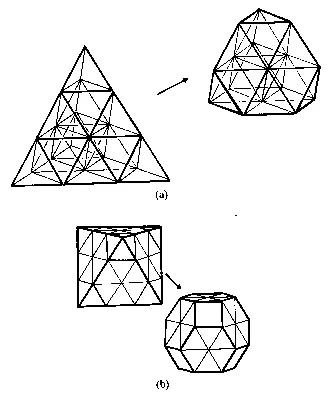
66 Fig. 9 68 3-frequency (3v) truncations
67 (a) Truncation of 3-frequency (3v) regular tetrahedron.
(b) Truncation of 3v regular octahedron, showing only external surface of system
9.0.2 Duality and the IVM
68We now introduce a new level of flexibility with the addition of a new set of vertices—in the exact center of each tetrahedron and octahedron. These new vertices are connected to the original IVM vertices, thereby introducing radial vectors into each of the original cells. Fig. 9-69 shows a single octahedron and tetrahedron with these central nodes.
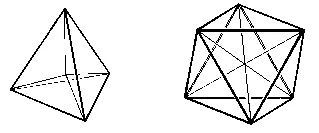
70 Fig. 9 69 Central nodes of tetrahedron and octahedron.
Angles
72The central angles of a tetrahedron is approximately 109° 28', exactly equal to the octahedron's dihedral angle. No longer surprised by such relationships, we go on to look inside the octahedron and note [136/137]its central angle of 90°, which is the surface angle of a cube. The octahedron's three body diagonals, or six radii, thus form the XYZ axes. Fig. 9-69 highlights these central angles by showing these two polyhedra with central nodes and radii. Right angles are thus integrated into the IVM system as by-products of the (stable) triangulated octahedron, rather than by an arbitrary initial choice of a network of unstable cubes. Since the IVM complex of octahedra and tetrahedra emerges automatically as a consequence of its unique property of spatial omnisymmetry, the array is not the product of an arbitrary choice.
Polyhedra
74We now observe considerable expansion of our inventory of generated shapes. Starting with the most familiar, we isolate the minimum cube. Formed by a single tetrahedron embraced by four neighboring 1/8-octahedral pyramids, or octants, the cube is once again based on the tetrahedron. We first encountered this relationship in "Structure and Pattern integrity" (using the tetrahedron to establish the minimum stable cube), and now we have determined the exact shape of the leftover space: four 1/8-octahedra.
75 This observation indicates that "degenerate stellation" of the tetrahedron forms a cube. The four vertices of the tetrahedron, together with the four centers of neighboring octahedra, provide the eight comers of this basic building block. Its six square faces are created by two adjacent quarters of the square cross-sections of single-frequency octahedra (Fig. 9-70). As with other IVM systems, larger and larger cubes will be outlined by more remote octahedron centers.
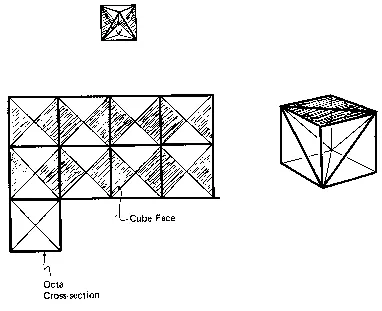
77 Fig. 9 70 Relationship of cube and IVM.
78 Next, we embrace a single octahedron by eight ¼-tetrahedra, thereby outlining the rhombic dodecahedron, whose twelve diamond faces have obtuse angles of 109°28' and acute angles of 70°32'—generated by the tetrahedral central angle and two adjacent axial angles, respectively. Its eight 3-valent vertices are the centers of embracing tetrahedra, while its six 4-valent vertices are the original octahedron vertices (Fig. 9-71).
79 Once again, we observe the relationship of duality between the VE and rhombic dodecahedron. The former has fourteen faces (six 4-sided and eight 3-sided) corresponding to the 4-valent vertices and 3-valent vertices of the latter. Likewise, the twelve 4-valent VE vertices line up with the twelve rhombic faces. (Refer to Fig. 4-17.)[137/138]
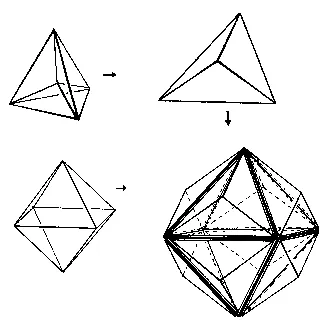
81 Fig. 9 71 Degenerate stellation of the octahedron
82 Accomplished by affixing ¼-tetrahedra to each face.
Domain
84The duality between VE and rhombic dodecahedron illustrates the relationship of duality and domain. Having already seen that spheres in closest packing outline the vertices of the VE, we now turn our attention to the domain of individual spheres.29 The domain of a sphere is defined as the region closer to a given sphere's center than to the center of any other sphere. This necessarily includes the sphere itself, as well as the portion of its surrounding gap that is closer to that sphere than to any other. Imagine a point at the exact center of an interstitial gap; this will be the dividing point between neighboring domains, that is, a vertex of the polyhedron outlined by the sphere's domain. This domain polyhedron happens to be the rhombic dodecahedron. As each sphere in cubic packing is by definition identically situated, each domain must be the same. Therefore, the shape of this region consistently fits together to fill space. Fuller's term for the rhombic dodecahedron is "spheric" because of this relationship to spheres in closest packing.[138/139]
85 We now have an experiential basis for the VE–rhombic-dodecahedron duality. Twelve vectors emanate from any point in the IVM, locating the vertices of the VE, while poking through the center of the twelve diamond faces which frame the point's domain. We were introduced to duality as exact face-to-vertex correspondence, and now we see how duals can be instrumental in locating a system's domain. Our investigation of space-filling in Chapter 12 will explore this relationship more fully.
86 Returning to the IVM, we observe that four rhombic dodecahedra, or "spherics", come together at the center of each tetrahedron, such that the tetrahedron central angle becomes the obtuse surface angle of the spheric. In the same way, eight cubes meet at the center of each octahedron, as allowed by the shared 90° surface and central angles, respectively.
87 For clarity, we shall refer to the new network, interconnecting the centers of all octahedral and tetrahedral cells, as IVM', and we can draw the following conclusion. If the vertices of a given polyhedron are located in the IVM, then that system's dual will be outlined by the IVM', and vice versa. Similarly, if a polyhedron is centered on a [139/140]vertex of the IVM, its dual will be centered on a vertex in IVM'. For example, we recall our first case of duality: the vertices of the octahedron's dual, the cube, are supplied by octahedron centers, which are nodes of IVM'.
88 This discovery leads us to another assumption. As truncation of our familiar polyhedra yields shapes contained within the IVM, the dual operation, stellation, should produce polyhedra outlined by IVM'.
89 The assumption is valid: the additional IVM' vertices provide the loci for the vertices of stellated versions of these basic shapes. Actually, this observation is not new, for we have already seen that ¼-tetrahedral pyramids affixed to octahedron faces produce Fuller's spheric, or, in other words, that a degenerately stellated octahedron becomes a rhombic dodecahedron. The 3-valent vertices of this diamond faceted shape are tetrahedron centers, by definition nodes of IVM'.
9.0.3 Framework of Possibility
90The isotropic vector matrix gives us a description of the symmetry of space. We can think of this matrix as a framework of possible directions and configurations of ordered space, or more simply, as a frame of reference. It is a network of vectors specifically situated to model nature's eternal tendency toward equilibrium. Lines are forces, length is magnitude, and all is in balance. The IVM weaves together a number of synergetics ideas: minimum system of Universe, vector equilibrium (both exhibiting four planes of symmetry), twelve degrees of freedom, complementarity of octahedra and tetrahedra, space-filling, and stability (exclusively a product of triangulation). In so doing, it sets the stage for an energetic mathematics, and systematizes further investigation.
91 The IVM also provides an alternative to the XYZ system's absolute origin. Every vertex in the IVM can be considered a temporary local origin, which, as reinforced by Fuller's use of the concept of "systems", is consistent with the requirements of describing Scenario Universe.
92 "All points in Universe are inherently centers of a local and unique isotropic-vector-matrix domain…" (537.11).
93 There can be no "absolute origin" in a scenario.
94 Finally, by describing such a wide variety of ordered polyhedra—and thereby clarifying the relationships between different shapes—the IVM supports Fuller's concept of "intertransformability". Countless potential shapes and transformations can be [140/141]systematically represented within this omnisymmetrical matrix; it is a framework of possibility.
Invention: Octet Truss
96Our familiarity with the IVM enables us to visualize and appreciate Fuller's "Octet Truss". Awarded U.S. Patent 2,986,241 in 1961, this structural framework is so widespread in modern architecture that one might assume buildings have always been constructed that way. Again, as the story goes, the invention can be traced to 1899 when Bucky was given toothpicks and half-dried peas in kindergarten. So extremely farsighted and cross-eyed that he was effectively blind (until he received his first pair of eyeglasses a year later), Bucky Fuller did not share the visual experience of his classmates and therefore lacked the preformed assumption that structures were supposed to be cubical. Thus, as other children quickly constructed little cubes, young Bucky groped with the materials until he was satisfied that his structures were sturdy. The result, much to the surprise of his teachers (one of whom lived a long, long life, and periodically wrote to Fuller recalling the event) was a complex of alternating octahedra and tetrahedra. He had built his first Octet Truss—also the first example of what was to become a lifetime habit of approaching structural tasks in revolutionary ways.
97 The experience had a great impact on the 4-year-old, as he recounted in a 1975 lecture:
98 "All the other kids, the minute they were told to make structures, immediately tried to imitate houses. I couldn't see, so I felt. And a triangle felt great! I kept going 'til it felt right, groping my way…" (EIK video)
99 The truss's omnisymmetrical triangulation distributes applied forces so efficiently that the resulting strength of such an architectural framework is far greater than predicted by conventional formulae:
100 "The unitary, systematic, nonredundant, octet-truss complex provides a total floor system with higher structural performance abilities than engineers could possibly ascribe to it through conventional structural analysis predicated only upon the behavior of its several parts." (650.11)
101 Struts can be all one length, thus simplifying construction, while the minimal volume-to-material ratio inherent in the geometry of the tetrahedron30 maximizes resistance to external loads. The intrinsic stability of triangulation together with efficient dispersal makes this [141/142]system the most advantageous possible use of materials in a spaceframe configuration:
102 "It is axiomatic to conventional engineering that if parts are horizontal", they are beams; and the total floor ability by such conventional engineering could be no stronger than the single strongest beam in the plural group. Thus their prediction falls short of the true behavior of the octet truss by many magnitudes…" (650.11)
103 The octet truss takes the conceptual matrix into physical realization, and thus embodies Fuller's design science concept of using geometric principles to human advantage.
104 We can now appreciate the difference between diamond and graphite. Both consisting of carbon atoms, the former is exquisitely hard and clear, the latter soft and grey, and their differences are due to geometry.
105 Carbon atoms in the structure of diamond take advantage of the strength of tetrahedra; their organization can be thought of as a double octet truss, two intersecting matrices with the vertices of one overlapping the cells of the other. Stabilized by the high number of bonds between neighboring atoms, which also allow forces to be distributed in many directions at once, the configuration is supremely invulnerable.
106 In contrast, carbon atoms in graphite are organized into planar layers of hexagons—triangulated and stable in themselves, but not rigidly connected to other layers. As a result, separate layers are able to shift slightly with respect to each other, which does not mean that graphite lacks all stability, but rather that it is relatively soft. This softness enables graphite to leave visible residue on the surface of paper, thus performing its useful function in pencils. A more illustrative although less widely recognized application is that these sliding layers make graphite a powerful lubricant.
107 The comparison provides a spectacular example of synergy: rearrangement of identical constituents produces two vastly different systems.
108 Thus we see that nature also employs design science.[142/143]