
16 "Design Science"
2"I did not set out to design a geodesic dome. I set out to discover the principles operative in Universe. For all I knew, this could have led to a pair of flying slippers."
3 This playful declaration stands as a concise summary of the philosophy behind Fuller's life's work and introduces the relationship of synergetics to design. "Design science", in the most general terms, maintains that faithful observation of Universe is the basis of successful invention. The idea therefore is not to invent some strange new gadget, hoping there will be a market for it, but rather to tap into the exquisite workings of nature. While the significance of scientific discoveries is not always immediately understood, the accumulated "generalized principles" have been applied in innovative ways throughout history, producing artifacts which have gradually transformed the physical environment. Therein lies the key to humanity's success aboard Spaceship Earth, explains Bucky Fuller.
"Comprehensive Anticipatory Design Science"
5Characteristically, his title expands—to embrace the full significance of this vital human endeavor.
6 Fuller defines design as the deliberate ordering of components. Thus distinguished from randomness, design implies the presence of intellect. His definition is worth our serious attention, for the word is too often associated with the concept of decoration—secondary or superficial embellishment as opposed to thoroughly developed systems. Fuller was quick to point out that Universe overflows with evidence of design; unimaginably intricate and reliable energy patterns reveal "eternal design interrelationship principles". Technology, to Fuller, is principle in action, and so "Universe is nothing but incredible technology". Its awesome complexity is the inspiration for Fuller's phrase "Intellectual Integrity of Eternally Regenerative Universe"—a [258/259]weighty title attempting to convey a nonanthropomorphic respect for a greater (in fact all-encompassing) divine intelligence.
7 Combining this newly defined word with "science", to describe a new discipline or field, further enriches its significance. "Science" hints at the necessary rigor, suggesting a systematic new study. Fuller thereby expands the realm of "design"; the scientific method is essential, for "design science" involves the application of principle. He points out that "generalized principles" are eternal truths, as opposed to special-case statements or transient facts, and as such are inherent aspects of reality waiting to be discovered. Only human beings are able to discern such truths (science) and thereby participate in their own evolution (design). "Design science" is thus saturated with meaning: humanity alone has access to the design laws of Universe, and that has determined our unique evolutionary function. Just as bees are meant to cross-pollinate, we are meant to solve problems. Without specialized long beaks or wings or other role-specific physical traits, human beings have learned to exploit mechanical advantage, discipline the electron, travel more quickly than the fastest leopard, and fly farther than the strongest bird. Our unique advantage is a faculty called "mind", which can integrate disparate facts of experience. We are therefore deliberately designed to be "comprehensivists" while all other creatures are specialists. This brings us to the next aspect of Fuller's wordy title.
"Comprehensive…"
9Fuller was profoundly impressed by the danger of overspecialization. He was once asked to speak at a convention of the American Association for the Advancement of Science, and the experience provided one of his best parables. Whether by luck or through Fuller's characteristic genius for detecting significant patterns, he happened to encounter two papers with a striking similarity—presented at different sections of the conference. The reports, on biology and on anthropology, both happened to discuss the phenomenon of extinction: the former investigating various extinct species, and the latter, extinct human tribes. Both papers concluded that the cause of extinction was overspecialization, which, taken to an extreme, precludes general adaptability. Fuller took the message to heart.
10 He says his predilection for thinking comprehensively began with his World War I Navy experience. Belonging to the last generation of sailors that preceded ship-to-shore radiotelephone equipment, [259/260]officers in 1917 were still trained as "comprehensivists". Everyone had to be capable of handling any job on the ship, for voice communication with land was not yet possible. The need for all members of a crew to act quickly in an emergency demanded quick "comprehensive" thinking and the flexibility to take over any job without instructions from superior naval powers. A second lesson was that a sailing vessel is itself a manageable whole system, and every member of her crew is working toward the success of the whole ship. It seemed to Bucky a very desirable way to operate. He began to see that our entire planet is one system and deliberately set out to understand the interrelatedness of human affairs. He later coined the famous "Spaceship Earth" to symbolize this approach, as it became ever more apparent that effective design had to recognize the existence of a finite and inescapably connected whole-system world. Lack of such awareness leaves us stranded on a ship with the starboard side shortsightedly using much of its time and energy in an effort to sink the port side, and vice versa.
11 Fuller then calls our attention to a subtle irony implicit in the compartmentalization of the sciences, which require an ever narrower focus as one pursues a given scientific discipline more deeply, as if to deny the relatedness of various aspects of scientific knowledge. At the beginning of this century, he recalls, chemistry and biology, for example, were totally separate fields, the former encompassing chemical elements and their reactions, the latter pondering the classification of species and the mystery of evolution. Moreover, all branches of science involved philosophical speculation. Time was given to questions such as "what is life?" and the difference between life and nonlife could not have seemed more self-evident.
12 In this century, however, science faced an unpredicted development. As a necessary reaction to new discovery, new fields emerged, such as biochemistry, defying the rigid boundaries between disciplines. (Science responded by making individuals that much more specialized within such new categories, laments Fuller.) More sophisticated equipment had revealed the chemistry of life, forcing scientists to integrate their fields. The helix of nucleotides in DNA, the magnificent chemical transitions in photosynthesis, and hundreds of newly observed reactions belonged inarguably to both chemistry and biology, and precipitated the birth of "biochemistry". And gradually the clear boundary between life and nonlife was dissolving, for both consist ultimately of electrochemical process. But scientists were no longer the "natural philosophers" characteristic of the turn of the century, maintains Fuller, and so this astonishing evolution [260/261]went largely unheralded. Specialization removed the burden of asking what a scientific development means in terms of the whole picture.
13 Fuller has a reason for pointing out such historical trends: the design scientist will be maximally effective as a comprehensive thinker. Once again, he redefines and thereby expands the concept of design. The design scientist is not to be concerned with an attractive handle for refrigerator doors, but rather with the whole concept of the distribution and preservation of food for humanity. Such subjects, he emphasizes, are not too large to think about. Only through systematic comprehensive planning does humanity have a chance to survive its growing crisis.
14 A "comprehensivist", he continues, may periodically have to "plunge very deeply" into a narrow subject or specialized project; however, such activity is always part of a larger plan. "Local problem solvers" can function with a global perspective. Our emphasis must shift from "earning a living" to accomplishing vital tasks if humanity is to survive, cautions Fuller; moreover, the "living" will take care of itself if we concentrate on doing what needs to be done.
15 These sweeping statements at first may seem difficult to apply; however, Fuller's philosophy is backed up by a lifetime of revolutionary invention and research into world patterns and trends, which stem directly from his 1927 decision to think about the whole system of "Spaceship Earth". He explains that his accomplishments were only possible because he gave himself the license to be a generalist: it is feasible to conceptualize humanity's food production and distribution (for example) as a whole system; it is a complicated study, but one with clearly defined boundaries: just food—where it is grown, where and when it is eaten, how and at what cost to the environment, consumer, etc.51
"…Anticipatory…"
17Finally, the design scientist must think ahead. In each industry, there are specific "gestation rates" that determine the length of time between invention and widespread practical application. These inherent lags vary according to the nature of a design: in the electronics industry, for example, it is only a matter of months before a new invention can be incorporated into commercial production; car manufacturers might require 5 years to bring a new idea to the consumer; and housing presents the slowest evolution of all, Fuller's rather optimistic estimate of the "gestation rate" being 50 years. [261/262]Psychological resistance to change, absence of urgency, and ignorance keep our approach to housing many generations behind our technological capability. The design scientist must take these lags into consideration, explains Fuller; an invention often must wait until its time, but the designer has a responsibility to anticipate long-term developments. Finally, a necessary implication is that we can glean important clues through the study of trends, and thereby determine what needs to be done.
18 So let us look at the relationship between "comprehensive anticipatory design science" and synergetics. Invention, as stated above, is the novel application of one or more "generalized principles". In the previous chapter, we discussed two inventions, the geodesic dome and tensegrity structures, in light of this statement. Briefly, the dome combines the inherent stability of triangles with the advantageous volume-to-surface-area ratio of spheres. A variety of structures based on geodesic chords could satisfy the above requirements, but icosahedral symmetry approximates the spherical distribution most efficiently. Both geodesic domes and tensegrities are direct applications of the principle describing the specific interdependence of tension and compression.
19 The theory of geodesic domes is taken a step further by an additional principle: the varying rates of geometric expansion. As discovered and exploited long ago by clipper-ship owners—as well as by today's shipping industry—a ship with twice the length of another has 8 times the volume and 4 times the surface area. Translated into practical advantage, the cargo (i.e. payload) of larger vessels increases rapidly with respect to the amount of material and drag, which together determine the effort and cost of building ships and driving them through the sea. Larger ships are therefore more cost-effective. Despite the pivotal role of this geometric principle in shaping the historical direction of shipping, the flow of resources, and the ultimate mobility of humankind, these varying rates are not popularly recognized. With respect to geodesic domes, this means doubling the diameter increases the material fourfold and encloses 8 times the volume. As both cost and temperature control of an enclosure are directly determined by surface area, the efficiency of a geodesic dome increases drastically with size. The implication is that their true design-science advantage is yet to be realized and may involve very large structures in novel environment control applications. Whether utilized for shelter, food production, recreation, or other functions, geodesic domes can enclose so much space with so little material that unprecedented future applications are not unlikely. [262/263]In conclusion, the geodesic dome embodies design science at work.
Dymaxion Map 52
21Another of Fuller's inventions, in response to a very different problem than architectural design, is based on similar geometric principles. The problem is to draw a flat map of the world without the gross distortions inherent in the Mercator projection. In the early 1940s, dismayed by this widely accepted map's inaccurate depiction of our world—a visual lie presenting Greenland as 3 times the size of Australia, when exactly the reverse is true—Fuller was determined to discover a better solution.
22 Let's consider the design problem. Visual data must be reliably translated from the surface of a spherical "whole system" onto a flat display with only one side. To understand how the Mercator projection attempts to accomplish this task, imagine wrapping a large rectangular piece of paper around a transparent globe, forming a cylinder that touches only the equator. The geographical outlines are then projected directly outward to the cylindrical paper, as if by a light source inside the globe casting omnidirectional shadows. As a result, the visual information is accurately translated to the paper only at the equator; some distortion exists slightly above and below the equator, and it increases radically as one goes farther north and south on the map. In many versions Antarctica is left out altogether, even South America is smaller than the gigantically distorted Greenland, and certain land areas—depending on which country has produced the map—must be split in half to turn the cylinder into a flat poster.
23 Unwilling to accept such distortion as necessary, Fuller started from scratch. If a spherical system is to be translated onto a flat surface, what is the most efficient and direct solution? It's a geometry problem; the relevant "generalized principle" involves the polyhedral system which best approximates a sphere with only one type of face. (The latter consideration insures an evenly distributed projection.) That system, which is of course an icosahedron, is the basis of a reliable and simple solution.
24 Imagine a globe with the edges of a spherical icosahedron superimposed on its surface by thin steel straps. Chapter 14 described planar polyhedra expanding into spherical polyhedra, as if drawn on balloons; we now visualize the reverse process. The steel arcs slowly unbend into straight-edge chords, while the curved triangle faces [263/264]flatten out into planar equilateral triangles. The overall shape change is relatively slight (consider for comparison a spherical tetrahedron undergoing the same operation, or a sphere turning into a cylinder as in the Mercator projection), and the global "whole system" is preserved. As the globe transforms into an icosahedron, twenty spherical triangles with 72° corners become planar triangles with 60° corners; 12 degrees are squeezed out of each angle. (With 3 angles per triangle, 12 degrees times 60 angles equals none other than our old friend the "720° takeout".) Because each triangle of the spherical icosahedron covers a relatively small portion of the sphere and is thus fairly flat, the distortion during this transformation is minimal—and in fact invisible to the untrained eye. Moreover, the polyhedral projection automatically distributes the distortion symmetrically around the globe's surface and thereby insures that the relative sizes of land masses are accurate. (This is why a regular polyhedron is a preferred vehicle; different types of faces would distort slightly different amounts during the transition from spherical to planar.) Finally, all geographical data are contained within the triangular boundaries; there is no "spilling" of information or need to fill in gaps with "extra" land as in the Mercator.
25 The next step is straightforward. Unfold the icosahedron to display its twenty triangles on a flat surface. The result is a map of the entire world with little distortion of the relative shape and size of land masses, and no breaks in the continental contours (Fig. 16-136). No nation is split and shown on two opposite sides of the map as if separated by 20,000 miles (32,000km).
26 That last step required more work than is immediately apparent, however. It took Fuller 2 years of experimenting to find an orientation in which all twelve icosahedral vertices land in the ocean—an essential requirement if land masses are not to be ripped apart. Observe in Fig. 16-136 that many of the vertices are extremely close to shore. One can imagine the frustrating task of searching for twelve water locations; moving a vertex away from land on one side of the globe would instantly result in a number of vertices bumping into land somewhere else. Contemplating the five or six angular gaps which are precariously close to land masses, one suspects that Fuller's final arrangement may be a unique solution to the problem.
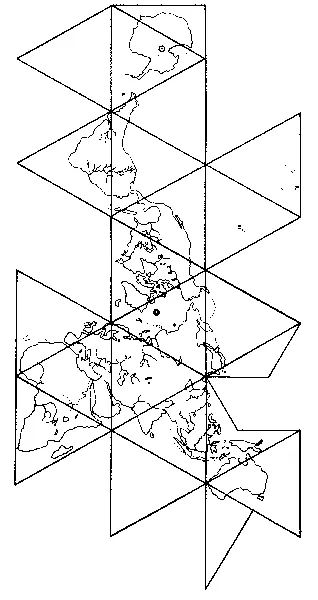
28 Fig. 16 136 DymaxionTM Map
29 Used with permission of the Buckminster Fuller Institute.
(See "Other resources", p.309, for more information about the Institute.)
30 The Dymaxion Map, awarded U.S. Patent 2,393,676 in 1946, is an unprecedented cartographic accomplishment, which was made possible by a straightforward application of geometry. This map is therefore another superb example of the design-science approach. Fuller considered the problem outside the context of traditional [264/265]mapmaking; rather than attempting to work with and refine history's previous best solution, he started over. He sets the example of considering a design problem as a whole system.
31 Suspended Storage Systems
32 A third synergetic design application is Fuller's 1983 hanging bookshelf. Conceived as a space-saving storage device, the narrow shelving unit is suspended from the ceiling by six wires. The original design was a tall hexagonal column of wood, with compartments on all sides creating omnidirectional access, as the unit is suspended rather than leaning against the wall (Fig. 16-137).
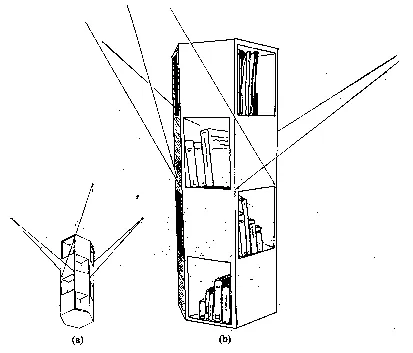
34 Fig. 16 137 Hanging bookshelf, U.S. Patent 4,377,114 (1983).
35 Hanging by its few cables, the column appears ready to swing back and forth at the slightest push from any direction. People would approach this structure—on display for a while in a Philadelphia bookstore—and touch [266/267]it hesitantly and gently, only to be astonished by its resistance. The more daring will ultimately lean against the column with all their weight and discover that it does not move. Just as for the tensegrity sculptures, this rigidity is especially surprising because we do not expect "delicate" tension elements to be capable of the same strength as "solid" columns; however, even those who anticipate the great capability of tension are caught off guard by this display. In spite of recognition that thin cables can support a massive block of wood, the fact that the shelf does not swing even slightly out of place remains astonishing.
36 This invention utilizes one geometric principle: Fuller's "twelve degrees of freedom". Twelve vectors, or independent forces (6 positive, 6 negative), must be applied to a body in space to completely restrict its mobility. In Chapter 7 we looked at the application of this inherent spatial characteristic to a bicycle wheel, and observed that a minimum of twelve spokes was required to rigidly restrain its hub. Fuller's bookshelf presents a similar design problem; why then is it anchored with only six "spokes"? The answer lies in the massiveness of this gigantic "hub"; the hexagonal column is heavy enough to pull firmly against the six wires and remove the remaining, or negative, six degrees of freedom. The cables are symmetrically arranged—as are the six spokes anchoring one half of our hypothetical bicycle hub—but in this case gravity takes care of the other six spokes, pulling in the opposite direction from each cable by taking advantage of a heavy object's considerable attraction to the Earth. If the column were made of lightweight plastic, the design would not work; six degrees of freedom would still be unaccounted for.
37 This design represents a remarkably simple application of a synergetic principle, and produces a startling piece of furniture, the major significance of which—if saving floor space is not a consideration—may be educational. It is a profoundly reorienting experience to feel the precariously suspended shelf's refusal to budge.
38 The above examples suggest that design science can be considered a science of spatial order. As such, this study is necessarily comprehensive; space is everywhere. We also learn that invention does not spring fully formed out of principle, but rather requires a little work. First a need is ascertained, as for example for an efficient shelter system. Then, relevant principles are gathered. From the jumble of known truths, one or two might apply to a problem. The next step is to pull them in, experiment, twist them around, and not give up: seek that innovative application of an age-old principle.[267/268]
39 More with Less
40 The three designs described above were chosen as straightforward examples of design science. However, Fuller's main purpose is to call our attention to an invisible design revolution already taking place, to inspire our active participation in guiding this progression in preferred ways. He points out fantastic technological advances, such as new communications satellites, each one weighing ¼-ton and outperforming 175,000 tons of transoceanic copper cable.53 Anyone who remembers the shaky transatlantic telephone connections of the past can appreciate the qualitative improvement as well. Similarly, ever stronger metal alloys enhance humankind's structural capability. The average person is not aware of this metallurgical revolution, says Bucky, because it cannot be seen. An invisible reality is quietly taking over, accomplishing so much more with so much less material and other resources, that the logical extension is sufficient and sustainable life support for all humanity.
41 To further explain this potential, Fuller discovers that he is forced to redefine "wealth". Too long associated with money and other tangible and limited resources, wealth is actually the organized capacity of society to apply its resources to take care of lives. A computer is not worth much in terms of its content of precious materials; its value is in the processing of information and knowledge. Wealth involves energy and knowledge; the former is neither created nor destroyed, and the latter is constantly increasing. Therefore, humanity's true wealth is constantly increasing and has no inherent upper limit. There is a fixed amount of gold in the world, but the currency of our emerging era is knowledge and its creative application.
42 Finally, Fuller points out that Thomas Malthus could not have foreseen this technological revolution. His epochal conclusion in 1805 that population increases geometrically while its resources—ability to feed, clothe, and house itself—expand arithmetically at best, is now obsolete. Malthus did not anticipate the phenomenon of more effective performance using less resources. His declaration predates refrigeration, let alone the information and communications revolution, emphasizes Bucky, and yet humanity's social and economic institutions are still based on the assumption of fundamental scarcity. Malthusian thinking has controlled human affairs for so long that we have mistaken it for absolute truth. The only barrier to a successfully sustainable planet is ignorance, Bucky declares. Fundamental scarcity is a remnant of the dark ages.[268/269]
43 The essential message of Fuller's design science is that human beings have access to the design laws of Universe, and a responsibility to use the extraordinary phenomenon of mind to discover and apply such principles. Our function is problem-solving. Synergetics, the discipline behind Fuller's more-with-less philosophy, above all encourages us to experiment. This material is superbly suited to nurture and enhance creativity, demanding both numerical rigor and intuitive leaps. The systematic study of spatial complexities is still young, and its significance and utility as yet undeveloped.
44 The future is wide open, but we must probe and step beyond our fragile equilibrium, if Fuller's vision is to be tested.
45 A design science revolution is imperative.[269/270]