
Appendixes
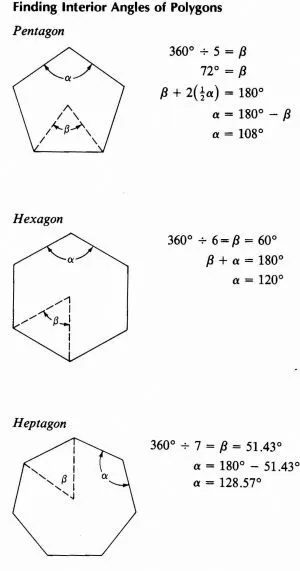
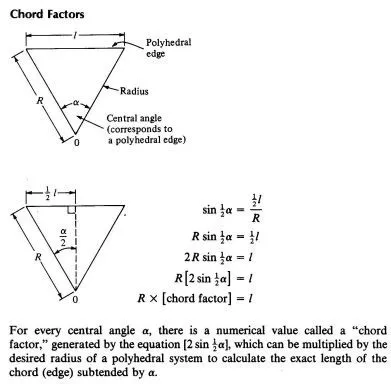
16.1 Appendix A: Trigonometric Calculations


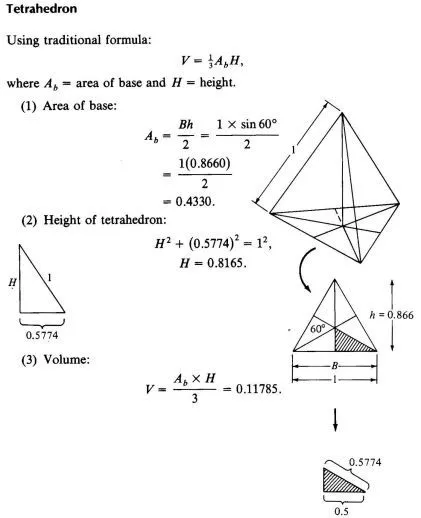
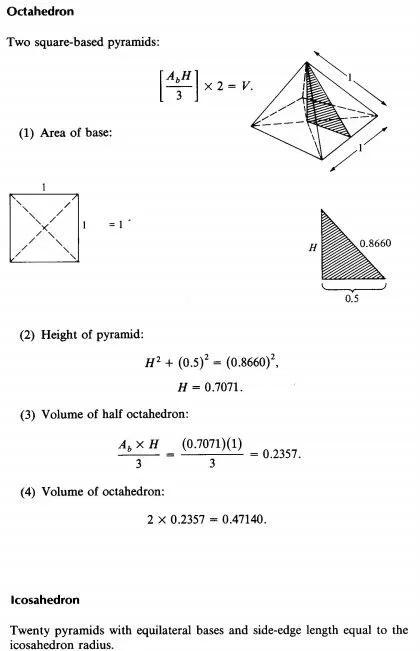
16.2 Appendix B: Volume Calculations for Three Prime Structural Systems


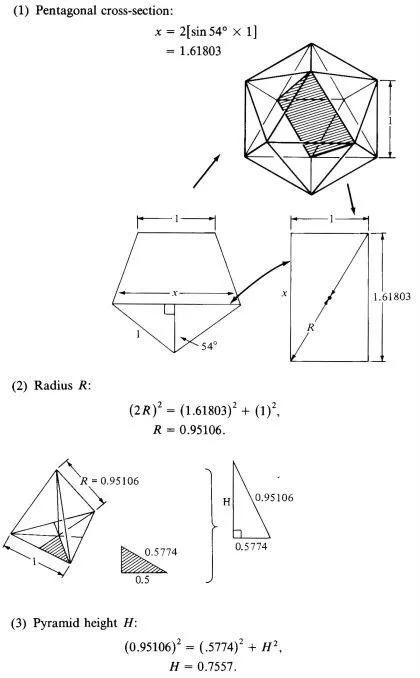

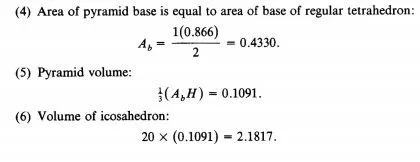

16.3 Appendix C: Special Properties of the Tetrahedron
10(1) Minimum system: the tetrahedron is the first case of insideness and outsideness.
11 (2) The regular tetrahedron fits inside the cube, with its edges providing the diagonals across the cube's six faces, and thereby supplying the six supporting struts needed to stabilize the otherwise unstable cube. Furthermore, two intersecting regular tetrahedra outline all eight vertices of the cube.
12 (3) The tetrahedron is unique in being its own dual.
13 (4) The six edges of the regular tetrahedron are parallel to the six intersecting vectors that define the vector equilibrium.
14 (5) Similarly, the four faces of the regular tetrahedron are the same four planes of symmetry inherent in the vector equilibrium and in cubic closepacking of spheres. The tetrahedron is thus at the root of an omnisymmetrical space-filling vector matrix, or isotropic vector matrix.
15 (6) When the volume of a tetrahedron is specified as one unit, other ordered polyhedra are found to have precise whole-number volume ratios, as opposed to the cumbersome and often irrational quantities generated by employing the cube as the unit of volume. Furthermore, the tetrahedron has the most surface area per unit of volume.
16 (7) Of all polyhedra, the tetrahedron has the greatest resistance to an applied load. It is the only system that cannot "dimple"; reacting to an external force, a tetrahedron must either remain unchanged or turn completely "inside out".
17 (8) The surface angles of the tetrahedron add up to 720°, which is the "angular takeout" inherent in all closed systems.
18 (9) The tetrahedron is the starting point, or "whole system", in Fuller's "Cosmic Hierarchy", and as such contains the axes of symmetry that characterize all the polyhedra of the isotropic vector matrix, or face-centered cubic symmetry in crystallography.
19 (10) Packing spheres together requires a minimum of four balls, to produce a stable arrangement, automatically forming a regular tetrahedron. The centers of the four spheres define the tetrahedral vertices. In Fuller's words, "four balls lock".[279/280]
20 (11) It has been demonstrated that many unstable polyhedra can be folded into tetrahedra, as in the jitterbug transformation.
21 (12) Fuller refers to the six edges of a tetrahedron as one "quantum" of structure, because the number of edges in regular, semiregular, and high-frequency geodesic polyhedra is always a multiple of six.[280/281]
16.4 Appendix D: Lists of Illustrations, Photos, Tables
22Illustrations
23 Figure no. page
24 Fig. 2 1 "Triangling" versus "squaring" 23
25 Fig. 2 2 "Cubing" versus "tetrahedroning" 24
26 Fig. 3 3 6 connections between 4 events, defining a tetrahedral system 30
27 Fig. 4 4 3 triangles, 4 triangles around a vertex 42
28 Fig. 4 5 5 triangles around each vertex form an icosahedron 43
29 Fig. 4 6 3 squares around each vertex form a cube 44
30 Fig. 4 7 3 pentagons per vertex form a pentagonal dodecahedron 44
31 Fig. 4 8 3 hexagons around each vertex form a flat honeycomb 45
32 Fig. 4 9 The 5 regular polyhedra 46
33 Fig. 4 10 "Dualing" polyhedra 50
34 Fig. 4 11 Degenerate truncation of a tetrahedron. 51
35 Fig. 4 12 Stellated cube and octahedron. 52
36 Fig. 4 13 Truncation of duals 53
37 Fig. 4 14 Icosidodecahedron. 54
38 Fig. 4 15 Degenerate stellation of cube 55
39 Fig. 4 16 Cuboctahedron and rhombic dodecahedron are dual polyhedra 56
40 Fig. 4 17 Symmetry of icosahedron and of the letters M, S, and R. 57
41 Fig. 5 18 Square necklace, collapsed 60
42 Fig. 5 19 Leverage 61
43 Fig. 5 20 Inscribed tetrahedron stabilizes cube. 65
44 Fig. 5 21 "Dimpling" 69
45 Fig. 5 22 Dimpling: ½ of octahedron caves in to nest inside other half. 69
46 Fig. 6 23 Cartesian vs. spherical coordinates. 79
47 Fig. 6 24 "4D": Tetrahedron / octahedron embody four distinct directions 80
48 Fig. 6 25 A cone: sliced and flattened 83
49 Fig. 6 26 Nets of icosahedron and octahedron 83
50 Fig. 6 27 4-frequency icosahedron 86
51 Fig. 6 28 Angle types 87
52 Fig. 7 29 Stable, metastable, and neutral equilibrium 89
53 Fig. 7 30 Entropy: closed-container experiment 92
54 Fig. 7 31 "Close-packed cookies": triangular vs. square pattern 93
55 Fig. 7 32 In search of equivalent radial and circumferential vectors. 95
56 Fig. 7 33 Vector equilibrium. 97
57 Fig. 7 34 (a) cuboctahedron; (b) twist cuboctahedron. 97
58 Fig. 7 35 Eight radiating tetrahedra alternate with six ½-octahedra. 99
59 Fig. 7 36 Four hexagonal cross-sections of the VE. 101
60 Fig. 7 37 Motion of partially restrained disc in a plane 102
61 Fig. 7 38 Minimum of 12 spokes needed for stability 103
62 Fig. 7 39 Ball restrained in space 105
63 Fig. 8 40 Closepacked spheres form array of equally spaced points in space 109
64 Fig. 8 41 Closepacking of three pennies 111
65 Fig. 8 42 Six spheres closepacked around one 111
66 Fig. 8 43 Cubic packing (top) versus hexagonal packing (bottom) 112
67 Fig. 8 44 Hexagonal (left) vs cubic (right): spheres 12-around-1 113
68 Fig. 8 45 Five oranges stacked to form ½-octahedron. 115
69 Fig. 8 46 Tetrahedral and octahedral closest sphere packing clusters. 116
70 Fig. 8 47 Triangular numbers. 117
71 Fig. 8 48 "Four balls lock" 119
72 Fig. 8 49 Frequency in closepacking of spheres 120
73 Fig. 8 50 Tetrahedral frequency (v) progression: 1v, 2v, 3v 121
74 Fig. 8 51 "Yes-no-no-yes-no-no" –nest layers 122
75 Fig. 8 52 Vector equilibrium progression: 1v, 2v, 3v 123
76 Fig. 8 53 Removing nuclear sphere from 1-frequency VE creates icosahedron 126
77 Fig. 8 54 Square pattern of spheres compressed into rhomboid shape 127
78 Fig. 8 55 Pyramids formed by triangular-number layers + one ball in central nest 130
79 Fig. 8 56 Interprecessing: two closepacked pairs of spheres creates a tetrahedron 131
80 Fig. 8 57 Tetrahedron as chef's hats 132
81 Fig. 8 58 Chef's hats back to tetrahedron 132
82 Fig. 8 59 Two 1/8-octahedra create minimum stable cube 133
83 Fig. 9 60 Unit-vector matrix within closepacked sphere cluster 135
84 Fig. 9 61 Alternating tetrahedra and octahedra 136
85 Fig. 9 62 Isotropic vector matrix and Octet Truss 137
86 Fig. 9 63 Octahedral cavities between adjacent VEs 138
87 Fig. 9 64 60° framework vs 90° framework 139
88 Fig. 9 65 Tetrahedra and octahedra team up to fill space 140
89 Fig. 9 66 Octahedral "egg-crate" 142
90 Fig. 9 67 Oct / Tet supplementary angles 143
91 Fig. 9 68 3-frequency (3v) truncations 144
92 Fig. 9 69 Central nodes of tetrahedron and octahedron. 145
93 Fig. 9 70 Relationship of cube and IVM. 146
94 Fig. 9 71 Degenerate stellation of the octahedron 147
95 Fig. 10 72 Self-similarity in subdivision of triangles and tetrahedra. 155
96 Fig. 10 73 2-frequency (2v) cube consists of 8 unit cubes 156
97 Fig. 10 74 2-frequency (2v) tetrahedron has altitude of 2 tetrahedra 157
98 Fig. 10 75 "Unwrap" a hidden central octahedron 160
99 Fig. 10 76 Derivation of an octant: 1/8-octahedron. 161
100 Fig. 10 77 One octant altitude is equal to ½ the altitude of the tetrahedron 161
101 Fig. 10 78 Four octants added to one tetrahedron produce one cube 162
102 Fig. 10 79 Subdivision of tetrahedron into 4 shallow pyramids 163
103 Fig. 10 80 2v tetrahedron with octahedron core 165
104 Fig. 10 81 2v octahedron with cubocahedron (VE) core 166
105 Fig. 10 82 Hierarchical nest within 4v tetrahedron 167
106 Fig. 11 83 "Jitterbug" transformation of VE 171
107 Fig. 11 84 Further jitterbugging. 173
108 Fig. 11 85 Octahedron within icosahedron 177
109 Fig. 11 86 Icosahedron within octahedron 177
110 Fig. 11 87 S module. 179
111 Fig. 11 88 Golden- ratio relationship: Icosa / Rhombic dodecahedron 180
112 Fig. 11 89 Four independent axes of rotation 181
113 Fig. 11 90 Tetrahedra "bonding" models of phases of matter 185
114 Fig. 12 91 Plane tesselations: Regular and semiregular tilings of the plane. 188
115 Fig. 12 92 Octahedron at junction of 8 cubes 190
116 Fig. 12 93 Space-filling rhombic dodecahedron via degenerate stellation of cube 194
117 Fig. 12 94 Space-filling tetrakaidecahedron by truncating 3v octahedron 196
118 Fig. 12 96 Volume cross-sections of 4v tetrahedron 200
119 Fig. 13 97 Development of A module. 203
120 Fig. 13 98 Modules for intertransformability 204
121 Fig. 13 99 Planar nets 207
122 Fig. 13 100 LCD of IVM: "Mite" 209
123 Fig. 13 102 The LCD of both cube and rhombic dodecahedron is the Mite. 212
124 Fig. 13 103 Each Mite is one octant of the coupler. 213
125 Fig. 13 104 "Coupler" 214
126 Fig. 13 105 Different rearrangements of 8 Mites in the coupler 216
127 Fig. 14 106 A lesser-circle path is always the long way around 219
128 Fig. 14 107 Spherical polyhedra 221
129 Fig. 14 108 Different sets of axes of symmetry 223
130 Fig. 14 109 The 6 great circles of the octahedron 224
131 Fig. 14 110 The 4 great-circle edges of the VE 224
132 Fig. 14 111 The 25 great circles of the VE 225
133 Fig. 14 112 The 6 great circles of the icosahedron 226
134 Fig. 14 113 The 31 great circles of the icosahedron 227
135 Fig. 14 114 Maximum of 120 equivalent domains: LCD 228
136 Fig. 14 115 LCD unit 229
137 Fig. 14 116 Revealed in the 31-great-circle pattern 230
138 Fig. 14 117 Revealed in 25 great-circle pattern 232
139 Fig. 14 118 Making bowties: relating central and surface angles 233
140 Fig. 14 119 4 bowties create the 4 great circles of the VE 234
141 Fig. 14 120 Reflective bounces in local holding-pattern figure-8 loop 236
142 Fig. 14 121 6 bowties create the 6 great circles of the cube or octahedron 237
143 Fig. 14 122 The 3-great-circle model requires 6 foldable circles 238
144 Fig. 14 123 6 pentagonal bowties create the 6 great circles of the icosahedron 239
145 Fig. 14 124 15-great-circle model, created by doubling the edges 240
146 Fig. 15 125 Reed sphere of six interwoven great circles 247
147 Fig. 15 126 31-great circle subdivision of icosahedron LCD 248
148 Fig. 15 127 4-frequency (4v) triangles superimposed on icosahedron 249
149 Fig. 15 128 Transformation from planar to spherical 251
150 Fig. 15 129 4v icosahedron: transformation of Fig. 15-3 251
151 Fig. 15 130 5/8 truncation of 4v icosa—as basis of geodesic dome. 255
152 Fig. 15 131 Geodesic pattern possibilities 256
153 Fig. 15 132 LCD in higher frequencies 257
154 Fig. 15 133 Compression: neutral axis, girth, and spherical limit case 262
155 Fig. 15 134 Wheel with compression spokes 265
156 Fig. 15 135 Tensegrity icosahedron and its Platonic (planar) counterpart. 269
157 Fig. 16 136 DymaxionTM Map 281
158 Fig. 16 137 Hanging bookshelf, U.S. Patent 4,377,114 (1983). 282
159 Photos
160 Photo no. page
161 Photo 11 1 Complex of jitterbugs 182
162 Photo 15 2 Tensegrity icosahedron and tensegrity tetrahedron. 267
163 Photo 15 3 3v tensegrity icosahedron with 90 struts. 268
164 Photo 15 4 Six-strut "expanded octahedron" tensegrity. 270
165 Tables
166 Table no. page
167 Table 4 1 Euler's Law (V + F = E + 2) 47
168 Table 5 2 "Structural quanta":
volume per edge for the 3 prime structural systems. 67
169 Table 6 3 "Structural quanta":
polyhedra edges in even multiples of the tetrahedron's 6 85
170 Table 7 4 VE: equal radial and circumferential vectors and angles 98
171 Table 10 5 Volume Ratios 153
172 Table 12 6 Octahedron-tetrahedron ratio in space filling 197