7 Vector Equilibrium
2If you begin to suspect that the concepts hiding behind Fuller's intimidating terminology are often easier to understand than their titles, you will soon find that "vector equilibrium" is no exception:
3 The vector equilibrium is an omnidirectional equilibrium of forces in which the magnitude of its explosive potentials is exactly matched by the strength of its external cohering bonds.(430.03)
4 If Fuller's description doesn't make it crystal clear, read on! The "VE", as it is often called, is truly the cornerstone of synergetics.
5 Vectors are certainly familiar to us by now; but what is meant by equilibrium? The word is by no means esoteric; like "systems", it enjoys considerable popularity these days. That is no wonder, for the concept is at the root of all phenomena, both physical and metaphysical.
6 Defined by The American Heritage Dictionary as "any condition in which all acting influences are cancelled by others, resulting in a stable, balanced, or unchanging system", equilibrium is not inactivity, but rather a dynamic balance. 22
7 This balance is not necessarily physical, but may be mental or emotional as well. In fact, so much of experience is characterized by fluctuation in and out of fragile balances, that it is easy to understand the word's frequent use covering everything from structural to emotional to financial equilibrium.
8 A simple mechanical model of equilibrium involves a ball and a bowl.
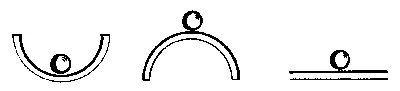
10 Fig. 7 29 Stable, metastable, and neutral equilibrium
11 Allowed to roll around inside the open smooth surface, a ball will finally come to rest at the bottom of the bowl, requiring renewed force to set it back in motion. This state is called stable equilibrium. On the outside of an inverted bowl (or dome) the ball might rest briefly at the center, but the slightest disturbance will make it roll off—thus demonstrating metastable equilibrium. The third possibility is that the ball sits on a flat table, in a state of neutral equilibrium (Fig. 7-29).
12 Nature exhibits a fundamental drive toward equilibrium. Scattered pockets of varying temperatures [082/083]will equalize at the mean temperature; opposing forces of different magnitude naturally seek a state of rest; these differences cannot remain imbalanced. Greater forces overpower smaller forces, causing motion until they balance out. Demonstrations of this universal tendency are provided by countless everyday experiences. For example, if a massive object sits on too weak a shelf, the force exerted by gravity toward the Earth's center exceeds the strength of the shelf's restraining force and the object comes crashing through. Motion continues until a new equilibrium is achieved by the object landing on a sturdy floor capable of matching the gravitational force with an equal and opposite restraining force. Apparent motion then ceases, as a stable equilibrium is maintained.
13 Invisible motion continues, however; atoms never stand still. The systems approach encourages us to note that we can zoom in to observe the same event on another level of resolution.
14 The front door is opened and quickly closed, allowing a rush of cold winter air into the living room. Freezing temperatures dominate the corner of the room near the door, while the other side by the radiator is cozy and warm. However, the imbalance quickly disappears; the temperature soon becomes more or less consistent throughout the room.
15 Nature's tendency to seek equilibrium is a spontaneous reaction; it is the path of least resistance.
16 We have already seen that vectors model certain events and reactions of nature. In this discussion, we focus on one specific use of vectors: to represent forces. The application is straightforward. Forces push or pull on something. The strength or magnitude of a force is represented by the length of the vector, and its direction is of course specified by the orientation: frequency and angle, as Bucky says.
17 It follows, then, that a balance of forces is geometrically modelable. We can create a spatial diagram of the concept of equilibrium, and in so doing learn more about space's inherent symmetry.
18 Bucky's love affair with vectors dates back to his World War I Navy experience. Introduced
to vector diagrams of colliding ships in [083/084]the officer's training program, he
discovered that the tiny arrows contained all the necessary information about the ships'
masses and speeds and compass headings to predict the results of collisions or the effect
of tail winds and other influential forces. Bucky was fascinated by the economical
elegance of the system. These vectors actually modeled the energetic events of reality—a
pleasant contrast to the mathematics teacher's "lines stretching to infinity". Bucky was
hooked.
He reminisces in a 1975 videotaped lecture:
19 "A vector is an experience, so I thought, if I could only have a geometry of vectors, that would be great." (EIK video)
20 This concept was introduced in the previous chapter, but now we must discern the specific shape of the configuration generated by vector diagrams and models.
"Nature's Own Geometry"
22We periodically remind ourselves of the purpose behind this geometric journey. Trying to faithfully trace Bucky's footsteps, we seek to isolate the "coordinate system of nature": how Universe is organized. One of the essential parts of the mystery is how to account for structural similarities between totally unrelated phenomena, vastly different in both scale and material. The implication is that, rather than being coordinated, things coordinate themselves. This self-organization occurs according to a set of physical forces or constraints, absolutely independent of scale or specific interactive forces. In short, space shapes all that inhabits it.
23 But how? Through what vehicles does nature adhere to this underlying order? Let's look at Fuller's fundamental operating assumption:
24 It is a hypothesis of synergetics that forces in both macrocosmic and microcosmic structures interact in the same way, moving toward the most economic equilibrium packings. By embracing all the energetic phenomena of total physical experience, synergetics provides for a single coherent system of geometric principles.…(209.00)
25 Synergetics seeks to establish the natural laws through which the self-organization of systems in the most diverse fields of science occurs. Science, as we noted earlier, acknowledges a fundamental drive toward equilibrium, but what else can be observed about this tendency?
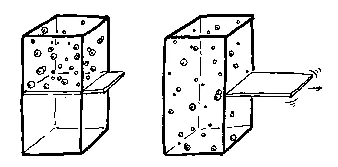
27 Fig. 7 30 Entropy: closed-container experiment
28 Gas molecules buzzing around in a closed-container are suddenly allowed, by the removal of a barrier, into an adjacent empty compartment of the same size (Fig. 7-30). The molecules rapidly disperse, taking advantage of their new freedom by using the additional room [084/085]to spread out and slow down. The reverse action—of all the gas molecules suddenly gathering in one half of a container—has never been observed, just as in the living room disparate temperatures equalize, but that room will never spontaneously become warm on one side while the other side suddenly cools off. The closed-container experiment is the classic model for illustrating nature's entropic tendencies. The Austrian physicist Ludwig Boltzmann (1844–1906), noted for his work in entropy theory, called the resulting dispersal disorderly behavior. A geometer, however, might observe the individual gas molecules vying for the most room—accomplished of course by a maximally symmetrical distribution—and not perceive such a progression as disorder. Both perceptions call it equilibrium.
Spatial Considerations
30A symmetrical distribution of "energy events" involves a large number of equivalent separation distances. For a more tangible image than provided by gas molecules, picture a large room full of people asked to spread themselves out for stretching exercises. If the room is sufficiently crowded, a more or less triangular pattern in the distribution of people can be observed, as a result of individuals' trying to maximize the area of their territory. Each person feels he or she has more space when the distances between people are maximized, which is the case when all distances are as close to equivalent as possible. If it's hard to see why that equivalence implies a triangular pattern, read on.
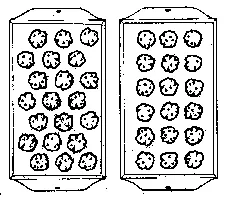
32 Fig. 7 31 "Close-packed cookies": triangular vs. square pattern
33 Triangular pattern enables one more row of cookies than square pattern with the same minimum separation distance between cookies
34 Think about baking cookies on a tray. Intuition rather than geometrical training tells you that the cookies in successive rows should be offset to maximize the number which can fit on each tray without spreading into each other. Observe in Fig. 7-31 that a [085/086]square distribution with the same minimum separation between cookies wastes considerable tray area, resulting in fewer cookies than a triangular pattern.
35 In the same way, people in a room naturally (and quite unconscious of the advantages of triangular distribution) milling around until each carves out a desirable comfort zone can end up by increasing the overall symmetry. This organization does not require a director at the head of the room. Nature behaves in the same manner, seeking the most comfortable resting position. Forces continue to push or pull until counterbalanced, and in the absence of other influences, symmetrical considerations dominate. (There is, in Fuller's words, an "a priori absolute mystery" of why nature behaves this way, which is beyond explanation. The question is thus how Universe operates.)
36 The advantageous balances suggested by the term equilibrium can be expressed in terms of symmetry. The properties of space are necessarily behind all events and reactions in nature; hence Fuller's assertion that forces in both "macrocosmic and microcosmic structures interact in the same way". Space is the same on every scale, embracing and molding the "most economic equilibrious packings".
37 With the conceptual foundation in place, we can now describe the model proposed by Fuller to represent equilibrium. In his words, we seek the simplest "omni-accommodative system" able to model the behavior of complex systems. Basically, we want to draw, or better [086/087]yet, build that much-discussed balance of forces. To accomplish the desired result, a model must incorporate two aspects of Fuller's geometry: first it must consist of vectors, and secondly it must cover all directions. In short, we want to illustrate an equilibrium of vectors in space.
Planar Equilibrium
39Spatial configurations tend to be difficult to visualize, whereas fiat patterns are not, so we start with the page. Draw a vector of some arbitrary length—which we designate "unit length"—in any direction. To counteract that force, we position a second vector directly opposite the first, head to head (Fig. 7-32.a). They have the same magnitude and opposite direction and are therefore balanced.[087/088]
40 It is an unstable balance however, easily knocked out of equilibrium by a force from any other direction. Suppose that the original two forces push on a body with equal strength from east and west. A force from the north or south, even if smaller than the east-west pair, can easily destroy that unstable equilibrium. So how can we most efficiently insure the stability of the body in question?
41 Suppose instead that the forces are directed outwardly from the body (Fuller's "explosive potential", as quoted in the first paragraph of this chapter). To begin with, imagine four equal vectors, heading north, south, east and west—that is, in the positive and negative directions of the X and Y axes. To counteract the four explosive forces, we need equivalent restraining forces ("implosive" or "embracing"). Fuller's "embracing" vectors are not technically part of the conventional language of vectors. Having neither head nor tail, their effect is simply restraining, like a net, and their magnitude is still assumed to be represented by their length. As strength is graphically depicted by vector-length, we soon find that there is no easy way to draw four embracing vectors of unit length. In Fig. 7-32.b, the ends of our four explosive vectors are interconnected, but these new lines are approximately 1.414 (i.e. √2)times as long as the outward forces. The longer vector lines represent more powerful forces and thus overpower the explosive potential, meaning that the whole display must collapse inwardly.
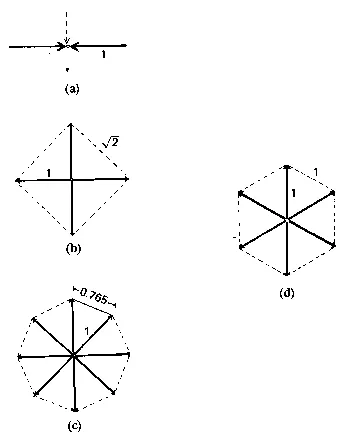
43 Fig. 7 32 In search of equivalent radial and circumferential vectors.
44 We might then choose to add more outward forces, maintaining symmetry by an additional unit vector in between each of the original four (Fig. 7-32.c). Now we have eight equal forces emanating from one point, and the resulting eight embracing lines are only 0.765 times as long as the unit length—too small to restrain the explosive forces. This imbalance leads to outward dispersal of the hypothetical system.
45 The sought-after balance will be achieved by "omnisymmetry", that is, maximum symmetry. The desired array must consist exclusively of unit-length vectors—both explosive and embracing.
46 One way to solve the problem is to picture a square grid of "energy events", interconnected by vectors. Squares provide an easy starting point because they make up the basic framework of current mathematics: the XY coordinate system. As before, the length of vectors which connect "events" represents the strength of their interattraction. Because the distance between diagonal corners is 1.414 times the distance between adjacent loci, the attractive forces represented are that much greater. Imbalance (or lack of equilibrium) in a diagram of forces represents motion. As a result of the [088/089]attractive forces between neighboring energy events, they push and pull on each other until all the disparate separation distances became equal. Again, like the cookie tray, a pattern of equilateral triangles is established. Every single energy event is a uniform distance apart from each neighbor, and there are 60° angles between all vector connections. The forces are finally balanced, and the resulting array informs us about the fundamental symmetry inherent in a flat surface.
47 Going back to the radial vector diagram, we now arrange six vectors emanating from a point. The embracing vectors will be the same length as the "exploding" group. An inescapable consequence of this fact (obvious in retrospect) is that angles between all vectors are also identical—not just those between radial vectors, but also those between circumferential and radial vectors (Fig. 7-32.d). No other arrangement has this property, because 60° angles are integral to equilateral triangles.
48 A diagram of radial vectors can be thought of as an apple pie divided into some number of pieces. These pieces are always triangular, with two radial edges and one circumferential edge. Because of the fact that the angular sum in every fiat triangle is 180°, the only way for a triangle to have all angles the same is with three 60° angles. Therefore, the only angular measurement that will allow us to divide the vector pie "omnisymmetrically" is 60°, requiring that unity (360°) be divided six ways. The procedure is straightforward so far. In the plane, equilibrium is demonstrated by a hexagon (Fig. 7-32.d).
49 Now we make the leap into space, with its accompanying leap in complexity. It may be difficult to visualize a spatial array, especially noncubical configurations, but taking it step by step, we shall be able to develop and understand Fuller's model.
50 In terms of vectorial dynamics, the outward radial thrust of the vector equilibrium is exactly balanced by the circumferentially restraining chordal forces: hence the figure is an equilibrium of vectors. All the edges of the figure are of equal length, and this length is always the same as the distance of any of its vertexes from the center of the figure. (430.03)
51 A "geometry of vectors", Fuller reasoned, must be "omnidirectionally operative"—hence, radially oriented and omnisymmetrical. Following the planar example, we want some number of vectors emanating from an origin, situated so that the distances between vector end points (vertices) are not only all equal to each other, but also exactly equal to the length of the radial vectors.[089/090]
Cuboctahedron as Vector Equilibrium
53We can understand the symmetry of the plane by observing that although any polygon can be made to have equal edge lengths, only the regular hexagon can have edges equal in length to the distance between the polygon's center and its vertices. In the same way, although there are many regular and semiregular polyhedra with equal edge lengths, there is only one spatial configuration in which the length of each polyhedral edge is equal to that of the radial distance from its center of gravity to any vertex: the cuboctahedron (Fig. 7-33).
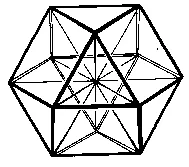
55 Fig. 7 33 Vector equilibrium.
56 This shape therefore is the only one that allows the requisite arrangement of vectors to demonstrate equilibrium.
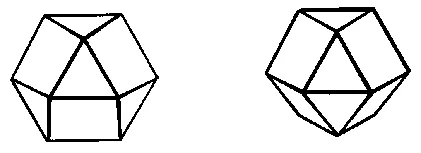
58 Fig. 7 34 (a) cuboctahedron; (b) twist cuboctahedron.
59 If the cuboctahedron is sliced in half and one "hemisphere" is rotated 60° with respect to the other, the resulting "twist cuboctahedron" (Fig. 7-34.b) maintains the radial-circumferential equivalence. With its asymmetrical arrangement of faces, however, this shape is not similarly suited to model equilibrium. The desired balance of vectors is therefore achieved through the straight cuboctahedron (Fig. 7-34.a).
60 We first saw the cuboctahedron as the degenerate truncation of both the cube and the octahedron, but at that point in our investigation we were only looking at surface topology. Now diving into the interior shape, we discover this unique property of equivalence. Table 7-4 compares the radial lengths of various familiar polyhedra given unit edge lengths. Only in the cuboctahedron—hereafter referred to by Fuller's term, vector equilibrium or VE—can the radius be of unit length.
61 Table 7 4 VE: equal radial and circumferential vectors and angles
63 Again, in order for all vectors to be exactly the same length, the angles between them—both radial and circumferential—are necessarily equal. In Fig. 7-33, the VE is shown with both radial and [090/091]edge vectors. Radial vectors connect the twelve vertices to the system's center, thereby forming twenty-four radiating equilateral triangles, corresponding to each polyhedral edge and pointing inwardly. We should not be surprised to find an array of equilateral triangles in the VE, for this is the only polygon with equal distances and angles between all points. And, as vectors incorporate both magnitude and direction, an equilibrium of vectors must—in Fuller's terminology—balance both angle and frequency. Sixty-degree angles are inevitable.
64 What if we had anticipated the necessity of 60° angles? We could then have started this part of the investigation by specifying the angle between radial vectors and looking for the resulting implications of that choice. The discovery then would be that the necessary 60° gaps in a spatial array generate exactly twelve vectors, just as six is the outcome in a plane.
65 Had we started thus—with the choice of angles—we would have had to check the resulting vector lengths, to find out that indeed they are all the same. In either case, the end result is extremely satisfying.
VE: Results
67Our first encounter with the vector equilibrium in Chapter 4—then we called it the "cuboctahedron"—illuminated its direct relationship to the octahedron and the cube.
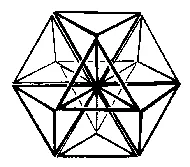
69 Fig. 7 35 Eight radiating tetrahedra alternate with six ½-octahedra.
70 We now elaborate on our description of the VE, and before the end of this investigation we shall know almost everything about this extremely important shape. Let's begin here with its major characteristics.
71 Above all, it is the "omnidirectional arrangement of forces". This equivalence is unique to the VE.
72 Secondly, this shape bears an interesting relationship to other familiar polyhedra. Its twelve radii form eight symmetrically arrayed [091/092]regular tetrahedra—corresponding to the VE's eight triangular faces. Fig. 7-35 emphasizes the tetrahedra, which radiate outward edge to edge, creating six cavities in the shape of square-based pyramids. Again, because of the uniform edge lengths everywhere, these cavities are actually perfect ½-octahedra, corresponding to the six square faces of the VE, which in turn correspond to the six faces of the cube, as was revealed by degenerate truncation in Chapter 4.
73 Thirdly,
74 the pattern of this nuclear equilibrium discloses four hexagonal planes symmetrically interacting and symmetrically arrayed…around the nuclear center.(981.11)
75 If you look closely at Fig. 7-36, the four hexagons are clearly visible: one parallel to the horizon, one in the plane of the page, and two more, slanted to the right and to the left, at 60° to the horizon. As we might have expected, the vector equilibrium consists—in a way exclusively—of hexagons. The symmetrical properties of hexagons with respect to the plane are evident (refer back to Fig. 7-32), and so the discovery of intersecting hexagons in a spatial equilibrium of vectors is not surprising.
76 However, intuition cannot as easily predict the number of hexagons. An array of equivalent vectors (taking into consideration both magnitude and angular orientation) is achieved by exactly four evenly spaced intersecting hexagons. Thus the existence of four fundamental planar directions ("dimensions"?) describes one aspect of the inherent shape of space.[092/093]
77 These hexagons are exactly parallel to the four faces of the tetrahedron; having the same angular orientation, they are identical mathematical planes. The only difference is that in the VE they intersect at a common center, while in the minimum system they together enclose space.
78 Also fascinating is the fact that each of the twelve radiating vectors is perfectly aligned with an opposite vector—exactly 180° apart. Thus the twelve can be seen as six intersecting lines with a positive and negative direction (each line twice the length of the original unit vector)—just as the XYZ axes are three lines intersecting to define six directions: three positive and three negative, evenly spaced with intervening angles of 90°. Once again, these six intersecting lines are parallel to the tetrahedron's edges. It was not at all obvious from our initial requirements for a vector equilibrium display that the resulting radial lines would be colinear pairs, nor that these six (double-length) vectors would each lie in the same plane as two others, producing four precisely defined hexagons.
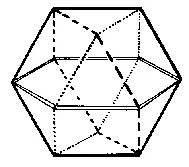
80 Fig. 7 36 Four hexagonal cross-sections of the VE.
81 Our goal was to create a radial display of evenly spaced unit vectors. In so doing, we arrive at two fundamental observations about the order inherent in space: the existence of four distinct planes of symmetry and six linear elements. Both aspects are first exhibited in nature's choice of minimum system and secondly reinforced by her unique equilibrium configuration.
7.0.1 Degrees of freedom
82The subject of twelve fundamental directions of symmetry, with their six natural positive-negative pairs, leads directly to a discussion of the "twelve degrees of freedom" inherent in space. The term is almost self-descriptive, but can be best explained in reverse. That is, we explore the number of degrees of freedom inherent in space (and thus affecting every system) in terms of how many restraining forces are necessary to completely inhibit a system's motion. What is the minimum number of applied forces necessary to anchor a body in space?
83 Again, we can start with a planar analogy. Imagine a flat circular disk, such as a coaster, lying on a table and held in place by two taut strings pulling in opposite directions. The disk looks stable, but actually is free to move back and forth, at 90° to the line of the two restraints (Fig. 7-37.a). So, we try applying three tension [093/094]forces, 120° apart (Fig. 7-37.a), and observe that the circle's position is fixed. Actually, it turns out that only the location of the exact center of the circle is fixed, for the disk is free to rotate slightly in place. Because rotation involves motion directed at 90° to all three strings, there is nothing to restrain the circle from twisting back and forth, as shown in Fig. 7-37.b. Three additional strings to counteract each of the original restraints would have to be added to prevent all motion, for a total of three positive and three negative vectors.
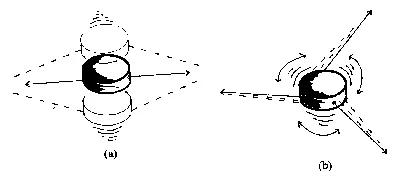
85 Fig. 7 37 Motion of partially restrained disc in a plane
86 (a) restrained at 1 point
(b) restrained at 3 points
87 In space, a similar procedure involves a bicycle wheel. Suppose that our goal is to anchor the hub with a minimum of spokes. At first glance this may appear to be the same problem as the previous planar example; however, in this case, the hub has both width and length. Both circular ends of the narrow hub—typically about ½-inch (13mm) wide and 3 inches (76mm) long—must be stabilized. With only six spokes attaching the hub to the rim (three fixing the position of each end, as shown in Fig. 7-38.a), the system feels quite rigid; force can be applied to the hub from any direction—up, down, back or forth—without budging it. However, the hub has no resistance to an applied torque, the effect of which occurs at 90° to the spokes, and is therefore able to twist slightly about its long axis. Three more spokes at each end, to counterbalance the original six, remove the remaining flexibility. All 12 degrees of freedom are finally accounted for, with a minimum of twelve spokes (Fig. 7-38.b).
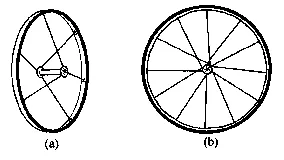
89 Fig. 7 38 Minimum of 12 spokes needed for stability
90 (a) wheel with 6 spokes
(b) wheel with 12 spokes
91 This experiment is quite rewarding to experience—well worth trying for yourself. You don't need to go as far as dismantling a bicycle wheel; just find a hoop of any material and size and a short [094/095]dowel segment, and then connect the two with radial strings added one at a time until the hub suddenly becomes rigidly restrained. It is enormously satisfying to feel the hub become absolutely immobile (all "freedom" taken away), with the surprisingly low number of twelve spokes. 23
92 What both the planar and spatial procedures indicate is that degrees of freedom are both positive and negative. In anchoring the hub of the bicycle wheel, there at first appear to be six degrees of freedom; however, each has a positive and negative direction. In conclusion, degrees of freedom measure the extent of a system's mobility: how many alternative directions of motion must be impeded before the body in space is completely restrained.
93 Fuller's use of the term "degrees of freedom" must be distinguished from the conventional treatment of the subject which specifies that a rigid body has 6 degrees of freedom (3 translational and 3 rotational) which have 2 directions each, thus requiring 12 unidirectional constraints.
94 The twelve vectors needed to restrain a body can also be omnidirectional, instead of the basically planar organization of the spoke wheel. Fuller takes us through a similar sequence in Synergetics, which starts with a ball attached to one string. The ball is free to swing around in every direction; the only restraint is on the radial "sweepout" distance. The ball's motion is thus free to describe a spherical domain. The addition of a second string restricts the ball to motion within a circular arc in a single plane (Fig. 7-39.a). A third string allows the ball to swing only back and forth, in a linear path. The ball can always be pushed slightly out of place, no matter how taut the three strings (Fig. 7-39.b). And just as, in our search for the minimum system, a fourth event suddenly created insideness and outsideness, by adding a fourth string to the ball, its position is suddenly fixed. ("Four-dimensionality" again.) In their most symmetrical array, the four strings go to the four vertices of an imaginary tetrahedron, and are therefore separated by approximately109.47°, the tetrahedron's central angle (Fig. 7-39.c).[095/096]
95 [096/097]But of course that's not the end of the story; the ball is still free to twist in place. To prevent this slight rotation, three strings must be attached to each location of the original four (Fig. 7-39.d). This result is related to the fact that three is the minimum number of coordinates needed to specify the location of a point in space, with reference to the origin of a coordinate system.
96 The whole picture is falling into place. Every physical body has four basic sides, or four comers: two points alone are only colinear, and three are only coplanar; not until there are four comers can the property of spatial existence be recognized. As a result, any physical body must be held at four noncoplanar points, with three restraints at each point, in order to be stabilized (Fig. 7-39.d).
97 This result suddenly ties in to the earlier discussion of pattern integrity. Triangles are necessary for stability. Therefore, while the ball was seemingly held in place by four restraints, it could still rotate locally because the locus of each individual restraint could not be stable without triangulation—subsequently provided by the addition of three strings per locus.
98 Bucky explains the situation further. Consider the ball with the original four restraints. The strings impinging on the ball create four vertices without supplying the necessary six edges to stabilize their position with respect to each other. They essentially form an unstable quadrilateral rather than a stable tetrahedron. The lesson is the same. There are four fundamental corners in every system, and each must be triangulated: 4 × 3 = 12. Thus there are twelve degrees of freedom, tetrahedrally organized. Twelve is a frequently recurring number in synergetics, a fundamental part of space and geometry, as we shall see again and again.
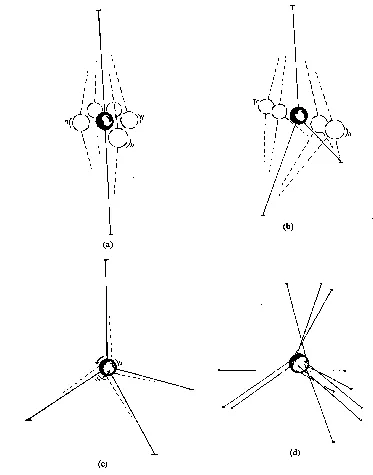
100 Fig. 7 39 Ball restrained in space
101 (a) ball restrained at 2 points
(b) ball restrained 3 points
(c) ball restrained at 4 points
(d) ball restrained at 12 points
102 The above procedure describes Fuller's own interpretation of "degrees of freedom", which must be distinguished from Loeb's analysis of the concept, as briefly explained in Chapter 5.
103 The introduction to vector equilibrium is now complete except for one philosophical consideration. It is important to realize that the whole discussion is about conceptual—never actual—balance; equilibrium in any physical form can only be an approximation. No matter how exactly centered the hub of the bicycle wheel seems and no matter how tight the spokes, gravity's pull on the hub will always exert more tension on the upper spokes, leaving the lower spokes ever so slightly slack and imperceptibly curved. The balance is imperfect. Moreover, energetic motion never ceases. The air molecules in the living room do not stop their vigorous motion once the [097/098]temperature is consistent. The floor and fallen object press together in a persistent dynamic exchange, encompassing furious activity at the atomic and molecular levels.
104 There is always motion in real systems: some (however minute) residual springiness in tension materials, as well as ever-present invisible bustling activity on the atomic scale. We cannot see the energetic motion in most systems, and so our perception is that of a state of perfect equilibrium. And indeed, for all practical purposes—that is, for a given level of resolution—we can have a stable balance.
105 But Fuller cannot in good conscience leave it at that. He reminds us that real equilibrium would mean an end to all, or "Universal death". An end to aberrations and imperfections is an end to motion and energy. All physical reality—life and nonlife alike—consists only of energy. Hence there is no absolute equilibrium:
106 Nature is said to abhor an equilibrium as much as she abhors a perfect vacuum or a perfect anything.… The asymmetric deviations and aberrations relative to equilibrium are inherent in the imperfection of a limited life…. Despite the untenability of equilibrium, it seemed to me that we could approach or employ it referentially…. A comprehensive energy system could employ the positive and negative pulsations and intertransformative tendencies of equilibrium. (420.041)
107 The vector equilibrium is a condition in which nature never allows herself to tarry. The vector equilibrium itself is never found exactly symmetrical in nature's crystallography. Ever pulsive and impulsive, nature never pauses her cycling at equilibrium: she refuses to get caught irrecoverably at the zero phase of energy. (440.05)
108 All events, all systems exist as a result of their constant fluctuation in and out of ideal equilibrium—far too rapidly for perception. Fuller's goal was to develop a model for what that theoretical ideal must look like, in terms of spatial properties. But vector equilibrium is not a structure; he is quick to point out the distinction: it is a system—to be "comprehensively" grasped by "metaphysical minds":
109 Synergetics…accommodates Heisenberg's indeterminism of mensuration inherent in the omniasymmetry of wavilinear physical pulsations in respect to the only metaphysical (ergo, physically unattainable) waveless exactitude of absolute equilibrium. It is only from the vantage of eternal exactitude that metaphysical mind intuitively discovers, comprehends, and equates the kinetic integrities of physical Universe's pulsative asymmetries. (211.00)
110 The concept of imperfection can only be held relative to the mind's grasp of theoretical perfection. In other words, "pulsative asymmetries" [098/099]require a frame of reference in order to be defined and registered.
111 Time is responsible for these asymmetries. Separate time out of the picture, and you are left with the absolute perfection of timelessness. Absolute equilibrium exists sub-time or meta-time; the passage of the shortest instant of time will reveal "pulsative asymmetries". But metaphysical mind has an all important need for timeless models, through which to understand Universe.[099/100]