
5 Structure and "Pattern integrity"
2"I'm a little child and I've just found my mother's necklace."
3 Famous for his marathon lecture sessions, Fuller used to talk about synergetics for days on end. Time constraints in later years usually prohibited such extensive coverage, but he almost always told the story of the necklace. Looking a bit like a small child himself as he draped this 10-foot (3m) loop over his shoulders, Bucky explained that the process of collecting "experimental evidence" starts with children.
4 Fuller was a remarkable teacher, particularly in his ability to explain difficult concepts in simple terms. Not drawn to the formal logic of proofs, his genius lay in his novel use of everyday experiences. Elaborately detailed descriptions, relying on familiar materials and specific colors, were tailored to elucidate various complex phenomena. In one such scenario he is able to explain the intimidating concept of precession, which is one of the mysteries of gyroscopic motion, through a series of easily visualized events. His images materialize so vividly in the mind's eye that the underlying abstract statements can be grasped effortlessly.
5 The best renditions of the precession sequence are found in videotaped lectures, because Fuller's gestures are as important as his words; the 43-hour Everything I Know lectures (EIK video) contain an especially good version. Original written document was published in Fortune, May, 1940. Fuller wrote the 2-page piece in response to a request (or challenge!) from the Sperry Gyroscope company.
6 "I'm going to be a little child now…" We are immediately in his world, looking out. Even having heard this routine countless times, one can forgive the simplicity of the story. This is stuff for 5-year-olds, but it is riveting—and a welcome break in the often heady lecture.
7 The necklace grows out of Fuller's insistence that every child is born a genius—endlessly curious, probing, full of wonder about everything. If a child's questions are rewarded with answers that feel right, that is, correspond to his experience, the inherent genius will blossom. More often, not challenged creatively by tedious memorization that doesn't seem to relate to the world around him, a child simply learns to play the game. Fuller's conviction that children spontaneously leap at the chance to understand Universe when excited by true and comprehensive information was a primary [054/055]motivating force behind synergetics. His aim was to supply models to elucidate the wonders of science to adults and children alike.
8 It's an unusual necklace. Ten or more thin wooden dowels are linked together with red rubber-tubing segments into a continuous flexible loop. Bucky keeps taking it off his shoulders to remove another one of the 10-inch (25cm) dowels. One by one they drop to the floor, as the necklace turns into recognizable polygons. Recognizable, that is, when he struggles to hold them out flat and round. Soon, the "drapable necklace" resembles a hexagon, then a pentagon. Next, the four sticks that are easily persuaded to be a square, just as readily collapse into a bundle—four parallel sticks held in one fist (Fig. 5-18).
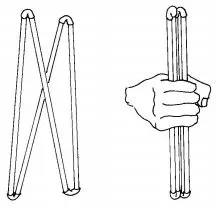
10 Fig. 5 18 Square necklace, collapsed
11 His expression is utterly earnest, "You remember when the teacher went to the blackboard and drew a square?" (Nods fill the lecture hall.) "Well, the only reason it stayed a square was that the blackboard held it there!" The shape collapses, dangling from one hand. (Many laugh. Some look concerned; they have begun to sense that he is deeply serious about this.)
12 One more stick is pulled out of the loop. Three are left dangling. If he removed another, the necklace would disappear, for two sticks alone cannot form an open loop. Connect the two ends of the three-dowel string, and suddenly, "It holds its shape", he cries out, astonished. Loudness underscores the importance of this fundamental truth, with enthusiasm undiminished by the repetition of a thousand lectures.
13 "Only the triangle is inherently stable" (609.01).
14 Bucky reminds us that the conditions and materials of the experiment did not change. That red tubing is still flexible, the sticks still [055/056]rigid. So what is responsible for the sudden change? Before going on, he wants us to really understand why a triangle holds its shape.
15 Two sticks connected by a hinge create two lever arms. The farther out a force is applied, the greater the mechanical advantage—which means that forces of decreasing strength can accomplish the same result (Fig. 5-19).
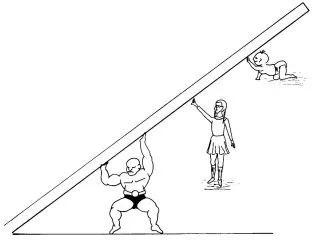
17 Fig. 5 19 Leverage
18 Each flexible corner is stabilized with minimum mechanical effort by a force exerted at the very ends of its two sticks, or lever arms. A third stick, acting as a "push-pull brace", can be attached to the ends of the other two sticks, to most efficiently stabilize the flexible opposite angle. So each of the triangle's three sticks "stabilizes its opposite angle with minimum effort". Only a triangle has a built-in bracing device for each corner; therefore, only a triangle is stable.
5.0.1 Pattern integrity
19The term "pattern integrity" is a product of Fuller's lifelong commitment to vocabulary suitable for describing Scenario Universe. He [056/057]explains,
20 When we speak of pattern integrities, we refer to generalized patterns of conceptuality gleaned sensorially from a plurality of special-case pattern experiences…. In a comprehensive view of nature, the physical world is seen as a patterning of patternings… (505.01–505.04)
21 Let's start with his own simplest illustration. Tie a knot in a piece of nylon rope. An "overhand knot", as the simplest possible knot, is a good starting point. Hold both ends of the rope and make a loop by crossing one end over the other, tracing a full circle (360°). Then pick up the end that lies underneath, and go in through the opening to link a second loop with the first (another 360° turn). The procedure applies a set of instructions to a piece of material, and a pattern thereby becomes visible.
22 What if we had applied the same instructions to a segment of manila rope instead? Or a shoelace? Or even a piece of cooked spaghetti? We would still create an overhand knot. The procedure does not need to specify material.
23 "A pattern has an integrity independent of the medium by virtue of which you have received the information that it exists." (505.201).
24 The knot isn't that little bundle that we can see and touch, it's a weightless design, made visible by the rope.
25 The overhand-knot pattern has integrity: once tied, it stays put. In contrast, consider directions that specify going around once (360°), simply making a loop. This pattern quickly disappears with the slightest provocation; it is not a pattern integrity. (Even though the overhand knot depends on friction to maintain its existence, a single loop will not be a stable pattern no matter how smooth or coarse the rope.) Notice that it requires a minimum of two full circles to create a pattern integrity. 2 × 360° = 720°, the same as the sum of the surface angles of the tetrahedron (four triangles yield 4 × 180°). Minimum system, minimum knot, 720°.
26 A curious coincidence? Synergetics is full of such coincidences.
27 A similar example involves dropping a stone into a tank of water. "The stone does not penetrate the water molecules", Fuller explains in Synergetics, but rather "jostles the molecules", which in turn "jostle their neighboring molecules" and so on. The scattered jostling, appearing chaotic in any one spot, produces a precisely organized cumulative reaction: perfect waves emanating in concentric circles.
28 Identical waves would be produced by dropping a stone in a tank full of milk or kerosene (or any liquid of similar viscosity). A wave is [057/058]not liquid; it is an event, reliably predicted by initial conditions. The water will not surprise us and suddenly break out into triangular craters. As the liquid's molecular array is rearranged by an outside disturbance, all-embracing space permeates the experience. Because liquids are by definition almost incompressible, they cannot react to an applied force by contracting and expanding; rather, the water must move around. In short, the impact of any force is quickly distributed, creating the specific pattern shaped by the interaction of space's inherent constraints with the characteristics of liquid.
29 The concept thus introduced, Bucky goes on to the most important and misunderstood of all pattern integrities: life.
30 What is really important…about you or me is the thinkable you or the thinkable me, the abstract metaphysical you or me, …what communications we have made with one another".(801.23).
31 Every human being is a unique pattern integrity, temporarily given shape by flesh, as is the knot by rope.
32 …All you see is a little of my pink face and hands and my shoes and clothing, and you can't see me, which is entirely the thinking, abstract, metaphysical me. It becomes shocking to think that we recognize one another only as the touchable, nonthinking biological organism and its clothed ensemble. (801.23)
33 Our bodies are physical, but life is metaphysical. Housed in a temporary arrangement of energy as cells, life is a pattern integrity far more complex than the knot or the wave. Remember that all the material present in the cells of your body 7 years ago has been completely replaced today, somehow showing up with the same arrangement, color, and function. It doesn't matter whether you ate bananas or tuna fish for lunch. A human being processes thousands of tons of food, air, and water in a lifetime. Just as a slip knot tied in a segment of cotton rope, which is spliced to a piece of nylon rope, in turn spliced to manila rope, then to Dacron rope (and so on) can be slid along the rope from material to material without changing its "pattern integrity", we too slide along the diverse strands supplied by Universe—as "self-rebuilding, beautifully designed pattern integrities". No weight is lost at the moment of death. Whatever "life" is, it's not physical.
34 The key is consciousness. "Mozart will always be there to any who hears his music". Likewise, "when we say 'atom' or think 'atom' we are…with livingly thinkable Democritus who first conceived and named the invisible phenomenon 'atom'". (801.23). Life is made of awareness and thought, not flesh and blood. Each human being embodies a unique pattern integrity, evolving with every experience and thought. The total pattern of an individual's life is inconceivably [058/059]complex and ultimately eternal. No human being could ever completely describe such a pattern, as he can the overhand knot; that capability is relegated to the "Greater Intellectual Integrity of Eternally Regenerative Universe".
35 If we seem to stray from the subject of mathematics, resist the temptation to categorize rigidly. Synergetics does not stop with geometry. Fuller was deeply impressed by a definition in a 1951 Massachusetts Institute of Technology catalog, which read "Mathematics is the science of structure and pattern in general" (606.01) not games with numbers and equations, but the tools for systematic analysis of reality. To Fuller this meant that mathematics ought to enable the "comprehensivist" to see the underlying similarities between superficially disparate phenomena, which might be missed by the specialist. Rope may not be much like water, but the knot is like the wave—is like the tetrahedron.
36 Our emphasis thus far has been on pattern. What about structure?
37 Let's go back to the regular polyhedra. On constructing the five shapes out of wooden dowels and rubber connectors, it is immediately apparent that some are stable and others collapse. The "necklace" demonstrates that only triangles hold their shape, and so the problem becomes quite simple.
38 Picture a cube. Better yet, make one out of dowels and rubber tubing, or straws and string. Whatever material you choose, as long as the joints are flexible, the cube will collapse. Connectors with a certain degree of stiffness, such as marshmallows or pipecleaners, are misleading at first, because the cube appears to stand on its own. However the shape is so easily rearranged by a slight push that the illusion does not last.
39 The six unstable windows must be braced in order for a cube to be rigid. So six extra struts, inserted diagonally across each face, would be the minimum number that could stabilize the system.
40 Six struts? Just like a tetrahedron! And not only are there the right number of struts, but they can also be arranged the same way. A regular tetrahedron fits inside a cube with its six edges precisely aligned across the cube's faces (Fig. 5-20). We can therefore state that there is an implied tetrahedron in every stable cube. Nothing in our investigation thus far would predict the precise fit of a cube and a tetrahedron. This and many other examples of shared symmetry among polyhedra (as seen in the previous chapter) are powerful demonstrations of the order inherent in space.
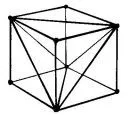
42 Fig. 5 20 Inscribed tetrahedron stabilizes cube.
43 If the cube is unstable without a scaffold of triangulation, what about cardboard models? They stand up by themselves with no trouble. The key word is cardboard. A polyhedron constructed out [059/060]of stiff polygon faces, rather than edges and connectors, is effectively triangulated. Cardboard provides the necessary diagonal brace. It provides a lot of extra material too, but the untrained eye will not recognize the redundancy at first.
44 Likewise, the stiffness of marshmallows or pipecleaners provides triangulation, in the form of tiny web-like triangular gussets at the corners, strong enough to stabilize the whole window. Furthermore, stiff material is itself rigid because of triangulation on the molecular level.
45 Only when polyhedra are considered as vector systems is stability an issue. Construction is one method of determining stability, but a simple formula utilized by Loeb can also be used to check: E = 3V 6. 20 If the number of edges is less than 3 times the number of vertices minus 6, the system will be unstable. But the criterion is really even simpler: for polyhedra without interior edges, a stable system is always triangulated and a triangulated system is always stable. 3V 6 = E holds true for a polyhedral shell if and only if that system consists exclusively of triangles.
46 The other option is to establish internal triangles; an unstable shell can be stabilized by interior edges, or body diagonals. Instead of triangulating the surface, the bracing members create triangles inside the shell to maintain the system's stability.
5.0.2 Structure
47Upstaged by the crowd of oversized polyhedral toys, Bucky again resembles the small child we
saw earlier, playing with his mother's necklace. But the words this time are more
ambiguous:
"There are only three basic structural systems in Universe".
48 Fuller long ago decided that science simply did not have a definition of structure, and took it upon himself to remedy the oversight. Science, Fuller explains, did not feel the need for a definition, because "structure" seemed to be self-evident. It holds its shape! [060/061]Language, caught in the old world of "solids", did not keep up with science's evolving understanding of the true nature of matter. In a universe consisting entirely of fast-moving energy, we must ask how something holds its shape.
49 "Structure is defined as a locally regenerative pattern integrity of Universe" (606.01).
50 A good starting point. Structure is also "a complex of events interacting to form a stable pattern". Similar, but more specific: the pattern consists of action, not things.
51 "Regenerative" is an important qualification, because of the transient nature of energy. The pattern, not the energy flowing through, has a certain degree of permanence. A structure must therefore be continually regenerating in order to be detected.
52 Structure is "local" because it is finite; it has a beginning and an end. "We cannot have a total structure of Universe" (606.01).
53 "Interacting" signifies the emphasis on relationships.
54 The phrase "complex of events" suggests an analogy to constellations, whose components—though spectacularly far apart—are interrelated for some cosmic span of time, creating a set of relationships, in other words, a pattern. The seven stars of the Big Dipper are light-years apart—the epitome of nonsimultaneous energy events. They are only perceived as a meaningful pattern from a special vantage point, Spaceship Earth. The remoteness of individual atoms in any structure or substance—not to mention the distance between atomic constituents—prompted Fuller to write "one of the deeply impressive things about structures is that they cohere at all". There is nothing "solid" about structure.
55 What do all structures have in common that allows their coherence? Triangles. At the root of all stable complexes is nature's only self-stabilizing pattern.
56 No Fuller study is complete without an "inventory": a list, not of each and every "special case" example, but rather, of the types of [061/062]categories. The task, then, is to combine our new working definition of structure with the earlier one of systems. That means triangles involved in a subdivision of Universe. The virtually unlimited variety of irregular triangulated enclosures are not to be included in this inventory; rather, we seek a list of symmetrical stable enclosures.
57 And now we can sit back, for our task is already finished. Remember that only three systems can be made out of regular triangles: tetrahedron, octahedron, and icosahedron. These are the "three prime structural systems of Universe".
58 What can be learned through this kind of simplification? As in Euler's identification of vertices, edges, and faces, such categories organize the otherwise indigestible data to reveal new important features. An example is seen in Fuller's "structural quanta": the total material used for each of the three structural systems (easily measured in terms of number of edges) goes from 6 sticks to 12 to 30. Chapter 10 will cover Fuller's ideas on the subject of volume in detail, but for now we can demonstrate an interesting fact while utilizing the traditional formulae of high-school geometry.[062/063]
59 Going from the smallest to the largest structure, the volume increases, not only absolutely, but relative to the number of edges. In other words, the ratio of volume to structural investment is a significant variable, increasing with additional structural quanta.
60 The same holds true for ratios of volume to surface-area, as will be seen below. For clarity, we adopt unit edge lengths for all three polyhedra. Appendix B shows each step of the calculations, but the relevant results are displayed in Table 5 1.
61 Table 5 2 "Structural quanta":
volume per edge for the 3 prime structural systems.
63 Comparison of results in rightmost column:
65 The implications of this information are suggested by Fuller's summarizing statement:
66 The tetrahedron gives one unit of environment control per structural quantum. The octahedron gives two units of environment control per structural quantum. The icosahedron gives 3.7…. (612.10)
67 Fuller referred to six edges as a "structural quantum" because the total number of edges in each polyhedron is a multiple of 6. "Environment control" simply refers to the ability to enclose and thereby regulate space.
68 Toward the goal of maximal enclosed space with minimal structural material (whether in terms of total strut length or surface area), designs based on the icosahedral end of the spectrum are advantageous. Hence Fuller's geodesic dome. For resistance to external loads, the tiny pointed tetrahedron is least vulnerable, for its concentrated structural elements resist buckling. The tetrahedron is all edges, enabling maximal structural resistance, and therefore highly applicable to truss design. (See Chapter 9.)
69 The icosahedron "dimples" easily. Fuller's term means just what it says. Push hard on one vertex and five triangles cave in, such that the tip of the inverted pyramid reaches just beyond the icosahedron's center of gravity. (See Fig. 5-21.)
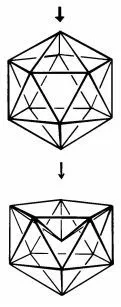
71 Fig. 5 21 "Dimpling"
72 The tetrahedron is unique in being [063/064]impervious to dimpling. Push hard on any vertex and either the whole system turns inside out (if the tetrahedron is made of rubber) or nothing happens; structural resistance prevails.
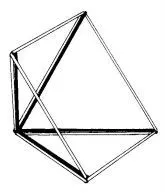
74 Fig. 5 22 Dimpling: ½ of octahedron caves in to nest inside other half.
75 The octahedron, as expected, falls in the middle on both counts, that is, in terms of volume efficiency and load resistance. It will "dimple", but in so doing one half caves in to "nest" exactly inside the other half (Fig. 5-22).
76 Three of Fuller's inventions, the geodesic dome, the Dymaxion Map, and the Octet Truss, stem directly from the above principles. All three will be discussed in detail later, as other relevant geometric principles are revealed.[064/065]