11 Jitterbug
2Synergetics can be described as dynamic geometry. Its treatment of polyhedra as vector diagrams and emphasis on the changes and transformations in systems distinguishes Fuller's work from the traditional geometric approach. His conviction that mathematics ought to supply dynamic models—in recognition of dynamic Universe—led to a number of interesting discoveries. "Jitterbug" is the most striking example.
3 Twelve equiradius spheres pack tightly around one, as noted earlier, and if the nuclear sphere is removed the other twelve can shift slightly inward. A vector equilibrium thereby contracts into the triangulated icosahedron. What would this transformation from Chapter 8 look like in terms of vectors?
4 Following the example set by the transition from closepacked spheres to the isotropic vector matrix, we replace spheres with vectors. Twenty-four wooden dowels and twelve 4-way rubber connectors are put together to make a vector equilibrium (Fig. 11-83.a). The model consists of eight triangles and six squares flexibly hinged together, and intentionally lacks the VE radial vectors, which would correspond to the now missing nuclear sphere. Therefore, since square windows collapse, we are back to the issue of stability.
5 In Chapter 5, we asked how many additional sticks were needed to stabilize each unstable system. For the VE, the answer was simple: six, one to brace each unstable square window. This time around we take a more open-minded approach to unstable systems and see where it leads. Suppose we don't stabilize the VE?
6 Instability enables motion. But what kind of motion? This new outlook inspires us to explore the ways in which flexible vector models change. The discoveries are remarkably satisfying (and the procedures are somewhat playful). In the case of the VE, the result is an elegant dance of symmetry that Bucky called the "jitterbug".
7 "Jitterbug" describes a transformation of the stick-model VE, in which all twelve vertices move toward the system's center at the [159/160]same rate. The advantages of having an actual model on hand at this point are greater for the jitterbug than for any of the previous concepts. A verbal account of the transformation, no matter how precise, is inadequate; likewise for drawings. The wonder of the jitterbug lies in its motion—from the unique equilibrium arrangement through various disorderly stages and on to new order.
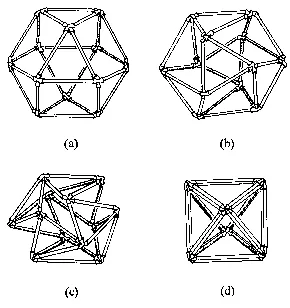
9 Fig. 11 83 "Jitterbug" transformation of VE
10 Jitterbug models tend to capture the attention of the most disinterested bystander; their dance is fascinating to watch. So find twenty-four sticks and twelve connectors and put them together; the model is guaranteed to intrigue.
11.0.1 Folding a Polyhedron
11The model fascinates because so much seems to be happening at once. The vector-equilibrium starting point looks simple enough. Unstable if left to its own devices, the VE must be deliberately held open—with one triangle flat against a table top and two hands holding the opposite (top) triangle. Notice that the two triangles point in opposite directions, together forming a 6-pointed star if you peer into the system from above (Fig. 11-83.a).[160/161]
12 Now, simply lower the top triangle toward its opposite triangle (i.e., toward the table) without allowing either one to rotate. The first surprise is that the equator seems to be twisting, despite your careful avoidance of rotation. If you pull the triangle back out and try it again, you will see that this equatorial twist can go in either direction; in fact the system can oscillate back and forth, going through the zero point, or equilibrium, every time.
13 Secondly, although you are only pushing on one direction (forcing the triangle toward the table) the entire system contracts symmetrically—like a round balloon slowly deflating. Apparently, the effects of your unidirectional force are omnidirectional. You can see and feel that although you push and pull along a single line the contraction and expansion are both uniformly spherical.
14 Focus on the square windows, because only squares can change; triangles hold their shape. As the top triangle approaches the bottom triangle, each square compresses slightly, becoming a fat diamond, and the dance has begun. The radius of the system is now slightly shorter than the length of its twenty-four edges (vector equilibrium no longer). The dance continues as the top triangle approaches the bottom triangle and the diamonds grow slightly narrower, reaching the point at which their width is exactly equal to the edge length (Fig. 11-83.b). The VE has thus turned into an icosahedron—at least the shape of an icosahedron—but we don't stop to add the six extra sticks across the diamond windows to complete the picture, for that would turn our jitterbug into a stable structure.
15 Instead, keep going: past the icosahedral stage, the diamonds, ever thinner, soon become narrow slits and finally snap shut (Fig. 11-83.c, Fig. 11-83.d). The dance comes to a halt in the form of an octahedron. Twenty-four sticks have come together into twelve pairs, creating a double-edge octahedron (Fig. 11-83.d).
16 This contraction is continuous, and so there are countless slightly different stages, but only three are significant geometric shapes. The jitterbug is of interest primarily because of its surprising flow from one polyhedron into another; the emphasis is on its motion. However, we do want to be familiar with its geometric checkpoints.
17 First, the vector equilibrium. Unit-vector edges are balanced by unit-length radii. When the system contracts to the icosahedral position, the distances between each vertex and its five neighboring vertices are suddenly the same—unlike the VE, in which each vertex has only four nearest neighbors, each one the unit distance away, while two additional neighbors are approximately 1.414 units away, [161/162]i.e., the length of the square's diagonal. To accommodate this surface equivalence, the radius must decrease from 1.0 to 0.9511. Nature will not compromise on these numbers: for all neighboring vertices to be separated by equal lengths, the radius must be shorter than that length. A perfect static balance is impossible; hence the dynamic, eternally fluctuating events of Universe.
18 The twelve vertices continue their inward journey until they land at the six corners of an octahedron; sets of dowels clamp together, grouping the twelve vertices into six pairs (Fig. 11-83.d). The radius has decreased to 0.7071 times its original length, and that's the end.
19 But wait! There's another twist left in the jitterbug. Hold on to that top triangle, which has been so carefully kept from rotating until now, and deliberately start to twist it. (The triangle will only yield in one direction, depending on the direction of the jitterbug's initial twist.) If you turn it far enough (180°) the entire system collapses into a flat 2-frequency triangle spread out on the table (Fig. 11-84.a). Then, fold in the three corner triangles, like petals of a flower, bringing their edges together to create the fourth and final stage: the minimum system of Universe (Fig. 11-84.b).
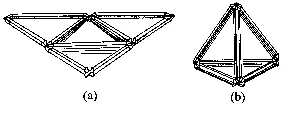
21 Fig. 11 84 Further jitterbugging.
22 It's a dense tetrahedron, with four parallel sticks for each of its six edges, three converged vertices at each of its four corners, and a radius of 0.6124.
23 "Quadrivalent", says Bucky, and hence full of explosive potential—ready to spring back out into "our friend the vector equilibrium".
24 This folded model also demonstrates the tetrahedron "turning itself inside out", for the three petals can be opened and flattened out again, and then folded back in the opposite direction, creating the mirror-image or "negative" tetrahedron. Fuller then reminds us that "unity is plural and at minimum two" and every system has an invisible negative counterpart.
25 Negative Universe is the complementary but invisible Universe.(351.00).
26 Such digressions are unavoidable; for Fuller the implications of a model are always [162/163]multifaceted, one observation plunging into another, layers upon layers, intertwined.
Volume and Phase Changes
28The jitterbug exhibits a total transformation of shape and size without any change in material. Nothing is added or taken away, but the system's characteristics are profoundly altered by rearrangement of the parts. The concept is reminiscent of the differences between ice, water, and water vapor, all consisting exclusively of H2O molecules. When a child—whose model-making experience is limited to "building blocks"—first learns that rearrangement of the constituents is responsible for these profound changes, the idea is not easily accepted. Fuller maintains that experience with models like the jitterbug would better prepare a child for the lessons of science. Chemistry's invisible phase changes would seem perfectly logical, as they would be consistent with first-hand experience. And indeed, the jitterbug's floppy, flexible behavior as VE is parallel to that of a gas: the dense tetrahedral configuration with its motion totally restrained is more like the "solid" phase. Same stuff, radically different properties. He has a point. These dynamic models inspire a different kind of conceptualizing.
29 At the zero point, twenty-four wooden dowels and twelve rubber connectors embrace a volume of twenty, as we recall from "Multiplication by Division". After contracting and twisting through the jitterbug, the bundle of sticks encloses a single unit of volume, one tetrahedron. The system has thus gone from 20 tetrahedron volumes to 1, with a stop at 4, in the octahedron.
30 Icosahedron
31 The icosahedron however refuses to cooperate. Its volume of approximately 18.51 is not as appealing as the whole-number ratios shared by the other stopping points. Jitterbug now introduces a rationale. The icosahedron is a phase that falls in between octahedron and vector equilibrium, rather than a definitive stopping point in the flow.
32 The jitterbug is a continuous transformation through countless transitional stages, both regular and not, and at certain intervals an ordered polyhedron emerges. Found when the jitterbug is simply open as far as possible, the cuboctahedron is definitive, absolute zero. The octahedron clicks into place when six pairs [163/164]of vertices suddenly come together. No ambiguity at either point.
33 The icosahedral stage on the other hand is always approximate; we have to eye the distances between vertices, guessing whether or not they are equal to one. The dance does not stop naturally at this point; we just recognize the familiar shape along the way from VE to octahedron. It is thus a transient phase of the jitterbug—with no reason to stop and rest, no choice but to continue.
34 Similarly, the icosahedral vertices fall in between nodes of the IVM, the omnisymmetrical framework that outlines most of the symmetrical geometric shapes. One result of being out of phase with this matrix (which is also defined by closepacked spheres) is that the icosahedron's frequency cannot be increased by surrounding it with additional layers of spheres, or vectors. It cannot grow modularly; the initial choice of size, or frequency, is final. To change the frequency, a new model must be built from scratch. The icosahedron is thus restricted to single-layer construction. "The icosahedron must collapse to exist", explains Bucky; it always "behaves independently" of the other polyhedra:
35 The icosahedron goes out of rational tunability due to its radius being too little to permit it having the same-size nuclear sphere, therefore putting it in a different frequency system. (461.05)
36 Accordingly, its volume does not fit into the "cosmic hierarchy" of rational systems.
37 Single Layer versus IVM
38 What are the consequences of the icosahedron's "independence" of the cosmic hierarchy? As a collapsed VE, it is always a shell, a single-layer construction:
39 The icosahedron, in order to contract, must be a single-layer affair. You could not have two adjacent layers of vector equilibria and then have them collapse to become the icosahedron…. So you can only have this contraction in a single-layer of the vector equilibrium, and it has to be an outside layer, remote from other layers…. It may have as high a frequency as nature may require. The center is vacant. (456.20–456.21).
40 Accordingly, as we recall from Chapter 8, the design chosen by nature for many protective shells involves icosahedral symmetry—from the microscopic virus capsid to larger (visible with an ordinary microscope) radiolaria, the cornea of an eye, and a plethora of other elegant creations.[164/165]
41 "Trans-Universe" versus "Locally Operative"
42 The vector-equilibrium railroad tracks are trans-Universe, but the icosahedron is a locally operative system. (458.12)
43 Fuller's ambiguous and somewhat mystical declaration becomes almost straightforward after the jitterbug demonstration. Vector equilibrium is incorporated into an infinitely extending network.
44 Conceptual and timeless, VE is everywhere; it is the balance of forces at the root of all phenomena. The icosahedron, on the other hand, is always a special-case collapse, an aberration in the omnisymmetrical frame of reference. Aberrations are finite, local, inescapably stuck in time, as we recall from "Angular topology". The icosahedron is thus fundamentally different from VE, which—with its timeless perfection—permeates all of Universe.
45 Fives
46 Fivefold symmetry dominates the icosahedron, distinguishing it once again from the cosmic hierarchy, with 3-fold, 4-fold, and 6-fold rotational symmetries. This is another sign of the icosahedron's nonconformism. It's full of fives: to begin with, the obvious five triangles around each vertex, determining the symmetry about each of its long axes. Then, its thirty edges fall into five sets of six orthogonal edges, that is, three parallel pairs of mutually perpendicular edges. Fig. 11-85.a highlights the five distinct sets of orthogonal edges.34 (The edges can also be grouped into sets of five parallel edges embracing [165/166]the equator, in six different directions.) Joining the mid-points of the six edges of one set displayed in Fig. 11-85.a, we discover an octahedron hiding inside—implicit in the icosahedral symmetry—in one of five possible orientations (Fig. 11-85.b). The icosahedron may be out of phase with the rest of the IVM family, but it displays many significant relationships to these other shapes, which, being unexpected, are all the more fascinating to uncover. A few examples will be given below, and there's always room for further exploration. Just as in our earlier development of the cosmic hierarchy, we investigate how various shapes fit inside each other, and thereby learn about similarities in shape, volume, and valency.
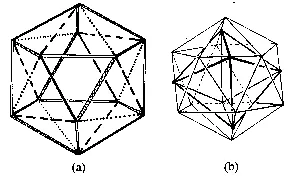
48 Fig. 11 85 Octahedron within icosahedron
49 (a) 5 sets of 6 edges: each set of 6 consists of 3 mutually perpendicular pairs.
(b) Connecting midpoints of one set of 6 edges outlines a regular octahedron
50 Whereas the cosmic-hierarchy relationships are consistently straightforward and balanced (just bisect edges and connect midpoints to generate the next shape), whenever the icosahedron is introduced, more intricate connections emerge. We therefore have to look somewhat harder to find these new relationships which highlight the icosahedron's transitional role in the hierarchy.
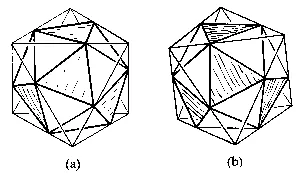
52 Fig. 11 86 Icosahedron within octahedron
53 We saw how the octahedron emerges out of the arrangement of icosahedral edges, on the inside, and now we reverse the situation. The icosahedron can be oriented so that eight of its twenty faces are coplanar with and flush against the eight faces of a surrounding octahedron, while the twelve icosahedral vertices are located on its twelve edges. However, the icosahedron must sit in a skew (or twisted) position, with its vertices intersecting the octahedral edges off center, dividing each edge into two segments, the longer 1.618 times the length of the shorter. This asymmetry means that there are two distinct orientations of the icosahedron inside the octahedron—positive and negative, as shown in Fig. 11-86.a, Fig. 11-86.b.
54 The ratio 1.618 to 1, known as the "golden section", might have played a prominent role in synergetics, for it shows up frequently [166/167](especially in relation to the icosahedron); however, Fuller rarely mentions this intriguing number. Accordingly, this text will not spend time exploring the famous ratio, which—as a source of fascination to geometers for millennia—enjoys considerable press already. (Specifically, for the role played by the golden section in the icosahedron, see Loeb's "Contribution to Synergetics" and its "Addendum" in Synergetics 2, both Section G.)35 Fuller has a different method of coping with such relationships; rather than describing certain comparisons and their numerical values, he employs geometric "modules"—a holistic way of describing geometry with geometry.
55 "S modules"
56 The icosahedron's crooked position within an inscribing octahedron defines specific leftover space—six pockets of empty territory between the icosahedron and its octahedral embrace (Fig. 11-87). The symmetry of the six identical pockets is such that each can be split in half, producing two equivalent irregular tetrahedra, which then further divide into two mirror-image halves.
57 This final thin tetrahedron is Fuller's "S quanta module". It is a volumetric unit that describes the degree to which the icosahedron is out of phase with the IVM. Just as grade-school "long division" introduces the arithmetic remainder, the process of dividing an octahedron by an icosahedron requires a geometric remainder—the S module. Chapter 13 will describe Fuller's A modules and B modules, volumetric counterparts of the S module; taken altogether these quantum units comprise Fuller's finite accounting system. Finally, Fig. 11-87 indicates the golden-section ratio between different edge lengths of the S module.
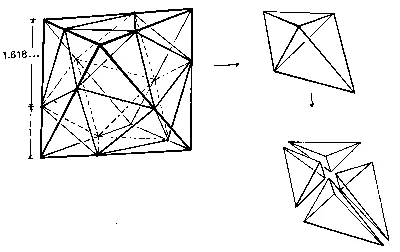
59 Fig. 11 87 S module.
60 Icosahedron and Rhombic Dodecahedron
61 A pattern emerges. The out-of-phase relationship between icosahedron and different IVM polyhedra appears to involve the golden section. We test the pattern on the rhombic dodecahedron. Do its 12 faces correspond to the 12 vertices of the icosahedron? It turns out that the two shapes exhibit an interesting relationship, with the icosahedron fitting inside the rhombic dodecahedron, predictably in a skew position. Its vertices impinge on the rhombic faces slightly off center, dividing the long diagonal of each diamond into two unequal segments—the longer again 1.618 times [167/168] the length of the shorter (Fig. 11-88). Ever reliable, the golden section reinforces our awareness of the underlying order in space.
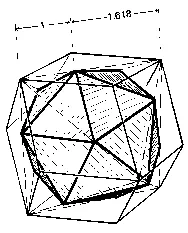
63 Fig. 11 88 Golden- ratio relationship: Icosa / Rhombic dodecahedron
64 The golden-section ratio is revealed in the relationship between icosahedron and rhombic dodecahedron.
65 Pentagonal Dodecahedron
66 Finally, recall the pentagonal faces of the icosahedron's dual; the fivefold symmetry of this dodecahedron is right out in the open. Furthermore, the pentagon is a prime source of golden section ratios (See Loeb's "Contribution to Synergetics"). The pentagonal dodecahedron [168/169]is of course also out of phase with the IVM, for its symmetry scheme is the same as that of its dual, the icosahedron.
67 Four Dimensions
68 Back to the jitterbug. Fuller proposes that this fluid transition from stage to stage is best described as 4-dimensional:
69 The vector-equilibrium model displays 4-dimensional hexagonal central cross section…. (966.04)
70 Four-dimensionality evolves in omnisymmetric equality of radial and chordal rates of convergence and divergence…. (966.02)
71 First of all, radial and chordal equivalence produces four distinct planes, and secondly, the jitterbug contraction operates around four independent axes. Let's see how this works.
72 Triangles hold their shape, and therefore an equivalent model to the stick jitterbug described above can be built out of eight cardboard triangles hinged together with strong tape. The advantage in this case of "solid" triangles is that it makes Fuller's "4-dimensional" assignment easier to understand (Fig. 11-89).
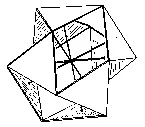
74 Fig. 11 89 Four independent axes of rotation
75 The eight triangles operate in pairs. Diametrically opposite triangles remain aligned, rotating synchronously about a common axis as they together approach the jitterbug center at a constant rate. The separate pairs thus rotate around four different axes, displaying simultaneous motion in four distinct directions.
76 "Push straight toward the table; don't let either triangle rotate": Bucky emphasizes the simplicity of the task. He then feigns surprise at the subsequent twisting at the equator. The entire system converges symmetrically, despite the unidirectional force. He calls this behavior 4-dimensionality, referring to the four independent directions of rotation.[169/170]
77 Complex of Jitterbugs
78 In an isotropic vector matrix, adjacent vector equilibria create octahedral cavities; to fill space the two polyhedra must occur in equal numbers. Contemplating this alternating array in light of the VE's jitterbug behavior, Fuller suspected that a complex of jitterbugs could be synchronized to twist and contract, while their octahedral counterparts simultaneously expand, twisting open into VEs. It is an extraordinarily difficult vision to conjure up in the mind's eye: an array of synchronized twisting triangles—transforming from order to chaotic inscrutability and then back into order—but with all the places switched. VEs become octahedra; octahedra become VEs. The ease of confirming the jitterbugging of one VE does little toward answering the question of whether a number of interconnected jitterbugs can coordinate to create this dynamic labyrinth.
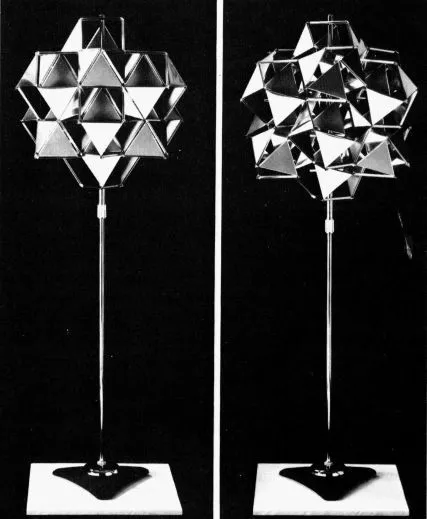
80 Photo 11 1 Complex of jitterbugs
81 An array of alternating octahedra and vector equilibria is shown on the left; on the right, the display is undergoing the simultaneous transformation of all cells, such that octahedra are opening up to become VEs while the VEs are contracting into octahedra. The action is frozen in mid transformation, making it possible to see the icosahedral phase. Photo courtesy of Carl Solway Gallery, Cincinnati, Ohio.
82 Would additional VEs packed around a single one serve to lock it in place? The question is difficult to answer without actually putting it to the test with the aid of a model—an awesome task. Thanks to an ingeniously designed 4-valent universal joint36 to accommodate the intricate twisting of adjacent triangular plates, a magnificent sculpture has emerged after considerable speculation. A movable complex of stainless steel and aluminum triangles hinged together effectively demonstrates that the convoluted transformation is possible (Photo 11-1). This translation from abstract mathematical concept to physical manifestation of the motion is both an engineering and an aesthetic feat.
83 Fuller proposes that this complex of pulsing jitterbugs demonstrates the effects of a force propagating through space—a tangible display of otherwise invisible energy events:
84 1032.20 Energy Wave Propagation: …You introduce just one energy action—push or pull—into the field, and its inertia provides the reaction to your push or pull; the resultant propagates the…omni-intertransformations whose comprehensive synergetic effect in turn propagates an omnidirectional wave.
85 In other words, the unique symmetry of the VE combines with this newfound jitterbug property to produce a model of omnisymmetrical motion, a radiating wave of activity. Just as the IVM is a static conceptual framework—describing the symmetry of space—this model illustrates the concept of dynamic, "eternally pulsating" energy events in space. It causes the IVM to come to life.
86 A model can elucidate a concept without being an exact duplicate of the phenomenon in question. In fact, considering the oddly [170/171]mystical language that creeps into modern physicists' description of atomic and subatomic behavior, we can conclude that invisible reality does not readily submit to large-scale reenactment with "solid" materials. The intention of Fuller's models therefore is to provide a consistent analogy—a tangible display that parallels and thereby explains invisible behavior:
87 Dropping a stone in the water discloses a planar pattern of precessional wave regeneration. The local unit-energy force articulates an omnidirectional, spherically [171/172]expanding, 4-dimensional counterpart of the planar water waves' circular expansion. (1032.20)
88 The expanding concentric waves made by a stone dropped in a lake are directly visible on the water's surface. It is therefore easy to picture the image of a wave propagating across a plane. It is more difficult to visualize a corresponding situation in space, which is precisely the territory Fuller set out to conquer. He strove to clarify invisible aspects of reality through models that can be seen and felt. The complex of jitterbugs makes the concept of an expanding spherical wave of energy visible.
89 Whatever the analogous events in Universe, the model is intricate and phenomenal. Fuller's argument is that nature depends upon such dynamic orderly coordination. The complex of jitterbugs demonstrates a complicated but organized operation, and if nature permits this transformation of her omnisymmetrical framework, she might use the same trick elsewhere. At the moment, jitterbugs therefore merely hint at possibilities. It is worth reflecting on the extraordinary intuition required to have discovered this subtle and magnificent geometric phenomenon.
11.0.2 Other Dynamic Models
90Topology and Phase
91 Physical Universe differentiates into three categories: liquid, crystalline, and gaseous phases. These distinct states of matter arise as a result of changing temperature or pressure, which induce different types of bonds. Fuller proposes a simple geometric analogy to make these invisible changes easy to comprehend. Appropriately, the model is completed with an exhaustive enumeration of the ways in which two tetrahedra can be connected to each other. The three arrangements of the minimum conceptual system model the three phases of physical matter.
92 First, two tetrahedra are triple-bonded, sharing one face between them (Fig. 11-90.a). Because the relative positions of the two tetrahedra are completely fixed, the arrangement qualifies as a stable set of relationships and represents a crystalline structure:
93 The closest-packing, triple-bonded, fixed-end arrangement corresponds with rigid-structure molecular compounds.(931.60)
94 Once again, the intention is not to create a large-scale duplicate of a particular "solid" compound, but rather to display the different characteristics of each chemical phase. The model is a kind of visual shorthand.
95 [172/173]
96 One of the three bonds is now released, leaving a double bond between two tetrahedra. The shared edge acts like a hinge (Fig. 11-90.b); the tetrahedral pair can swing back and forth, but they cannot be moved closer together or farther apart. The configuration is thus noncompressible—one of the distinguishing characteristics of liquids. It bends any way you desire—malleable just like a liquid—but the double bond persists:
97 The medium-packed condition of a double-bonded, binged arrangement is still flexible, but sum-totally as an aggregate, all space-filling complex is noncompressible—as are liquids. (931.60)
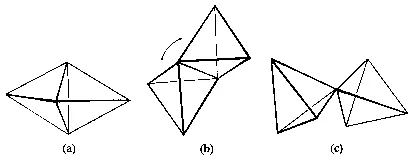
99 Fig. 11 90 Tetrahedra "bonding" models of phases of matter
100 Finally, we break another of the bonds. "Single-bonded" tetrahedra are joined by a vertex, and their behavior is analogous to that of a gas. The vertex bond acts as a universal joint; the two halves can swing freely with respect to each other, moving together and apart without disrupting the type of bond (Fig. 11-90.c). The arrangement is compressible, expandable, and completely flexible—short of dissociation. Perpetual connectedness indicates that both tetrahedra continue to participate in the same substance; they exhibit a consistent relationship, but lack structural definition:
101 Tetrahedra linked together entirely by…single-bonded universal jointing use lots of space, which is the openmost condition of flexibility and mutability characterizing the behavior of gases. (931.60)
102 The analogy is complete. All the while, Bucky holds the simple structures in his hands, and explains the different basic properties of solids, liquids, and gases. With any luck, a small child is present, forcing him to keep his discourse simple. How can the same type of molecule produce such radically different substances? Bucky offers a tangible explanation through geometry. This model is perhaps useful as a mnemonic device—an easy way to remember the chemistry lesson [173./174]by relating the different characteristics to their analogous stage of the model—rather than as a true demonstration of phase changes in a substance.
103 It is worth noting that this model of interconnected tetrahedra is more appropriate, and, in fact, quite accurate, in connection with the bonding of carbon atoms within molecules. In conclusion, it is unfortunate that this and other polyhedral characteristics and relationships are generally overlooked in educational curricula.
104 Fuller developed many dynamic models, and readers who go on to further study will find a variety of examples in Synergetics. The transformations discussed in this chapter set the stage to explore other examples. Appropriate parallels in nature may well arise from such efforts.[174/175]