
8 Tales Told by the Spheres: Closest Packing
2Much has been written over the years by mathematicians and scientists about the problem of "closepacking" equiradius spheres. It's not a subject that the rest of humanity has tended to get excited about; however, the orderly patterns revealed by these packings are unexpectedly fascinating. Closepacking equiradius spheres might at first sound like the type of abstract mathematical game Fuller railed against; after all, there's no such thing as a sphere. But if nature exhibits no examples of pure spheres—that is, no perfectly continuous surfaces equidistant from one center—we can still discuss the concept of a spherical domain. Imagine various approximations of the model, such as a soap bubble or, less fragile, a ping-pong ball. The concept of multiple equiradius spheres turns out to be quite useful, providing a superb tool with which to investigate the properties of space. Let's look into some of the reasons why.
Equilibrium: Equalization of Distances
4The connection to equilibrium is perhaps the most important reason to experiment with sphere packing. A sphere is defined as the locus of all points at a given distance from a central point; consequently, in an array of tangent spheres, their centers will be separated by a uniform distance. The configuration developed in the previous chapter to represent vector equilibrium—requiring equal lengths in all directions—can be created quite simply with the aid of this model. If one sphere is completely surrounded by a number of spheres of the same size, the distances between the internal sphere's center and the centers of all surrounding spheres are necessarily the same as the distance between the centers of adjacent external spheres, provided all spheres are in contact with each other.
5 The resulting cluster is shown in Fig. 8-40, along with a cross-section of the packing to illustrate that the distances are the same. Closepacked spheres automatically set up an array of evenly spaced points. Equal distances represent balanced forces: ergo, equilibrium. [100/101]
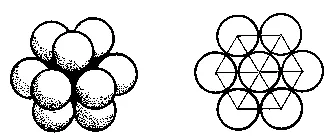
7 Fig. 8 40 Closepacked spheres form array of equally spaced points in space
Symmetry versus Specificity of Form
9A sphere is the form of "omnisymmetry" in spatial reality. Symmetry describes the degree to which a system can be rearranged without detectable change. The sphere's shape presents no corners, no angles—in short, no landmarks—by which to detect rotation or reflection. Its very shapelessness enables us to explore the shape of space. Furthermore, the total absence of angular form makes the precisely sculpted shapes generated by packing the identical "shapeless" units together all the more surprising. It is easy to see that individual spheres, as omnisymmetrical forms with neither surface angles nor specific facets to mold the form of clusters, cannot determine through their own shape the overall shape of packings. In conclusion, we are not so much interested in the ("nondemonstrable") spheres themselves, as in using sphere-packing as a medium through which spatial constraints can take visible shape.
Organization of Identical Units
11Finally, the standard model of an atom is spherical: packets of energy are spinning so rapidly about a tiny nucleus that the atom can be considered occupying a spherical domain. (In fact, the orbit of any object spinning in all directions defines a sphere.) We can therefore pack spheres together in the hope of learning about atomic and molecular aggregations. To state the problem more generally, the organization of identical units is an important theme in biology and chemistry. All sorts of units—such as atoms, molecules, cells, DNA nucleotides—must be organized to function cooperatively in structures far more complex than the individual units themselves. Spatial constraints are responsible for much of the superb organization [101/102]of biological phenomena—allowing and encouraging certain configurations while prohibiting others. Yet, despite the influential role of space, scientific thought does not as a matter of course take this into consideration.
12 Sphere-packing can be thought of as a method of blindly gathering evidence; we experiment with these identical units without knowing the outcomes, and space enters in to direct traffic. The resulting configurations are absolutely reliable. We are thereby able to observe the shape of space, manifesting itself through the innocent spheres.
New Level of Focus
14Despite our discipline of viewing whole systems, we have reached a point at which we must zoom in to look closely at certain details of Fuller's Synergetics. The sections called "Closest Packing of Spheres" contain some of the most difficult passages in his book, rendering Fuller's observations inaccessible without considerable perseverance. Not only is the description hard to follow, but these patterns seem to elude application. It is therefore especially important to understand the logic behind Fuller's use of sphere-packing in an investigation of nature's coordinate system. Otherwise, it will be difficult to see how these details fit back into the big picture. Even though the immediate goal of this text is to clarify the configurations described by Fuller, a list of results, no matter how clear, is not likely to be interesting unless the premise behind the search is understood. At this point, the reader may even have thought of further reasons to add to the ones stated above, for there are many dimensions of this issue. However, as it probably remains difficult to predict or visualize the patterns themselves, we bravely proceed.
8.0.1 Background: Closepacking
15Packing spheres together with a minimum of interstitial space is a problem that still presents a challenge to mathematicians.24 (Actually the problem has been solved, but it turns out to be extremely difficult to prove that the solution is indeed maximally dense.) For our goal of exploring Fuller's studies, we only deal with one of the two types of closest packing described below.
16 Once again, we start with the plane in order to establish a firm hold on the concept. Suppose we want to fit the largest possible [102/103]number of pennies on the surface of a small table—another way of saying we want the pennies to lie as close to each other as possible. As we saw in the previous chapter, a square grid of tangent pennies wastes considerably more table space than a triangular array.
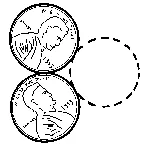
18 Fig. 8 41 Closepacking of three pennies
19 Observe in Fig. 8-41 that two tangent pennies create a valley that naturally embraces a third penny. All pennies are therefore allowed as close together as physically possible if every penny is situated in a valley created by two others.
20 In the same way, there is only one closest-packing arrangement of spheres in the plane: each sphere must be in contact with six others (Fig. 8-42).
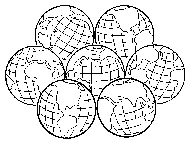
22 Fig. 8 42 Six spheres closepacked around one
23 A second identical layer can be placed on top of the first, with its spheres all landing in nests created by three neighbors on the [103/104]first layer. To achieve our goal of packing spheres as close together as possible, we have thus far had no choice as to the next step.
24 A third layer however can be superimposed on the second in one of two different ways to maintain maximum density. The spheres of the third layer can either be placed directly above the spheres of the first layer or above the nests in the first layer.
25 A schematic comparison of the two packings is shown in Fig. 8-43. The former is called [104/105]hexagonal closepacking; the latter, cubic closepacking. In both cases, every sphere touches exactly twelve others—as we might have anticipated from our VE studies. The difference between these two packings is explained in the following description.
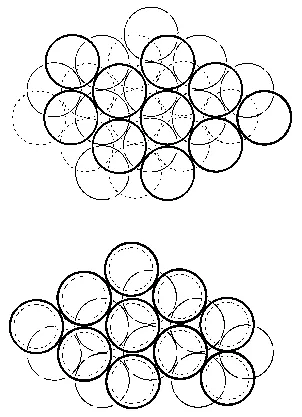
27 Fig. 8 43 Cubic packing (top) versus hexagonal packing (bottom)
28 (showing three layers of spheres in each packing)
29 Instead of trying to imagine indefinitely large planar expanses, we focus on a small portion of the closepacking—the arrangement surrounding a single sphere. We start with one ball on a table; six others closepack around the first, and find themselves exactly tangent to each other. As with the pennies, there is no choice as to the number of spheres in the cluster. The flat hexagon of spheres creates six separate "nests" of three spheres each, as seen in Fig. 8-42, but additional spheres of the same size, sitting in any one of the six [105/106]nests, partially block adjacent nests. As a result, there is only room for a ball in every other nest, allowing a total of three nesting spheres on the hexagonal cluster. These three balls (by magic or else by inherent spatial properties) rest exactly tangent to each other, a perfect equilateral triangle (Fig. 8-44.a, top). The arrangement has neither leftover space nor crowding; all three spheres on top are tightly shoved into nests, and—because the planar group (six around one) are clearly as close together as possible—all ten spheres are convincingly closest-packed.
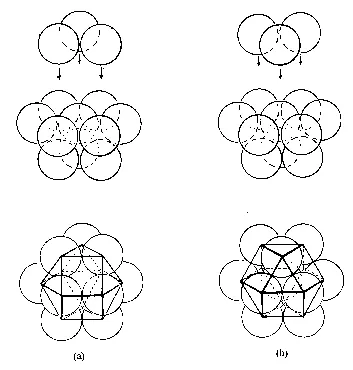
31 Fig. 8 44 Hexagonal (left) vs cubic (right): spheres 12-around-1
32 Hexagonal packing corresponds to the "twist" VE, while cubic packing corresponds to the VE
(cuboctahedron).
(Compare with Fig. 7-34.a and Fig. 7-34.b).
33 We can then flip the whole package over and repeat the procedure on the other side. We again have two choices: the second three-ball addition can be placed either directly above the three on the bottom (meaning both the top and bottom triangles are pointing the same way), or it can be oriented the opposite way (Fig. 8-44.a, Fig. 8-44.b). The former choice (hexagonal) outlines the vertices of a polyhedron in which the squares are adjacent to other squares (in three pairs meeting at the "equator"), as are six of the eight triangles (Fig. 8-44.a). The latter choice (cubic) consistently alternates triangles and squares, so that squares are entirely framed by neighboring triangles—and triangles by squares (Fig. 8-44.b).
34 The latter arrangement—"our friend the vector equilibrium" as Bucky says—is the more symmetrical of the two choices, and is therefore used as the basis of Fuller's subsequent sphere-packing studies.
Planes of Symmetry
36The following observations pertain to an indefinite expanse of cubically closepacked spheres. For example, imagine a room full of Ping-pong balls so tightly nested together that every ball touches exactly twelve others as described above. The idea of a room full of balls at first suggests such chaos that the precise organization arising out of the requirements of closest packing is truly remarkable.
37 The array contains seven planes of symmetry, characterized by two different types of cross-section.
38 The first is obvious, because we generated the cubic packing with successive layers of triangulated planes. However, it is not necessarily obvious that there are four different orientations of triangulated planes—parallel to the four faces of the tetrahedron (and therefore to the VE's four intersecting hexagons). Even though we built this array by stacking triangular layers of balls in only one direction, the result incorporates parallel triangulated layers in four different directions. (We further note that all four hexagons of the [106/107]VE are preserved in cubic packing, whereas in hexagonal packing, hexagons are formed in only one orientation, the horizontal plane.)
39 Secondly, there are three distinct planes characterized by a square pattern of spheres. This discovery seems to contradict our expectations, for we have learned that squares are not closepacked. However, the emergence of three mutually perpendicular square patterns is an inescapable by-product of nesting triangular layers. The square planes correspond to the VE's square faces, which consist of three mutually perpendicular pairs of parallel faces—just like the faces of a cube.
40 In a space-filling array of closepacked spheres, these seven planes extend indefinitely—with neither curve nor bend. A cross-section of such a packing has a square or triangular arrangement, depending on which way the packing is sliced. So although we started with only triangulated layers (in order to create a maximally dense array of spheres), square cross-sections automatically arose, just as octahedral cavities automatically arose next to the radiating tetrahedra in the vector equilibrium.
41 This is the shape of space.
42 It is interesting to note that, although when we stacked triangulated layers it was necessary to make a decision at the third layer that led to two different packings, if we were to start out instead with the square layers (unstable though they may be), there is only one way to proceed. Successive square layers can be placed on top of each other so that each ball lands in a square nest (as opposed to being placed directly on top of another ball, creating an array of cubes which would clearly not be closepacked). The internesting of layers stabilizes the otherwise unstable separate layers. Once two layers are packed together, every ball nests in a group of four balls on the adjacent layer—creating ½-octahedral pyramids (Fig. 8-45) separated by the inevitable by-product tetrahedra. Continuing to stack square layers in this way, cubic packing—rather than hexagonal—emerges. The vector equilibrium array is thus generated automatically, with no decisions along the way, by simply stacking square layers. Each and every ball is surrounded by exactly twelve others, in the more symmetrical of the two possibilities.
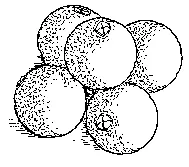
44 Fig. 8 45 Five oranges stacked to form ½-octahedron.
45 It is satisfying to reflect on the exquisite logic of this tradeoff: although balls arranged in square patterns are not as closely packed as triangular planes, the nests are deeper. A ball placed in any 4-ball nest (to start a second layer) sinks deeply into the cluster; in comparison it seems perched on top of the tight triangular nest. Therefore, successive square layers, although inefficient in themselves, fit more closely together than triangulated layers.[107/108]
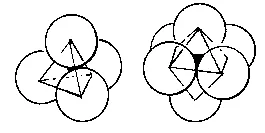
47 Fig. 8 46 Tetrahedral and octahedral closest sphere packing clusters.
48 Part of the challenge to mathematicians in proving that the hexagonal and cubic packings qualify as the solution to minimizing interstitial space is the fact that spheres in these two packings occupy just over 74% of the available space, while the 4-ball tetrahedron alone is able to occupy 77.96% of its overall volume.25242424 It is easy to accept that four balls cannot be pushed any closer together than the tetrahedral cluster and accordingly that the latter figure is the maximum density. Therefore, 74% seems insufficient—not easy to accept as the solution to the problem of closest packing. However, there is no getting around the fact that the 6-ball octahedral cluster (Fig. 8-46) is less dense than the 4-ball tetrahedron—as the former has more leftover room in the middle—and that the constraints of space are such that tetrahedral sphere clusters simply cannot be extended indefinitely by themselves. Attempting to fill space exclusively with tetrahedral groups, we quickly discover awkward leftover gaps—spaces not quite big enough to contain another sphere.
49 In order for spheres to be both consistently tangent and tightly nested together, we have to allow the naturally alternating tetrahedral and octahedral clusters. The problem would be remarkably easy if spheres [108/109]could pack tetrahedrally in an indefinite array, but they cannot. No amount of force can change this constraint; space is simply not shaped that way. Twelve around one, creating 60° angles both radially and axially, with alternating tetrahedra and octahedra, is the closest packing.
8.0.2 Fuller Observations
50Having settled on the most symmetrical and dense sphere packing, to faithfully present the characteristics of space, we are ready to explore, the shapes and "periodicities" observed by Fuller. The reliable precision of these patterns indicates that they are molded by space, not by imposed design.
51 What are these patterns that captured Fuller's attention so long ago (and kept it for 50 years)?
52 We start very simply with the phenomenon of "triangular numbers", a sequence of numbers in which each successive term is equal to the previous term plus the number of terms so far. These numbers can be generated by triangular collections of balls, arranged as in a rack of billiard balls. The total number of balls in each triangle, in a series of progressively larger groups, is a triangular number. Fig. 8-47 shows the first five groups. The first member of the sequence is "1"; the second is obtained by adding two to the first, to get "3"; the third, by adding three to the other two, to get "6"; and so on. Each successive number is generated by the addition of a row with one more ball than the last. The sequence of numbers thus generated (1, 3, 6, 10, 15, 21, 28,…) is specified by (n ² - n)/2 for n = 2, 3, 4, …. (n = 1 corresponds to 0, which is not—strictly speaking—modeled by a triangle).[109/110]
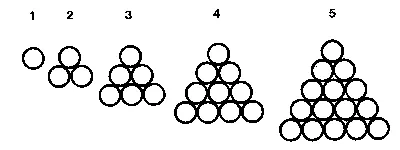
54 Fig. 8 47 Triangular numbers.
55 The formula (n ² - n)/2 might appear to be a more difficult way to obtain these values (and certainly for small groups its easier just to count balls), but of course for the twentieth or even the ninth triangular number, it's far more direct to subtract 10 from 10 ² and divide that by 2 to get 45 than to draw rows and rows (9 rows) of circles! Mathematics presents a shortcut—otherwise known as a generalized principle.
56 So far we have a numerical progression (n ² - n)/2 that happens to be modeled by triangular clusters. We might have chosen to discuss a variety of other sequences, for example, the numbers generated by n ²: 1, 4, 9, 16, 25, …, which could be labeled "square numbers" because they are geometrically represented by square clusters. But we have a specific motivation for paying attention to triangular numbers, because of one especially significant characteristic: the nth term is the number of relationships between n items, for n = 1, 2, 3, 4, …. For example suppose that for any given number of people, we wish to know how many telephone lines are required to link everyone to everyone else by a private line. The answer is the triangular number corresponding to a number of rows one less than the number of people. Two people require only one line; three require three; four require six (as portrayed in Fig. 3-3), and n require (n ² - n)/2 private lines. It is no longer far-fetched to imagine applications for this formula.
57 The real lesson from triangular numbers is that significant algebraic expressions, such as (n ² -n)/2, the number of relationships between n events, can be represented geometrically. That much established, we proceed to the next development.
Tetrahedra
59We can stack triangular arrays of decreasing size, creating tetrahedral clusters. (We could thereby isolate a sequence of "tetrahedral numbers".) But let's go back to the very beginning.
60 One sphere alone is completely free to move, and closepacking is of course not an issue. Suppose we have two billiard balls tangent to each other. If the only requirement is that the two balls stay in contact, we shall observe that they are free to roll around each other's entire surfaces (Fig. 8-48.a). We then introduce a third ball, allowing it to roll in any direction while touching at least one of the first two balls. It eventually rolls into the valley between the other two, establishing a naturally stable triangle (Fig. 8-48.b). At this point we require all three balls to stay in contact, and discover that they [110/111]are still able to roll, but only inward or outward (toward or away from the triangle's center, in tandem) "like a rubber doughnut", to use Bucky's words. The freedom of motion of each sphere is thus considerably more limited—spinning about one specific horizontal axis instead of unrestrained motion in every direction.
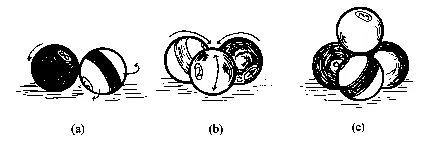
62 Fig. 8 48 "Four balls lock"
63 (a) two balls
(b) three balls
(c) four balls
64 A fourth ball rolls across the surfaces and lands comfortably in the triangular nest. Suddenly, all four balls are locked into place, unable to roll or move in any direction (Fig. 8-48.c). This is the first stable arrangement, with the requisite minimum of four. The tetrahedron is once again at the root of our investigation.
65 At this point, it may be illuminating to construct some of these structures, for example with Styrofoam balls and toothpicks, or small plastic beads and glue. One particularly satisfying demonstration involves bringing four spheres together and trying to create a square. It is easy to feel how unstable that arrangement is: the balls gravitate naturally toward the tight tetrahedral cluster. Fuller placed considerable emphasis on the benefits of hands-on construction to gain thorough familiarity.
66 The theme of Fuller's tetrahedral sphere packings is the presence or absence of nuclei. The word "nucleus" evokes the image of a central ball spatially surrounded by other balls, which is exactly the way Fuller uses it for the VE packings. However, his observations about tetrahedral patterns are based on a somewhat different approach. Most of the impenetrability of the sphere-packing sections in Synergetics can be removed with one simple clarification: a "nucleus" in VE packings is defined as a ball at the geometrical center of the whole cluster, whereas a "nucleus" in tetrahedral stacks is a ball at the exact center of an individual planar layer.
67 Start with the 4-ball tetrahedron developed above, which consists of a fourth ball added to a triangle of three others. Next, the simple 4-ball tetrahedron is placed on top of a flat 6-ball [111/112]triangular base, creating a tetrahedron with three balls per edge (Fig. 8-49). There are three layers, with ten balls altogether—6 plus 3 plus 1. Throughout his sphere-packing studies, Fuller uses the number of tangency points per edge (in other words, the number of spaces between spheres along an edge of the cluster, rather than the number of spheres) for the assignment of frequency. The 4-ball tetrahedron is thus "1-frequency" (as is appropriate for the first case), and the next case, the 10-ball tetrahedron, is "2-frequency". We can visualize that each sphere-cluster polyhedron corresponds to a line drawing (or toothpick structure) in which the spheres' centers locate vertices which are interconnected by lines (or toothpick edges) through tangency points.
68 Recalling that "frequency" is defined as the number of modular subdivisions, the justification for Fuller's frequency assignment is evident from this translation, because the number of subdivisions (or line segments) per edge corresponds to the number of spaces between spheres, rather than to the spheres themselves, which correspond directly to the vertices (Fig. 8-49).
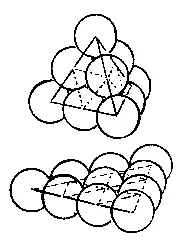
70 Fig. 8 49 Frequency in closepacking of spheres
71 Triangular clusters, each with one more row than the last, are stacked to create larger and larger tetrahedral packings. We place the 10-ball (2-frequency) tetrahedron on top of the next triangular base, which itself consists of ten balls, to get a 3-frequency tetrahedron, with twenty spheres altogether (Fig. 8-49). We have thus begun a list of values that might be called tetrahedral numbers: 4, 10, 20, followed by 20 plus the additional triangular layer of 15, to total 35 (Fig. 8-50). The progression can be continued indefinitely.
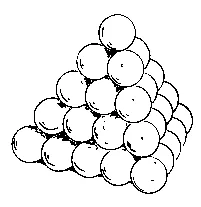
73 Fig. 8 50 Tetrahedral frequency (v) progression: 1v, 2v, 3v
74 Consider the different individual layers. There is a ball in the exact geometric center of some of the triangular groups, while others, having three balls around the exact center instead, are left with a central nest. Successive triangular clusters reveal a specific pattern: every third layer has a central ball, or nucleus. Fuller describes this progression as a "yes-no-no-yes-no-no" pattern. To see how it works, let's look at the first few members of the sequence. One ball [112/113] alone is automatically central—" a potential nucleus" in Fuller's words; it earns a "yes.' The next layer, the 3-ball triangle, has a nest, but no nucleus; that merits a "no;" likewise for six ("no"). Not until the 10-ball (3-frequency) group is there a nucleus—shown as the dark ball in Fig. 8-51 ("yes" again). Each "yes" case (with nucleus) consists of a hexagonal arrangement with three additional corners tacked on, to complete a triangle. The rest ("no" cases) are organized triangularly from the center out to the corners—simple 3-fold rotational symmetry, containing no central hexagon.
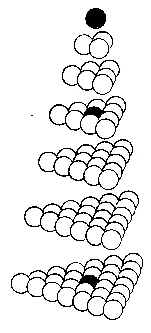
76 Fig. 8 51 "Yes-no-no-yes-no-no" –nest layers
77 Nest layers in 6-frequency (6v) tetrahedral sphere packings.
78 Fuller calls our attention to this periodicity (or pattern) within the system: starting from the top, the pattern is Y-N-N-Y-N-N-Y… [113/114](notice that "N" can stand for "nest" as well as for "no"):
79 415.55 Nucleus and Nestable Configurations in Tetrahedra: In any number of successive planar layers of tetrahedrally organized sphere packings, every third triangular layer has a sphere at its centroid (nucleus.)
80 Fuller's yes-no-no pattern describes the presence of nuclei in certain layers of a pyramid; he does not ask which pyramids of gradually increasing frequency contain an overall nucleus (at the center of gravity.) This is a subject open for further exploration, which we leave for the time being as we continue to explore Fuller's material.
81 Vector equilibrium
82 In cubic packing, twelve spheres surround one sphere, with each sphere tangent to every neighbor and without any gaps. This perfect geometric fit of the thirteen omnisymmetrical forms provides a basis for understanding the fundamental directions inherent in space. But we saw that the configuration is more specific than just a numerical consistency; the spheres outline the vertices of the cuboctahedron, or VE. This shape seems to appear out of nowhere. Created by the cluster of cornerless spheres shoved together, this result is as counter-intuitive as it is reliable. The more we learn about the shape of space, however, the more natural the appearance of the VE—or any manifestation of "twelve degrees of freedom"—becomes.
83 Frequency
84 The six squares and eight triangles outlined by the closepacked spheres, although unmistakable even in the simplest case, become more and more distinct as the frequency increases. As Fuller's convention is to refer to the number of spaces (rather than spheres) along the "edge" of the cuboctahedral cluster as the frequency of the system, the first 12-around-1 group is "one-frequency". The next layer—in the VE case, a surrounding envelope rather than just another layer added to the bottom—is 2-frequency, having three balls along each edge. The next is 3-frequency, with four balls per edge, and so on. It follows that the higher the frequency, the smaller an individual sphere is in relation to its polyhedral face, and so these polygonal faces look progressively less bumpy, or more sharply defined (Fig. 8-52). The precise planar organization of the clustered spheres becomes more obvious as the frequency increases. [114/115] The appearance of eight triangles and six squares was not an accidental property of the first layer: the VE is here to stay. This lesson is continually reinforced by additional layers.
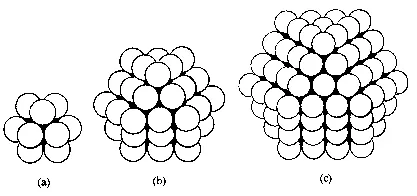
86 Fig. 8 52 Vector equilibrium progression: 1v, 2v, 3v
87 Having established the shape of symmetrical nuclear sphere-packing we proceed to investigate numbers. Twelve balls fit tightly around one; how many does it take to completely surround the twelve with a second layer? By carefully placing balls in the "nests" on the cluster's surface, we generate a 2-frequency VE shell of exactly forty-two balls. We might begin by placing one ball at the center of each of the six squares and then in each nest along the twenty-four VE "edges", thereby superimposing six 2-frequency squares (nine balls each) over the simple 4-ball squares (Fig. 8-52.b). The edges of the six 2-frequency squares supply the spheres for the adjacent 2-frequency triangles (without adding any more balls). These 2nd-layer triangles cover the eight 3-ball triangles of the first layer. The twelve vertices, or corner spheres, are each shared by two squares, and so 12 must be subtracted from 54 (9 spheres per square times 6 squares) to get the total number for the second VE layer: 42 spheres. (See Fig. 8-52.)
88 Envelop the whole package with a third layer, a 3-frequency shell with four balls per edge. Following the above procedure, we count sixteen balls in each of the six squares, for a total of 16 × 6 = 96, from which we must subtract the twelve vertices counted twice due to overlap between squares. The edges of the eight triangles are again already in place—provided by the edges of the squares—but on this shell, a central sphere which belongs in each 3-frequency [115/116]triangle must still be added; eight more spheres are therefore needed to complete the enveloping layer. 96 minus 12 plus 8 yields a total of 92 balls.
89 The next shell (4-frequency) requires 162 balls; the 5-frequency layer consists of 252, 6- of 362, and so on. We are now able to detect a pattern by looking carefully at these numbers: 12, 42, 92, 162, 252, 362,…. It will come as no surprise to the observant student of numbers to learn that the next shell consists of 492 balls.
90 What exactly is going on? To begin with, we notice the consistent last digit: every single number ends with 2, reminiscent of Euler's law and its "constant 2". Fuller interprets this persistent "excess of 2" in radial sphere packing as further affirmation of the inevitable "poles of spinnability", inherent in the topology of singly closed systems. And indeed, the temptation to embrace a single explanation is strong. The fact that the number of spheres per shell always ends with the digit 2—even though those numbers increase drastically with each successive layer—seems too strange to ignore; we want an explanation for nature's behavior. But at this stage, speculation as to significance is a sidetrack: our task is to fully describe the configurations. As soon as we fully understand the patterns and are thus armed with the facts, such speculation will be appropriate and indeed inevitable.
91 After observing the reliable last digit, we can simplify our sequence—following Fuller's procedure—by subtracting the 2 from each term, removing the distraction to assist further analysis. We are left with 10, 40, 90, 160, 250, 360, 490, …, all divisible by 10. So let's divide by 10. This leaves 1, 4, 9, 16, 25, 36, 49, …, and now the pattern is clear.
92 The latter sequence is generated by f ², for f = 1,2,3,4,5,6,7 We choose "f "in this case, to represent frequency, for it turns out that the relationship between frequency and number of units per shell can be directly specified. Nature thus reveals yet another "generalized principle". This equation actually describes a straightforward edge-length-to-surface-area relationship, exactly what we expect from geometry—in a slightly different format.
93 The next question is how to specify the relationship in precise terms. We work in reverse from our final sequence (f = 1,2,3,4,…) to generate the original sequence. First we must raise the frequency f to the 2nd power, then multiply each term by 10, and then add 2: 10f ²+2 therefore gives us the total number of spheres for any shell (specified by frequency) in nuclear sphere packings.[116/117]
94 Icosahedron
95 We return to the initial 12-around-1 cluster, to try a new twist (literally). Imagine that we have thirteen spherical balloons—instead of ping-pong balls—so that we can we reach through with a long pin to puncture the nuclear balloon, causing it to slowly deflate. As the nuclear balloon disappears, the twelve outside balloons shift, closing in symmetrically toward the empty space in the center. They can't go far—only enough for the six unstable squares of the VE to "tighten up" into two noncoplanar (or hinged) triangles. Squares were stable in the VE only because the nuclear sphere held them in place; the array was thus stabilized by triangulation in radial directions, producing alternating tetrahedra and ½-octahedra. Now, without the nucleus, the surface must be stable by itself; it therefore must be triangulated (Fig. 8-53).
96 The VE configuration has twelve "vertex" spheres. What shape do these twelve spheres become when fully triangulated? The six squares transform into two triangles each, which (added to the original eight) make twenty triangles in all. Twenty triangles and twelve vertices? That is none other than our friend the icosahedron, largest of the regular polyhedra, one of the "three prime structural systems in Universe".
97 We can create higher-frequency versions of the icosahedron, but they will always be single-layer shells. The icosahedral configuration arose as a result of removing the VE nucleus; the remaining spheres move in, partially filling the gap, and thus their positions no longer allow a space-filling array of spheres. Because icosahedral clusters are completely triangulated, they cannot be extended either inwardly or outwardly; they lack the necessary alternation of tetrahedra and octahedra.
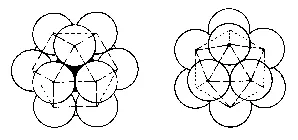
99 Fig. 8 53 Removing nuclear sphere from 1-frequency VE creates icosahedron
100 Such omni-triangulated sphere-packing shells can have any frequency, despite being restricted to single-layer construction. Let's [117/118]see what happens. Consecutive higher-frequency icosahedral shells cannot surround a previous layer as they do in the VE—which of course starts with a nucleus and continually surrounds it with layers. Icosahedral shells simply do not nest together. Instead, progressively larger, or higher-frequency icosahedra must be built one by one, each with one more sphere per edge, and always single-thickness.
101 What will happen to the relationship between frequency and number of spheres on a given shell? It turns out that—while both shape and volume change considerably—the number is unaffected by this transition from the VE's fourteen faces to the twenty icosahedral triangles. We verify this fact through the following observations. Notice in Fig. 8-54 that a square pattern of spheres can be compressed into a rhomboid (diamond) shape without changing the number of spheres. The resulting diamond is more tightly packed than the square and consists of two triangles of the same frequency as the original square, sharing one edge, that is, the row of spheres that used to form the diagonal of the square. Fig. 8-54 shows how the spheres of two triangles on an icosahedral shell correspond to one square face of a VE of the same frequency. And therefore, because the spheres on an icosahedral shell are all as closely packed as possible (as opposed to the VE, which alternates triangles with the more loosely packed square faces), a smaller, denser shell is produced, with the same number of spheres as a VE shell of the same frequency. 10f ² + 2 therefore also applies to icosahedra.
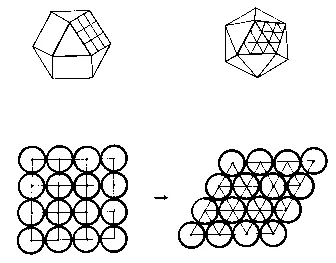
103 Fig. 8 54 Square pattern of spheres compressed into rhomboid shape
104 The icosahedron contains as much interior volume relative to surface area as is possible with only one type of face. Ever economical, nature therefore chooses icosahedral symmetry for the construction of a shell made of identical units; requiring a minimum of effort, this arrangement can arise automatically. Maximum volume, minimum material. It is thus easy to account for the icosahedral symmetry detected in the isometric virus capsid, the tough protein shell created by nature to house and protect the more fragile genetic material within, which is the source of the virus's instructions.26 Nature consistently exhibits elegant solutions to design problems, because she finds the most efficient, or least energetic, way to operate. She has no choice but to adhere to the constraints of space. The example of the spherical virus shell is worth our brief attention, for it provides an elegant illustration of the "design science" of nature at work.
105 Let's examine the criteria: (1) A container must be constructed out of a large number of identical constituents (protein molecules), [118/119](2) for reasons which will be explained below, the shell must be able to self-assemble—that is, build and rebuild itself automatically, (3) maximum symmetry is advantageous to minimize the energy required for attractive bonds between the capsid molecules, and (4) the arrangement must be stable, which means triangulated.
106 The elegance of the relationship between structure and function is well documented in modern biology, and the isometric virus is no exception; its structure must be suited to its specific functions. A tough shell is to completely enclose minute amounts of genetic material—quantities necessarily insufficient for carrying detailed bonding instructions—yet it must easily disassemble and reassemble itself in order to release the viral genetic material into a host cell. The overall structure must therefore be dictated by properties of the subunits and by the constraints of space itself—both criteria also establishing a built-in check system.
107 A sphere, which maximizes the volume-to-surface-area ratio, is the key to an efficient solution. Interconnected molecules, which can only approximate that theoretical sphere, will achieve a spherical distribution most efficiently through icosahedral symmetry. Observations of isometric viruses have consistently revealed icosahedral patterns, thus reconfirming that nature chooses optimal designs.27 We shall study this configuration in more detail in Chapter 15.[119/120]
108 Further Discoveries: Nests
109 Throughout our investigation, we note the recurrence of a limited inventory of polyhedral shapes. This is perhaps revealed most dramatically by the behavior of closepacked spheres. A striking example is found in the results of an extra sphere placed in the central nest of flat triangular clusters.
110 The first case is already quite familiar: a sphere placed in the minimum triangle of three spheres produces a regular tetrahedron, assuming all four spheres are the same size. A ½-octahedron is born out of a sphere nesting in a square group of four spheres, and we might reproduce any number of familiar shapes by putting equiradius balls together, but here we confine ourselves to the triangular clusters, for the scientific method tells us that the strength of an experiment often rests in drawing boundaries. Results thus obtained may lead to broader generalizations about related questions.
111 Remember our observation that every "N", in Fuller's Y-N-N pattern, represents a layer with a nest, since any triangular cluster without a central ball has a central nest. The center of a ball added to the first nest becomes the fourth vertex of a regular tetrahedron; the next group, six balls, also has a central nest, so a seventh ball is put in the space. Magically, the shape thus created is a significant one: the semisymmetrical tetrahedral pyramid, which is exactly one-eighth of the regular octahedron (Fig. 8-55). To understand what is meant by "one-eighth" of an octahedron, imagine that we slice a regular octahedron made out of "firm cheese", to use one of Bucky's images, in half—creating two square-based pyramids (Egyptian style). Then, cut both halves into quarters, to get eight octants, each with an equilateral triangle base and three isosceles-triangle side faces (45°/ 45°/ 90°). The octahedral central angle is 90°, a fact which will prove especially significant in the next chapter.
112 The seventh ball is simply placed in the nest of the six-ball triangular layer to complete the four vertices of an "octant". Nothing in our sphere-packing investigation thus far would lead us to predict the appearance of this important shape, which is already a significant part of our polyhedral inventory. (Such unpredictability is getting to be a pattern.) So we proceed to the next case.
113 The 10-ball triangle has a nucleus (1: yes; 3: no; 6: no; 10: yes;…) and therefore no nest. So we skip to the 15-ball cluster and, as before, drop a sixteenth ball in the central nest. We are no longer surprised to discover that the resulting shallow pyramid is [120/121]also a very special shape: one-quarter of a regular tetrahedron—a portion encompassing the volume from the tetrahedron's center of gravity out to any one of its four faces (Fig. 8-55). The tetrahedron's central angle, 109.471 degrees (109°28'16"), seems so irregular that the sense of coincidence is underlined.
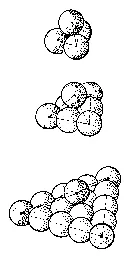
115 Fig. 8 55 Pyramids formed by triangular-number layers + one ball in central nest
116 With fifteen balls in the plane and a sixteenth in the center, this pyramid is quite shallow—and in fact, as a section of the minimum system, it is Fuller's terminal case. For each of the first five triangular numbers without nuclei, a sphere placed in the central nest forms an important shape in the VE-octet framework, an idea that we shall explore in greater detail in the next chapter. We thus have come to the end of this particular experiment, with the conclusion that closepacked spheres automatically yield many significant geometric shapes.
117 "Interprecessing"
118 The essence of precession, to Fuller, is 90°. And indeed, the counter-intuitive or mysterious thing about the behavior of gyroscopes (and other examples of precession in physics) is the resultant motion in a direction 90° away from that of an applied force. For example if a downward force is imposed at the north point of a [121/122]gyroscope spinning clockwise, it will tilt toward the east: 90° away from the direction one intuitively expects. Fuller's "interprecessing" involves two systems "precessing" together, which he uses to mean oriented at 90° with respect to each other. In his sphere-packing studies, "interprecessing" reveals subtle facets of symmetry which might otherwise go unnoticed.
119 We start with the simplest case: two identical pairs of tangent spheres, parallel to each other and separated by some distance. Rotate one of the 2-ball sets 90°, and then move the two pairs toward each other until they meet in the middle, so that the midpoints, or tangency points, of the two pairs are as close together as possible. (Notice that without the 90° twist, the result of bringing the parallel pairs together would be a square—unstable and not closepacked.) What is the result of this simplest case of interprecessing? A tetrahedron, of course (Fig. 8-56).
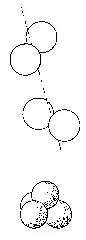
121 Fig. 8 56 Interprecessing: two closepacked pairs of spheres creates a tetrahedron
122 In retrospect, the answer appears obvious, for the initial condition of four spheres—the necessary ingredients of a tetrahedron—gives it away. However, the experiment highlights the 90° symmetry of the tetrahedron, which is otherwise obscured by the predominance of triangles and 60° angles. Rather than elaborating on the tetrahedron's right-angle symmetry here, we shall allow subsequent [122/123]demonstrations to further illustrate this orthogonal characteristic. (See especially Chapters 9 and 10.)
123 Take two identical sets of 60 spheres, closepacked as shown in Fig. 8-57.a. Their irregular trapezoidal shape eludes immediate identification. That they do not seem to be a part of our familiar group of shapes is confirmed by numerous experiments in which participants are given these two pieces and asked to put them together in some way that seems correct. Countless false moves involve bringing similar faces directly toward each other, and again and again, the identical halves are put together in unsatisfying and incorrect ways.
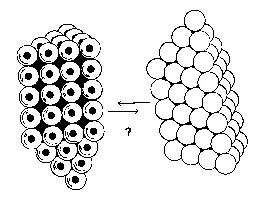
125 Fig. 8 57 Tetrahedron as chef's hats
126 The correct solution is rarely discovered by the uninitiated—but once seen is unmistakable. This problem (simple, after the fact) is initially challenging because it is so hard to get [123/124]beyond the natural assumption that the two halves must approach each other directly—as if one half were approaching its own reflection in a mirror. What actually has to occur of course is that one half rotates 90° with respect to the other (interprecessing) and the two rectangles mesh together perfectly, at right angles. "Wow!" Bucky would exclaim, apparently as surprised as his audience. The surprise is genuine in a sense, for the result is visually striking even if one already knows the answer: a perfect tetrahedron, eight balls per edge, or 7-frequency (Fig. 8-58.)
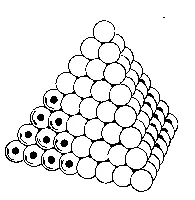
128 Fig. 8 58 Chef's hats back to tetrahedron
129 Along the same lines, we now look at 60° twists. An especially pleasing example involves two simplest triangles, of three spheres each. The triangles face each other directly; then one rotates 60° before pushing them together, and the result is an octahedron. The six spheres are precisely situated as octahedron vertices, framing eight triangles. (Refer back to Fig. 8-46.)
130 Next, let's take two 1/8-octahedron 7-ball sets (the 6-ball triangle with a seventh ball in the central nest). The two triangular bases of each cluster face each other, and then one is rotated 60°, allowing the triangles to come together as a 6-pointed star, and suddenly the fourteen balls become a cube! This is the minimum stable cube formed out of spheres (Fig. 8-59). Eight spheres alone, [124/125]positioned as the eight corners of the cube, are not closepacked, and that configuration would therefore be unstable, as the spheres have a tendency to roll into the unoccupied valleys.
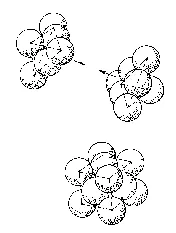
132 Fig. 8 59 Two 1/8-octahedra create minimum stable cube
133 In fact, just as a floppy toothpick cube needed six extra diagonal sticks (the six edges of a tetrahedron) to stabilize the square faces, eight balls also require an additional six, to complete a stable cube. Thus we have fourteen balls altogether: a parallel to the fourteen topological parameters (vertices plus edges plus faces) of the tetrahedron. The cube in every stable form seems to be based on an implied tetrahedron.
A Final Philosophical Note
135Fuller pointed out that sphere-packing models encourage us to conceive of area and volume in terms of discrete quanta instead of as the physically impossible continuums promoted by traditional geometry:
136 Because there are no experimentally-known "continuums", we cannot concede validity to the concept of continuous "surfaces" or of continuous "solids". The dimensional characteristics we used to refer to as "areas" and "volumes", which are always the 2nd- and 3rd-power values of linear increments, we can now identify experimentally, arithmetically, and geometrically only as quantum units that aggregate as points, both in system-embracing areal aggregates and…as volume-occupant aggregates. The areal and volumetric quanta of separately islanded "points" are always accountable numerically as the 2nd and 3rd powers of the frequency of modular subdivision of the system's radial or circumferential vectors. (515.011)
137 He argued that sphere polyhedra, having the advantage of visibly separate subunits, illustrate the otherwise invisible truth about physical reality. An awareness of the particles inherent in all physical systems (on some level of resolution) is nurtured, because in the sphere packings it is so logical to express volume and area in terms of number of units. The examples of the VE and icosahedron models demonstrate how the terms for expressing length (frequency) and area (number of particles) are actually related by a formula (10f ²+2)—as would be necessary in a new geometry.
138 Fuller attributed the precedent for thinking about volume in terms of quanta to Amadeo Avogadro (1776–1856) and his discovery that equal volumes of all gases, under the same conditions of pressure and temperature, contain the same number of molecules. Avogadro thereby identified volume with number of molecules a long time ago. [125/126]We take this a step further, by remembering that, although we tend to conceive of volume as a spatial continuum, our convention for quantifying an amount of space uses number of imaginary cubes—even if that quantity usually involves an extraneous partial cube (or fraction) tacked on to a whole number. We shall discuss the subject of volume more fully in Chapter 10. For now, we simply lay the groundwork with the evidence that polyhedra can be constructed out of a multitude of spheres, at different frequencies, and that the resulting models play an important role in satisfying Fuller's criteria for a geometry consistent with Universe.[126/127]