
3 Systems and Synergy
2Fuller's mathematical explorations seem to fly out in many directions at once, but they share a common starting point in the concept of systems. Derived from the Greek for "putting together", the word system means any group of interrelated elements involved in a collective entity. If that sounds vague, it's meant to. The theme is widely encompassing.
3 Long ago, secluded in his room experimenting with toothpicks or ping-pong balls or whatever available material seemed likely to reveal nature's secrets, Fuller began to see a persistent message of interdependence. He was later to discover the precisely descriptive word "synergy", but even without that lexical advantage a sense of interacting parts increasingly dominated his vision. More like the poets and artists of his generation than the scientists, he was drawn to relationships rather than objects.
4 By stating that Fuller looked at systems, we learn very little, especially in view of the word's current popularity. We have transportation systems and systems analysts, stereo systems and even skin-care systems, all conspiring to diminish the precision and usefulness of the word. But let us enter into the spirit of Bucky's half-century search and abandon our 20th-century sophistication in order to rediscover the obvious en route to the surprising and complex. Much can be gained, for alongside our era's growing consciousness of systems and interdependence is also its ever-increasing specialization. Individuals are encouraged to narrow their focus, precluding a comprehensive vision and inhibiting curiosity. How-things-work questions are reserved for children; as adults we are afraid to step outside our expertise. Furthermore, we are quite likely to have decided that we have no use for mathematics at all by the time we reach high school. Both factors—specialization and avoidance of mathematics—cause some aspects of Fuller's synergetics to seem dense while others seem oddly simple. However, the novelty of his approach serves to give us new insights, so bear with [025/026]Bucky as he "discovers the world by himself";11 his enthusiasm may be contagious.
5 Fuller was unafraid to appear naïve. He announced his observations with equal fervor for the simplest ("only the triangle holds its shape") and the very complex (the surface angles of the planar rhombic triacontahedron correspond exactly to the central angles of the icosahedron's 15 great circles), but on every level he was conscious of systems.
6 A system, says Bucky, is a "conceivable entity" dividing Universe into two parts: the inside and the outside of the system. That's it (except, of course, for the part of Universe doing the dividing; he demands precision). A system is anything that has "insideness and outsideness". Is this notion too simple to deserve our further attention? In fact, as is typical of Fuller's experimental procedure, this is where the fun starts. We begin with a statement almost absurdly general, and ask what must necessarily follow. At this point in Fuller's lectures the mathematics sneaks in, but in his books the subject is apt to make a less subtle entrance! (Half-page sentences sprinkled with polysyllabic words of his own invention have discouraged many a reader.) The math does not have to be intimidating; it's simply a more precise analysis of our definition of system.
7 So far a system must have an inside and an outside. That sounds easy; he means something we can point to. But is that trivial after all? Let's look at the mathematical words: what are the basic elements necessary for insideness and outsideness, i.e., the minimum requirements for existence?
8 Assuming we can imagine an element that doesn't itself have any substance (the Greeks' dimensionless "point"), let's begin with two of them. There now exists a region between the two points—albeit quite an unmanageable region as it lacks any other boundaries. The same is true for three points, creating a triangular "betweenness", no matter how the three are arranged (so long as they are not in a straight line). In mathematics, any three non-colinear points define a plane; they also define a unique circle.
9 Suddenly with the introduction of a fourth point, we have an entirely new situation. We can put that fourth point anywhere we choose, except in the same plane as the first three, and we invariably divide space into two sections: that which is inside the 4-point system and that which is outside. Unwittingly, we have created the minimum system. (Similarly, mathematics requires exactly four noncoplanar points to define a sphere.) Any material can demonstrate [026/027]this procedure—small marshmallows and toothpicks will do the trick, or pipecleaner segments inserted into plastic straws. The mathematical statement is unaltered by our choice: a minimum of four corners is required for existence.
10 What else must be true? Let's look at the connections between the four corners. Between two points there is only one link; add a third for a total of three links, inevitably forming a triangle (see if you can make something else!). Now, bring in a fourth point and count the number of interconnections. By joining a to b, b to c, c to d, d to a, a to c, and finally b to d (Fig. 3-3), we exhaust all the possibilities with six connections, or edges in geometrical terminology. Edges join vertices, and together they generate windows called faces.
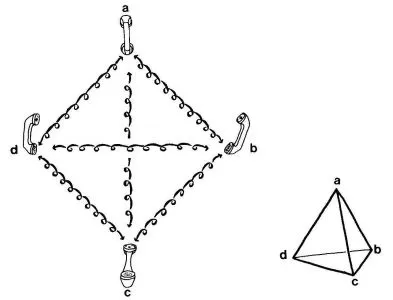
12 Fig. 3 3 6 connections between 4 events, defining a tetrahedral system
13 This minimum system was given the name tetrahedron (four sides) by the Greeks, after the four triangular faces created by the set of four vertices and their six edges (Fig. 3-3). Fuller deplored the Greek nomenclature, which refers exclusively to the number of faces—the very elements that don't exist.
14 ("There are no solids, no continuous surfaces…only energy event complexes [and] relationships.") 12
15 However, he did not fully develop a satisfactory alternative, so we [027/028]shall have to work with the time-honored convention. What we lose in accurate description of physical reality, we gain in clarity and consistency.
16 The tetrahedron shows up frequently in this exploration. This and other recurring patterns seem coincidental or magical at first, but soon come to be anticipated—endless demonstrations of the order inherent in space. The process is typical of synergetics: we stumble into the tetrahedron by asking the most elementary question—what is the simplest way to enclose space?—and later, everywhere we look, there it is again, an inescapable consequence of a spectrum of geometric procedures.
17 The straightforward logic of our first encounter with the tetrahedron drives us to wonder if it displays any other unique properties. It turns out to be a reliable sort of minimum module or "quantum", as Fuller points out in myriad ways. Not the least impressive involves counting the edges of all regular, semiregular, and triangulated geodesic polyhedra (from the simple cube to the more complex rhombic dodecahedron to the vast array of geodesics). The resulting numbers are all multiples of the tetrahedron's six. We can therefore take apart any polyhedral system in these categories and reassemble its edges into some number of complete tetrahedra. Even though we are not yet familiar with these other polyhedra, the observation stands as a representative example of the surprising whole-number relationships which make our investigation increasingly alluring.
Conceptual and Real Systems
19Notice that these geometrical systems are purely conceptual: so far they exist only in our mind, as sets of relationships. They can be lent substance by any number of materials, as for example the toothpicks and marshmallows mentioned above. However, the essence of a system is independent of the choice of materials: six sticks will create a tetrahedron whether we use wood or metal. Similarly, four ping-pong balls or four people constitute a tetrahedral system. The tetrahedron, being a conceptual entity, is "sizeless and timeless". Thus Fuller writes in Synergetics, "Size is always a special-case experience".(515.14) Size belongs to a different category of parameters than vertices, edges and faces—those which only relate to actual constructs, such as color, temperature, and duration.
20 Does he take this concern with terminology too far? His justification is twofold, encompassing first a deep conviction that words influence the shape of our thinking, and secondly faith in the power [028/029]of accurate models in problem-solving. For humanity to solve its complex problems, he was convinced that vocabulary and other models had to be absolutely precise. So Fuller's concern that we recognize conceptual systems as sizeless sets of relationships capable of being physically embodied is an essential part of his geometry of thinking. In either form, the emphasis is on the relationships.
21 We begin to see a basis for the phenomenon of vastly different properties exhibited by systems with identical constituents. One notable example is the soft grey graphite of pencils in contrast to sparkling impenetrable diamonds, both consisting exclusively of carbon atoms. Geometry alone accounts for their differences. We shall see how later, but as always our attention will be on shape and valency (numbers of connections) rather than substance.
22 Let's get back to our starting point. Any subdivision of Universe constitutes a system. We have found the simplest example and learned the mathematical terms; our next step is to look at more complex systems. It does not stretch our definition to discuss some very elaborate forms, such as a school, or even a crocodile (both have the requisite boundary). For that matter, our entire planet is a system—unimaginably intricate but still finite. This line of thought, together with our geometry lesson, suggests an approach to problem-solving: a "whole systems" view that demands consideration of the influence of every move on its entire system. Such an approach, which prohibits short-term or piecemeal solutions to long-term problems, may sound simplistic or vague at first; however, the method is based on the assumption of rigorous analytical procedures.
23 In Synergetics, Fuller introduces the concept with a deliberately simple example, which provides an analogy for more complex situations. A fictitious child draws on the ground with a stick, announcing that he has made a triangle. Then Bucky himself intervenes to point out to the child that he has created four triangles—not just one—because "operational mathematics" requires that a triangle must be inscribed on something in order to exist. Whether on a piece of paper or on the surface of the Earth, that something is always a system, with an inside and an outside. Unwittingly, the child has divided the Earth's surface into two areas. Both regions are bounded by three arcs, and therefore both qualify as spherical triangles, despite the fact that one is small and tangible and the other covers most of the Earth's surface. We are not used to thinking in these terms, philosophizes Fuller, but we must begin to really think about what we're doing.[029/030]
24 Hold on, says the child, that's only two triangles! Why did you say there were four? Well, Bucky continues, concave and convex are not the same; when you delineated two concave triangles on the outside surface, you also created two convex spherical triangles—one very small and the other very large—on the inside. But I didn't mean to make four triangles, protests the bewildered child. That doesn't matter, his teacher replies; you are still responsible for them.
25 His story can be considered a parable; its purpose is as much to encourage a sort of holistic morality as to make a mathematical statement. The message: tunnel vision is obsolete. As human beings, we cannot afford to ignore the effect of our actions on the rest of a system while working on an isolated part. Rather we must become responsible for whole systems. We didn't mean to make four triangles—or indeed, to make "the big mess of pollution" (814.01).
26 As playful as this example seems, it calls our attention to what Fuller perceives as a dangerous "bias on one side of the line" inherent in traditional mathematics. He points out that our grade-school geometry lessons involve concepts defined as bounded by certain lines—a triangle is an area bounded by three lines, for example—thus excusing us from paying attention to its environment. Once a figure is delineated, we no longer have to consider the rest of the system. This narrow approach, Fuller argues, instills in us at an impressionable age a deep bias toward our side of the line; we see and feel an unshakable correctness about our side's way of "carrying on". On the other hand,
27 "Operational geometry invalidates all bias" (811.04).
28 It forces us to remain aware of all sides. In Fuller's opinion, being taught in the first place that all four triangles are "equally valid" would significantly influence our later thinking and planning.
29 One consequence of this approach is Fuller's realization that "unity is inherently plural" (400.08). "Oneness" is impossible, he explains, for any identifiable system divides Universe into two parts, and requires a minimum of six relationships to do so. Furthermore, as illustrated in the above parable, all "operations" produce a plurality of experiences, and awareness itself—without which there can be no life—implies the existence of "otherness". Ergo,
30 "Unity is plural and at minimum two". (EIK video)
Limits of Resolution as Part of the Whole-Systems Approach
32Another important aspect of Fuller's systems concept is tune-in-ability, which deals with limits of resolution and is best explained by analogy. Fuller's ready example, as implied by the term, would be to [030/031]remind us of the radio waves of all different amplitude and frequency, filling the room wherever you happen to be reading this page. These waves are as much a part of physical reality as the chair you are sitting in, but the specific energy pattern is such that you cannot tune in to the programs without help from a radio. Information and energy are scattered chaotically throughout your room, mostly undetected, except for the small fraction (chairs, visible light, and so on) that can be directly perceived by human senses. You can turn on the radio and thereby tune in to one program (one system), temporarily ignoring the rest.
33 Boundaries change all the time as new elements are incorporated into a system, or as the focus zooms in to investigate a component in greater detail. New levels of complexity reveal distinct new systems. For example, we might look at the system called your living room, and then want to consider its function in the bigger system, your house, or conversely, zoom in to investigate the red overstuffed chair, and the details of its carpentry and upholstery; or further still, one nail might be of interest as a system. We can also go back out—to your town, your state, etc. The concept of tune-in-ability allows us to treat a set of events or items as a system despite the involvement of many concurrent factors on other levels.
34 What kinds of things constitute systems? Tetrahedron, crocodile, room, chair, you, thought,…. Wait.
35 What about thoughts? We recall Fuller's lifelong effort never to use mankind's precious tool of language carelessly:
36 "I discipline myself to define every word I use; else I must give it up".
37 In a 1975 videotaped lecture, he explains that he would not allow himself the use of any word for which he did not have
38 "a clear experientially referenced definition". (EIK video)
39 Such an effort requires enormous discipline to avoid automatic associations and thereby enable an objective analysis of each word. It extends to the most basic words and actions—even "thinking". Fuller formulates his definition analytically, asking, "What is it I am conscious of doing, when I say I am thinking?" We may not be able to say what it is, but we should be able to specify the procedure.
40 Thinking, he explains, starts with "spontaneous preoccupation"; the process is never deliberate initially. We then choose to "accommodate the trend", through conscious dismissal of "irrelevancies" which are temporarily held off to the side, as they do not seem to belong in the current thought. Fuller places "irrelevancies" in two categories: experiences too large or too infrequent to influence the tuned-in thought, and those too small and too frequent to play a part. The process he describes is similar to tuning a radio, with its [031/032]progressive dismissal of irrelevant (other frequency) events, ultimately leaving only the few experiences which are "lucidly relevant", and thus interconnected by their relationships.
41 Thinking isolates events; "understanding" then interconnects them. "understanding is structure", Fuller declares, for it means establishing the relationships between events.
42 A "thought" is then a "relevant set", or a "considerable set": experiences related to each other in some way. All the rest of experience is outside the set—not tuned in. A thought therefore defines an insideness and an outsideness; it is a "conceptual subdivision of Universe".
43 "I'll call it a system", declares Bucky; "I now have a geometric description of a thought".
44 This is the conclusion that initially led Fuller to wonder how many "events" were necessary to create insideness and outsideness. Realizing that a thought required at least enough "somethings" to define an isolated system, it seemed vitally important to know the minimum number—the terminal condition. He thereby arrived at the tetrahedron. "This gave me great power of definition", he recalls, both in terms of understanding more about "thinking" and by isolating the theoretical minimum case, with its 4 events and 6 relationships.
45 One example of the development of a thought—by no means a minimal thought—could be found in what to cook for dinner. Walking to the grocery store, you notice that the leaves of the maple trees are turning autumn-red, but you consciously push that observation off to the side to be considered later, as it does not relate to the pressing issue of dinner. You begin to pull in the various relevant items: the food that you already have at home that could become a part of this meal, what you had for dinner last night, special items that might be featured by the grocery store, favorite foods, how they look, ideas about nutrition, certain foods that go well together, and so on. Out of this jumble of related events, a structure starts to take form. After a while, dinner is planned, and your mind is free to attend to some of the other thoughts waiting quietly in the side chambers.
46 This kind of digression is typical of Fuller's discourse, both written and oral. Such juxtapositions of geometry and philosophy are quite deliberate, for synergetics strives to identify structural similarities among phenomena—both physical and metaphysical. Fuller encourages us to seek these patterns, which we often miss because of the narrow focus of our attention.
47 To conclude: Geometry is the science of systems—which are themselves defined by relationships. (Geometry is therefore the study [032/033]of relationships; this makes it sound relevant to quite a lot!) A system is necessarily polyhedral; as a finite aggregate of interrelated events, it has all the qualifications. Relationships can be polyhedrally diagrammed in an effort to understand the behavior of a given whole system. Along these same lines, Fuller has described synergetics as the
48 "exploratory strategy of starting with the whole and the known behavior of some of its parts and the progressive discovery of the integral unknowns along with the progressive comprehension of the hierarchy of generalized principles" (152.00).
49 This mouthful can readily be identified as Fuller's elaboration of Eddington's definition of science as "the systematic attempt to set in order the facts of experience". (EIK video)
50 Thinking in terms of systems is a crucial part of Fuller's mathematics. The isolation of systems enables the description of local processes and relationships without reference to an absolute origin—an indispensable tool in a scenario universe. And finally, we pay particular attention to how Fuller's geometry emerges—its principles developing from the basis of the process of thinking. Hence the title of Fuller's opus: Synergetics: Explorations in the Geometry of Thinking.
51 Synergy
52 Implicit in the above discussion of systems is a property described accurately by only one word. "Synergy" has come into fairly widespread use recently, perhaps due to Bucky's many years of championing its cause, or perhaps just because we finally needed it badly enough. Formerly unknown except to biologists and chemists, this word describes the extraordinarily important property that "the whole is more than the sum of its parts". In Fuller's words,
53 "Synergy means the behavior of whole systems unpredicted by the behavior of their parts taken separately".
54 Consider the phenomenon of gravity. The most thorough examination of any object (from pebbles to planets) by itself will not predict the surprising behavior of the attractive force between two objects, in direct proportion to the product of their masses and changing inversely with the square of the distance between them. Another dramatic example is the combination of an explosive metal and a poisonous gas to produce a harmless white powder that we sprinkle on our food—sodium chloride, or table salt.
55 Bucky's favorite illustration was the behavior of alloys
56 "synergy alone explains metals increasing their strength" (109.01).
57 He enthusiastically [033/034]describes the properties of chrome-nickel steel, whose extraordinary strength at high temperatures enabled the development of the jet engine. Its primary constituents—iron, chromium, and nickel—have tensile strengths of 60,000, 70,000, and 80,000 pounds per square inch respectively, and combine to create an alloy with 350,000 psi tensile strength. Not only does the chain far exceed the strength of its weakest link, but counter-intuitively even outperforms the sum of its components' tensile capabilities. Thus the chain analogy falls through, calling for a new methodology which will incorporate interaugmentation.
58 A flood of examples of "synergy" is so readily available that one might wonder how we got along without the word. Bucky wondered and concluded that humanity must be out of touch with its environment. Synergy is certainly how nature works; though we pay little direct attention to the phenomenon, we are still familiar with it. Few are surprised by complex systems arising out of the interaction of simpler parts.
59 Fuller took it a step further. He saw the age-old forms of geometry as models of synergy, comprehensible only in terms of relationships. His eye drawn to their vector edges, he simply did not perceive the "solid" polyhedra of Plato. Self-exiled from the formal mathematical community which would have told him otherwise, Fuller saw the static constructs of geometry as ready and waiting to elucidate the dynamic events of physical Universe.
60 Determined to model the new "invisible" energetic reality, Fuller began to refer to his accumulated findings as "energetic geometry". As the search for "nature's coordinate system" progressed and the recurring theme of synergy became more and more prevalent, the term evolved to "synergetic-energetic geometry" and finally to "synergetics". Fuller's vocabulary tended to develop organically in response to his changing needs for emphasis. He felt a great responsibility to get it just right. In the thirties, enchanted by certain properties of the cuboctahedron, Fuller replaced the Greek name with his own trademark word, "Dymaxion", less from egotism than from frustration in being unable to invent exactly the right name—one with enough impact. 13 Later, he found the perfect term to express its unique property, and eagerly renamed this indispensable shape "vector equilibrium". The name remained unaltered; when Fuller found his truth, he never wavered.
61 The term "synergetics", then, was a response to the single most important characteristic of energetic reality. As discussed in Chapter 1, Fuller's overriding goal was to collect the "generalized principles". [034/035]The law of synergy, although too all-encompassing to seem a valid starting point for such an inventory, dictates a basic strategy of starting with a whole system and then investigating its parts. The most painstaking study of its separate components will never reveal the behavior of a system. All other generalized principles therefore must be subsets of this fundamental truth: the whole is not equal to the sum of its isolated parts.
62 Now we take some time out to look at aspects of conventional geometry that will illuminate Fuller's work, despite the fact that it is not directly included in Synergetics.