
4 Tools of the Trade
2Whether or not the thought of high-school geometry class stirs unpleasant memories, chances are that most of the actual material is long forgotten. Moreover, few of geometry's more pleasing properties are taught, leaving volumes of elegant transformations in the realm of esoteric knowledge. Lack of exposure to these age-old discoveries is the primary barrier to understanding synergetics.
3 By now familiar with Fuller's underlying assumptions, we shall take time out to introduce some background material. The origins of humanity's fascination with geometry can be traced back 4,000 years, to the Babylonian and Egyptian civilizations; two millennia later, geometry flourished in ancient Greece, and its development continues today. Yet most of us know almost nothing about the accumulated findings of this long search. Familiarity with some of these geometric shapes and transformations will ease the rest of the journey into the intricacies of synergetics.
4 A little experimentation with basic geometric forms and procedures reveals the important role of space itself. The work of other thinkers reinforces the fundamental premise of synergetics: space has shape—all structures are formed according to spatial symmetries and constraints. It turns out that the number of symmetrical arrangements allowed by space is surprisingly limited; perpetual (synergetic) interaction of relatively few patterns accounts for the seemingly endless variety of form.
5 Even for readers whose background in geometry is already strong, reviewing it can be enjoyable and perhaps even illuminating. There are so many significant connections among polyhedral shapes and operations that even experienced geometers continually discover new ones.
6 Bucky's delight in a new-found truth never lost its intensity. He promptly adopted each discovery into his growing synergetics inventory. If, in his enthusiasm, he appeared to be taking credit for [036/037]age-old discoveries, let us—rather than judging—try to enter into the spirit of his search. And if egotism seemed to have gone hand in hand with enthusiasm, it is because both grew out of his constant willingness to see everything as if for the first time. Both were part of the whole system Bucky.
7 Our most rewarding course is to immerse ourselves in the geometry. We shall first set the stage with some of the Greek basics, and then move on to the work of Arthur L. Loeb of Harvard University—whose "Contribution to Synergetics" 14 provides an analytical counterpart to the 800 pages of Fuller's more intuitive approach—before moving on to the thought-provoking twists of Fuller's mathematical thinking.
8 As this thinking is encompassing and holistic, it would be counterproductive to scrutinize isolated parts of Fuller's geometry. Synergetics must be critically examined as a whole system before judging its contribution to mathematics. The emphasis (and certainly the excitement) in Fuller's ongoing research was in the inherent "omni-interaccommodation"—that is, uncovered principles are never contradictory but rather augment each others' significance. Fuller's developing inventory was thus continually strengthened, becoming more and more integral to his thinking. He was especially gratified, in his later years, to receive numerous letters from noted scientists, reinforcing his discoveries with their observations from research in other fields.
9 Bucky's guiding purpose in developing synergetics was to reacquaint us with Universe. Such eagerness is compelling.
10 ("Beautiful, beautiful bubbles…", "eternally regenerative Universe", "…ecstasy in discovering nature's beautiful agreement".)
11 We do him and ourselves a disservice to expect his approach to fit comfortably into the traditional scholarly framework. Unacknowledged by academic institutions for most of his life, he felt unencumbered by their conventions. (But we are not, and this volume will attempt to locate sources wherever possible.)
12 Onward! Let's take another look at geometry; the journey itself is fascinating, as well as full of useful tools for understanding Fuller's work.
4.1 Plato Presents
13The Platonic polyhedra, as their name suggests, have been documented by humanity for at least two millennia. However, despite the fact that the five shapes (also called regular polyhedra) are well known, few people are [037/038]aware of what exactly defines this group—and fewer still of the implications about space itself.
14 The requirements seem lenient at first. They are two: the faces of a polyhedron must be identical, and the same number of them must meet at each vertex. The tetrahedron fits, with its four triangles and four equivalent (3-valent) vertices. (Notice the roots of the word equivalent.) From these two criteria alone, one might suspect the existence of many more regular polyhedra.
4.1.1 Triangles
15Let's study the possibilities step by step, beginning with the simplest polygon (fewest sides) and the smallest number of edges meeting at each vertex. In keeping with Fuller's use of vectors as edges, this study will be confined to "straight" edges. It is quickly apparent that a minimum of three edges must meet at each vertex of a polyhedron, for if vertices join only two straight edges, the resulting array is necessarily planar. This lower limit can also be expressed in terms of faces, for we can readily visualize that a corner needs at least three polygons in order to hold water—which is another way of saying the inside is separated from the outside, as specified by Fuller's definition of system.
16 The minimal polygon is a triangle. Three triangles around one vertex form a pyramid, the base of which automatically creates a fourth triangular face. As all corners and all faces are identical, the first regular polyhedron—a tetrahedron—is completed after one step (Fig. 4-4.a).
17 Next, a second regular polyhedron can be started by surrounding one vertex with four triangles, resulting in the traditional [038/039]square-based pyramid (Fig. 4-4.b).
18 But, as our specifications for regularity indicate that all vertices must connect four edges, an additional edge is required at each of the four vertices around the pyramid's base, bringing the total to twelve edges. By connecting the four dangling edges (Fig. 4-4.c), we introduce a sixth vertex, which is also surrounded by four triangles. The result is an octahedron, with eight triangular faces and six 4-valent vertices. Both criteria for regular polyhedra are satisfied, and so the octahedron is added to our list.
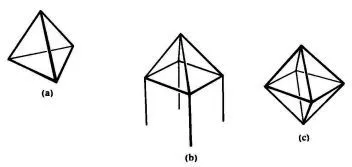
20 Fig. 4 4 3 triangles, 4 triangles around a vertex
21 a) 3 triangles around each vertex form a tetrahedron;
b), c) 4 triangles around each vertex form an octahedron
22 As the procedure is thus far simple and successful, analogy suggests the next step. Five triangles around one vertex form a shallow pyramid (Fig. 4-5.a). Paying attention as before to nothing but the two rules, we continue to employ triangular faces while making sure that five of them surround each corner. The structure essentially builds itself in that there is only one possible outcome—and we don't even have to know what it is to be able to finish the task. The icosahedron, with twenty (in Greek, "icosa") triangles and twelve 5-valent corners, is indeed regular (Fig. 4-5.b).
23 Once more then. Bring six triangles together at a corner. But wait! Six 60° angles add up to 360°, or the whole [039/040]plane (Fig. 4-5.c). An unprecedented result, this indicates that we could surround vertices with six equilateral triangles indefinitely and never force the collection to curve around to close itself off. A space-enclosing system is therefore unattainable with exclusively 6-valent vertices. Is it possible we have exhausted the possibilities for regular polyhedra out of triangles? We simply cannot have fewer than three or more than five triangles around all vertices and create a closed finite system. We thus encounter a first upper limit.
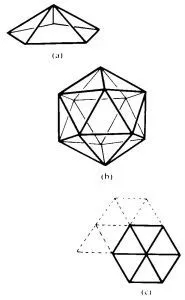
25 Fig. 4 5 5 triangles around each vertex form an icosahedron
Squares
27Let's back up and start the procedure over, with another kind of polygon. Continuing the step-by-step approach, we change from triangles to squares by increasing the number of sides by one. The method is reliable if plodding. What happens if two squares come together? Again, that's just a hinge (Fig. 4-6). So start with three. If there are three squares around one corner, the same must be true for all corners, and as before, the structure is self-determining. Continue to join three squares at available vertices until the system closes itself off. With six squares and eight corners, this is the most familiar shape in our developing family of regular polyhedra—the ubiquitous cube.
28 Next, we gather four squares at a vertex and immediately hit ground. Four times 90° is 360°, the whole plane again. And while such groups of four will generate graph paper indefinitely, they can never close off as a system. So that's it for squares.[040/041]
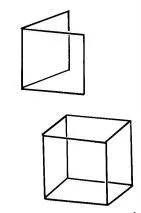
30 Fig. 4 6 3 squares around each vertex form a cube
Pentagons
32Triangles, squares, …, now we come to pentagons. Three of them around each corner works. A system exists as soon as there are twelve pentagons and twenty 3-valent corners. Called the pentagonal dodecahedron ("dodeca" is Greek for twelve), it adheres to the definition of regular polyhedra (Fig. 4-7).
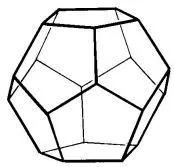
34 Fig. 4 7 3 pentagons per vertex form a pentagonal dodecahedron
35 Try four around a corner. Another new situation. The interior angle of a regular pentagon measures 108° (See Appendix A); four of them together add up to 432°, which is more than the planar 360°. This indicates that four pentagons simply will not fit around one point. Not only have we reached a stopping point for regular polyhedra out of pentagons, but this example also shows that not all regular polygons can be made to fill a page (or tile a floor). Specific spatial constraints apply in two dimensions as well as in three. We shall investigate these patterns in more detail in Chapter 12.
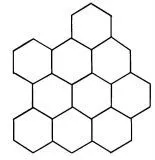
37 Fig. 4 8 3 hexagons around each vertex form a flat honeycomb
38 Having exhausted the pentagonal possibilities, we go on to hexagons. Three of their 120° angles total 360°, and are therefore planar right away—creating the hexagonal pattern seen in honeycomb and frequently used for bathroom floor tiles (Fig. 4-8). Three heptagons with angles totaling 385.71° just won't fit together. Neither will octagons, nor any polygons with more vertices.
A Limited Family
40A quick review reveals the surprisingly limited inventory of five regular polyhedra: tetrahedron, octahedron, icosahedron, cube, and pentagonal dodecahedron (Fig. 4-9). Like it or not, we have reached the end. A child in kindergarten, with the two rules carefully explained, will discover the same five shapes. Space takes over, imposing that upper limit. This idea runs counter to the bias of our mathematical background that space is passive emptiness and we [041/042]impose desired configurations. Invisible, unyielding constraints sound more like mysticism than science.
41 If we dwell on this subject, that is because it is crucial to understanding the framework of Bucky's investigation. Space has specific characteristics, and we want not only to list and understand them, but also to begin to really feel their embracing qualities—a sense of structured space permeating all experience.
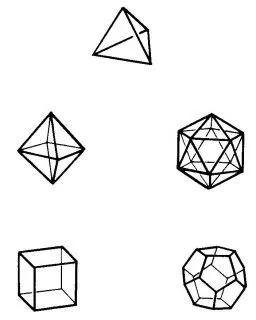
43 Fig. 4 9 The 5 regular polyhedra
44 The regular polyhedra provide a good starting point from which to branch out in all directions. An 18th-century mathematician, Leonhard Euler (1707–1783), greatly simplified our task with his [042/043]realization that all patterns can be broken down into three elements: crossings, lines, and open areas. He thereby introduced the basic elements of structure (vertices, edges, and faces) which underlie all geometrical analysis. Bucky saw this contribution as a breakthrough of equal importance to the law for which Euler is known, for this precise identification of terms enabled Euler's other, more famous observation.
4.1.2 Euler's Law
45Euler's law states that the number of vertices plus the number of faces in every system (remember Fuller's definition) will always equal the number of edges plus two. It may not sound like much at first, until you reflect on the variety of structures—from the tetrahedron to the aforementioned crocodile—that all obey this simple statement. Every system shares this fundamental relationship. The number of vertices can be precisely determined by knowing the number of faces and edges, and so on.
46 Denote the numbers of vertices, faces, and edges by V, F, and E respectively. Then we have V + F = E + 2. What about that constant 2?
47 The other numbers might be extremely large, or as small as four, yet by Euler's equation the difference between the number of edges and the sum of the number of vertices and faces will always be exactly two. It seems unlikely at first.
48 To gain confidence in this principle, let's try it out on the regular polyhedra. Remember the four vertices and four faces of the tetrahedron; four plus four is eight, exactly two more than its six edges. Not bad so far. Similarly, we can count to check the other four regular polyhedra. The results are displayed in Table 4-1.
49 Table 4 1 Euler's Law (V + F = E + 2)
51 The persistent 2 has led to some controversy. Fuller long ago assigned his own meaning to the recurring number 2 occurs in the [043/044]equation to represent the "poles of spinnability". That requires some clarification.
52 All systems, Fuller explains, can be spun about a central axis. An axis has two poles (e.g., north and south), and thus at any given time, two vertices must be poles. Subtract the two poles from the total number of vertices to get a number exactly equal to the combined number of edges and faces. Simply stated, in Fuller's view, the permanent 2 represents two vertices which, as "poles of spinnability", should be subtracted from the total number of vertices to equalize the equation. It's a puzzling explanation.
53 There is another way to view that constant element, as you may have guessed. What are the characteristics of the variables included in Euler's Law? Zero-dimensional points, one-dimensional lines, and two-dimensional areas—each a level higher than the last. The law compares all aspects of structure—almost. Something's missing. Three-dimensional space is the next and only absent parameter; its geometrical units (corresponding to vertices, edges, and faces) are cells. Why are cells left out of this fundamental relationship? The other view, as expounded by Loeb, says they're not. 15
54 Recall Bucky's definition of a system: a subdivision of space creating an inside and an outside, both equally important. Two cells! Could the constant 2 in the equation be incorporating the otherwise only missing dimension? Indeed it is. Euler's law is actually a special case of Schlaefli's formula for any number of cells. In other words, if the number of cells, C, is substituted for 2, the equation holds true for multicellular structures, that is, arrangements with more than two cells: V + F = E + C, even when C is greater than 2. 16
55 Evaluation of significance is a tricky business, but we cannot avoid indulging in it altogether, as Fuller's Synergetics overflows with such speculation. It is ultimately puzzling that Fuller, with his emphatic observation that every polyhedron is a system dividing Universe into two parts (inside and outside), would not connect Euler's constant 2 with the implied two cells. His insistence that both parts of a system must be considered equally important provides a truly new orientation in geometry.
56 At some point in any discussion about Euler and the "polar 2", Fuller would speak of a structural system's inherent "constant relative abundance". The meaning of the term eluded many. Fuller observes in Synergetics that the number of faces in triangulated systems 17 is always 2 times the number of vertices minus 2 (the subtraction, he says, again taking account of the 2 poles). He [044/045]further states that the number of edges is 3 times the number of vertices less 2.
57 Turning these two statements into simple equations, we have
58 F = 2(V - 2)
59 and
60 E = 3(V - 2).
61 Simplifying,
63 Combining the two equations by subtraction, we have
65 or
66 E + 2 = V + F.
67 So his observations directly substantiate Euler's law. Constant relative abundance refers to the ever-present two faces and three edges for each vertex in triangulated polyhedra, (excepting of course the two "poles", which are not included, according to Fuller's rationale).
4.1.3 Duality
68Table 4-1 reveals a curious pattern. Notice the relationship between cube and octahedron, along with the similar pairing of pentagonal dodecahedron and icosahedron. Polyhedra thus related, each with the same number of vertices as the other has faces, are called each other's dual. 18 We are thereby introduced to duality as a numerical relationship; the vertex and face tallies are simply switched. Reassuringly, the significance extends: Loeb observes the geometric manifestation of duality in precise matching of vertex to face. Two dual polyhedra line up with every corner of each meeting the center of a window of the other, as the correspondence implies. (Fig. 4-10.a shows the dual relationship of the cube and octahedron.)
69 We have conspicuously ignored one member of Plato's polyhedral family. What is the tetrahedron's dual? Following Loeb's example, we count elements to predict the answer, and find the same number of vertices as faces. Therefore, by interchanging the two elements to find the tetrahedron's dual, we generate another tetrahedron (Fig. 4-10.b). [045/046]Once again, the minimum system stands out: only the tetrahedron is its own dual. Put two of them together to check: the four windows and corners line up, and curiously, the combined eight vertices of two same-size tetrahedra outline the corners of a cube, as Fuller never tired of explaining.
70 "Two equal tetrahedra (positive and negative) joined at their common centers define the cube" (462.00.fig)
71 (See also Fig. 4-10.c).
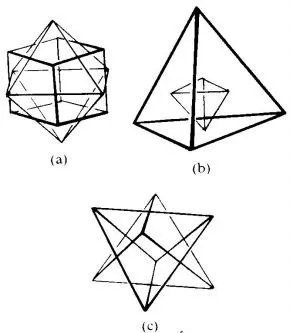
73 Fig. 4 10 "Dualing" polyhedra
74 (a), (b) Dual polyhedra
(c) 2 tetrahedra intersect to form the 8 vertices of a cube: "star tetrahedron"
4.1.4 Truncation and Stellation
75The introduction of two operations explored by Arthur Loeb will further elucidate the relationships between polyhedra. By altering and combining the five regular polyhedra, we can generate new shapes—one of the geometric phenomena that inspired Fuller's coinage "intertransformabilities". Loeb's observations will help to clarify the meaning of this polysyllabic Fullerism.
76 "Truncation" involves chopping off corners so that they are replaced by surfaces (Fig. 4-11.a). 19 Truncation of a 3-valent vertex will generate a triangle; 4-valent vertices become squares, and so on. The number of edges determines the number of sides of the new polygon. Notice that the definition does not specify how much of the corner is sliced away in truncation. Loeb's work reinforces our [046/047]emphasis thus far on topology (studying numbers of elements, or valency) rather than size. The location of slicing is therefore unimportant, until the truncation planes move inward far enough to touch each other. At that point the edges between the new planes disappear, and so the topology changes.
77 Fig. 4-11 shows various possibilities, including that final chop at the mid-edge point. This special limit case, called by Loeb degenerate, yields some interesting results, as we shall see. (For example, the "degenerate truncation" of a tetrahedron unexpectedly turns out to be another member of the Platonic Family, the octahedron, as revealed by Fig. 4-11.d.)
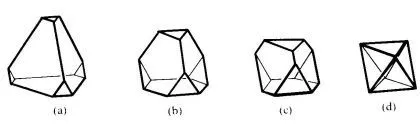
79 Fig. 4 11 Degenerate truncation of a tetrahedron.
80 Readers interested in learning more about these concepts and the mathematical analyses involved should read Space Structures by Arthur Loeb. Although we introduce only "vertex truncation", Loeb's studies extend to "edge truncation" as well. For our purpose of becoming familiar with the interconnectedness of basic polyhedra, we explore just one of Loeb's discoveries in the following pages. Then when we see these shapes again in the context of synergetics, some of their important relationships can be anticipated.
81 Whereas truncation cuts off corners, "stellation" is accomplished by the addition of a corner-imposing a shallow pyramid on a formerly flat face. How many sides the pyramid will have is determined [047/048]by the number of edges of the face to be stellated. Fig. 4-12 compares a stellated cube and a stellated octahedron. Notice that—as required by their different faces—the cube's superimposed pyramids have four sides, while the octahedron's have three. Degenerate stellation occurs when the altitude (height) of the added pyramids is such that adjacent faces of neighboring pyramids become coplanar, as will be illustrated next.
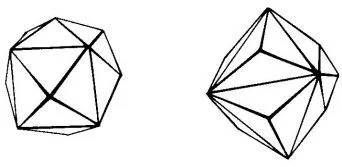
83 Fig. 4 12 Stellated cube and octahedron.
84 An Experiment
85 What happens if we truncate both members of a pair of dual polyhedra? The octahedron and cube provide a representative pair for Loeb's elegant experiment. Chop off the corners of the cube, creating eight new triangle faces, while changing the six squares into octagons (Fig. 4-13.a). The truncated octahedron (also called tetrakaidecahedron [048/049]for its fourteen faces) (Fig. 4-13.b) is a space-filling shape—a subject that we shall explore more fully in Chapter 12.
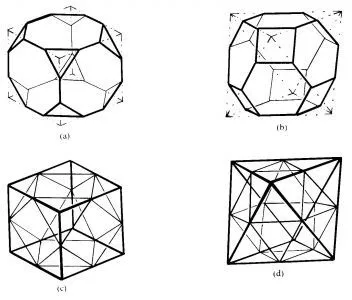
87 Fig. 4 13 Truncation of duals
88 (a), (b) Truncation of cube and octahedron.
(c), (d) Degenerate truncation of cube produces same polyhedron as degenerate truncation of
octahedron: cuboctahedron
89 Now, notice what happens if we allow all truncation planes to expand. The truncated cube's triangles and octahedron's squares independently spread to the "degenerate case", with truncation planes meeting at mid-edge points (Fig. 4-13.c, Fig. 4-13.d). Suddenly octagons and hexagons are phased out, becoming squares and triangles respectively. The two different systems turn into the same polyhedron. Conventionally called the cuboctahedron for reasons now apparent (and renamed "vector equilibrium" by Fuller, for a reason explored in Chapter 7), this polyhedron plays a crucial role in Synergetics. In the present context it merely provides an exemplary illustration of the interactions of duality and truncation.
90 Loeb's further investigation reveals that degenerate truncation of any dual pair leads to the same polyhedron. For instance, degenerate truncation of both the pentagonal dodecahedron and the icosahedron creates the icosidodecahedron, named for its twenty triangles and twelve pentagons. The pentagons, created by slicing the twelve 5-valent vertices, alternate with the twenty icosahedral triangles. Looked at another way, twenty triangles have resulted from chopping off all the 3-valent vertices of the pentagonal dodecahedron (Fig. 4-14). With either outlook, we begin to see the effect of duality. (Take special note of the system's twelve 5-fold elements; their presence will soon be interpreted as a fundamental law under certain conditions.)
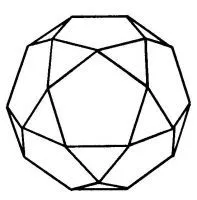
92 Fig. 4 14 Icosidodecahedron.
93 We now need a new category as we uncover new polyhedra that are not regular, but certainly far from random or irregular. The cuboctahedron and the icosidodecahedron are alike in having only one kind of vertex but two different kinds of faces. Such polyhedra are called semiregular. It will not come as a surprise that their duals have one kind of face and two kinds of vertices. You can begin to [049/050]imagine the potential for generating new systems, as reflected in the term "intertransformabilities".
94 The elegant results of degenerately truncating dual polyhedra inspire further questions. Does it follow that degenerate stellation of a dual pair will create the same polyhedron? And if so, how do we define degenerate stellation? Experimentation answers both questions.
95 To check the hypothesis with our reliable octahedron-cube pair, we stellate both systems independently. Try to imagine the transition: six shallow square pyramids are superimposed on the cube, while eight triangular pyramids are added to the octahedron, as seen in Fig. 4-12. We then increase the altitude of all pyramids, until triangles of adjacent pyramids just become coplanar. In both cases, 24 individual triangular facets suddenly merge into 12 rhombic (or diamond) shapes, thereby creating the rhombic dodecahedron, named for its 12 rhombic faces. The original edges of the cube form the short diagonals of the 12 faces, while the octahedral edges turn into the 12 long diagonals (Fig. 4-15). We thereby have illustrated degenerate stellation.
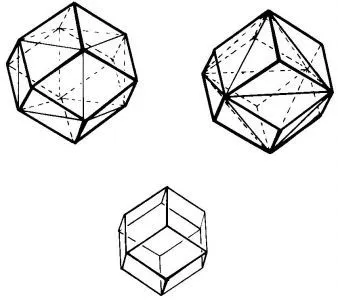
97 Fig. 4 15 Degenerate stellation of cube
98 Produces same polyhedron as stellation of octahedron: rhombic dodecahedron.
99 Notice that both members of the original dual pair have the same number of edges. This turns out to be a necessary condition of duality, which follows logically from the nature of the geometric correspondence. In order for each vertex to line up with a face, the edges of two dual polyhedra must cross each other, as can be seen in Fig. 4-9. [050/051]We further observe that whereas degenerate truncation produced quadrivalent vertices (cuboctahedron), degenerate stellation produced quadrilateral faces (rhombic dodecahedron). A generalized principle emerges.
4.1.5 "Intertransformability"
100As Fuller so often observed, nature consists exclusively of endlessly transforming energy. Atoms gather in "high-frequency" clusters, disassociate periodically, and regroup elsewhere—new patterns, different substances. We interpret these transient events as solids and liquids because of the limitations of our five senses. To Fuller, "exquisitely transformable" polyhedra were highly logical models with which to elucidate nature's behavior. "Intertransformability" thus applies to both nature and her models.
101 We now consider a final experiment from Loeb's research, to bring the subject to a close. Start by truncating a representative polyhedron such as the cube. Continue to the degenerate polyhedron (in this case the cuboctahedron, as illustrated in Fig. 4-13.c), and put it aside for a moment. Now take that same cube, the degenerate stellation of which yields the rhombic dodecahedron (as seen in Fig. 4-15) with its twelve rhombic faces.
102 Twelve identical faces? Have we accidentally overlooked a regular polyhedron? No, for the other requirement, of identical vertices, is not satisfied. The diamonds' obtuse angles come together at eight 3-valent vertices, and their acute angles at six 4-valent vertices. (Refer to Fig. 4-15.)
103 Those numbers are familiar. Twelve identical faces, along with six 4-valent and eight 3-valent vertices, correspond to the twelve identical vertices, six 4-valent faces (squares), and eight 3-valent faces (triangles) of the cuboctahedron (Fig. 4-16). Loeb thus [051/052]shows that duality extends to semiregular polyhedra. This fact would have enabled us to predict the rhombic dodecahedron's existence, by specifying twelve similar quadrilateral faces to correspond to twelve 4-valent vertices, and so on. Now we can examine the results of the experiment. A pair of dual polyhedra was created by applying the two inverse operations to the same initial shape.
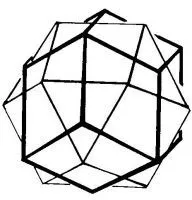
105 Fig. 4 16 Cuboctahedron and rhombic dodecahedron are dual polyhedra
106 Had we started with an octahedron, the cube's dual, the results would have been the same. Degenerate stellation creates the rhombic dodecahedron (Fig. 4-11), and degenerate truncation, the cuboctahedron, as described above (Fig. 4-12). Thus, the two operations generate dual polyhedra from one starting point. Loeb concludes that degenerate truncation and stellation are dual operations.
107 To generalize, Loeb discovers that if both members of a pair of dual polyhedra are truncated (or both stellated) to the degenerate case, they will lead to the same result. Conversely, separate degenerate truncation and stellation of the same shape create a new dual pair. Finally, regular polyhedra usually generate semiregular ones.
4.1.6 Symmetry
108The foundation is almost in place. A final tool to pick up is an understanding of symmetry: "exact correspondence of form or constituent configuration on opposite sides of a dividing line or plane or [052/053]about a center or axis". This somewhat abstruse definition from The American Heritage Dictionary introduces the two types of symmetry.
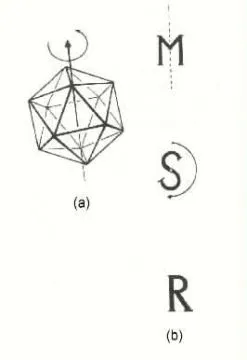
110 Fig. 4 17 Symmetry of icosahedron and of the letters M, S, and R.
111 Mirror symmetry is the more familiar, involving the exact reflection of a pattern on either side of a "mirror line" (or plane). The letter "M" exhibits mirror symmetry; "R" does not (Fig. 4-17.b).
112 Rotational symmetry specifies that a configuration can be rotated some fraction of 360° (depending on the numerical type of rotational symmetry) without changing the pattern. For example, a square, exhibiting fourfold rotational symmetry about its center, can be rotated 90°, 180°, or 270° without detectable change. Similarly, an icosahedron has fivefold rotational symmetry about an axis through a pair of opposite vertices (Fig. 4-17.a). The letter "S" exhibits twofold rotational symmetry; it looks the same after a 180°turn (Fig. 4-17.b). In other words, in x-fold rotational symmetry, constituents of a pattern are repeated x times about a common center.
113 These concepts will prove useful as we proceed through Fuller's discoveries.[053/054]