
13 The Heart of the Matter: A- and B-Quanta Modules
2Minimum system, triangulation, equilibrium of vectors, closest-packed spheres, and space-filling: the path toward the isotropic vector matrix has many origins, any of which can yield the unique omni-symmetrical array. The result of traveling all of these routes is a powerful awareness of the interplay of octahedral and tetrahedral symmetries in space. However, the more thoroughly we search the IVM, the greater the intricacy of these "intertransformabilities"—calling for a new level of analysis to keep track of our discoveries.
3 IVM got us down to the basics. Even the cube, mathematics' conventional building-block, reduces to octahedron-tetrahedron components. However, tetrahedra and octahedra are not true structural quanta, for it was often necessary to break them apart into subcomponents in order to build other polyhedra. Our task is therefore still unfinished. We have yet to get to the heart of the tetrahedron and octahedron.
4 Necessity thus leads us to Fuller's A- and B-Quanta Modules.42
5 The missing element in our IVM analysis is a way to handle redundancy. Symmetry—the degree to which a system looks exactly the same in different orientations—is a kind of structural redundancy. The tetrahedron, the octahedron, and their various combinations all have a high degree of symmetry, and now we intend to get to the root of it. How? By subdividing symmetrically until we can go no further. As long as a system exhibits some degree of symmetry, it can be divided into identical subunits, which can be put together to recreate the original system. Ergo, the system was redundant. Through progressive subdivision, we can locate the minimum sub-unit of any system. This final asymmetrical module—or "least common denominator" (LCD)—contains the geometrical data needed to reconstruct the whole system. We find the LCD by subdividing a polyhedron until we reach the limit case, that is, a module that can no longer be split into similar units.[189/190]
6 A-Quanta Modules
7 Let's start again with our highly symmetrical friend, the tetrahedron. The fact that its four faces are equivalent presents the first opportunity for subdivision—resulting in four equal parts. Each ¼ tetrahedron encompasses the region from the center of gravity (cg) to a face (Fig. 13-97.a). It is evident from the 3-fold symmetry of these shallow pyramids that each can be sliced into three identical pieces, as if it were a triangular pie (Fig. 13-97.b). The resulting pie pieces—long thin tetrahedra stretching from the apex of the ¼ tetrahedron (cg of regular tetrahedron) out to an original unit-length edge—are quite irregular, and so the process is almost complete. However, one type of symmetry conspicuously remains. Each sliver can be split in half to produce two mirror-image parts: a right- and a left-handed version with identical angles and lengths (Fig. 13-97.c). And suddenly we have come to the end. There is no possible way to divide that final product into equal parts; the shape thus generated is the limit case. Fuller calls this asymmetrical tetrahedron the "A-quanta module".
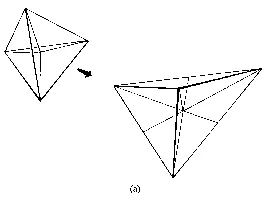
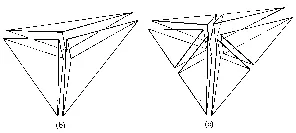
10 Fig. 13 97 Development of A module.
11 A-quanta modules contain the complete geometric ingredients needed to create a regular tetrahedron. We need 24 A modules (12 positive and 12 negative) to make a tetrahedron, but one module alone supplies the information. The A module, representing the volumetric essence of the tetrahedron, introduces a new kind of building block.
12 B-Quanta Modules
13 Having ascertained the minimum unit of the minimum system, we must not forget about inherent complementarity. The above analysis is repeated. A regular octahedron splits into 8 equivalent pyramids (octants) (each of which divides into 6 equal pieces), as did the ¼-tetrahedra, yielding 48 asymmetrical minimum units (LCDs) of the octahedron (Fig. 13-98.a). That would have been the end of the story except for a subtle catch, an overlooked redundancy.
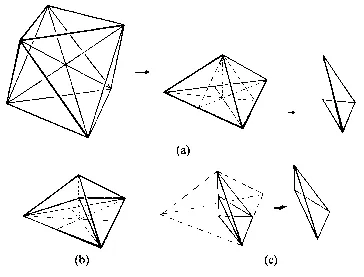
15 Fig. 13 98 Modules for intertransformability
16 (a) 1/6-octant equals 1/48-octahedron.
(b) The ¼-tetrahedron fits inside the octant and has ½ the altitude.
(c) Subtracting an A module from 1/48-octahedron defines the B module.
17 The 1/8-octahedron has twice the altitude of the ¼-tetrahedron, but both pyramids have the same (equilateral triangle) base. The ¼-tetrahedron therefore fits right inside the octant, occupying exactly half the available volume (Fig. 13-98.b). The remaining volume is pure octahedron—a hat-shaped wedge that accounts for the shape difference between the two pyramids. This concave triangular [190/191]lid can be subdivided into six equal irregular tetrahedra (three positive, three negative) and these are called B-Quanta Modules. They are generated by the LCD of the octahedron after that of the tetrahedron is taken away. As long as the octahedron's asymmetrical unit contained a complete A module within its boundaries, the unit was redundant. By removing the A module which had occupied half the [191/192]volume of the octahedron's LCD, we finally achieve a second true modular quantum (Fig. 13-98.c). Thinner and more pointed than the A's, the B-quanta have a very different shape but precisely the same volume. Neither A nor B can be made from the other; they are fundamentally distinct, complementary equivolume modules.
18 The LCD of the octahedron (1/48) consists of one A and one B, while the LCD of the tetrahedron (1/24) is simply an A module. The analysis is complete: we have broken down our IVM constituents into their essential characteristics. We can go no further.
19 However, the field is now wide open for experimentation. Armed with the IVM quantum
units, we can anticipate a tremendous range of combinations and permutations, or
rearrangements. Having systematically analyzed our basic systems, we now start to put
their essential quanta back together in order to further understand the relationships
between polyhedra. We have thus developed a far more sophisticated (and specific)
framework with which to explore polyhedral intertransformability. Fuller takes it a step
further.
(Why stop with polyhedra?)
20 If you are willing to go along with the physicists, recognizing complementarity, then you will see that tetrahedra plus octahedra—and their common constituents, the unit-volume A- and B-Quanta Modules—provide a satisfactory way for both [192/193]physical and metaphysical, generalized cosmic accounting of all human experience. (950.34)
21 We also observe considerable multiplication of complexity with the new framework created by
subdivision.
As Bucky would have it: multiplication by division.
Energy Characteristics
23Progressive subdivision has left us with legitimate geometric quanta: final packages which cannot be split into equal halves. In a general sense, the model parallels science's search for the ultimate aspects of reality. Physics probes deeper and deeper into matter, breaking it down into ever-smaller constituents—cells, molecules, atoms, sub-atomic particles—ultimately seeking a package of energy (quarks?) which cannot be split apart. Fuller probes similarly into his geometry, hoping to gain insights about Universe itself.
24 Fuller's profound faith in the significance of reliable patterns—coupled with his unflagging determination to find nature's coordinate system—led him to draw many parallels between synergetics and nature. Most of these are both suggestive and undeveloped; he planted his seeds, left the cultivation for posterity, and went on with his search. Certain that science can be modeled, Fuller felt a great responsibility to pursue what he saw as an ever more relevant investigation; if patterns are to emerge, sufficient data must be collected. Toward the goal of clarifying the patterns observed by Fuller, our strategy might be to forge ahead: cover as much ground as possible and worry about significance later. However, in his coverage of intriguing geometric properties, Fuller often immediately assigns connections to physical phenomena. We can neither ignore nor confirm such speculation, and so for now, we merely record and file away. The respective energy "valving" (ability to direct, store, control) properties of A modules and B modules is a typical example.
25 Once again, the issue is based on "operational" procedure. Models of Fuller's two tetrahedral quanta are constructed out of paper. The process starts with a planar "net" (a flat pattern piece which can be folded up and taped together to make a specific polyhedron). Consider for example the regular tetrahedron. Its four equilateral-triangle faces can be generated by folding one (double-size) triangle along lines that connect mid-edge points (Fig. 13-99.a).
26 This ability to form a tetrahedron by folding one triangle is not to be taken for granted; the situation that allows all four faces of a generic tetrahedron to fit [193/194]inside a triangular frame—requiring exactly supplementary angles out of the infinite possibilities—is an exception. We are not surprised by Fig. 13-99.a for we expect such exceptional cooperation from the uniquely symmetrical regular tetrahedron.
27 The surprise is that the asymmetrical A module unfolds into one planar triangle:
28 an asymmetrical triangle with three different edge sizes, yet with the rare property of folding up into a whole irregular tetrahedron. (914.01)
29 This unusual property makes it a kind of pure form. The B module, on the other hand, will always fold out into four separate planar triangles no matter which vertex you start with; its net will never fit into one triangular frame. Fig. 13-99.b compares the two nets.
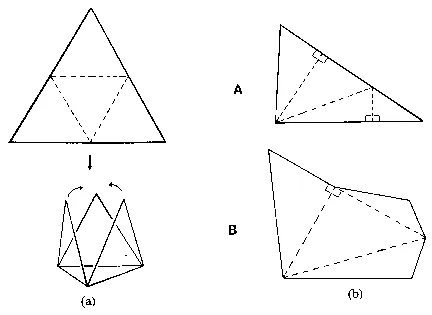
31 Fig. 13 99 Planar nets
32 a) regular tetrahedron
b) A module, B module
33 Fuller connects this geometric property with "energy". A modules are thus said to concentrate or hold energy, while B's release or distribute. This conclusion is based on the fact that "energy bounces around in A's working toward the narrowest vertex", only able to escape at a "twist vertex exit" (921.15).
34 Comparing pattern pieces, A's planar net offers three escapes; the jagged 4-triangle complex of B offers twice that number (Fig. 13-99.b). It is a somewhat bizarre observation to begin with, and characteristically it led to the following ambiguous assignment of meaning: a vertex, or non-180° junction, in a planar net represents disorderly energy-escaping properties. Hence in A modules, energy is seen as contained, able to [194/195]bounce around inside the net without many available exits, whereas in B modules, energy is quickly released.
35 We can conceive of this energy in many ways—as light beams, as bouncing electrons, or even as billiard balls for a more tangible image. All three qualify as "energy events", and having a specific image in mind makes it easier to think about the different "energy-holding" characteristics. To understand and evaluate Fuller's assertion, we go along with his use of "energy", for the word covers a great deal of territory already and his usage is internally consistent. Fuller calls our attention to a geometric property that we may not have otherwise noticed, and with respect to this phenomenon of planar nets there is no doubt as to the difference between A modules and B modules. What is the significance of this distinction? What are we to conclude about the orderly contained A versus the disorderly sprawling B? In terms of physical Universe, a judgement probably cannot be made. However, for the purposes of this text and of continuing to explore the geometric interactions of the two quanta, we adopt Fuller's energy assignment: A's conserve; B's dissipate. It provides a consistent reference system with which to classify the two quanta and their subsequent interactions. Furthermore, two basic modules exhibiting the same volume and different energy characteristics provide an even more attractive model of "fundamental complementarity": equivalent weight or importance, opposite charge. Sound familiar? The parallels are tantalizing.
36 Mite
37 Next we apply our LCD analysis to the IVM. The procedure—calling for progressive subdivision in search of the minimum repeating unit—comes to an end with a unit that can no longer be symmetrically divided. As before, we seek the smallest system that can be duplicated to recreate the whole IVM—a microcosm, containing all the ingredients of the macro-array.
38 Having already split tetrahedra into equal quarters and octahedra into eighths, we skip directly to a unit consisting of a ¼-tetrahedron and 1/8-octahedron back to back, sharing an equilateral-triangle face. This unit, which connects the geometrical centers (or cg's) of any adjacent tetrahedron and octahedron in the IVM, exhibits the same 3 fold symmetry as its two triangular pyramids taken separately. Final subdivision thus yields six equivalent asymmetrical tetrahedra: three positive and three negative (Fig. 13-100).[195/196]
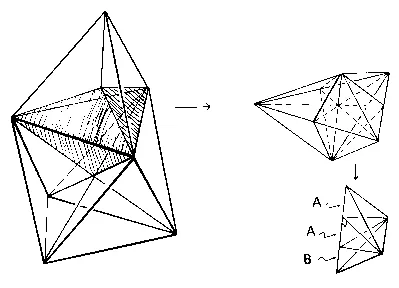
40 Fig. 13 100 LCD of IVM: "Mite"
41 As the smallest repeating unit of the IVM, this system is the minimum space filler, thus inspiring Fuller's term "Mite" (Minimum space-filling Tetrahedron.) A collection of A modules cannot fill space; they can only make regular tetrahedra. The skinny irregular B's cannot even create a symmetrical polyhedron by themselves—let alone fill space. The Mite is the LCD of the omnisymmetrical space-filling matrix, and therefore is the minimum case, the first all-space filler:
42 954.09 We find the Mite tetrahedron…to be the smallest, simplest, geometrically possible (volume, field, or charge), allspace-filling module of the isotropic vector matrix of Universe.
43 Knowing that the Mite encompasses the asymmetrical units of both the tetrahedron and octahedron, we can identify its constituent A modules and B modules. The tetrahedron contributes an A module, while the adjacent octahedron adds both another A (the mirror image of the first) and a B, for a total of three equivolume Modules. The positive and negative A's are in balance, and the solo B may be either positive or negative, thereby determining the sign of the whole Mite. Like A modules and B modules, Mites come in one of two possible orientations (Fig. 13-101.a).
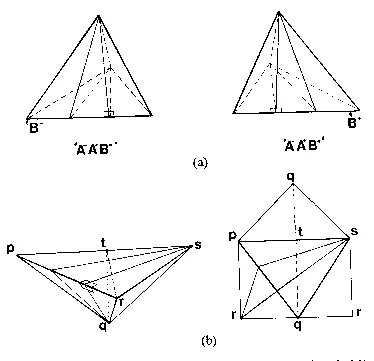
45 Fig. 13 101 Modular decomposition of Mite
46 (a) Orientation of Mite.
(b) Unexpected mirror plane in Mite.
47 We cannot fail to comment on another 2:1 ratio just displayed by the minimum space-filler. As suggested by this discovery, it turns out that there must be two A modules for every B module in any space-filling polyhedron. We shall see how this rule applies to our familiar candidates below, and once again, Loeb's "Contribution" provides a more thorough analysis of the phenomenon. Appropriate [196/197]examples will be cited throughout this chapter, but readers are encouraged to turn to the back of Synergetics for Loeb's report.43
Mirrors
49There's more to the Mite than meets the eye. Fig. 13-101.a shows a corresponding face of both a positive and a negative Mite. As every Mite incorporates both a positive and a negative A module, it is the unpaired B module—slanting off to one side or the other—that determines the charge of the overall system.
50 From the above recipe, it appears evident that this minimum space-filling tetrahedron is either right- or left-handed. This was also evident from our initial generating procedure, subdividing the IVM to carve out the smallest repeating unit with mirror symmetry, which is then split into equivalent mirror-image (positive and negative) Mites.
51 However, a surprising and easily overlooked result of joining two A's and a B modifies the above conclusion. An unexpected mirror plane runs through the middle of this irregular tetrahedron that we have assumed must be either right-handed or left-handed. This means that a [197/198]Mite is actually its own mirror image. The positive and negative versions are identical. The slanting orientation depicted in Fig. 13-101.a obscures this fact; however, it turns out that the Mite has two isosceles faces, a fact that indicates that the remaining two faces must be identical (but mirror-image) triangles. Therefore, the outside container of the Mite (ignoring the arrangement of its modular ingredients) incorporates a subtle mirror plane and is actually exactly the same shape as its mirror image. A+ A- B+ equals A+ A- B- (Fig. 13-101.b).
52 This extraordinary fact means that we don't need positive and negative Mites to fill all space; one or the other version—or both in random combinations—will suffice. As its own mirror image, any Mite can fill either position, positive or negative.
53 We can conclude therefore that the two versions are identical; however, Bucky points out that different internal configurations cannot be ignored, for they point to different energy characteristics:
54 Though outwardly conformed identically with one another, the Mites are always either positively or negatively biased internally with respect to their energy valving (amplifying, chocking, cutting off, and holding) proclivities. (954.43)
Cubes into Mites
56Once the A- and B- game gets going, significant relationships are uncovered at every move. The game thus becomes more and more fascinating as it is played. For example, we might carve open a cube, generating six square-based pyramids, one from each face to the cg. Then slice each square pyramid into quarters, like a peanut-butter sandwich. We thereby rediscover the Mite, observing that the cube consists of twenty-four Mites (Fig. 13-102.a). Oriented with one of its isosceles triangles (45°/ 45°/ 90°) on the cube's surface, the Mite simply rotates to transform Octet Trusses into boxes.
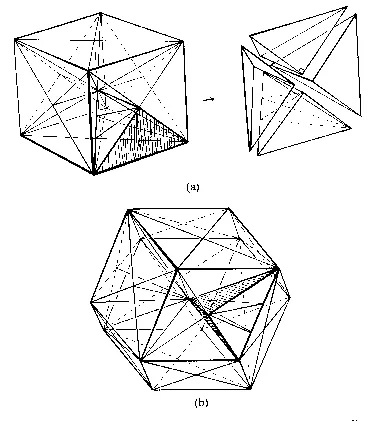
58 Fig. 13 102 The LCD of both cube and rhombic dodecahedron is the Mite.
Rhombic Dodecahedra
60Next, we apply the LCD procedure to the rhombic dodecahedron. Its twelve faces each frame a diamond-shaped valley ending at the cg point. Each of these inverted pyramids can be split into four (2 positive, 2 negative) asymmetrical tetrahedra (Fig. 13-102.b). This is the LCD of Fuller's "spheric", and it is none other than the Mite, the LCD of the isotropic vector matrix. Forty-eight Mites in yet another orientation make up this space-filling shape. Not surprisingly, space-filling and Mites have an important connection.[198/199]
61 No longer caught off guard by such interconnectedness, we conclude by observing that the Mite—faithfully representing octet symmetry—is also an integral component of the cube and the rhombic dodecahedron.
62 Coupler
63 Fuller's coupler is an irregular octahedron made of eight Mites—or sixteen A modules and eight B modules (Fig. 13-103). Given this composition, the "semisymmetrical" coupler is clearly a space filler. Because of the Mite's newfound mirror symmetry, the coupler does not have to have equal numbers of positive and negative B modules; any eight Mites will make a coupler. This special octahedron has two [199/200]equal-length axes (which will be referred to as x and y) and a third shorter axis (z). The point of intersection of the three axes will be called K.
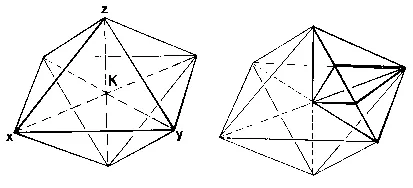
65 Fig. 13 103 Each Mite is one octant of the coupler.
66 The equal x and y axes outline a square equatorial cross-section, which we can now identify as the face of a cube. In fact, the coupler is two 1/6-cube pyramids back to back. 44
67 The other cross-sections (xz and yz) are diamonds—in fact, the exact shape of a rhombic dodecahedron's face. At this point we shall not be surprised to learn that splitting the coupler in half along either diamond cross-section isolates one-twelfth of the rhombic dodecahedron. Six ½-couplers make a cube; twelve ½-couplers (split the other way) make a rhombic dodecahedron.
68 Couplers literally couple "everything". (954.50)
69 Aptly named, the new octahedron joins together both pairs of cubes and pairs of rhombic dodecahedra. Fuller's nomenclature proves quite logical:
70 We give it the name the Coupler because it always occurs between the adjacently matching diamond faces of all the symmetrical allspace-filling rhombic dodecahedra, the "spherics"…·(954.47)
71 The coupler's different pairs of opposite vertices reach to the geometric centers of two adjacent polyhedra (cube or spheric, depending on the orientation), incorporating their shared face as a cross-section (Fig. 13-104.a, Fig. 13-104.b). Half a coupler belongs to one cube (or spheric), and the other half to its neighbor. So the coupler literally couples—well, not "everything" but—a couple of space-fillers.
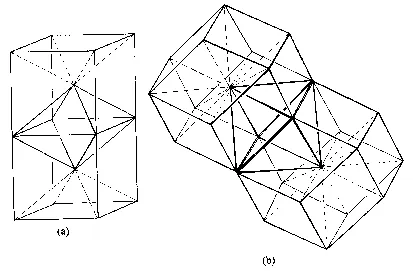
73 Fig. 13 104 "Coupler"
74 Fuller continues: The coupler's role is cosmically relevant, for
75 "rhombic dodecahedra are the unique cosmic domains of their respectively embraced unit radius closest-packed spheres." (954.47)
76 The coupler therefore connects the centers of gravity of adjacent [200/201]spheres, and its domain includes both the spheres and the intervening (dead air) space. This observation explains why the coupler's volumetric center was labeled K: it marks the exact "kissing point" between tangent spheres in a closepacked array.
77 Now we have the complete story behind Fuller's somewhat dense explanation of his coupler:
78 …The uniquely asymmetrical octahedra serve most economically to join, or couple, the centers of volume of each of the 12 unit radius spheres tangentially closest packed around every closest packed sphere in Universe, with the center of volume of that omnisymmetrical, ergo nuclear, sphere. (954.48)
79 Perhaps the most intriguing aspect of the coupler is its similar role in the cube and in the rhombic dodecahedron, thereby linking (or coupling) the two space fillers in a new partnership.
Volume and Energy
81The inventory of twenty-four modules (sixteen A, eight B) indicate that the coupler has the same volume as the regular tetrahedron with its twenty-four A-quanta. Both have a tetrahedral volume of one. (Recall also that a coupler consists of two 1/6-cube pyramids back [201/202]to back, or 1/3 of a cube, and that in Chapter 10 the volume of a tetrahedron was shown to be 1/3 that of a cube.)
82 Dissimilar in symmetry and shape, they are related by their shared unit volume, inviting comparison. The coupler is a different sort of minimum system: a semisymmetrical space filler, in contrast with the tetrahedron's origin as the minimum system of any kind, i.e., the first case of insideness and outsideness.
83 Finally, we have to comment on the coupler's internal flexibility. The number of different ways to arrange eight Mites is greatly increased by the unexpected mirror symmetry. Since positive and negative Mites can switch places, we actually have a pool of sixteen from which to choose for each of the eight positions. A coupler might consist of four positive and four negative Mites, or all positive, all negative, or any of the possible combinations in between: (0 8, 1 7, 2 6, 3 5, 4 4, …, 8 0). Then, within each of these nine possible groups, the Mites can be switched around into four different arrangements. (A few of these combinations are shown in Fig. 13-105.) The resulting 36 varieties of couplers all have the same outward shape, but in Fuller's view, their internal variations represent important distinctions in energy behavior:
84 "When we discover the many rearrangements within the uniquely asymmetric Coupler octahedra of volume one permitted by the unique self-interorientability of the A and B Modules without any manifest of external conformation alteration, we find that under some arrangements they are abetting the X axis interconnectings [202/203]between nuclear spheres and their 12 closest-packed…spheres, or the Y axis interconnectings…" (954.58)
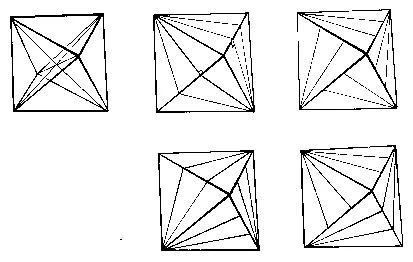
86 Fig. 13 105 Different rearrangements of 8 Mites in the coupler
87 "When we consider that each of the 8 couplers which surround each nuclear coupler may consist of any of 36 different AAB intramural orientations, we comprehend that the number of potentially unique nucleus and nuclear-shell interpatternings is adequate to account for all chemical element isotopal variations…as well as accommodation…for all the nuclear substructurings, while doing so by omnirational quantation…." (954.54)
88 In other words, "energy" travels in one direction or another depending on the arrangement of the (oppositely biased) A's and B's. Synergetics thus accounts for nature's incredible variety and complexity despite its small number of different constituents. The secondary level of organization involves grouping the different couplers together and results in an explosion of potential variations. A modules and B modules can thus be rearranged into orderly octet configurations in myriad ways; clusters might appear quite chaotic in some locations and precisely ordered into whole octahedra and tetrahedra in others, while the overall space-filling matrix remains intact. As in genetics, a small number of simple constituents are able to generate a virtually unlimited repertoire of patterns.
13.0.1 Review: All-Space Fillers
89Dismantling the cube, we saw that each of its six inverted pyramids breaks down into four Mites. What does this tell us about A modules and B modules? 24 Mites yield a total of 72 modules, with twice as many A's and B's (or 48 : 24). This 2-to-1 ratio gets to the modular heart of the octahedron–tetrahedron prerequisite for space filling, as developed in the last chapter.
90 Neither tetrahedra with only A's nor octahedra with equal numbers of A's and B's can qualify as space fillers. So far, so good. Thinking only in terms of A modules and B modules, what proportion of tetrahedra and octahedra would we need to satisfy the recipe of two A's for every B? The octahedron's 48 B's must co-occur with 96 A's; the octahedron itself supplies half of them, but 48 A modules are still missing. Two tetrahedra will provide exactly the right number of A modules to complete the formula, thus reconfirming the 1-to-2 octahedron–tetrahedron ratio discovered in the previous chapter.
91 The 48 Mites in the rhombic dodecahedron are easily dissected into 96 A's and 48 B's, or a total of 144 modules. With twice as many A's [203/204]as B's, Fuller's "spheric" does not contradict the growing evidence of a general rule.
92 A modules and B modules in the truncated octahedron—also a space filler—can be counted by recalling the numbers of internal single-frequency tetrahedra and octahedra determined in the last chapter. 32 tetrahedra, with 24 A modules each, contribute 768 A's, while 16 octahedra consist of 768 A's and 768 B's, for a total of 1536 A's and 768 B's altogether (768 × 2 = 1536). We can begin to have confidence in the reliability of our 2:1 ratio, especially in view of the jump to much larger numbers. With a total of 2,304 modules, this is the smallest truncated octahedron outlined by IVM vertices. Fuller's inventory of all-space fillers (954.10) lists the truncated octahedron with twice the linear dimensions and 8 times the volume (consisting of 18,432 quanta modules) rather than the smaller version. The reason for this choice is not clear; however, the magnitude of these quantities hints at the complexity of his modular system—in terms of both the variety of systems that can be made from the modules and the number of rearrangements within those systems. From these numbers it is evident that, although the quanta modules help us to understand the conceptual essence of many polyhedral intertransformabilities, they are very impractical for hands-on experimentation. So many modules are needed to make complete polyhedra that this system does not offer an ideal strategy for model making. Instead, we might utilize the analysis to work out relationships on paper.
93 From the above examples, we can see that the A modules and B modules get to the root of the 2-tetrahedron–1-octahedron rule developed in the previous chapter. Because the earlier analysis depended on disassembling its two basic units, it was necessary to probe further to isolate the real quanta. A modules and B modules, which cannot be symmetrically subdivided, were isolated as the true quanta with which to measure and analyze related polyhedral systems.
94 Impressed by the geometric significance of these modules, Fuller proposes that somewhere within this discovery lie secrets with far greater applicability than just to geometry:
95 "The A- and B-Quanta Modules may possibly quantize our total experience. It is a phenomenal matter to discover asymmetrical polyhedral units of geometry that are reorientably compositable to occupy one asymmetrical polyhedral space; it is equally unique that, despite disparate asymmetric polyhedral form, both have the same volume. . . Their unit volume and energy quanta values provide a geometry elucidating both fundamental structuring and fundamental and complex intertransformings, both gravitational and radiational." (920.01)[204/205]
96 From their energy associations to their remarkable symmetry, these modules synthesize much of Fuller's research. Significant relationships to physical phenomena may well reward continued investigation, for nature also deals with discrete quanta, creating endless variation through synergetic recombinations. Fuller reasoned that his geometric quanta—the end result of a systematic and logical progression of steps—must relate to physical phenomena. The approach is typically Fuller's: assume significance until proven otherwise. In essence he suggests that tiny whole or discrete systems should replace irrational unending digits—somehow providing a comprehensive rational coordinate system.[205/206]