
14 Cosmic Railroad Tracks: Great Circles
2Any planar closed loop drawn on the surface of a sphere is necessarily a perfect circle, as a result of the sphere's steady curvature. Such loops qualify as either "great" or "lesser" circles, and the distinction is defined in mathematics as follows. A great circle is formed by the intersection of a plane passing through the center of a sphere with the surface of that sphere. Any other circle, no matter what size, is lesser. The center of a great circle coincides with the sphere's center. In short, a great circle is an equator—found in any angular orientation, but always around the fattest part of its sphere.
3 What's so great about a great circle?
4 Above all, it provides the shortest route between any two points on a sphere. This geometric fact is not obvious in many cases; for example, looking at a globe it appears that the logical route between two points situated some distance apart on the Tropic of Cancer involves traveling along their shared "lesser circle" band (Fig. 14-106.a). However, the principle is made more obvious by Fuller's juxtaposition of two extreme cases. He describes a small lesser circle near the North Pole of an imaginary globe, and labels two points A and B (Fig. 14-106.b). As with the larger Tropic of Cancer, the eye naturally travels from A to B along their mutual lesser-circle path, without suspecting that this represents the "long way around". Fuller then redraws the same lesser circle in a new location—superimposed over the globe's equator so that A and B both fall on the horizontal great circle.
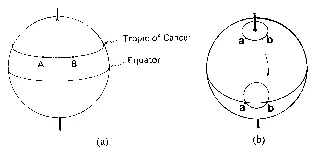
6 Fig. 14 106 A lesser-circle path is always the long way around
7 The shortest route between A and B is suddenly obvious. Likewise, between any two points on a sphere the most expedient route will be a great-circle segment; Fuller's example makes it easy to see that a lesser-circle path will always present a detour.
8 Other special characteristics: Any two great circles on a sphere must intersect twice—specifically, at two points 180° apart. There is no other possibility: unless they are actually the same circle, two great circles can neither avoid each other altogether, nor intersect only once, nor intersect more than twice. Finally, the junction of two great circles inscribes two pairs of equal and opposite angles on [206/207]the sphere's surface, whose two angular values add up to 180°; the statement is equivalent for the intersection of two Euclidean "straight lines". Lesser circles do not share this property; in fact, their intersection produces opposite angles which are necessarily unequal. In conclusion, on the surface of a sphere, only great circles have the geometric characteristics of "straight lines"
9 As we examine different aspects of great circles, you will notice that much of this material is quite complicated; the patterns are too intricate to be readily visualized in the mind's eye. Furthermore, connections drawn between the geometric models and physical phenomena are unusually speculative. However, as Fuller's Synergetics devotes considerable attention to great circles, anyone who has tried to decipher these sections will welcome full coverage. Referring back and forth from the text to the drawings will be essential.
Why Are We Talking About Spheres?
11The vertices of regular and semiregular polyhedra lie on the surface of an imaginary sphere, which is to say that all vertices are equidistant from a polyhedron's center. Given this fact, we can picture spherical versions of each polyhedron, in which the polyhedral edges have stretched outward to become great-circle arcs and the faces have expanded into curved surfaces, as if each shape had been blown up like a balloon. Fig. 14-107 shows a spherical tetrahedron, octahedron, and icosahedron as examples. Comparing these systems with their planar counterparts, it is clear that polyhedral edges are actually chords of great-circle arcs. We can conclude that the shortest distance between two events of a system always involves a great circle.[207/208]
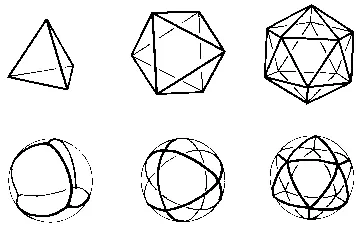
13 Fig. 14 107 Spherical polyhedra
14 The concept (rather than the reality) of a sphere—i.e., an omnisymmetrical container—acts as a frame of reference for polyhedral systems. Spherical polyhedra thus introduce new versions of familiar characters. The topological information (that is, the numbers and valencies of vertices, edges, and faces) of any polyhedron are displayed on a spherical canvas. An obvious consequence of this type of display is that shape is no longer a variable. Shape similarities, which are so rigorously accounted for by A and B modules, are thus ignored; our investigation now focuses in on topological, or surface, characteristics. Transforming polyhedra into balloons temporarily equalizes shape and size, providing a "common denominator" for other comparisons. The process develops a somewhat unorthodox chart.
New Classification System
16However, the chart is not yet complete. Simply projecting edges and faces onto a spherical surface does not teach us anything new. We have yet to exploit the nature of the sphere.
17 Spheres suggest spin. That's how synergetics initially arrives at the omnidirectional form. Spin any system in all directions, and ultimately the action will have defined a circumscribing spherical envelope. Fuller places considerable emphasis on the "spinnability" of systems, arguing that as everything in Universe is in motion, the different axes of spin inherent in systems are worthy of investigation.[208/209]
18 All polyhedra have three sets of topological aspects: vertices, edges, and faces. These sets correspond to three types of axes of rotational symmetry (or "spin") which connect pairs of either polar-opposite vertices, mid-edge points, or face centers. As a polyhedron spins about any one of these axes, an implied great circle is generated midway between the two poles, in other words, at the equator. Equators corresponding to all existing axes of symmetry can be simultaneously represented on a spherical surface, creating an exhaustive chart of the topological symmetries of a given system. Each symmetrical polyhedron has its own great-circle diagram, which incorporates all its axes of rotational symmetry—or axes of spin, in Fuller's terminology. The patterns generated by related polyhedra may include some of the same circles, as determined by common symmetries; however, the complete chart of a polyhedron is exactly shared only by its dual, as will be shown below.
19 Great circles reveal a new aspect of polyhedral "intertransformability", a novel (if obscure) means of detecting symmetrical relationships among systems. We can anticipate the emergence of decidedly unfamiliar patterns in this game for their resemblance to the source polyhedron is sometimes subtle. Finally, in pursuing this study we discover new variations on upper limits and minimum cases. Great circles thus provide another tool with which to detect inherent spatial constraints.
14.0.1 Great-Circle Patterns
20Let's begin with a representative system, the octahedron. We interconnect polar opposites, starting with vertices, followed by mid-edge points and finally face centers. Six paired vertices are connected by three mutually perpendicular lines, the familiar XYZ axes meeting at the octahedral center of gravity (Fig. 14-108.a). These axes define three orthogonal great circles, which divide the sphere's surface into eight triangular areas, or octants. Three symmetrically arranged great circles will always form the edges of a spherical octahedron (Fig. 14-107, middle). That much is straightforward.
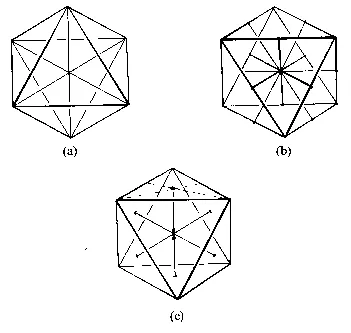
22 Fig. 14 108 Different sets of axes of symmetry
23 (a) Paired vertices yield three axes of 4-fold rotational symmetry.
(b) Paired edges yield six 2-fold axes.
(c) Paired faces yield four 3-fold axes.
24 On to edges. The octahedron's twelve edges consist of six opposing pairs, the midpoints of which can be connected by six intersecting axes (Fig. 14-108.b). The same number of great circles are thereby generated, delineating another facet of the octahedron's symmetry (Fig. 14-109). Unlike the previous case, the pattern made by six great circles does not look like an octahedron. Its 24 right isosceles triangles [209/210] outline the edges of both the spherical cube and rhombic dodecahedron, as well as the edges of two intersecting spherical tetrahedra (otherwise known as the "star tetrahedron"), thus highlighting the topological relationship between these four systems. This exercise demonstrates a new aspect of "intertransformability": great circles generated by a given polyhedron often delineate the spherical edges of its symmetrical cousins.[210/211]
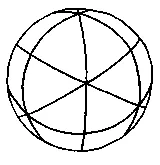
26 Fig. 14 109 The 6 great circles of the octahedron
27 Finally, the centers of opposite faces are joined together (Fig. 14-108.c). The octahedron's four pairs of triangles define four intersecting axes, and in turn four symmetrically arrayed great circles (Fig. 14-110). As the spherical edges of Fuller's vector equilibrium, this pattern is particularly significant, as will be developed below.
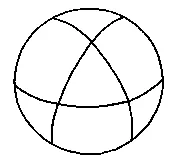
29 Fig. 14 110 The 4 great-circle edges of the VE
30 The sets of three, six, and four great circles can all be superimposed on one sphere to exhaustively display the "unique topological aspects" of the octahedron. With a grand total of thirteen, we have located all the great circles that correspond to the octahedron's symmetry. We can go no further.
31 Now consider the cube. It is quickly apparent that its total great-circle pattern will be identical to that of the octahedron. The cube's eight vertices generate the same four great circles as the octahedron's faces, its six faces correspond to the three orthogonal great circles, and the twelve edge midpoints are identically situated to those of the octahedron. Such is the result of duality. The same sets of circles are generated by different elements, and the end results are equivalent.
32 Next, we turn to the VE. With two kinds of faces the situation might seem more complicated; however, the above procedure still applies. The VE's eight triangles define the same four axes as the faces of the octahedron, while its squares contribute three orthogonal (XYZ) axes. Seven great circles altogether are generated by the axes of the fourteen VE faces. Twelve vertices correspond to the same six great circles as those of the octahedron (or cube) edges, and finally 24 edges spin out the unfamiliar pattern of twelve great circles. With a total of 25 great circles, the topological parameters of the VE are exhausted (Fig. 14-111).[211/212]
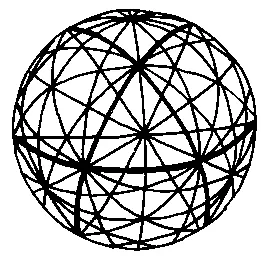
34 Fig. 14 111 The 25 great circles of the VE
35 The tetrahedron presents a slightly different situation in that its vertices do not group into polar opposites, but rather are positioned directly across from the centers of faces. However, four axes of symmetry (all going through the center of gravity) can be created by connecting the vertices with their opposite faces. In having axes of rotational symmetry that connect faces and vertices, the tetrahedron is again unique; as we recall from Chapter 4, only tetrahedra have the same number of vertices as faces. (Only the tetrahedron is its own dual.) The four great circles generated by these unorthodox axes produce (once again) the spherical vector equilibrium. This is not surprising if we recall the lesson from "multiplication by division", which first uncovered this shared symmetry between the tetrahedron, octahedron, and VE: By simply interconnecting mid-edge points, all three polyhedra were found to be inherent in the topological makeup of the starting-point tetrahedron. They share the same four axes of symmetry.
36 The axes of symmetry associated with the tetrahedron's six edges are more orthodox: mid-edge points of opposite edges are simply joined to reestablish the XYZ axes. Familiar by now with evidence of right angles hiding within this triangular shape, we can no longer be caught off guard by this discovery. The corresponding three great circles are the edges of the spherical octahedron, once again illustrating the depth of the octahedron-tetrahedron relationship. And now all topological aspects are used up; the tetrahedron has seven great circles, the minimum number possible for symmetrical polyhedra.
37 Next, we look at the maximum case. It's not easy to accept the concept of an upper limit on the number of symmetrically positioned great circles that can be imposed on a sphere; common sense suggests that we should be able to keep adding new rings indefinitely. [212/213] However, we recall from Chapter 3 that all systems are polyhedral—that is, everything that divides inside from outside can be described in terms of some number (four or more) of "event complexes" and their relationships—and from Chapter 4 that the system with the greatest number of identical regular polygons and equivalent vertices is an icosahedron. This tells us that the number of great circles allowed by the topological aspects of the icosahedron is the maximum for these symmetrical patterns.
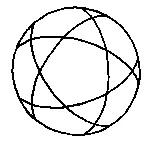
39 Fig. 14 112 The 6 great circles of the icosahedron
40 The axes defined by the icosahedron's twelve vertices introduce six great circles. We already have a pattern with six circles (octahedron-VE, Fig. 14-109); however, this is an entirely new set, "out of phase" with the earlier group, as defined by the "jitterbug" transformation (Fig. 14-112). Outlining 12 pentagons and 20 triangles (as opposed to 24 isosceles triangles), these arcs present the most symmetrical arrangement of six great circles. When a vector equilibrium contracts into an icosahedron in the jitterbug transformation, the radius—edge-length equivalence is lost, but the distances between adjacent vertices on the surface are suddenly all equal. As an icosahedron produces the most symmetrical distribution of twelve vertices on a closed system, it follows that the same is true for their corresponding six great circles.
41 Next, the axes of symmetry connecting the centers of icosahedron faces generate ten great circles, while the thirty edges spin out fifteen more: 6 + 10 + 15 = 31, the total number of great circles in the limit-case pattern (Fig. 14-113). These circles provide the spherical edges of a pentagonal dodecahedron as well as those of an icosahedron, and (less predictably) also include the octahedron. These relationships will be explored below.
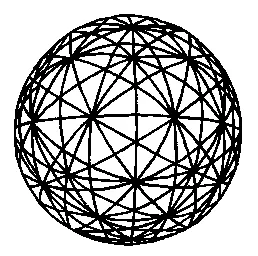
43 Fig. 14 113 The 31 great circles of the icosahedron
Least Common Denominator
45The spherical icosahedron divides the surface of a sphere into the greatest number of completely regular domains (with both equal arc lengths and equal surface angles). We can therefore subdivide one of [213/214]these symmetrical triangles to find the least common denominator of surface unity—in much the same way we isolated A- and B-modules. Each triangle is split into six equal parts by perpendicular bisectors, to obtain a final non-symmetrically-divisible unit (Fig. 14-114.a). The result is 120 asymmetrical triangles (60 positive, 60 negative), the maximum number of equivalent domains on the surface of a sphere. These perpendicular bisectors are the icosahedron's fifteen great circles (Fig. 14-114.b).
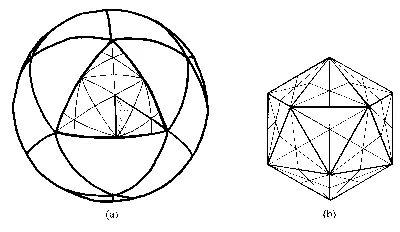
47 Fig. 14 114 Maximum of 120 equivalent domains: LCD
48 Imagine that some number of hypothetical creatures are to inhabit the surface of a large sphere and it is considered necessary that each [214/215] one sit in the middle of an identical plot. The consequence of this stipulation is that no more than 120 creatures can fit on the sphere, no matter how large it is. This result is certainly counterintuitive, for assuming a large enough sphere, it seems that we should be able to accommodate as many creatures as we want. However, the unyielding laws of symmetry limit the population to the unexpectedly low number of 120.
49 We go back to the 31-great-circle diagram to observe the 120 triangles in context. These asymmetrical triangles are true LCD units; any one of them contains all the geometric information necessary to reconstruct the entire pattern. This is an important factor in the development of geodesic domes, as will be seen in the next chapter, which discusses the relationship of great circles to geodesic domes.
LCD: "Intertransformability"
51The following exploration is similar to the transmutations of A and B modules and uncovers some of the same relationships; however, consistent with great-circle limitations, this study deals only with surface characteristics. Each symmetrical great-circle pattern has a least common denominator. For example, the spherical octahedron has eight equilateral faces, which can be split into six asymmetrical triangles, each one 1/6 of 1/8, or 1/48, of the whole surface. These triangles are LCD units, because they cannot be further subdivided to yield equivalent shapes.
52 To isolate the LCD of 25 great circles, we must take into consideration that the spherical VE has two types of faces. Therefore, the smallest unit that can be reproduced to generate the whole pattern [215/216]requires 1/6th of a VE triangle joined to 1/8th of an adjacent square. In this way, both aspects of the VE pattern are incorporated into the LCD, and the result is an asymmetrical triangle that covers 1/48th of the sphere (Fig. 14-115).
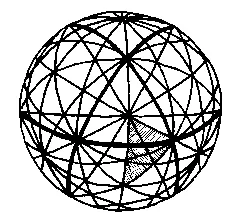
54 Fig. 14 115 LCD unit
55 By changing the boundaries, LCDs of a given spherical polyhedron often can be caused to make up the faces of various other polyhedra. Interesting transformations are found between the great circles of the VE and the icosahedron, for the shift from 25 to 31 is another result of the icosahedron's "out of phase" role in the "cosmic hierarchy".
LCD of 31 Great Circles
57Each triangle of the icosahedron consists of six LCDs, for a total of 120 asymmetrical triangles. That much is straightforward, as are the first two transformations.
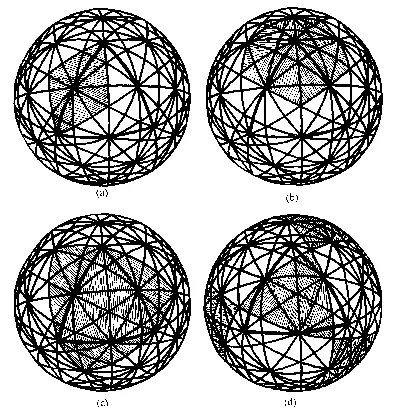
59 Fig. 14 116 Revealed in the 31-great-circle pattern
60 (a) rhombic triacontahedron
(b) pentagonal dodecahedron
(c) octahedron
(d) VE
61 Instead of the standard groups of six LCDs making up icosahedron faces, we change the boundaries. Four of these units form the diamond face of the spherical rhombic triacontahedron, so that we have thirty groups of four triangles instead of twenty groups of six. Fig. 14-116.a shows that each icosahedron edge is the long diagonal of one of the thirty diamonds; the planar rhombic triacontahedron is thus a "degenerately stellated" icosahedron.
62 Secondly, we can recombine the 120 units into twelve groups of ten with each triangular unit radiating out from an icosahedron vertex, to highlight the pentagonal dodecahedron (Fig. 14-116.b).
63 Next, we discover a few asymmetrical transformations. A spherical triangle of fifteen LCD units, incorporating a complete icosahedron triangle radially framed (like a pinwheel) by nine extra LCDs, is one face of the spherical octahedron. With this observation, we isolate the octahedron face just by looking at the pattern, so it's worth checking the arithmetic: multiply fifteen units per face by eight faces to get 120, or the whole system. Fig. 14-116.c shows this skew relationship, again reminiscent of the jitterbug transformation. And lastly, we observe the edges of a spherical VE. At first this seems to present a contradiction, given the unsynchronized relationship of the 25- and 31-great-circle patterns. However, the VE's four great circles are included among the 31 icosahedral equators, although asymmetrically positioned with respect to its vertices (Fig. 14-116.d). We now recall from Chapter 11 that it was possible for all the faces of an octahedron to be aligned with eight of the icosahedron's twenty (Fig. 11-87). This skew correspondence, which defined the S module, shows [216/217]how a subset of four out of the ten circles generated by icosahedron faces will be correctly situated to create the spherical VE.
64 The number of different polyhedra hiding within the 31 great circles reemphasizes the existence of significant relationships between the "out of phase" icosahedral family and the IVM group.
VE's 25 Great Circles
66The intertransformability displayed by the VE's least common denominator is straightforward, in contrast to the skew relationships demonstrated above. Groups of four units create diamond faces [217/218]exactly centered over each VE vertex, thereby defining the twelve faces of its dual, the rhombic dodecahedron (Fig. 14-117.a). Six LCD triangles come together to create octahedron faces (Fig. 14-117.b), while the cube's six squares each consists of eight asymmetrical units (Fig. 14-117.c). And a spherical tetrahedron uses a dozen LCDs per face, distributing the 48 units among only four faces (Fig. 14-117.d).
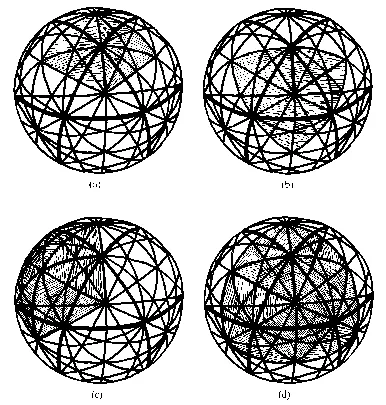
68 Fig. 14 117 Revealed in 25 great-circle pattern
69 (a) rhombic dodecahedron; (b) octahedron;
(c) cube; and (d) tetrahedron.
70 This brief look at various regroupings of LCD units shows how great-circle diagrams provide a new way to classify certain polyhedral characteristics, and thereby discover shared symmetries between systems.[218/219]
14.0.2 Operational Mathematics
71Fuller made a remarkable discovery about great-circle patterns that is responsible for their great significance in his mathematics. This discovery involves an intricate relationship between central and surface angles and could so easily be missed that one cannot help reflecting on the intuition that led Fuller to such an insight. As with other aspects of his "operational" method, the demonstration relies on readily available materials, but its significance extends to structuring in nature. This is a particularly satisfying exercise, and readers are encouraged to make Bucky's discovery themselves by following the simple instructions. Rather than a "plane", Bucky starts with a real system, a "finite piece of paper" (831.01).
72 Using a compass, draw four circles with diameter of approximately 6 inches (152mm), and then cut them out with scissors. Fold each one. Then fold the resulting semicircles into thirds, as shown in Fig. 14-118. The section labeled A is folded toward you, while C is folded back, producing a Z-shaped cross-section.
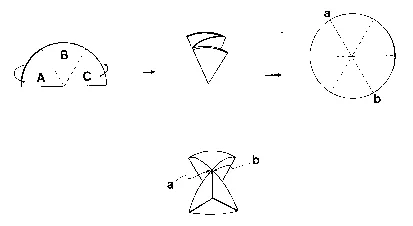
74 Fig. 14 118 Making bowties: relating central and surface angles
75 Making sure that all creases are sharp, unfold the paper to obtain a circle with three intersecting diameters clearly marked by fold lines (Fig. 14-118). The circle is thus divided into six equilateral triangles. The process of sweeping out a circle with a compass insures that all radii are equal, and because at one point in the procedure all six pie-slices are piled up together, we know that the central angles must [219/220]all be exactly the same. 360° divided among six equal segments yields 60° angles. First-hand experience has confirmed both the constant radius and 60° angles, and therefore the presence of equilateral triangles with arc segments at their outer edges is experientially proved.
76 One fold (line AB) faces you; the other two folds are facing away. Bringing point A to point B, we create one of Fuller's "bowties" (Fig. 14-118, bottom). A bobby pin straddling the seam keeps the bowtie together: two unit-length regular tetrahedra joined by an edge. We repeat the procedure three times, producing four bowties in all. It is then apparent that two of them can be placed seam to seam and pinned together with two more bobby pins, to produce four tetrahedra surrounding a ½-octahedral cavity. The other two bowties are similarly paired, and finally the two pairs are connected along their congruent fold lines with four more bobby pins. A complete paper sphere emerges (Fig. 14-119). This strange procedure has created a very familiar pattern: four continuous great circles, or a spherical VE. The only materials required are four paper circles and twelve bobby pins.
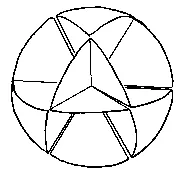
78 Fig. 14 119 4 bowties create the 4 great circles of the VE
79 What has happened? Four separate paper circles have been folded, bent, transformed into bowties, and pinned together without paying any attention to converging angles. No special jig is required to line up adjacent bowties and insure that consecutive great-circle arcs are colinear. Folded edges are simply brought together, and four continuous great circles magically reappear, as if the original paper circles were still intact. Looking only at the finished model, it appears that we had to cleverly cut slits in the paper circles in just the right places to allow the four circles to pass through each other. The procedure is reminiscent of the magic trick in which a handkerchief [220/221]is cut into many tiny pieces and thrown randomly into a hat, only to reappear intact.
80 A spherical VE can be constructed through this simple folding exercise because of the specific interplay of its surface and central angles. Remarkable numerical cooperation is required to allow adjacent central angles to fold out of flat circular disks, while automatically generating correct surface angles. That four great circles will submit to this bowtie operation is not at all obvious from studying the whole pattern, and even less so in the case of other, far more complicated models.
Conservation of Angle
82Physics tells us that a beam of light directed toward a mirror at some angle from the left will bounce away from the mirror making the same angle on the right. The angle of incidence is equal to the angle of reflection. Fuller points out that the same is true for the great-circle models, if we think of the paths as trajectories.
83 Great circles maintain the illusion of being continuous bands, argues Fuller; however the bowtie procedure reveals the truth about these patterns, and in so doing illustrates an aspect of energy-event reality. A great-circle path may look continuous, but what really happens is that as soon as a trajectory (or great-circle arc) meets an obstacle, in the form of another great-circle event, they collide and the course of both trajectories is necessarily altered. Both paths are forced to bounce back, just like a ball bouncing off a wall.
84 Here's the fun part. Because the intersection of two great circles provides two pairs of equal angles, their paths mimic the classical collision in physics. The same angular situation results from two overlapping great circles as from an idealized "energy-event" collision; these symmetrical patterns can therefore be thought of as the paths taken by billiard balls on the surface of a spherical pool table. If you didn't see the collisions, you might think that two balls went through the same point at the same time; however, their true paths are bowties.
85 Imagine a great-circle wall constructed vertically out from the surface of a sphere. If a ball traveling parallel to the sphere's surface (describing another great circle) hit the wall and bounced back (Fig. 14-120.a),
86 "… it would bounce inwardly off that wall at the same angle that it would have traversed the great-circle line had the wall not been there…" (901.13)
87 Adjacent bowties therefore produce colinear great-circle arcs, because the angle made by the paper disk [221/222]bouncing back" from a bobby-pin collision point is the same angle the circle would have made on the other side if the bobby pin had not been there. Fuller continues,
88 "and it would bounce angularly off successively encountered walls in a similar-triangle manner…(901.13).
89 Hence the completed bowties. The image of the colliding ball and great-circle wall makes it easier to understand why Fuller interpreted great circles as the trajectories of energy events, and explains why he was convinced that these models have physical significance. His bowtie analogy is consistent with the classical collision model.
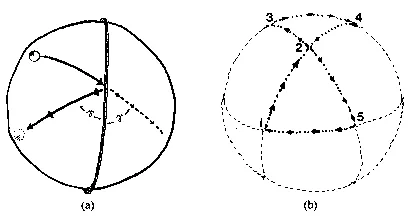
91 Fig. 14 120 Reflective bounces in local holding-pattern figure-8 loop
92 (a) Ball bounces back from the wall at the same angle it would have made with the wall on the
other side had the wall not been there.
(b) "Local holding pattern:" figure-8 loop.
93 Consider the paper model described above. Soon after an energy event meets its first collision, the new trajectory meets a second obstacle and its course is again altered. Conservation of angle determines the new heading once again, and the process repeats until, at the sixth collision, the great-circle path comes back upon itself, completing the bowtie loop (Fig. 14-120.b).
94 Successive arc segments of one energy event form figure-8 loops, or "local holding patterns" (455.05), which lie side by side and appear to be continuous great circles. Construction paper shows us how it works, and Fuller tells us that this is what happens in physical reality as well. Discrete energy events form local circuits, just as discrete paper circles form bowties; they only look continuous.[222/223]
Foldable Systems
96Just as we needed at least four vertices to make a system,
97 "four is also the minimum number of great circles that may be folded into local bow ties and fastened comer-to-comer to make the whole sphere…" (455.04)
98 An interesting characteristic of this minimum model is that the sum of the areas of its four separate circles, which fold up to create the model, is equal to the surface area of the sphere they define, or 4R ².
99 A system with less than four great circles cannot be directly constructed out of that number of bowties, but in some cases the pattern can be simulated using more than the prescribed number of paper disks and doubling the polyhedral edges:
100 You cannot make a spherical octahedron or a spherical tetrahedron by itself… 109°28' of angle cannot be broken up into 360°-totalling spherical increments…. (842.02–842.03)
101 A spherical tetrahedron can only be created out of "foldable" paper circles by constructing the 6-great-circle spherical cube, which produces two intersecting tetrahedra. See Fig. 14-121: six great circles will submit to a bowtie construction, similar to the 4-great-circle model described above:
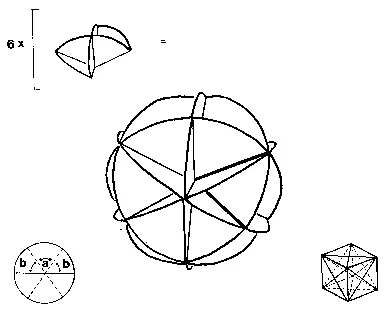
103 Fig. 14 121 6 bowties create the 6 great circles of the cube or octahedron
104 842.04 Nor can we project the spherical octahedron by folding three great circles. The only way…is by making six great circles with all the edges double…
105 In this construction, six circles are folded in half and then the resulting semicircles are each folded in the middle at a right angle. The six bent semicircle pancakes (rather than three open bowties) are then simply pinned together to simulate the three great circles of the octahedron (Fig. 14-122).
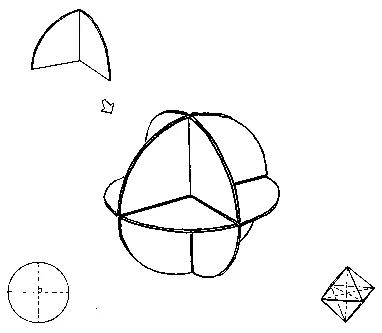
107 Fig. 14 122 The 3-great-circle model requires 6 foldable circles
108 Fuller attributes these discoveries to a "basic cosmic sixness":
109 "There is a basic cosmic sixness of the two sets of tetrahedra in the vector equilibrium. There is a basic cosmic sixness also in an octahedron minimally-great-circle-produced of six great circles; you can see only three because they are doubled up. And there are also six great circles occurring in the icosahedron. Ml these are foldable…. This sixness corresponds to our six quanta: our six vectors that make one quantum." (842.05–842.06)
110 Both 6-great-circle patterns can be constructed out of foldable circles. The star-tetrahedron version involves six bowties with two right isosceles triangles on the surface (60°/ 60°/ 90°) created by central angles of 70°32' (a) and 54°44' (b), as labeled in [223/224]Fig. 14-121. The six bowties are pinned together at the seams to create the 24 surface triangles of the spherical cube and star tetrahedron. And it works: the illusion of six continuous circles is maintained.
111 The icosahedral six great circles fold into pentagonal bowties. Fold lines divide each circle into ten equal slices of pie, carving out the 36° central angles. Each circle is then pinched together at one point to form a double-pentagon figure-8. Just like the triangular predecessors, each circle folds into a "local circuit" and is connected to other local circuits to create the illusion of continuous great circles (Fig. 14-123).
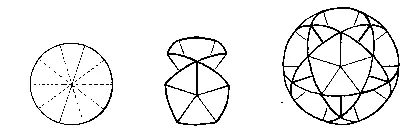
113 Fig. 14 123 6 pentagonal bowties create the 6 great circles of the icosahedron
114 Fuller experiments with the "foldability" of considerably more intricate patterns. Larger numbers of great circles intersect more frequently, and arc segments have correspondingly smaller central angles. The number of folds and the precision required for each of the tiny irregular angles make these higher-frequency models extraordinarily difficult to build, and even more difficult to visualize without a model.
115 Each of the ten great circles of the icosahedron can fold into winding chains of six narrow tetrahedra, which then interlink to reproduce the 10-great-circle pattern. (455.20.fig)
116 Fuller claims that [224/225]the 15-great-circle pattern (outlining the 120 LCD units) can be reconstructed with fifteen 4-tetrahedron chains. (458.12.fig)
117 While a paper circle will fold into four consecutive LCD tetrahedra, it is not clear how they fit together to recreate the whole sphere. We note however that this pattern can be easily generated by using thirty paper circles and doubling the edges. Each circle folds into four adjacent LCD tetrahedra, to form one self-contained diamond—a face of the rhombic triacontahedron (Fig. 14-124).[225/226]
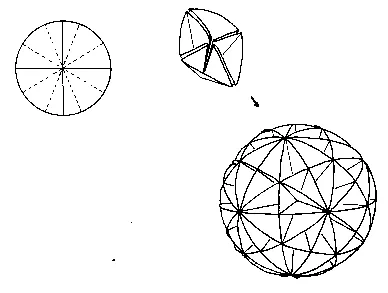
119 Fig. 14 124 15-great-circle model, created by doubling the edges
120 For the purposes of this chapter, we want to understand the basics of how foldable great circles work; further experimentation with construction paper is left to curious (and ambitious) readers. We proceed to look at Fuller's interpretation of the significance of this behavior in terms of physical reality.
14.0.3 Energy Paths
121Here's the basic premise: First, the concept of a sphere provides a model of the generalized system, and on the surface of a sphere the shortest route is a geodesic path. Secondly, Universe breaks down into discrete systems, which consist exclusively of energy events and their relationships. And finally, energy is always in motion, perpetually transferred between finite local systems along most direct routes, and therefore, energy must be traveling through Universe via great-circle paths.
Gas Molecules
123We consider a specific example:
124 A vast number of molecules of gas interacting in great circles inside of a sphere will produce a number of great-circle triangles. The velocity of their accomplishment of this structural system of total intertriangulation averaging will seem to be instantaneous to the human observer. (703.14) [226/227]
125 Fuller's hypothetical molecules are bouncing around so fast that the overall pattern of their activity seems instantaneous. But in reality, he reminds us, there is no "instant Universe"; time is always a factor. Molecules collide and bounce back; equal angles created by the symmetry of their collisions create the illusion of full great circles interweaving, but their trajectories are really local loops:
126 The triangles, being dynamically resilient, mutably intertransform one another, imposing an averaging of the random-force vectors of the entire system, resulting in angular self-interstabilizing as a pattern of omnispherical symmetry. (703.14)
127 To Fuller the ability to fold individual paper circles and automatically generate an entire symmetrical pattern gives great-circle models important physical relevance. They demonstrate his statement that no two lines can go through the same point at the same time and illustrate the concept of "interference patterns". The model, says Fuller, is consistent with physical behavior.
128 Although physical systems are always imperfect, the result of a vast number of interactions is approximate symmetry. With enough data or time, all possible paths can be tried, and the properties of space come into play. What does a maximally symmetrical distribution on a spherical surface look like?
129 The aggregate of all the inter-great-circlings resolve themselves typically into a regular pattern of 12 pentagons and 20 triangles, or sometimes more complexedly, into 12 pentagons, 30 hexagons, and 80 triangles described by 240 great-circle chords. (703.14)
130 The pattern is always icosahedral, some version of the maximally symmetrical shell. (Refer to Chapter 11 for a comparison of space-filling versus shell symmetries.) Icosahedral symmetry fits the most great circles on a closed system. One notable characteristic of this pattern, no matter how high the frequency of subdivision 45 is the presence of exactly twelve pentagons evenly distributed around the system—one at the location of each 5-valent icosahedral vertex:
131 "…the 12 pentagons, and only 12, will persist as constants; also the number of triangles will occur in multiples of 20." (703.15).
132 This constant number of pentagons, together with "twelve spheres around one" and "twelve degrees of freedom", suggests a fundamental twelveness inherent in space. We shall return to this pattern in the next chapter, looking at geodesic structures.
133 Fuller uses molecules bouncing around in a spherical system as a model, because molecules are energy events occurring in large enough numbers to describe the symmetrical patterns developed as polyhedral [227/228]abstractions. In conclusion, energetic behavior is subject to symmetrical constraints, and in order to adhere to logic or theory, probability calls for very large numbers.
Great-Circle Railroad Tracks of Energy
135Chapter 8 examined the closest packing of spheres. The next question in Fuller's investigation is how "energy" will navigate through these clusters. The idea that closepacked spheres present a sort of conceptual model of physical Universe is at the root of Fuller's great-circle studies. As a space-filling array of discrete systems, whose omnisymmetrical qualities recommend them as a general representation of eternally spinning energy-event systems, close-packed spheres do provide a tantalizing model. Chapter 8 described the closest packing, which places every sphere in contact with twelve others, and this chapter mapped out the complete network of shortest-distance paths around a spherical system described by these twelve contact points. The "cosmic railroad tracks" thus described were the 25 great circles of the VE:
136 The 12 points of tangency of unit-radius spheres in closest packing, such as is employed by any given chemical element, are important because energies traveling over the surface of spheres must follow the most economical spherical surface routes, which are inherently great circle routes, and in order to travel over a series of spheres, they could pass from one sphere to another only at the 12 points of tangency of any one sphere with its closest-packed neighboring uniform-radius sphere." (452.01)
137 In an effort to describe a symbolic model of atomic and molecular activity, Fuller allows the omnisymmetrical (or perhaps "omni-spinnable" is more appropriate) form of spheres to represent atoms and explains that energy, or charge, can only travel from system to system through points of tangency. (Fuller is also quick to point out that tangency is actually "extremely close proximity", for in physical reality nothing "touches".) Energy is thus found either in finite local circuits (bowties) on one system, or jumping over to a neighboring system through VE vertices:
138 These four great-circle sets of the vector equilibrium [i.e. sets of 3, 4, 6, and 12] demonstrate all the shortest, most economical railroad "routes" between all the points in Universe, traveling either convexly or concavely. The physical-energy travel patterns can either follow the great-circle routes from sphere to sphere or go around in local holding patterns of figure eights on one sphere. Either is permitted and accommodated." (455.05)[228/229]
139 These "universal railroad tracks" are specifically along the 25 great circles because of the relationship of vector equilibrium to the cosmically significant closepacked spheres.
Icosahedron as Local Shunting Circuit
141"The vector equilibrium railroad tracks are trans-Universe, but the icosahedron is a locally operative system" (458.12).
142 This distinction, introduced by the jitterbug transformation, has particular significance in Fuller's great-circle theories. The VE is integral to our space-filling network of equivalent vectors; however, once the VE contracts into the icosahedron with its slightly shorter radius, it is disconnected from that universal IVM network. It loses its contacts. "Energy" is free to travel endlessly throughout the railroad tracks of Universe, sliding from sphere to sphere along the economic great-circle paths, until it runs into an icosahedron. The icosahedral 31 great circles are not "trans-Universe" lines of supply; their function is to disconnect energy from the closest-packing railroad tracks and direct it into local orbits. The icosahedron throws the switch:
143 The icosahedron's function in Universe may be to throw the switch of cosmic energy into a local shunting circuit. In the icosahedron energy gets itself locked up even more by the six great circles—which may explain why electrons are borrowable and independent of the proton–neutron group. (458.11)
144 Fuller suggests that there might be a meaningful connection between the icosahedron and the electron, because the tiny negative charge is readily transferred from atom to atom in molecules and crystals. The icosahedron's independent role, in Fuller's view, "shunting" energy into local circuits (that is, able to disconnect energy charges from a bigger matrix) is suggestive of the electron's role:
145 458.05 The energy charge of the electron is easy to discharge from the surfaces of systems. Our 25 great circles could lock up a whole lot of energy to be discharged. The spark could jump over at this point…. If we assume that the vertexes are points of discharge, then we see how the six great circles of the icosahedron—which never get near its own vertexes—may represent the way the residual charge will always remain bold on the surface of the icosahedron.
146 Lacking contact points, the icosahedron is a free-floating unit in Universe; so is the electron. The suggestion of a relationship remains just that, a tantalizing parallel, seeds perhaps of future investigation, but certainly among Fuller's more abstruse parallels.[229/230]
14.0.4 Inventory: Seven Unique Cosmic Axes of Symmetry
147The VE's 25 great circles incorporate those of the rhombic dodecahedron, octahedron, cube, and tetrahedron. The icosahedral 31 belong to a different family of symmetries. Both groups together constitute seven sets of axes of symmetry: four contributed by the VE's vertices, edges, and two types of faces, and three by the icosahedron's vertices, edges, and faces.
148 1042.05 The seven unique cosmic axes of symmetry describe all of crystallography. They describe the all and only great circles foldable into bow ties, which may be reassembled to produce the seven great-circle spherical sets….
149 We have a list of symmetrical possibilities. With this inventory, Fuller integrates specific information about inherent spatial characteristics with concepts of energy behavior, to gain insights about structuring in nature.
Excess of One
151It is interesting to note that the number of great circles associated with each polyhedron is always one more than the number of its edges. For example:
153 Fuller quickly identifies this constant "excess of one great circle" (and its implied two poles) with the
154 "excess two polar vertices characterizing all topological systems" (1052.31).
155 However, this discovery is not a new bit of magic, but rather follows directly from Euler's law. Recalling the way in which great circles are generated, we realize that each circle corresponds to a pair of either vertices, edges, or faces. Therefore, the number of great circles can be tallied by counting half the total number of topological aspects, or ½( E + F + V).
156 We can now write an equation stating that one less than the number of great circles is equal to the number of edges:
157 ½(E + F + V) - 1 = E.
158 Multiplying both sides by 2, we have
159 E + F + V - 2 = 2E,[230/231]
160 or
161 F + V - 2 = E
162 and finally
163 F + V = E + 2,
164 which is Euler's law.
165 Even if Fuller's cosmic railroad tracks leave you skeptical, great circles provide fascinating geometric patterns, which introduce a new system of classifying and comparing the topology and symmetry of various polyhedra. Part of their fascination lies in the surprisingly limited number of variations among the great-circle sets generated by our cast of polyhedra. But perhaps most importantly, experiments with great circles—building wire models—provided the impetus and the clues for Fuller's subsequent journey into geodesics.[231/232]