
12 "All-Space" Filling: New Types of Packing Crates
2Fuller in his characteristic drive for verbal accuracy updates geometry's conventional term "space filling" with his own more descriptive (and predictably longer) "all-space filling". Here's the puzzle: which of the polyhedra introduced so far can pack together in such a way that all available volume is occupied without any gaps?
3 The concept is not new; ever since closepacking equiradius spheres, we have danced around the issue of space filling, and in the process made most of the discoveries that this chapter will expand upon. The IVM disclosed certain space fillers, while making it clear that other polyhedra did not share this ability. However, filling all space now becomes the focus of our investigation, calling for the systematic analysis that enables new insights and a more thorough understanding.
4 Despite its obvious applicability, space filling is not emphasized in Fuller's work. An ability to "fill all space" is generally mentioned as further description of a given polyhedron rather than providing an investigative starting point for synergetics. Fuller's "operational" approach encourages more experimental exercises, such as packing spheres together, which then lead to space fillers after the fact.
5 In view of our overall goal of researching the characteristics of space, what could be more logical than to ask what fits into it? What shapes are accommodated by space? The notion that space is not a passive vacuum gradually becomes second nature; experience has changed our awareness. Now we want to become ever more exact about these active properties. The existence of an extremely limited group of polyhedra that can pack together to fill all space is one of the more direct illustrations of the specificity of spatial characteristics.
6 The puzzle is quite challenging. Without actually making a horde of tiny cardboard models of the polyhedra in question, these spatial configurations are extraordinarily difficult to visualize—with the sole exception of the obvious space filler, an array of cubes. Once again, to gain more experience with the concept, we revert to the plane, or to be more accurate, the page. In deference to Bucky's strict precision, we must acknowledge that the theoretical "plane" is a nondemonstrable concept, but we can certainly (and quite appropriately) discuss filling up a page.
12.0.1 Plane Tessellations
7The mathematical title may be somewhat intimidating, but plane tessellations are actually quite familiar. Derived from the Latin word for "tiling", tessellation, in mathematics, refers to planar patterns of polygons. Because of the ease of working with flat patterns, we begin our study of space filling with the analogous situation in the plane. Which regular polygons fit together edge to edge to fill a page?
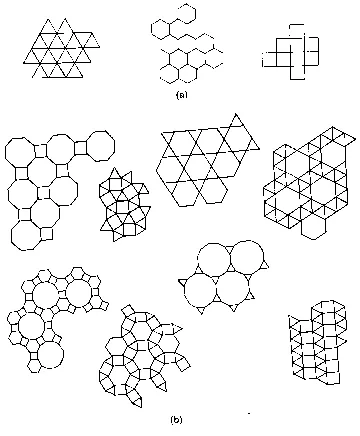
9 Fig. 12 91 Plane tesselations: Regular and semiregular tilings of the plane.
10 We can fill up a page with squares, as anyone who has ever seen graph paper knows, and the pattern created by equilateral triangles is almost as familiar. Another successful tessellation is found on many bathroom floors covered by tiny hexagonal tiles (Fig. 12-91.a). With these immediately apparent examples, we might begin to suspect that any regular polygon can fill a page. However, a little experimentation quickly reveals that we have already exhausted the possibilities.
11 Three regular pentagons (equilateral and equiangular) placed side by side leave a 36° angular gap—not nearly wide enough to accommodate a fourth pentagon. Five-sided tiles are thus disqualified. Three heptagons simply cannot fit around a single point, as we saw in Chapter 4; octagons meet a similar fate, as of course do any polygons with more sides. We are suddenly confronted with a very limited group of plane fillers: triangles, squares, and hexagons.
12 Opening up the field to allow combinations of regular polygons while maintaining equivalent vertices expands the inventory only slightly. Eight "semiregular" tessellations join the three patterns above (Fig. 12-91.b). Still an impressively small group. These eleven tilings can be categorized in terms of the different rotational symmetries exhibited by each, and within this group every category of repeating planar pattern is represented. It is fascinating to reflect on the implications of these results: for example, a wallpaper designer can only create what the limitations inherent in the plane will allow.
13 These cumulative experiences—especially those as straightforward as plane tessellations—nurture our growing awareness of spatial [176/177]constraints. And with each step, our knowledge of the elegant precision of this order expands synergetically.
14 Filling Space
15 Cubes stack neatly together to fill space. What other polyhedra exhibit this property? Attempts to fit regular tetrahedra together are quickly frustrated; likewise for octahedra. However, working together, the two shapes can fill space indefinitely. None of this is new information: we discovered the complementarity of octahedra and tetrahedra while exploring isometric arrays of both spheres and vectors. Subsequently, multiplication by division uncovered the octahedron hiding inside every tetrahedron. The octahedron—tetrahedron marriage is clearly an eternal bond.
16 Neither icosahedra nor pentagonal dodecahedra can fill all space.
17 Icosahedra, though symmetrical in themselves, will not close-pack with one another or with any other symmetrical polyhedra. (910.01)
18 The cube thus stands alone among regular polyhedra.
19 Complementarity
20 But let's reevaluate our apparently simple array of cubes. As the obvious solution to filling all space with a single polyhedron, this packing seems to provide the most straightforward information about the shape of space. But look further. What if you could see the cubes' face diagonals? An implied tetrahedron awaits visibility. Now imagine filling in the necessary diagonals, so that the inscribed tetrahedron—surrounded by four 1/8-octahedra—appears in each cube. At every junction of eight cubes, the octahedral parts come together and form one complete octahedron around each cubical corner (Fig. 12-92). As rectilinear boxes are unstable without diagonal bracing, a stabilized packing of cubes turns into an Octet Truss. Whether visible or not, the octet symmetry is implicit in the configuration.
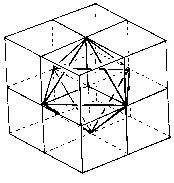
22 Fig. 12 92 Octahedron at junction of 8 cubes
23 The Greeks failed to get at the triangulated heart of their stack of cubes, philosophizes Bucky, for "like all humans they were innately intent upon finding the 'Building Block' of Universe". Had they experimented with arranging tetrahedra vertex to vertex and been [178/179]confronted with the inescapable octahedral cavities, he continues, they
24 would have anticipated the physicists' 1922 discovery of "fundamental complementarity."… But the Greeks did not do so, and they tied up humanity's accounting with the cube which now, 2,000 years later, has humanity in a lethal bind of 99% scientific illiteracy. (986.049b)
25 Fueled by the developments of 20th-century physics, Fuller spoke frequently and emphatically of the "inherent complementarity" of Universe. He cites two examples in particular out of the many provided by quantum physics. First, the "complementarity principle" announced by Niels Bohr (1885–1962) in 1928, which goes hand in hand with Heisenberg's indeterminism. Bohr summarizes the basic feature of quantum physics by stating that experimental evidence cannot be comprehended within a single frame, but rather must be understood as "complementary", or partial, information. The totality of a phenomenon must therefore be represented through more than one complementary part, for all aspects cannot be accurately measured simultaneously.37
26 Fuller also calls our attention to a later Nobel-winning development made by two Chinese physicists working in the U.S. In 1957, Tsung-Dao Lee and Chen Ning Yang were honored for their discovery that "parity" is not conserved in weak interactions, for the subatomic particles involved show "handedness".38 In other words, simplifies Bucky, fundamental complementarity does not consist of mirror-image pairs. Concave–convex, tension–compression, proton–neutron, male–female: Universe is always plural, supporting interdependent, inseparable pairs which are not simply mirror-image halves. It is thus reassuringly consistent that the essence of structure and space should also exhibit this fundamental dualism. There is no single building block of Universe.
27 Other Space Fillers
28 The role played by tetrahedra and octahedra in an array of cubes—not to mention in the IVM—demonstrates that these two structures combine to create a variety of polyhedra. This observation suggests an operational strategy: experiment with various combinations in the hope of finding other space fillers.
29 Two tetrahedra are affixed to opposite faces of an octahedron with the same edge length. Supplementary dihedral angles cause adjacent [179/180]triangular faces to be coplanar, thereby merging into six rhombic faces (Fig. 9-67). The resulting slanted structure, introduced in Chapter 9, is called a rhombohedron and can be thought of as a partially flattened cube. Six squares have simply been squashed into diamonds. It's not hard to imagine that an entire array of toothpick cubes could lean over in unison, transforming into an array of distorted cubes. Rhombohedra therefore fill space. The simplicity of this development hints at a starting point.
30 In his "Contribution to Synergetics", Loeb analyzes various polyhedra for their divisibility into tetrahedra and octahedra, and demonstrates that a shape will fill space if it consists of two tetrahedra for every one octahedron.39 Suddenly out of randomness an order emerges, and trial-and-error is replaced by a generalized principle. The ability to fill all space can be added to the list of descriptive properties (such as stability, symmetry, duality) by which we categorize the scattered cast of polyhedral characters. And now, armed with Loeb's conclusive analysis, we will continue to explore the puzzle from a slightly different frame of reference.
31 The Search Continues
32 The IVM simplifies our task, providing a frame of reference which itself fills space. All of the polyhedra covered so far, with the exception of the icosahedron and pentagonal dodecahedron, are outlined within the IVM and IVM' framework by various combinations of octahedral and tetrahedral components (both parts and wholes). We can therefore survey the matrix to ascertain which of these systems are able to meet face to face without intervening cavities.
33 Polyhedra that fit together without gaps must completely surround a common vertex. IVM vertices therefore provide a good starting point; we can systematically investigate the different types of nodes in the matrix, checking the surrounding cells for space-filling polyhedra. Our first node reveals an already familiar space-filling team: each IVM vertex joins six octahedra and eight tetrahedra—as well as polyhedral combinations of the two. The most obvious of these combinations is the vector equilibrium, and our study of the IVM already made it clear that VEs do not fill space, but rather must cooperate with octahedra to create an uninterrupted array, providing yet another example of complementarity. The necessity of this pairing follows directly from octahedron-tetrahedron interdependence. [180/181] (Chapter 13 will elaborate on such space-filling teams, which arise out of the 2-to-1 ratio mentioned above.)
34 Our next step is to investigate other vertices. Interconnecting the centers of octahedra, we trace the array of minimum cubes. That one's easy. The fact that cubes fill space is not new; what else can we learn?
35 If octahedron centers provide the meeting point for eight cubes, what happens at the centers of tetrahedra? To begin with we observe that four ¼-tetrahedra convene. The base of each shallow pyramid is the face of a neighboring octahedron, so we ask what shape is created by an octahedron framed by eight ¼-tetrahedra. As seen in Chapter 9, this is equivalent to Loeb's "degenerate stellation"; the thin triangular faces of adjacent ¼-tetrahedra become coplanar when surrounding an octahedron, and thereby merge into one diamond face. The result: a rhombic dodecahedron (Fig. 9-71). In IVM context, this means that every octahedron reaches out, incorporating eight neighboring ¼-tetrahedra, so that the tetrahedra are completely used up (no leftovers). The entire matrix is thus involved, meaning of course that rhombic dodecahedra fill space. By interconnecting the centers of every tetrahedron in the IVM we automatically generate an array of rhombic dodecahedra.
36 The space-filling puzzle becomes more enticing with this new addition. With its many diamond faces and irregular surface angles, this shape is not, like the cube, an obvious space filler. A casual observer would not suspect this intricate polyhedron of fitting so beautifully together. In fact, without the advantage of the IVM, it is difficult to picture how rhombic dodecahedra manage to fill space.
37 The Dual Perspective
38 Recalling from Chapter 4 that the rhombic dodecahedron is also a "degenerately stellated" cube, it is interesting to observe the relationship between the two packings. A cube with four body diagonals dividing the inside into six pyramids is shown in Fig. 12-93.a. These square-based pyramids are the exact shape required to degenerately stellate a second cube. We can "unwrap" that subdivided cube and place its components on the six faces of a second intact cube—only to arrive once again at our diamond-faceted friend (Fig. 12-93.b). We therefore have a new way to visualize the rhombic-dodecahedron [181/182]packing. Start with an array of cubes, in which every other cube is subdivided by a central node, while the rest remain empty. We have just described an array of rhombic dodecahedra (Fig. 12-93.c). A framework of cubes is so familiar and readily imagined that this exercise brings the rhombic dodecahedron's space-filling capability into easy grasp.40 [182/183]
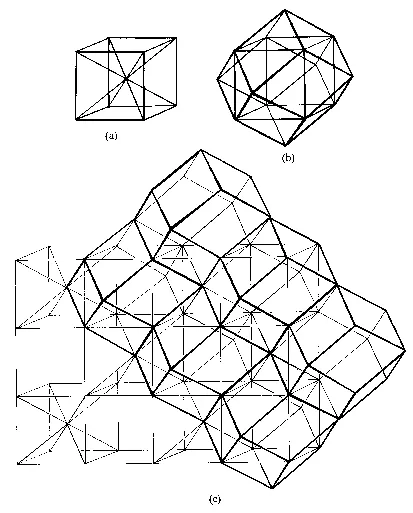
40 Fig. 12 93 Space-filling rhombic dodecahedron via degenerate stellation of cube
41 (a) Cube's 4 body diagonals divide its inside into 6 pyramids.
(b) Cube's 6 inside pyramids stacked outside cube to form degenerate stellation, forming a
rhombic dodecahedron.
(c) Array of space-filling rhombic dodecahedra interleaved with array of space-filling
cubes.
42 Duality and Domain in Sphere Packing
43 Imagine that our closest-packed spheres are actually perfectly round balloons. Supposing they are all packed tightly into a closed container which insures that their positions are fixed, we then try to picture what would happen if more air were steadily pumped into each balloon. Remember that they are unable to move—preventing the natural reaction of collectively spreading out and taking up more space. Instead each individual balloon expands and presses more tightly against its neighbors so that the points of tangency merge into planes of tangency:
44 A bubble is only a spherical bubble by itself. The minute you get two bubbles together, they develop a plane between them. (536.44)
45 We allow the balloons to grow to the extent that all available space is occupied. What is the shape of the balloons once they merge together? Remember that twelve spheres pack tightly around one, and so the tangency points between spheres, which were located at the twelve (4-valent) vertices of vector equilibria, must now be replaced by the same number of 4-valent faces. We are thus reminded that the domain of a sphere in closest packing—in Fuller's words "the sphere and the sphere's own space"—is a rhombic dodecahedron.
46 The above sequence provides an important insight into the space-filling ability of rhombic dodecahedra. By renaming this diamond-faceted polyhedron "spheric", Fuller places considerable emphasis on its relationship to closest packing. The spheric is thus presented as a cosmically significant shape, the domain of the generalized energy event, and consequently, the domain of every intersection in the omnisymmetrical vector matrix.
47 Synergetics thus arrives at its all-space fillers through investigation of nature's omnisymmetrical framework. IVM provides the context:
48 A "spheric" is any one of the rhombic dodecahedra symmetrically recurrent throughout an isotropic vector-matrix-geometry… (426.10)
49 426.20 Allspace Filling: …Each rhombic dodecahedron defines exactly the unique and omnisimilar domain of every radiantly alternate vertex…as well as the unique and omnisimilar domains…of any aggregate of closest-packed uniradius spheres…
50 In a later section of Synergetics, Fuller expands upon the above observations with a more general statement about any point in space.[183/184]
51 The most complete description of the domain of a point is not a vector equilibrium but a rhombic dodecahedron, because it would have to be allspace filling and because it has the most omnidirectional symmetry. The nearest thing you could get to a sphere in relation to a point, and which would fill all space, is a rhombic dodecahedron. (536.43)
52 Truncated Octahedron
53 The "truncated octahedron", or tetrakaidecahedron, is also a known space filler (Fig. 12-94.a). A model of this semiregular polyhedron can be constructed by taping together eight cardboard hexagons and six squares of the same edge length. But Fuller is wary of that approach, a geometry which supports the illusion of "solids". Instead, synergetics prescribes that we view the system in context. Therefore, to generate this shape we start with a "3-frequency octahedron". With its edges divided into three equal segments, this octahedron submits quite naturally to vertex truncation, as shown in Chapter 9, Fig. 9-68.b. A (single-frequency) ½-octahedron can be chopped off from each comer, creating six square faces and converting the 3-frequency triangles into equilateral hexagons.
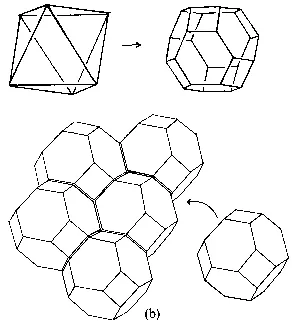
55 Fig. 12 94 Space-filling tetrakaidecahedron by truncating 3v octahedron
56 (a) Truncation of 3v octahedron to form tetrakaidecahedron (truncated octahedron).
(b) Tetrakaidecahedra (truncated octahedra) are space-filling (4 around each IVM
vertex).
57 How do they fit together? Hexagonal faces of two truncated octahedra come together after rotating 60° with respect to each other, so that square faces alternate (rather than landing next to [184/185] each other) and begin to frame a cavity in the exact tetrakaidecahedral shape (Fig. 12-94.b).
58 Four tetrakaidecahedra fit together around one IVM vertex. To ascertain the exact relationship of this packing to the IVM will require some investigation: how remote are the vertices involved, and how many cells are incorporated in between? We will answer these questions below, but first we go back to the simpler cases, for a sense of the whole progression.
Two to One: A Review
60We can now appreciate Loeb's development of the requirement that a space-filling polyhedron can be broken down into twice as many octahedra as tetrahedra.41
61 The cube consists of one tetrahedron plus four 1/8-octahedra—or a total of ½-octahedron. This ratio of 1 to ½ certainly qualifies. Eight ¼-tetrahedra (for a total of two) embrace one octahedron to create the rhombic dodecahedron. With this confirmation, we start a list of results, displayed in Table 12-6.
62 The VE consists of eight tetrahedra and six ½-octahedra: 8 to 3. Lacking one octahedron, the VE must not be a space filler, a conclusion that is consistent with our earlier observation of the IVM. However, pair a VE with the missing octahedron and all space can be filled. The 2-to-1 ratio also serves as a prescription for complementary pairing; if an IVM system is not a space filler, the ratio tells us what's missing.
63 Table 12 6 Octahedron-tetrahedron ratio in space filling
65 The rest? All-space-filling rhombohedra are utterly straightforward; with two tetrahedra on either side of an octahedron, this shape gave [185/186]us our starting point for the space-filling ratio. Icosahedra cannot be broken down into tetrahedra or octahedra; the icosahedron is eternally out of phase. That brings us to the truncations, which can be analyzed in terms of the IVM. As a representative example, we explore the truncated octahedron.
66 The 3-frequency octahedron incorporates nineteen single-frequency octahedra and thirty-two tetrahedra. It can be a frustrating experience to count these individual cells, but it can be done! Skeptics are encouraged to get out a box of toothpicks and some mini-marshmallows. Fig. 12-95 illustrates the dissection of one half of a 3-frequency octahedron, to make it easier to count the unit cells in individual layers. Sixteen tetrahedra and nineteen ½-octahedra are clearly visible in the three layers shown. These results are simply doubled to verify the totals in the first sentence of this paragraph.
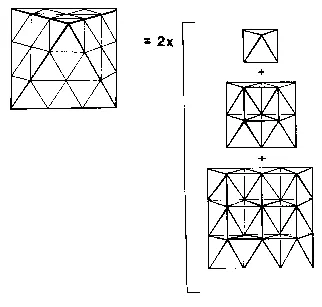
68 Fig. 12 95 Individual layers of 3-frequency octahedron.
69 The ratio of 32:19 does not qualify. Not surprisingly, the 3-frequency octahedron—like any regular octahedron, for size does not affect shape—is not a space filler. The truncation process removes half of a small octahedron from each of the six comers, or three octahedra altogether. Nineteen minus three leaves sixteen, while the total of thirty-two tetrahedra does not change. 32:16 is indeed 2-to-1, and the rule holds true once again.[186/187]
70 The truncated tetrahedron can be dissected in the same manner as its octahedral counterpart. The IVM starting point, a 3-frequency tetrahedron, consists of eleven unit tetrahedra and four octahedra, and is clearly not a space filler—as we well know. Fig. 12-96 enables the unit cells to be counted, by separating the layers of a 4-frequency tetrahedron. In the process of counting, we can also finally verify the claim introduced in Chapter 2 that 3rd-power numerical values (2³, 3³, 4³, etc.) are represented by the volumes of tetrahedra of increasing frequency. Recall that the expression "x cubed" is derived from the fact that cubes of progressively higher frequency consist of 1, 8, 27, 64,… unit cubes. Fuller points out that exactly the same volumetric increase is exhibited by tetrahedra, as [187/188]portrayed in Fig. 2-1.b. We now take advantage of the dissected 4-frequency tetrahedron to verify these values. Adding up the volumes of the unit tetrahedra (each with a volume of one) and unit octahedra (each with a volume of four) in successive layers, we quickly find that the "cubic" numbers are confirmed, as shown in Fig. 12-96. A 2-frequency tetrahedron has a volume of 8; a 3-frequency, 27; a 4-frequency, 64; and so on.
71 "Nature is not 'cubing,' she is 'tetrahedroning,'" announces the triumphant Bucky.
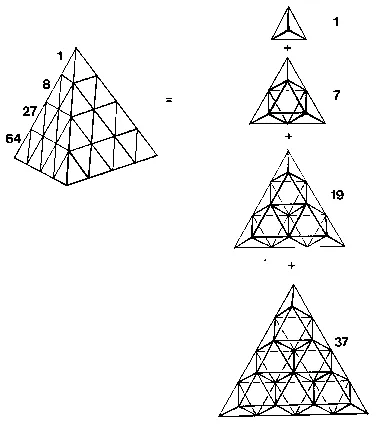
73 Fig. 12 96 Volume cross-sections of 4v tetrahedron
74 Volume accounting in tetrahedra of increasing frequency: 3rd-power model
75 Back to the space-filling investigation, our next candidate is the (semiregular) truncated tetrahedron, which in synergetics is derived from a 3-frequency tetrahedron. Subtracting a unit tetrahedron from each of the four corners yields a truncated tetrahedron consisting of seven small tetrahedra and four octahedra (Fig. 9-68.a). Seven-to-four does not correspond to the desired ratio, and we thus learn that this shape will not fill space either; it lacks one unit tetrahedron. As a final illustration of the dissection method, we note the new totals when a 3-frequency tetrahedron is paired with a 3-frequency octahedron. The resulting inventory consists of 43 tetrahedra and 23 octahedra, which does not quite reach the desired double ratio. What if we add a second 3-frequency tetrahedron? The final total is then 54 tetrahedra and 27 octahedra, and that's it. Two 3v tetrahedra paired with one 3v octahedron are able to fill space. Once again, shape proves independent of size.
76 The above examples provide first-hand confirmation of the space-filling hypothesis, allowing us to feel confident that a new truth has been revealed.
77 Out of all the accumulated data, a consistent finding emerges. With this generalized principle, we are equipped to determine whether any polyhedron that submits to analysis in terms of octahedral and tetrahedral components is a space filler. We just have to break it down into these constituent parts and check the ratio for the requisite 2-to-1. The ratio replaces the arduous task of trying to push shapes together and twist them around to see if they pack; it is another shortcut. IVM provides the framework; 2-to-1 is the ratio; all criteria supplied.
78 Coincidence? Magic? Or rules of spatial order?[188/189]