
2 The Irrationality of Pi
2Young Bucky Fuller seems to have been haunted by . Discovering that the ratio of a sphere's circumference to its diameter is an irrational number commonly referred to by the Greek letter was perhaps the most disturbing of all geometry's strange lessons. Just as he could not imagine where its accomplice in deception, the infinite straight line, stopped, Bucky could not let go of a vision of thousands upon thousands of digits trailing after 3.14159…, spilling out the classroom window and stretching absurdly to the next town and then farther, never allowed to stop.
3 He has told the story countless times, each rendition sounding like the first, with an air of revelation. If he happens to be standing by the ocean, so much the better; he's bound to talk about the foaming waves.
4 "Look at them all!" he marvels, "beautiful, beautiful bubbles, every one of them!"
5 Bucky recalls that growing up near the ocean gave him plenty of time to think about the structuring of these bubbles. Looking back at the wake trailing behind his boat, or standing knee-deep in breaking waves at the shore, he saw the water continuously being laced with white foam. Its whiteness was created by vast numbers of tiny air bubbles, each one suddenly formed and emerging at the water's surface.
6 "How many bubbles am I looking at?" Bucky would ask himself, "fantastic numbers, of course".
7 He could not help wondering: if each and every one of those spheres involves , to how many digits does nature carry out the irrational in making one of those bubbles, before discovering that it can't be completed? At what point does nature stop and make a "fake bubble"? And how would the decisions be made? In meetings of the chemistry and mathematics departments? No, the young Bucky concluded, I don't think nature's making any fake bubbles; I don't think nature is using .
8 It is a decidedly amusing image: nature gathering department heads, nature's consternation over fudging the numbers, getting [015/016]away with imperfect bubbles—and it is through such deliberate personification that the ideas become memorable. The story of a young man looking out from his ship carries a deeper message. Fuller uses this particular event—even assigning a time and place, 1917 on a U.S. Navy ship—as a moment of revelation, the threshold of his conscious search for nature's coordinate system. The scene is bait, to draw us in, make us as curious about nature's structuring as that young sailor was. It works. If he had started on a heady discourse about mathematical concepts versus natural structures, his audience might have walked away.
9 It's important to realize the nature of his rebellion: not to challenge the theoretical numerical ratio between the circumference and diameter of the ideal sphere, but rather to challenge that sphere to materialize. Irrational numbers don't belong in tangible experiences. It is a question of sorting out the demonstrable from the impossible and then developing models based on the former. Essentially, Bucky is choosing not to play with , posing the question "why shouldn't mathematics deal with experience"?
"Nature Isn't Using Pi"
11Nature can have no perfect spheres because she has no continuous surfaces. The mathematician's sphere calls for all points on its surface to be exactly equidistant from the center. This "sphere", explains Fuller, has no holes. It is an absolutely impermeable container sealing off a section of Universe, a perpetual energy-conserving machine defying all laws of nature. The illusion of a physical continuum in any spherical system is due to the limitations of the human senses.
12 On some level of resolution, all physical "solids" and surfaces break down into discrete particles. A magnifying glass uncovers the tiny dots of different colors that make up the "pure" blue sky in a magazine photograph, and a microscope—if it could be set up in the sea—would reveal that nature's bubbles are likewise fragmented, consisting of untold numbers of discrete molecules located approximately equidistant from an approximate center. If such a phenomenon could be precisely measured, we would find that the ratio of a bubble's circumference and diameter is some number very close to the elusive , but the point, says Bucky, is that the bubble differs from the Greek ideal. A physical entity is necessarily demonstrable and finite, while an irrational number such as is just the opposite. A real sphere consists of a large but finite number of [016/017]interconnected individual energy events. Moreover, the middle of each of the implied chordal (straight-line) connections between events is slightly closer to the sphere's center than the ends, thereby violating the mathematical definition, and insuring some small departure from the ratio . Any cross-section of this sphere will be, not a circle, but a many-many-sided polygon. Likewise, the most perfect-looking circle, carefully drawn with a sharpened pencil and accurate compass, will appear fuzzy and fragmented through a good magnifying glass. The most precise ball bearing is imperfect: a good approximation of , but always imperfect, with bizarre mountains and valleys dramatically visible after 5,000 times magnification. In Chapter 15 we shall examine the specifics of one alternative model for the mathematician's impossible sphere.
13 "Fake bubbles" led to further contemplation about . Nature is always associating in simple whole rational numbers, thought Bucky: H2O, never HO. Irrational numbers do not show up in chemical combinations of atoms and molecules.
14 Clearly, nature employs "one coordinate, omnirational, mensuration system". (410.011)
15 None of this is new information; any one of us could have thought about it for a while and understood that of course does not play a role in the making of bubbles. What happens is that turbulence introduces air into the water and the air is so light that it floats toward the surface to escape. It's an easy problem of getting the most air in each pocket with the least surface area of water pushing in to collapse the bubble. A spherical space allows the most volume per unit of surface area (as we shall learn in later chapters), providing the most efficient enclosure for that air. (Nature is exquisitely efficient.) But, even if we did contemplate this mystery at the seashore, we probably didn't bother to take our children aside and explain it to them before they became perplexed and frustrated by the never-ending in mathematics class.
16 If nature's lack of employment of isn't news, why does Bucky persist? Why use his own considerable—but still finite—energy to lecture tirelessly on the subject for half a century? The answer lies in the fact that our education and popular awareness fall short of the mark; Fuller felt that society did not sufficiently emphasize this discrepancy between theoretical games and real structures. We introduce "solids" to school children long before they learn the real story about energy-event reality. If humanity is to feel comfortable with science, argues Fuller, education must present accurate models in the first place. The message behind the bubble's story is: why not tell the truth from the beginning? He calls for widespread recognition of [017/018]discrete energy events, a reality that cannot be perceived by human senses.
17 Unfortunately, the issue is not that easily resolved. We shall not ever completely escape the brain-teasing presence of irrational numbers. For example, the construction of the simplest polygons, with carefully measured unit-length edges, frequently produces irrational diagonals. The distance between nonadjacent vertices in a regular pentagon is the irrational number known as the "golden section", which we shall see again in Chapter 11, and the diagonal of a square is incontrovertibly 2. However, in every actual construction, a finite approximation can be determined according to the specific limitations of available measuring instruments. That numerical fractions must terminate is a consequence of investigating verifiable experience rather than theoretical relationships. Just as architects do not work with irrational-length two-by-fours, measurements obtained through "operational procedure" are necessarily real. Finally, Bucky's dismissal of these troublesome values calls attention to the granular constitution of physical reality, as described in the following section.
Finite accounting system
19"You cannot have a fraction of an energy event", philosophizes Bucky.
20 Science's progressive subdivision ultimately reaches indivisible particles, which means that reality consists of whole numbers of energy events. Therefore, we need models that will demonstrate the concept of structures consisting of discrete, or countable, units. In synergetics, area and volume are presented as quantities that can be counted, as opposed to measured and described as a continuum. Area is associated with some whole number of events on the surface, while volume is tallied as the number of events throughout a system. Chapter 8 will examine how sphere-packing models illustrate the association of volume and surface area with discrete units; Chapter 10 will discuss the concept of volume in general and its role in synergetics.
21 We are not used to thinking of reality as submitting to a "finite accounting system", but in fact it does. Consider the phenomenon of light. Few things seem more continuous than the light that fills your living room when you turn on the switch, or the light that seems to fill the whole world on a sunny day at the beach. But we now know that even light consists of individual packages of energy, called photons. Although they could hardly be smaller or lighter, photons [018/019]are nonetheless discrete events, countable in theory, even if there are always too many, jumping around too fast, to make that enumeration possible in practice. With its flawless illusion of continuity contradicting science's detection of constituent photons, light is a perfect phenomenon to symbolize the validity of a "finite accounting system". We could hypothesize a system in which volume was tallied in terms of the number of photons in a given space, and area, the number of photons found at the surface; however, it would be a fantastically impractical system. A more appropriate unit is called for. For now, however, we simply consider the qualitative implications of the discrete-events concept. A punctuated reality is hard to get used to.
Which Way Is "Up"?
23Fuller proposed a revolution in modes of thinking and problem-solving, which above all else required a comprehensive approach, as will be discussed in Chapter 16. To Fuller, "comprehensive" means not leaving out anything—least of all humanity's important tool of language. A dictionary contains an inventory of 250,000 agreements, he explains, specific sounds developed as symbols for 250,000 nuances of experience. He saw this gradual accomplishment as one of the most remarkable developments in the history of humanity, with its implied cooperative effort.
24 One aspect of his revolution thus involves an effort to employ words accurately. Fuller's discourses on the subject tend to be quite humorous, almost (but not quite) concealing how deeply serious he was about the matter. Much of our language is absolutely stuck in "dark ages" thinking, he would lecture. Up and down, for instance. These two words are remnants of humanity's early perception of a flat Earth; "there is no up and down in Universe!" exclaims Fuller. When we say "look down at the ground" or "I'm going downstairs" we reinforce an underlying sensory perception of a platform world. Neither the ground nor Australia can accurately be referred to as down; 3 hours after a man in California says that the astronauts are up in the sky, the shuttle is located in the direction of his feet. Up and down are simply not very precise on a spherical planet. The replacements? In and out. The radially organized systems of Universe have two basic directions: in toward the center and radially out in a plurality of directions. Airplanes go out to leave and back in to land on the Earth's surface. We go in toward the center of the Earth when we walk downstairs. The substitutions seem somewhat trivial [019/020]at first, but again it is difficult to judge without trying them out. Experimenting with "in" and "out" can be truly reorienting; unexpectedly one does feel more like a part of a finite spherical system—an astronaut on "Spaceship Earth". (It's hard to keep at it for long however; up/down reflexes are powerful.)
25 The sun does not go down, insists Bucky; how long are we going to keep lying to our children? First of all, we now know there is no up and down in the solar system and secondly, the sun is not actively touring around the Earth. Rather, we are the travelers, and our language should reflect that knowledge. Oddly, the phraseology which gives the sun an active role ('darling, look at the beautiful sun going down') does seem to reinforce the erroneous conception of a yellow circle traveling across the sky. While we know this isn't the case, it often feels like the way things happen. This effect is not easily measured and probably varies from individual to individual.
26 What does all this have to do with geometry? Remember that one of the goals of synergetics is to help coordinate our senses with reality, that is, to put us in touch with Universe, which to Fuller involves eradication of the erroneous vocabulary which keeps us locked into "dark-ages" thinking on a sensorial level. In short, we need to align our reflexes with our intellect. Instead of sunset and sunrise, reinforcing the sun's active role, Fuller suggests sunclipse and sunsight, which imply instead that our view of the sun has been obscured and that an obstacle has been removed, respectively. Who knows if people could adjust to such substitutions? It might be worth a try.
27 The cube is another remnant of flat-Earth days, and Fuller has a wealth of reasons to prefer another mathematical starting point, which will be discussed throughout this volume. Our age-old dependence on squares and cubes is honored by an unfortunate verbal shorthand for "x to the 2nd power" and "x to the 3rd power". The expressions "x squared" and "x cubed" are so commonly used that most people assume these multiplication functions to have a true and exclusive relationship to squares and cubes. The shorthand "squared" is derived of course from the fact that a square can be subdivided by parallel lines, with "x" subdivisions along each edge, into "x to the 2nd power" smaller squares. For example, a square with 2 "modular subdivisions" per edge contains 4 small squares, and similarly 3 subdivisions yield 9 squares, 4 yield 16, 5 yield 25, and so on (Fig. 2-1). Everyone is familiar with these diagrams, but what most people do not realize is that this result is not unique to squares. Triangles exhibit the same property, as also shown in Fig. 2-1.
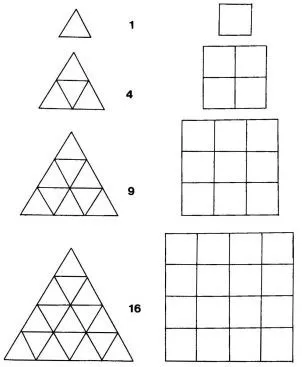
29 Fig. 2 1 "Triangling" versus "squaring"
30 Furthermore, explains Fuller, triangles take up only half the [020/021]space, because every square divides into two triangles. Triangles in general, therefore, provide a more efficient diagram for the mathematical function of multiplying a number by itself. Nature is always most economical; therefore nature is not "squaring"; she is "triangling".
31 Happily, the same is true in three dimensions: the increasing volumes of subdivided tetrahedra (if this is an unfamiliar shape, wait until the next chapter!) supply the 3rd-power values just as accurately as do subdivided cubes: 2³ = 8, 3³ = 27, 4³ = 64, etc. Tetrahedra of course take up less room than cubes, and to Bucky, the choice is clear. We do not, at this point in the text, have the necessary experience to fully understand the 3rd-power model shown in Fig. 2-2, but the relevant principles will eventually be discussed.
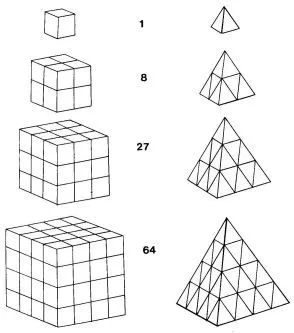
33 Fig. 2 2 "Cubing" versus "tetrahedroning"
34 Note that tetrahedra alone cannot fit together face to face to form the larger tetrahedra shown; they must alternate with octahedra, as explored in Chapters 8, 9, 10, 12, 13. The volume values shown employ a unit-length tetrahedron as one unit of volume, in the same manner that a unit-length cube is conventionally employed. Despite the tetrahedron's inability to fill space, the relative volumes of tetrahedra of increasing size are identical to those exhibited by cubes of increasing size.
35 The point to be made now is that squares and cubes cannot boast a special inherent significance for multiplicative [021/022]accounting. Triangles and tetrahedra are equally reliable (and in some ways more reliable, as we shall see).
36 Fuller argues that our arbitrary habitual references to squares and cubes keep us locked into a right-angled viewpoint, which obscures our vision of the truth. From now on, says Bucky, we have to say "triangling" not "squaring" if we want to play the game the way nature plays it.
Visual Literacy
38Fuller's concern with fine-tuning communication, developing and using words that are consistent with scientific reality, is one facet of the role of language with respect to synergetics. Another deals with the difficulty of describing visual and structural patterns. Anyone who has tried to describe an object over the telephone is well aware of the problems involved; there seems to be a shortage of functional [022/023]words. The temptation to use your hands is irresistible, despite the futility. This scarcity of linguistic aids is especially severe for non-cubical structures—which characterize most of nature. That a language of pattern and structure is not widely accessible indicates that humanity's understanding of such phenomena is similarly underdeveloped. We thus join forces with Fuller in an investigation of this neglected field, and in so doing we become more and more aware of the rich complexity of the order inherent in space. Along the way, we are introduced to some new terminology that includes the lesser-known language of geometry as well as some words invented by Fuller. More information—useful only, it is clear, if the terminology is both precise and consistent—leads to better comprehension, which in turn leads to the ability to experiment knowledgeably. Experiment fosters both greater understanding and invention—in short, progress.
39 In conclusion, Fuller's insistence on employing accurate vocabulary is part of an important aspect of human communication. We join him as pioneers in the science of spatial complexity, the terminology of which is for the most part unfamiliar. The systematic study of structural phenomena is an important and badly neglected aspect of human experience.
Peaceful Coexistence
41There is a strong temptation to ignore synergetics on the grounds that we feel perfectly able to handle mathematical concepts that cannot be seen. Academic "sophistication" leaves us with a certain intellectual pride that makes Fuller's observations with their childlike (but-the-emperor-isn't-wearing-any-clothes) ring to them seem unimportant. Every child is boggled by infinity and surfaces of no thickness, but these are necessary concepts, natural extensions of philosophical "what-ifs". The human mind is not bounded by the constraints of demonstrability.
42 True enough. However, it is also possible to define a system of thought and exploration that is confined to the "facts of experience", and moreover such a system is able to reveal additional insights about physical and metaphysical phenomena that would not necessarily be discovered following the traditional route. Such is the case with Fuller's synergetics; as we shall see, his hands-on approach led to a number of impressive geometrical discoveries. Synergetics is a different kind of mathematical pursuit, not a replacement for calculus but rather a complementary body of thought. Reading further will not face you with an ultimate demand for a decision of fundamental [023/024]allegiance: synergetics or the mathematics you learned in school. Rather, you have the option of being additionally enriched by a fascinating exploration of structure and pattern that cannot help but change the way you see the visual environment.
43 When Bucky reminisces, "There is nothing in my life that equals the sense of ecstasy I have felt in discovering nature's beautiful agreement", he offers us an enticing invitation. He has taken an alternate route and it has not disappointed him.
44 Operational mathematics cannot claim exclusive rights to the name of mathematics, any more than other branches of mathematics can; it is simply a new approach, stemming from the characteristically human drive to experiment. Its claim instead is that exposure to these concepts fosters an understanding of nature's structuring and therefore provides an advantageous base of experience. In short, synergetics is an internally consistent system which has produced significant models with respect to certain physical phenomena and led directly to practical inventions (with "life-support advantage", to use Fuller's terminology). It is likely that thus far we have only skimmed the surface of the applications of synergetics; very few people have been exposed to its principles, and so their full significance is as yet untested.
45 Finally, Bucky's approach is compellingly playful, and we should read his material with the inclination to enjoy the adventure. "Sense of ecstasy"? Why not? Fuller's unorthodox way of looking at mathematics—and indeed Universe—can provide a way to circumvent some of our more rigidly held assumptions. Here is an invitation to start over; with a temporary suspension of disbelief, we can embrace a new understanding of the exquisitely designed "scenario Universe". One of the challenges of synergetics lies in opening rusty mental gates that block discovery, for we are asked to be explorers and "comprehensive thinkers"—job titles not usually assigned in our specialized world. The essence of synergetics is "modelability"; anyone can play with these models, and likewise, claims Fuller, anyone can understand science once they get their hands on nature's coordinate system. Its accessibility and emphasis on experimental involvement makes Fuller's thinking extremely important. He offers us an approach to learning and thinking—an open-minded, experimental curiosity—which itself is applicable to every discipline and aspect of life. No question is too simple or too complex to be asked. Fuller's first words in Synergetics are "Dare to be naïve", reminding us that we have the option to see the world through new eyes.[024/025]