1 Comprehensive Heritage
2Bucky Fuller was born on July 12, 1895 in Milton, Massachusetts, just outside Boston, to Richard Buckminster Full-er, Sr., and Caroline Wolcott (Andrews) Fuller. He was christened Richard Buckminster Fuller, Jr., and given the un-usual but ancestral family name Buckminster.1 That name dated back to his celebrated forebear Colonel Joseph Buckminster, who left the British Army to fight with George Washington in the Revolutionary War.2
3 Before he was ten years old, young Bucky, as he had come to be called by both family and friends, was already developing the classic Fuller flair for selecting his own pathway, and he demonstrated that resolve when deciding how he would inscribe his name. Tradition at the Fuller family’s summer retreat on Bear Island in Maine’s Penobscot Bay required all visitors, be they family, friend, or stranger, to sign the guest register. As a child, each summer Bucky would experiment in penning his yearly contribution to that register. One year he signed in as ‘‘Richard B. Fuller,’’ another year as ‘‘Richard (Bucky) Fuller’’ and another as ‘‘R. B. Fuller.’’ Finally, after years of experimentation, Bucky settled on the combination he maintained throughout the balance of his life. He felt that using his first initial with his uncommon middle name was the most sophisticated combination; thus, Bucky became R. Buckminster Fuller.3
4 In many respects, he was the culmination of several generations of New England nonconformity. Not adhering to traditional beliefs was so prevalent in the Fuller family that it had become the status quo.
5 Fuller’s great, great, great, great-grandfather, Lt. Thomas Fuller of the British Navy, traveled to the American Colonies on a furlough in 1630
6 and became so exhilarated by the revolutionary demands for greater free-dom being openly expressed that he settled in New England. Lt. Fuller’s offspring shared his love of new ideas and possibilities, and his grandson the Reverend Timothy Fuller graduated from Harvard in 1760 and became a Massachusetts delegate to the Federal Constitutional Assembly. The nonconformist, freethinking Reverend Fuller was so incensed about the fact that the draft Constitution did not prohibit slavery, he refused to vote for its ratification.4
7 His son, Timothy Fuller, Jr., was born in 1778 and gained notoriety as a founding member of Harvard’s Hasty Pudding Club. As a penalty for taking part in a student revolt, Timothy, Jr., was graduated second in the Harvard class of 1801 rather than in his rightful place at the head of that class.5
8 Fuller’s grandfather the Reverend Arthur Buckminster Fuller graduated from Harvard in 1840 and maintained the family tradition of support-ing greater freedom for all people. He was a staunch abolitionist, and although he held positions as a minister in Boston and chaplain of the Fifth Massachusetts Regiment, he was not opposed to fighting for his beliefs. His dedication to the cause of freedom eventually led to the Reverend Fuller’s untimely death while leading a successful charge of Union troops during the Civil War.6
9 From records of family history and accomplishments, it is clear that the external achievements of the Fuller family, as in most families prior to the turn of the century, were fulfilled by men. Young Bucky was, how-ever, influenced by one strong female ancestor, his great-aunt Margaret Fuller. Margaret Fuller was the singular, prominent nonconformist female of the Fuller clan, and in her short life from 1810 to 1850, she became the most famous of Bucky’s ancestors.7
10 Margaret was a feminist long before the term was coined, and she paved the way for future generations of women to fight for greater free-dom and equality.8 Her platform for change was the written word, and in conjunction with her good friend the poet Ralph Waldo Emerson, Margaret Fuller founded the Transcendentalist literary magazine The Dial. She also became the first female foreign correspondent employed by a major newspaper, The New York Times.9
11 Although she died decades before Bucky’s birth, Margaret Fuller’s influence endured within the Fuller family, and young Bucky was not exempt from it. He was told stories of his famous aunt, her distinguished cohorts, and their Nature-based philosophy which stressed the divine orderliness of the Universe.10
12 Years later, when Bucky himself began to establish his comprehen-sivist philosophy, he could not help but be influenced by the connection between human beings and all Nature which Margaret had championed. His philosophy would, however, also include the mechanical technology which was just beginning to seriously influence lifestyles when Transcen-dentalism was flourishing and which was overlooked or viewed as a negative influence by most Transcendentalists. Bucky felt that natural creations such as the human hand represented technology at its finest and believed that the best human-created technology was that which most closely mirrored Nature’s creations.11
13 Although she significantly influenced Bucky’s ideas, Margaret was an exception to the male-dominated society into which he was bom. His family was no different than most, in that men were expected to go out into the world while women were supposed to fulfill a role regarded by the men as far less important: maintaining the home.12 Although Bucky sought to overcome prejudice at all levels, even in the later years of his life, the influence of the male-dominated environment into which he had been born continued to influence him. Still, the strong women of the Fuller family, including his mother and Aunt Margaret, did somewhat balance Bucky’s exposure to the traditional male-dominated perspective. Their influence nurtured what would later blossom into a passionate desire to eliminate discrimination wherever he encountered it and to work at projects which benefited all humanity.
14 Fuller, however, could not completely break free of his early up-bringing. Even though, during the final years of his life, he proclaimed that the Equal Rights Amendment to the Constitution was the most signifi-cant piece of legislation ever written, women tended to be relegated to support positions rather than partners in his life.13 He was always quick to acknowledge the contributions of his wife, his mother, and other women, but he rarely spoke or wrote about the accomplishments of women in the same glowing terms as he did those of his male ancestors or men like Henry Ford and Albert Einstein. Special adulation was, however, re-served for his father.
15 Like all the American Fuller men before him, Bucky’s father, Rich-ard Fuller, attended
Harvard. Following his graduation in 1883, however, the rebellious Richard became the
first male in eight generations who did not observe the family heritage of service and
prominence as a minister or a lawyer.14 Instead, Richard Fuller indulged the family
penchant for adventure to become an importer of leather hides and exotic teas. In
that
position Richard Fuller became one of the few Milton citizens who journeyed farther than could
be traveled in one day on foot or by horseback.15 The Fullers were one of many families who
moved from Boston to Milton, a town which had for generations served primarily as a summer
retreat from the Boston heat. In Milton, Richard and Caroline Fuller contracted for the
construction of a large house, and in that house their second child and first son, Richard
Buckminster, Jr., was bom on a cloudless summer day in 1895. At the time, the Fullers’
immediate family
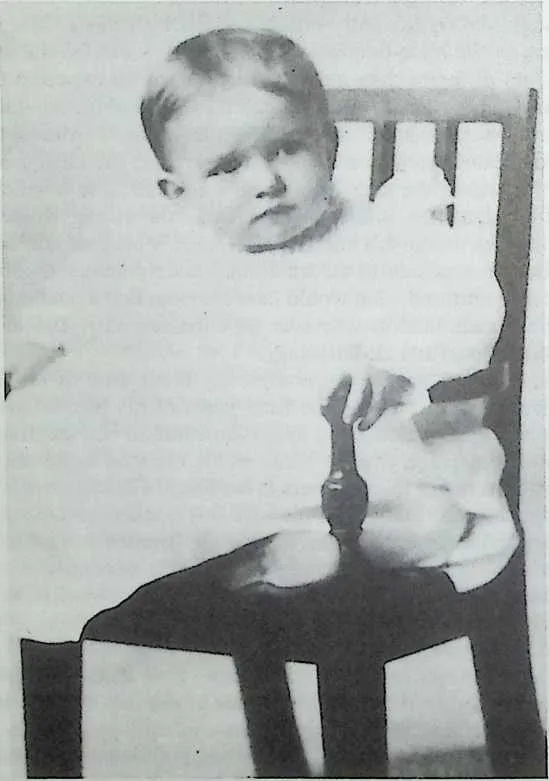
1718Fig. 1-1 Early baby photograph of Bucky.
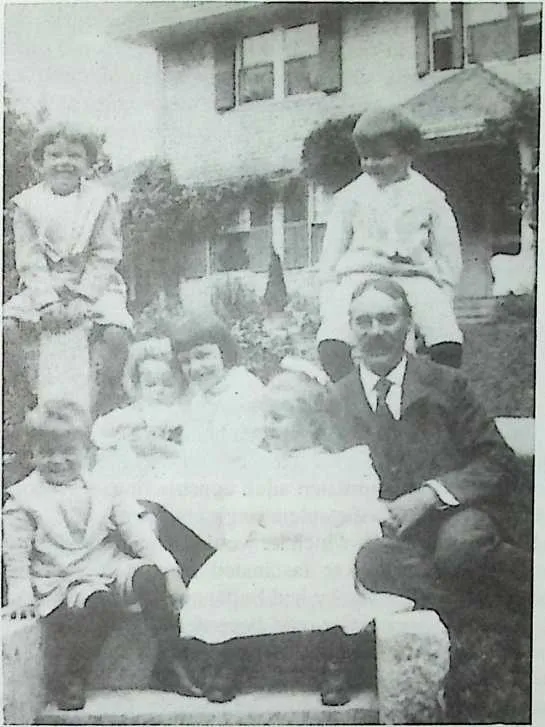
20 Fig. 1-2 Young Bucky (upper left, sitting astride stone ledge) with some of the Fuller clan, 1899. Brother Wolcott and sister Leslie are seated second and third from the left.
21 consisted of only one other child, Bucky’s older sister Leslie, but within a few years two more children were bom, brother Wolcott (Wolly) and sister Rosamond (Rosy).16
22 Even as a youngster Bucky was unique within the Fuller clan, which included numerous nearby aunts, uncles, and cousins.17 Because he had been bom with an extreme undiagnosed nearsightedness, his visual perception of reality was limited to fuzzy shapes, and he compensated for that disability by relying on his other senses as well as his independent think-ing for an understanding of his environment.18
23 By the time he had reached the age of four, Bucky, as he had been nicknamed by friends and family, had developed an acute sense of hear-ing, touch, and especially smell. In fact, his sense of smell was so sensitive that later in life he would assert that he was usually able to recognize and make inferences about people only from their scent. And he retained those acute capacities throughout his life. Even in his eighties, he would amaze people by demonstrating an uncanny ability to determine a great deal about a person just from a scent which went undetected by others.19
24 Because of his handicap, during the last of those nearly sightless initial four years of life, young Bucky fabricated what would be the first of many futuristic structures. His kindergarten teacher provided her students with the traditional toy construction materials of the day, dried peas and toothpicks, and the other children immediately began reproducing structures which mirrored the buildings they had observed in daily life. Naturally, their frameworks were rectangular, supported by right angle comers held firm with dried peas. However, with no accurate visual experience to rely upon, young Bucky began creating a structure which satisfied his sense of touch rather than imitated adult construction.20 Accordingly, his framework was composed of stable triangles and was, in fact, a rudimentary model of the octet truss, which he would invent and patent in 1961.21
25 Although his teacher was fascinated enough to call in the other teachers to see what little Bucky had built, no one had any idea just how important that crude structure would become.22 Even today, few people who are not involved in the construction industry appreciate the importance of the octet truss. Yet, without that light, incredibly strong structure, a great deal of construction would not be possible. One need only look up during a concert or stage performance to see Fuller’s invention. The
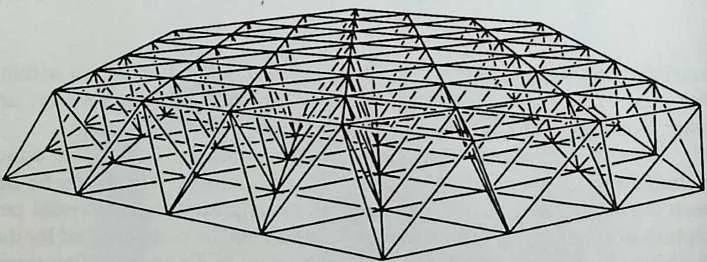
2728Fig. 1-3 The modem octet truss.
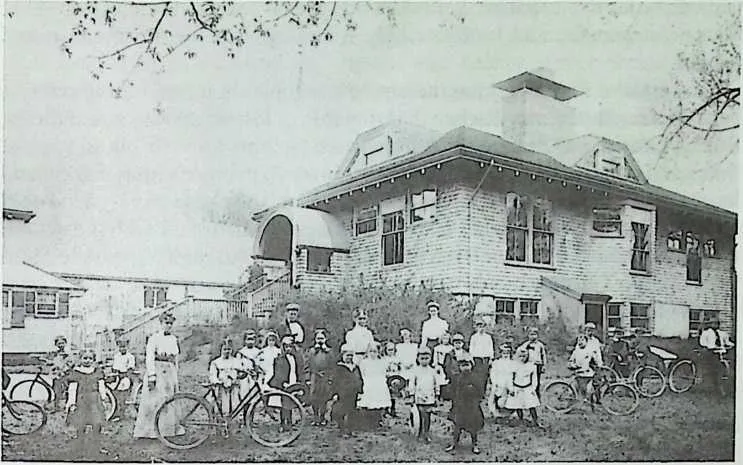
30 Fig. 1-4 Milton Academy, 1904. Bucky is fifth from the right standing behind his bicycle.
31 triangulated scaffolding which provides the strength for staging many performances is simply a series of connected octet truss structures.
32 The year 1900 ushered in a new century as well as an entirely new life for Bucky. Late in 1899, his nearsightedness was diagnosed, and eyeglasses were prescribed. Following that momentous transformation, the five-year-old was able to view a new world beyond his wildest dreams. Prior to receiving glasses, Bucky had believed everyone was confined to the same blurred environment he experienced. So when his sister Leslie described the world as she saw it, he thought he was listening to the output of a fanciful imagination. With his newly discovered, normal vision Bucky embarked upon a journey of outward exploration, question-ing, and experimental learning which would continue throughout his life. 23
33 The moment he obtained eyeglasses, Bucky felt reborn, excited to discover an endlessly fascinating environment.24 He was especially captivated by eyes, both human and animal, and quickly became aware of the communication occurring between people’s eyes.25 Because he had functioned without true visual contact for the first years of his life, Fuller valued the human capability of conscious eye-to-eye communication more than most people, and he knowingly relied upon it for information and insight.
34 In typical Fuller fashion, he turned his apparent visual problem into a benefit over the years. Rather than regarding his myopia as a handicap, Bucky considered himself fortunate to be able to remove his glasses at times and consciously shift his attention inward, using his imagination and intuition, rather than his sight, for guidance. At those times, he could effortlessly recall the inner, imaginative environment he had lived within and explored prior to receiving glasses, and that ‘‘in-sight’’ provided him with many of his extraordinary ideas.26
35 Fuller’s formal education was typical for an upper-middle-class New England boy at the turn of the century, but he was perpetually hampered by his small physique and dense eyeglasses. Still, he was an athletic, adventurous lad who perpetually tested limits as well as the patience of his parents and relatives. Along with his best friend, Lincoln Pierce, Bucky constantly attempted to climb and run farther than he had before as well as to build new types of ‘‘structures.’’ He also spent a great deal of his time emulating the folk hero Robin Hood. Richard Fuller read stories of Robin Hood to his son at a very young age, and they assumed massive propor-tions within Bucky’s vivid imagination. Once he had found a role model, it was not long before Bucky was patterning his adventures after Robin.27
36 Rather than cowboys and Indians, Fuller’s play centered on roaming nearby woods and effecting swift moral and romantic justice for creatures, both human and animal, he found in distress. In time, his unmistakable Robin Hood escapades ceased, but the image of rushing in on his ‘‘white horse’’ to save others from peril remained with Fuller. Thus, he often found himself charging into situations and assuming responsibilities well beyond his legal and physical capabilities in a rash effort to help people in trouble.28
37 Frequently those surprising acts of confidence were rewarded when other people and resources joined his crusade or he succeeded on sheer audacious courage alone, but during the early years of his adult life, Fuller frequently found himself overmatched against established ‘‘giants,’’ be they from government bureaucracies or construction trade unions. In those futile challenges, Fuller usually came out the vanquished hero rather than the victorious Robin Hood, and he soon mastered the art of thoroughly considering the competition before jumping into a situation.
38 The early exploits of Bucky-Robin Hood were most prevalent during his favorite time of year, summer. He loved the family encampment, which was held at their privately owned, primitive complex on Bear Island in Maine. The Fuller family had purchased the entire island as well as a few smaller surrounding islands, and each summer those islands served as a gathering site. Even during the later years of his life when he was traveling around the World several times each year, Bucky always set aside the month of August for his Bear Island retreat.29
39 As a young boy on the island, Bucky learned the skills of the sea from neighboring sailors and fishermen, and there he began to develop a reverence for and appreciation of Nature. And it was in that Maine wilder-ness that he also came to appreciate Nature as something more than an entity to be tamed and dominated by human beings. Several months on the island each year provided Fuller with valuable experience living in harmony with Nature and observing the elegant, simple technology of Nature itself as demonstrated throughout the island’s wild environment. Prone to investigation and inquiry, Bucky quickly initiated a program of engineering inventions which provided a greater degree of creature com-forts for the inhabitants of rugged Bear Island.30 Without a great deal of conscious thought, those inventions mirrored what he would later desig-nate as the ‘‘natural technology’’ of his observations throughout the island.
40 Natural technology simply referred to employing the extremely effi-cient techniques he perceived within Nature throughout his own designs. From that study of Nature, Fuller learned to mirror Nature’s ingenious, yet uncomplicated principles and designs in increasingly more sophisti-cated inventions, such as the geodesic dome and the Dymaxion Map.
41 One of Bucky’s earliest Bear Island inventions modeling Nature was a mechanical oar patterned after the motion of jellyfish. It consisted of a tepee-like cone mounted on the end of a pole and resembled an inside-out umbrella. Standing at the rear of his boat, Fuller would pull the pole toward him through a large iron ring attached to the rear of the boat. As the peak of the umbrella-like invention pointed toward the boat, it dis-played little resistance. However, when it was pushed backward into the water, the cone opened, propelling the boat forward.31
42 That simple device allowed Bucky to push his boat with almost the same force as if the pole were touching the bottom of the waterway. He employed his ‘‘mechanical jellyfish’’ to propel his boat far more rapidly and with less effort than was possible using conventional rowing tech-niques.32 Thus, he found that the time required to complete his daily chore of rowing the four-mile round-trip mail run to Eagle Island was cut in half
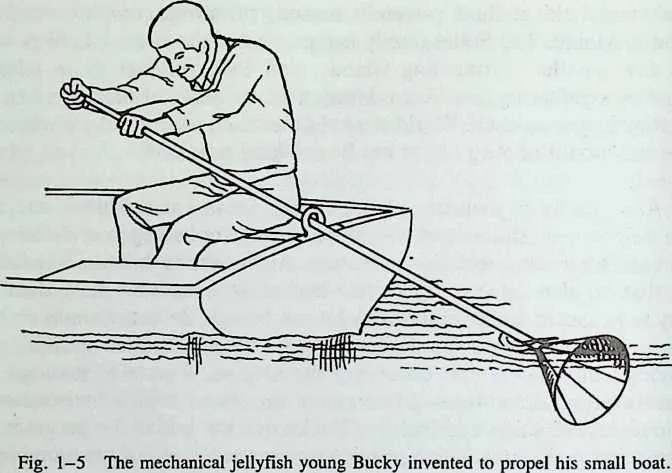
44 by employing his mind rather than mere muscle. Bucky also discovered that his boat trips were much safer and more enjoyable because he could perform the pushing maneuver while facing forward so that he could see any hazardous or interesting events developing in front of him much sooner than if he were rowing facing the rear.33
45 By designing, building, and maintaining boats under the watchful guidance of neighboring seamen, Fuller learned a great deal about basic construction and the special requirements of moving vehicles which would serve him well in later designs.34 Those same men also taught him to be an accomplished sailor, an avocation which he continued to love throughout his life.
46 The discipline of sailing provided Bucky with a pragmatic under-standing of the importance of designing a precise location for each ele-ment of any structure or device, stowing everything for easy access while keeping things out of the way when not in use. The sailing credo of ‘‘everything in its place, and a place for everything’’ thus became an essential component of Fuller’s consciousness while he was still a boy, and it served him well throughout the ensuing years.35
47 His nautical training also supported Bucky’s understanding and ap-preciation of natural resources and their efficient deployment. In sailing, he found that each crew member and component of a ship was most valuable when situated in its proper location and could become a serious problem when out of place. He came to understand that, similarly, re-sources can be employed even if they are out of place, but that they are most beneficial within the confines of a single task.36 For example, a wrench can be used as a hammer when a hammer is not available, but it is most effective in accomplishing the tasks for which it was designed.
48 Fuller soon realized that a similar axiom of maximum efficiency could be applied to human beings, and later in life, he employed that insight to consciously determine his niche of maximum efficiency so that he could provide a maximum contribution to humanity. In later years, the cultivation of his insight into the importance of the placement of elements helped him to formulate his perception of pollution as much more than simply a negative component of the environment.37 Instead, Fuller de-scribed pollution as resources not positioned at their maximally effective location. In the most extreme cases, such dislocation is not only less beneficial, but harmful.38
49 Bucky often illustrated that perspective when he discussed sulfur polluting the atmosphere. Almost everyone has observed huge plumes of sulfur pouring out of industrial smokestacks to dirty the air. Yet, at the same moment one industrial giant is releasing large quantities of sulfur into the air, other production facilities are mining it from the ground to be used in manufacturing processes.39
50 Clearly, when examined from a comprehensive perspective, this is a case of resources requiring positive relocation. The polluters need only reclaim the waste sulfur from their processes and relocate it to those industries which require the material. By operating thusly, polluters not only become good citizens, they may also profit from the sale of a sub-stance they once considered waste material.40
51 With his ‘‘Robin Hood consciousness,’’ Fuller himself was always searching for such relocation situations. Whenever he uncovered a signifi-cant example, he would attempt to have the errant resources transferred to locations and applications in which they would be of benefit rather than a problem. He also assisted others in attaining a perspective which aided them in understanding, discovering, and supporting similar resource reallocation.
52 Another major influence on Bucky was his father. Although Richard Fuller, Sr., spent much of his time traveling around the World and died early in Bucky’s life, he was respected and remembered by his young son as well as the Milton community. His work as an importer caused Richard Fuller to take many extended voyages to South America and India in pursuit of merchandise. Even decades later, Bucky could vividly recall his father being away for several months at a time and coming home with stories and pictures of exotic destinations.
53 Upon returning to Milton, the senior Fuller was welcomed as a local hero. Much of the small community would gather at the Fuller home to listen intently as he spun intriguing tales of the foreign lands he had visited, and Bucky, like most young children, was particularly captivated by his father’s heroic travels. He also dreamed of the day when he too might undertake such exciting journeys with his father.
54 Although Bucky would eventually travel to places his father never knew, those journeys would not be in the company of the elder Fuller. Richard Fuller suffered the first of a series of debilitating strokes in 1907, and they progressively limited his activity until his death three years later.41 During that difficult period, Bucky, who was entering his teenage years, earnestly helped with his father’s care whenever possible. In that effort, he was also witness to the rapid deterioration of not only his father, but his hero. That traumatic experience may well have left a lifelong emotional scar which was evidenced in a rigid tenacity that belied his diminutive frame. Although even as an adult he was only five foot six inches tall, Fuller consistently demonstrated an inner tenacity which might have been his way of proving that he did not suffer from the same weak-ness he had witnessed in his father.
55 Bucky also developed and exhibited an innate compassion and re-spect for human life during the three years he helped with his father’s care, and those characteristics would eventually become his hallmark as millions of people experienced his caring nature over the course of his life. He would spend hours patiently fanning his father during the hot afternoons or reading aloud to the man who had only years earlier been the one reading aloud to his young son.42 Still, as his father’s condition continued to degenerate, Bucky began to wonder about the force which was abandoning a man who had been so vital only a few years earlier. As with many of his questions, that issue was so complex that many years transpired before Bucky began to appreciate and understand that essence of life. Esoteric questions were abruptly put aside when Richard Fuller succumbed to his illness and died on Bucky’s fifteenth birthday in 1910.
56 His father’s death was a tremendous blow to the family and es-pecially to Bucky. In his short lifetime, Richard Fuller had had a signifi-cant impact on his children. He had opened them to a World seldom seen by children or adults and had implanted within them a myriad of pos-sibilities. He had also supported them in a luxurious lifestyle which could not continue without his income.
57 The end of his father’s life brought about drastic changes for the household and Bucky. Not only had he lost the strong masculine guidance of a man he loved and respected, but, as the eldest son, he was expected to assume some responsibility as ‘‘man of the house.’’43 Thus, Richard Buckminster Fuller, Jr., initiated an attempt to become the next Fuller man to maintain the family tradition of education and a distinguished career which had been carried on for centuries. Unfortunately, those family traditions and expectations did not fit into the changing environ-ment Bucky was beginning to experience and in which he was starting to experiment.
58 The death of Richard Fuller was the first of several emotional shocks which molded Bucky into a rambunctious teenager who frequently over-reacted and eventually into an adult who sometimes succumbed to that same characteristic. He needed love and approval during those difficult teenage years, but he was often confronted with austere discipline as well as lack of support and respect from a family strained by an enormous trauma.44
59 Being a strong, proud woman from a family steeped in an American ancestry as deep as that of Bucky’s father, his mother attempted to main-tain the family’s affluent lifestyle; however, the tremendous changes which began with Richard Fuller’s first stroke only escalated following his death. As the eldest male, Bucky was expected to take on additional responsibilities while serving as a role model for his brother and his two sisters. Out of financial necessity, the servants who had supported the Fullers’ comfortable lifestyle were dismissed, and Bucky assumed the physically demanding chores such as stoking the furnace through long New England winters, cleaning heavy rugs, and all the yardwork required for a large house. It was while toiling at those arduous, yet necessary, chores that Fuller began to develop a respect for housework and appreciate the enormous amount of time and energy it demanded.45
60 At that time, even the simplest cleaning chores required strength and endurance. For instance, heavy rugs were carried outside and hung over clotheslines, where they were beaten and brushed by hand.46 Years later, Fuller would recall his early house-cleaning experiences when developing the ultramodern Dymaxion House and other dwellings, and because of those recollections, he would mindfully design built-in, labor-saving de-vices, such as suction ducts which automatically removed loose dirt and dust from a home.
61 While helping care for his ailing father, Bucky continued his formal education at one of New England’s finest and most expensive preparatory schools, nearby Milton Academy. Milton was predominantly a boys’ boarding school. However, because of his family’s financial problems, Bucky could attend only as a day student from 1904 through his gradua-tion in 1913.
62 Although his principle interests at Milton Academy were not what his mother preferred, they were no different from those of most boys. He was far more concerned about being accepted by his peers than receiving the best possible education, and he would have been just as happy attending a less prestigious school which would not have taxed the family finances. Mrs. Fuller was, however, determined her eldest son would receive the best possible education, and she scrimped and saved so he could study at Milton, even though studying was not at the top of Bucky’s priority list during those years.
63 Fitting in with the other boys while attending Milton on a limited budget, as well as his budding sense of independence, placed Bucky in a precarious position, and problems quickly arose. Without funds, Bucky was unable to have the clothes and other items which would have helped conceal his ungainly appearance. With large, thick glasses magnifying the size of his eyes and a head too large for his body, Bucky looked to be a scholarly owl.
64 In addition, he had already begun to develop his insatiable curiosity about everything, and his attention tended to regularly stray far from his own personality and appearance.47 That wandering curiosity, which would serve as a wellspring of new ideas in later life, was a problem for the teenager. It resulted in his dressing carelessly and not paying attention to the social norms followed by the rich boys, making him even more of an outsider at Milton.
65 His enormous curiosity and stubbornly independent thinking did bol-ster him scholastically even though they eventually impeded his progress within the educational system. Bucky was especially adept in science and mathematics, where he generally received A’s. He did not fare so well in the subjects which were of little interest, such as classics, Latin, English literature, and history.48 At Milton, his curiosity and constant questioning led him into some of his first serious conflicts with ‘‘authority.’’ The dimensions of his student-teacher confrontations as well as the right-eousness of his position are evident in the following illustration, which Fuller recounted thousands of times during his own lectures.
66 When Euclidian geometry was introduced to his class, the teacher made a dot on the blackboard and explained that it did not have substance but was merely an imaginary point in space. She continued by declaring that a series of points produced lines and a series of lines produced planes, all of which were nonexistent. The teacher then told the class that planes could be assembled to create three-dimensional shapes, such as cubes and pyramids, which did have substance and actually existed in the physical environment.49
67 It was during such moments of obviously illogical justification that Bucky could no longer restrain himself and entered into incessant ques-tioning. First, he wanted to know how something of substance could be created from nothing. Then, he wanted to know about the cube that had been created. How much did it weigh? What was its size? And where was it located?50
68 Bucky’s geometry teacher quickly diagnosed his inquiries as imperti-nence and ‘‘suggested’’ he suppress his wisecracks before he found him-self deeply immersed in trouble. Realizing he had confronted (and threat-ened) the teacher’s authority and that she was either unwilling or unable to answer his questions, Bucky backed off.51 And after a few such incidents, he also realized that the system would not tolerate his outbursts of curi-osity. Overwhelmed by an intense desire to please his family and fit in with the other boys, Bucky then resolved to do his best to keep quiet and ‘‘play the game’’ of school according to its illogical rules.52
69 He did, however, continue thinking independently and noting the differences between his personal experiences and the lessons he was being taught in school.53 Years later, those obvious differences would become a primary motivation for the creation of his unique philosophy, operating strategy, and search for a truth which conformed to his experience rather than tradition.
70 Although he truly wanted to understand what he was being taught, like most children, Bucky sought acceptance by his peers above all else. And since he knew that excelling scholastically would not endear him as ‘‘one of the fellows,’’ he sought to demonstrate his masculinity on the field of athletics. He exhibited his love of challenges by not selecting a sport suited to his physical attributes; rather, he chose to try out for the school’s championship football team.54 Summers on rugged Bear Island
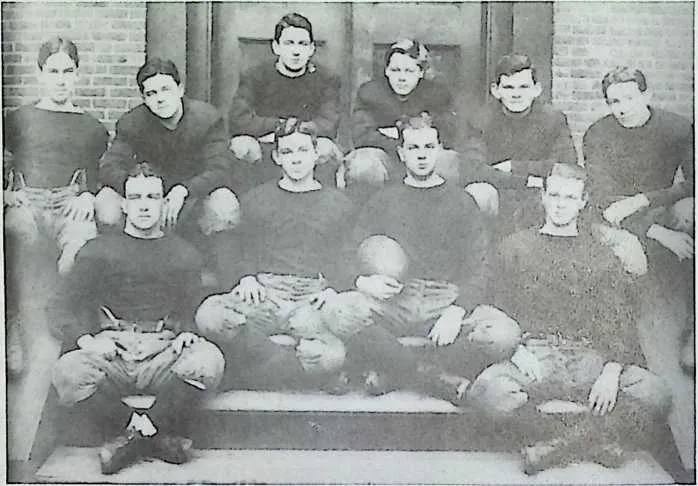
7273Fig. 1-6 The Milton Academy football team. Bucky is seated in the front row, far left.
74 had helped Bucky develop a surprising strength for his small size, but his poor vision and glasses seemed to rule out rugged contact sports.55
75 Still, Bucky was resolute in his intent, and although day students were relegated to second-class status at Milton, the rigid determination Bucky seemed to have acquired from his father’s death served him well in the trenches of football scrimmages. The shadow of that incident also continued to haunt him in less positive ways, as was evidenced in a football-related episode. During the first days of practice, he learned that the school did not furnish all the required equipment; each member was expected to provide his own helmet. When he told his mother that he needed a helmet, the frugal Mrs. Fuller, who was attempting to manage without her husband’s income, attempted to satisfy her son and preserve her budget by purchasing what she felt was adequate. Consequently, Bucky received a cheap imitation ‘‘helmet’’ made of quilting rather than the genuine, sturdy leather variety used by the other boys.56
76 Although unhappy about his mother’s judgment, Bucky politely thanked her for the helmet. He did, however, feel a great deal of shame and embarrassment when he was forced to wear it in order to play, and in conjunction with other experiences, that incident may well have contrib-uted to his attitude toward both women and money. In fact, the feeling of embarrassment was so powerful that even during the last years of his life, Fuller vividly recalled the incident and the accompanying sense of in-feriority, as well as his mother’s lack of understanding.57
77 Having an intimate familiarity with frequent embarrassment and re-jection resulting from lack of material possessions following his father’s death provided Bucky with great empathy for less fortunate people every-where. Accordingly, he later sought, with tremendous fervor, to relieve the suffering of large segments of dispossessed humanity. Most conspic-uous was his passion for finding ways to feed and shelter all humanity, and a great deal of his energy focused on reallocating military resources toward such humanitarian endeavors.
78 Even as a youth, Bucky’s enthusiasm was something to behold, and football was no exception. Through sheer zeal he overcame the obstacles of his small size, poor eyesight, and lack of funds to become a star athlete. In fact, he was so successful that during his senior year, Fuller won the coveted position of varsity quarterback. The previous three Milton Acade-my senior quarterbacks had become quarterbacks at Harvard, and Bucky desperately wanted to continue that tradition when his application to Har-vard was accepted in 1913.58
79 He was the fifth consecutive generation of the Fuller family’s men to attend Harvard. His father, grandfather, great-grandfather, and great-great-grandfather had all attended that university and had kept detailed diaries and records of their college experiences. Those documents were given to Bucky prior to his departure for college, and he studied them intently.59 In fact, he may have learned more from his ancestors’ records than he did from his formal Harvard education.
80 Through the diaries, Fuller was exposed to vivid recollections of the living conditions experienced by the Harvard classes of 1883, 1843, 1801, and 1760.60 Studying those accounts provided him with a unique histor-ical perspective available to few individuals of that, or any, era. The diaries presented a broad portrait of human development in America from the time of George Washington through the industrial revolution. From them, Fuller gained an unparalleled understanding of the changes which had occurred since America had declared its independence and how many of those innovations had enhanced the quality of everyday life for each successive generation of his family.
81 For example, each of his ancestors recounted two-day round-trips between the Cambridge
campus of Harvard and Boston proper. That short journey was time consuming because travel
was limited to two pos-
sibilities: on foot or by horse. However, in 1913, when Fuller entered Harvard, an entirely new era
of transportation had begun, marking the onset of a dramatic transformation in the relationship
between human beings and their environment. That shifting relationship was conspic-uously
demonstrated by the 1913 opening of the subway system, which carried people between
Cambridge and Boston in only seven minutes.61
82 Adhering to tradition was not a quality Bucky Fuller ever mastered, and nowhere was his stubborn independence more strikingly evident than
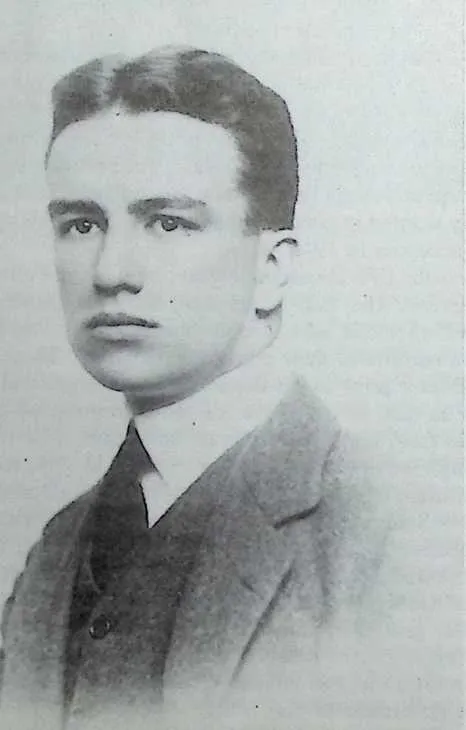
84 Fig. 1-7 A 1913 formal portrait taken just prior to Fuller’s entering Harvard.
85 in his ideas on education. Although he had kept relatively quiet during his years at Milton Academy, Bucky’s attempt to follow in his ancestors’ educational footsteps was another matter. He entered Harvard in 1913 with a set of beliefs very removed from the reality which existed at that institution.62
86 Throughout his boyhood, Bucky had been exposed to the idealistic Harvard reminiscences of his father and his father’s friends, and as is true of most remembrances, those men had spoken in glowing terms about their most positive experiences. Thus, Bucky became intoxicated with stories extolling Harvard athletics, scholarship, and gentlemanly fel-lowship and he entered Harvard believing it to be an essentially mythical kingdom of superathletes and heroic individuals guided by the highest of ideals.63
87 Young and impetuous, Bucky was not, however, extremely in-terested in the superb formal education being provided for him. Like most eighteen-year-olds, he was far more concerned with socializing and the singular issue which continued to haunt him: being accepted by his peers.64
88 At that time, the Harvard social scene was dominated by clubs sim-ilar to modem fraternities, and all his Milton Academy friends were being invited to join those clubs. No such invitations came Bucky’s way. Years later, he would explain that peer rejection as a direct consequence of his lack of family wealth and a father to arrange an entry, but it also had a great deal to do with his tenacious individuality.65
89 Rather than conform to the standards of the young aristocrats who dominated Harvard, consciously and unconsciously Bucky tended to over-look his appearance, while continuing to pay a great deal of attention to his experiences and environment. It was as if some part of him realized that the system was unjust and sought to keep him apart from it, while another aspect of his character battled for peer acceptance. In the midst of such internal contradictions, something had to give way, and it was not long before a troublesome incident occurred.
90 His first semester at Harvard was filled with frustration and dejec-tion. To compensate for the fact that all his Milton friends were becoming members of fraternal clubs and would no longer associate with him, Bucky again focused on athletics. Football had gained him acceptance at Milton, and he felt that sport would again serve his purpose. Having won the position of varsity quarterback at Milton, Bucky was a prime candi-date to attain that position on Harvard’s team, but his dream was abruptly shattered when he broke his knee during a practice session.66 To aggra-vate matters, Bucky fell in love for the first time but was left heartbroken when the girl dropped him for another young man who belonged to one of the prestigious social clubs.67
91 Desperately he concentrated even more on impressing his former friends rather than on his studies and went so far as to create his own social club. When his club did not impress or attract anyone, Bucky sought other solutions and inadvertently stumbled upon a unique method of impressing other young men with his skill as a worldly gentleman of interest to women. That episode exemplifies the reckless abandon with which he often entered into risky activities before considering all the possible consequences.
92 At the time, his older sister, Leslie, was moving and asked Bucky to care for her Russian wolfhound during the process. While walking the elegant dog one evening, Bucky passed the stage door of the local theater prior to a Ziegfeld Follies type of show and found that all the young actresses would stop to pet the wolfhound and chat before entering the theater. Thus, the stage door of the Passing Show of 1912 quickly became a regular destination on Fuller’s evening constitutional with the dog, and those walks soon resulted in dinner dates with the actresses. Fuller was particularly enamored of a young starlet named Marilyn Miller, and when the show moved to New York City, he withdrew most of the money his mother had deposited in the bank for his tuition, lodging, and other expenses, skipping his midyear exams to visit Marilyn Miller.68
93 During that short trip, the infatuated Fuller was determined to im-press Miss Miller, and in a rash gesture, he invited her and the entire chorus line of the show to a dinner party at Churchill’s, one of New York’s finest restaurants.69 Years later, he recalled that ‘‘the champagne flowed like the Hudson River’’ that night. However, the following morn-ing Buckminster Fuller, the playboy, realized he had squandered more than his entire year’s college allowance on a single evening. In fact, his bill was so large that his extended family was forced to cover the excess balance.70 In a single night, he had not only ruined his college career but also blatantly displayed his true feelings toward the frugal New England attitude of his mother by using her money to consort with young actresses, a class of women whose reputation was, at best, dubious to his family.71
94 When Bucky’s actions were reviewed by the Harvard administration, the combination of having spent all his money and missing his midyear examinations left them no choice but to expel him. Their official explana-tion was that Bucky had missed too many classes, but it was patently clear that their action was a direct response to his irresponsible attitude and lack of respect for Harvard’s dignified traditions.72
95 Bucky’s scandalous behavior compelled his mother to convene a council of his uncles and other family men for advice, and when Bucky expressed his thoughts and feelings to the panel of Fuller elders, he was admonished as a young man who should be seen and not heard. He was further instructed to disregard his own thoughts and experiences and fol-low the dictates of the more worldly, older men. The men ‘‘advised’’ Bucky to shape up in order to make something of himself and earn a respectable living in the ‘‘cold, hard world.’’ Because the younger Fuller felt his elders loved him and were concerned with his welfare, he at-tempted to follow their recommendation.73
96 To support him in returning to a more acceptable mode of conduct and gaining an appreciation of how hard and cold the real world could be, the uncles decided to send Bucky to work far from the comforts of Boston.74 Their selection was a job as an apprentice mechanic at a new mill being erected by the Connecticut Canada Textile Company in Sher-brooke, Quebec.75 Although the mill was owned by one of their distant relatives, Bucky found no favoritism when he arrived in the small French-Canadian village on a dreadfully cold day in February 1914.76
97 Most people would have considered such an assignment cruel punishment, but young Bucky, ever in search of new adventures, per-ceived the desolate unopened mill as an exciting proposition. When he first laid eyes on it, standing in a recently cleared field amid huge piles of earth, dirty snow, and empty machinery crates, Fuller knew he faced another arduous challenge.77 That job provided him with many valuable experiences, including his first formal contact with modem industrializa-tion and the initial use of his engineering talent on a large scale.78
98 Fuller was also happy to be far from the societal pressures of Boston and Cambridge. At Sherbrooke, he found no unreasonable customs; rather, he discovered himself spending most of his time with a crew of Lancashire and German engineers and mechanics who had a job to do and judged a man by his work rather than his appearance. Their specific assignment was installation of the textile machinery, which had been shipped from England and France. While evaluating that machinery for the chief engineer, Bucky began to recognize and appreciate the invisible, yet significant, differences between seemingly similar pieces of equip-ment. He found that the cotton-weaving machines from France appeared exactly like those from England, but that the French equipment was superior in both metal quality and precision of parts. Because of such unseen differences, the British equipment was also greatly damaged in transit and British parts were continually being broken during the installa-tion process.79
99 As a result of his obvious interest and aptitude, Bucky was assigned the task of finding ways to repair or replace damaged parts.80 Since the manufacturing factories were several weeks’ travel by ship, he quickly set about learning what local resources were available and soon found himself engaged in a self-tutored course in metallurgy, stress engineering, and the operation of small forges and machine shops.81
100 Having spent years improvising new ideas on isolated Bear Island, Bucky was extremely successful at his new assignment. Yet, exactly how he was able to communicate with the French-speaking Canadians who repaired and produced parts for him remains a mystery,82 but in later years he often demonstrated that same ability to establish some form of inter-communication with people who did not speak English. During that pe-riod he also came to realize just how useful the universal language of mathematics could be in conveying his mechanical requirements.83
101 Regardless of how those results were achieved, they amazed the chief engineer, who suggested Bucky keep an engineering notebook of his work. As fate would have it, that notebook with its detailed sketches supported Fuller in producing even more amazing modifications to the equipment. Utilizing his mind in conjunction with the local resources, Fuller was even able to design and produce several parts which were far superior to the original ones.84
102 After a full winter of ‘‘punishment’’ at Sherbrooke, Fuller’s family and the Harvard administration allowed him to return to college the fol-lowing fall. Everyone believed he had learned his lesson and would be-come a model student, but that hope was quickly foiled when he was again expelled for ‘‘lack of ambition’’ and a tendency to spend more time pursuing girls and parties than good grades.85 That second expulsion marked the conclusion of Buckminster Fuller’s formal education. He pos-sessed the ability to succeed, as proven by his high school grades in science and mathematics courses. However, as he would later recount to numerous genuinely fascinated audiences that often included educators, his boredom with a system that concentrated on memorizing facts rather than examining new ideas contributed greatly to his failure.86
103 Having succeeded as a millwright and an inventor in the more prac-tical environment of Quebec, Fuller felt constrained by an educational institution which he perceived as discouraging innovation and independent thought. Accordingly, he again began pushing the limits of his instructors’ patience as he had done earlier at Milton and questioned not only their understanding of a subject but the traditional beliefs and methods they employed.
104 When he left Harvard for the second and final time, Bucky was excited to attain his freedom and quickly moved to the bright lights of New York City, where he took a job with the meat-packing firm Armour and Company.87 During the ensuing two years, Bucky found that his job greatly constrained his social life as he worked in twenty-eight of the company’s local branches and held several different positions. Those incessant changes in location and assignment were not, however, the result of work difficulties. Instead, Fuller was frequently transferred be-cause Armour management recognized him as executive material and sought to train him in all aspects of the business.88
105 As an informal ‘‘management trainee,’’ Bucky was not, however, exempted from the arduous working conditions of that era. Because stor-age facilities were primitive at best, fresh meat was delivered early each morning, and a daily work schedule beginning at 3 a.m. was the norm. Fourteen-hour workdays were also common, and Bucky was lucky if his workday was finished by 5 p.m.
106 Even bound to that rigorous schedule six days per week and con-fronted with endless hours of demanding physical labor, loading and unloading quarters of meat, Bucky throve at Armour.89 He was excited to witness and learn about New York City in the early morning as the metropolis was prepared for another day, and he began to appreciate the elaborate systems required to satisfy basic human needs when people lived in tightly packed, large communities.90
107 Although such living conditions are common today, they were rare in 1915, when the majority of the World’s population was still agrarian. Through that intimate involvement with tum-of-the-century New York City resource supply, Fuller gained an appreciation of an environment which was to become dominant during his lifetime, and he acquired that understanding well before most people were aware of the problems inher-ent within large cities. The New York City influences were most palpable in his later designs for futuristic, densely populated living environments. Within those intricate community designs, Fuller focused primarily on the experience of individuals and improving their daily lives through effective resource management.