
7 Vehicle of the Future
2®The development of Fuller’s Dymaxion Vehicle dates back to his youth. Decades later, during his two years of silence, Bucky seriously considered the possibility of constructing such a Vehicle. It was while examining the drawings of Fuller’s unique 4D House that his infant daughter, Allegra, referred to the por-poise-shaped object situated at the house’s base as a ‘‘zoommobile.’’1 The Vehicle was, in fact, more a product of Bucky’s vivid imagination than practicality, and it was designed to travel on land or water as well as in the air. Its first appearance was at the base of the Dymaxion House model that Bucky transported from lecture to lecture in an enormous suitcase.2
3 Fuller’s idea of delivering Dymaxion Houses by air and installing them throughout the World, including in remote rural locations, presented several unique problems. Chief among those problems was transportation. Though the House was designed to support its residents in an autonomous lifestyle, a means of personal transportation was needed to provide resi-dents with the self-sufficient status Fuller sought for them.3
4 Because Dymaxion Houses were to be installed at any site, including ones serviced by poor roads or no roads at all, the Vehicle which would accompany the House had to fly and make spot landings without runways, just as a bird does.4 Fuller felt his ultimate Vehicle should also be able to travel over rough terrain and on highways as well as in the water. That concept was so radical that, even though the yet-to-be-invented tech-nology he required to complete the project is now available, such a vehicle has never been developed for use by the general public.
5 Years after his initial work on the Dymaxion Vehicle, Fuller would theorize that the core of the problem obstructing progress on such a vehicle was a condition he had faced many times during his career and which he perceived as a continuing impediment to humanity’s advance-ment. That single issue is the bureaucratic drive for power and control that pervades any organization, especially governments. Both the Dymaxion House and the Dymaxion Vehicle were conceived to function autono-mously. Once built and installed, they would require no roads, airports, electrical power lines, plumbing and sewage connections, or any of the other links through which corporations and governments control indi-vidual human beings’ lives.5
6 Bucky eventually realized that if such autonomous innovations were publicly available, independent-thinking humans would quickly discover that the bureaucracies dominating their lives were no longer necessary or useful.6 At that point, governments, corporations, and most other archaic bureaucratic structures would lose public support, and in the natural order of evolution and development, they would collapse. Fuller believed that such a scenario was inevitable and that the production of autonomous inventions would simply hasten its arrival. Within such an environment, resistance from the establishment was inevitable.
7 Because of the formidable opposition he received from power struc-tures, Fuller also realized that the officials who dominate other individuals through bureaucracies and who prosper from their power would resort to extremes in blocking any innovation which would provide individuals with more autonomy and freedom.7 Still, he envisioned a new era in which the responsibility for maintaining basic human needs would shift from governments and other institutions to individuals themselves and their autonomous devices such as the Dymaxion House. Fuller’s vision of that new era was characterized by a peaceful design science revolution in which changes are predicated upon peaceful innovations that benefit all humankind rather than the wishes of conquering military powers. Design science is predicated on concentrating humanity’s resources on life-supporting tasks rather than weaponry. By employing such a strategy, Fuller felt that we could successfully support every human being on Earth.8
8 When Bucky examined his design science revolution idea in detail, he determined that it could greatly contribute to the development and evolution of humanity and that it was, in fact, a necessary element in the success of the human species. Following that logic, Fuller believed that no politician, government, or corporation would be able to entirely obstruct the momentum of a design science revolution which would eventually furnish every person on Spaceship Earth with resources and a freedom never before known to modem humankind.9
9 Although the Dymaxion Vehicle was conceived of as an accessory of the autonomous Dymaxion House, it became more well known and sup-ported than the House because of people’s fascination with moving vehi-cles and the immediate freedom they afford. The human obsession with automobiles and speed was especially prevalent during the late 1920s and early 1930s when Fuller designed and developed the Dymaxion Vehicle. Even though the Dymaxion House would have proved far more beneficial to humanity than the Vehicle, its immobility held far less appeal for the American public than the Dymaxion Vehicle. Consequently, the full-size Vehicle was financed and manufactured well before the House.
10 Although not truly aware of the possible ultimate outcome of his efforts, Fuller had, in fact, been preparing himself for his work on the Dymaxion Vehicle since boyhood. Both flight and sailing had always fascinated him. Those interests were obvious during a series of 1917 discussions Fuller had with his Newport News naval commanding officer, Commander Pat Bellinger. The boom mast Bucky had invented to rescue overturned seaplanes had provided him with a great deal of attention, and Bellinger was extremely interested in listening to Bucky expound on his seemingly impossible ideas.10
11 During one such conversation, Fuller explained his radical notion of utilizing liquid oxygen in a turbine engine to produce enormous air pres-sure, an idea which captivated Bellinger. At that time, turbine engines were large, immobile machines used chiefly for generating electricity, and no one considered them adaptable to smaller jobs such as powering air-craft. Fuller himself realized that, even if his ideal turbine engine had been constructed in 1917, it would have failed because no material had yet been developed which could contain the enormous heat and pressure that the ignited liquid oxygen would produce.11
12 Although Bucky had no models or resources for testing his propul-sion theories, he intently examined all the potential problems he might encounter in creating a small turbine engine. When he had planned each aspect of his theoretical engine as completely as he felt was possible, he discussed that phase with Bellinger. Bucky thus became one of the first to conceive of a practical jet engine, during a period when the technology which would make such an innovation possible was just beginning to emerge.12
13 At that time, Fuller did not believe that his radical ideas would be approved or even considered by the naval authorities. Still, as a young man in his early twenties, he was thrilled to have an opportunity to discuss them with the experienced aviator and engineer Pat Bellinger. As the two men debated the pros and cons of jet turbine propulsion in greater detail, Fuller realized that such an engine was exactly what was needed for an autonomous flying vehicle which could make pinpoint landings and take-offs. Years later, he would again theorize on the practicality of such a method of propulsion while developing the Dymaxion Vehicle, and in the 1960s and 1970s, he was elated to witness his radical 1917 idea being produced in jet aircraft and rocket technology.13
14 When Fuller began designing his Dymaxion House in 1927 and realized that the primary method of reaching remote locations would have to be flight which employed spot landings and takeoffs, he turned his attention back to the jet turbine concept.14 He also began studying the different methods of flight employed by birds in an attempt to find the most efficient flying technique for solving his problem.
15 From his observations and studies of scientific experiments, Bucky learned that all the components of Universe are in motion, and that all motion tends to be in the direction of least resistance. He applied that knowledge directly to his Vehicle’s design. Rather than using excessive propulsion energy in an effort to fight or tame Nature as many engineers were doing, Fuller attempted to create a Vehicle which would travel smoothly in a preferred direction because it was confronted by less re-sistance in that direction. In other words, he decreased the resistance in the direction he wanted the vehicle to travel instead of increasing the amount of energy required to propel it.15 The extremely streamlined body of the Dymaxion Vehicle provides the most conspicuous illustration of Fuller employing the principle of least resistance, but that principle was also used in other, more subtle aspects of the design, such as the use of high-strength, lightweight materials.16
16 Through his extensive observation of Nature, Fuller came to appreci-ate the impeccable streamlining of birds and fish, as well as the design of those creatures which results in maximum efficiency and low resistance in motion. Because of that understanding, he was amazed to discover that designers of land vehicles had made little or no effort to adapt Nature’s unmistakably successful, aerodynamic designs.17
17 Over the course of thousands of years, the people who designed ships of the sea had, out of necessity, incorporated streamlining into their work. Weight and speed were major considerations when a group of people was
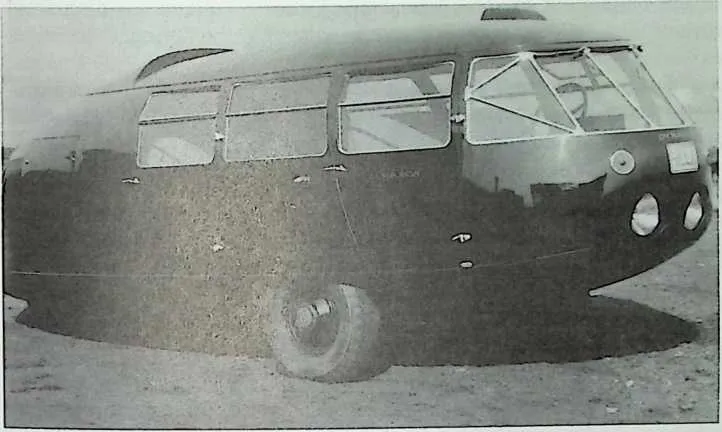
1920Fig. 7-1 The second Dymaxion Vehicle. Although each of the three Vehicles included new innovations, the basic design and appearance remained unchanged.
21 isolated at sea for months at a time. In the early 1930s, engineers working in the fledgling aircraft industry, which was also very weight-and perfor-mance-conscious, were also beginning to discover the enormous benefits of streamlining. However, automobiles were still regarded as horseless carriages, and they maintained the box-like shape of carnages well into the 1940s.
22 Because his intention was to design a vehicle which would eventually travel on water or land or in the air, Fuller was not constrained by popular opinion or traditional modes of operation. Consequently, his Vehicle was designed in the streamlined configuration he determined to be most effi-cient. The earliest shape of the Dymaxion Vehicle was a direct adaptation of the streamlined design Bucky had observed in fish.18 In fact, he was so captivated by the simple elegance of the fish’s streamlined form that Bucky combined it with his love of flight to create a flying-fish drawing as the Vehicle’s logo, a design which adorned all his workers’ white coats.19
23 In his comprehensive investigation of streamlining, Fuller found that the phenomenon was more prevalent than he had first realized and, in fact, is a fundamental component in all of Nature’s designs. Because streamlin-ing results in the most efficient motion and everything is in motion, Nature employs it to some extent everywhere. Fuller even discovered streamlining in objects which move only slightly during their entire existence.20
24 For instance, fruits and vegetables move very little, but when move-ment occurs, they are designed to move in the direction of least resistance with maximum efficiency. Fruit falling from trees contains seeds stream-lined to travel in a preferred direction. In the case of fruit seeds, that preferred direction is usually deep into the ground.
25 When a ripe apple drops from the tree, it splatters, sending its per-fectly aimed, teardrop-shaped seeds into the ground. Rain and frost then aid the seeds in continuing to employ their streamlined design to burrow deeper into the earth.
26 Since Nature’s arrangements are the product of thousands of years of adaptation and evolution, Fuller reasoned that it was the duty of thinking human beings to incorporate Nature’s proven designs and techniques into artifacts and inventions. Hence, he adapted a strategy of imitating Nature whenever possible in the design of his Vehicle.21
27 Because the Vehicle was ultimately to fly, Bucky studied birds and determined that, based on their primary method of flight, they could be divided into two distinct categories. The first grouping contains long-winged soaring birds, such as the gulls and eagles. The other category contains smaller-winged birds like the duck, which cannot soar but can fly much faster for short distances. In examining the flight pattern of the duck and other members of that class, Fuller found that they begin flying by building momentum, and he began formulating a flight theory incorporat-ing that technique into the future evolution of his Vehicle.22
28 Fuller often utilized the following analogy of a pole vaulter to explain how ducks fly and thereby clarify the flight theory which he hoped to employ in his Vehicle. Although a pole adds weight to an athlete, it also establishes a synergistic advantage when utilized as a tool. An unaided athlete can high-jump only a short distance above his own height, but that same athlete can use a pole to exploit his momentum in vaulting over a bar three times his height.23
29 In equating the vaulting athlete with a duck taking off, Fuller re-counted a hypothetical scenario in which, just as the pole-vaulting athlete is about to clear the bar, another, longer vaulting pole magically appears. The athlete swings onto the second vaulting pole, building on his mo-mentum to achieve a greater height as seen in Fig. 7-2. If new vaulting poles continue to appear, the athlete can persist in achieving greater and greater momentum and in moving higher and farther with each successive pole and action. That phenomenon mirrors what occurs when a duck begins a flight.24
30 In taking off, a duck employs its webbed feet to scoop itself up onto the surface of the water in a vigorous run. At the same time, it flaps its short wings very powerfully to achieve additional speed. That process is enhanced by the duck’s highly streamlined body design, which augments forward momentum. The duck’s momentum increases to a point where the air-pressure differential created by the construction and flapping of its wings provides it with a slight vertical lift similar to the lift of the vaulter’s pole. The duck then begins falling forward more rapidly in the direction of least resistance and, at the same time, uses its wings to give itself another short vault upward. By executing this maneuver continuously, the duck employs its increasing forward momentum and speed to provide a gradual lift, just as the vaulter might use pole after pole to build momentum and reach greater heights.25
31 In his ongoing examination of such flight, Fuller also discovered that pilots on aircraft carriers are aware of the benefits provided by the duck’s system of flight, and that they emulate that maneuver when taking off on the short runways of aircraft carriers.26 The first thing that a pilot does upon clearing a carrier’s runway is direct the nose of the plane down
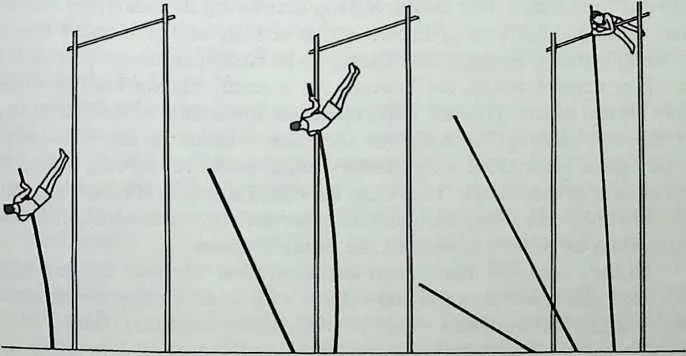
33 Fig. 7-2 A pole vaulter magically encounters longer poles which allow him to build upon his momentum in a scenario which Fuller employed to explain how a duck takes off and how the Dymaxion Vehicle would eventually fly.
34 toward the water to build up speed. By executing that maneuver, the plane gains a quick burst of momentum from the pull of gravity, and that burst aids in the plane’s becoming airborne. A duck performs an identical pro-cedure. It synergistically employs a combination of forward momentum, streamlined design, short wings, and gravity to travel in the direction of least resistance while increasing its speed and gaining altitude.
35 Those elements of flight design combine to produce a phenomenon Fuller dubbed ‘‘jet stilts.’’ Jet stilts allow ducks to take off from small bodies of water and to rapidly gain altitude. Fuller referred to the duck’s technique as a jet because a duck actually pushes air out from under its wings in short spurts in a manner imitated by modem jet engines.27
36 Unlike the force of most modem aircraft jets, the force of the duck’s jet stilts can be precisely directed. Initially, the duck thrusts its wings downward to generate altitude. However, as it begins to build momentum and altitude, the jet stilts are shifted to pushing backward in a horizontal direction, and that action increases the duck’s forward movement.28
37 Fuller understood that everything in Nature supports a condition of maximum efficiency, and that the design of a duck’s head is no excep-tion.29 That simple configuration assists the duck’s flight just as its wings do. The duck’s head shape also demonstrates the subtle mannerisms inher-ent in Nature’s design.
38 In silhouette, a duck’s head looks very much like an airplane wing, with a greater length over the curved top than along the straighter bottom. That aerodynamic form is known as an airfoil, and it induces the air traveling a greater distance over the top to be stretched thinner than the air traveling straight across the bottom. As a result of that configuration, more air and greater pressure build up on the lower side of the airfoil than on the top, causing the wing (or the duck’s head) to lift. That same aerodynamic principle is employed by blimp pilots to increase the speed and altitude of their ships. They raise the blimp’s nose and create a greater pressure under the blimp than above it, producing additional altitude and momentum as well as increasing the blimp’s speed.
39 Fuller’s study of the design and operation of short-winged birds provoked him to envision a flying vehicle with small jet engines replacing large wings. Those engines would provide a constant thrust, similar to the pulsating of the bird’s short wings, and that thrust would maintain the vehicle’s flight.30
40 During Fuller’s early 1930s examination of flight, an engine able to provide the immense thrust needed for takeoff without a runway (similar to a helicopter) was relegated to science fiction. Large wings and long runways were still critical to successful airplane takeoffs. At the time, Bucky predicted that a jet technology capable of producing instant lift would be developed in the near future and that such jet technology would be capable of sustaining flight and rendering wings unnecessary.31 His prognosticated jet engine materialized within twenty years.
41 He also recognized that by removing the wings from a well-designed flying vehicle, he could reduce its weight significantly. Without wings, a lightweight, streamlined vehicle would be a natural candidate for jet-stilt flight when the predicted jet engines were developed. Bucky imagined an extremely lightweight, superbly streamlined vehicle propelled by jet tur-bine engines on both sides.32 With such a vehicle at our disposal, he felt that human travel, like that of birds, would no longer be confined to the constraints of airports, roads, and other bureaucratic boundaries, and that autonomous, freethinking individuals could live and prosper wherever they chose.
42 Bucky’s ultimate Dymaxion Vehicle was to have wheels for ground travel and jet stilts for instant takeoff and flight.33 The two jet-stilt en-gines were to be directed slightly outward so that the effect of their combined thrust would converge just above the Vehicle’s center of grav-ity. Because stabilization requires a minimum of three supports, as is modeled in three-legged tripods, the Vehicle needed a third support in addition to the two engines for stable flight. Fuller found that support within the Vehicle’s natural tendency to fall forward into gravity. That falling motion would be offset by the forward and upward momentum of the Vehicle in flight.34
43 The tripod balancing phenomenon that Fuller theorized for use in the Vehicle can be modeled by a person walking on stilts as demonstrated in Fig. 7---3. A stilt walker actually balances on a hinge formed by the two stilts, just as the Vehicle would have only two engines. The stilt walker can fall only one of two ways, backward or forward. He chooses to fall forward, and as he does, he shifts the right stilt, moves it forward, and creates a temporary new third leg that breaks his fall.
44 That new leg also establishes a fresh hinge angled slightly to the left, and the walker begins to fall in that direction. To break the shifted fall, the left stilt is advanced and the forward-falling momentum is again broken. That action initiates a continuing cycle of left, right, left, right, stilt movement. Thus, the process of forward movement on stilts is actually a
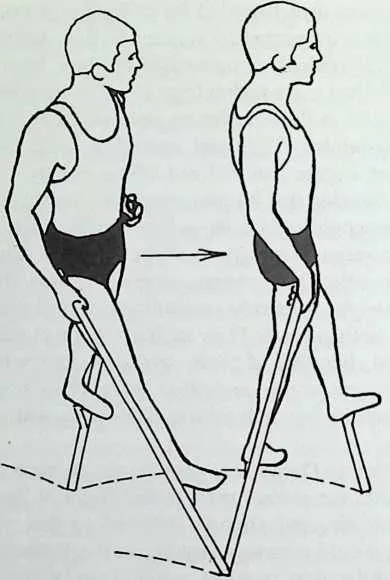
46 Fig. 7-3 A stilt walker does not move forward in a straight line but advances in a zigzag right, left, right fashion which models the tripodal forward motion Fuller envisioned for the flight of his Dymaxion Vehicle.
47 constant, delicate falling forward and from side to side, which relies upon an invisible third compression member (invisible stilt).35
48 An important element of Fuller’s design was his requirement that the vector thrust from the two jets on the sides of the Vehicle and the third ‘‘invisible gravity’’ jet in front converge above the Vehicle. That configu-ration would produce the effect of suspending the Vehicle from a moving tripod of jets and would keep it from becoming top-heavy and rolling over in flight. Because of its jet configuration, Fuller designated the Dymaxion Vehicle as an ‘‘Omni-Medium, Twin Jet Stilt Transport.’’36
49 He envisioned the Vehicle’s jet stilts as being very adaptable. They could be employed to generate altitude or build speed, and they would be flexible enough to be aimed in a wide or narrow mode to compensate for ground terrain and altitude.37
50 From the moment that radical idea came to him, Bucky was aware that developing such a unique method of flight would require the expendi-ture of millions of dollars and years of intense work. He also believed that his idea would be developed over time by governments and corporations with large budgets and workforces. Hence, he focused his energy and attention on producing scale models which did not fly. He also began writing and speaking about that unique method of flight to stimulate interest and activity among those who possessed the time and resources to develop jet-stilt flight.38
51 Eventually those endeavors did result in funding for a full-scale project which employed the newest technology available. The prototypes Bucky constructed were planned to accommodate jet-stilt flight but were built principally to test the ground-traveling capabilities of the Vehicle, which he believed would someday be adapted to fly without wings.
52 When Bucky realized that his lack of resources and time would render him ineffective in attempting to develop the jet propulsion tech-nology needed for his Vehicle, he resolved to build a less complex pro-totype.39 The purpose of that Vehicle was studying the ground-taxiing qualities of an Omni-Medium Transport which would eventually fly as well as travel on land and water. Fuller’s first step in that process was studying the large-pattern relationships between vehicles such as air-planes, boats, trucks, cars, and trains and the primary substance in which they operated (water, air, or land).40
53 In his examination, Fuller found that all vehicles were most vulnera-ble to damage at the critical moment when they moved from a load-distributing element such as air or water into contact with a crystalline (commonly referred to as solid) element such as land or a rock.41 In other words, an airplane or a boat is most susceptible to damage when it comes into contact with another airplane or boat or with land. That vulnerability is a consequence of the fact that crystalline elements do not distribute weight, as is the case with liquids and gases. When a vehicle comes into contact with gases or liquids (i.e., air or water), those elements distribute the force of the impact.
54 In the case of water, we see the splash when a solid object impacts the surface, and that same phenomenon occurs when a solid object col-lides with an invisible gas such as air. If the object is large enough and the observer is close enough to the occurrence, he or she will feel the offset wave of air as the object passes.42
55 When a vehicle is suspended in air or water, the forces which hold its weight up are evenly distributed hydraulically and pneumatically over the surface contacting the liquid or the gas. That phenomenon is conspic-uously evident in the operation of an airplane, which has its entire weight supported by air pressure on the underside of its body and wings during flight. However, once on the ground, the plane’s weight must be sup-ported solely by the crystalline (i.e., solid) wheels and landing gear which touch the ground. That concentrated stress results in airplanes’ being slow and unwieldy on the ground, even though they are extremely fast and maneuverable in the air.
56 Fuller found that when a vehicle (which is crystalline) contacts an-other crystalline structure, such as a rock or another vehicle, the load and weight are instantly focused at the area of contact, and that concentration often creates a serious problem. The hazard is particularly acute in planes and ships of the sea, which are far more delicate than land vehicles. Ships and planes can be constructed without enormously strong or heavy struc-tures because the medium in which they operate most of the time cushions them and distributes load stresses. However, those same vehicles must be protected from rigorous contact with land by the cushioning of pneumatic landing gears in airplanes or pliable bumper guards on ships.43
57 Because of his familiarity with aviation, Fuller knew that a pilot’s most perilous moments occur when the plane contacts the Earth in landing and taxis to its final destination.44 In scrutinizing that dangerous pro-cedure, Bucky discovered a genuine need for research into the properties of streamlined vehicles and for work on designing vehicles that are able to travel on the ground as safely as they do in the air. Such a vehicle would be easier to land than conventional airplanes and would not be as suscepti-ble to treacherous ground crosswinds, which pose formidable problems for aircraft maneuvering on the ground.45
58 Even though Bucky designed and produced the Dymaxion Vehicle during the infancy of aviation and prior to the advent of major streamlin-ing, he was extremely aware of the benefits that more streamlined designs might provide for aircraft. At that time, bulky planes were apt to be caught up in winds on landing and takeoffs. On the ground, they would swerve violently and sometimes flip over from the force of even a mild breeze. To eliminate that treacherous problem, Bucky streamlined his Vehicle wher-ever possible.
59 When the first Dymaxion Vehicle was completed, he wanted to test it at high speeds under the most rigorous wind conditions available. As airports were generally nothing more than flattened and graded farm fields, the best paved areas for such tests were public highways which offered long, clear expanses with unexpected gusty winds. Naturally, Bucky decided to use public highways in examining the performance and maneuverability of his Vehicle.46
60 Although it had been built primarily to test the ground-taxiing ca-pabilities of a future Omni-Medium Transport and not as an automobile, in order to test the Dymaxion Vehicle on public streets and highways, Fuller had to purchase an automobile license from the state of Connecti-cut. And since it was usually seen traveling on streets and highways just like any other car, people began referring to Fuller’s Vehicle as the Dymaxion Car. Even though he was continually explaining its potential for air and water transport, it still became known as a car.47
61 Fuller actually began working on the Dymaxion Vehicle concept during his silent years, when he spent weeks sketching his visions of both advanced housing and advanced transportation. Several years later, his friend the sculptor Noguchi produced clay models of the Vehicle from those sketches. The clay models were then used to construct more durable plaster models, which Fuller painted so they would resemble vehicles rather than futuristic works of art.48
62 In building models, Fuller once again created tangible artifacts which people could examine, so that, in some measure, they could experience his new ideas. Thus, Fuller’s vision of a radical new system of transporta-tion advanced one step closer to reality.
63 Although rudimentary, his models of the Dymaxion Vehicle con-formed to and supported Bucky’s strategy of speaking only when invited and not discussing artifacts until they were constructed in some form. He would exhibit the Vehicle models in conjunction with the Dymaxion House model whenever possible, and their very presence generated in-terest, questions, and invitations to speak about his ideas elsewhere. Es-tablishing public awareness of his ideas was one of the first hurdles Fuller encountered in producing a practical prototype of the Vehicle. That obsta-cle provided him with a pragmatic opportunity to test his self-disciplines of building artifacts and speaking only when asked.
64 Bucky created his models during the onset of the Great Depression, when most of the population was intensely focused on earning a living and acquiring the necessities of life, not on something as obscure as new transportation possibilities. Because jobs and money were in short supply, people increasingly turned their attention from long-range considerations, such as new technology and futuristic housing, to short-term survival issues, such as immediate food and shelter. Manufacturers, however, were still chiefly concerned with creating a demand for and selling new products, and they were willing to try almost anything which might entice the public into spending the little money available.
65 One of the largest American manufacturing sectors was the auto-mobile industry, whose management was required to continue supporting many of its large factories and to earn profits for stockholders despite the Depression. People in the automobile industry were perpetually inaugurat-ing new schemes for selling cars, and one of the most successful devices used was the auto show. Auto shows featured displays of the newest model cars along with unique exhibits intended to attract potential cus-tomers.
66 The producers of one major New York auto show were in dire need of unusual attractions for their upcoming event when they saw and were impressed by Fuller’s Vehicle and House models displayed at an engineer-ing bookstore on Park Avenue. Because of the Depression, only the largest manufacturers could afford the fee required to display their cars at that show, and the producers invited Fuller to exhibit his models free of charge. He was given a prominent booth for his display as well as for describing the theories behind his ideas. At his booth, Bucky met and impressed many well-known people who were captivated by his ideas.49
67 Among the individuals Fuller met during that exhibition was Bill Stout, the man who designed the Ford tri-motor airplane. Stout was also president of the Society of Automotive Engineers, and he was so im-pressed with Fuller’s work that he wrote an article about the Dy maxion Vehicle for the Society’s magazine. Years after Fuller had completed work on his Vehicle, Stout would also design and build a famous car, the Scarab Car. Although Stout’s car was also radically different from earlier automobiles, it did utilize some of the principles and ideas Fuller had developed earlier.5(>
68 As a result of his massive exposure at exhibitions and in the media, Fuller’s ideas came to the attention of thousands of people, including a wealthy Philadelphia stock trader, Philip Pearson. Somehow Pearson had foreseen the imminent stock crash and had sold short, making an instant fortune at a time when his fellow traders were broke. In another shrewd maneuver, Pearson had converted much of his wealth into cash which he had tucked securely away in safety deposit boxes.
69 It was Pearson who provided the final impetus for Fuller’s next major engineering initiative, the production of a working prototype Dymaxion Car. The investor was keenly aware of the Depression’s economic impact, and after visiting Bucky’s Dymaxion exhibition, he was also convinced that he would be more satisfied by giving some of his wealth to Fuller for the development of his ideas than by allowing it to languish in safety deposit boxes or to be lost to the Depression. Pearson felt that with financial support, Fuller might develop a vehicle which would be of value to society and that such an innovation might even help to end the most pressing problem of that era, the Depression. He also believed that there was a slight possibility his investment in Fuller’s work would result in a commercially viable product from which he could profit.51
70 Although the offer of money was a welcome relief from the financial shoestring Bucky had been dangling upon for years, he did not immediate-ly accept Pearson’s benevolence. Because the benefactor was a stranger and Bucky had experienced trouble with financial backers years earlier, Fuller questioned Pearson’s motivation. To alleviate his own doubts, Full-er devised a simple contract, which included a stipulation he often referred to as the ‘‘ice-cream-soda clause.’’ That provision stated that Bucky could do whatever he chose with the money, including something as frivolous as spending it all on ice-cream sodas.52
71 Bucky’s suspicion was not unjustified or illogical because, with multi-tudes out of work, many people were searching for quick profit-making schemes. As a result of that possibility, Bucky wanted to be absolutely certain that he was free to do whatever he saw needed to be accomplished without the constraints of profits, survival, sales, or other short-term mo-tives.55
72 Pearson accepted Fuller’s terms, but as a businessman, he always believed that he could exert financial domination over Bucky and the Vehicle if he chose to do so in the future. He was, however, surprised two years later when the Vehicle became well known and commercial produc-tion appeared possible.54 Only then was Fuller truly thankful for the unique contract. At that time, many people told Bucky that Pearson should profit from what was perceived as his investment, but because the contract was not based on profit and provided Fuller complete freedom to continue his research under any circumstances, he was free to reject business, design, or engineering ‘‘advice’’ from Pearson or anyone else.55
73 Having accepted financial support, Fuller quickly formed the Dymaxion Corporation with R. Buckminster Fuller as its director and chief engineer. He also located and rented an abandoned automobile factory in Bridgeport, Connecticut, which was ideal for his project. The building had previously been used to manufacture the Locomobile, an automobile which, like so many others, succumbed to the Depression.56
74 Bucky arrived in Bridgeport with his money literally in his pocket on March 4, 1933, the day Franklin Roosevelt was inaugurated as President and immediately declared a bank moratorium, freezing all accounts. For-tunately, Pearson had delivered all the promised financing to Fuller in cash, so Bucky was one of the few people in town with a great deal of negotiable currency.57 Ironically, Fuller was instantly transformed from an insignificant dreamer to a prestigious member of society. The news that he possessed cash and was opening a manufacturing plant spread quickly throughout Bridgeport, and within hours, he was inundated with people seeking jobs or attempting to sell him goods and services for his ven-ture.58
75 Because of the Depression, Fuller was deluged with over one thou-sand applications for the twenty-eight jobs he had to fill, and he could pick from some of the area’s finest craftsmen.59 The men he eventually hired were predominantly unemployed mechanics, draftsmen, and other spe-cialized craftsmen who possessed a great deal of expertise.
76 One of Fuller’s most difficult tasks was selecting twenty-eight work-ers from the flood of men who applied.60 In his interviewing process, Bucky was constantly confronted by the devastation of the Depression, and that experience greatly supported his growing concern for the needs of the ‘‘common man.’’
77 Because of the extreme poverty gripping the country, many of the applicants had families who had not eaten regularly for months or years. Since he was operating on a limited budget and a tight schedule, Fuller had to engage his staff quickly and begin production. To expedite that difficult situation, he instituted a policy of determining which of several equally qualified applicants for a position had the largest family that had not eaten for the longest time and hiring the man whose family appeared to be suffering the most.61 The times were so harsh that most of the appli-cants broke down and cried when Fuller told them they had a job and could feed their families.62
78 The high quality of the applicants was exemplified by the two body workers Fuller hired. In the booming economy prior to the crash of 1929, the Rolls Royce Company of Britain had begun to open a manufac-turing plant in nearby Hartford, Connecticut. When the economy and the stock market crashed, Rolls Royce terminated that operation, leaving many of their fine craftsmen stranded in America. As a result of that closure, two of the first men Fuller interviewed and hired were premier Rolls Royce bodyworkers.63 They were later joined by other exceptional craftsmen who had immigrated to America, including Italian machine-tool workers and Polish hammer workers.64
79 Since completing the single vehicle he planned to construct required a great many diverse tasks, Fuller hired extremely talented men who each had a primary as well as several secondary skills. That multidimensional characteristic produced a unique mix of workers who could execute tasks other than their specialties and could assist one another. The comprehen-sive nature of his crew also established a synergistic environment in which men with diverse ethnicity and talents supported one another in a spirit of camaraderie, interaction, and cooperation.65 That spirit resulted in the emergence of many new ideas and possibilities which would not have been discovered by a team of specialists, each focusing on only one single task or aspect of the operation.
80 Although he strongly believed in the equality of each individual, the pragmatic Fuller also realized that, like a ship at sea, his project required the vision and guidance of a single leader. Since he was the one with the ideas, Fuller established himself as the ultimate authority. Even though he
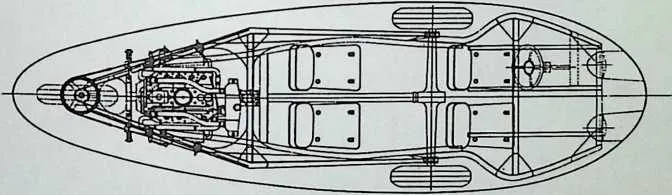
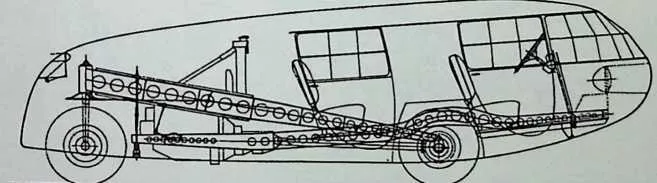
83 Fig. 7-4 Technical drawings of the Dymaxion Vehicle from above (top) and from the side (bottom).
84 provided his men with an autonomy which allowed them to work together in harmony and to bring forth ideas for the project, Bucky was practical enough to establish his command quickly.
85 On the first day of operation, he called a meeting of the entire crew to explain the details of the operation. During that meeting he also re-emphasized the temporary nature of their project and the fact that he intended to complete construction in six months. Bucky reminded every-one that he had only enough money to construct one prototype vehicle and again warned his men that he had no intention of generating a profit or commercially manufacturing vehicles.66
86 Since the men were grateful for any job and had already agreed to the terms of employment, Fuller’s restatement of the situation met no chal-lenge, and everyone began working with great excitement. The entire staff clearly understood Bucky’s plan was to build a single demonstration vehi-cle for testing the principles he had discovered and was continuing to unearth, and the men accepted his motivation and priorities. Accordingly, they worked harmoniously with Bucky.67 The fact that he continued to
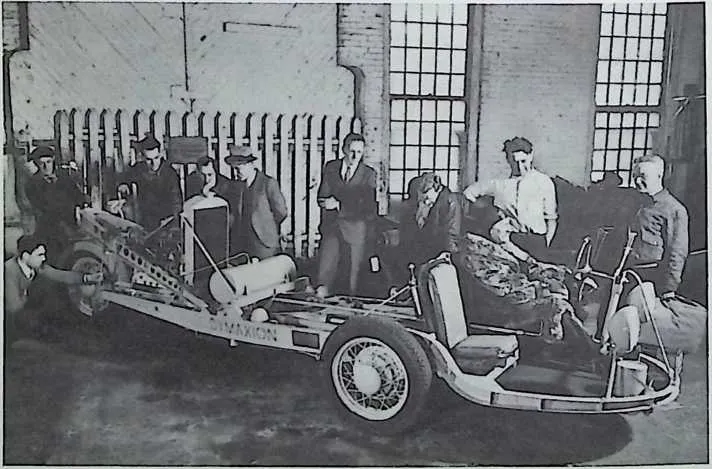
88 Fig. 7-5 Some of Fuller’s team of workers examining the initial Vehicle’s chassis. Starling Burgess is seated at the wheel while Bucky is seen standing at the far right.
89 drink and party extensively during the limited spare time available also contributed to his dual image as an eccentric genius who was also ‘‘one of the guys.’’
90 The project moved forward, generally adhering to a tight schedule for the first months. Because Fuller had carefully considered most aspectsof few the design for years, the Vehicle began nearing completion within those months.68 The crew worked on parts throughout the large building, but the Vehicle itself was assembled in a windowless room toward the back of the factory. That assembly room was kept constantly guarded so that no unauthorized personnel could view the Vehicle in a state of partial com-pletion. Bucky did not feel that he was hiding anything from the public, but he simply did not want a partially completed Vehicle creating an image that the project was some harebrained scheme.69
91 After three months of continuous progress, the Vehicle was nearing completion and Bucky was preparing for a series of comprehensive tests when a serious problem emerged. As the workers began to realize that their jobs would soon end and their families might have to return to the misery of the Depression, each of them began to slow his pace, threaten-ing the Vehicle’s completion. Fuller understood that the situation was not a conspiracy and that his workers were not reacting out of malice or a conscious desire to condemn the project to failure. He also realized that he had to act expeditiously if he was to save the Dymaxion Vehicle from perpetual incompletion.70
92 To resolve the problem Bucky selected an extremely risky, unor-thodox response consistent with his belief in changing environments in-stead of trying to change people. Rather than talk to his staff about their behavior, he simply initiated work on a second, more advanced vehicle, even though he had barely enough funding to complete the first vehicle. With Vehicle number two in production, the men felt their jobs were secure and quickly finished the first Vehicle so that it could be unveiled to the public on Bucky’s birthday, July 12, 1933.71
93 That worker slowdown provided Bucky with several valuable lessons which helped him avoid similar problems in future years. In addition to learning a great deal about production technology, he also gained an enormous amount of insight into basic human behavior. Specifically, Bucky learned just how much the welfare of dependents affects the behav-ior of individuals, even when those individuals are motivated by the best of intentions. Later, when Bucky finally did close down the operation, that lesson was reinforced. His staff again opposed the imminent closure despite the fact that he had been straightforward with them from the start and clearly had no funds to continue the operation.
94 Only one of the men Fuller hired for the project did not participate in those actions and had not sought employment on the project. He was the illustrious aeronautical engineer Starling Burgess, whom Fuller persuaded to join the endeavor. Burgess was extraordinarily qualified and accepted the position of chief engineer primarily because he was fascinated by the unusual undertaking and was not involved in any major project at the time.72
95 As a prominent naval architect, Burgess had designed two sailboats which had won the America’s Cup, and he was under commission to produce a Bermuda class sloop. Since building that boat was not a large project and Bucky loved sailing, he allowed Burgess to use the Dymaxion Vehicle factory for designing and constructing that boat. The other staff members had no problem with building the ship. In fact, they were thrilled to see another enterprise, which provided additional work, come into the plant, and duties were rearranged to accommodate boatbuilding in the Vehicle’s production schedule.73
96 At that time, Burgess was more well known than Bucky. Many people were familiar with his outstanding record as a sailboat designer, but few realized he had also designed airplanes. In 1912, Burgess and the scientist James Dunn had developed the Burgess-Dunn plane for the United States Navy. That plane was the first delta-winged aircraft (i.e., an aircraft with swept-back wings) and the first plane in which pilots could safely remove their hands from the steering mechanism without losing control.74 Because of his aviation experience, Burgess was particularly eager to work with Fuller in testing the ground-taxiing qualities of the Omni-Medium Trans-port Vehicle, which Bucky contended would one day fly.
97 Even though he was far more skeptical of the flight possibilities that Fuller asserted could one day be incorporated into the Vehicle, Burgess’s expertise was invaluable to the project. Burgess’s previous years of expe-rience in building and testing full-sized prototype boats and airplanes provided the inexperienced Fuller with a great deal of confidence in almost every aspect of production, but Burgess’s dynamic personality quickly began to clash with Bucky’s similarly large ego.
98 One classic example of the conflicts which flared between the two men particularly irritated Bucky because he had to confront it every morn-ing when he arrived at the plant. Soon after joining the project, Burgess instructed one of the workers to paint his name beside Bucky’s on the sign in front of the building in equally large letters, as if they were partners. Although Bucky quietly tolerated that display in an attempt to maintain harmony throughout the project, it bothered him more than he was willing to admit.75
99 Fuller viewed Burgess, as well as everyone else working on the project, as his employees, an authoritarian position which appears to conflict with his antiauthoritarian stance. However, in an examination of this and other aspects of Fuller’s life, the dual facets of Buckminster Fuller emerge. As an ordinary human being, he was susceptible to the same issues as everyone else, including a tendency to dominate others. Although he perceived his ideas as beneficial to all people and the control he asserted as being in the best interest of everyone, his need to dominate could also be seen as egotistical.
100 The egotistic side of Fuller was quite different from the personality he usually presented. That day-to-day facet was most obvious in Bucky’s commitment to his overriding mission and in the talks he presented over the years. He seldom bragged or promoted himself during those talks; rather, he sought to share the urgency surrounding the issues and oppor-tunities which confront all humanity. Thus, although the clash of egos between the personalities of Burgess and Fuller was inevitable, Bucky sublimated that side of himself for the good of the project and the benefits to humankind that he believed it would produce.
101 Starling Burgess had been raised within a heritage of talent and genius. The Burgess family had a proven record of successful design. Starling’s father had designed three sailing ships that each won an Amer-ica’s Cup. His brother was the chief mathematician for the United States Navy’s lighter-than-air-structures design program, which produced zep-pelin blimps. Starling was a skilled mathematician who loved sailing and designing racing boats for wealthy yachting clients.76
102 Since only the wealthy could afford yacht racing, Burgess was ac-customed to demanding the finest materials and the highest quality work-manship on the craft he designed. He required the same high standards for the Dymaxion Vehicle. Both Fuller and Burgess agreed that pioneer in-ventors and designers, such as themselves, had a responsibility to fabri-cate prototype artifacts with such quality, precision, and attention to detail that the value of the invention would not be undermined by inferior materials or workmanship. With such superior quality, an invention could be judged only by its performance and not by something relatively insig-nificant, such as a defect in a part, which could create a minor failure that would shift the spotlight from the benefits of a total project.77 That insis-tence on quality resulted in all the Dymaxion Vehicles being built of the finest materials available and being engineered with the same precision used in aircraft and fine racing yachts. Thus, shoddy workmanship did not detract from Fuller’s intended objectives or radical design.
103 The Dymaxion Vehicle project provided Fuller with his first large-scale opportunity to test his conviction that mirroring Nature’s designs would be the most effective mode of operation. Bucky had found that the creatures which moved with maximum efficiency had developed on Earth over thousands of years of evolution, and he felt that such successfully evolved designs merited imitation in human engineering projects. He was especially interested in the natural techniques used for the propulsion and the steering techniques of birds and fish.
104 Observing those creatures, Fuller realized that positioning a steering mechanism---be it the tail of a bird or the fin of a fish---in the front of an animal was ineffective and was never seen in Nature.78 He reasoned that such a configuration would be analogous to attempting to steer a huge oceanliner by pushing on its front end with a small boat. Similarly, Fuller believed that the front-wheel steering mechanisms, which were funda-mental components of automobiles, were just as ineffective. Because he chose to utilize techniques which worked well rather than ones which were popular, Fuller’s Vehicle was designed with front-wheel propulsion and a single rear steering wheel, mirroring what he had observed in birds and fish.79
105 The Dymaxion Vehicle’s steering and propulsion technology was so revolutionary that even though its conception and development occurred in the early 1930s, only one commercial vehicle has since utilized those innovations together. That vehicle is the large three-wheeled street cleaner which is required to maneuver sharply while cleaning gutters and curbs.80
106 Fuller discovered that front-wheel-drive, pulling propulsion provided an enormous advantage over the commonplace rear-wheel-drive pushing, and he illustrated that advantage using an ordinary wheelbarrow. When passing over obstacles, a wheelbarrow pushed from behind can be dan-gerous, as its front wheel strikes an obstacle and it lurches backward into the stomach of the person pushing. However, if that same wheelbarrow is turned around and pulled, a person actually lifts it over bumps as it is pulled, and the problem disappears.
107 Once the simple beauty of that shift became apparent to Bucky, he immediately reconsidered his ideas and designed his Vehicle to include a single, rear steering tire pulled by two front tires so that it would embody a more natural steering pattern as well as the propulsion strategy of the pulled wheelbarrow. In subsequent testing, Fuller also established that such an arrangement resulted in superior traction and reduced skidding.81
108 At the time, most cars employed front-wheel steering and rear-wheel propulsion, which caused the front wheels to be pushed into the ground and produced a great deal of skidding. The characteristic was, and still is, evident in high-speed auto races, where the drivers invariably slide through turns with little steering control. In such instances, the car’s front wheels tend to be forced into the ground as the driver maneuvers through turns by allowing the rear wheels to continue spinning rapidly. That act generally causes the rear of the car to slide in the desired direction.
109 It also results in most auto racing being chiefly a matter of controlling a car’s angle of skid. Managing skids for hours at a time is a difficult assignment because once a car begins slipping, the driver has lost most control and a significant part of the car is no longer connected to the ground. In fact, Fuller found that during such skidding a car could be considered somewhat of a flying machine.82 Only when the car returns to the straightaway does the power of the rear wheels fully engage in propel-ling it forward again and can the driver regain control as the car again reverts to operating as a land vehicle.
110 By observing such maneuvers, Fuller was convinced that his final design of a three-wheel vehicle with front-wheel drive and a single rear steering tire provided safety and maximum effectiveness using a minimum of resources. His strategy of always seeking maximum efficiency is also evident in the three-wheel configuration. Bucky understood that three was the minimum number of wheels or contact points required for sta-bility.82
111 Certainly, four wheels provided somewhat more stability, but through experimentation he discovered that the added stability was offset by excess weight and loss of maneuverability. He was also pleased to find that his belief in the fundamental nature of the triangle and triangulation could be incorporated into his Vehicle. Most of Fuller’s theories did prove correct, and the final product of his team’s effort was a Vehicle which Fuller often contended was more maneuverable and responsive than any car he had ever driven.
112 The initial public showing of the Dymaxion Vehicle on July 12, 1933, was a great success. Over three thousand people crowded the test track next to the factory to watch as it was put through its paces. That showing catapulted both Fuller and the Vehicle into the public eye.84 He and his amazing car were prominently featured in newspapers and maga-zines across the country, while dignitaries began to visit the factory for a look at the future of transportation. Most everyone wanted to drive the Dymaxion Vehicle, and those allowed to were amazed at its performance. Since the steering configuration permitted the back end to move at right angles to the Vehicle’s body, it could be parked in a space only a few inches longer than itself. 85
113 Fuller often executed that maneuver, to the amazement of onlookers. He would drive the Dymaxion Vehicle into a parking space front end first, maneuvering the rounded nose to within an inch of the car in front of the space. That feat could be performed safely because the driver sat forward of the front wheels, providing an excellent view of everything in front.86 Modem vans have now embodied similar configurations, but in 1933, it was an unusual arrangement. Once Fuller had positioned the front end of the Vehicle snugly within an inch of the other car, he would aim the rear wheel directly toward the curb, swinging the rear end in perpendicular to the curb.87
114 Whenever the vehicle was driven on public streets, it drew a crowd, but the parking maneuver always captured the most public attention. As a result of that attention, it was often featured in movie newsreels. A news-reel producer would establish a parking space only three inches longer than the Dymaxion Vehicle and call for action. Fuller would then drive down the street very rapidly and pull directly into the space with perfect control and no hesitancy. As long as he was certain he had the excess three inches, Bucky would quickly turn the rear wheel and complete the specta-cle with great confidence.88
115 During numerous trial runs, Fuller and his team discovered a great deal about front-wheel drive and the astounding capabilities of the Vehicle they had created. They determined that constant acceleration prevented skids and allowed the execution of very sharp turns. Bucky also found that the Vehicle could perform many unusual maneuvers, and as he practiced them, he continued learning more about the principles behind his de-sign.89 For example, he found he could slow the Vehicle down to fifteen miles per hour and execute a 180-degree turn while the inside front wheel made a circle only one foot in diameter. Bucky could literally turn the Vehicle and be traveling in the opposite direction within a matter of seconds.90
116 No other car on the road could perform such a maneuver, and Fuller sometimes exhibited it while curious police officers were ogling at the strange car in amazement. His innocent stunt soon backfired, however, as word of the turn spread among the area’s police departments. Once of-ficers learned about the amazing car, he was continually being stopped by the police and ‘‘requested’’ to perform the magical 180-degree turn.91
117 In one such instance, Bucky was driving through New York with a group of editors from the New Yorker and Fortune when he was stopped by a traffic officer at Fifty-seventh Street and Fifth Avenue. While the officer demanded to know exactly what Bucky was driving, Bucky cleverly turned the steering and slowly rotated the entire car around the stationary police officer. That maneuver also backfired because, upon witnessing the traffic-stopping event one block away, the next officer demanded a similar demonstration. The incident was then repeated at almost every successive comer, causing Bucky and his guests to spend nearly an hour traveling one mile down Fifth Avenue.92