
12 A Home at Last
2©Housing was always a favorite theme of Fuller’s work and thoughts, and despite his reservations about industrialists, he was quick to join with them on a major project when that undertaking appeared to advance the cause of better housing.
3 The issue of shelter and Bucky himself were both thrust into the forefront of the United States war effort during the height of World War II when the Dymaxion House project was resurrected. Since he had considered the problem in great detail well before it surfaced, and since it exemplified the ‘‘emergence-by-emergency’’ strategy in which he so unremittingly believed, Bucky was thoroughly prepared to tackle the problem of housing in 1944.
4 While working for the Board of Economic Warfare during World War II, he was given constant access to the most recent information about manufacturing in the United States, including the problems which arose as many of the young men who composed the work force were sent off to war. Housing was one of the problems Fuller observed, and during the war, it became a top-priority issue almost overnight. Housing rose to instant prominence as a solution to another issue rather than as a problem which required a solution.
5 Wartime aircraft production was concentrated throughout the West Coast and the Midwest at the time, and one of the major aircraft manufac-turing centers was Wichita, Kansas. In a scenario typical of what had occurred at other such wartime centers, the population of Wichita had grown from 100,000 to 200,000 in approximately one week at the onset of the war as both males and females patriotically responded to a call for workers to manufacture military equipment. Small aircraft factories which had barely been able to stay in business were expanded in a matter of weeks, and housing near those plants was so scarce that beds were used on a twenty-four-hour basis, with workers sleeping in eight-hour shifts.
6 As the war dragged on, many of those factory workers became disillusioned with Wichita’s difficult living conditions, and comfort began to overshadow patriotism and wages. The workers also began to believe that when the war ended, aircraft production would immediately drop drastically, and their jobs would be in jeopardy. Such sentiments caused a steady flow of workers to leave the aircraft industry for other fields which appeared to be more secure and less demanding. Management at aircraft plants around the country charted that problem in a single statistic: the ratio of people who quit to those who were hired. And in the spring of 1944, the number quitting was increasing dramatically while the number being hired was declining at a similar rate. The issue was so significant that it actually threatened the Allied war effort.
7 Both the aircraft factory executives and the War Department officials were frantically searching for a solution when someone recalled that Bucky Fuller was always championing the idea of mass-production hous-ing built in factories and shipped intact to people’s lots. As he was a government employee working for the Board of Economic Warfare, Bucky was immediately summoned to the higher echelons of the War Department and interrogated about his housing ideas.1 Most everyone involved in interviewing Fuller was both surprised and delighted to learn that he had not abandoned the project he had initiated nearly eighteen years earlier. Instead, Bucky had continued to think about and develop his 4D (by then known as Dymaxion) House so that it would be ready when the idea had sufficiently gestated.2
8 Fuller staunchly believed that all ideas have a specific gestation period between their inception and the moment they are ready for practical application. He also felt that the gestation period is predicated upon the particular field of endeavor, and he steadfastly maintained that, for the housing industry, that period was twenty-five years. Thus, when he was approached about his 1927 idea in 1944, Fuller believed the time was right to begin working on its final stages so that it could be mass-produced for the general public at the proper moment: 1952.3
9 One of Fuller’s earliest presentations of the Dymaxion House idea was to Herman Wolf, who worked in public relations for the War Produc-tion Board. Wolf then arranged a meeting between Fuller, Walter Reuther of the CIO, and Harvey Brown, president of the International Association of Machinists, which represented aircraft workers. The machinists’ union was particularly excited about the possibility of supporting Fuller’s project because it was their workers whose postwar fate was in jeopardy, and following that meeting, the two union leaders quickly arranged a meeting between Bucky and the management of the Wichita company they be-lieved to have the best labor relations.4
10 Everyone involved agreed that the company, Beech Aircraft, would be the best place to establish the initial prototype project which, if suc-cessful, was to be duplicated at other plants. Everyone except Fuller felt that what they called a prefabricated house would be a viable product sought by military personnel returning home from the war.5 Bucky, how-ever, was adamant about his intention, and whenever the term prefabri-cated house would arise, he was quick to remind everyone that he was not interested in simply creating a factory-built house. In fact, when he met with Jack Gaty, a conservative man who was vice-president and general manager of Beech Aircraft in Wichita, one of the first issues Fuller ad-dressed was the monumental scope of the project.6
11 Bucky began by reiterating that he had no interest in simply building prefabricated houses, and at the end of four hours of Fuller’s exposition, Gaty was impressed enough by both Bucky and his ideas to extend Beech’s commitment to the project.7 He also requested that Fuller present his ideas to the Beech workers, and within hours an appearance had been arranged. At that meeting, all the shop stewards and workers able to fit into the International Association of Machinists auditorium listened as, once again, Bucky did not lack for words. After several hours of presenta-tion, the prototype project was unanimously accepted by both workers and management.8 /
12 By the time Fuller returned to Washington, DC, a few days later, to organize his portion of the production effort word of the project had already spread throughout Wichita, and the problem of workers leaving for other jobs instantly began to subside. In fact, when Bucky returned to Wichita a few weeks later, the first thing Gaty showed him was Beech’s chart of hirings and resignations, documenting the fact that the dramatic shift had begun the very week Fuller spoke to the workers.9
13 Bucky had gone to Washington to prepare for a move as well as to handle preparation for the next stage of Dymaxion House development. When he had accepted his position with the Board of Economic Warfare in 1942, Anne had remained in New York so that Allegra could complete the year at the Dalton School. Following that school year, the family was reunited in Bucky’s small Washington, DC, apartment, and Allegra was enrolled as a day student in the fashionable Miss Madeira’s School. When the nomadic Bucky suggested that his family once again change resi-dences to the crowded, relatively isolated midwestern town of Wichita, which was so far from the cultural resources his wife and daughter loved, neither of them shared his enthusiasm. Thus, Allegra became a boarding student at Miss Madeira’s School while Anne moved to an apartment in Forest Hills, Long Island, near her family.10
14 Meanwhile, in his continuing quest to develop the quintessential inexpensive, yet technologically advanced, home for the average family, Bucky was confronted with a necessary but unappealing task: financial organization. While in Washington, he incorporated the Dymaxion Living Machines Company, which was later changed to Fuller Houses, Inc., with R. Buckminster Fuller as chief designer and engineer. Having no desire to be involved in the daily bureaucratic operation of his corporation, es-pecially the financial management, Bucky asked several trusted fellow government workers to serve as corporate officers.11 Key among those individuals was Herman Wolf, who was appointed president.
15 To uphold his portion of the agreement with Beech, Bucky had to generate capital, and Wolf convinced him to once again begin dealing in an area in which he was extremely uncomfortable: the sale of stock. Despite his discomfort with and mistrust of the system, money was needed, and Bucky reluctantly agreed to issue 15,500 shares of stock in Fuller Houses at a par value of $10 per share. Bucky retained 5500 shares, Beech was given an option on 1000 shares, and the remaining 9000 were sold to the public. In actuality, the public investors consisted mainly of the company’s officers, as well as their friends and family members. Since Herman Wolf was becoming more and more of a driving force behind the organization, many of those shares were sold to members of his family and friends in the labor unions. Although Bucky did not know what details of the project Wolf shared with others, Bucky’s message to potential investors was crystal clear.12
16 He told everyone that he felt Dymaxion Houses could not be prac-tically marketed until adequate time and resources had been allocated for development, and that the main criterion he would use to determine the exact moment of readiness was when a Dymaxion House could be in-stalled anywhere in the World as quickly and easily as a telephone. Fuller further explained that he projected that if they worked diligently on the project, the moment of readiness would occur sometime in 1952. Accord-ingly, he suggested that everyone involved regard their time and money as a contribution toward solving the postwar housing problem and that inves-tors consider their money ‘‘thrown away.’’13
17 Although, Bucky would straightforwardly explain that position to anyone, he had learned about corporate politics earlier and had chartered Fuller Houses, Inc. in a way which ensured him complete control. Thus, his 5500 shares carried with them veto power over all aspects of produc-tion of the House.14
18 In October of 1944, Fuller and the officers of his corporation re-signed their government positions and moved to Wichita to begin produc-tion of the prototype Dymaxion House. Upon arriving, Bucky met with Jack Gaty and resolved the details of production. As he did not want the House project disrupting aircraft production, Gaty suggested that Fuller’s work be set up in an abandoned building on the Beech grounds. After some discussion, Fuller agreed to use the location once it was adequately renovated, and within days, the new site of Fuller Houses was coming to life under the watchful eye of Bucky and his staff. Although small, that staff was composed of some of the finest workers in the area.15
19 Remembering another lesson from his Dymaxion Car venture, Fuller had made an initial request of only six mechanics from the Beech work force of twenty thousand. However, because he recalled his earlier prob-lem with workers who were afraid of losing their jobs, Bucky insisted that the Beech mechanics be the most skilled workers available.16 He felt that such workers would be irreplaceable and, consequently, they would not fear the loss of their jobs in the aircraft plant while working on the Dymaxion House.
20 By the time his small operation was established at Beech, word of the project had spread throughout the aircraft industry.17 The rampant spec-ulation was that Fuller and his team were not just developing a prototype but actually creating a gigantic new industry which would soon replace aircraft production, thereby securing the jobs of hundreds of thousands of factory workers.18
21 One of the primary problems Fuller envisioned when he first dis-cussed the project was something which constantly plagued his work: his insistence on employing state-of-the-art materials, even if they had not even been invented when he initiated a project. Because his inventions were predominantly designed for future generations, Bucky was never hampered by the limitations of the ordinary materials which were used for a task at a particular time. Instead, he simply examined the materials
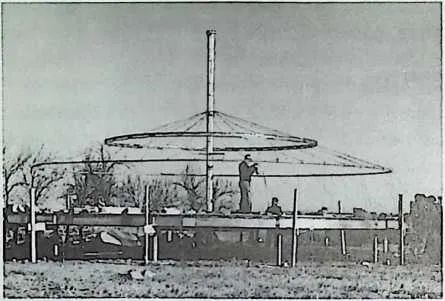
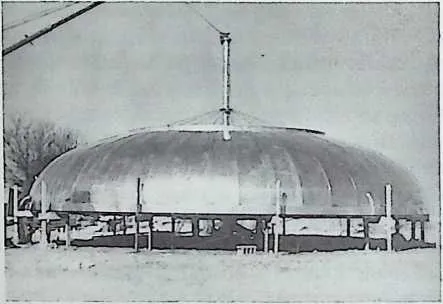
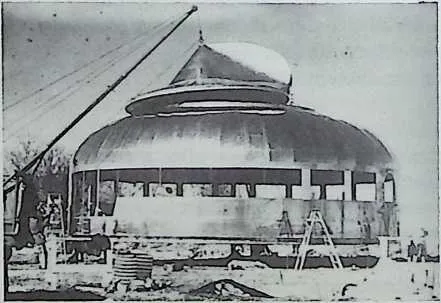
25 Fig. 12-1 through 12-3 Stages of erecting the Dymaxion House.
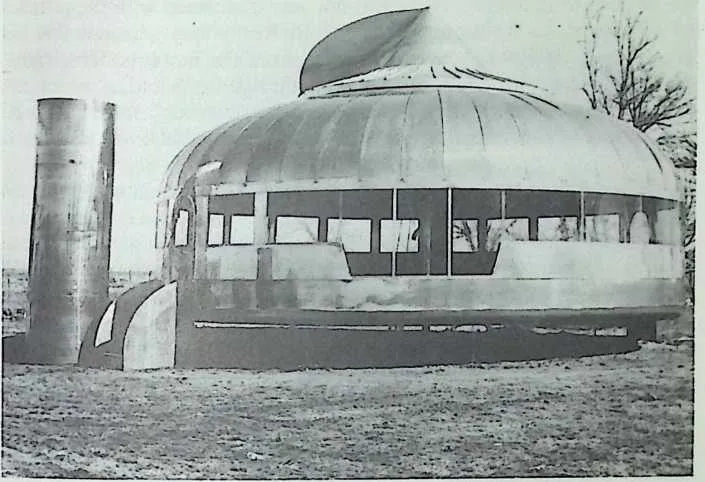
27 Fig. 12-4 The completed exterior of the Dymaxion House next to the tube into which all the components of the entire House were packaged for shipping.
28 available as well as the probable development strategy for new substances and then speculated what types of materials would be available at the time his inventions would be completed or needed by society. That was true of the high-strength metal alloys needed for the jet engines on the Dymaxion Vehicle as well as in the 1930s when he told people that his Dymaxion Bathroom would eventually be fabricated from a lightweight plastic-like material invented years later, which came to be known as Fiberglas.
29 Because of that stance, Fuller felt obligated to require the future use of materials which he believed would be available in 1952 and beyond and to demand that such unknown materials actually be specified for use in the Dymaxion House. His more pragmatic associates did, however, convince Bucky that only the modem materials available at that time be used, ensuring the project would not be hampered waiting for substances which had not yet been invented.19
30 Still, even those materials posed a problem. Because of the war, most industrial materials were tightly controlled, and that was particularly true of the substances required for strategic military applications such as the production of aircraft. As he was not very concerned with the politics of short-term issues such as World War II, Bucky was adamant that his Dymaxion House prototype be fabricated from the most modem, light-weight, efficient materials. By working thusly, he felt that when the House was ready for mass production in 1952, it would not have to be radically changed to accommodate newly available materials and technology.20
31 Even though they were using highly sophisticated materials such as high-strength aluminum and Plexiglas in airplane production, Beech man-agement frowned on the idea of building a prototype that employed those materials. Since no one could guarantee that the U.S. government would allow even small amounts of any high-priority materials to be employed in nonmilitary projects at that time, Beech management was also concerned that the final product would not be practical due to lack of the necessary materials. Management was not, however, able to stop Bucky’s incessant search for and insistence upon components made from restricted sub-stances such as aluminum, steel, and Plexiglas. His requirement of exotic materials was, however, quickly resolved when the Air Corps recognized the service Fuller was providing by maintaining the morale of workers as well as aircraft production and awarded him a contract for two Dymaxion Houses.21 The contract also furnished his project with a top-priority status equal to that of companies producing armaments, thereby permitting him access to all the materials he required---including those which had been only recently developed.
3233Because Bucky personally supervised the production and develop-ment of the Air Corps’ two Houses and because he had been continually refining his ideas concerning the Dymaxion House since its inception in 1927, work proceeded far more rapidly than most people expected. In fact, the Air Corps Houses were completed and displayed to the public within a single year.
34 Although it was extremely unlike anything seen before, the prototype House shown at the October 1946 unveiling was clearly a natural evolu-tion of Fuller’s earlier work. Like his earlier house designs, the Beech version hung from a central mast; however, the newer design was com-pletely circular rather than hexagonal. It was fabricated from the most ultramodern materials, including its primary element, the best lightweight aluminum which provided maximum strength with minimum weight. In fact, the entire structure weighed only 6,000 pounds, an amazing figure when compared to the weight of a house of that size even today: approx-imately 300,000 pounds.22
35 The House itself was not completely constructed on the factory as-sembly line; rather, all the components were fabricated and packaged at the factory into a compact unit which was shipped to a building site. Those prepackaged units with assembly instructions were similar to an enormous model kit which could be assembled on the site in a matter of days by a single person. In the Fuller tradition, each individual component was designed for ease of handling and assembly. Thus, no piece weighed more than ten pounds, so that any component could be installed by a single worker who could lift it with one hand and use the other hand to fasten the part in place.23
36 Utilizing the system he had first devised for the Dymaxion Deploy-ment Unit, the Dymaxion House was also constructed chiefly from the top down. The curved roof sections were hung on steel cables suspended from the central mast, and then the wall sections were attached to the completed roof. Around the House’s entire 118-foot circumference, residents had access to the outside environment through a sweeping series of continuous Plexiglas windows, which were slightly tinted to avert glare and were furnished with pull-down curtains for privacy.24
37 Fuller also employed his Dymaxion Deployment Unit discoveries in cooling and heating the House. Each of the panels below the windows was designed to lower eighteen inches, providing screened openings so that the occupants could establish a complete or partial ring of ventilation around the base of their home at any time. To augment that ventilation and to generate a natural airflow, Fuller designed and built a revolutionary new feature on top of his House: a massive ventilator which rotated atop the central mast.25
38 Because of its design, the ventilator looked more like the underside of a sailing ship or the tail of an airplane than the roof of a house. Having designed it to function aerodynamically, Bucky was pleased by that per-ception. The ventilator was streamlined and was positioned so that its closed side (which was rounded) would constantly turn into the wind like the wide end of a windsock. Opposite that side was the tapered, tail-like side with its opening, which because of its exposure to the negative pressure of passing winds literally sucked fresh air up through the house and out the ventilator.
39 Since they were constructing the prototype in tornado-prone Kansas
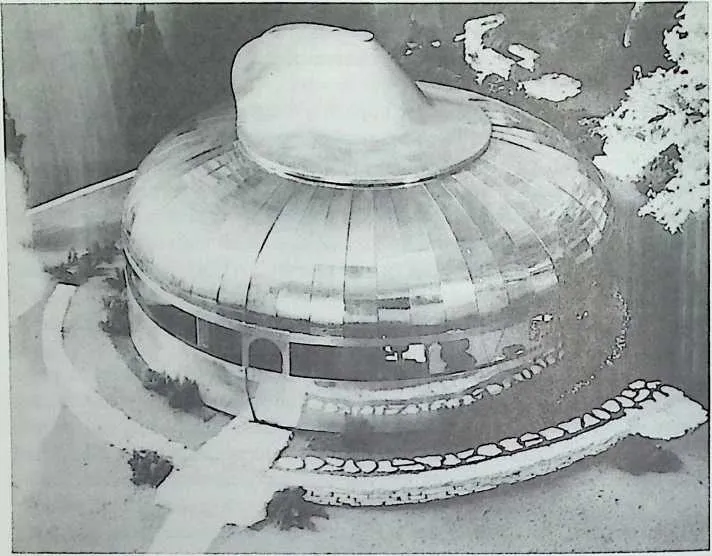
4142Fig. 12-5 A model of the Dymaxion House.
43 and Bucky wanted his house to be as safe as possible in the severest of storms, he designed the conspicuous ventilator so that it could actually lift three feet on its central mast spine and instantly relieve any great pressure differential which might arise from such a storm. During the sudden change in air pressure characteristic of powerful storms such as tornadoes, walls and windows of buildings are usually blown out, causing a great deal of the destruction. Fuller’s design, however, eliminated that pos-sibility by providing the ventilator which was akin to the emergency valve on a pressure cooker. That valve opens up to release excess steam pressure rather than allow the entire cooker to explode.26
44 The House’s safety and engineering features were, however, over-shadowed by the more evident benefits it provided for occupants. Inside the nearly eleven-hundred-square-foot, single-family dwelling was a spa-cious combination of cozy comfort and modem technology. Although the
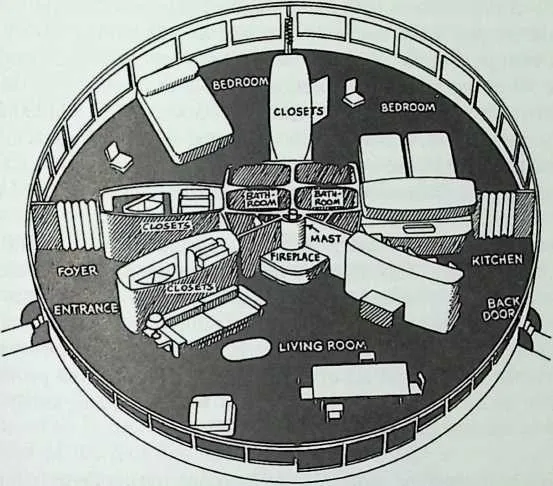
4647Fig. 12-6 The interior of the Dymaxion House.
48 House was primarily fabricated from metal, Bucky created a warm inter-nal ambience and captivated its occupants with touches such as floors covered by wood (over aluminum beams) and an open fireplace dominat-ing the large living room.27
49 The House’s curved ceilings also provided occupants with a uniquely varied living environment seldom seen in homes before or since. At approximately sixteen feet in height, those ceilings created a spacious feeling, and if the owner wanted to change a room’s ambience, both the color and the intensity of the hidden lighting could be instantly altered.28
50 Similarly, the entire House was filled with unique environment-altering and labor-saving technology including some inventions created exclusively for the project. Among the innovations Fuller built into the House were revolving motorized closets in each of the two bedrooms, a dust-filtering system, and pressurized wall outlets for vacuum cleaner hoses.29
51 For most people, the House’s most amazing aspect was its price. After careful calculations, both Fuller and Beech agreed that the complete unit could be profitably marketed for a retail price of $65OO30 which converts to approximately $46,000 in 1989 dollars, an astounding figure at a time when the price of an average home was in excess of $12,000. Even more surprising was the fact that the $6500 figure included freight, assembly, installation, and a profit for the local dealer. The actual cost of mass-producing the House’s component parts, which could be packed into less than three hundred square feet for shipment, was estimated at only S1800.3’
52 Because both Bucky and Beech believed that women would be the primary beneficiaries of the House’s innovations, some of the first people to tour the completed prototype were a group of twenty-eight wives of project workers.3- Everyone was certain of their project’s success, when, following their examination, twenty-six of those women commented on its spectacular beauty and all of them agreed that it could probably be thoroughly cleaned in half an hour.33 The women unanimously agreed that they wanted to purchase a Dymaxion House.
53 Those women's instantaneous desire to purchase a Dymaxion House was not an unusual reaction. In fact, following the enormous publicity that the project received between October of 1945 and February' of 1946 (.including a major illustrated article in Fortune magazine), a flood of thirty-seven thousand unsolicited orders poured into both Fuller Houses and Beech. Many of those people were so excited about the Dymaxion House that they even included down-payment checks with their
54 During that period. Bucky also began another of his characteristic retreat from the ‘‘evils’’ of financial success and those who would attempt to profit from his ideas. His first instance of concern occurred when the trading value of shares of Fuller Houses. Inc., which had been issued at SIO. jumped to S20 in a matter of days. Then, a successful Philadelphia entrepreneur named William Wasserman purchased one thousand shares of company stock in a power play which allowed him to assume the position of chairman of the board and to begin working on generating the finances required to initiate mass production of the Houses. Wasserman w orked in alliance with Herman Wolf and the union people who had invested in Fuller Houses, all of whom began to envision the enormous nrofis they would reap as a result of commercial success.35
5556Beech engineers did their part by estimating the costs of production distribution, including setting up machinery and a new sales organiza-tion, at $10 million.36 Then, Wasserman and his financial people began working on a plan to raise that money. Their idea was to recapitalize Fuller Houses, Inc., by issuing 750,000 shares of stock at a par value of $1 and allowing all the original stockholders to exchange shares of the old stock for the new at a 1 -to-10 ratio. The plan was to generate an additional 595,000 shares of stock which would be offered to the public at $10, producing an income of $5,950,000 as well as increasing the value of an original share of stock to at least $100. The balance of the capital needed was then to be raised through loans or the issuance of bonds. In fact, public demand for the Dymaxion House was so potent that the govern-ment even volunteered to step in with a major start-up Ioan.37
57 Despite their skill and savvy, the sophisticated financial planners forgot to consider one factor: Fuller himself and the self-destructive aspect of his personality which lingered from his youth and was particularly conspicuous in financial matters. The financiers had also proceeded with-out regarding Bucky’s tendency at times to assume rigid, unchangeable positions on an issue. The gestation period of his idea was one such issue. Regardless of the fact that his 5500 shares of Fuller Houses would have skyrocketed to a value of at least $550,000 and his dream of quality mass-production homes for average people would have been realized in an extremely short time, Bucky was not about to endorse production until the exact moment he deemed everything was completely ready. He firmly believed that moment would occur no earlier than 1952.38
58 Although most people involved felt Bucky would not be able to resist the enormous financial windfall, they were quickly proved wrong. Each time William Wasserman was near the final stages of a financial arrange-ment, Bucky, with his ultimate control over production, would simply veto the agreement over some issue which was insignificant when com-pared to the massive scope of the proposed project. Yet, because Fuller’s objections were valid and his contract was binding, Wasserman would simply have to make the necessary alterations and try again.39
59 Even though both sides in that confrontation contended that they were right, the truth seems to lie somewhere between the contradictory opinions. Wasserman argued that every time a deal was ready for finaliza-tion, Bucky would thwart it with new, unnecessary changes to the House. Bucky simply maintained his position of making continual improvement, was never satisfied, and felt he was simply continuing to develop the best possible prototype of the Dymaxion House, just as he had promised.40
60 Whatever his motive, the constant obstruction finally wore Wasser-man down and caused him to accept a buyout offer from Fuller. That action signaled the eventual end of Fuller Houses, as other investors quickly began selling their shares and the price dropped. Even Jack Gaty sold Beech’s shares as Fuller Houses fell into financial collapse.41
61 Other individuals and organizations also attempted to sway Bucky’s opinion, but he quickly explained the impossibility of the task before them. He argued that the self-contained House could not be assembled and installed by skilled union laborers because every union contended that it had sole jurisdiction over the process, which was actually little more than assembling pieces and connecting external wires and pipes to available systems and foundations.42
62 He also explained that, in his opinion, the union problem was even more complicated. From his earlier experience with the Dymaxion Bathroom, Bucky was certain that every union would oppose installation of the House because, with all its wiring, plumbing, and so on installed at the factory, it would provide little initial work for local trades. Bucky
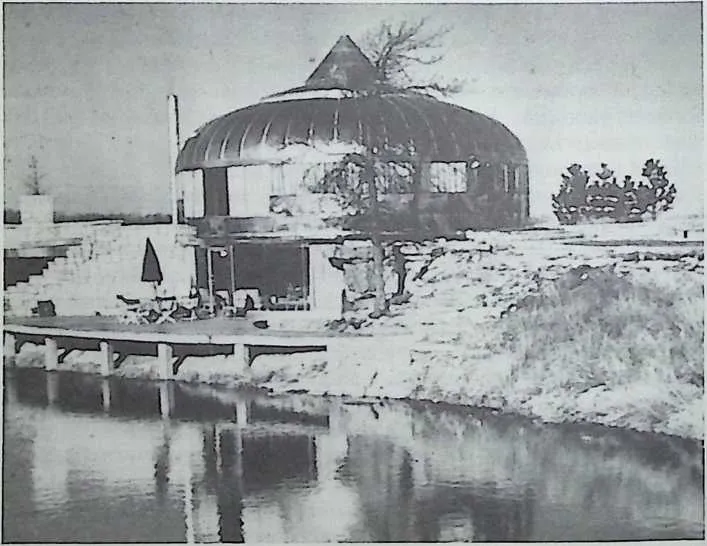
64 Fig. 12-7 The prototype Dymaxion House was sold to a man who did not value its mobility or the spinning vent on top. Consequently, he had the vent removed and the house permanently installed on a foundation as a lake cottage.
65 further rationalized his decision with his belief that the Dymaxion House was, in actuality, creating an entirely new industry, and prior to practical implementation, he felt responsible for developing all aspects of that industry, including a revolutionary new type of installation and transport truck and a system of rapid delivery and deployment.43
66 Despite the pressure from friends, stockholders, people seeking to purchase the Houses, and individuals who wanted to become distributors for it, Fuller could not be swayed from his conviction that the timing was not right. Thus, he would permit no further progress toward mass produc-tion until the 1952 date, and with no one willing to wait an additional six years, the project ground to a halt.44
67 Although Bucky was satisfied with the House’s developmental prog-ress and the fact that when the operation was closed down no one had lost any money, his stockholders were quite upset by having been deprived of the enormous profits they had envisioned in the near future. Herman Wolf had convinced many of his friends and family to invest in the company of which he was still president, and he was particularly agitated by the situation. At one point the pressure and distress became too much for Wolf, and he made the mistake of turning his anger toward Fuller’s family.
68 As the story goes, one day following the project’s closure, a dis-traught Wolf burst into the Fuller’s New York apartment and tried to warn Anne that Bucky had been having an affair with a young woman while in Kansas. Although we will never know if that particular affair actually occurred, it made no difference to Anne, who maintained her position as Bucky’s ever-faithful wife, completely surprising Wolf with her reac-tion.43
69 Rather than question Bucky’s actions, she defended her idealized perception of reality, her husband, and his actions, telling Wolf, ‘‘You have no right to say such things about Bucky to me. And, even if it were true, it’s none of your business.’’46 Thus, even during a moment of great stress and in the face of possible betrayal, Anne showed a tenacious determination nearly as strong as Bucky’s. The incident also illustrates how she often singlehandedly maintained the deep bond between herself and Bucky, of which he often boasted. She was, as he frequently com-mented, his anchor, and his passionate pursuit of the daring aspects of life on the edge was greatly facilitated by his knowledge that no matter what he might do, she would always be there for him.
70 Following the 1946 Dymaxion-House-project collapse, Bucky re-turned to the East Coast, moved into the apartment Anne had rented in Forest Hills, Long Island, and tried to determine exactly what project most required his attention. He also attempted to influence Allegra in deciding on her future and was somewhat surprised to find she had devel-oped a mind of her own. As a result of their interaction and Allegra’s determination, she was probably more influential on him than vice versa.
71 Having graduated from Miss Madeira’s School that year, Bucky’s daughter spent the summer studying ballet with George Balanchine in New York, a feat which caught her father somewhat off guard. With his biased vision and limited time spent with Allegra, Bucky had believed his daughter’s primary skills and interests focused in the same areas he loved. During the brief periods he spent at home with Anne and Allegra, Bucky had witnessed Allegra’s easy mastery of mathematics and mechanical skills, and he was so certain that she would follow in his footsteps that he had applied for and sought support in gamering a place for her at one of America’s finest engineering schools, Massachusetts Institute of Tech-nology. Since only six girls were enrolled at MIT at that time, Bucky himself was thrilled when Allegra was accepted by the school. He was not, however, encouraged by his wife’s and daughter’s reaction to the news.47
72 Upon returning to New York, it became clear to Bucky that Allegra’s interest in dance was far more than a young girl’s passing fancy. Only then was he, in an uncharacteristically compromising act, able to let go of his belief that he knew the best course for her future. Bucky asked his daughter to join him in a discussion of her future, and although he was somewhat surprised to learn that she was more interested in following Anne’s love of the arts than his devotion to science and technology, he was willing to support his daughter’s wishes.48
73 Since Bucky tended to be on the road while Anne had stayed with Allegra during her formative years, Allegra’s preference seems only natu-ral; however, it left Bucky dumbfounded. Still, he was able to swallow his ego and support the same innate wisdom of youth and abundance of choices for his daughter that he championed for all young people.
74 Rather than attempting to further convince Allegra that following in his footsteps was best for her, Bucky first asked if she did, in fact, want to become a dancer. When Allegra answered yes, he concealed his disap-pointment and demonstrated that he truly believed young people were as competent as their elders by asking what path she wanted to take in pursuing a career in dance. After further discussion, Bucky was able to at least proffer his low opinion of formal educational facilities and suggest that she might want to bypass that option and work directly at becoming a dancer. To his young daughter, who was not unlike most teenagers, such an option appeared quite glamorous, and she began to pursue a career in professional dance.49
75 Even though that interaction demonstrated how being away had left him somewhat out of touch with his family, Bucky did not change his ways. He had focused his attention on the larger context of continually supporting the most people possible at the expense of being with and supporting his own wife and child, but he felt that in working for all humanity he was, in fact, working for Anne and Allegra. Even though most of his friends and relatives asserted he should be more of a family man, Bucky was not about to sacrifice his commitment, and he continued with his mission.
76 He did, however, attempt to secure the love and acceptance of family and friends with gifts and trips. Specifically, when he finally attained financial wealth, Bucky was constantly giving family and friends expen-sive presents for no apparent reason other than that he felt they should have the items. He also flew Anne, Allegra, and later his grandchildren around the World to be with him on his excursions whenever they would accept his invitations. In that way, he attempted to make up for past deprivation without forfeiting his prominent position or the work he felt needed to be done.
77 In 1946, however, the only action Bucky felt to be appropriate was standing back and allowing his nineteen-year-old daughter the opportunity to pursue her career. Thus, Allegra spent several years working her way up through the ranks as a professional dancer. Although that career was far more appealing to her than classical scientific study, she soon found that her rich heritage of intellectual stimulation created a yearning for more academic endeavors. One of the methods she used to satisfy that need was to begin attending her father’s local speaking engagements. Allegra had always loved listening to Bucky, and because she had grown up experiencing his intricate speech patterns, she was more able than most to comprehend his ideas.
78 Since she was being trained in the body movements of dance, follow-ing one such lecture Allegra decided to offer Bucky some advice predi-cated on her dance experience. She pointed out that he had been raised in a New England society where gentlemen frowned upon gestures as vulgar, and that as a result of that training, when he spoke it was always without much inflection, standing rigidly straight with his hands at his sides. Allegra went on to remind her father that when he spoke to family and friends in private, he was constantly using his hands to gesture, and that those movements greatly enhanced their understanding of his ideas.50 Continuing her train of thought, his daughter explained that in studying dance, she had learned that arm and leg movements can be effective communication tools, and she suggested that Bucky might become a more effective speaker if he used his natural body movements to enhance his public presentations. She advised her father simply to let himself go and be more natural when speaking to groups.51
79 Although it was true that he had been raised in the rigid New England tradition, Bucky was always willing to try new ideas, especially when they came from someone he dearly loved. Thus, within weeks, he began implementing a less controlled mode of presentation and creating the endearing yet often frenetic style of lecturing which became his trade-mark. In fact, until old age impeded him somewhat, Bucky was known for spontaneously jumping up from his chair or even crawling around the stage to demonstrate and emphasize his ideas.