
13 Conscious Thought
2In changing his lecture style to include his daughter’s dance concepts, Bucky did not alter either the context or the content of his presentations. He also continued to maintain an unmistakable distinction between his personality as evidenced in his personal life and the persona he presented to the public. Always one to divulge the complete truth as he knew it at any given moment, Bucky never concealed any of the antics of his personal life; however, he also felt that those acts were so insignificant in relationship to his mission that he seldom mentioned them in public unless they illustrated a point he was attempting to make. Also, when he spoke to audiences, Fuller was not presenting preconceived ideas, in that he was simply ‘‘thinking out loud,’’ as he called his method of sharing information. He felt he was allowing information to pass from or through himself, flowing naturally without a great deal of conscious consideration as to its content. Thus, he usually spoke of the topics which were of the most value to the largest number of people.
3 As always, Bucky continued to focus on spontaneous ideas rather than planned speeches, and he made a point of never using notes or thinking about what he was going to say prior to walking onstage.1 Thus, his lengthy thinking out loud lectures usually expanded upon ideas he had spoken about or considered previously. At times, however, unique new ideas simply appeared and were injected into his lectures in a matter-of-fact manner which delighted and surprised both Fuller and his audiences.
4 Although his public speaking was truly spontaneous, Fuller thor-oughly considered the components of the process we call thought so that he could better participate in that phenomenon.2 Because he felt that all nonphysical aspects of Universe conform to the same generalized princi-ples that govern the physical aspects of our reality, Bucky used physical geometry to clarify his discoveries concerning the thought process. He would often explain that thought is a process of consciousness sorting. During that process, the confusing jumble of our experiences are rear-ranged so that our minds can more easily discover relationships between the items in that unsorted patch work of input.3
5 Fuller recognized that the Earth, the solar system, the entire cosmos, and individual human beings were continually moving in a plethora of directions. Because of that constant change, each person perceives events and objects (i.e., objects are actually fabricated from events known as energy) from a multitude of changing viewpoints which rarely coincide with the exact observations of other human beings.
6 Bucky was amazed by the infinite number of possible perceptions that he established were available to just one individual when he consid-ered only the revolution and movement through space of the Earth com-bined with a person’s daily movement. Although the continuous change and the shifting perception due to that constant motion may seem inconse-quential to a person preoccupied with the activities of daily life, Fuller believed they were extremely important. He discovered that many people intellectually accept the physical motion of the cosmos and the constant change of Universe itself but that few consider their actions in relationship to the grand sweep of changing movement.
7 Since he was a comprehensivist concerned with all Universe, Fuller realized that the conspicuous movement of humans as well as every aspect of their environment significantly influences all action and development. Thus, he set out to become intimately aware of and involved with the vast movement and change which engulfs all humanity so that he could in-crease his effectiveness.4 He truly believed, and his actions demonstrated, that by becoming aware of his constantly changing environment he could operate within it more efficiently on all levels from the most mundane tasks to the loftiest pursuits of knowledge.
8 Prior to doing that, Bucky found that he had to acknowledge that every individual has a unique perception of reality. When considering his actions within the context of the enormous continual motion surrounding each of us, Fuller realized that all experiences could be regarded as omnidirectionally positioned with respect to the observer.5 In other words, from the viewpoint of any observer, all events and experiences are moving around an apparently stationary center. That center is the observer himself or herself. Thus, the framework for any observation is that the observer is at the center of Universe viewing the passing of an immense number of rapidly moving objects and events.
9 Since he felt that the thought process consisted primarily of success-fully arranging those constantly shifting, omnidirectional individual expe-riences, Fuller applied his understanding of motion and the relationship between observer and observed to his exploration of thinking. He specifi-cally set out to determine how he and all humans mentally arrange experi-ences during the process of thinking.6
10 Because he believed that all metaphysical phenomena---including thinking---could be modeled with physical artifacts, Fuller employed his beloved geometry to describe the sorting procedure that is thought. As in Einstein’s theories, the observer is critical to Fuller’s evaluation of the thought process, and Bucky established the observer (himself for purposes of experimentation) at the center of an infinite set of multidirectional experiences available to be organized.
11 After hypothesizing just how the thought process functions, Bucky was challenged to communicate his outlandish, yet logical, conclusions to others in a way which would stimulate rather than bore them. Conse-quently, he devoted many years to envisioning how thoughts and ideas are formulated and determining the best illustrative examples to communicate his insights. His interpretation is more easily understood if one uses a geometric sorting illustration he devised.
12 Once Fuller’s illustrative model of the human thought process is grasped, an individual may begin to appreciate on a conscious level what is an unconscious process for most people. In other words, when a person understands the representative illustration of idea sorting that Fuller con-cocted, he or she will actually be able to think more clearly. Following such a shift, an individual may practice initiating effective conscious thinking, just as Bucky often did. That ability to distinguish and under-stand the human thought process not only supports an individual’s think-ing more efficiently, but it also aids in more effective performance within the confines of a changing environment.
13 Although thinking is an ongoing comprehensive procedure, Bucky divided the process into several steps for the sake of examination and to clarify his geometric illustration. The first of those steps is sorting all experiences into two categories: the huge set of experiences which are irrelevant and the very small set of experiences relevant to the issue at hand.7 When one is examining an issue, this sorting procedure delineates the inner and outer limits of consideration so that the thinker can focus his or her attention on a comprehensible aggregation of experiences or items. A more concrete sense of those limits can be envisioned by considering all experiences which are too small and frequently occurring to be dismissed outwardly and of all those which are too large and infrequently occurring as being dismissed inwardly.8
14 Imagining a transparent sphere helps one to grasp this sorting process more fully. All experiences which are too small and frequently occurring to be considered (i.e., the smaller the experience or phenomenon, the more often it occurs) are grouped inside the sphere, and all those which are too large and infrequent are sorted outside it. The tiny set of experi-ences remaining are those modeled by the sphere itself, and they can be easily examined.9 Without such a sorting process, human beings would be so overwhelmed by information that they could never complete the exam-ination of even the most trivial issue.
15 For example, when a person becomes hungry and thinks about din-ner, he enters into a seemingly instantaneous sorting process focused on food. The person first dismisses large experiences, such as global hunger and farming, which occur very infrequently within his experience. Next, the person excludes small experiences, such as the processing of food in the digestive tract, which occur very frequently in his life. Following that sorting, what remains is a small array of experiences relevant to the issue of his personal hunger and dinner.
16 If that set of thoughts is still too large for comfortable consideration, another round of dismissing begins, refining the relevant experiences to an even smaller set. In that more detailed session, the focus of the particular thought becomes even more precise. Experiences such as notable meals which have been eaten are eliminated outwardly, and experiences such as past trips to the supermarket are eliminated inwardly.
17 By continuous employment of this process, the thinker reaches a point of considering only a set of relevant experiences and facts, such as the last trip to the supermarket and meals which could be prepared within his time constraints. However, because the procedure occurs so rapidly, with ordinary issues ‘‘the thought’’ which resolves the question of that day’s dinner appears as an almost instantaneous idea.10 In the case of complex issues, thinking requires additional time and is most effective when concentrated conscious effort is applied.
18 If an individual possesses some understanding of the process itself, as Fuller did, he or she can more consciously work within its limitations to expedite an answer. Because thinking is a synergistic process (i.e., one in which the whole cannot be predicted by observation of its parts), by definition the thinker cannot know the result prior to its appearance.11 He or she can, however, support the process of sorting experiences and information as a conscious effort to resolve an issue more rapidly. Through years of practice, that organizational sorting process became as natural to Fuller as walking or talking.
19 He defined a thought as a relevant set of experiences bounded by macroirrelevant and microirrelevant experiences which are temporarily separated inwardly and outwardly.12 Such a dismissal does not invalidate those experiences. Rather, they are relegated to the inner and outer bound-aries of consideration so that a workable number of experiences may be examined. Without such a sorting process, individuals would have to consider all their experiences in even the most trivial thought process and would never reach any conclusion.
20 Once an individual understands that process, he or she can begin to utilize it consciously, as Fuller did, to limit his or her focus and to resolve issues without invalidating extraneous experiences. By practicing such a discipline, any person can consciously concentrate on the experiences needed to explore a particular thought and can reach decisions much more rapidly. Thus, thinking becomes an allied tool of human development and experience rather than an obscure phenomenon which is beyond the mas-tery of individual human beings.
21 Fuller believed that even the wisest humans could not completely control the thought process.13 Yet, whether an individual is consciously directing or participating in the thought process or not, thinking remains constant. Bucky himself practiced this conscious sorting process for years in an effort to enhance his thinking; however, he still often found himself engrossed in the spontaneous contemplation of a particular topic. When that occurred, he would generally realize that the subject of his preoccupa-tion was one he had begun examining and had deferred many times. He might then decide to pursue that issue through to its conclusion in a very conscious fashion and, consequently, to initiate his deliberately controlled thought process.14
22 Within that operation, Fuller would seek to recognize relationships between the small number of experiences which constituted his carefully organized thought. He could then examine those experiences to determine their relationship to the macro- and microirrelevant experiences which delineated the thought’s boundaries.15 For instance, when thinking about tonight’s dinner possibilities, an individual might decide to prepare roast beef. Such a decision would be based on his experience of what is avail-able in the refrigerator as well as the time available to prepare a meal. However, when that decision is then examined in relationship to pre-viously dismissed macroirrelevant experiences such as future meal-plan-ning, and micro irrelevant experiences such as the effects of red meat on the digestive system, the original decision may be changed.
23 Fuller would sometimes further extend that process to discover rela-tionships between his thought and the essential principles which sustained it. By doing this, he was able to learn even more about the fundamental operating principles of Universe.16 When a thought is carried to such an extreme, the thinker is provided with valuable insight into the fundamen-tal operation of and the relationships within Universe. Such perceptions often result in a greater understanding of all aspects of life. In the instance of dinner, an individual might well find that by examining his need for food, he begins to perceive a pattern of excess eating in his life. Fuller himself so strongly believed in the importance of discovering relationships that he often defined understanding as the ability to discover rela-tionships.17 Accordingly, he perceived the human thought process as being intensely focused upon relationships.
24 He also felt that no experience or idea could be completely isolated from other experiences, ideas, or Universe in general. Rather, he believed that everything exists only in relationship to other events and beings, and without others (be they people, animals, ideas, or any phenomenon), nothing would exist.18 To emphasize the significance of that reality, Bucky frequently recounted his axiom, ‘‘Unity is plural and at minimum two.’’19
25 Fuller also believed that one of humanity’s fundamental missions is to find relationships between the various elements of Universe so that we humans can support the harmonious development and evolution of those components.20 Human minds are a basic tool in that process, and Fuller was convinced that it is therefore essential that every human being under-stand the primary operation of that tool, thinking.
26 Having closed out his Fuller Houses operation as well as the possible mass production of the Dy maxion House in 1946, Bucky again sought a project which would be of maximum benefit to humanity. To support his making the best decision, he felt that he once again required a break similar to the 1927 retreat which had marked the transition between his first thirty-five years of youthful exploration and the second major period of his life, from 1927 through 1947.21 During that second era, Bucky continued to learn, but he concentrated on discovery, contribution, and pragmatic invention. He was continually searching for and learning about the principles which govern all Universe during that time while illustrating what he had learned through his inventions.
27 Still, like most great humans prior to shifting their focus, Bucky felt a need to step back and examine his situation in order to efficiently move forward during what would become the fulfillment phase of his life. Since he did not feel the need to clear his mind of previous ideas, but rather to acquire new information in a concentrated manner, the 1947 break was not as severe as his 1927 retreat.22 It did, nonetheless, signal a transition to a uniquely different period of activity for Bucky.
28 That third era was characterized by Fuller’s single-minded focus on one invention and the two fields which contributed to the creation of that invention. Thus, the geodesic dome, along with mathematics and con-struction, dominated Fuller’s life from 1947 through 1970.
29 Fuller’s withdrawal from the rigors of his usual schedule was by no
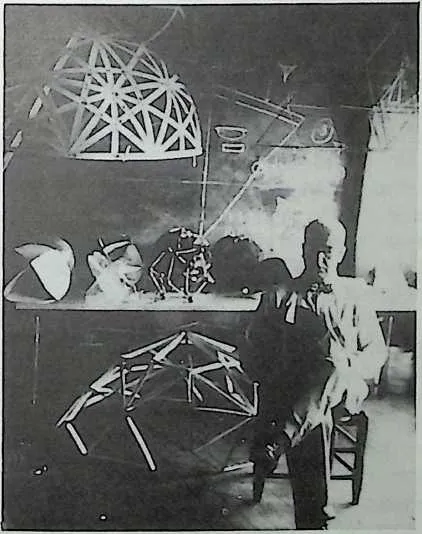
31 Fig. 13-1 Fuller with some of the geometric models which provided him with so many insights and led to his invention of a practical geodesic dome, 1948.
32 means a holiday. Rather, he spent much of 1947 and 1948 studying the single field which he believed would provide the greatest benefit to his future contribution to humankind: spherical geometry. He devoted most of his time to studying and thinking about spherical trigonometry as well as improving on the conventional tenets of that subject. His theories concern-ing the human thought process were very useful to his studies, and he continued applying them to his beloved geometry during those two years.23
33 Once Fuller had grasped the mind’s sorting process, he resolved to further expand his geometric model of human thought by discovering the minimum number of items required to establish the ‘‘insideness’’ and ‘‘outsideness’’ into which experiences are sorted. He found that a sphere, such as the clear sphere described earlier, was a workable structure for that process. However, mathematically and visually a sphere is repre-sented as an infinite number of points, and Fuller wanted to determine what structure could provide the same sorting characteristics (i.e., insid-eness and outsideness) using a minimum number of points. By determin-ing the minimum number of points required to create such a structure, he understood that he would also be discovering the minimum effective structure for the thought-sorting process.24
34 In his quest for the minimum number of items (experiences, in the case of thoughts) required to produce those two qualities, Fuller found that any two items could be joined by a line, and that any three connected items produced a triangle. Such configurations generate the characteristic of ‘‘betweenness’’ but do not have the three-dimensional makeup needed for the characteristics of ‘‘insideness’’ and ‘‘outsideness’’ which result in a thinkable set.25
35 Four items do, however, generate a structure with those attributes. In fact, Fuller found that four is the minimum number of items (be they experiences, points of a geometrical model, human beings, or anything else) required to delineate inner and outer boundaries. When displayed as a geometric model, those four items form a tetrahedron (i.e., a structure composed of four triangular faces). They also represent the smallest con-ceptual subdivision of Universe, Fuller referred to that subdivision as a ‘‘system.’’26
36 In Fuller’s theory, a system divides all Universe into that which is outside the system and that
which is inside the system, plus a small amount of Universe which embodies the system itself.
Even though most people rarely consider their daily functioning on the grand scale of all
Universe, almost all human activities are, in fact, predicated upon distinc-tions established by
systems. The thought-sorting process described ear-
Her provides an excellent example of how people regularly employ sys-tems in daily
life.
37 Fuller reasoned that since thoughts are systems composed of experi-ences and since four items constitute a minimum system, a minimum thought is composed of four experiences.27 Those four experiences do not occur simultaneously. Rather, they are experienced by an individual at different times, and the memory of them is stored within that person’s brain. Although those memories are the items which are examined for relationships during the thought process, Bucky referred to them as if they were no different from the actual experiences.28
38 He theorized that in its quest for greater understanding, the human mind continuously searches through that ever-expanding repository of experiences for those with similar qualities. When a person’s mind un-covers comparable characteristics within two or three experiences, those experiences are grouped together for further study.29 However, when a fourth experience with similar qualities is discovered and added to the others, the minimum number of items needed to create a set dividing all Universe is established, and that set has the potential of becoming a thought. In other words, with four experiences, the mind has enough information to produce a dividing structure the geometrical equivalent of which is the tetrahedron with its four points. Before any set of experiences can be upgraded to the status of thought, however, it must first arouse the mind’s curious attention.
39 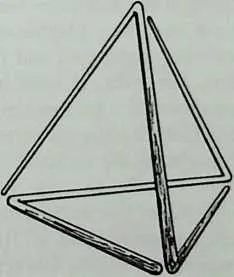 Fuller felt that the act of grouping four experiences together is usu-ally an indication that
some amount of curiosity has, in fact, been stimu-lated.30 To attain the next level of thought, the
human mind searches for
Fuller felt that the act of grouping four experiences together is usu-ally an indication that
some amount of curiosity has, in fact, been stimu-lated.30 To attain the next level of thought, the
human mind searches for
40 Fig. 13-2 A tetrahedron with its six sides (relationships) and four vertices (items).
41 the relationships between those four items. As with many of his other ideas, Fuller modeled the relationships within a thinkable set of related experiences geometrically to provide a better understanding, and he cre-ated the following analysis.31
42 One relationship exists between two items, be they experiences, dogs, rocks or anything else. Three items form a triangle, which contains three relationships or connections between the various elements. How-ever, when the number of items is increased to four, the number of relationships (i.e., connections) escalates to six, as is modeled by the six sides of the tetrahedron.32
43 According to Fuller, those six relationships are the human mind’s quarry in its pursuit of a thought.33 Initially, individuals do not con-sciously recognize the final disposition of a thought. In fact, Fuller felt that if a thought is discovered prior to the completion of what a person believes is a specific thinking process focusing on a particular topic, that procedure is not ‘‘thinking.’’ Instead, the process is simply a sorting of known experiences.34 In thinking, the final resolution can be grasped only after the minimum six relationships are uncovered, and the thought always remains obscure until the last relationship is recognized.35
44 An individual might gain some insight into the final thought with fewer than six relationships, but the six relationships are required to generate the complete thought, just as six sides are required to construct a tetrahedron.36 With fewer relationships, a ‘‘thought in process’’ might be modeled as a line or a triangle with the quality of betweenness. However, using his geometrical model, Fuller demonstrated that four experiences and six relationships are the minimum requirements which yield the char-acteristics of insideness and outsideness needed to define a thought.
45 In Fuller’s theory of thinking, simply knowing about four similar experiences does not constitute a thought.37 For example, most young children experience numerous metaphysical occurrences. They frequently have imaginary playmates, appear to communicate telepathically before learning languages, and master specific talents with little or no instruc-tion. However, in most instances, only after children have matured and encountered metaphysical phenomena are relationships between such ear-ly childhood events seriously considered. And only then, do thoughts concerning the metaphysical aspects of life begin to surface.
46 Fuller felt that the combination of four items found throughout Uni-verse is essential to all life.
Since four is the minimum number of items required to divide Universe, he believed that it also
provides the most
efficient expression of the critical differentiation which establishes indi-vidual human life.38
Without the differentiation of insideness and out-sideness provided by a minimum of four
experiences combined into a thought, human beings would be unable to perceive themselves as
sepa-rate from other beings or components of Universe, and all humanity would meld into a
single entity.
47 Fuller observed that foumess, in fact, occurs throughout Nature. Because Nature always employs only the exact amount of resources and energy necessary for any task, the majority of natural construction is predicated upon the tetrahedron and its minimal four items or points.39 To better understand why four is so significant, Fuller considered another geometrical phenomenon, the most efficient, stable configuration in which four identical balls can be closely packed. Three balls on a flat surface come together naturally in a triangular formation with each ball touching the other two at a single point. To completely stabilize that configuration, the fourth ball nests in the indentation provided by the other three as seen in Fig. 13-3.40
48 This modest structure provides another demonstration Fuller em-ployed to illuminate a metaphysical phenomenon using a physical artifact. By connecting the centers of this most efficient means of packing a fundamental component of Universe (i.e., the sphere), the essential reg-ular tetrahedron is fabricated.41
49 Because of its efficiency, Fuller perceived four and its geometric manifestation, the tetrahedron, to be the most utilized structural system in Universe, and as such, it became a fundamental element of his philosophy and operating strategy.42 Foumess is constantly employed by Nature in both physical and metaphysical situations. Once he recognized this elegant wonder of nature, Bucky regretted that most human beings do not grasp the significance of this apparently innocent, yet ingenious, phenomenon.43
50 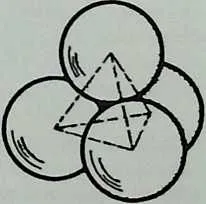 He believed that when a significant number of individuals do begin to
51 Fig. 13-3 Four balls packed as closely as possible. When the centers of these balls are connected, as shown, the connecting lines form a tetrahedron.
52 recognize the prevalence and importance of the four-item, six-relationship configuration known in its physical form as the tetrahedron, humanity would enter into a new era of enlightenment. At that time, he felt great changes would occur in all fields of human endeavor, including educa-tion, construction, and the processes of conscious thinking.44
53 In education, the ninety-degree, right-angle geometry predicated on the square would be replaced by the Synergetic Geometry which Fuller developed and which is predicated upon the tetrahedron and on concepts which can be experienced rather than obscure principles. Unstable, ineffi-cient right-angle buildings, which have been the basis of most human construction since the inception of permanent structures, would be replaced by the geodesic structures that were so essential to Fuller’s work. Predi-cated on stable triangulation, which does not require the heavy buttressing of current material-intensive construction techniques, geodesic structures would provide humanity with the medium to house many more people while using far fewer resources than ordinary buildings.
54 In the area of conscious thinking, understanding the four-element structure would permit society to better appreciate and utilize the power of the human mind. With such an understanding, individuals could know-ingly enter into an expansion of their awareness and evolution by con-sciously choosing to think about issues in an efficiently productive mode rather than in the haphazard manner currently employed by most people.
55 Another facet of thought which Fuller believed to be extremely important was imagination. The root of the word imagination is image, and Fuller defined imagination as the uniquely human ability to create an image. Through years of personal experience and observation, he came to believe that the human capacity to think and create order from chaos is primarily the result of the ability to employ imagination.45
56 According to his hypothesis, in thinking and establishing order, hu-mans gather an enormous quantity of information.46 They then utilize imag-ination by applying that accumulation of data to complex problems. Such an ability is especially important when new information is obtained through observation and experience. When that occurs, individuals use their minds to imagine and uncover relationships between the new information and previously accumulated knowledge, and that is imagination at work.
57 Fuller further felt that the process of imagination was even more miraculous in light of the fact that no human being has ever looked from outside of himself or herself. He would explain that information gathered outside a person’s physical body is assembled inside that individual’s brain just as news from the outside is collected within a television studio. Each person’s internal ‘‘studio’’ is the site at which his or her ‘‘image-ination’’ is utilized to discover relationships between the assembled items of news.47
58 Bucky’s understanding of and use of human imagination was evident in the evolution of his lectures. During almost all his speaking engage-ments, he employed some geodesic models to demonstrate principles and concepts, but his earlier lectures were far more cluttered with models than in later years.
59 With his fame in the 1930s, Bucky began receiving his earliest major requests to lecture. Having used models extensively during his 1927 re-treat, he felt that they might enhance his ideas during his speaking engage-ments, and he soon found that models provided an excellent means of illustrating concepts as he discussed them. In fact, his lecture models became so profuse that he soon found himself towing a large trailer brimming with models to every speech.48
60 Although those models provided excellent visual aids, they continued to increase in number as his knowledge and understanding of Universe
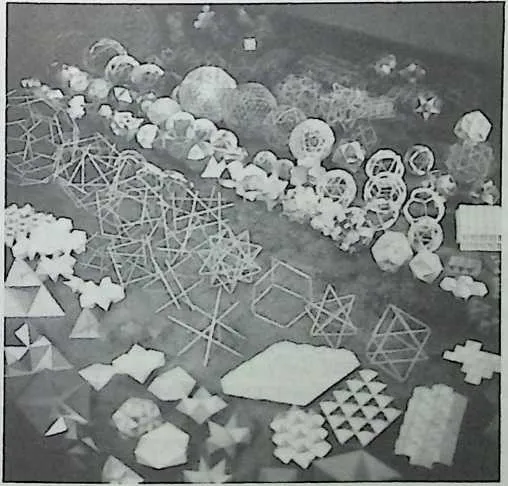
62 Fig. 13-4 A portion of Fuller’s extensive collection of geometric models.
63 heightened, and he sought innovative solutions to the problem of his growing aggregation of models. Specifically, Bucky needed a method of effectively and efficiently illustrating complex issues without having to transport truckloads of models and equipment. The development of pub-licly available, high-quality photography provided the solution he sought, and, always one to try the latest technology, Fuller quickly became one of the first lecturers to use slides throughout his talks. In fact, Bucky replaced nearly all his models with slides of them, thereby resolving his shipping problem.49 Still, he was troubled by frequently confronting situations in which he was stranded without any visual aids to support his words.
64 For instance, at formal dinners, he would often be introduced to important individuals who would invite him to explain one of his concepts on the spur of the moment. Although Bucky could easily have fallen back on polite small talk, such instances provided him with two opportunities he was seldom able to resist, an interested individual and an invitation to communicate. After doing his best in several such situations, Fuller began to realize that he could, in fact, communicate his ideas smoothly without the aid of either models or slides. When describing ideas, he accom-plished that feat by relying on his audience’s sensory experiences.50
65 Bucky knew that every person has vivid memories of past experi-ences, and in speaking to a stranger, he would start the discussion by attempting to discover which of that person’s experiences related directly to the topic at hand. He then utilized those experiences to describe abstract principles and ideas in a manner similar to the way he employed models during his lectures.51
66 The spliced-rope illustration he used to explain pattern integrities and their relationship to life provides an excellent example of that technique in action. Bucky’s description was acceptable to any listener because every-one had some experience of a rope. In fact, over the years, Fuller re-counted the details of that demonstration thousands of times to both indi-viduals and groups without ever fabricating that rope or even an illustration of it. Yet, he was never questioned about not having an actual rope or even a photograph of it.52
67 By predicating his discussion upon an individual’s past experiences rather than some unfamiliar abstract idea, Fuller quickly established a common ground of understanding between himself and his audience. The result of such action was that rather than alienating people with his wisdom, his mutually understood experiences communicated ideas in an easily grasped and accepted format.
68 Bucky’s strategy was successful because human beings visualize experiences only within their minds. He knew that even his slides and models were perceived only internally, within an individual’s mind. Thus, he understood that his function as a communicator was to stimulate the imagination of all members of his audience so that they, in turn, could individually construct an image of a model or an idea within their minds and visualize its demonstration of the principles he was sharing.
69 Fuller was certain that because his listeners were far more involved in the procedure when no visible artifact existed, communication was much more successful under such circumstances. He believed that when a per-son generates an image in his or her mind without visual aids, that image and idea has a far greater impact and the communication is accessed and retained at a much deeper level.53
70 Bucky came to truly appreciate the magnitude of human imagination when he was a member of an audience forced to experience an entire play without visual aids. The incident occurred in 1940, and the perpetrator was Fuller’s good friend Alexander King, the art editor of Life magazine at the time.
71 King was also a playwright and a recognized authority on the theater who had written what he believed was an excellent play. The final years of the Depression, however, made Broadway production a very risky finan-cial endeavor, and few people were interested in investing in the play. King therefore set out to bypass all the problems of finance and produc-tion. To accomplish his goal, he rented a large New York theater for one evening and invited dignitaries and critics to the ‘‘opening’’ of his new play. As a close friend, Bucky was also invited to the formal-dress open-ing night.54
72 The guests arrived on the designated night and were surprised to find an empty theater with the curtain raised and nothing onstage except two grand pianos. Bucky later discovered that the pianos were displayed only because King was required to hire stagehands when he rented the theater. Being somewhat eccentric and wanting to get the most for his money, King instructed the stagehands to position the grand pianos on either side of the stage and to move them from one side to the other several times during the performance. King himself merely used the piano benches as seats while he spoke.55
73 King’s performance began when he walked to center stage and de-scribed the play’s scenery to a dumbfounded audience. He then proceeded to read the entire play aloud. What impressed Bucky was the fact that many years later, he recalled the smallest details of his friend’s work far more vividly than other productions he had seen in more customary stag-ings. He also found that phenomenon to be prevalent among others of his friends who had been members of that audience.56
74 In analyzing the situation, Bucky found that such graphic recall was a direct result of an imaging process King had stimulated in his audience. Rather than provide visual images, he had forced each person to create his or her own personal impression of the play, and since people could fash-ion images predicated only upon their personal experiences, those impres-sions were more familiar and very lucid.
75 For example, when King spoke of the house in which the characters resided, each person in the audience immediately generated an image of a house which conformed to his or her unique experiences. Thus, no person hesitated to accept the fact that the characters could live in that type of house. Furthermore, in creating his or her personal images, every indi-vidual introduced images far more detailed than any which could have been portrayed within the limitations of even the most sophisticated stage.57
76 Bucky also noticed that the audience was actively involved in the proceedings and consequently paid close attention to King’s presenta-tion.58 Because his technique was similar to radio, King’s strategy stimu-lated an interactive performance which belonged as much to his audience as it did to the author and ‘‘performer.’’
77 That, and similar experiences, helped Fuller formulate his strategy of constantly asking his audience (be it a single person or a packed au-ditorium) to recall common, special-case experiences from their lives. By conducting his ‘‘thinking out loud’’ sessions thusly, Bucky was able to establish a common ground, to stimulate his audience’s individual imag-inations, and to motivate them to participate and pay close attention to his message, all in a matter of minutes.
78 Once he had established an experience or item which was commonly recognized by everyone, Bucky could then quickly facilitate a group in collectively examining the principles upon which that experience or item was predicated. With each individual actively participating in his explora-tive lecture process and seeking to understand the ideas, Fuller was able to expand his audience’s experience and its limited concept of reality by guiding them to unearth other special cases in which that same principle was evident. Accordingly, his audiences entered into a conscious search for additional relationships between the myriad of finite experiences stored in their brains, and their collective and individual knowledge in-creased in the ongoing process recognized as ‘‘thinking.’’