
17 Legacy to the Future
2The years of 1969 and 1970 marked a monumental transition for humanity. It was also the time in which Fuller, who was then seventy-five years old, experienced the final great transition of his life. Although he did not cease work on any of the projects he felt required his attention, Fuller shifted his focus to completion rather than to the development of new undertakings.
3 He also devoted a significant amount of time to a transitional retreat similar to those which marked the other major shifts in his life during 1927 and 1949. As the 1949 break had been less time-consuming and intense than the 1927 interlude, so, too, the 1969 break was less intense than the one in 1949. In fact, to most people, his retreat appeared to be nothing more than enjoying time on the new sailing sloop he had purchased and christened Intuition. That time did, however, mark a decided shift in Fuller’s concentration.
4 After completing the 1969 World-Game seminars, he felt his in-ventory of global resources had been exposed to the public in such a way that others were excited enough to take it over, and he began allowing others to manage and operate that aspect of his work. Although continuing under Fuller’s guidance for the next decade, the World Game began functioning as a separate entity, whose managers frequently called upon Fuller for insight and wisdom. Characteristically, Bucky might actually have continued with his World Game studies and planning had it not been for a series of events which convinced him that his revolutionary ideas simply could not be carried out rapidly enough for him.
5 Although it appeared to be a coincidence, the fact that the initial SIU World Game seminar occurred at the same time that the first humans were landing on the moon was perceived by Fuller as an obvious indication that his ideas and the plan of the Greater Intellect were synchronized. For the first time in the history of humanity, human beings could actually stand on another of the celestial bodies and observe the Earth in its entirety, just as Bucky had always demanded that it be regarded within the World Game and his other endeavors.
6 He also ardently believed that every person living on Earth should have an opportunity to comprehensively view our home Planet as well as the distribution of its resources and population. Thus, Bucky felt that a $30-million World Game installation at SIU was an essential element of humanity’s development.1 In the spirit of compromise, Bucky did agree to undertake the project in gradual increments, and the Illinois state legisla-ture allocated $3 million in funding for the project, provided Fuller and his associates could raise an additional $9 million. That project was just getting under way when the controversial nature of Bucky and his revolu-tionary ideas again surfaced and shifted the course of his life. Specifically, in 1970 the wave of campus unrest which had begun during the mid-1960s on the West Coast reached the Midwest and the Carbondale Campus of SIU, creating an air of tension among faculty and students alike.2
7 Although the brunt of the student protests were against the United States’ involvement in Vietnam and Southeast Asia, with his comprehen-sive perspective Fuller felt that the problem was far more sweeping. He believed that the Vietnam crisis was merely one component of the much larger Cold War between communist and capitalist alliances which had been compounding since the end of World War II.3
8 As Fuller perceived the situation, the countries involved in that dis-pute were devoting billions of research dollars to the discovery of more effective methods of destroying ‘‘the enemy.’’ That increased weaponry production had grown to such an extent that some countries would be able to destroy the entire Planet within minutes, and much of the research for such devastation was occurring where research had traditionally occurred, at university laboratories. Bucky believed that as a part of the Cold War, not only were both sides allocating huge sums of money to the formulation of new weapons, but they were also devoting a great deal of money to the destruction of each other’s primary source of new scientific discoveries, the universities. He felt that such foreign intervention was a major factor contributing to the unrest on American campuses.4
9 Whether such interference was occurring or not, college students during the late 1960s and early 1970s were adamantly opposed to military research on campus, and they often vented their opposition at an institu-tion’s president. At SIU’s Carbondale campus that man was Fuller s good friend, president Delyte Morris. Morris had been instrumental in estab-lishing Bucky’s position at SIU, and he had continued to lend enthusiastic support to Fuller’s projects as well as to those of other liberal professors with vision. Students, however, perceived Morris as a figurehead of the military---industrial complex which was responsible for the United States aggressive military posture, and they called for Morris s resignation.5
10 Peaceful protest soon escalated into more revolutionary behavior as rumors about Morris were spread, and his home was vandalized. Within a short time, the pressure of such action, along with legislators calling for force to be used against the students, resulted in Morris s resigning his position.6
11 Without Morris’s support, Fuller’s projects and those of other pro-gressive professors were doomed. The Illinois legislature withdrew its offer of $3 million in World Game funding, and, rather than being an asset at SIU, Bucky found himself regarded as a liability. In the midst of that stressful situation, Martin Meyerson, president of the University of Penn-sylvania, came forth with a most intriguing proposition. He had known Bucky since 1948, when Fuller taught at the Chicago Institute of Design and Meyerson was head of planning for the City of Chicago. An architect, Meyerson had served as dean of the School of Environmental Design at the Berkeley campus of the University of California, and because of his compassion for and deep interest in students, he had been appointe chancellor of that institution during the 1960s. When he accepted t e position as president of the University of Pennsylvania in 1971, Meyerson immediately set out to achieve something he had wanted for years, having Buckminster Fuller associated with an institution he headed.7
12 Because Bucky thoroughly trusted and respected Meyerson, he was willing to seriously consider the possibility of moving his center of opera tion, even though he was seventy-five years old. Bucky reasoned at since he would not stop his nearly continuous global lecturing and consu t ing or spending at least several weeks each year isolated with family an friends on Bear Island, the location of his office was not really vep/ significant. Consequently, he entered into negotiations with Meyerson. t his advanced age, Bucky was quite certain about his wants and nee s. e sought the best possible support for sharing his message as effectively an rapidly as possible with the public and for making certain that the researc he had instituted continued in earnest. He also wanted to be associate with an institution which would support proper housing of his archive so that it would be available to the public.8
13 One of their initial negotiating sessions quickly concluded when Meyerson asked just how much money Fuller would require to continue his research projects and, in his characteristic disregard for finances, Bucky casually replied about $300,000 or $400,000 per year. Having only recently attained his position at the university, Meyerson did not have access to such funding, and he began searching for a different strategy.9 He found his solution in the newly formed University Science Center, which was being built as one element of a Philadelphia redevelopment project. The University of Pennsylvania was only one participant in that project, and Meyerson enlisted the support of three other member institu-tions to join the University of Pennsylvania in sponsoring Fuller’s move to Philadelphia. The other three members of the consortium which eventually convinced Bucky to move were Bryn Mawr, Haverford, and Swarthmore Colleges.10
14 The combined resources and prestige of those four institutions per-suaded Bucky that his work would progress much more rapidly in Phila-delphia. Thus, he accepted the position of World Fellow in Residence at the University City Science Center and shocked the administration at SIU by announcing that he and the vast resources he had accumulated over the years were leaving their university.11
15 When the move was completed in 1972, Fuller was given a magnifi-cent reception. Mayor Frank Rizzo designated Bucky as an honorary citizen of Philadelphia, an honor never before accorded to anyone other than foreign heads of state. The mayor also presented him with a gold case containing an insignia of citizenship, which he jokingly mentioned would get Fuller out of any trouble he might get into with the police. Although he felt he was past the age when such an honor would be of practical use, Bucky was reminded of the New York City honorary police captain badge he had received fifty years earlier and the number of times it had extri-cated him from traffic problems with police officers.12
16 As with most of Fuller’s actions, the move to Philadelphia was fraught with controversy. Although no formal contract had been signed, he had informally promised his extensive Chronofile archive to SIU, and its relocation to the University Science Center marked an end to that agreement. Still, Bucky felt that he had to respond to the changes of the moment, and he believed that the Philadelphia office would provide a much more efficient base for his work.13
17 The move itself was difficult for both Bucky and Anne. Although he appeared to be in better health than his frail wife, both had reached a stage of life when physical demands were becoming more and more of a strain. Additionally, Bucky felt obligated to maintain much of the support for several of the research projects he had initiated as well as for his headquar-
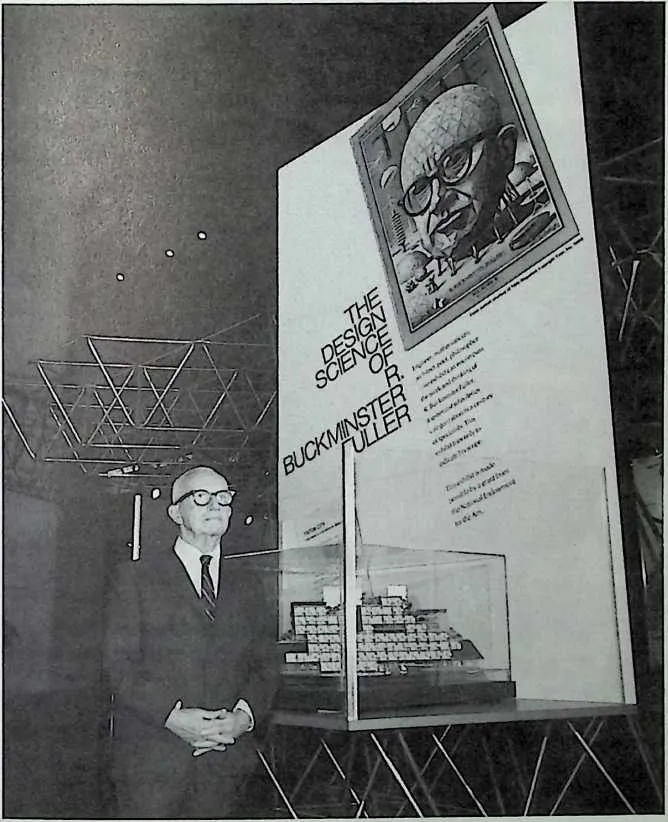
19 Fig. 17-1 Fuller at the 1973 Chicago Museum of Science and Industry exhibition of his work. Above him is a replica of the 1964 Time magazine cover on which he was featured and next to him is a model of Triton City; also shown in Fig. 17-2.
20 ters office.14 The primary financial sustenance for those endeavors re-sulted from his ongoing worldwide lectures which continued to number well over one hundred each year.
21 That breakneck pace of travel and speaking finally caught up with Bucky in November of 1972, when he simply collapsed. Believing that he was suffering a heart attack, Bucky was rushed to a hospital, where doctors determined that he was simply exhausted. His fervor in doing all that he felt needed to be done for as many people as possible had finally taken its toll.15
22 One of the endeavors which may have contributed to the decline of Fuller’s health and energy level was the process of compiling and com-pleting his ideas about mathematics. He was adamant that the geometric math he had christened ‘‘Synergetic-Energetic Geometry’’ (later renamed Synergetic Geometry) as well as his thoughts on Nature’s fundamental coordinate system should be properly recorded prior to his death. Because of that desire, an informal compilation project had been initiated during his 1927 period of silence, but formalizing that endeavor into a book had to wait until the end of his life when Fuller felt his ideas would be more complete.16
23 Realizing old age was creeping up on him and aware of the massive nature of the task, in 1961 Fuller had signed a contract to complete such a book for the small advance of $2500. The publisher, Macmillan Publish-ing Company, had patiently waited for several years without seeing any activity from Fuller on what was to be a seventy-thousand-word book based on his most recent lectures. With every intention of producing the book, Bucky had begun maintaining bits and pieces of his best ideas and writings. Those tentative chapters were kept in an imposing black leather briefcase stamped with the initials ‘‘B.F.’’ which was protected by Bucky and his staff with the same caution afforded to secret documents by military organizations. That briefcase was always kept near Fuller and was never mailed or checked with baggage when he was traveling.17 When its contents were later examined by Ed Applewhite (Fuller’s eventual collaborator on the book which became Synergetics and ex-plained his mathematical concepts) he was amazed to discover that the outward precautions were not a true indication of its contents. Inside, he found notes, ideas, and writing which were simply stuffed into the satchel for future analysis.18
24 Applewhite had first met Bucky and his family during the mid-1950s at the age of fifteen. Ten years later, Bucky asked him to join Fuller Houses as director of personnel working on the Dymaxion House in Wichita, and Applewhite accepted.19 Following the demise of that pro-ject, Applewhite went to work for the government and later the CIA.
25 In 1969, when he visited Bucky at his Carbondale office, Applewhite had just retired from his post at the CIA and was looking for work. During that trip, Fuller offered Applewhite the opportunity to manage all his affairs.20 Having experienced Fuller’s frenetic energy and tendency to-ward independence and complete control of his projects over the years, Applewhite was aware of the pitfalls such a position might include and declined the offer. He did, however, agree to collaborate with Fuller on gathering together all the pieces of Synergetic-Energetic Geometry so that it could be published in one volume. Several other people had failed at that task, but Applewhite felt confident that he could apply the organiza-tional skills he had acquired working with codes in both the navy and the CIA to master the formidable assignment.21 Still, Bucky’s philosophy and ideas would additionally require interpretation, translation, and explana-tion before they could be even partially understood or appreciated by average readers---a task which will most likely continue for decades.
26 Having initiated the World-Game seminars in 1969, Bucky felt that he had completed the global-resources aspect of his life and was ready to move on to a culmination of his mathematical ideas. He was also aware of his advancing age and deteriorating health. Hearing aids had become as necessary as his thick glasses in helping him to fully experience his physical environment and to maintain his breakneck pace of lectures, writing, and projects. Most of his books were, however, not uniquely composed as printed material. Rather, they tended to be edited transcrip-tions of his thinking out loud lecture sessions, which he felt should be preserved in written form.22
27 Although somewhat successful, those books were primarily pur-chased on the strength of Fuller’s personality. After hearing one of his lectures or learning about him through the media, people wanted to exam-ine more of his ideas, and books appeared to be the best means of doing so at a slower pace than the one used by Bucky in personal presentations. Even though Fuller’s ideas, like Nature itself, were elegant in their sim-plicity, his books tended to be as convoluted as his lectures. And although Synergetics was created in a much different manner, Fuller’s requirement of expressing precisely what he felt was true at a given moment with a lesser regard for the reaction of his audience resulted in that work’s retaining a similar quality.
28 Many aspects of that book’s production are as significant as the work itself because they represent a microcosm of the Fuller personality while providing a glimpse of the difficulties he constantly confronted as he struggled to benefit the most people possible within the few short years he knew were left to him. The process clearly portrays a man who at the age of seventy-six was constantly aware of what he felt needed to be done in the best interests of humanity and who also realized he had to produce a minimum income of $200,000 per year to support his staff and the pro-jects in development.23 Under those pressures, Applewhite and Fuller agreed to only four guidelines for Synergetics: All the geometry was to be expressed in written words. Applewhite was not to be listed as a coauthor. All the text was to be in Fuller’s phraseology. And, the book was not to make any attempt to conform to technical textbook or academic stand-ards.24
29 Following those guidelines, Applewhite began a thorough search through Bucky’s accumulated Chronofile material, including both written and recorded works and other collected memorabilia. He was particularly astonished after he opened the revered briefcase containing the most re-cent version of the Synergetics manuscript, only to find an amalgamation of diverse writings including the most recent first chapter of the book written as fifty pages of blank verse entitled ‘‘Brain and Mind.’’ Ap-plewhite successfully argued that poetry was not suited to such a work, and after several lengthy discussions, ‘‘Brain and Mind’’ became a sec-tion of Intuition, one of Fuller’s books of poetry.25
30 Applewhite then began the heroic task of assembling and organizing all of Fuller’s written and spoken thoughts pertaining to geometry and soon found that separating a single topic from the message of a com-prehensivist was not only difficult but impossible. Thus, Synergetics, although outwardly focused upon the mathematics Bucky had been devel-oping for decades, also includes a great deal of his philosophy, under-standing of Universe, and tendency to explain phenomena in much greater detail than most people would ever care to study.
31 Applewhite’s strategy for creating the book was quite simple, and it resulted in a monumental resource which was not only used in the produc-tion of Synergetics but will also be of immense value to future generations interested in Fuller’s work. He instituted his work by typing relevant quotations on 5" X 8" index cards and sorting them into topics.26 That accumulation of wisdom eventually became the Synergetics Dictionary, which was published separately as four massive volumes in 1986.
32 Since Fuller remained in Philadelphia only a few days each month, Applewhite was forced to catch Bucky whenever and wherever he could. Thus, collaborative ‘‘writing’’ sessions were held in hotels and restaurants around the World, as well as in both Applewhite’s home and Fuller’s office and home. A major portion of the work on Synergetics was also done via long-distance telephone conversations, with Fuller calling Ap-plewhite at almost any hour of the day from sites as diverse as La Jolla, California; Tokyo, Japan; New Delhi, India; and Windsor Castle in England.27
33 Prior to a meeting, Applewhite would prepare and organize triple-spaced sheets of Fuller’s quotes in the order he felt would be most log-ical.28 Then, in typical Fuller fashion, Bucky would begin amending the pages to include his most recent thoughts on the topic. Bucky’s work was always done longhand on single sheets.29 He somehow managed to com-mit all his notes about what was typed on a page to that page, even if it meant a nearly illegibly tiny handwriting. Noticing that quirk, Applewhite soon initiated a policy of allotting massive margins so that Fuller would write in script large enough to be deciphered.30
34 The changes were then retyped and the new sheets submitted to Fuller, at which time he would again amend them.31 Although Bucky maintained that he required only seven changes to a draft, that process might have continued indefinitely had not a new agreement been reached with Macmillan Publishing. Under the new contract, specific deadlines were created and the advance for Synergetics was increased to three payments of $25,000.32 Because Macmillan had already been waiting for nearly a decade without seeing a single page of manuscript, the new contract also permitted the publisher to withdraw from the agreement if, after reading portions of the work, the editors determined it did not suit their requirements. Fuller and Applewhite were able to honor the first deadline of the new contract, and Macmillan accepted the book after its editors examined the first third.33
35 Even though Applewhite himself had limited access to Fuller over the next years, each succeeding section was submitted to the publisher on time, and the completed manuscript was delivered in March of 1974, just over four years after Applewhite had agreed to work with Bucky. Believ-ing he had completed the monumental task, which had occupied almost all his waking hours during that time, Applewhite then boarded a Polish freighter for a much needed, isolated eleven-day trip to Germany.34 How-ever, upon returning to the United States, he was surprised to discover that his work was far from completed.
36 From Bucky’s perception, no task was ever completely finished. Rather, it was accurate for a particular moment in time, but when that moment passed, his sense of integrity required him to revise and rewrite any elements he felt were no longer thoroughly accurate. Thus, when Macmillan began returning galley proofs to be checked for simple errors, to the consternation of everyone, Bucky acted as if he were dealing with manuscript pages and began making massive alterations. Such action should not have surprised anyone who had worked with Fuller and had witnessed his almost total disregard of the formalities of bureaucratic processes. Still, people involved in the project, especially Applewhite, quickly reminded Bucky that any large changes would be charged to him.35
37 Displaying the nearly fanatical need to disregard such financial for-malities which had often plagued and limited his effectiveness, Fuller continued with the alterations he felt were ‘‘essential,’’ and they eventually resulted in his paying for over $3500 worth of additional changes.36 Those massive modifications also created production delays while adding to the somewhat agitated atmosphere surrounding the project at Macmillan.
38 That animosity was compounded by internal changes at Macmillan which resulted in Synergetics being passed from editor to editor. When the project’s completion was finally in sight, the publisher’s executives sched-uled Synergetics as its featured book for their 1974 fall list of new books even though the only people who had actually read the final work in its entirety were Applewhite and a few copy editors.37
39 Prior to the final printing, however, another aspect of the drama which so often surrounded Bucky’s projects surfaced. Cutting finished galley proofs into pages and binding them into what appear to be finished books is a standard practice in the industry. Those galley ‘‘books’’ do not usually include illustrations or photographs, and Synergetics was no ex-ception. However, without its essential artwork, the book, which was inherently difficult to understand, appeared even more convoluted.38
40 To make matters worse, numerous copies of the galley books were circulated throughout Macmillan so that they could be inspected by vari-ous departments, including the sales, marketing, editorial, and legal de-partments. When the managers of those areas attempted to read and assess the book, they realized the enormity of their problem.39 Some people, including Ed Applewhite, were beginning to speculate that Synergetics might have been more appropriately issued through a technical or special-ty publisher. In fact, after reviewing the book, many of the Macmillan managers were seriously considering printing it as a college textbook rather than a popular or ‘‘trade’’ publication.40
41 Such a move would not have been imprudent. With its 876 pages, 150 illustrations, and dozens of tables, charts and diagrams, Synergetics was meant to be studied rather than read. Furthermore, its structure is that of a textbook, with numbered sections rather than chapters. For example, Section 400.00, ‘‘Systems,’’ is divided into subsections such as 410.00, ‘‘Closest Packing of Spheres,’’ and 420.00, ‘‘Isotropic Vector Matrix.’’ To further ‘‘clarify’’ topics, subsections such as 410.00 are divided into subsubsections such as 410.01, ‘‘Nature’s Coordination,’’ and 410.10, ‘‘Omnitriangulation of Sixty Degrees.’’41 Below those subsubsections are subsubsubsections, such as 410.011 and 410.02, which are not titled and present the actual text paragraphs. Each and every paragraph of that massive volume is thus numbered and focuses on a particular topic.
42 While the entire work does contain a massive amount of knowledge (much of which has been interpreted and presented throughout this book), in Synergetics that information is presented in the form of a mathematical dictionary rather than a popular work. And, although many people need and use a dictionary, few are moved to read one from cover to cover. To make matters worse, Synergetics has no index, and therefore a person attempting to reference a particular topic is forced to search through pages and pages of material.
43 This is not to say that the book is not precisely as Fuller felt it should be. Always the comprehensivist, Bucky had succeeded in his attempt to combine science, poetry, and philosophy in a single work. Such an as-tonishing accomplishment would be praised were it not for the fact that few mortals are as comprehensively oriented as was Fuller, and thus, most people were reluctant to respond positively to, much less to acquire and read, such an epic volume.
44 What Synergetics needed was another volume or at least a few chap-ters of extensive translation and explanation. What it received from the management at Macmillan during the early summer of 1974 was cancella-tion. Unable to decide about the work, Macmillan managers simply re-moved it from their production schedule and continued an internal debate for the next several months. Finally, during the late fall, work on the book again began to progress. That decision was, however, so controversial that it could be made only by the company’s chairman of the board.42 He resolved to attempt reducing the company’s losses on the work by releas-ing it as a general trade book on the strength of Fuller’s name and reputa-tion. He also decided to cut costs by eliminating the color printing from the previously planned thirty-two pages of color drawings (which would have added a tremendous amount of clarity to the work) as well as by increasing the retail price from the planned $12.50 to $25.00, a very high price for 1975.43
45 As a result of those decisions, Bucky’s attempt to complete the mathematical coordinate facet of his life and to publish his findings culmi-nated in an initial printing of fifteen thousand copies of Synergetics in April of 1975.44 Subsequent printings followed, and although it was considered successful by everyone who had worked on the project, the book remains an enigma to most people, including the critics who re-viewed the first edition. Rather than seriously commenting on the work, most of them were unable to understand it and simply relegated the book to the category of an interesting ‘‘intellectual toy.’’
46 Engineers, architects, and scholars tend to prominently display the hefty volume on their bookshelves. However, on examining the book, one might find the binding barely broken. It is a marvelous collection of what Bucky believed to be all he had learned in his search for Nature’s coordi-nate system through 1974, and it has been somewhat of an inspiration for many of the insights provided throughout this book. It is also a massive resource for those willing to consider, among other things, the possibility that most of the mathematics taught through the centuries is erroneous, and that Fuller had, in fact, discovered a cosmic mathematics predicated upon Nature.
47 Synergetics is not, however, easily accessible to the general public. Within months of its completion, Fuller had recognized that problem and had entered into a process of rectifying it. In characteristic fashion, he had actually begun rewriting the book during the production process, and that rewriting continued even after the book had been published. When the possibility of altering the finished work was rejected, he simply started work on the second volume.45
48 Ed Applewhite was also involved in that work. Thus, Synergetics 2 follows the same convoluted style of Synergetics. Fortunately, Fuller had discovered the flaw in the earlier work, and in a continuing attempt to clarify and make his ideas as accessible as possible, he divided many of Applewhite’s numbered sections, subsections, subsubsections, and sub-subsubsections into narrative scenario sequences which are easier to fol-low. Scenarios such as ‘‘Child as Explorer’’ and ‘‘Complex Humans’’ provide readers with a much more accessible entrance into Fuller’s ideas and help somewhat to overcome the ‘‘mathematical dictionary’’ presenta-tion of the two volumes.
49 Both books were also greatly enhanced by the inclusion in Synergetics 2 of a complete index of the two volumes. Still, expectations were already set from Synergetics, and readers unable to cope with that volume were usually not willing to attempt reading what appeared to be a similar work. Unwilling to have those books relegated to the back shelves of libraries, following the 1979 publication of Synergetics 2, Bucky mounted an ongoing campaign of advising his audiences to read the second volume before taking on the first book.46
50 In both Synergetics books, readers will find a detailed recounting of many of the theories and hypothesises presented throughout this book. Fuller believed that both physical and metaphysical phenomena as well as the general principles which governed all Universe could be modeled by means of physical illustrations and could be explained particularly well with geometry (i.e., his own synergetic geometry, which is predicated on the triangle rather than right-angle squares and rectangles). Thus, a reader will find those volumes filled with esoteric, almost poetic, interpretations of reality as well as complex mathematical descriptions of the means through which Nature demonstrates and configures everything to conform to generalized principles.
51 With the 1975 publication of Synergetics, Fuller essentially com-pleted his work with mathematics, geometry, and the search for Nature’s coordinate system. He had already culminated his concentration on geo-desic structures with the Montreal Expo dome. Not that the comprehen-sively curious Fuller totally abandoned those, or any other, topics. Rather, he shifted his primary focus to the next project he believed to be most important: the completion of publicly chronicling his philosophy and gen-eral observations concerning the development of humanity. His primary method of relating those thoughts was, as usual, the written and spoken word.
52 Specifically, Bucky began working on one final book which would embody his philosophical convictions as well as his perception of the development of human civilization: where we had come from and what we were moving toward. Fuller also sought to include in that book his strat-egies for solving the most significant problems of the future.
53 The book he created was Critical Path, and like Synergetics, it was written with the assistance of a collaborator, Kiyoshi Kuromiya. Critical Path, like most of Bucky’s other books, tends to drift back and forth through topics, just as Fuller did in his lectures.
54 Within a verbal format, Bucky was able to ‘‘weave’’ the threads of a lecture tapestry, the whole of which was often evident to his audience only following the lecture’s completion, if they perceived it at all. Thinking in front of people, he could rely on his sense of the audience’s understand-ing, his personality, and his ability to share a broad context filled with details that generally went unnoticed.47 However, in the written format, those ephemeral qualities of communication were not available, and his books generally tend to fall short of delivering the unadulterated message that was presented in speaking.
55 Even with the support of Fuller’s other staff members, producing Critical Path was a formidable task for Kuromiya and the aging Fuller. It was, however, published in 1980 and marked the culmination of the final stage of Fuller’s lengthy process of completing and recording his work for posterity as well as his documenting critical solutions to major issues. Critical Path, more succinctly than ever, documents his philosophy and proposals for most efficiently achieving human success in the shortest period of time, many aspects of which have been recounted throughout this book.
56 When, in 1980, both Bucky and Anne reached their mid-eighties and Anne’s health was deteriorating, the family decided that another move would be advisable. Thus, the couple moved to a house in Pacific Pal-isades, California, within two blocks of Allegra and Bob Snyder’s home. Their grandson, Jaime, also moved into that house to help care for the couple. While Anne and Jaime generally stayed home, Bucky continued his frenetic pace of travel and speaking engagements as well as spent a great deal of time in Philadelphia where his headquarters remained.
57 Bucky was no longer an obscure, eccentric character. His years of considering solutions to humanity’s future problems had brought him worldwide esteem. Thousands of people attended each of the one-hun-dred-plus thinking out loud lectures he continued presenting every year, and despite his increasing age, those sessions were consistently hours in length, exhausting audiences long before Fuller was through.
58 The talks were, however, reaching a new and different audience. Rather than being limited to scientific and technologically oriented indi-viduals, Fuller’s message was increasingly welcomed by people with interests in humanistic and psychological issues as well as those con-cemed about the future. Although many of those audiences may have had difficulty with the technical and mathematical nature of his writing, they could empathize with his message that future success and prosperity for all humanity was a genuine possibility. They also appreciated Bucky’s life as a demonstration of what one individual could accomplish if he was de-termined to operate comprehensively and unselfishly on behalf of all hu-manity.
59 And although with his advancing years a certain amount of rigid egotism surfaced, because most people clearly observed and admired his commitment he was seldom confronted on the issue. For his part, Bucky was simply more interested in presenting the issues and facts that he felt were most important (as he perceived them) as efficiently as possible. Thus, a question about some personal aspect of his life would most likely result in an hour or longer monologue on humanity’s evolution.
60 Throughout his later lectures and writing, Fuller also championed some of the revolutionary ideas which he realized would not come to fruition during his lifetime but which he believed were seeds for the future work of others. One of the most dramatic of those projects was the ‘‘floating city.’’
61 During the early 1960s, Fuller had accepted a challenge from a wealthy Japanese patron, Matsutaro Shoriki, to design what amounted to a gigantic houseboat community that was to be floated in Tokyo Bay and would alleviate some of Japan’s overcrowding. Always concerned with maximum efficiency rather than ‘‘practical aspects,’’ Fuller proposed constructing a floating nine-thousand-foot-high tetrahedronal building. The structure was to house 300,000 families in spacious apartments, each containing two thousand square feet and overlooking the water. Since the World’s tallest humanly fabricated structure at that time was a two-thou-sand-foot television tower and the World’s tallest building was the Empire State Building at 1472 feet, Fuller’s proposal appeared to be more fantasy than reality. However, after examining his engineering calculations, many engineering and architectural experts agreed that the idea, although radi-cal, was feasible.48
62 In an effort to appease those who felt that something less formidable would be more practical during the initial stages of the project, Bucky redesigned the structure so that it could be built in sections, with the first segment housing only one thousand occupants. He also planned to con-struct the floating city from prefabricated modules, so that obsolete or worn-out apartments, schools, or stores could simply be removed from the main structure and their materials recycled. The open spaces in the frame-work created by such a change would then be filled with whatever new modules were required. Thus, it would be a flexible structure that could be anchored wherever it was needed.49
63 Although the idea was carefully studied by everyone, including the Japanese financier’s engineers, and proved to be valid, Shoriki died while the project was still in the drawing and proposal phase. It was, however, picked up on a much smaller scale by the United States Department of Housing and Urban Development during the late 1960s and was chris-
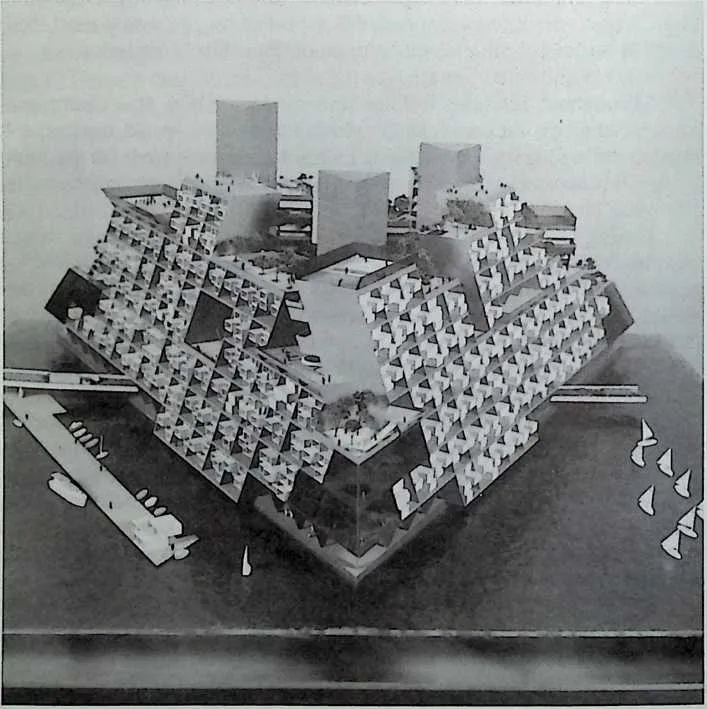
6566Fig. 17-2 The Triton City, floating self-contained community model.
67 tened Triton City. Triton City was to be a floating neighborhood of no more than five thousand people, embodying all the positive amenities of any neighborhood, including parks strategically placed within the massive courtyard area of the structure, stores, and parking. Since Fuller felt that the flow and storage of automobiles were major problems for urban dwell-ers, he relegated all motorized-vehicle access and parking to unseen, lower-level locations. Above the parking areas, pedestrians would move about safely on elevators and escalators, all of which would be enclosed in glass for increased visibility, security, and ambience.50
68 After examining Fuller’s models, drawings, and specifications, the Department of the Navy certified the seaworthiness of Triton City as well as the feasibility of building it at Fuller’s estimated cost by using construc-tion facilities which were, at the time, devoted to aircraft carriers. As President Johnson’s administration was deeply interested in social service programs for the poor, the fact that apartments could be realistically rented at a rate so low that people living just above the poverty level could afford them was particularly appealing.51
69 The City of Baltimore was seriously considering acquiring the first Triton City and installing it in Baltimore’s harbor, when politics once again resulted in the demise of a Fuller project. When the Nixon admin-istration was elected in 1968, social service programs were no longer a high priority, and the Democrat-controlled city of Baltimore lost its na-tional political advantage. Thus, work on its Triton City ground to an abrupt halt, and another of Fuller’s futuristic ideas was relegated to obscu-rity until the moment it is needed and will be rediscovered.52
70 Although Triton City and its larger Japanese version were designed for protected harbors, Fuller also envisioned mooring similar structures throughout the World’s oceans. He felt that cities anchored at sea could be supported by enormous pontoons submerged below the water’s surface where there was no turbulence. Structural columns would then rise from those pontoons to support the floating city high above the surface of the sea. With such a system, even during the most furious storm, the city would remain as motionless as any structure built on land.53
71 Similarly, Bucky proposed building fully submerged cities which could be anchored at sea. The only portion of such structures which would extend above the surface of the water was to be a large vertical tower through which air would flow. On top of that tower, Fuller proposed installing platforms for landing helicopters or other aircraft which do not require runways. The primary means of transporting goods and people to submerged cities was, however, to be submarines. Fuller felt that long-range atomic submarines would become the future trucks and buses of the World, linking modem oceangoing colonies both above and below the sea. Such colonies could also serve as ‘‘ports’’ for repairing and resupply-ing the submarines.54
72 Even more radical than his proposals for structures at sea were Full-er’s ideas for structures floating in the sky. During the late 1950s, he hypothesized that the weight of construction materials was decreasing so radically, while the strength of those same materials was increasing, that he would soon be able to design and construct enormous geodesic spheres which weighed very little.55 Bucky then began calculating further pos-sibilities and found that a tensegrity-supported geodesic sphere one hun-dred feet in diameter would enclose 7 tons of air. The structure itself, however, would weigh only 3‘/2 tons.When the diameter of the structure was doubled, the weight of the structure doubled to 7 tons, but the mass and weight of the enclosed air increased to a total of 56 tons. The ratio of air to structure weight became 8 to 1 rather than 2 to 1, as was true of the smaller structure.56
73 Doubling the diameter again to four hundred feet, Fuller found that the same phenomenon continued to hold true, so that the ratio of air to structure weight increased to 33 to 1. He continued hypothetically expand-ing the size of the geodesic spheres until he was discussing a structure one-half mile in diameter in which the air-to-structure weight ratio would be approximately 1000 to 1. In other words, the weight of the structure would be negligible in comparison to the weight of the air it would enclose.
74 He also found that when the sun shone on such an open-frame alumi-num geodesic sphere, the light passing through would reflect off the concave interior and would heat the inside air slightly. That air would be so heavy in comparison to the structure that even a change of one degree would become significant. Bucky calculated that a single-degree increase in the temperature of the internal air would cause it to expand and force a quantity of air weighing more than the structure itself out of the sphere. The result of such a change would be that the total weight of the interior air plus the structure itself would become less than the total weight of an equivalent volume of atmospheric air. Hence, the structure, with its en-closed thinner air, would rise to a level where the atmosphere was of an equal density. In other words, the structure would rise into the sky and float.57
75 Fuller felt that any geodesic spheres larger than one-half mile could become ‘‘floating clouds,’’ and he christened those theoretical structures ‘‘Cloud Nines.’’ He also calculated that the air in his Cloud Nine struc-tures would become denser as cooler air rushed in, or during the evening when the sun’s light was not available. To remedy that problem, he proposed that large sections of the surface be covered with lightweight polyethylene ‘‘curtains’’ which could be closed, retarding the rate at which air could enter the structure. Thus, by regulation of the opening of the curtains, a Cloud Nine structure could be maintained floating at a specific altitude. It could then be left to float at will or, more practically, could be anchored above specific sites to provide a new form of shelter. Such shelters could also be moved to disaster sites in a matter of days to handle emergencies.58
76 Like the weight of the structure itself, the weight of humans occupy-ing a Cloud Nine and their belongings, including buildings, would be negligible in comparison to the weight of the displaced air. With that ratio maintained, the structures could float above the Earth’s surface indefi-nitely, providing a unique new shelter option.59
77 Always more concerned with individuals than organizations, Fuller also devoted a great deal of his time to examining and developing life support which focused on individuals. Chief among his interests was the ‘‘autonomous black box,’’ or living-technology packet, which Bucky forsaw as an ideal companion to small geodesic domes of the future.60
78 Having observed changing technology for decades, in the 1960s Bucky was certain that the same technology which permitted human beings to survive in and explore space would soon be applied to survival on Earth. Specifically, he believed that the life-support packages, which weighed hundreds of pounds and sustained several people in space for days, were becoming increasingly smaller and more efficient and would someday be available to support human beings living on Earth.61
79 In Fuller’s estimation, such a package would eventually be small enough for an average person to carry and, like any major appliance, could be rented for a price he calculated to be about two hundred dollars per year. The package would provide an individual with everything he or she needed in terms of energy, water treatment, sewage recycling, and communication, as well as the other services which now compel most people to live in communities where their homes are connected to the public corporations providing such services. With such an autonomous black box, an individual would no longer be limited by the dictates of society, and it could be incorporated in an easily constructed geodesic-dome home to create a quality, inexpensive living environment almost anywhere on Earth.62
80 Should such a black box become available, it is unlikely that Fuller will receive any credit for considering the invention years ago. He will, however, receive a great deal of recognition if and when a project he initiated during the early 1970s is realized. The project was to be con-structed in East St. Louis, Illinois, a poor, predominantly black communi-ty directly across the Mississippi from St. Louis, Missouri. East St. Louis had always been a destitute neighborhood in that region, but the people of that community had survived working for the heavy industry located there. However, when American heavy industry began closing plants in the 1960s, East St. Louis became a truly impoverished community.
81 As East St. Louis was near his Carbondale headquarters, Fuller was asked by a friend, the well-known black dancer Katherine Dunham, if he
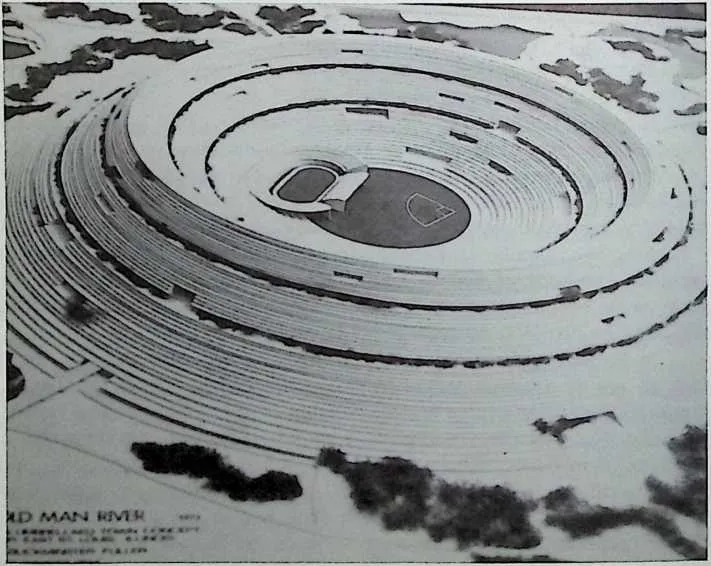
8384Fig. 17-3 An early model of the Old Man River City, without its geodesic dome covering.
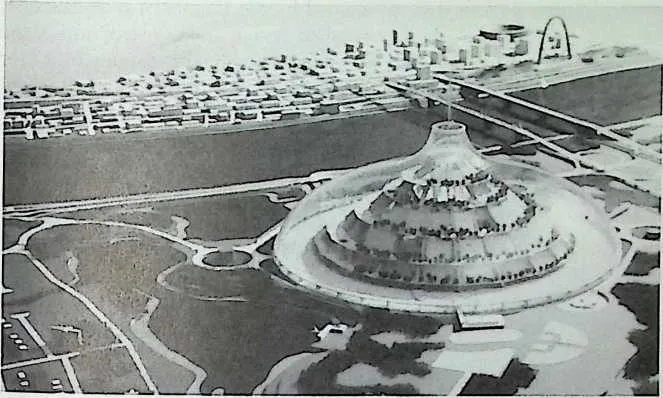
86 Fig. 17-4 A later model of the Old Man River city in which the geodesic dome has been replaced by a clear covering.
87 might consider using his design science strategy to create a practical program which would help that community.63 Fuller felt that the town of seventy thousand was an ideal location for again demonstrating the prac-ticality of his ideas, and in 1971, he made his initial proposal to the community.64
88 Bucky suggested creating a form of the floating city on land. His proposal was to build an enormous self-contained community which would house twenty-five thousand families within a giant crater-like struc-ture that was to be one-half mile from rim to rim. The structure’s environ-ment was to be controlled by covering it with a massive, clear geodesic dome one mile in diameter.65
89 Within the structure, individual families would each live in apart-ments of two thousand five hundred square feet, which would provide views both outwardly and inwardly. The interior view was to be of the public area, which would occupy the lower interior tiers of the structure as well as its ground level. Those lower areas were to be filled with recrea-tional facilities and stores. As in the floating cities as well as the small communities of the past whose living arrangements had served as a model for Fuller’s visions, the residents of the complex would be able to work and go about their daily business without ever leaving the complex. All necessary services would be provided internally.66
90 When Fuller’s ideas were welcomed by the East St. Louis citizens, he helped form a team to facilitate detailed design and construction of the complex. Since he was constantly traveling, the primary responsibility for the operation fell to his good friend Professor James Fitzgibbon, the head of Washington University’s School of Architecture. Fuller himself do-nated his time and ideas to the project, and two or three times each year, he would return to the community, meeting with and advising the team and interested citizens.67
91 Bucky’s only stipulation for his unpaid work on the project reflected the same distrust which had hampered so many of his other endeavors. He demanded that the design solutions be free of any compromises which might be required to qualify for private foundation or government financ-ing.68 By agreeing to that single requirement, the residents and the design team condemned Old Man River to a fate similar to that of Fuller’s Dymaxion Car and House. The fact that it had to remain pristine and
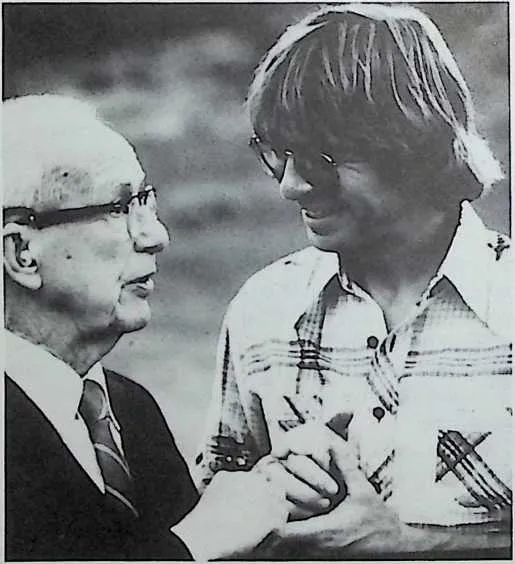
93 Fig. 17-5 Fuller with John Denver at Bucky’s eightieth-birthday celebration, hosted by Denver at his Windstar Foundation in 1975.
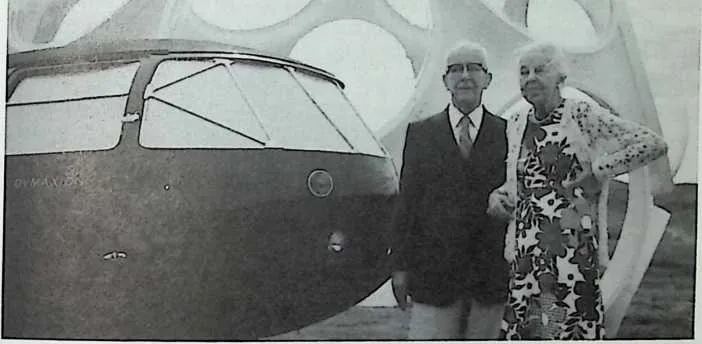
95 Fig. 17-6 Bucky and Anne in front of the Dymaxion Car and the Fly’s-Eye Geodesic Dome at the eightieth-birthday celebration.
96 uncompromised by the traditional societal restrictions is one of the ele-ments which has kept Old Man River from moving beyond the dream of a local community. Largely unfmanced and without the national or interna-tional support such a massive undertaking requires, Old Man River’s progress has been slow. Still, because the project was not completely dominated by Fuller as was the case with his other endeavors, the ini-tiative he inspired during the early 1970s endures among several East St. Louis citizens. Thus, Old Man River remains a small but viable project championed by local residents of East St. Louis who continue working on the undertaking. Even though the idea is represented only by a model, some design drawings, a small office, and the dreams of a few indi-viduals, those people continue to envision its completion in the year 2004.
97 Even though the 1981 publication of Critical Path essentially marked the culmination of Fuller’s work, as old age began to catch up with him, he continued his extensive series of lectures. The last of his in-depth series took place during the summer of 1981, when he devoted six full days to sharing ‘‘everything he knew’’ with an assembled group of 150 people who were just as eager to listen to his thinking out loud as had been the college students of Black Mountain College thirty-three years earlier. And Bucky did not disappoint that audience either.
98 Although he continued expounding on the same topics that charac-terized most of his talks and that have been discussed throughout these pages, he did so with an enthusiasm for life that tended to cause people to forget he was eighty-six years old. Still, his age could not be denied, and it finally slowed him down in late 1981, when, for the first time in decades, he was forced to spend several weeks in one place while he recovered from a hip replacement operation. Not that the time was wasted idly lying around. In need of constantly sharing his latest thoughts, even before Critical Path’s publication, Bucky was working on the book’s sequel, Crunch of Giants, which was published in 1983.
99 He was also planning one last attempt at experientially sharing his vision of humanity’s status on Spaceship Earth. That attempt was de-signed to utilize all of his previously gained understanding, and it resulted in the production of the largest portable World map in history. That innovation, which became known simply as the ‘‘Big Map,’’ was a Dymaxion Map the size of a basketball court, and Bucky presented sever-al of his last lectures in auditoriums where the Map was displayed on the floor. Using the Big Map, Fuller created a presentation in which one hundred participants, each representing 1 percent of the World’s popula-tion, were positioned in their correct geographic location. Then, with well over a dozen people crowded onto both India and China, while only six people occupied all of North America, items representing resources pro-duced and consumed were distributed.
100 It was not long before the entire audience was aware of obvious discrepancies, as the people representing India and the East were left holding only a small amount of food, while those in North America possessed more than they could carry. Global warfare was also explored as participants experienced the vast military overproduction of the United States and the Soviet Union. That enormous presentation was extremely successful, and Fuller even managed to stage it for members of the United States Congress. Still, he was very aware of the limitation of his age as well as the toll Anne’s health was taking on him.
101 In late 1982, she underwent an operation for a cancer which had spread through her internal organs. Following that, she was constantly in and out of the hospital with complications. Bucky balanced his hectic schedule to be with her as often as possible, but his commitment to humanity also drove him to work even more furiously on sharing his message whenever possible.
102 In early June of 1983, that schedule once again caught up with him. He was trapped on a Boston subway-station escalator with one of his young associates when it stopped running. Caught within a mob of push-ing humanity, the eighty-seven-year-old Fuller had no choice but to go along with the crowd as it pushed him rapidly up the escalator stairs. Upon reaching the upper landing, he collapsed. Paramedics were called to the scene, and although he appeared fine after a short rest, they insisted that he be examined at a local hospital. Doctors at that hospital pronounced him in excellent physical condition for a man his age, and he was soon back on the road.
103 Anne was not so fortunate. On May 13 she underwent another opera-tion for cancer, and she spent most of May and June confined to home or a Los Angeles hospital. Although Bucky made every effort to be with her whenever possible, he also continued the frenetic pace which had charac-terized most of his life, traveling at breakneck speed in order to meet all his commitments most efficiently.
104 A sample of his itinerary even during those last days of his life shows him in Los Angeles on May 30, in Philadelphia on May 31 and June 1, and taping a National Public Radio interview in Washington, DC, on the afternoon of June 2. Late that same night, Bucky appeared on the Larry King radio show from midnight to 3 a.m., and he spoke at ‘‘The Frontiers of Healing’’ Conference at 8 p.m. the next evening.
105 Following that speech, he flew to New York, where the very next day (Saturday, June 4) he spent seven hours presenting an Integrity Day talk. The next two days were devoted to meetings and receptions through-out New York, followed by two days of meetings and work at his Phila-delphia office and a one-day trip to Boston where he attended the Harvard commencement ceremonies.
106 On June 10, Bucky returned to his Pacific Palisades home for five days of interviews, work, and talks throughout the Los Angeles area before leaving for San Francisco and a speech at the opening of the new headquarters of the North Face, a major geodesic tent and outdoor equip-ment manufacturer. He then flew to Philadelphia, where he worked at his office during the afternoon of June 18 prior to flying to London for four days of meetings and interviews.
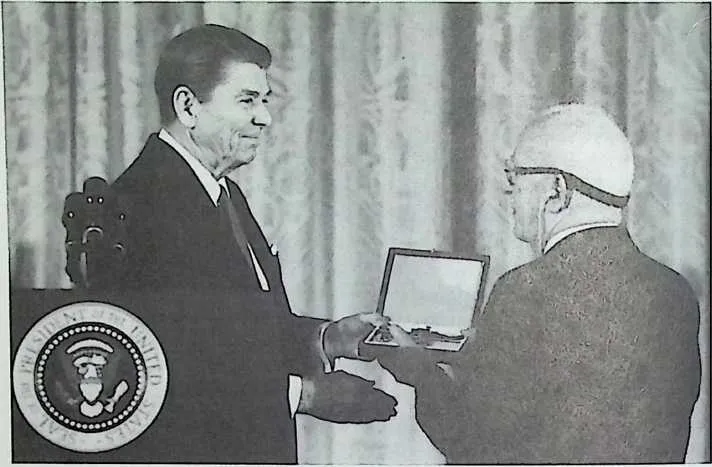
108 Fig. 17-7 Fuller receives the Medal of Freedom (the highest civilian award given by the United States government) from President Reagan in 1983, shortly before his death. The citation reads: ‘‘A true renaissance man, and one of the greatest minds of our times, Richard Buckminster Fuller’s contribution as a geometrician, educator, and architect-designer are benchmarks of accomplishment in their Fields. Among his most notable inventions and discoveries are synergetic geometry, geodesic structures and tensegrity structures. Mr. Fuller reminds us all that America is a land of pioneers, haven for innovation and the free expression of ideas.’’
109 June 23 found him flying back to Washington, DC, where he made a presentation at the White House in the afternoon and boarded another plane to Chicago to attend an evening dinner dance honoring people with Chicago connections who had been subjects of Time magazine covers. After a picture-taking session in Chicago the following day, Bucky flew back to his Pacific Palisades home for his final public appearance.
110 The next day, Saturday, June 25, he presented an all-day, thinking out loud Integrity Day in Huntington Beach. During the course of that talk, he spoke of Anne’s health as well as his own mortality and men-tioned that he felt she was lingering and waiting for him.
111 His conviction was fulfilled just six days later. After a morning meeting with coauthor of Humans in Universe Anwar Dil on July 1, just eleven days short of his eighty-eighth birthday, Bucky visited Anne at Good Samaritan Hospital. She had lapsed into a coma, and that morning the doctors informed him that it was unlikely she would regain con-sciousness.
112 After sitting with her, Bucky and his grandson, Jaime Snyder, went out for lunch. Jaime then left Bucky at the hospital to be with Anne, and sitting at his wife’s bedside in the intensive care unit, Bucky suffered a massive heart attack. Even though he was in the one location which would maximize his possibility of being revived, Bucky died that afternoon. Anne never regained consciousness and died thirty-six hours later.
113 A few days hence, they were buried side by side in Milton, Mas-sachusetts, under a double tombstone which characteristically reflected Bucky’s wishes exclusively. It reads: ‘‘CALL ME TRIMTAB.’’69
114 Within weeks, his daughter, Allegra, and grandson, Jaime, had closed Fuller’s Philadelphia office and had begun the arduous process of packing the enormous archive which had served Bucky, his associates, and anyone else who requested information or assistance. The staff moved on to new challenges, and the material itself was soon rehoused in a Los Angeles vault so that it would be closer to the family. There it remains, a vast informational resource which may someday once again be made available to the public and to scholars.
115 Buckminster Fuller left a legacy of which any individual would be proud. He spread seeds of ideas throughout the World, and they have enriched the lives of millions of individuals. More importantly, those seeds which have yet to germinate may well provide the essence of solu-tions to the issues that face humanity now and will face us in the future.
116 Fuller’s legacy to each of us also includes his very life. Devoting himself to living as an experiment to determine what one individual could accomplish on behalf of humanity, Fuller clearly proved that an average individual does possess capabilities far beyond what most of us realize. During the fifty-six years of his personal experiment between 1927 and 1983, he demonstrated and documented that even without the advantages modem technology affords individuals today, one person could make a major difference. And, as time passes and people around the World in-creasingly come together to consider and solve global issues, his true legacy may well become even more apparent.
117 We are one people living on the tiny sphere Fuller named Spaceship Earth, and because of his decision to work on behalf of each and every member of the crew of that Spaceship for the majority of his life, the Planet and its inhabitants are better off. Yet, he did not leave us stranded without the spirit of his ongoing inspiration. As he reminded us in his epic poem entitled How Little I Know:
118119. . . the prime code
120Or angle and frequency modulated signal Could have been transmitted
121From a remote stellar location.
122It seems more likely . . .
123That the inanimate structural pattern integrity. Which we call human being,
124Was a frequency modulated code message Beamed at Earth from remote location.
125Man as prime organizing
126"Principle" construct pattern integrity Was radiated here from the stars--- Not as primal cell, but as
127A fully articulated high order being, Possibly as the synergetic totality Of all the gravitation
128And radiation effects
129Of all the stars
130In our galaxy
131And from all the adjacent galaxies
132With some weak effects
133And some strong effects
134And from all time
135And pattern itself being weightless.
136The life integrities are apparently
137Inherently immortal.
138You and I
139Are essential functions of Universe
140We are exquisite syntropy.
141I’ll be seeing you!
142Forever.70