
15 Expanding Globally
2Following his successes at Ford and with the radome, Fuller’s status as a designer, architect, and intellectual was firmly established. Yet he remained a radical thorn in the side of the Old Guard, especially those whose primary interests were fi-
3 nancial and those who dominated the construction industry. Bucky’s feel-ings toward most conventional architecture and the people who cham-pioned it is epitomized in the following whimsical song, which he wrote for a group of his students who loved to sing while they worked on dome
4 projects.
5 Roam Home to a Dome
67(Sung to the tune of ‘‘Home on the Range’’) There once was a square with a romantic flare. Pure Beaux Arts, McKim, Meade and White; In the mood that ensued, he went factory-nude Mies, Gropy, Corbussy, and Wright.
8Roam home to a dome
9Where Georgian and Gothic once stood;
10Now chemical bonds alone guard our blondes. And even the plumbing looks good.
11Let architects sing of aesthetics that bring Rich clients in hordes to their knees. Just give me a home in a great circle dome Where the stresses and strains are at ease.
12Roam home to a dome
13On the crest of a neighboring hill
14Where the chores are all done, before they're begun And eclectic nonsense is nil.
15Let modern folks dream of glass boxes with steam
16Out along super-burbia way;
17Split-levels, split-loans, split breadwinner homes
18No down money, lifetime to pay.
19Roam home to a dome,
20No banker would back with a dime.
21No mortgage to show, no payments to go,
22Where you dwell, dream, and spend only time.1
23 Although usually presented as a parody, the ditty provides a glimpse of Fuller’s true feelings toward the construction establishment. He genu-inely believed that the ideal life of ‘‘dwell, dream and spend only time’’ should be available to every person, and he perceived the geodesic dome as supporting that vision. He was also well aware of the cold reception that the dome and his other radical inventions had received from tradi-tional leaders and organizations who firmly believed in maintaining the status quo.2 Hence, even his million-dollar-per-year income of the 1950s did not hinder Bucky’s incessant commentary on the importance of mov-ing beyond accepted societal opinions and sharing the abundance of Earth’s resources among all humanity.
24 In Fuller’s view, the establishment’s negative reaction to geodesic domes was typical of the belief systems which constantly confronted him. However, with the mid-1950s creation of the DEW Line of radomes, geodesic domes began to proliferate globally and to be employed for many diverse functions. Because of his controlling patent, Fuller himself was intimately involved with most of those domes.3
25 Some of the most visible modem domes are those used as arenas and sports facilities, and following his success at Ford, Bucky became highly involved in the first such structure. At the time, Walter O’Malley, owner of the Brooklyn Dodgers baseball team, was so inspired by the Ford project that he decided to look into the possibility of installing a dome above his team’s stadium. The innovative O’Malley was one of the first people to believe that such a project was possible and to realize the practical significance of weatherproofing a stadium in that fashion.4
26 Always interested in new and unique projects, Bucky accepted
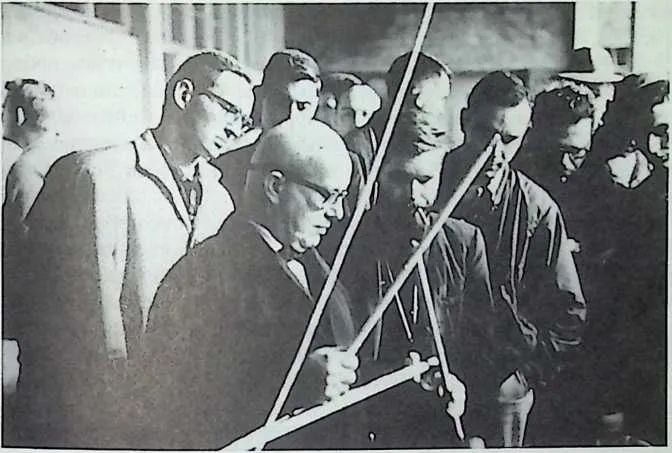
2829Fig. 15-1 Fuller working with students, 1959.
30 O’Malley’s invitation to work on a dome plan for the Brooklyn stadium, and in an act typifying his respect for young people and their ideas, he solicited the assistance of the Princeton University School of Architecture. At Princeton, a team of students and faculty worked closely with Bucky over the next two years developing several possibilities. Their work was, however, abruptly terminated in 1957 when O’Malley negotiated a deal to move his team to Los Angeles where inclement weather was not an issue.5
31 Bucky’s work was nonetheless useful. The possibility of erecting a domed stadium had received an enormous amount of attention and had captured the American people’s imagination. As a result of that publicity and a recommendation from O’Malley, when Judge Roy Hofheinz sought national recognition for his attempt to acquire a major-league baseball franchise in Houston, Texas, he contacted Bucky to discuss the possibility of a Houston geodesic dome stadium.6
32 In 1959, Fuller and Hofheinz signed an agreement, and Bucky began work on what would eventually become the Astrodome. Along with nu-merous other projects, Fuller worked on the Houston dome for several years, and in 1962, Hofheinz was on the verge of signing a formal con-tract to utilize one of Bucky’s geodesic dome designs when he abruptly backed out of the deal and signed a contract with another company, Roof Structures.7
33 As Fuller would later recount, Roof Structures had been attempting to circumvent his geodesic dome patent for years. The small company had been able to pursue that effort with the support and urging of the gigantic U.S. Steel Corporation which wanted geodesic domes to be constructed of steel rather than the lighter, more durable aluminum which Fuller knew was much more efficient for large structures.8
34 In a scenario typical of those which continually haunted Fuller and his radical ideas, he was again confronted by the short-term power of profit-oriented big business. The management of U.S. Steel were keenly aware that they would lose a great deal of prestige as well as future contracts if the first stadium dome was constructed of aluminum, and when they learned that Bucky was about to receive a contract for the first covered sports arena, they resolved to devote even more money to thwart-ing that effort. The Roof Structures-U.S. Steel alliance used its financial and political power to cajole Hofheinz into signing an agreement with Roof Structures, and the Astrodome was built of steel in a redesign of Bucky’s original plans. Because of the changes in his design, Fuller’s argument for the efficiency of aluminum as well as his geodesic patent rights were excluded from the process, as was any acknowledgment of his input into the project.9
35 Such a ruse could not, however, remain hidden forever, and Bucky was eventually acknowledged as the Astrodome’s primary designer. At the stadium’s opening in 1965, Judge Hofheinz’s son was responsible for publicity, and he constantly emphasized that the structure was actually a modified geodesic dome initially designed by Buckminster Fuller.10
36 Bucky had always been adamant about using the most effective, modem materials available. He employed lightweight, strong aluminum in his large structures, and those who worked with and learned from him tended to pursue a similar strategy. It was therefore no surprise that Don Richter, one of Fuller’s closest assistants at the Chicago Institute of De-sign and on other projects, took a job as a designer for Kaiser Aluminum Company.11
37 In the mid-1950s, that company was one of many directly managed by Henry J. Kaiser himself, and when Kaiser happened to spot a small model of a geodesic dome on Richter’s desk, he assumed it was one of his company’s new products and questioned the young designer. Richter ex-plained that the object was a geodesic dome model and was soon expound-ing the merits and possibilities inherent in geodesic structures. The enthu-siastic engineer’s fervor and ideas provided a vision of possible new ventures to Kaiser, and at his behest, Kaiser Aluminum purchased the right to manufacture geodesic domes from Fuller.12
38 Kaiser’s first venture was designed by Don Richter and served as a prototype for a series of aluminum domes which were assembled from preconstructed sections efficiently manufactured at Kaiser factories. The initial dome was to be an auditorium for Kaiser’s Hawaiian Village Hotel in Honolulu.13
39 As it was the first such project, the erection time for the 145-foot diameter dome could only be estimated. Engineers working on the struc-ture projected that workers would require several days to assemble the sections which were to be shipped from Kaiser’s Oakland plant, and
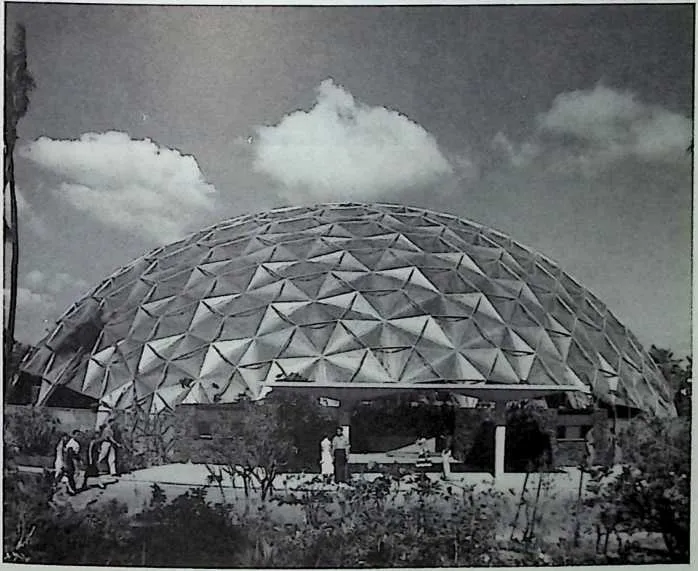
4142Fig. 15-2 The Kaiser Hawaiian geodesic dome.
44 Fig. 15-3 The concert being performed inside the Kaiser dome less than twenty-four hours after construction began.
45 Henry Kaiser himself relied on that estimate in determining when to arrive for the grand opening of his newest project.14
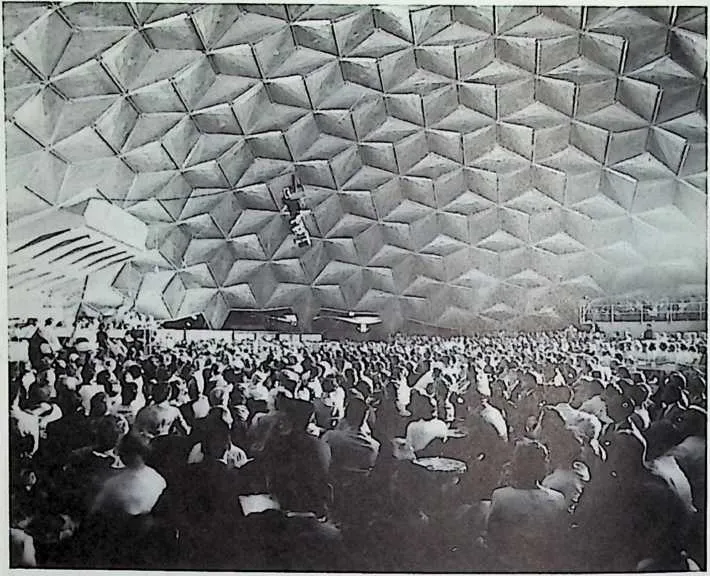
46 However, when the dome sections reached Hawaii and assembly began, it became unmistakably apparent that the timing estimates were well off the mark and that the dome could be completed within hours rather than days. Envisioning a potential media event, Kaiser’s public relations people decided to hire extra crews and to continue the erection process throughout the night. They also contacted the conductor and man-ager of the Hawaiian Symphony Orchestra to ask if a concert in the dome the following day would be possible. Perceiving the media value of such an occasion, the conductor summoned the symphony, and the announce-ment of the free concert was made on local radio stations as the auditorium dome took shape.15
47 That structure was completed in twenty-two hours, and one hour later, a capacity crowd of 1832 people enjoyed a concert by the orches-tra.16 One of the people who was not in attendance was the dome’s owner. Henry Kaiser simply could not reach Hawaii on such short notice, and by the time he arrived on his preplanned schedule, the festivities had long since ended.17
48 Another Kaiser miscalculation occurred when the engineers consid-ered the sound qualities of the dome. They had assumed that since it was constructed of massive aluminum panels, the sound quality inside would be somewhat metallic, and they contracted the services of a noted acous-tical engineer prior to the dome’s construction. When he arrived in Hawaii following the dome’s grand opening, the acoustical engineer agreed with the conductor of the symphony orchestra, who commented that the acous-tics were the best he had ever experienced inside a building.18
49 Kaiser engineers could have saved themselves a great deal of time and effort had they simply discussed their concern with Fuller. As they later discovered, the acoustical quality inside a spherical structure, which conforms to Nature’s patterns of most efficient construction, is excep-tional. In the Kaiser dome, sound radiated throughout the building and was actually focused toward the center, far exceeding the sound quality of conventional buildings with comers that trap sound and cause unnatural
5152Fig. 15-4 The Union Tank Car geodesic dome.
5455Fig. 15-5 The interior of the Union Tank Car geodesic dome.
56 reverberations. The acoustics of the Kaiser design were also enhanced by the three-section, triangular panels which acted as acoustical mirrors, reflecting sound uniformly back inward toward the audience.
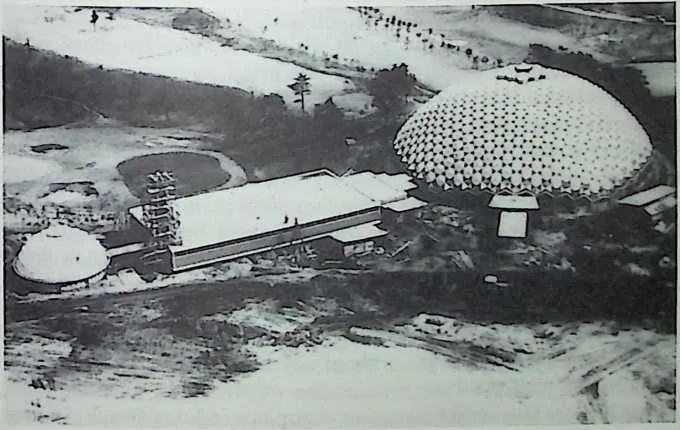
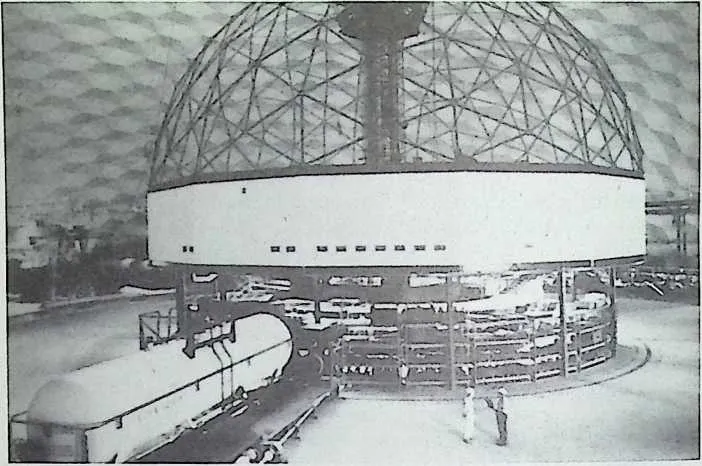
57 Another major dome project of the 1950s designed and constructed by Fuller’s company was the Union Tank Car dome in Baton Rouge, Louisiana. Union Tank Car’s operation required a great deal of space in which to maneuver railroad cars while they were being reconditioned and repaired. Ordinarily, that process was hampered by conventional rec-tangular structures with congested linear tracks running through them. The company’s management felt that the dome’s circular structure might provide a more workable environment, and when consulted, Bucky agreed. He was then awarded a contract and began designing what would be the largest clear-span (i.e., without any columns) structure built by human beings until the 1982 construction of the larger geodesic dome housing Howard Hughes’s Spruce Goose airplane in Long Beach, Califor-nia, which is shown under construction in Figs. 15-6 through 15-10.19
58 When completed, the Union Tank Car dome fulfilled everyone’s expectations. With a diameter of 384 feet and a central height of 128 feet, it provided ample space for a revolving circular track segment which radiated from the central hub of the dome like a spoke.20 Railroad cars could be moved onto that track spur and shuttled to an outer stationionary spur for work. Because of the massive open space provided by the dome, new cars coming in could be positioned without disturbing cars being worked on.
59 Fuller was particularly proud of that dome because it also conformed to his belief in the importance of recycling materials, as it was constructed mainly of scrapped steel salvaged from the same railroad cars which the facility was designed to service.21 Union Tank Car went on to build other such domes, using an even more unique system which employed a gigan-tic pneumatic ‘‘balloon’’ that was gradually inflated as construction ad-vanced. In that system, the balloon lifted the dome to higher and higher levels as it was assembled from the top down.22
60 The apolitical nature of Fuller’s work and contributions to humanity were conspicuously evident in another 1950s geodesic project. Kaiser Aluminum had received a contract from the United States government for a flamboyant dome to house the United States pavilion at the 1959 Ameri-can Exchange Exhibition in Moscow, and like so many other domes, the structure itself generated far more interest than its contents. One particular incident which occurred among the displays during that exhibition also generated a great deal of attention in the media. While escorting Soviet Premier Khrushchev through the exhibition, then Vice President Richard Nixon became embroiled in an argument which was later dubbed the ‘‘kitchen debate’’ because it had occurred in a modem kitchen display.23
61 Following his examination of the American exhibition, Khrushchev was particularly impressed with the golden dome Kaiser had built and commented that he would like to have Fuller come to Russia to teach Soviet engineers. Soviet engineers also requested and were granted the right to examine and measure the geodesic dome in great detail, and as a gesture of goodwill, that dome was sold to the Russian government which installed it as a permanent exhibit in Moscow’s Sokolniki Park.24
62 Khrushchev, like most people, was apparently not aware of Fuller’s impact on Soviet engineering when he made his comment. Bucky had already traveled to the USSR and had learned firsthand just how well known he was to Soviet engineers. A year earlier, he had been invited to serve as the engineering representative in a United States delegation to the USSR led by the famous editor and writer Norman Cousins. During that
63 Fig. 15-6 through 15-10 The steps in the on-site fabrication of the geodesic dome housing the Spruce Goose in Long Beach, California. Even though it remains the largest dome in the World, it was still erected in the Fuller tradition from the top down.
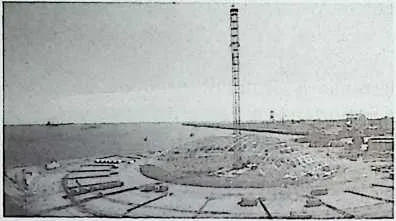
65 Fig. 15-6 The framework for the top is assembled around a central mast.
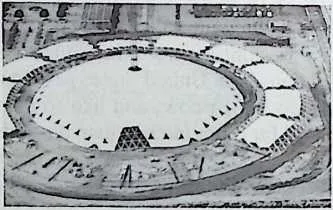
67 Fig. 15-7 Upper framework is covered by panels, and lower level and panels are prepared to be fastened. Note, no panels are positioned on the lower area of the photo where the Spruce Goose airplane is to be moved into the dome.
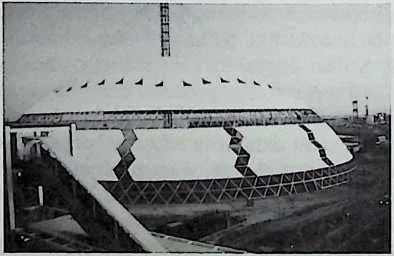
69 Fig. 15-8 After the completed upper section is hoisted on the mast, many of the lower sections are put into place.
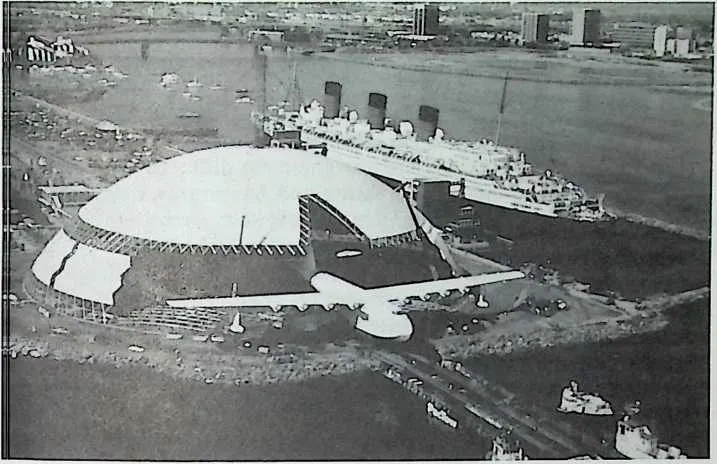
7172Fig. 15-9 The World’s largest airplane is moved inside the World’s largest dome. The ship beside the dome is the Queen Mary.
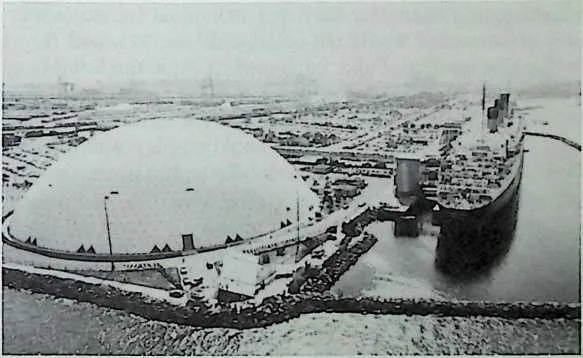
7475Fig. 15-10 The completed dome beside the Queen Mary.
76 trip, Fuller was surprised to be the only member of the group invited to a dinner sponsored by a group of Soviet engineers, and upon arriving, he learned that the reason he was the sole American at the dinner was that it was being given in his honor.23
77 During the event, Bucky was told that the Soviets had, in fact, been studying his work with great interest for nearly thirty years and that they felt his engineering ideas could make an enormous difference within their society by providing inexpensive shelter and housing as well as other innovations.26 They also admitted that Fuller’s ideas were so radical that having them accepted by the old-line politicians who controlled most Soviet activities and policies would probably be even more difficult than their gaining acceptance in Western society.27
78 When Fuller was asked to share his thoughts on innovation and how to implement it, he agreed that geodesic structures could most certainly contribute to the welfare of any country, especially ones such as the Soviet Union in which harsh weather and limited resources were so prevalent. He also recounted the importance of his ability to operate as an individual without the restraints of any bureaucracy or government. Specifically, Bucky asked the Soviet engineers what would happen in their country if they acted as he did, pursuing roundabout methods of obtaining scarce, newly developed materials controlled by the government. The question received a hesitant laugh from his audience, as they agreed that any Soviet engineer attempting to employ the same individual initiative that Fuller frequently demonstrated would not be around long to report the story.28
79 Despite that reaction, Fuller continued to chide the Soviet engineers in the same way he advised students and others interested in making contributions to the future. He suggested that the most successful operat-ing strategy any person living on Earth could employ was to work as an individual in cooperation with other individuals, but not under the domi-nation of archaic bureaucracies.29
80 During the same year as that initial Soviet Union journey, Bucky also made the first of what would eventually be over forty trips around the World in response to invitations. One of his stops on that tour was to give three lectures in New Delhi, India, where he could not help but notice a striking woman wearing a beautiful sari who was given a seat of honor in the front row for all three lectures. What intrigued Fuller more than anything was how intent that woman seemed to be on understanding his every word.30
81 Following the final lecture, she was introduced as Indira Gandhi, daughter of Prime Minister Nehru. When Gandhi inquired about a small model Bucky used in his lecture, he was pleased not only to explain it in great detail but to present it to her as a gift. When Gandhi then asked if Bucky could possibly visit her home to meet with and explain his ideas to her father, he was thrilled and graciously accepted.31
82 Later, Fuller arrived at the huge residence, which had been con-structed by the British during their rule and was used to house Indian politicians. A servant led him past the public rooms to a much smaller room which served as the reception area of Nehru’s private suite, and Bucky was left alone to wait for further instructions. However, instead of someone’s telling him what was expected, Nehru simply opened another door and quietly slipped in. Standing near that door in his usual white tunic, the prime minister bowed to Bucky with hands folded in the tradi-tional Hindu greeting. Following that lead, Bucky made a similar bow of greeting and, without a word from Nehru, began thinking out loud. As Nehru stood silently, Bucky continued speaking for the allotted 1 Vi hours, at which time he stopped. Nehru then bowed with folded hands and silently left the room.32
83 Following that monologue, Bucky discussed the meeting with Indira Gandhi, and she explained that whenever her father was listening to something or someone he felt was extremely important, he would stand silently as he had done with Fuller. She further clarified that Nehru felt that when he acted thusly, his mind would not drift and he could receive maximum benefit from the speaker.33
84 Gandhi also found Bucky to be enormously interesting as well as congenial, and she invited him to visit whenever he was in India, which he did on several occasions. Both she and her father particularly enjoyed listening to Fuller’s integration of spiritual and scientific disciplines be-cause they found it quite similar to their own beliefs.34
85 Fuller was provided with a unique view of Indira Gandhi during another of his visits. He was in India in 1964 when Prime Minister Nehru suffered a stroke, and upon hearing the news, he immediately called Gandhi, who was, by then, a close friend. Although she was distraught, Gandhi asked him to come over right away, and Bucky was pleased to be of use to her. When he arrived at her home, Gandhi’s devastation was obvious, and Bucky did what he could to comfort her. During their conversation, he also asked if she would consider continuing her father’s political work if he did not recover.35
86 Gandhi emphatically replied that she had no interest or talent in that area, and Bucky felt her sentiment was genuine. When Nehru died later that year, she was able to maintain her apolitical position despite a public outcry for her to become politically active. Yet, within two years, in an action similar to Bucky’s strategy of doing what was needed for the welfare of the most people, Gandhi applied herself to the political arena, ran for prime minister, and won. Over the years, she and Bucky main-tained their close relationship, and because he felt that she was not acting from the self-centered motives he generally found sustaining other politi-cians, she was one of his few true politician friends.36
87 Throughout all of his projects and travels, Bucky continued ac-cumulating a growing archive of information documenting his life as well as the global changes he had witnessed. That amalgamation continued to expand with Fuller’s popularity, and in 1959, at an age when most people retire, he finally began establishing a formal base for his operation and the data he had collected. The motivation for that formalization was twofold. First, he truly wanted the material and ideas he had accumulated to be easily accessible to future generations, and second, the administration of Southern Illinois University at Carbondale provided him with an oppor-tunity to more effectively pursue his work in association with their institution.37
88 SIU offered Bucky a position as research professor. That post included staff assistance as well as an office and the facilities to conduct his research on a continuing basis. The university also allocated enough space to house his archive, which he tentatively bequeathed to SIU.38
89 In return, Bucky agreed to lecture and to conduct seminars for stu-dents whenever his busy schedule permitted. What the university really acquired was the prestige of having Buckminster Fuller on its faculty, and his stature helped transform SIU. During the thirteen years of his tenure, SIU student enrollment increased from five thousand to over thirty thou-sand, and a growing number of prominent academicians and gatherings were presented at the university simply because of Fuller’s presence.39
90 Still, Fuller’s schedule did not provide much time for normal aca-demic life.40 He rarely spent a total of more than six weeks per year in Carbondale, and since he was traveling around the World the majority of the time, it was appropriate that the small office which served as his first true global headquarters was situated above a travel agency.41
91 It was also fitting that prior to moving to Carbondale, the Fullers had one of the earliest geodesic dome homes built for them. The house was a small, thirty-nine-foot-diameter white plywood dome with two bedrooms, and it finally allowed Bucky to fulfill his dream of being able to ‘‘roam home to a dome’’ on the rare occasions he found himself in Carbondale.42
92 With the dawn of the 1960s, Fuller’s focus began a gradual transfor-mation from physical inventions to metaphysical ideas. He had always believed that the difference between the physical and the metaphysical was simply that metaphysical phenomena could not be directly experi-enced by human beings, but in the 1960s he began an ever expanding public display of his prowess as a philosophical thinker as well as an engineer, a designer, and an architect. As society radically shifted during that decade, Fuller’s perspective proved correct, and both he and his ideas were increasingly accepted by people from all walks of life.
93 Bucky saw society rapidly entering into a new era which would eventually be termed the information age, and he realized that as human-ity advanced into that period, nonphysical phenomena (especially knowl-edge) would increasingly become more important than physical phe-nomena (especially muscle or military force).43 In other words, ideas and not the inventions they spawned would be recognized as the critical com-ponents of innovation. Accordingly, his thinking-out-loud lectures and writing proliferated in response to public demand.
94 Bucky’s poetic ability was also publicly acknowledged by the school which had formerly chastised him for his wild lifestyle and lack of interest in traditional education when, in 1962, he was awarded the Charles Eliot Norton Chair of Poetry at Harvard.44 Harvard’s chapter of Phi Beta Kappa also honored the formerly twice-expelled student by presenting him with its key.
95 By 1963, the demand for Bucky’s ideas had reached a feverish pitch, and he was able to publish his first books since the 1938 Nine Chains to the Moon. With typical Fuller vigor and excess, he did not simply release one or two books but published four during that year alone. Those works were a book which included a great deal of poetry, No More Secondhand God; two books of prose, Ideas and Integrities and Education Automa-tion; and the diminutive yet powerful and ever-popular Operating Manual for Spaceship Earth.
96 In conjunction with his speaking engagements, which had mush-roomed to well over one hundred per year at sites around the World, Bucky’s books and articles advanced his ideas to the forefront of contem-porary thought. Nowhere were those ideas more well received and studied than among youthful audiences who did not perceive Fuller as an aged inventor-philosopher. Rather, they saw him as he truly was, a radical progressive interested in the welfare of all humanity who presented prag-matic possibilities for human achievement and fulfillment.
97 His largest audiences always convened on college campuses, where students proved to be far more receptive than staff or faculty who were generally steeped in traditional thinking and concepts. And it was to youthful students that Fuller’s message of the hope which was their birth-right was geared.45
98 Bucky had personally observed his own potential being systemat-ically molded into a traditional cast by society, and even though he had evaded being shaped in the image others felt would be best for him, he realized that most young people were not so fortunate. Because of that experience and his ongoing observations, Fuller constantly shared his view of a perpetually changing environment which created an entirely new set of circumstances for each generation of children.46
99 Bucky had specifically devoted a great deal of his life to surveying the effects on individual human beings of dramatic shifts in technology. By examining the ease with which young children accepted phenomena such as airplanes, computers, Moon landings, and other unanticipated changes, Fuller came to understand that each of those innovations had marked a dramatic change in what was accepted as the norm by the general public. He also realized that because children are not entrenched in a belief system and can more readily appreciate the wisdom exhibited by a changing environment, they are usually the first to accept a new phenomenon or artifact as natural and normal.47
100 Although Fuller’s hypothesis of what is natural asserted that only individuals bom following the discovery of a new innovation could com-pletely accept that change, he believed that, in general, the younger a person was, the more flexible and adaptable to change he or she would be.48 To illustrate that point, Bucky often recounted stories from his own youth.
101 During that period, the norm was devoid of modem technological conveniences such as automobiles, telephones, electric lights, refrigera-tion, and indoor plumbing. Despite a lifetime of being deeply involved with the leading edge of technology, Fuller, like all human beings, could not help but retain some connection to that simpler era of his boyhood. In fact, he was one of the family members who most vehemently argued that the family retreat on Bear Island should be kept in the rustic state he remembered from his youth.
102 Other family members also supported his desire to maintain Bear Island without modem technology and creature comforts. Thus, innova-tions such as electricity, indoor plumbing, and the modem high-speed communication have yet to reach the Fullers’ island domain, an ironic twist for the retreat of a man who championed the mass production and easy accessibility of modem technology. That rustic island, with its un-disturbed, tum-of-the-century environment, continued to provide Bucky with a protected retreat from the grind of fast-paced modem civilization throughout his life. No matter how far he traveled or how many projects he became involved with, nearly every summer several weeks were set aside for rejuvenation at the Bear Island complex.49
103 There, he could reestablish his perspective, remind himself of his earlier insights into Nature, and determine just how much society had changed. His comparative observation was aided by the Bear Island re-treat, the one setting which, more than any other, reminded him of his youth and sustained his awareness of Nature in its purest sense.50 As he would write, ‘‘My teleologic stimulation first grew out of boyhood expe-riences on a small island eleven miles off the mainland, in Penobscot Bay of the state of Maine.’’51
104 In later life, Bucky realized that during his early years people had been inherently remote from one another. He learned that customs and traditions had been developed over thousands of years during which peo-ple had lived in isolated tribes and communities.52 Within those small communities, individuals had been in almost constant contact with one another.
105 That daily proximity to a small group of people and remoteness from most others spawned behavior patterns which had been codified over the centuries into laws, rules, and traditions. Although many of those laws and traditions were, and still are, no longer germane to the prevailing conditions, most older people continue complying with them.
106 Fuller came to understand that such antiquated belief systems are powerfully ingrained within a society and tend to endure into future gener-ations regardless of their relevance. For example, because he was born before humans could fly, flying was always somewhat of a remarkable phenomenon to Bucky. Even though, during the last decades of his life, he circumnavigated the Earth several times each year via airplane and was a pilot, Fuller’s conditioning and youthful memories had established flight as far more alien to him than to his descendants.53
107 He clearly remembered the dangers involved in early flight and the admiration bestowed upon the brave men and women who flew airplanes and returned safely. During that period many airplanes crashed, and the unmistakable risks generated a widespread fear of flight. Even in the later years of his life, when flying was documented as the safest means of mass transportation, Fuller found that many older people, like himself, still held onto some of their subconsciously conditioned belief that flying was in-herently dangerous.54
108 When confronted by people reluctant even to consider his ideas about generational influences on human beliefs and the human ability to accept innovation, Fuller would ask them to recall their initial reaction to the Moon landing of 1969. Following that monumental feat, he found that most people began behaving as if it were a routine event. At the time, Bucky also observed people’s attitudes as they quickly shifted from as-tonishment to asserting that landing on the Moon was a simple accom-plishment whose ‘‘time had come.’’55
109 In further examining human reactions, Fuller confirmed his feeling that the Moon landing, like other momentous achievements, could be considered natural and logical only by individuals born following its oc-currence. Because they study such events and their development as history rather than regard them as major transitional moments in their lives, individuals born following an event’s occurrence are endowed with a unique new perspective. Fuller found that no matter how people attempt to alter their perspective, those born prior to the first Moon landing always viewed that feat---and any other such events which had occurred follow-ing their birth---as an unnatural surprise which they pretended was natu-ral. He also believed that adults tend to pretend events are natural out of vanity. They simply do not want to appear ignorant or, worse, wrong.56
110 In later years, Fuller himself was often confronted by the specific issue of young children’s perception of the 1969 Moon landing. Children born after that date frequently wrote to him asking the question, ‘‘If humans can send people to the moon, why can’t we create a World that works for everyone?’’ Such queries only served to support Bucky’s obser-vation that children have a unique modem sense of what is normal and natural.57 He also felt that the seemingly naive question illustrated that as a result of their perspective, children generally cannot understand why the problems adults believe are complicated cannot be easily solved.58
111 Fuller believed that because modem children generally experience the positive, life-supporting aspects of human technological achieve-ments, they feel that increasing such successful action is natural and normal. Although a child’s view appears naive to many adults, within that juvenile attitude Fuller discerned a tenacious hope for the future of all life on Earth.59
112 His studies and observations led Bucky to theorize that humanity had reached a moment in its evolution when individual human beings could consciously choose the path of future development, and that a more child-like route would serve rather than hinder progress.60 The path of action Bucky himself selected to endorse and employ included returning to the natural, youthful perspective of endless curiosity and potentialities that everyone has experienced at one time or another.
113 Applying that youthful perspective of cooperation and questioning for most of his life, Fuller was able to produce a remarkable number of diverse inventions, books, articles, and lectures, as well as to explain the underlying thoughts and principles of his work. Still, even his childhood curiosity and insight had not always been nurtured in the manner he would later recommend as essential for all children. Like most young adults, Bucky had been expected to grow up and take on responsibilities.
114 However, during the period when adults had pressured him to con-form to society’s rules, Bucky was able to continue observing and learn-ing from everything he encountered. That constant attention to his en-vironment and the rapidly occurring changes within it would eventually support his developing insights that were far beyond those of most other people. Thus, when he consciously resolved to return to a curious youthful perspective predicated upon personal experience rather than to accept the dogma and tradition of the past, Fuller was somewhat prepared for the opposition he encountered.
115 Another example of generation-based conditioning which Bucky ob-served was his attitude toward automobiles. When he had entered Harvard in 1913, only three of the seven hundred freshmen owned automobiles, and one of those was the property of the son of Ray Stanley, inventor and manufacturer of the Stanley Steamer.61
116 Bucky himself did not purchase an automobile until the early 1920s, and that car’s tires usually blew out after only about one hundred miles, forcing him to make frequent stops. Removing and repairing those tires was a formidable task, requiring at least one hour per tire. Even the simple act of starting his car was generally a major undertaking, with Fuller often having often to remove the spark plugs and prime them with gasoline just to start the engine.62 Although those and other automobile problems mo-nopolized a great deal of his time, they also established an intimacy between owner and machine which is rare today.
117 The cars of that era provided Fuller and his peers with direct, person-al experiences of the automobile’s unreliability and caused them to drive with utmost caution. Because of their important function and the fact that they tended to wear out quickly, brakes also constituted a major problem in early automobiles, and Fuller observed his own resistance to change as better brakes were developed. Although he drove for most of his life, Bucky persisted in maintaining a somewhat tentative driving style, not completely trusting even the most modem brakes. Constantly more-or-less unsure of even a modem vehicle’s roadworthiness, Fuller allowed a larger-than-usual distance when following other cars, especially in his later years, when the average speeds of cars increased greatly. That habit inevitably invited younger drivers who were accustomed to reliable brakes and faster speeds to pass him with great confidence.63
118 In his incessant observation of human nature, Fuller noted that those younger drivers had been conditioned to expect mechanical success from their vehicles, just as he had been conditioned to expect mechanical failure. He perceived that variation in driving technique as another dem-onstration of irreversible generational differences which have to be re-spected by individuals of every age if we are to achieve universal human cooperation.64
119 Fuller believed that his experiences with the automobile and the airplane were palpable examples of the manner in which different circum-stances affect the behavior and perception of people born during different eras.65 They also demonstrated the natural resistance of even the most daring older people to new technology. He felt that an apparently safe, logical action or innovation is, in fact, uniquely appropriate only within the context of a specific time frame, and that an innovation is thus thor-oughly comfortable only for the generation born following its appearance.
120 Fuller also observed that universal phenomenon within his own fami-ly. His daughter Allegra was born in 1927, the year Lindbergh flew across the Atlantic Ocean. At the time, flying was still an uncommon experience limited to an elite minority, and people rarely saw an airplane in flight. In his later lectures, Bucky would speak of his thoughts during one such unusual encounter with flight. He was wheeling Allegra through Chi-cago’s Lincoln Park in her carriage on a bright fall day in 1927 when a small biplane appeared overhead. Although an airplane overhead is a common experience in modem Chicago, it was an strange event at that time, and it sparked Bucky’s thoughts. He began considering his young daughter and her relationship to the airplane, and he was soon engrossed in thinking about another large pattern of human development and realiz-ing that his daughter would grow up in an era when airplanes in the sky would be considered normal.66
121 Years later, Bucky would again observe the changing norm in his own family when Allegra’s daughter, his granddaughter Alexandra, was born in 1954 near New York City. Alexandra’s first home was Riverdale, just north of Manhattan Island. The apartment was on the top floor of an aged wooden house with a glass porch, and most westbound flights leav-ing La Guardia Airport took off directly over that house.67
122 Every few minutes Alexandra would hear a very loud noise overhead and someone would say ‘‘airplane’’ to her. Thus, it was not surprising to Bucky when her first spoken word was not mom or dad, but air. Family and friends would carry Alexandra onto the glass porch to show her the airplanes flying overhead, and she saw thousands of airplanes before she ever noticed a bird. Thus, to her, an airplane in the sky was far more normal and natural than a bird. Looking down from that house, Alexandra could see streets jammed with automobiles, and an environment filled with automobiles also became a familiar component of Alexandra’s reality.68
123 By observing the conditions in which his granddaughter was being raised, Fuller again witnessed the enormous differences between the en-vironmental experiences of modem generations and what he had encoun-tered just fifty years earlier. During his youth, the appearance of even a single automobile had produced sizable crowds of spectators within a few minutes.69
124 Bucky was also very cognizant of Alexandra’s early education and, in particular, the children’s picture books she was being shown by adults. Those books usually contained illustrations of common farm animals. Adults would show young Alexandra the animal pictures, announcing that such animals were outside, but she rarely saw live farm animals as a young child. Bucky realized that to Alexandra, animals were simply images in books, and that in her young mind, a picture of a pig was about the same as a picture of a polio vims. She did, however, notice that adults enjoyed showing her the books, so, in Bucky’s opinion, she laughed along with them even though the images contained no real meaning for her.70
125 Alexandra’s unique concept of what was natural provided Bucky with another indication of the rapid transformation occurring within the generational perspective. During Alexandra’s childhood, a few people were still born and raised in farming environments where chickens and pigs were a daily experience, but the predominant environmental experi-ence in the United States had shifted from rural to urban. The fundamental catalyst for that shift had been the development of labor-saving machinery following World War I, especially farm equipment.71
126 New machines permitted farmwork to be accomplished more effi-ciently than was possible using only animal and human muscle. When mechanized farm equipment was combined with other new developments, such as refrigeration and rapid transportation, individuals were provided with a new freedom to live long distances from agricultural production areas and still be provided with food.
127 The rural lifestyle had been dominant since primitive human beings had shifted from being hunter-gatherers to being cultivators of crops, and its predominance over the centuries has remained an extremely powerful influence on what is now regarded as normal and natural. Fuller found that only within his lifetime had basic agricultural production become mecha-nized, causing the majority of the American population to relocate into urban centers. Living within those urban areas, humans found their per-ception of what was natural quickly becoming unrelated to and insulated from rural influences such as vegetation, earth, and animals. Because of that shift, the norm for Alexandra’s generation was to first experience animals through books rather than in the flesh.72 Today, that experience has again changed, as many modem children first experience animals and the outdoors through the technology of television.
128 Fuller believed that such transitions in common experience were neither good nor bad, but that they had to be acknowledged and accepted if humans were to live together in harmony on a Planet which is becoming more and more densely populated. He realized that change had been, and would continue to be, constant, but that humanity’s newly discovered technology had increased the speed of change to such a rapid velocity that individuals had to be extremely conscious and observant just to notice even the most conspicuous shifts.73
129 Operating in harmony with such rapid transformations requires an enormous amount of attention to detail. Bucky felt that people had to observe their environment ceaselessly if they were to anticipate the changes which would affect their future, and he successfully demonstrated that technique throughout his life.
130 Still, he found that most of the population persisted in following old precepts rather than examining ideas, traditions and laws within the con-text of a rapidly changing environment, as he did.74 Nearly all of those current laws were conceived by and for individuals who lived in small rural communities and had frequent contact with their neighbors but little contact with the outside world. Within that environment, wars were lim-ited to local disputes between neighboring nations or tribes, and news of a war traveled so slowly that it often arrived at a neighboring village after battles had ended. Currently, however, any warlike action attracts an immediate response from an informed populace which appreciates the threat of total planetary annihilation.
131 Fuller saw that current laws, procedures, and bureaucracies were---as they still are---becoming increasingly extraneous, inappropriate, and inef-fective as modem communication and transportation brought people closer to their fellow inhabitants on our small Planet. He was one of the first to express the opinion that individual citizens of Earth must demand innovative new operating systems which will accommodate the unprece-dented changes we are experiencing---something he felt only young peo-ple could easily appreciate.75
132 In his constant work with young people, Fuller found that the sup-posedly recent phenomenon of the ‘‘generation gap’’ was not predicated on the hostility of a younger generation toward the older generation, as was generally believed. He felt that a generation gap has always existed as a result of the younger generation being bom into a new natural order which is unnatural to older people and which will itself eventually change.76
133 Fuller felt that the question humanity now faces is whether all people can live together in harmony by predicating action on what is natural at a given moment and an anticipation of what will be natural in the future. He demonstrated that one individual could shift his or her perception to do just that. A substantial portion of his legacy is the example of a single individual willing and able to adapt in order to contribute to the well-being of all of humanity. Within that legacy of constant adaptation to change is a model of the potential every individual has to transform himself or herself as humanity continues its increasingly rapid development.
134 In recounting the trials and tribulations of his life, Bucky invariably began by asserting ±at he was simply an ordinary individual who re-sponded to the circumstances he encountered. He would continue by contending that his audience had the potential to accomplish as much as, if not more than, he had achieved. He would then proceed to explain pre-cisely how he had realized such success, using his own life to explain the principles he found to be operative throughout Universe.77 One theme which invariably received an enthusiastic response from young people was that of individuals thinking for themselves.
135 Fuller argued that organizations, be they educational, religious, po-litical, industrial, or any other form, and the individuals who control them must sustain a belief system of scarcity because an environment of total abundance would relegate such institutions to extinction.78 Within tradi-tional systems, individuals are generally encouraged to follow the dictates of former generations rather than to think for themselves and to predicate their actions upon experiences of the moment.
136 Fuller felt that because they were deeply entrenched in the financial constraints of that belief system, most adults devoted a great deal of time to the issues of job security and obtaining the necessities of survival for themselves and their families rather than to thinking for themselves and determining what needed to be done in a rapidly changing society. Within our system, most people consider the wishes of their ‘‘boss’’ of para-mount in importance, further relegating independent thought to a less significant status.
137 Bucky realized that in the relatively static, slowly changing societies of the past, such a focus had not been nearly as important as it was becoming in the rapidly transforming society which technology had ad-vanced. He also felt that the single most significant hope for the future rested with the children who had not yet been indoctrinated into the system or impeded by bosses and the belief that they had to earn a living.79
138 Fuller frequently discussed his perception of humanity’s drastically transforming environment and relationship of people to their environment in terms of how the process of news dissemination had shifted. His theory of that change began with the contention that men, like all male mammals, have generally been inclined to roam over much larger areas than women or the young.
139 Out of necessity, mothers tended to remain near the home, taking care of the young, while fathers usually operated autonomously, hunting and gathering food. In the case of humans, the man would return home with items, and the woman, with her less vociferous authority and her wisdom, would determine what to do with them. Fuller felt that the most important nonmaterial item men brought home was the news. For most of human existence, roving males have gathered and disseminated most in-formation concerning the outside world for women and children. Families learned from those traveling men, but their information was presented with a masculine interpretation.80
140 The primary authority recognized by children raised in such an atmo-sphere were parents who educated children based on the information that their father brought home. Children were also generally taught to respect the authority and wisdom of older men such as a king or a grandfather. Thus, the information obtained by children was usually tainted by the prejudices of older men and the traditions of past generations. That tradi-tion continued in the majority of societies throughout most of recorded human history and began to change radically worldwide only during this century. Because he was born at the turn of the century, Fuller was able to witness that shift and, consequently, to be aware of its significance.81
141 As a young man he noticed that if adults regularly used certain phrases or spoke with a dialect, those practices were passed on to children as ‘‘the’’ proper manner of speaking. Because of that practice, languages were very locally oriented. In the early-twentieth-century United States, with its almost total immigrant population, that orientation resulted in the dialects of small neighborhoods’ adhering to the customs and accents of the country from which the residents had emigrated, despite those neigh-borhoods often being right next to one another.82
142 Still, even in that rapidly changing culture, the father continued to bring home the news from beyond the immediate neighborhood and to supply his family with information biased in favor of his belief system and the traditions he had been taught. Then, Bucky witnessed that condition almost instantly shift one May afternoon in 1927 when many fathers returned home from work to hear their children recount that the man on the radio had said that a man had just flown nonstop across the Atlantic Ocean.83
143 Fuller felt that the phenomenon of women and children listening to the radio at home and learning about Lindbergh’s exploits before men at work had heard the news or had seen it printed in the newspapers was, ultimately, far more significant than the journey itself. He also realized that those events were similar in that neither of them had been anticipated by the general public, both had been the result of modem technology, and both had altered the course of human development dramatically.84
144 He believed that the radio and other modem forms of communication had provided most people with a freedom unmatched by other in-ventions.85 In our information-oriented society, communication and infor-mation represent power, and the radio shifted a great deal of power away from men, who had always dominated humanity with muscle and military authority, and toward women. More importantly, children were no longer as prejudiced by their parents’ traditional beliefs.
145 Bucky also theorized that the radio announcer’s swift advance to a position of immense authority in society had created another significant change which had influenced youth more than any other segment of society. That change focused on our language and, ultimately, acted as a catalyst for more rapid human integration. Radio announcers, and later television personalities, attained their positions because their speech pat-terns were devoid of regional vernacular and, therefore, could be under-stood by the greatest number of people. Consequently, as children grew older and perceived authority, wisdom, and insight to be coming over the airwaves rather than from their parents, they imitated radio personalities rather than mom or dad.86 The result of that shift was a more universal language and another step toward a single global human species in which individuals do not view themselves as different from other human beings.
146 During this century, children also began to learn more about distant places formerly relegated to obscure references in textbooks, and they started to develop a compassion for other members of the human species, regardless of where those people happened to live. Bucky appreciated and participated as that empathy and concern for the entire population of Earth was graphically demonstrated by one particular generation.
147 During the 1960s, students began to speak out publicly, especially in the United States. The generation which had grown up with the knowl-edge provided by early television had entered college, and campuses were becoming a forum for public discussions of global issues as an increasing number of students voiced concern for fellow human beings. Nowhere was that expression of questioning and protest more visible than at the University of California at Berkeley, where the ‘‘free speech movement’’ was bom. And there, just as on so many other campuses, the radical ideas of Buckminster Fuller provided valuable insights into possible solutions to the growing global problems being examined. During the free speech era, Fuller, who was nearing seventy, presented many of his lengthiest and most inspired thinking-out-loud sessions.87 At that time he also became such an endearing figure that he was nicknamed ‘‘Grandfather of the Universe.’’
148 The students who listened to and read Bucky’s words usually accept-ed his statement that he was an ordinary individual, but they also tended to be inspired by his demonstration of just how much any individual, includ-ing themselves, could accomplish if they set their minds to it as Fuller had done. Since he had challenged authority for most of his life, Fuller empa-thized with the plight of 1960s students. He also advised them that lasting social change could best be accomplished through controlled tech-nological innovation focusing on the welfare of individuals rather than on the destruction of warfare.88
149 Many who listened to and read Fuller’s ideas took his thoughts to heart and concentrated on the technological innovation he had cham-pioned since the early 1950s. As a result of such interest, the geodesic dome entered the world of the hippie.
150 Bucky had always been somewhat of a Bohemian artist, and he was not opposed to his invention’s taking hold among young people searching for a unique, inexpensive structure which could serve as home, a green-house, or in a multitude of other functions. Hundreds of the students who had worked with Fuller or had attended his lectures during the 1950s had followed his suggestion and had begun to work at the leading edge of design technology, but the students of the 1960s applied Bucky’s design-science ideas in a much more direct manner. They simply began building and experimenting with rudimentary domes, and the geodesic dome soon came to be associated with the openly liberal lifestyle of the 1960s generation.
151 Geodesic domes began springing up on remote hillsides and in com-munes around the United States. Some of the most well-known such domes were erected on the outskirts of Trinidad, Colorado, at a site which became known as Drop City because of the tendency of people to simply drop in for a period of time. Drop City was originally established by a group of students who heard Fuller lecture in Boulder, Colorado, and were so inspired by his philosophy of independent thinking and action that they decided to establish a self-contained community using geodesic domes as homes.89
152 Following the Fuller strategy of recycling resources, those young people built most of their unique structures with whatever materials they could acquire inexpensively or could scavenge. Some were constructed of plywood covered with tarpaper fastened to chickenwire by bottlecaps and used glass from old cars for windows. However, the domes which gained the most attention were those fabricated from the tops of scrapped cars.90
153 Drop City thrived for several years, not so much as a stable commu-nity but as a place where people could come and go as they pleased. It also became known as the stopover for young people traveling from the East Coast to the San Francisco area during the hippie period of Haight Ashbury.91
154 Because he tended to traverse many disparate elements of society, Bucky was also involved with more traditional events of the 1960s at the same time that he was lecturing and encouraging radical students. One of the most conspicuous such ventures was the United States Pavilion at the Montreal World’s Fair, Expo ’67. In 1965, the United States government had requested Bucky’s help with the project, and he had proposed con-struction of the ultimate Geoscope, which he had begun designing years earlier.
155 His proposition consisted of a Geoscope housed in a gigantic geo-desic dome. The Geoscope was to unfold and transform into a huge, computer-controlled Dymaxion Map which would display global events and resources updated to a given moment. Not possessing the comprehen-sive global vision of a Buckminster Fuller, government officials decided that the World’s Fair display would be more acceptable and less contro-versial if it presented the positive attributes of the United States rather than any global scenarios which might tarnish the image of the United States as a benevolent global giant.92
156 The officials did, however, resolve to use Fuller’s geodesic dome idea to house their display, and Bucky was commissioned to design that structure, which, when completed, represented the culmination of geo-desic dome designing for him. To assist him in that effort, Bucky selected Shoji Sadao, a former student with whom he had formed Fuller and Sadao, Inc., an architectural design firm.93
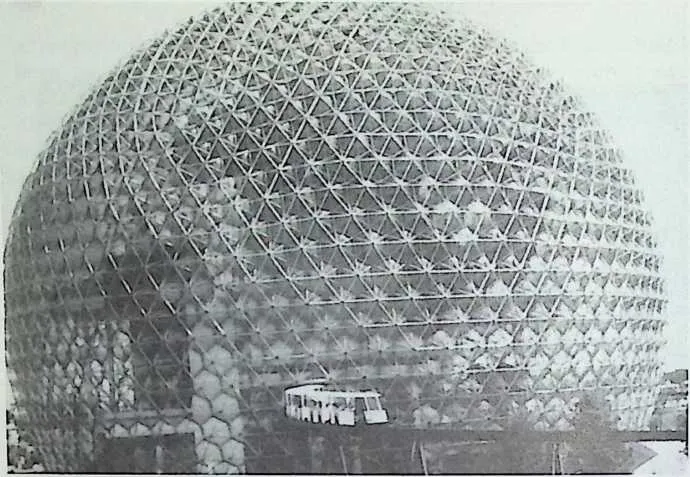
157 That dome was unique in many ways. A three-quarters sphere, it was as tall as a twenty-story building; yet, rather than being constructed from conventional plans and blueprints, it was fabricated almost entirely from a complex set of mathematical tables. Those figures provided workers with the exact specifications needed to stamp out precise stainless-steel-alloy components which were assembled to create the dome’s frame.94
158 Fuller himself wanted to construct the dome using the same system of lightweight aluminum struts bolted together that he had employed in some of his most successful earlier domes, but once again, his opinion was overridden by the dictates of financial and corporate powers. Those indi-viduals insisted that steel components be permanently welded in place. During construction as well as years later, those bureaucrats would come to regret not following Fuller’s visionary as well as pragmatic sug-gestions. Had they allowed him to proceed without restraint, the dome would have been assembled far more rapidly and would have been finished ahead of schedule rather than still being worked on as the Fair opened.95
159 When Expo ’67 closed, the United States government immediately received several offers to purchase the geodesic dome which had housed its exhibit, but because of the welded joints, it could only be left in place and sold to the city of Montreal for one dollar. Had that dome been built of aluminum sections bolted together, as Fuller recommended, it could have been easily disassembled and moved to another location by the purchaser. However, with heavy steel components welded together, the only options were leaving it where it had been erected or demolishing it. Thus, the city of Montreal received a bargain dome, even though it was of great interest to several other parties and could have been sold at a profit.^6
160 Eventually, the construction methodology resulted in the Montreal dome’s destruction. Rather than simply replacing sections which failed or
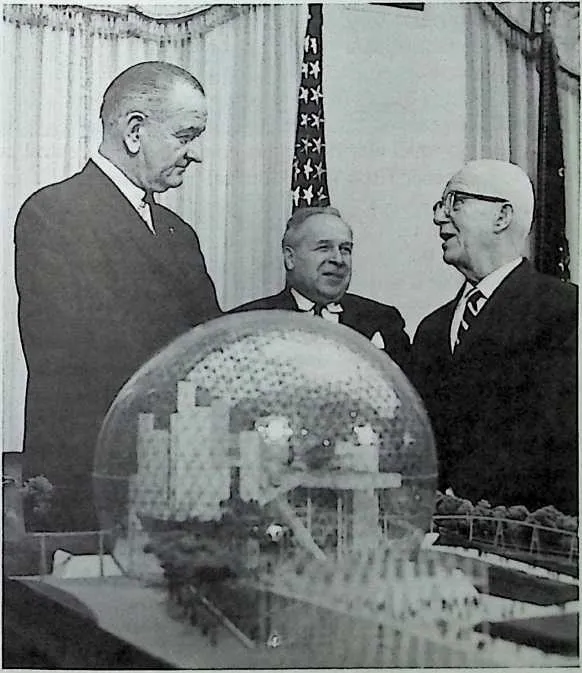
162163Fig. 15-11 Fuller discusses the Expo dome with President Johnson.
164 adjusting bolts when problems arose and leaks occurred, as would have been the case with bolted aluminum sections, workers were forced to reweld problem areas, many of which were several stories up on the dome’s surface. During one such repair session, sparks from the equip-ment ignited a panel of the Plexiglas windows which served as the skin, and within minutes, the fire had spread so rapidly that firefighters could only watch as all but the dome’s steel skeleton was destroyed.97
165 Still, during its glory, the huge ‘‘skybreak bubble,’’ as it came to be known, was an engineering marvel to behold and proved far more popular than any of the Fair’s other exhibits. Inside the dome, the United States displayed various exhibits under the title ‘‘Creative America,’’ but the crowning achievement of creativity was the dome itself.98
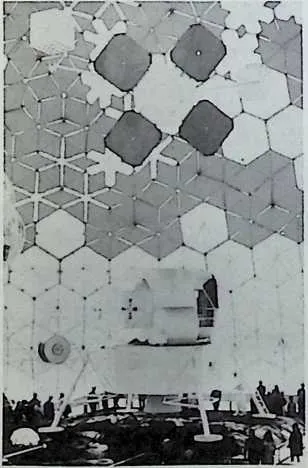
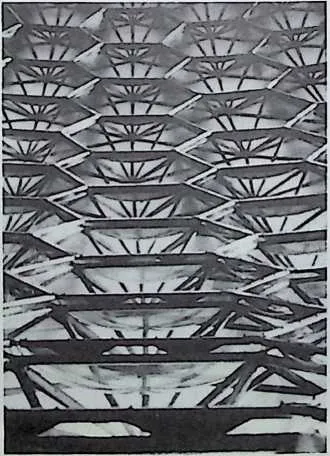
166 In designing the enormous structure, Fuller innovatively solved many unique problems. Primary among them was comprehensive en-vironmental control. To maintain temperature control with such a huge amount of clear window space, Fuller devised a system of light sensors which raised and lowered shades on many of the clear panels in response to the amount and direction of the incoming sunlight. He also installed a system using over 250 small electric motors connected to a central com-puter which could open or close the individual triangular panels in re-sponse to weather conditions.99
167 Inside the dome, the structure’s enormous size created a unique environment in which the separation between outside and inside was almost invisible. That near invisibility was, in fact, a phenomenon which Bucky had been considering for many years. He felt that if gargantuan domes could be installed over sections of cities, the amount of energy saved would be monumental while simultaneously providing the residents with much more comfortable living conditions.100
168 For example, Fuller calculated that a single one-mile-diameter dome enclosing the mid-Manhattan area between Twenty-second and Sixty-second Streets and between the Hudson and East Rivers would have a surface area of only l/s4 of all the buildings it would enclose. That dome would reduce the heating and cooling requirements of the buildings it covered to */84 of the current requirements. In addition to regulating the temperature, such a dome would also control the precipitation and the air quality within the enclosed environment.101
169 When Bucky proposed such radical solutions, many people balked at the possibility of constantly living inside any structure. Once the Montreal dome was completed, he would refute that argument by explaining that
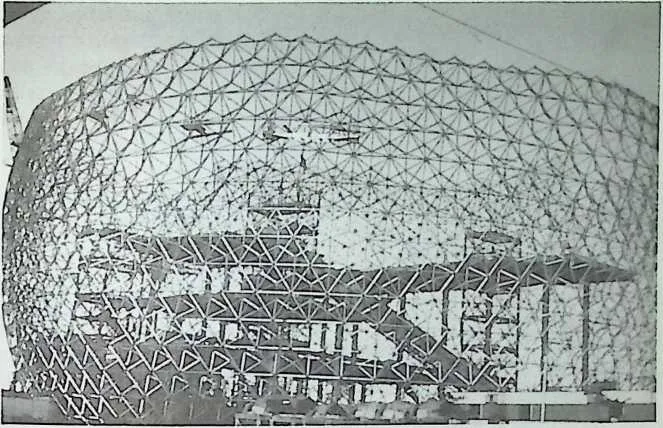
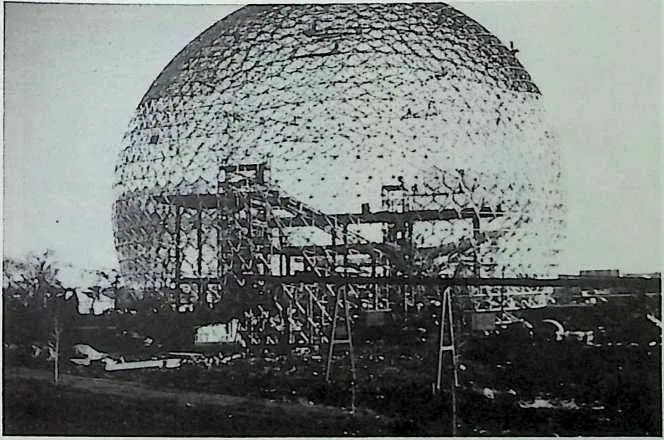
172173Fig. 15-12 and 15-13 The Montreal Expo ‘67 geodesic dome under construction.
174 . ■
175 .. -5
176 Fig. 15-14 Completed exterior of the Montreal Expo ‘67 geodesic dome.
177 Fig. 15-15 and 15-16 The interior of the Montreal Expo ‘67 geodesic dome.
179 even at the relatively small scale of the Montreal dome, the structure itself was beginning to become invisible to the human eye. He would then explain that at the mammoth scale of a one-mile-diameter dome, only the lowest sections of the dome would be visible to people situated near the dome’s outer edges. Most sections of such a massive structure would be so distant from any point on the ground that they would be invisible to the naked eye, and from the inner area, even the lowest sections of the dome would be so distant that they would be imperceptible.102
180 The idea of a ‘‘skybreak dome’’ was by no means new to Fuller, and he often explained that it might be applicable at sizes as large as several miles in diameter and as small as individual dwellings. In fact, that concept was so important to Bucky that he had initiated work on it in 1949, right after he had invented the geodesic dome.103
181 At that time, he had worked with a group of students to develop a geodesic dome which would allow people to literally ‘‘live in the gar-den.’’ The skybreak dwelling which they designed was to cover the com-plete grounds of a residence rather than simply to enclose a number of rooms as is normally the case. That larger dome was to have transparent sections which could be covered to provide shade or privacy; however, the dome would also provide constant environmental control and protection from rain, snow, wind, and insects as well as temperature. Within that dome, people could build rooms for privacy if they desired, but the entire interior was designed to be filled with trees and plants so the inhabitants would have the advantages of nature year-round. Thus, the concept of living in the garden.104
182 Although that idea has yet to be brought to fruition, Bucky did demonstrate the feasibility of a skybreak dome at the Montreal World’s Fair. When it opened in 1967, people were stunned by the beauty and practicability of the structure.105
183 Because 1967 was the Fuller’s fiftieth wedding anniversary, Bucky dedicated the Montreal dome to his wife, Anne. On May 28 he brought her to tour the fair and to view what he described to her in the following statement: ‘‘I have inadvertently brought about the production and installation of our own Taj Mahal as pure fallout of my love for you.’’106