
5 Emergence from the Ashes
2ein a scene reminiscent of an overly melodramatic movie, dur-ing 1927, Bucky found himself unemployed with a new daughter to support as winter was approaching. With no steady income the Fuller family was living beyond its means and falling further and further into debt. Searching for solace and escape, Bucky continued drinking and carousing. He also tended to wander aimlessly through the Chicago streets pondering his situation. It was dur-ing one such walk that he ventured down to the shore of Lake Michigan on a particularly cold autumn evening and seriously contemplated swimming out until he was exhausted and ending his life.1
3 With the cold Chicago wind pounding at him, Fuller thought about his wife and new daughter as well as all the family and friends he had once again disappointed. Several of those people had invested in his Stockade Systems venture, had lost money, and were vilifying his reputation. They equated the fact that he was a poor businessman with his overall character, and having heard others constantly slander him, Bucky was beginning to believe their accusations.2
4 Although neither his nor Anne’s families were excessively wealthy, Bucky felt that if he removed the burden of his presence from everyone’s lives, the two families would band together to support his wife and child. He also knew that his insurance policy would provide them with sufficient funds for several years. In weighing only that narrow range of personal issues, suicide appeared to be a viable alternative for Fuller that depress-ing day. After several hours of internal debate over the question ‘‘Buck-minster Fuller---life or death,’’ Bucky was suddenly seized by an experi-ence which would transform his life and his overall perception forever.3
5 As he would later recall, he experienced what he thought was the most significant of many seemingly mystical events which occurred throughout his life. During almost all of the lectures which followed that experience, he would recount that he had unexpectedly found himself suspended several feet above the ground enclosed in a ‘‘sparkling sphere of light.’’ During the incident, time appeared to stop while he listened to a voice speaking directly to him.4 Although the experience was difficult for the pragmatic Fuller to accept as reality, he remembered not resisting and allowing himself to savor it fully. Because of that, he was able to re-member the exact words he heard. The voice declared, ‘‘From now on you need never await temporal attestation to your thought. You think the truth.’’5
6 It continued, ‘‘You do not have the right to eliminate yourself. You do not belong to you. You belong to Universe. Your significance will remain forever obscure to you, but you may assume that you are fulfilling your role if you apply yourself to converting your experiences to the highest advantage of others.’’6
7 Although we will never know if that ‘‘voice’’ was simply Fuller’s inner thoughts or some higher guidance, it did result in a vastly trans-formed individual. Even the harsh conditions of that lakeshore could not impede Fuller’s metamorphosis, and he began considering the insight he had received and charting a new course of action. That operating strategy would not only change his life, but it would dramatically influence all humanity.
8 Following that experience, Fuller began to examine his life and believe that he had become entangled in his latest amalgam of problems by listening to and accepting as truth what others told him.7 He realized that his family and friends loved him and wanted the best for him; how-ever, he was also beginning to feel that their ideas were severely preju-diced by the restricted teachings of traditional leaders who sought to maintain the status quo.8 Because he had attempted to follow those tradi-tional guidelines and failed miserably, Bucky wanted to search for new ideas and methodologies which were flexible enough to focus on the reality of the moment and could be of use to himself and future genera-tions. Accordingly, he resolved to accept nothing other than his own experience.9
9 The only exception to that resolution were the few individuals whom he experienced as operating in a manner similar to his new strategy. Fuller listened to those people because he felt that they were not attempting to persuade him that their ideas were superior or that they were seeking personal gain.10 In other words, he consciously chose to return to a position of always questioning---a process which is natural to every child and remains available to all human beings throughout our lives.
10 Believing that smaller, special-case issues were embodied within larger issues, Fuller usually tackled the most ominous questions or prob-lems first.11 Hence, the first thing he thought about following his new resolve was God. As he relied heavily upon pragmatic, experiential logic, God (which he would later refer to as the Greater Intellect or Greater Integrity operating throughout Universe) had truly become an enigma to Bucky. Standing on the shore of Lake Michigan, Fuller asked himself if there was anything in his personal experience which forced him to admit that there was a Greater Intellect than human beings operative in Universe.12
11 Because so many of his ancestors had been Unitarian ministers, Fuller had been provided with rigorous Christian training, even though the majority of that teaching had been within his mother’s Episcopal church.13 He remembered being taught by adult relatives and their friends whom he had trusted and whose ideas he had accepted on faith. However, standing by the lake, he seriously considered the possibility that such traditional ideas might be inaccurate.14
12 Examining the depths of his own experience and insight, Fuller was overcome by the massive amount of evidence that he felt supported the existence of a Universal Intelligence.15 His primary confirmation lay in the perfect design and orderliness he had found within every aspect of Nature. Everything he had studied seemed to be governed by an exquisite set of interaccommodative principles which he felt could only be the work of a Greater Intellect.16
13 Looking back upon the first thirty-two years of his life and all that he had learned, Fuller was also amazed by the perfection and integrity of events which had earlier appeared to be disastrous mistakes. Those mis-takes had served to guide him, and he felt that they could have appeared at the exact moment required only as a result of divine intervention. Bucky’s perspective was beginning to expand radically, and that heightened per-spective could not exclude a Greater Intellect or the perfection of the actions of that Greater Intellect as manifest through all creatures. As a human being, Fuller was particularly interested in the role of people in such an organized pattern. Under that intense scrutiny, Bucky acknowl-edged and accepted the existence of God.
14 From his earlier years’ experiences, it is evident that he had always accepted the existence of a perfect plan operating throughout Universe. Bucky was constantly discovering the interrelationships between phe-nomena and elements, but on that autumn day he mindfully examined all his experience and accepted the fact that there was a grand plan to every-thing and that he must, therefore, be a perfect element of that plan. By reexamining his experiences within that context, he was able to perceive the uniqueness of his first thirty-two years and their possible significance. He remembered experiences such as his Sherbrooke mill training, work-ing for Admiral Gleave, learning about telepathy from Alexandra, and the frustration of trying to erect quality Stockade buildings, and he could only conclude that he was a storehouse of experiences which could prove valuable to future generations.17
15 Although Fuller did not realize it at the time, he was beginning to comprehend the dawn of a new era which the general public would not begin to acknowledge until the 1970s. He was grasping the fact that even though most people believe wealth is found in material objects, the non-physical commodities of knowledge and wisdom are the essence of true wealth.18 Only recently have most people begun to understand and accept that maxim as humanity advances into an ‘‘information age’’ predicated upon knowledge. Once he realized that he was a unique repository of valuable information, Fuller began viewing himself as an irreplaceable link in a chain of human knowledge dating back to the dawn of civiliza-tion. He also concluded that he did not have the right to end his life and break that chain.19
16 Walking home, Fuller decided to share his insights and knowledge with others so that they would not have to suffer the pain and mistakes he had experienced. He also remembered the harsh reality of his predica-ment. Cold and tired, he realized that he still had to do something about supporting his wife and child. He could not simply abandon them and walk the countryside sharing his wisdom like some itinerant preacher.
17 Reality set in even more quickly as Bucky entered their rather lavish apartment overlooking Lake Michigan. Among other expenses, the rent on their home was due, and he had no idea how he would meet the payment.20 He did, however, possess a new view of the perfection of Universe, and that perspective included a redefined fiscal philosophy which would serve to support him and his family financially for the next fifty-six years.
18 Fuller felt that the Greater Intellect operating within a perfect Uni-verse would support the tasks it wanted to have accomplished. Logically, Bucky deduced that if he were participating in such a task, he would be supported and his needs would be met. Although his faith in that perfec-tion was often tested when projects running low on support were almost abandoned, Fuller found that if a project contributed to the welfare of humanity, the needed support would eventually appear. Usually, a test of his faith caused that support to emerge at the last possible moment prior to disaster, and from an unconsidered source.21
19 The impending disaster of Autumn 1927 was the Fullers’ imminent eviction as well as the question of procuring the necessities of life. Upon returning home from his Lake Michigan experience, Bucky immediately told Anne about his insight and plan to devote himself to serving humanity with no attention to earning a living. Although initially skeptical, Anne soon began to appreciate the wisdom and insight of Bucky’s idea as well as just how staunchly he felt moved to change his life. The melding of that understanding and her provincial New England upbringing, which deemed that a woman should follow her husband, also helped Anne in deciding to support Bucky’s outlandish scheme.22
20 Bucky decided that more than anything he needed time. Time to clear his mind of everything he had been told and to start out fresh; time to assess his capabilities and to determine how best to utilize them; and time to study the great independent thinkers of the past and to postulate a plan for independent thinking and contributing to humanity.23 Although he had selected an extremely ambitious assignment, Bucky’s excitement and overwhelming enthusiasm would eventually carry him through the seem-ingly impossible.
21 Still, during that autumn, the conflict between high ideals and the practicalities of daily existence haunted the young family. Deciding to forgo the convention of earning a living was one thing, but putting that conviction into practice was quite another. Although Bucky once again felt he was a failure, the four-year Stockade experience provided him with new insights and reinforced his earlier attitude toward money.24
22 When he compared his work with Stockade to his naval experience, Fuller immediately noticed that in the navy his sole objective had been to successfully operate his ship, but in business he had been confronted by two conflicting motives. The first motive was successfully erecting quality buildings, and the second was making money.
23 That discrepancy combined with his later vision to spark Fuller’s developing the unique economic philosophy he espoused throughout the balance of his life. His interpretation is exemplified in his often quoted statement that ‘‘An individual can make money or make sense; the two are mutually exclusive.’’25 That comment has often been mistakenly in-terpreted as demonstrating a socialist bent, but nothing could be further from the truth. Bucky felt that every human being was entitled to being supported and that financial gains should not be a factor in selecting areas of work. However, in a more pragmatic context, he believed, and proved through his actions, that a person would make money if he or she concen-trated on actions which made sense and supported the greater good of all humanity.26
24 Fuller had chosen to operate Stockade so that his product and opera-tion made sense to him; the result had been financial losses every year. Stockade’s product was useful and of value, but Fuller’s attention had not been intently focused on the marketing or sales aspects of the operation. Rather, as a technically oriented, pragmatic individual, his primary con-cern had been continuing to refine and develop the quality of his product.
25 He had also flaunted a lack of respect and a lack of affinity for money which would become one of his trademarks. He perceived money as the means of exchange rather than as an end in itself. Accordingly, he never attempted to accumulate money or profits. When money flowed into a Fuller enterprise, it was immediately used to meet expenses, and any ‘‘profits’’ which remained also flowed back out, as he simply applied them toward developing a more efficient product or his next project.27 One of the most significant of those projects was Fuller’s invention and popularization of the geodesic dome years later. That creation would probably not have occurred without Fuller’s Stockade experiences. Dur-ing the four Stockade years, Bucky discovered exactly how difficult it is to implement new technology, especially in the fields of construction and housing.
26 In 1927, however, the practicalities of daily life nagged at the young family, and their first order of business was finding a much less expensive apartment. Bucky combed Chicago until he located a tiny, cheap apart-ment hotel in a slum section of the city, where he rented a single room with one closet. Their tiny home did have a small alcove with a stove and sink, where Anne cooked what meager rations they could afford.28
27 As Bucky was withdrawing from society to formulate his grand strategy, maintaining the basics of life fell on Anne’s shoulders.29 Al-though the Fullers sometimes survived on one skimpy meal per day, she managed to feed the family on the sparse cash they usually received at the last minute from unconsidered sources. For example, two deaths in their families resulted in small inheritances, and a few old friends stopped by to pay forgotten debts.30
28 Meanwhile, Bucky entered a period of intense contemplation. Rather than spending his time drinking and carousing or working to earn a living, he went to the library and studied the works of other independent thinkers such as Mohandas Gandhi and Leonardo da Vinci.31 He also took a vow of silence, pledging to not say anything until he truly had something significant to communicate. He did speak to Anne and Allegra, but for nearly two years he was silent to the rest of the world. It was during that period of silent meditation and study that Bucky was able to formulate the self-disciplines which would serve him so well during the balance of his life and that would support his contribution to society.32
29 One of Bucky’s early resolutions was to make his contribution to humanity primarily through a unique concept he had observed in Nature: precession. Precession is a word Fuller first found used in physics and engineering. He later recognized the phenomenon of precession to be a
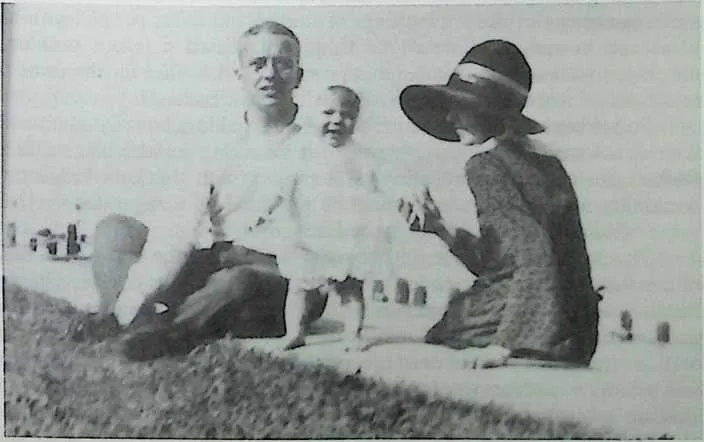
3132Fig. 5-1 Bucky, Anne, and Allegra, 1928.
33 generalized principle applicable to any project or area. Precession, as defined by Fuller, is the effect of bodies in motion on other bodies in motion. It was originally used to describe the action of spinning gyro-scopes, where a force applied to the spinning axis always results in a motion whose direction is skewed from the original force.33
34 In applying the generalized principle of precession to his life and work, Fuller employed and relied upon what most people regard as the ‘‘side effects’’ of an action rather than upon what is considered the direct action.34 For example, while working to improve plumbing, he developed a prototype toilet bowl and later an entire bathroom. Rather than initiate a public crusade to reform bathroom fixtures and the sanitation industry, Fuller simply produced his inventions and allowed the public and the manufacturers to discover his unique ideas. Such indirect action may appear ineffective within the context of the short-term results that moti-vate most of society, but Fuller found it to be far more efficient in producing maximally effective results with a minimum of effort.
35 Bucky’s first step in operating precessionally was to find something which he felt needed to be done and which was not being attended to by anyone else. He would then undertake that task with the faith that he, his new project, and his family would be supported if his enterprise was, in fact, needed.35
36 Taking lessons from his Stockade experiences, Fuller resolved never again to attempt marketing, selling, or impressing other people with his. ideas and inventions. Instead, he simply identified a future problem, developed an invention to solve that problem, and waited for the issue to reach the critical moment of massive public awareness.36
37 Following his 1927 transformation, Fuller seldom concerned himself with direct support, such as payment for inventing a particular artifact. Rather, he focused his attention on a project with the knowledge that seemingly indirect assistance would be provided by a regenerative Uni-verse which always supports required actions.
38 That mode of operation did not provide him with the luxury of a boss or an instructor to correct his work or a regular salary. The Greater Intellect did, however, guide him by furnishing financial and moral sup-port for those projects which, in retrospect, could be seen to have contrib-uted to human success and development.37 The sustenance Fuller received was usually so indirect that he could almost never categorically state that a specific compensation was for the accomplishment of a certain task. He also found that support for his projects generally appeared only at the last instant and from unexpected sources.38
39 To sustain the operation of his seemingly tenuous precessional sys-tem, Fuller maintained a policy of responding to as many invitations as possible. By doing that, he kept a diversity of options open and made himself available to even more support.
40 Fuller also resolved that minimizing the emotional aspects of deci-sions and actions would greatly enhance his efficiency. Regardless of the fear or joy of a particular moment, he always sought to act on behalf of all humanity with as little regard as possible for his personal feelings.39
41 Because he seldom followed the mainstream of society, Fuller’s style of action generated criticism from others as well as insecurities within himself. As a result of constant scrutiny (from others as well as from himself), later in life Fuller would remark that he habitually felt like a child who had meandered into a forest and arrived at the critical moment of realizing he was lost. That sense of perpetually being on the edge of the unknown caused him to continuously reexamine the elements of his changing environment with great sensitivity and care.40
42 Some people did criticize the resulting deliberate action as inflexible and overly controlling. This was particularly conspicuous when others involved in a project sought to move more rapidly or in a direction of which Bucky did not approve. In instances such as when others involved with Stockade wanted to look for new methods of expanding profits rather than developing the product, Fuller’s will usually prevailed. However, time and time again, such confrontations resulted in criticism.
43 Critics usually did not, however, appreciate the fact that during the early years of his life, Fuller had thrown caution to the winds and had been dominated by others on numerous occasions with devastating results. Being expelled from Harvard twice and having his first child die in his arms after realizing that he had not kept his promise are only two of the more vivid instances from which Fuller learned the importance of consid-ering his actions thoroughly and seriously.
44 During his youthful exploration, Bucky endured many major learn-ing experiences---mistakes---which taught him valuable lessons but also impeded the contribution he was able to make to his fellow human beings. Once Fuller determined his life mission, he felt obligated to do everything possible to maximize his effectiveness, and to deliberate with caution prior to undertaking important actions. The most conspicuous such delib-eration was the nearly two years of virtual silence he spent during 1927 and 1928, but Bucky also carefully considered what could occur prior to starting work on the Dymaxion Car and the prototype Dymaxion House, among others of his projects. In both those future endeavors and other instances, Fuller was, in fact, so cautious and dominating that he, and he alone, retained the power to veto the actions of any other involved parties.41
45 Another significant self-discipline Fuller employed throughout the remainder of his life was the direct result of his self-imposed 1927 hiatus. During that period, he learned to maximize his efficiency by taking great care in what he said and to whom he spoke. In the years that followed, Bucky would continue closely watching what he said and to whom he spoke, and he soon found that people really listen to someone only when the listener solicits information.42 The invitation may be subtle, such as a casual question or reading a book, but Fuller was certain that when an individual takes the initiative to request or invite information, he or she is seriously interested and will provide the best audience.43
46 Whenever he was invited to speak, Bucky felt that the question of interest was satisfied in advance and that his audience sincerely wanted to hear what he had to say. Because that audience had solicited him to provide information, he knew that individuals attending were sincerely interested and would make every effort to grasp his thoughts and words.44
47 Even though he spoke to audiences ranging from a single individual to thousands of people, hundreds of times each year, communication via the written and spoken word was not Fuller’s true talent or primary mode of contributing his message to others. He was a thinker, not a commu-nicator, and he acknowledged that fact at the beginning of many of his talks when he told his audience that he was not utilizing notes, nor had he thought about what he would say prior to speaking.45
48 Thus, he christened his talks ‘‘thinking-out-loud’’ sessions. Such a mode of speaking appears to contradict his discipline of considering his words carefully; however, Fuller’s thinking-out-loud sessions were not intended to be taken as direct communication from one person. Rather, he felt he was acting as a channel for a flow of information as well as sharing exactly what was occurring within his mind at a given moment. Because of that practice, during many of those sessions, he would change and update insights as he himself broadened his perspective.46 Through years of practicing that method of verbal communication, Bucky came to be a master at such oration. During his 1927 self-evaluation, however, he was far from that mastery, and he sought an operating strategy more compati-ble with his innate talents and his observation of Nature’s patterns.
49 In examining possible options at that time, Fuller discovered that Nature was constantly transforming the environment in ways which sup-ported the improved behavior of those creatures living within their en-vironments, including human beings. He then resolved to mirror that strategy of operation by designing and developing inventions which alter environments and make them more beneficial. He referred to those in-ventions as ‘‘artifacts.’’47
50 Initially, Fuller focused on discovering and understanding the struc-tural, mechanical, chemical, and technological principles Nature employs in transforming environments. Once he grasped those principles, he de-signed and built artifacts which supported our eternally regenerative Uni-verse, just as Nature does. Since he was a human being living on Earth, his particular focus was supporting eternally regenerative human success for every individual on Earth.
51 One of the most critical elements of Bucky’s philosophy and operat-ing strategy arising from his period of silence was his understanding of the metaphysical aspects of human existence, which were to become the focus of much of his time and energy. The groundwork for that understanding had been laid during his earlier years, when he had learned to appreciate and respect the wonders of Nature, and it had been further enhanced by his experience of young Alexandra’s life and untimely death. Following his 1927 withdrawal, Bucky devoted a major portion of his life to studying and gaining an understanding of the metaphysical phenomena which he felt embody the essence of all human existence.
52 Some of the first metaphysical issues he examined arose from his unparalleled experiences with Alexandra. Following her death, he had attempted to purge himself of those painful memories, but by contemplat-ing his experiences in a more scholarly and less personal context, he discovered a virtual wellspring of inspiring ideas. For instance, Bucky determined that when two individuals successfully communicate with one another, something people refer to as ‘‘understanding’’ occurs, but under-standing cannot be found within the physical body of either person. Un-derstanding exemplifies the numerous synergistic phenomena which trans-pire between humans but cannot be materially isolated. He felt that such phenomena, like everything which transpires between human beings, are metaphysical, yet they have the potential for influencing our physical environment.48
53 Because he was convinced that all Universe is controlled by a set of generalized principles which govern both physical and metaphysical (i.e., nonphysical) phenomena, Fuller decided to examine the physical in his study of the metaphysical. He selected physics to help him in that study because physicists had developed a precise definition of the physical. He then employed that definition to understand the metaphysical.49
54 Bucky found that physics defines the physical as ‘‘anything com-posed of energy.’’ When the energy is associative (i.e., powerfully con-nected with other energy), it is designated as matter, and when it is disassociative (i.e., moving with less connection to other energy), it is called radiation. All energy perpetually shifts between these two forms, but in either case, measuring it with humanly conceived instruments is frequently possible.50
55 Fuller was convinced that metaphysical phenomena were also energy-based phenomena, but that they were so subtle they could not be measured by any devices of his era or be consciously experienced by human senses. He also felt that the consequences of metaphysical events could be measured.51
56 For example, a metaphysical phenomenon, such as information trans-mitted between beings, could not be quantitatively gauged, even though researchers might experimentally determine which people are more sen-sitive to the information they receive. Each participant in a metaphysical event (such as an exchange of information) does, however, experience and appreciate the consequences, quality, and significance of the event (such as the transmitted information), and those experiences can be quantified. Because of those findings, Bucky concluded that although metaphysical phenomena remained beyond the range of the senses of almost all the people he met, those phenomena were still a product of the same energy transmission patterns explained by scientists.52
57 After thoroughly studying the metaphysical, he began to appreciate it as the most significant component of what humans designate as ‘‘life.’’ He also found that in order to operate most effectively he needed a comprehensive definition of life which focused on metaphysical phe-nomena and still satisfied his experiential mode of operation.53 The cre-ation of such an experiential-metaphysical definition appeared to be a difficult task because metaphysical phenomena are, by definition, not directly experienced by the human senses.
58 In developing his definition of life, Fuller first considered the charac-teristic of awareness and, in particular, the awareness one being has of another being. He then developed the following hypothesis: When one living being is consciously aware of another living being, communication occurs, and that contact can be regarded as one experiment which, if successful, experientially demonstrates the existence of ‘‘life.’’ Fuller further ascertained that although communication is evidence of life, com-munication does not transpire between physical entities.54
59 In the Fuller hypothesis, the physical entities---be they humans, cats, or any living beings---are simply vehicles for messages, just as a tele-phone is a vehicle for the transmission of messages. The beings (i.e., life forms) which initiate contact are metaphysical phenomena Fuller desig-nated as ‘‘pattern integrities.’’ He further speculated that although those pattern integrities cannot be directly detected by our physical sensory equipment at its current level of development, they are, in fact, the es-sence of life.55 Because pattern integrities are not material, Fuller found the concept difficult to describe using our limited vocabulary and worldly impression of reality. Yet, it is important to translate that metaphysical phenomenon into the clearest possible physical representation in order to understand Fuller’s impression of the essence of life.
60 Over the years, Fuller devoted a great deal of time to creating such a representation. He spent long hours finding ways to mirror metaphysical reality in easily recognizable physical phenomena and demonstrations, and he came to appreciate the significance of the phenomena he called ‘‘pattern integrities’’---which include but are not limited to human beings---in even the most mundane tasks.
61 While formulating his theory of pattern integrities, Fuller also real-ized that metaphysical phenomena are always conceptual, a fact which establishes them as independent of physical limitations such as size and time. Being devoid of the tangible components that most humans experi-ence and view as reality, he speculated that pattern integrities are ex-tremely difficult to understand, much less accept.56 Human beings are accustomed to dealing with what they believe to be the solidness of material reality, and without such familiar forms, people tend to become easily confused. Since both physical and metaphysical phenomena, in-cluding pattern integrities, conform to the same set of strict rules (i.e., generalized principles) which Fuller sought to uncover throughout his life, he theorized that the metaphysical could be modeled and described by tangible events and objects which can be detected by the human sensory system.57 Using such representations, Fuller was able to more easily understand the important metaphysical concepts which continuously influ-ence all aspects of human existence.
62 He felt that all pattern integrities exist independently of local phe-nomena or events (i.e., human bodies, planets, flowers growing), and that humans can discover their existence only by experiencing the local phe-nomena or event which results from them.58 For instance, human physical bodies are the local phenomena created by pattern integrities which are the essences of individual human lives.
63 Fuller often recounted the following graphic example to explain more completely the concept of pattern integrity. He first asked his audience to imagine splicing together three sections of identical diameter rope, each composed of a different material. The first one-foot section would be nylon, and it would be spliced to a one-foot section of manila rope. A third one-foot segment of cotton rope would then be attached to the end of the manila segment, creating a single three-foot rope composed of three materials.59
64 If the unspliced end of the nylon section is grasped and manipulated into a horizontal circle followed by a second perpendicular circle, a slip-knot is formed. Because the rope is interfering with itself, that configura-tion can also be considered an interference pattern within it. When the ends of the composite rope are pulled, the knot constricts, modeling the manner in which energy interferes with itself and creates the physical environment that humans perceive as reality.60
6566To better understand the self-interference which creates physical mass, Fuller studied the phenomenon of celestial bodies. In his examina-tion, he found there is a perpetual attraction between the spherical islands of mass we designate as planets and stars. When two such masses exert a pull upon one another, as the ends of the rope were pulled, an energy interference (modeled by the knot) occurs between them. As the pulling attraction increases, the interference is tightened until the energy be-comes so bound up and compressed that it can be perceived as what we call mass.61 In this way, planets, stars, and all matter have been, and continue to be, created. Similarly, as the energy-interference knots loosen, mass is converted back into its more disassociative form, radiant energy.
67Fuller often remarked that this ostensibly simple phenomenon is the basis of Einstein’s theories. Einstein discovered and mathematically de-scribed the situation Fuller later modeled with his rope demonstration. In his work, Einstein calculated formulas which explained that energy and mass are essentially the same. He further theorized that those two funda-mental components shift from one state to another in human perception just as water transforms into ice or steam.
68When energy changes appearance to become mass, it interferes with itself, slowing down in speed and tying itself into knots that humans
69 designate as solids. Energy constricted into mass can also unknot itself and become what we call radiant energy, such as sunlight or heat.
70 When the slipknot of the spliced rope is relaxed, it can slide along and move from the nylon section to the manila section. If the process is continued, the knot can be slipped from the manila segment to the cotton segment. Finally, the knot can be maneuvered off the end of the cotton section, and it disappears.62
71 After sharing that illustration hundreds of times, Fuller determined that when discussing the slipknot most people talk about the rope as if it were the knot. The rope is not, however, the knot. The rope is a limited local phenomenon which provides a vehicle for the invisible pattern (‘‘knot’’) to become visible to human beings.63 Fuller used the rope in that demonstration to explore the intricacies of the pattern known as a knot. He also explained that the slipknot’s initial appearance was not on the rope, but as a metaphysical thought within his mind. His mind trans-mitted the idea slipknot to his brain, which directed his hands to create it.64 Through that outwardly simple, yet highly complex, procedure, Full-er found himself responsible for the manifestation of a knot pattern formed upon the rope. Yet when he spoke about the demonstration, he empha-sized that the initial step in the process of manifesting the knot (and any creation) was the metaphysical act in which a human mind discovered a pattern and imagined its physical counterpart.65
72 That simple rope exploration also demonstrated that the knot was not nylon, even though it was upon the nylon section that it first made its presence known to people other than the individual who first thought about it. The manila and cotton rope segments were also involved in the physical manifestation of that pattern knot, but neither of those materials was the actual knot.66
73 In Fuller’s theory the knot was, and remains, a pattern integrity.67 People are able to physically detect and observe that pattern integrity because it interferes with and shows itself upon an item (rope) which humans can perceive via their limited sensory system. Fuller felt that there are, however, many more phenomena that cannot be experienced by human physical senses than ones which can be detected with the human sensory system. He believed that only a small percentage of the pattern integrities operating throughout Universe make themselves readily known to human beings through a limited number of humanly apprehensible objects and phenomena.68
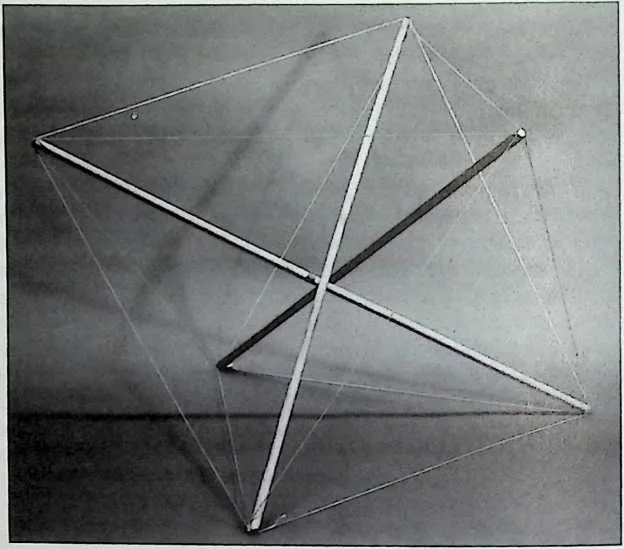
75 Fig. 5-2 Model of a simple tensegrity structure. Notice that none of the struts touch, yet they are held in place by the taut wires.
7677Bucky began investigating patterns and the concept of pattern integ-rity during the 1920s. In the 1940s, he initiated a more intense exploration of how such patterns could be modeled into complex structures, and that exploration resulted in the invention of tensegrity structures, the basis of geodesic domes. He coined the term tensegrity by combining the words tension and integrity.69 Tensegrity structures exhibit an ideal balance of tension in which each element is perfectly aligned in the exact location where it is most ‘‘comfortable’’ while providing maximum strength to the overall framework. These structures also model the natural energy pat-terns that Fuller believed were present throughout Universe and that pro-vide a three-dimensional representation of the interactive interference pat-terns he found in all natural construction from trees to the cells of human beings.
78 Although Bucky believed he was, in fact, unearthing a fundamental natural pattern as early as 1927, he was not able to confirm the accuracy of his ideas to his satisfaction until the late 1940s. At that time, he success-fully constructed large structures to demonstrate principles which he had previously explored only through model building and mathematical cal-culations. During that era, practical tensegrity structures and geodesic domes proved structurally sound and, in fact, stronger per pound of mate-rial used than any other type of structure, providing him with tangible proof that his ideas were valid.70 His work was also corroborated years later when virologists discovered that the hard shells of viruses are actu-ally microscopic geodesic spheres.71
79 Each tensegrity structure, be it one of Fuller’s models or a natural formation, relies on closure for its strength. The characteristic of closure causes every interference pattern (i.e., section) of the structure to support itself and the structure as a whole by interfering with and consequently buttressing its neighboring patterns.72
80 Such closure and interdependence are difficult to explain and under-stand because tensional construction and engineering are rarely employed by human beings. Even today, architects and engineers seldom utilize, much less understand, the properties of tension which Fuller championed throughout his life. Consequently, relatively few people have direct expe-rience of man-made tensegrity, and without firsthand familiarity, indi-viduals find the concept of tensegrity hard to grasp, even though it is a fundamental component of Nature.
81 Most people have, however, witnessed a form of tensional interde-pendence in the fragile structure of a house of cards. Such structures exhibit unmistakable closure and interference. In order to remain stand-ing, each card is tenuously dependent on its neighbors, and only when all the cards are in balance does the house stand without external support. Although such an equilibrium is difficult to create and maintain by the use of cards, tensegrity structures are expressly designed to continuously dis-tribute loads and pressures and to maintain that perfect balance.
82 Fuller began describing that phenomenon as synergy, a word he first found employed in the field of chemistry. Synergy is defined as the combination of elements to create results that are not evident when one examines the elements singly. Tensegrity structures are perfect examples of synergy. Although Fuller did not coin the term, by using it consistently throughout his lectures, he did bring it into common usage.73
83 The synergistic cooperation evident throughout tensegrity structures results in a structural integrity in which each section is harmoniously integrated with its neighboring sections. Within tensegrity models, inter-ference creates a mutual synergistic support system which is the founda-tion for structures much stronger and far more efficient than would be imagined from observing the pieces individually. Integrated interference also produces a structure in which a pattern can be followed completely around the framework from any point and always returns to that same point.74
84 Seemingly simple interference patterns not only generate incredibly strong and efficient structures, they also produce a uniquely flexible sta-bility which provides geodesic domes with their durability.75 That same flexible stability is often maximized in nature’s designs, but society has yet to apply it widely in construction or other endeavors as Fuller did in his work.
85 Another graphic model of pattern integrity Fuller often discussed can be observed by dropping a stone into water. That simple act produces a circular wave pattern which emanates from the point of contact and is the same for any object or liquid. Prior to serious studies of that phenomenon, most people believed that waves were part of the water or other liquid in which they were detected. However, after more comprehensive examina-tion of wave phenomena, the everyday appearance of similar waves in different liquids at distant locations led people to realize that waves were not the substances in which they were found.76 Scientists eventually es-tablished that waves are a universal phenomenon which demonstrate sim-ilar characteristics when passing through any substance.
86 For example, the falling stone also creates waves in the air before it strikes the liquid. At first, individuals find this phenomenon difficult to accept because they cannot see air or patterns in air. However, if the falling object is large enough and the observer is extremely still, he or she might detect a slight breeze as it passes. That breeze is the surge of strong airwaves which the object creates as it falls through the air. Modem researchers have added smoke to air in order to study gaseous wave patterns in wind tunnels, and in doing so, they have determined the universality of all physical wave patterns. Just as the knot was a pattern integrity which provided proof of its existence to Fuller and his audiences through a local vehicle (i.e., the rope), so a wave is a pattern integrity which is evident to humans only via local substances such as air or water.
87 Once Fuller grasped the universality and magnitude of such patterns, he formed his belief that human beings themselves are one of the more complex pattern integrities. In fact, he often stated that human beings represent the most complex pattern integrities known to humankind.77 Bucky felt that a person is much more than the local physical vehicle in which each of us is manifested for personal expression on Earth. Like the knot or the wave, he viewed individuals as metaphysical phenomena providing evidence of their existence to other metaphysical beings (i.e., people and animals) by operating through local vehicles perceived as physical bodies.78
88 The concept of human beings as pattern integrities is not easily understood or explained, and Fuller sought graphic illustrations to support its understanding. The following was one of his most often used such illustrations. Most of us have had the experience of watching a movie or a videotape played in reverse. In such instances, a person appears to be flying backward out of the water and up to a diving board or looks ungainly as he or she rides a bicycle in reverse. Viewers understand that those scenes, which appear to reverse time, do not portray actual condi-tions. The scenes do, however, provide an imaginative model which Fuller utilized to examine the everyday processes essential to life.
89 He envisioned a scenario in which his breakfast flowed in such a reverse manner. First, the food which he had eaten and was becoming part of his physical body flowed backward through the digestive process, came out of his mouth, and returned to his plate. The dishes containing Fuller’s meal were then carried back to the kitchen, where the food jumped into pans and was uncooked. The food continued its reverse journey and reentered packages. Eggs were restored to their shells and placed back in cartons, and milk miraculously flowed into its carton. The packaged food then returned to the supermarket and from there proceeded to processing plants. It moved in bulk from processing plants to farms, where vegeta-bles entered into a process of reverse growth, returning to the ground. During that reverse growth, plants were reduced to the basic elements from which they had been formed, such as rainwater, solar radiation, and minerals.79
90 By imagining that backward flow, Fuller realized that just a few weeks earlier, a large part of what he viewed as ‘‘Bucky’’ had actually been basic recirculating elements and energies. The physical bodies that most of us believe constitute our existence might easily have been a cloud floating over the Himalaya Mountains or radiation traveling from the sun only weeks earlier.80 For Bucky, that astounding revelation supported his appreciation of just how fallacious it was to identify himself or anyone else with physical appearances. It also created some contradictions in his personal life, as he, like all mortals, found himself bound to a physical body which he sometimes considered less than ideal.
91 Through years of observation and study, Fuller did come to under-stand and appreciate the processes which create and maintain human physical bodies. Through those processes, numerous elements are con-tinually brought together. Water, air, proteins, and other elements move closer and closer toward one another until they reach a critical proximity and combine with other elements in a configuration recognizable as a human being.
92 Although Fuller felt that the essence (i.e., spirit, soul, pattern integ-rity) of human beings is eternal, he also realized that the process of elements’ combining to produce a specific human body does not continue indefinitely. Individual human beings integrate physical elements only as long as the particular pattern integrity known as a person is operating with the parameters that humans acknowledge as living.81 A person is the most compact and intricate association of elements known to humanity. Other compact associations of elements result in less complex configurations, such as trees, cats, and automobiles.
93 Fuller felt that in all those closely packed associations elements are tied into what could be regarded as knots which we perceive to be the components of physical reality.82 Within the hierarchy of physical compo-nents, the elements which come together are themselves composed of knots of less complex elements, and those knots are, in turn, composed of knots of even less complex elements.83
94 That hierarchy of elements continues breaking down into less and less intricate structures until a minimal basic component is realized. That fundamental component is the essential energy known to be the quintes-sential substance of the entire cosmos. As explained earlier, Fuller hy-pothesized that energy ties itself into knots, and that when those knots are tightened by the pull of increased tension (such as gravity when bodies move closer toward one another), they form the matter fundamental to physical existence and biological life.
95 Fuller believed that all element knots, from the most elaborate to the very primitive, assemble themselves around pattern integrities. The fact that the knots are patterns which integrate elements led him to coin the phrase ‘‘pattern integrity’’ to describe the phenomenon essential to all manifestations of life.84 Pattern integrities are nonphysical (like the idea of a knot) and, therefore, cannot be perceived by unaided human senses. They do, however, gather elements into their fields of operation at times, creating physical manifestations so that they can be perceived by human beings. Fuller thus felt that the most complex of those manifestations recognized by humans are human beings themselves.85
96 Although Fuller did not believe that civilizations identical to ours exist throughout the cosmos, he did feel that the cosmos is teeming with many different forms of life. He was also confident that humanity is on the threshold of becoming aware enough to recognize some of those life forms.86
97 One of the easiest means of examining the logic behind that thinking is through his concepts of pattern integrity and element knots. In his element-knot scenario, configurations of elements which are physically near enough to one another to be considered element knots are composed of smaller, less complex element knots which flow through them. Those smaller element knots are, in turn, composed of even smaller element knots. For instance, animals are made up of organs, which are made up of cells, which are made up of molecules, which are made up of atoms. Each of those gradations is a more refined element knot which flows through the larger knots.87
98 Fuller’s reverse breakfast narrative provides a more detailed example of such a flux. Bucky felt that he, like all human beings, was, and would continue eternally to be, a unique, everlasting pattern integrity.88 In order to be experienced by other unique, eternal pattern integrities, he felt that people allowed less complex element knots, such as air, water, and food, to flow through their individual pattern, and that those elements combined to produce the physical bodies which are visible to other pattern-integrity humans operating similarly on Earth.
99 The elements which form a physical body at any moment are not, however, stationary. They are perpetually moving through a body, just as the rope was sliding through the slipknot. A slight shift in perspective helps one to better understand that motion.
100 Fuller originally regarded the knot as moving along the rope, but he later determined that the rope could be seen as moving through the pattern integrity knot. Like a snake, the rope slides through the pattern knot. Similarly, elements slide through human bodies. Bucky hypothesized that because we human beings are a very complex species in the hierarchy of known life, we require more chains of intertwined elements than less sophisticated entities, such as trees.89
101 Each individual element strand is intertwined (i.e., knotted) with other element strands to form a virtual fabric of elements recognized as a
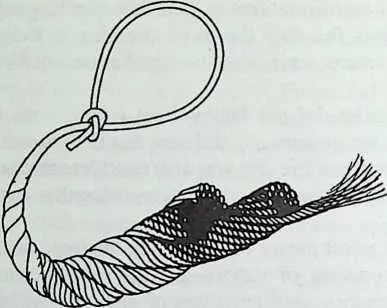
103 Fig. 5-3 As in all pattern integrities, less complicated filaments combine to form more compli-cated strands, which eventually produce yarn or rope that can be knotted into fabric.
104 person. Human bodies are composed of material strands containing ele-ments such as oxygen and water knotted to create more intricate chains of elements, which are, in turn, intertwined with other such strands to pro-duce even more complex element chains. That hierarchy continues until the physical configuration of a human being is complete.90
105 In an analogy applicable to all physical reality, a person’s body can be likened to a sweater. Humans can see and accept an article of clothing called a sweater. However, without special tools and detailed examina-tion, they do not perceive the microscopic fibers which are the fundamen-tal material of the sweater. Furthermore, we humans cannot see the atoms and molecules which are knotted together to form those microscopic fibers. The most delicate fibers are spun (knotted) into longer strands in a process which eventually results in thread. That thread is then combined with other threads to form yam, and the yam is knotted or woven into the sweater. Yet, in the true spirit of synergy, neither the yam nor any component of it could be recognized as the item known as sweater.
106 Sweater itself is actually an idea, a metaphysical phenomenon ac-cording to Fuller’s theory of life. Hence, it initially appeared within the metaphysical minds of human beings. After having expanded their awareness enough to discover a new concept, human beings consciously manifest that idea as a physical artifact. Only then can the material ele-ments which result in the creation of a sweater be brought together to create the actual item. Fuller theorized that that entire process, like all human discovery, occurred under the guidance of an expanding human understanding, another metaphysical phenomenon.
107 In considering the analogy of human bodies as living sweaters com-posed of element threads, it is important to note that the component element fibers and the levels of constituent elements which compose them are in perpetual motion. They advance through the living patterns and are immediately replaced by other elements. Customarily, new elements re-place the same type of elements, but they are, in fact, different elements. Hydrogen replaces hydrogen and oxygen replaces oxygen, but the new elements are substitutes.
108 Fuller observed that that same movement and change also occurs on a much larger scale as evidenced within our physical bodies, where he observed that human beings constantly shed old skin and waste prod-ucts.91 We are also converting resources into the energy which allows us to move, talk, and perform all the other activities considered a part of living.
109 Fuller felt that the elements which constitute physical reality continue moving throughout Universe as they are replaced in a specific pattern knot (be it a human, a rosebush or any physical object) by other moving elements.92 In other words, what individuals perceive as trees, roses, or even human beings are simply strands of elements and energies tied into forms which conform to a particular pattern integrity, and those elements are perpetually moving toward becoming components of other pattern integrities. As with all phenomena, the elements flow in the direction of least resistance. When an element abandons a particular pattern, the clos-est pattern integrity which offers the easiest access automatically becomes its next destination.
110 Fuller’s pattern integrity hypothesis covers all aspects of the life process. He explained that because they are eternal, the pattern integrities (knots) through which the elements pass remain intact throughout the process. The physical manifestation of a pattern integrity may accommo-date more elements and may appear to grow, but the basic pattern never changes. It simply integrates more strands of elements as it develops.93
111 Once that physical representation of the unseen metaphysical pattern integrity reaches maturity, the process of accommodating additional ele-ment strands reverses itself as the biological dog or tree advances toward death. When physical death occurs, element strands continue to flow from the biological form, but they are no longer replaced by other elements.
112 Because of a pattern integrity’s ability to integrate ever-shifting ele-ments without assuming the configuration of those elements, an oak tree continues to look like an oak tree from sapling to full growth and a poodle always looks like a dog. Even though both of those living beings may employ the exact same molecules of moving elements during different periods of their lives, they do not assume the form of those elements. Instead, the less complex elements conform to the structure of the more complex pattern manifestations. Water may be recycled through both the dog and the tree as well as through thousands of other living beings, but it is the water which assumes the form of the pattern through which it passes. Water never transforms a living pattern integrity or its representa-tive form into another pattern integrity or form by its presence. Within the hierarchy, the less complex element always conforms to the pattern integ-rity of the more complex element.
113 Fuller’s initial consideration of the knot-and-rope analogy was from the perspective of the knot’s sliding along the rope rather than the rope’s sliding through the knot. Because people tend to resist change and move-ment, when faced with such a variable scenario most individuals assume that the position of one of the two components is stable.
114 By assuming that one element is unchanging, people are able to visualize and understand the relationship of the second component to the immobile component. Because both elements are moving in relation to one another, considering either element to be in motion is, in fact, valid. By examining both possibilities in the open-minded manner which charac-terized most of his life, Fuller attained a great deal of insight overlooked by most people. He also came to understand that the underlying concept of all Universe being in perpetual motion was the basis of Einstein’s theory of relativity.94 Einstein hypothesized that everything is relative to every-thing else, and that all Universe is perpetually transforming.
115 When Fuller’s knot-and-rope demonstration is considered in light of Einstein’s relativity, the physical aspect of humans and other life-forms can again be appreciated as complex knots sliding along multiple strands of elements which cluster in a specific configuration for a moment and then move on. Fuller theorized that, following each such moment, the pattern integrity ‘‘person’’ also moves on along the various strands of elements. In his scenario of life, everything is in motion, and change is the norm.95
116 In accordance with his pattern integrity ideas, Bucky was certain that, like all human beings, he too was a perfectly designed, eternal pattern integrity. He then logically theorized that he always was and would continue forever to be that pattern integrity.96 Like everyone else, Fuller integrated resource elements into equipment (i.e., physical bodies) in order to operate within the biological limitations of Earth’s planetary environment. Having mastered that essential concept, Bucky began to theorize logical conclusions about other possible patterns of life in Uni-verse. As he felt that all humans are metaphysical pattern integrities accommodating the specific environmental ingredients found on Earth, he reasonably deduced that other pattern integrities could be operating simi-larly in other areas of Universe.97
117 Just as human beings select and utilize element strands from the Earth’s biosphere to integrate into their physical bodies, other pattern integrities would most likely do the same for the particular environment in which they chose to manifest. In other words, beings which could ‘‘live’’ on other planets and in other dimensions would be physically similar to humans only if their biospheric conditions were analogous to Earth’s, and that is an extremely remote possibility.98
118 Fuller reasoned that, in all likelihood, limited human sensory equip-ment simply does not allow people to detect the majority of those other pattern integrity organisms. Within the last decades, Fuller witnessed science lend credence to his theory by confirming that at our current stage of evolution, most unaided humans see and experience less than one tenth of one percent of the total electromagnetic spectrum.99
119 When combined with people’s often rigid beliefs concerning reality and human superiority, he felt it was obvious that such limitations must impede humanity from discovering life anywhere other than on Earth. Bucky believed that the cosmos may well be teeming with pattern integ-rities fabricating unique organisms, but restrictive human equipment (both natural and man-made) isolates us from those life-forms.100
120 He was convinced that human beings were established on Earth to do more than simply survive and are actually part of a grand universal strat-egy. In Fuller’s understanding of that strategy, human beings are not the only species performing the mission which people were established on Earth to fulfill. Bucky found that Nature always creates one or more backups for important tasks.101
121 For instance, plant seeds are naturally scattered across vast expanses of land so that if harsh conditions at one locale damage some of them, others will continue the species. Pursuing that logic, Bucky reasoned that if the force he labeled the Greater Intellect operating throughout Universe determined the human mission to be important at the minor outpost Earth, it must be significant enough to be needed and occurring at other locations.102
122 In Fuller’s theory, entities performing essential functions similar to those of human beings at other sites in the cosmos would undoubtedly be unlike the wildest expectations of most people. For instance, they might have adapted biologically to extreme temperatures that humans cannot tolerate because our bodies are mainly water. In such an extremely hot or cold environment, a species of pattern integrity beings might successfully manifest a physical vehicle by replacing the fluid humans employ as blood with mercury or other exotic substances. Fuller felt a more radical, but no less likely, possibility is that living beings at other locations manifest forms which are nothing like human physical bodies, or that they exhibit no body at all. The number of viable design combinations possible in the manifestation of living entities is infinite, yet each of those designs could successfully perform the same functions humans fulfill on Earth while remaining compatible with what we perceive as hostile environmental conditions.103
123 Fuller hypothesized that such beings would most likely have access to the same generalized principles humanity is now discovering to be operational throughout Universe. In his theory, extraterrestrial entities would appear very different from humans, if they could be seen at all. They would probably gather information and operate in ways even science fiction writers could not imagine. Consequently, evidence of their exis-tence would be exceedingly difficult for humans to detect.104
124 Fuller argued that even if humans could discover signs of the exis-tence of such beings, that evidence would probably appear so dissimilar from anything we would consider important that, in humankind’s present state of development, individuals would probably not even take note of it. Hence, because of our relatively crude exploratory equipment, it is un-likely that humans would be cognizant of other life-forms, even if evi-dence of those life-forms were right next to us or under our noses.105
125 Bucky theorized that we can begin to understand the primitive nature of human beings in this area when we realize that most people cannot even detect other human pattern integrities once they stop integrating physical elements and die. Although much of humanity believes that such a shift constitutes the end of a person’s existence, Fuller theorized and observed that, in his personal experience, people who truly comprehend the concept of pattern integrity also accept the fact that such a change in form is not the termination of anything other than the physical body, and it most certainly is not the end of a life.106
126 He also felt that the challenge now confronting individuals is con-scious selection of an evolutionary path which expands their awareness into the realms of the unseen metaphysical. Fuller observed that the most accepted means of extending consciousness into the realms of what is commonly considered the metaphysical is through scientific experience-expanding equipment such as the spectroscope, an instrument which detects unseen electromagnetic forces. Such equipment is sanctioned as credible by society because it usually produces a physical representation of an unex-perienceable phenomenon, and humans easily relate to such images.107
127 Because the concept of pattern integrity often seems complex and difficult to understand, Fuller later developed the following analogy. Using this story, he was able to help people relate the idea of pattern integrity to their everyday experiences. In his hypothetical scenario, Full-er had a friend named Ed who was continually speaking about another friend named Joe and insisting that Fuller and Joe should meet. Ed persists in talking about Joe because he feels Joe and Bucky have a great deal in common. Throughout one of his conversations with Bucky, Ed makes numerous references to Joe. Then he resolutely picks up the phone and calls Joe. After a short chat, he hands the telephone to Fuller, and the two men are introduced over the telephone. During that initial conversation, Joe and Bucky discover they not only have similar professions but are also working on similar projects. Within weeks the two men are calling each other regularly for professional support and advice, and a genuine friend-ship ensues. Still, they never meet in person.108
128 Over the years, their telephone relationship grows. Ed and most of Bucky’s other friends die, and eventually Joe becomes his only living friend. Nonetheless, they never meet face to face, and their relationship is limited to the telephone.109
129 With the death of all his other friends, Bucky’s friendship with Joe becomes extremely important to him. He even has a special red telephone with a separate line installed exclusively for Joe’s calls. Other calls come in and are made from other telephones, but the red phone is solely for Joe. Within weeks of its installation, Bucky finds himself beginning to think of the red telephone as Joe. That impression is not the result of a conscious decision. Fuller simply notices that whenever he thinks about Joe, the red telephone also creeps into his thoughts. Over time that association con-tinues to grow in meaning until Bucky becomes subconsciously convinced that Joe is, in fact, the red telephone.110
130 In sharing the story of ‘‘Joe and the red telephone,’’ Fuller would explain that his newly discovered perception of Joe was equivalent to most people’s impression of other human beings.111 Individuals see a human body of a certain height, weight, and color and believe that that physical body is Jim or Sally, when, in fact, that body is nothing more than a sophisticated telephone. Certainly, human physical bodies are more com-plex than telephones. However, in Fuller’s hypothesis, they are only devices which allow people to function physically within Earth’s atmo-sphere and to interact with the physical bodies manifested by other pattern integrities.
131 Bucky viewed human physical bodies as sophisticated vehicles which possess the capacity to grow and at times to repair themselves, but still only as mechanisms. He felt that most humans have become confused about this vital concept by centuries of misinformation and a lack of basic knowledge. Because of that indoctrination, individuals tend to believe that they actually are their vehicles (bodies) when, in fact, people are no more their physical vehicles than Joe was the red telephone.112
132 Fuller also found that people constantly create mental associations between physical bodies and particular names. They then believe the essence of the individual answering to a specific name is the body they observe. Such an opinion is analogous to removing the red phone and believing that Joe no longer exists.113
133 In the Fuller story, if the phone is disconnected and removed, Joe still exists, but the familiar system of communicating with him is no longer operational. Once that shift occurs, someone interested in commu-nicating with Joe must seek alternate techniques. Frequently, such options are considered impossible or fanatic by the majority of humanity during a particular period of time, and individuals who study or pursue those alternatives are labeled abnormal or eccentric. However, Fuller observed that once an unusual new method of communication is proven effective and gains acceptance, those individuals who were originally considered deviant are frequently heralded as visionaries, geniuses, and heroes.
134 Bucky witnessed that phenomenon during his youth when wireless communication was still being developed for practical applications and was not known to the general public. He clearly remembered his parents and their peers asserting that wireless communication was a wild fantasy, and that people who considered it worthwhile or practical for future use were impractical dreamers at best.114
135 After years of observing other types of comparable innovations being similarly categorized, Fuller felt that telepathic communication and the individuals studying it were being chastised in a similar fashion. Fuller believed that in the near future telepathy would be proven effective and would be validated by society, just as wireless communication was vali-dated and accepted less than a century ago.115
136 Through decades of experience and conscious observation, Fuller became convinced that human beings are not the bodies people believe to be their friends, neighbors, and associates. He felt that humans are com-plex pattern integrities, and that pattern integrities are conceptual rather than material.116 In examining his own actions, Bucky also saw that he had frequently been personally preoccupied within that belief system and unable to separate his own metaphysical essence from his physical being.117
137 From such observations and experiments upon himself, Fuller further theorized that metaphysical human minds deal only with conceptual phe-nomena, while human brains continually gather and record the sensory data from which minds discover metaphysical relationships. He felt that because brains deal only with finite sensory stimulation, people’s brains support their clinging to the erroneous notion that humans are the physical bodies which individuals occupy for a span of time.118
138 He felt that human pattern integrities are extremely high-frequency wave patterns which, like all energy in Universe, conform to the gener-alized principles governing wave patterns. The wave patterns which are the essence of human beings are most easily detected by other human pattern integrities when people have likewise integrated enough elements to establish a biological vehicle (i.e., a body) for themselves.119
139 Years later, he discovered that other high-frequency wave patterns, such as radio waves, also operate throughout the cosmos, and that human-kind is learning to beneficially employ some of those patterns which are of lower frequency, as evidenced in the proliferation of radio and television. Largely because of the advances he had witnessed since the invention of wireless communication at the turn of the century, Bucky came to believe that in the near future scientists would discover how to employ wave patterns in radio-like devices that transport objects and people from one location to another at the speed of light.120
140 Although that possibility seems incredible, Fuller found it extremely reasonable within the context of recent history. When he was young, radio and television had also been relegated to the realms of science fiction. Yet, within his lifetime, those remarkable innovations came to fruition and were developed into highly sophisticated, practical inventions.121
141 In addition, he felt that when individuals realize that human beings are not physical vehicles but are, in fact, metaphysical beings, they may also understand that humans are already able to transport themselves almost anywhere on Earth at the speed of light. Fuller believed that using computers and our expanding global communication networks, people regularly transport the knowledge and wisdom components of their es-sence at high speed.122
142 In his quest to appreciate and understand the essence of life, Fuller also found that scientists had discovered that each individual human body is composed of a distribution of elements identical to the distribution of the chemical elements which compose all the physical universe. He used that information to deduce that every person is actually a miniature uni-verse in and of herself or himself. In more humanistic terms, every indi-vidual is as unlimited as Universe itself and has within himself or herself all the possibilities available throughout Universe.123
143 Fuller felt that people could view their unlimited selves in one of two ways. Either we are each a total universe in and of ourselves, or we each represent one possibility of the playing of a ‘‘game’’ called Universe.124 Although he felt both of those alternatives were valid, by considering the latter perspective, Bucky was seized by the following insight.
144 He felt that the omniscient Greater Intellect operating throughout Universe creates individual humans as tests of various options of behavior and design in determining what each unique type of human being will yield. That perspective of life and the human experiment allowed Bucky to move away from judging individuals as good or bad. Instead, he was of the opinion that each person represents a unique test case of a possibility, and that those human characteristics which are most effective are sup-ported and utilized as models for future living experiments.125
145 In Fuller’s view, the current ‘‘you or me,’’ ‘‘good or evil’’ separatist perspective so many of us believe in was created by humans centuries ago and is not in accord with today’s environment. Years of viewing the human condition from a nonjudgmental perspective led Fuller to believe that every individual human being is important, and that no individual or species is superior to another. He also forecast that humanity is only now entering into an era in which such equality is becoming acceptable and necessary.126
146 Fuller’s theory that human beings are miniature universe experiments directly contradicted Darwin’s explanation of the essence of human life. Darwin was certain that biological cells were the building blocks of life, but Fuller felt that Darwin had overlooked the more subtle, yet significant, metaphysical aspects of life. Fuller viewed Darwin’s theory as limiting because it overlooked the essence of life, which Darwin simply did not have enough knowledge to postulate accurately. Fuller also felt that con-tinued acceptance of Darwin’s theory could only lead humanity toward greater misunderstanding and problems.127
147 Bucky was certain that humankind must now extend its vast scientific and technological knowledge, which focuses upon the nonphysical laws of Nature, into other fields so that the general populace will begin to com-prehend the truth of the human experience. He also believed that it is time to discontinue misrepresenting human beings as simply flesh-and-blood organisms who happen to possess the unique ability to think and under-stand. In Fuller’s view, human beings are an unlimited, integral compo-nent of the total integrity of Universe. He felt that we each possess a potential well beyond anything imagined by most people, and that al-though we are not indispensable, we do perform a needed service at this location in Universe.128