
9 Practical Applications
2®Bucky adjusted easily to life back in New York City. He had, after all, been traveling throughout the East Coast states dis-playing his revolutionary Vehicle and lecturing to enormous crowds for the past two years. He had also persisted in examin-ing and questioning all aspects of his environment, both seen and unseen. As his thoughts amassed, Bucky could not help but assemble them in written form, and he soon found his collection of writings growing to the size of a book. With that mass of material confronting him, the next major project requiring his attention was obvious. He thus devoted a great deal of 1935 and 1936 to writing a book he esoterically titled An Adventure Story of Thought. Later, in an attempt to entice readers, the title was changed to Nine Chains to the Moon.1
3 Without a publisher or an editor to provide a critique of his work in progress, Fuller was fortunate to be a member in good standing of the ‘‘Three Hours for Lunch Club.’’ While the Club members were noted for their raucous gatherings and parties, most of them were also experienced writers, and they provided Bucky with literary assistance and encourage-ment.2
4 Although his book was completed in the summer of 1936, Fuller had no formal experience or training as a writer and could find no publisher who would seriously consider his work. He had, however, become close friends with Christopher Morley, one of the premier authors of the day, and a man who had published over forty books with Doubleday. Morley had just begun working with the publishing firm of J. B. Lippincott and suggested that he champion Nine Chains to the Moon at that company.
5 When their new star writer ‘‘suggested’’ that Lippincott publish Bucky’s book, management could hardly contest his wish, and Fuller was offered a contract.3
6 Progress toward publication proceeded smoothly until an editor care-fully read the three chapters which focused on Albert Einstein. Fuller had devoted a great deal of time to studying Einstein’s work over the years, and he greatly admired the celebrated scientist. Because Einstein’s work had significantly influenced him and he felt that it provided a critical new context for all human beings, Bucky dedicated three chapters of his book to explaining and interpreting Einstein’s theories.4
7 When the Lippincott editors read those chapters, they immediately reevaluated their commitment to the book. At the time, a common legend claimed that Einstein had stated that only ten people in the World were capable of understanding his ideas. One of the Lippincott editors wrote Fuller and reported that they had examined the lists of people who were supposed to understand Einstein and could not find Fuller’s name on any of them. The editor continued by advising Bucky that they had, in fact, not found his name on any list of known scientists, educators, or promi-nent individuals, and Lippincott’s management felt that by publishing Nine Chains to the Moon they might be facilitating an enormous public hoax.5 He further informed Bucky that although they were concerned about his credibility, Lippincott would publish his book on the basis of Morley’s recommendation, but it would have to be printed without the three chapters on Einstein.6
89Being a brash young man with nothing to lose, Fuller wrote the editor and suggested that he solicit an opinion from the one true expert on Einstein, Albert Einstein himself. Bucky did not expect anything to occur as a result of his outlandish proposition, so he was truly surprised when he received a call from a Dr. Morris Fishbein one month later. Dr. Fishbein told Bucky that his friend Albert Einstein would be visiting New York City the following weekend, had read Fuller’s manuscript, and wanted to know if he would be available to discuss it during the visit. Bucky instant-ly made himself available and arrived at Dr. Fishbein’s apartment pre-cisely as directed. He was shown into a long drawing room with a high ceiling and tall windows overlooking the river. At the far end of that room sat a small man with dozens of people surrounding him.7
10Fuller was escorted through the crowd and introduced to that man, Albert Einstein. He would later recount that he felt some sort of aura or energy field surrounding Einstein, and he was certain that he was in the presence of greatness. After their introduction, Einstein immediately rose, telling Bucky that they had to speak in private. He then led the awestruck Fuller into a smaller study where the manuscript of Nine Chains was neatly stacked on a table underneath a reading lamp.8
11 After sitting down in front of the lamp with Bucky on the opposite side of the table, Einstein relieved Fuller’s anxiety by telling him that he had read the manuscript and thoroughly approved of Bucky’s analysis and explanations. He also said that he would notify Lippincott of his approval so the book could be printed in its entirety. Einstein continued by reveal-ing that he was particularly impressed with the chapter ‘ ‘E = MC2 = Mrs. Murphy’s Horsepower,’’ which envisioned what life would be like for an average person if Einstein’s theories were correct. He told Bucky that he never imagined that his ideas had any practical application, and he thanked Fuller for demonstrating pragmatic uses of his theories.9
12 Even years later Fuller would claim to remember Einstein’s exact words: ‘ ‘Young man, you amaze me. I cannot conceive anything I have ever done as having the slightest practical application. I evolved all this in the hope that it might be of use to cosmogonists and to astrophysicists in gaining a better understanding of the universe, but you appear to have found practical applications for it.’’10
13 Fuller left that momentous meeting with a renewed sense of purpose. In the three contested chapters, he had explained that Einstein’s work was a key element necessary to understanding Universe and the evolution of humanity, and Einstein had agreed with his assessment.11 From that day on, Bucky wrote about and discussed Einstein’s awareness of Universe and human evolution with greater confidence, and he became a master at simplifying Einstein’s complex discoveries for ordinary people.
14 A fundamental component in Fuller’s interpretation of Einstein’s work was the importance of understanding that change was normal and natural. Prior to Einstein’s theories, most people accepted as truth New-ton’s laws, which state that a body at rest remains at rest unless acted upon by an outside force. In contrast, Fuller recognized that Einstein had pro-vided the foundation for an entirely new interpretation of Universe in which ceaseless movement is the norm. Years earlier, physicists had discovered that everything in Universe is composed of energy, and Ein-stein calculated that energy equals mass times the speed of light to the second power.12
15 Fuller further inferred that if everything is composed of energy, and if energy is the result of mass perpetually moving at the speed of light (i.e., approximately 186,000 miles per second), all aspects of Universe are therefore moving and changing very rapidly. Such insight clearly establishes change, rather than rest, as normal.13
16 Although Fuller’s book was finally accepted in its totality by Lippin-cott in 1936, it was not printed and distributed until 1938 and was not acknowledged as a classic examination of the human condition until the 1960s when the magnitude of Fuller’s vision became widely appreciated. The book did, in fact, have flaws other than Fuller’s labyrinthine style of writing. Most notable was his series of twenty-two predictions which were to occur prior to 1948.
17 That section, which was published only in the introduction of the original 1938 edition, contained outlandish statements such as: ‘‘Beamed Radio transmission of power employing gold as the reflecting surface. The main system of general education to go on the air and screen.’’14 It was not that Fuller’s prognostications completely missed the mark, but that he misjudged the timing of many of them.
18 When considering the broad context of the evolution of all humanity, as Fuller did, a matter of decades became almost imperceptible. Still, the showman in Bucky seldom resisted the opportunity to wake people to impending issues which he felt would escalate into major problems by making spectacular predictions that became even more astounding be-cause of the time frames he proposed.
19 Needless to say, Nine Chains to the Moon was no best-seller. Few people purchased the book until it was reprinted decades later. Most critics, unable to decipher the intricacies of Fuller’s thought, simply panned the book. In fact, even Lippincott’s management had trouble following what Bucky was attempting to portray.15 Even the cover of that original edition reflects that lack of understanding. Despite the fact that the book had nothing to do with copper or Bucky’s job, because Fuller was working for the huge copper-mining company Phelps Dodge when Nine Chains was published, the book was released with a strange copper-colored cover.16
20 Fuller’s association with Phelps Dodge began after another low peri-od of his life. Having devoted nearly two years to writing Nine Chains to the Moon, Bucky once again found himself financially destitute during the summer of 1936. Still, he was able to employ his dynamic personality to earn enough to make ends meet. Bucky’s outgoing personality also re-suited in his becoming friends with William Osborn, a man with family ties to and a great deal of influence in the gigantic Phelps Dodge Corporation.17
21 Like so many others, Osborn was impressed as well as inspired by Fuller’s ideas, and when Phelps Dodge management decided to expand from simply mining copper to manufacturing copper products, Osborn ‘‘suggested’’ that Bucky be employed as a source of new ideas. Thus, in the fall of 1936, Fuller was offered a position as director of research with Phelps Dodge at a large salary.18
22 Although he had consciously resolved to operate as an individual whenever possible, Bucky’s concern for the financial welfare of his young daughter and his wife helped him to justify accepting that job. Prior to making the decision, the management at Phelps Dodge also agreed that he would be allowed a great deal of freedom and latitude in choosing exactly where to focus his attention.19
23 With his vast experience in the automobile industry, it was natural that Fuller’s first project at Phelps Dodge was a new brake system for cars and trucks. Bucky’s design consisted of a revolutionary solid bronze drum fitted with rubber insets to dissipate heat very rapidly, thereby solving the problems of overheating, grabbing, and fade, which had plagued auto-mobile and truck braking systems for decades.20 His new brakes also cut stopping times by nearly 50 percent and were the forerunner of the now-popular disc brakes.
24 Bucky also developed other innovations, but his most publicized work at Phelps Dodge focused on the production of an invention he had conceived and begun working on years earlier, the single-unit Dymaxion Bathroom. Bucky first envisioned the concept as a result of his idea to compartmentalize most of the ‘‘rooms’’ in his Dymaxion House. By designing them in that manner, he felt rooms could be inexpensively mass-produced and ‘‘installed’’ within the framework of the House just as a stove or furnace would be installed. Such an innovation also provided Dymaxion Houses with the potential for being instantly upgraded, with more advanced rooms replacing outdated models.21
25 The concept of modular rooms offered a great deal of potential benefit in the area of human sanitation because, at that time, private indoor bathrooms were primarily limited to the homes of upper-class, urban residents. The predominant rural sanitary facilities were still tradi-tional outhouses, and most low-or middle-income people living in apart-ments were forced to share a single bathroom with several families. Hence, a self-contained, private bathroom which could be easily installed,
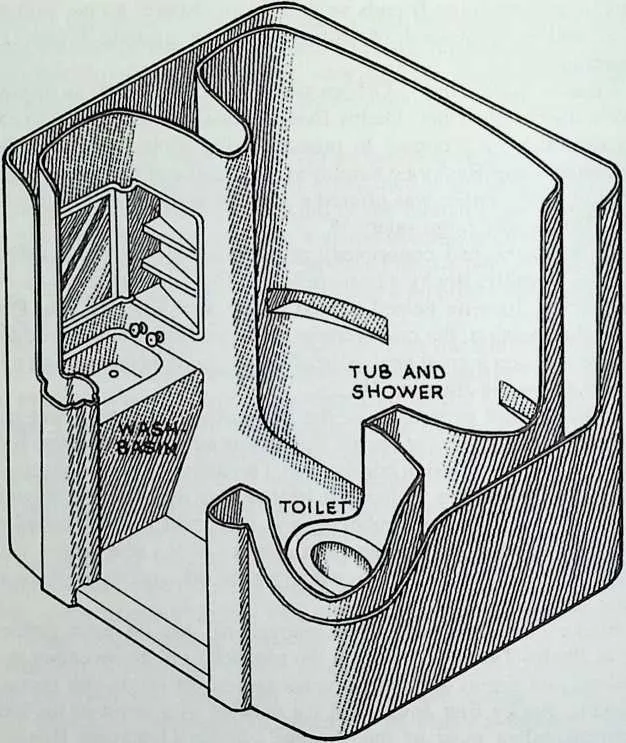
2728Fig. 9-1 Cutaway illustration of the single-unit, Dymaxion Bathroom.
29 owned by an individual, and moved just like any other appliance seemed to be an easily marketable product.
30 The Dymaxion Bathroom was designed to be manufactured on as-sembly lines in four sections which were assembled at the installation site. Those easy-to-transport sections could then be put together and connected to water, electricity, and drainage wherever needed.22 Bucky’s innovative design permitted an ultramodern bathroom with toilet, sink, shower, and tub to be installed in any house or apartment within hours. The entire unit occupied a floor space only five feet by five feet, weighed only 420
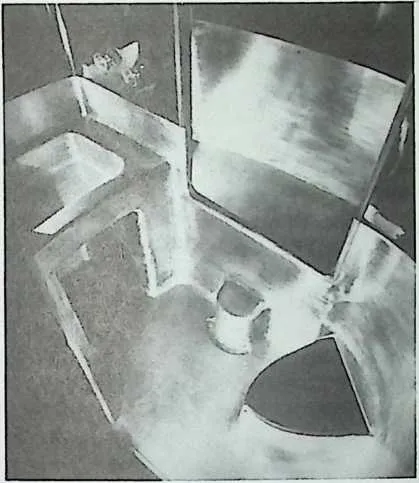
32 Fig. 9---2 Lower section of the Dymaxion Bathroom.
33 pounds (the weight of a conventional bathtub), and could be manufactured for about three hundred dollars. It could also be disassembled and moved with ease. Fuller even incorporated within the unit electrical strips for independent heating and a fan for cooling as well as small innovations such as a side hole rather than a spigot in the sink so babies could be bathed in greater safety.23
34 Within months of beginning, Bucky and his team had constructed prototype units using copper coated with either other metals or a colored synthetic resin. Although he utilized copper because Phelps Dodge’s pri-mary concern was mining and refining copper, Fuller speculated that the bathroom would be far more efficient in a lightweight plastic-like material that he predicted would be invented sometime in the near future. That material is the Fiberglas now used in the fabrication of modem tub and shower sections.24 Fiberglas was also the material employed in the con-struction of the modem, self-contained bathroom unit similar to the Dymaxion Bathroom which became commercially available in the early 1980S.25
35 Having witnessed the undermining of his earlier bathroom project by
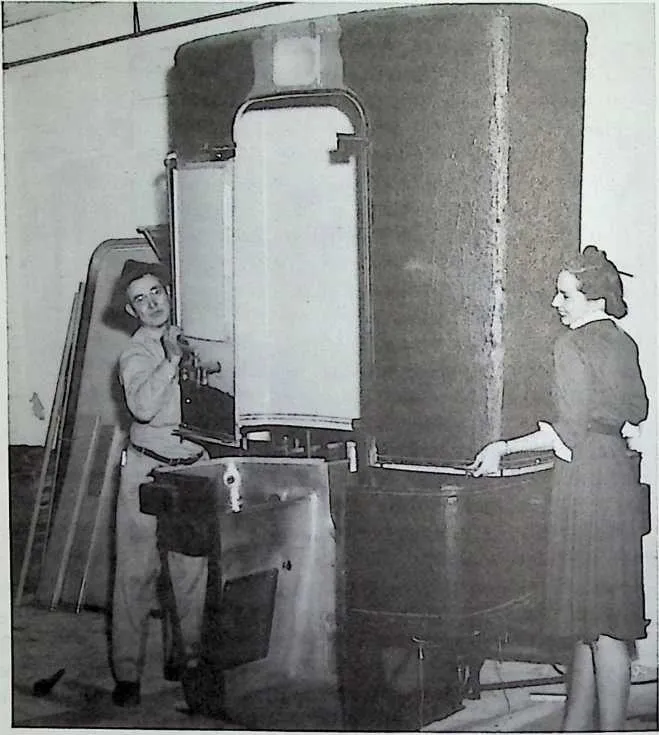
3738Fig. 9-3 The lightweight Dymaxion Bathroom sections being assembled.
39 the plumbers’ union, Fuller paid a great deal of attention to the concerns of that group, and he marketed his idea to them splendidly. In fact, the plumbers’ union was so impressed with the Dymaxion Bathroom that it was enthusiastically endorsed in the union’s official magazine, The Ladle. Their rationale for endorsing an invention which appeared to eliminate plumbers’ jobs was purely financial.26
40 Using his pragmatic logic, Fuller convinced union officials that mass production of such a device would result in many more people’s buying private bathrooms and having them installed. He then showed that every time bathroom owners moved, they would naturally want their personal bathroom disassembled and reinstalled at their new home.27 Thus, an entire new market of renters who had not previously used the services of plumbers would open up.
41 Bucky’s public relations effort was, however, in vain. One of Phelps Dodge’s largest customers was his former employer Standard Sanitary, and when they learned that the Dymaxion Bathroom was being resur-rected, an uproar ensued. Because of their negative experience with Fuller and his Bathroom years earlier, the management of Standard Sanitary was resolute in its opposition to rejuvenating the project, and as a result of that resolve, Phelps Dodge’s management had no choice but to discontinue the project.28
42 Although the Dymaxion Bathroom, like so many of his inventions, did not become commercially successful, Bucky was again satisfied with his work and the fact that he had advanced the project to a new level of development. Under the auspices of Phelps Dodge, he had produced thirteen prototype Dymaxion Bathrooms, most of which were sold to private parties and installed in homes when the project was terminated. Those units were so durable and well designed that at least half of them were known to be satisfactorily functioning as late as the mid-1970s.29
43 Always the showman who wanted others to ‘‘experience’’ his in-ventions as tactilely as possible, Bucky personally acquired one of the Dymaxion Bathrooms for exhibition. While still working for Phelps Dodge, he mounted that unit on an old pickup truck and drove up and down the East Coast with his new display. Not all those exhibitions were, however, solemn occasions, and more than once, he was seen driving the pickup through the sedate streets near the Hewlett home in Lawrence, Long Island, with assorted Hewletts riding in the Bathroom streaming toilet paper behind them.30
44 Because he always kept one eye on the future, Fuller regarded his revolutionary Dymaxion Bathroom as a rudimentary step in applying modem technology to resolving the issue of human sanitation. Bucky believed that human beings had not even scratched the surface of that issue, and accordingly, he continued his quest for more effective systems throughout the balance of his life. During that probe, the single invention he created which he felt could replace much of the Dymaxion Bathroom s functions and would revolutionize human cleanliness resulted from re-membrances of his days in the navy.31 Bucky recalled that when he and his shipmates would go on deck during a storm, even the thickest engine room grease would be quickly washed off their skin by the combination of wind and water.32
45 Having observed that phenomenon on numerous occasions, Bucky decided to investigate what had occurred, and he soon came to appreciate the cleansing power of ordinary water when it was atomized with air under high pressure. Employing that insight and with the assistance of students in his design classes during the late 1940s, Fuller designed and produced another invention.
46 That artifact was the ‘‘fog gun,’’ which utilized atomized water under pressure to clean human skin far more efficiently than anything previously known. With the fog gun, a person could take a complete shower using less than one pint of water, and since no drainage was required for the tiny amount of water used for washing face and hands, much of the human cleansing process would require minimal plumbing.33 In Fuller’s futuristic scenario, the act of cleansing was to become a simple ‘‘in-the-bedroom’’ process akin to dressing.34
47 Having previously experienced the wrath and power of the plumbing industry and being extremely busy with several other projects during the period he developed the fog gun, Bucky decided to simply build and test his idea with the help of his college students. After months of fabrication and careful testing, his students found the gun to be a completely satisfac-tory system of cleansing, which, in fact, caused less damage to skin than ordinary soap and water.35 Thus, another significant artifact was created and left until a time when future generations would require it.
48 Although Phelps Dodge was forced to scrap the Dymaxion Bathroom, the company’s management did not attempt to use Fuller as a scapegoat. They realized that Bucky had delivered the product they had requested, and he remained with the company, studying the future of copper. It was during that examination that he truly began to appreciate and understand the flow and use of raw materials and the patterns to which those materials conform.
49 Fuller was particularly interested in the primary industrial material of the era, metals. As he was working for a copper company, Bucky devoted most of his time to the scrutiny of copper and soon found it to be a bellwether metal.36 Being a bellwether metal meant that the use and distribution of all other metals followed the pattern of copper. In other words, if a shortage of copper occurred, a shortage of other metals was certain to follow. Because of that phenomenon, Fuller’s examination of copper flow provided him with a broad understanding of many other metals as well.
50 During his scrutiny of the copper industry, Bucky was amazed to find that he could actually calculate the amount of that metal which had been mined as well as the probable amount of copper which remained in the Earth and could be economically removed in the future. Thus, he was able to determine the total amount of copper available to humanity. That exercise suggested the possibility of similar studies for other ,materials and the ultimate potential to formally document all the Earth s natural re-sources and how they were being employed. Eventually, Fuller would expand that idea into his World Resources Inventory, which was the first comprehensive assessment of all available resources as well as how they could be more effectively utilized on behalf of all humanity.37
51 Bucky began his metal research by observing the fundamental fact that metal resources, like most elements on our Planet, rarely leave the Earth, and that any elements removed from the Planet are in such small quantities that they are not statistically significant. He then examined the fate of Earth’s fixed body of metals after they had been mined and incor-porated into products, and those products had been used up or had become obsolete.38
52 For example, during World War I, a great deal of copper was mined and employed in the production of armaments and electrical generating equipment. When more efficient, alloy metals began to replace copper in those applications, engineers found new applications for copper. One o the largest such uses was in the rapidly expanding communications indus-try. By studying the cycles of metals, Fuller found that mined copper was regularly recycled every 221/2 years. He also ascertained that because of World War I, more copper had been taken from the ground in 1917 than had been mined during the entire previous history of humankind.39 Hence, he predicted that a great volume of recycled copper would be available 221/2 years later in 1939.40
53 Few people paid any attention to that forecast. Even in July of 19 , when the docks of New York harbor were clogged with barges full of scrap copper, Fuller was not acknowledged for that insight. He was also ignored when he suggested that scrap metal was a valuable resource rather than discarded trash, the common contention among profit-oriented busi-nesspeople who sought to rid themselves of an unwanted commodity.41
54 Because of such attitudes the enormous inventory of American scrap copper was sold to Germany and Japan in the late 1930s. Shortly after that massive series of sales, those two countries formally became enemies of the United States and, ironically, returned the copper to the United States in the form of munitions which were manufactured from melted-down American scrap and fired at American troops.42
55 Fuller learned a great deal about large-scale, global patterns as well as resource flow and management from his study of copper. His most significant discovery was the fact that each time metals are recirculated, an important nonphysical element is added to them. That component is knowledge, and it enables humans to accomplish much more with the same amount of resource metal. For example, a modem communications satellite weighs approximately five hundred pounds, and some of that weight is copper. However, the satellite outperforms and makes obsolete the 175,000 tons of transatlantic copper cable previously used to carry messages across the Atlantic Ocean.42
56 Both the satellite and the cable are fabricated from resources which have existed on Earth since the Planet was formed epochs ago, but when advanced knowledge was added to the materials used in the satellite, those basic substances were employed far more efficiently than ever before. By adding knowledge to materials, humans are continually able to do much more with fewer and fewer resources. Fuller perceived that phenomenon of added value through applied knowledge to be a significant demonstra-tion of humanity using mind rather than muscle to grow. He also believed that the survival and flourishing of all humankind was predicated upon more efficient utilization of resources, resulting from the application of newly discovered knowledge.44
57 Bucky himself was continuously attempting to increase the knowl-edge of the management at Phelps Dodge with his constant flow of re-ports. Those reports were, however, written in a style Time magazine would later christen ‘‘Fullerese,’’ and Phelps Dodge executives could rarely decipher his communications. One executive did return a report which was to be forwarded to the board of directors, telling Fuller that something should be done because he couldn’t understand a word of it. The executive was certain that the board would not be able to understand Fuller’s message until Bucky read it aloud to him, punctuated by short pauses. It was then that both Fuller and the executive realized that the report was easily understood when read broken into short phrases. The executive suggested that Fuller revise the report into a similar style, but he was completely surprised when he received the new version.45
58 He called Fuller into his office and said, ‘‘This is lucid. But it is poetry, and I cannot possibly hand it to the president of the corporation for submission to the board of directors.’’46
59 When Bucky insisted that it was not poetry but simply a broken-up rendering of his previous work, the executive said he would solicit the opinion of two poet friends whom he was having dinner with that evening. The following morning he reported to Fuller, ‘‘It’s too bad; they say it’s poetry.’’ Hence, the report was changed back into its original form, but with a great many dots, dashes, and asterisks to separate the enormous sentences and paragraphs into the more easily understood poetic phrases.47
60 Thus began Bucky’s career as a poet. Over the years, he would often turn to that format for sharing his ideas in a more easily understood form. Fuller would eventually publish several volumes of that writing as poetry and would be acknowledged in that field when, in 1962, he was awarded the Charles Eliot Norton Chair of Poetry at Harvard.
61 In 1938, Fuller was presented with another opportunity to develop ideas which would result in additional new inventions and would also more directly influence public opinion. Because his work at Phelps Dodge had once again catapulted Bucky into the public spotlight, Ralph Daven-port, managing editor of Fortune magazine, felt Fuller would be an asset to the magazine’s staff. Accordingly, Davenport offered Bucky a position as ‘‘Science and Technology Consultant’’ at a generous salary of $15,000 per yearns
62 Davenport’s offer was simply too lucrative, both financially and in its potential to influence the course of human action, to be refused, and Bucky became an employee of Fortune. Although most of Fortune’s management was skeptical that the radical Fuller could fit into their some-what conservative and deadline-oriented environment, Bucky surprised everyone. He was, in fact, an ideal employee, always arriving at his office on time and remaining until closing. What he did during those hours, however, was somewhat controversial.49
63 While at Fortune, Fuller wrote very few articles. Instead, he devoted most of his time to the single pursuit at which he excelled, thinking. He would then share his thoughts with anyone who cared to listen, and almost everyone at the magazine seemed interested in his outlandish ideas. Edi-tors and writers were constantly dropping into his office to gamer the most recent workings of his mind, and many of those thoughts became the subjects of Fortune articles. As was generally the case wherever Fuller hung his hat, the one group who did not appreciate his contribution to the operation were the accountants, who, during one of their periodic exam-inations, found his editorial output to be well below that of almost every-one else.50
64 When the accountants questioned Bucky’s efficiency and productivi-ty, Davenport brusquely set them straight and concisely clarified Bucky’s true value to the magazine as well as to humanity. ‘‘Look, you,’’ he replied, ‘‘as managing editor, I have to have new ideas every single, solitary day, and sometimes I just dry up. Sol send for Bucky, and Bucky comes in and talks for about two hours. By the time he leaves, I have more ideas than I can publish in the magazine in ten years. He recharges my batteries, and he’s worth twice what he’s being paid.’’ With that, the inquiry was closed.51
65 During his tenure with the magazine, Bucky continued developing techniques for more easily conveying the complexities of his ideas experi-entially. In one such effort, he began displaying huge charts and graphs more and more. He also continued refining his ‘‘One Town World’’ mapping representation of the Earth so that it would more clearly display the entire Planet without visible distortion. Fuller believed that he could reveal the true deployment of global resources and influences of tech-nological advancements much more easily on such a map. Thus, the end-papers of Nine Chains to the Moon were printed with a rudimentary representation of what Fuller claimed was the most accurate global map-ping system known to humankind: the Dymaxion Map. Displays of re-sources using that early Dymaxion Map also appeared in Fortune during Fuller’s tenure at the magazine, and those illustrations began to generate interest in the Map itself. 52
66 Always working on several ideas at the same time, Fuller also con-tinued refining and expanding his mathematical theories in search of Nature’s coordinate system and Nature’s geometry. By 1939, he had studied the history of mathematics in great detail and was certain that several of the fundamental concepts of plane geometry were erroneous.53 Clearly, elements such as infinity and the intangible plane did not conform to the experiential environment in which Bucky found himself operating.
67 Still, Bucky’s continual outpouring of ideas and projects did not inhibit him from his habitual lifestyle of frivolity. In fact, with a steady income, he tended to drink and attend parties more than ever.54
68 Not all of Bucky’s habits appeared so contrary to his commitment to the well-being of humanity. In fact, one peculiar practice he developed during 1939 was actually a precursor of the future of exercise. It was during that year that Bucky suddenly decided he needed more exercise and began jogging. At the time, few people other than athletes were seen running in public, and the stocky figure of Bucky in shorts and a sweat-shirt trudging through Central Park must have raised some eyebrows among the pedestrians. With short legs, Bucky’s physique was not very well suited to his chosen sport, and he began referring to his form of jogging as ‘‘dog trotting.’’55
69 Even in an activity as individualized as running, Fuller’s belief that he knew what was best for everyone and his love of companionship were evident, and some bizarre situations resulted. For instance, on weekend evenings at the Hewlett’s Martin’s Lane estate, Bucky would often per-suade a crowd of the young men to join him for a late-night run. After having devoted most of the night to conversation and drinking, Bucky would suddenly stand up and shout, ‘‘Come on, Dog-Trot Club, time for a run!’’ Jackets and pants would then fly off, as the group prepared to join Bucky in a rowdy jaunt through the tastefully sedate neighborhood. Hav-ing witnessed that scene numerous other times, most of the neighbors would simply stare out at the midnight runners, commenting, ‘‘It s that crazy Bucky and his friends, again.’’56
70 Crazy or not, Bucky’s friends always seemed to recognize his genius and to support his projects. One of the most palpable evidences of that support occurred in the early summer of 1940, when he and Christopher Morley were driving through the Midwest. During that trip Fuller noticed hundreds of identical grain-storage bins scattered on farms alongside the road.5?
71 After stopping to question a farmer, Bucky discovered that most of the bins were identical because they were all manufactured by the Butler Manufacturing Company of Kansas City. Because Butler’s grain bins were superior in both design and quality to those manufactured by other companies, they had become extremely popular, with news of the excep-tional product spreading from farmer to farmer by word of mouth over the years.58
72 Always the designer and inventor, Bucky examined the Butler bins and quickly decided that they could easily be converted into shells for small prefabricated houses. As that concept formulated in his mind, Bucky explained to Morley that with the use of mass-production tech-niques, the cost of manufacturing such a structure would probably be in the astounding range of one dollar per square foot. Although Morley found Fuller’s concepts fascinating, he was not prepared to become a captive audience for Bucky’s incessant praise of Butler’s grain bin. As the
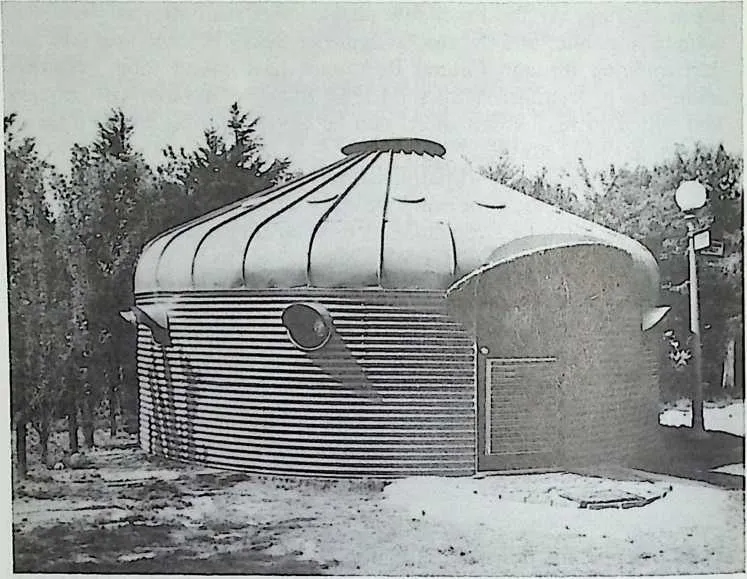
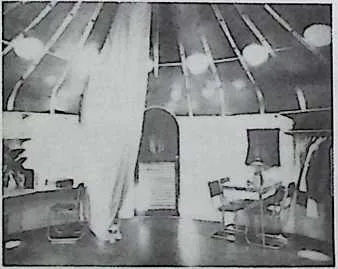
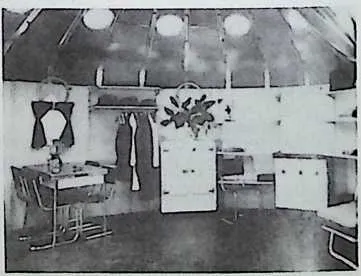
74 Fig. 9-4 A Dymaxion Deployment Unit installed as a residence.
75 Figs. 9-5 and 9-6 The furnished interior of a Dymaxion Deployment Unit. Curtains hanging from the center of the roof were used to divide the single ‘‘room’’ when necessary.
76 miles passed, the praise persisted, and Bucky began explaining the details of modifying Butler’s design to create inexpensive homes and other forms of shelter.59
77 At the time, Morley had just completed a novel entitled Kitty Foyle. After listening to Fuller’s ideas for hours, Morley suddenly declared that the fictional heroine, Kitty Foyle, wanted to see the housing idea pursued. He continued by explaining that if the novel was a success, he would finance Fuller’s designing such a structure and traveling to the Butler Manufacturing headquarters in Kansas City.60 As fate would have it, Kitty Foyle was an instant success. In fact, the book was so popular that it was made into a movie, and Bucky was soon journeying to Kansas City with house plans in hand.61
78 In Kansas City, he conferred with the president and the top manage-ment of the Butler Manufacturing Company, and in 1940, Butler and Bucky’s newly formed Dymaxion Company embarked on a joint venture to develop mass-production housing units christened Dymaxion Deploy-ment Units or DDUs.62 DDUs employed the standard grain-bin design and manufacturing techniques in conjunction with Fuller’s innovations and modem mass-production technology.
79 Twenty feet in diameter, the structures proved to be an ideal size for the primary unit of a small dwelling. Bucky created a more humane interior by lining the inside with Fiberglas-backed wallboard for both aesthetics and insulation. He also added a translucent vent in the center of the conical shaped roof to allow in both light and fresh air.63
80 The structures were designed to be installed on a circular brick floor which was covered by a combination of several materials and topped by Masonite flooring.64 Inside, the large round room could be divided into three smaller pie-shaped rooms by heavy curtains strung on wires. To bring in additional fresh air and light, Fuller installed circular porthole windows which were glazed with acrylic plastic, the first use of that material for windows.65
81 In addition to design innovations, Bucky also developed unique new construction techniques which later became important in the production of geodesic domes. For example, because he was concerned with worker safety and ease of construction, Fuller devised a system of erecting the building’s prefabricated sections from the top down rather than from the bottom up, as is normally the custom. That innovation eliminated dan-gerous work on high scaffolding and allowed a structure to be erected in a much shorter period of time.
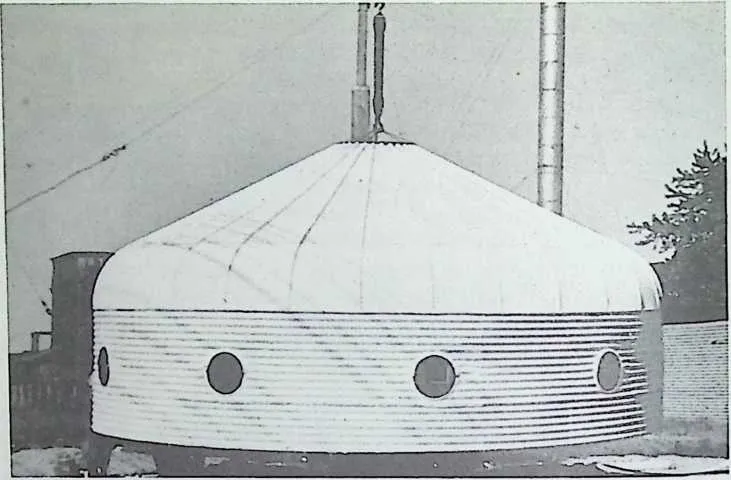
8384Fig. 9-7 The first Dymaxion Deployment Unit suspended on its mast prior to its final installa-tion at the time its ‘‘natural air-condition’’ was discovered.
85 Fuller’s unique system required a large metal ring several feet in diameter attached to a pulley and hanging from a mast in the center of the building site. Workers fastened individual roof sections to the ring, and when the entire roof was complete, it was hoisted up. The construction workers then attached the upper wall sections to the finished roof, and the structure was again hoisted by means of the pulley. Next, the lower wall sections were fastened in place, and the finished structure was gently lowered onto its foundation.66
86 One extremely hot afternoon during the construction of the first prototype DDU, Fuller chanced upon an amazing characteristic which he would later apply in many of his buildings, including geodesic domes. The completed Unit was still suspended from the central mast slightly above its foundation, when E. E. Norquist, president of Butler Manufac-turing, and his top management came out to inspect the work in progress.67
87 Being an inquisitive as well as an adventurous individual, Norquist entered the metal building even though the outside temperature was over one hundred degrees and the Unit had no ventilation or electricity for fans. Naturally, everyone, including Fuller, expected Norquist to come running back out of the scalding-hot metal structure, which was receiving the direct rays of the sun, and they thought he was joking when he exclaimed that the structure was, in fact, air-conditioned. Since Norquist was their boss, the other staff members played along and cautiously entered the DDU, expecting to encounter an inferno of heat. They were, however, amazed to discover that the interior was extremely comfortable, being at least twenty degrees cooler than outside.68
88 Fuller and the other engineers immediately began working to unravel the mystery and discovered cool air currents flowing down from the hole in the center of the conical roof and out the lower edges of the suspended building. Bucky quickly uncovered the principles which had created that cooling effect. He determined that the sun’s rays heated the air nearest the outer shell of the DDU to temperatures even higher than the outside air, and that that scorching air rose to create a low-pressure vacuum effect around the bottom edge of the structure. Because of that lower pressure around the structure’s base, which was suspended a few inches above the ground, air from inside the structure rushed out the bottom, producing lower pressure inside. That lower pressure could be balanced only by air rushing in through the other opening, the small ventilator aperture at the top of the DDU.69
89 Since that opening had a much smaller total area than the entire lower edge, more air per square inch had to enter through the top than was leaving through the bottom, so that the entering air was compressed. The resulting cooling could then be easily explained by the Bernoulli principle which states that the more a substance is condensed, the slower its mole-cules move and the colder it becomes. Thus, the air entering through the roof aperture was actually cooling the entire DDU. Remarkably, the warmer the outside temperature, the faster the air was forced to enter, and that phenomenon resulted in even lower inside temperatures.70
90 Once Fuller understood what had occurred, he became an instant proponent of that form of ‘‘natural air-conditioning.’’ He also discovered that the phenomenon was particularly efficient in spherical or circular structures.71 Years later, Bucky would become even more supportive o that method of environmental control, as he determined that a smal opening in the center of a geodesic dome combined with vents around its lower edge produces a similar cooling effect with no additional expense.7-
91 Like so many of Fuller’s inventions, the Dymaxion Deployment Unit suffered several setbacks even though it was sponsored by a major corpo ration. Fuller’s original idea was to produce an inexpensive home which could be mass-produced at a factory, delivered anywhere in sections, and erected in a matter of days by almost anyone. The structure was to provide an ideal home for small families and to be especially beneficial to those who had been rendered homeless by the Depression.73
92 Weighing only thirty-two hundred pounds (the average weight of an automobile at that time) without the brick floor, it conformed to Fuller’s modular intent. Because of the center mast pole, an instruction sheet, and a simple tool kit, the DDU could be easily assembled by a single person if necessary.74 Realizing that the simple structure would have to accommo-date the necessities of life if it was to be accepted as a home, Bucky also designed a second, smaller grain-bin unit which could be attached to the main Unit and which contained a small kitchen, a bathroom, and an additional bedroom.75
93 While working on the design, the comprehensivist Fuller could not help but consider every aspect of living in the radical new structure. Thus, he calculated that a completely furnished two-bin home, which included a stove and refrigerator, could be sold for approximately $1250.76
94 Because of World War II, the DDU was not, however, destined to become known as the family home Fuller envisioned. In fact, the first stages of the American war effort nearly terminated DDU production before it began in earnest. With industrial giants gearing up for war production, many materials were scarce and not allocated for something as curious and nonessential as a house made from grain bins.
95 Although World War II nearly finished the DDU, it also made the Unit famous. The British were fighting Germany, and several British military leaders had read about Bucky’s latest project. While searching for an inexpensive method of housing their troops, they examined the DDU and were impressed enough to place a large order. However, before manufacturing could begin, the war escalated, weapons became a priority for England, and the order was canceled.77
96 Following that setback, the United States became heavily involved in supporting Great Britain with armaments, and steel became a rationed commodity. Naturally, top priority was given to military applications, and inexpensive experimental housing for civilians was relegated to an even more insignificant priority.78
97 Then, just as it seemed that the project had been condemned, Fuller’s strategy of creating an invention and waiting for an emergency proved itself. At the time, the United States was expanding its support of the Allied forces. As the United States defense effort increased, small aggre-gates of American troops and technicians were being dispatched to remote locations where housing was unavailable.79 Most important among those troops were the groups being assigned to work with a new military device, radar. Radar stations were being established at extremely isolated sites where they could be maintained secretly, and the DDU seemed like an excellent air-deliverable means of quickly housing troops and protecting equipment at such sites.80
98 After examining Fuller’s DDU, several military officers felt that the invention could alleviate many of their remote housing and storage prob-lems, and they requested that a prototype unit be installed at the Wash-ington, DC, Haynes Point Park for further inspection. Following a positive response, the military leaders submitted a massive order for the Units, and Butler Manufacturing was catapulted to the top of the govern-ment’s steel priority list.81 Within weeks, Butler’s mass-production oper-ation was established and running twenty-four hours a day, and both the Company and Bucky began doing something to which he was not ac-customed: earning substantial profits.82 Soon small cities of DDUs were springing up in faraway locations such as the South Pacific islands and the Persian Gulf.83
99 Always the consummate designer, Bucky made certain that in ad i-tion to a complete instruction packet, every shipment contained the porta-ble mast and the tool kit which facilitated expeditious construction. Be-cause of such attention to details and the quality of his design, both Fuller and Butler began receiving praise from both the personnel for whom die DDUs provided quality living accommodations far superior to anything ever experienced by remote troops and from those who had to erect the DDUs.84
100 The DDU’s rapid success was, however, just as suddenly terminated by World War II when Japan attacked Pearl Harbor on December 7, 1941, and the United States officially entered the war. Steel then became the sole property of armament manufacturers, and with no steel, DDU man-ufacturing abruptly ground to a halt, leaving Bucky again searching for the next project requiring his attention.85 This time, however, he could do so without his usual financial predicament, since the DDU project ha resulted in profits for both himself and Butler.
101 Working at Butler had also resulted in another positive benefit. During that period Bucky had chosen to again end one of his most deleterious habits, drinking. In a moment of insightfulness, he suddenly realized that both he and his ideas were, at times, dismissed as inconsequential because of his copious drinking. He also felt that if he was to make a truly significant contribution to humanity through a continually advancing design-science revolution, he had to be taken seriously at all times, and so he simply decided to stop drinking and smoking.86
102 Prior to that moment in 1941, Bucky had relied on drink to soothe rough times and build friendships. However, he gradually came to realize just how much alcohol and the image it created of him interfered with his work. Fuller truly wanted his ideas to be considered seriously and, thus, without any special treatment program or pressure from other people, he simply gave up alcohol and smoking for the balance of his life so that he could be of greater service to humanity.87