
3 Lessons of Love, War, and Technology
2Although Fuller’s philosophy and strategies of life would not be fully developed for many years, even as a child he was beginning to envision Nature as a critical element of his life. As he grew older, Bucky began to appreciate how uniquely Nature designed even the simplest of organisms, and he sought to translate that unmatched efficient design into inventions as well as a more organic philosophy of life.
3 That saga of a young man managing to attain a perspective which helped him to mirror Nature’s designs in his inventions cannot, however, jump ahead to momentous accomplishments like the Dymaxion Car or the geodesic dome without first examining the events of his earlier life. How the rambunctious young man who had twice been expelled from Harvard matured into an insightful designer as well as a husband and father while developing a comprehensive understanding of Universe begins with the rigors of a tum-of-the-century work environment and a relationship which would endure for sixty-six years.
4 Fuller’s true intimacy with and observation of the ‘‘cold, hard world’’ began when he left Harvard for the second time. In 1915, he earned a meager $15 per week working for the meat-packing company Armour in New York City while putting in six fourteen-hour days each week.1 Still, he enjoyed his job and remained with Armour for nearly two years. During that time, the free-spending young man resolutely at-tempted to live within his financial means. He conserved some of his sparse funds by living with his mother, who had sold the big house in Milton and moved to an apartment in New York after her eldest daughter, Leslie, was married.2 When the tight quarters and his mother’s dominance became too much for Bucky, he moved to another inexpensive abode, the Brooklyn YMCA.3
5 Although work at Armour occupied most of his time, Bucky dis-played an incessant vitality and an ability to shift from work to partying night after night. Even while working seventy-hour weeks, he still found the time and energy to indulge his passion for dancing, especially with beautiful girls.
6 It was during a 1915 semiformal summer dance he attended on Long Island that Bucky was first captivated by a beautiful brunette woman with brown eyes. Questioning his friends, Bucky discovered that the beauty was nineteen-year-old Anne Hewlett, the best girl of one of his friends, Kenneth Phillips.4
7 Since many of the local young men considered Anne’s sister An-glesea, nicknamed Anx, even prettier, she was the one who was con-stantly pursued. Always one to accept a challenge and valuing his friend-ship with Kenneth Phillips, Bucky danced much of that night with Anx, even though it was Anne who had caught his eye.5 He liked Anx, and over the course of that summer, Bucky and Anx frequently double-dated with Kenneth and Anne on weekends. At times, dates consisted of simple evenings or afternoons at the Hewlett house on Martin’s Lane in Law-rence, Long Island. Just being at the large Hewlett house proved to be great fun for Bucky. With an often unruly clan of five sons and five daughters, Mr. and Mrs. James Monroe Hewlett’s home often abounded with friendly turmoil.6
8 A short distance down the road, Anne’s grandmother spent summers living with her two bachelor sons in the ancestral homestead, Rockaway Hall. That stately mansion, which still exists and is now known as Rock Hall, is one of the most beautiful eighteenth-century homes built on Long Island, and Bucky was awestruck whenever he was privileged to visit there with the Hewlett family.
9 Because Anne’s mother was ill from the time Bucky met her until her death a few years later, she spent most of her time quietly convalescing in an upstairs bedroom while the children and Mr. Hewlett maintained the family. The father, James Monroe Hewlett, was a noted architect and painter who eventually introduced Bucky to the finer aspects of architec-ture and the arts.7
10 During that first summer, Bucky’s primary focus was on Anx, al-though he also began to find himself growing more attracted to Anne. As summer turned into fall, Bucky’s feelings for Anne grew stronger, but he restrained himself because he believed that Anne was about to become engaged to Phillips. Anne found herself entertaining similar feelings for Bucky while Anx was moving on to other boys. Thus, it was Anne who invited Bucky over to dine with the family on a regular basis during the fall of 1915.8 After several such invitations, Anne felt compelled to confront Bucky’s polite but constrained attitude toward her, and she initi-ated the opportunity for his courtship by straightforwardly informing Bucky that she was not engaged or attached to Kenneth Phillips and did not intend to marry him. As he had had little experience with refined women or serious relationships, Bucky was both overjoyed and anxious about the prospect of courting Anne.9
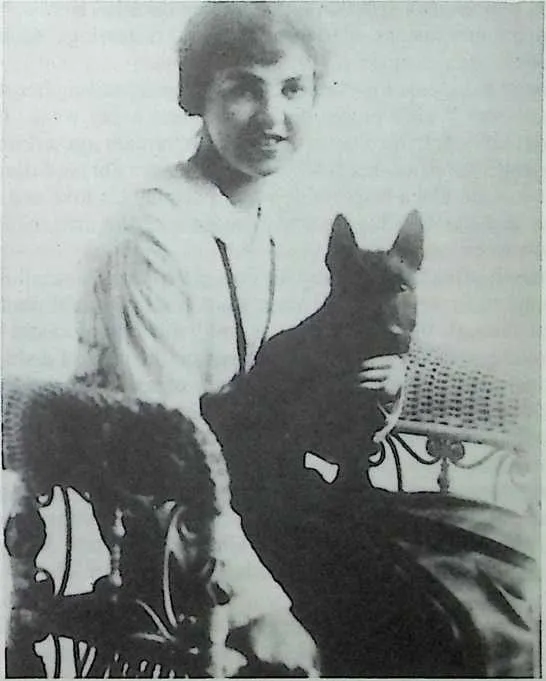
12 Fig. 3-1 Anne Hewlett during the time of her first encounters with Bucky.
13 As Anne was the eldest child, Bucky became the first outsider to attempt penetrating the closed inner circle of the Hewlett family. Accord-ingly, he was subjected to a great deal of scrutiny and good-natured harassment.10 Some of the younger children made great sport of teasing both Anne and Bucky, whom they called ‘‘The Butcher Boy’’ because of his job at Armour. Despite those obstacles, Bucky’s tenacity as well as his warm personality, playful nature, and love of Anne soon won over the entire Hewlett clan. In fact, the family so enjoyed his company, they bestowed on him the title of ‘‘honorary Hewlett.’’11
14 Although the multihour lectures Fuller delivered during the last dec-ades of his life provide clear evidence of an ability to speak eloquently when necessary, as a young man Bucky was quite shy and often found himself tongue-tied. Those traits were especially evident when he at-tempted to express his emotions to Anne in words. Hence, when he discovered another means of demonstrating his feelings of affection, Bucky quickly jumped upon it.
15 He found that Anne loved roses, and he began sending her a bouquet of red roses from Weir’s Florist on Fulton Street every week. In typical Fuller style, although he was attempting to remain on a budget, the financial ramifications of that splendid gesture were not well thought out. Because it seemed like a respectable way to display his love and win over both Anne and her family, Bucky spent five of the fifteen dollars he earned each week on her roses.12
16 Eventually, Bucky worked up the courage to make a small request of Anne. He asked for a picture. Because Anne had no formal photographs, she looked through the family albums until she found an old photo of herself standing beside an elderly gentleman on the deck of a ship. Bucky gratefully accepted the picture and promptly trimmed the old gentleman off. Thus, Mark Twain’s picture went into the wastebasket. Years later, Bucky would reminisce that he regretted that thoughtless gesture of his youth, which left him without the photograph of Anne and Mark Twain.13
17 During the summer of 1916, Bucky and Anne’s formal engagement was announced and was followed by a series of gala parties honoring the couple.14 The impending entry of the United States into World War I, however, significantly overshadowed the festive nature of those events.
18 When the United States declared war upon Germany in 1917, Fuller, like most young men, volunteered for military service with patriotic fer-vor. Later, he would recount that World War I did to his former college classmates what his own innate curiosity did to him. Both phenomena removed them from Harvard. Of the seven hundred men entering as freshmen in 1913, only forty-five graduated four years later. The majority of the student body members responded to the prevailing circumstances and dropped out of college to serve their country in the ‘‘Great War.’’15
19 Fuller’s experience with boats and the sea was an enormous advan-tage when he endeavored to enlist in the navy. He first attempted to join the military during the fall of 1916 at an official army training camp. That encampment had been established and commanded by former President Theodore Roosevelt to train young men for the defense of their country in the event of the United States’ entry into the War. Because of Bucky’s extremely poor eyesight, he was rejected from that army training center.16
20 The American demand for servicemen did, however, increase as the war escalated, and Fuller tried again the following year.17 That second effort was much more cleverly planned and demonstrated the ingenuity which would later propel him past many obstacles. Bucky first persuaded his relatives that volunteering the family’s small cabin cruiser to guard the coast of Maine was a greatly needed patriotic gesture. He then offered the navy not only a seaworthy ship but a trained crew to man the vessel. Within weeks, the tiny USS Wego, commanded by United States Navy Chief Boatswain R. Buckminster Fuller, was patrolling the Maine shoreline.18
21 With a crew of six, including Bucky’s brother Wolly and best friend Link Pierce, the tiny Wego was extremely crowded. In fact, the Wego may have been the smallest regularly commissioned vessel in the entire United States Navy.19 Sailing out of Bar Harbor, she soon became nicknamed the ‘‘State of Maine Navy.’’20
22 Although Fuller and his crew were motivated by the best of inten-tions, their only significant contribution to the war effort resulted from the tiny ship’s inadequacies rather than her superiority. When local yachtsmen noticed Bucky and crew patriotically guarding the coast and harbors, they followed suit and volunteered their vessels for similar duty. In dire need and uncertain as to where German U-boat submarines were patrolling, the navy accepted those offers and appointed each of the ships’ captains to the rank of boatswain. Having been commissioned before the rush, Bucky was a chief boatswain. Thus, the twenty-two-year-old with the slowest and smallest ship became the senior officer present and com-mander of the Bar Harbor flotilla. Regardless of Bucky’s rank or position as commander, the Wego could not keep pace with the expensive yachts under his command, and when the diminutive fleet sailed out on maneu-vers, Bucky and crew were soon trailing far behind the other boats.21
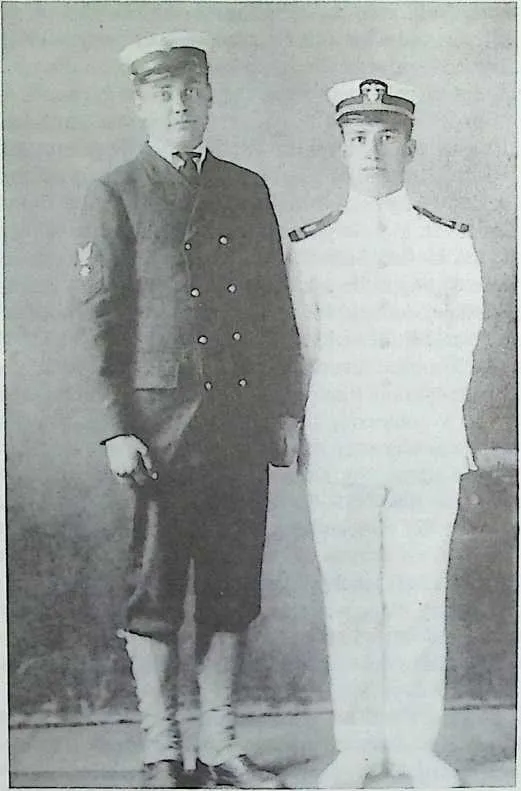
24 Fig. 3-2 Fuller (right) in uniform as the commander of the Wego with his first mate, Lincoln Pierce (left).
25 On one such occasion, the Wego’s engine began to sputter while it was lagging well behind the other ships. To make matters worse, the crew was caught in a coastal fog. Because Bucky and his crew were familiar with the area, they were able to maneuver their ailing ship into Machias Bay so they could make repairs and anchor safely for the night. To ensure security, Bucky posted a rotating watch through the night. At 2 a.m., when the fog lifted, the sentinel on duty spotted a rapidly flashing light at
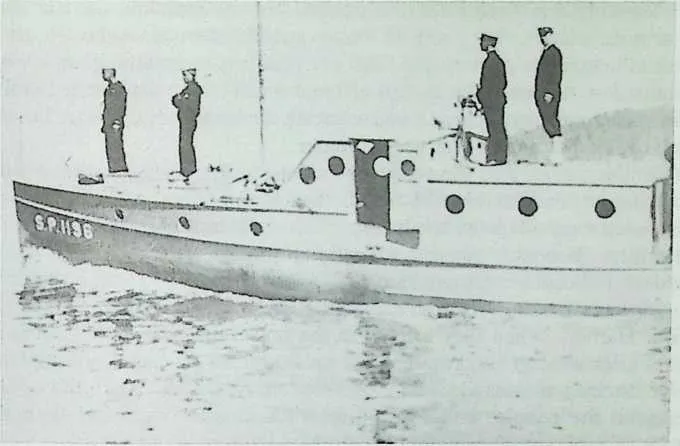
2728Fig. 3-3 The U.S.S. Wego with Fuller at the helm.
29 the end of the pier and saw it answered by similar flashes from Cross Island. He summoned the other crew members, who were below decks working on the engine, but no one on board could decipher the message being sent. Having some military knowledge and a vivid imagination, Fuller assumed that a message was being transmitted by secret code. Following that display the crew observed a large sardine trawler sailing out of Machiasport to Cross Island. Because it was anchored without lights, the Wego went unnoticed during that operation.22
30 Upon returning to Bar Harbor, Fuller immediately reported the sur-reptitious incident to naval authorities, and several large gunboats working in conjunction with naval intelligence agents converged on Cross Island the next day. Despite all the commotion, it was not until after the war concluded that Fuller and his crew learned just how accurate his vivid imagination had proven to be. When secret information was declassified, they learned that while stranded in the bay, they had inadvertently been the first to stumble upon and uncover a refueling depot for German U-boats and a transfer point for German spies entering the United States. They were also told that the sardine trawler had actually been covertly transporting German spies and equipment to that depot on the night the crew spotted it.23
31 The only drawback Fuller encountered in commanding the Bar Har-bor armada was that he could no longer spend time with Anne. Because his chief boatswain’s salary of $1800 per year was more than double what he earned at Armour, Bucky felt affluent and able to support a family. With such financial affluence and a strong desire to be together, he and Anne decided to marry that very summer.
32 In what would be the second of a long series of significant events occurring on his birthday (the first being his father’s death), Bucky and Anne were married on the south lawn of Rock Hall on July 12, 1917, with full military honors.24 As with everything during that era, the war domi-nated the Fullers’ honeymoon. Immediately following their wedding, they caught the late train to Boston and a ship back to Bucky’s command post at Bar Harbor. When they arrived at the dock, the newly wed Mr. and Mrs. Fuller were greeted at the dock by the entire contingent of captains under Bucky’s command. Bucky was especially touched when those men presented the couple with a beautiful silver basket engraved with the names of each ship’s captain.
33 Bucky and Anne rented a small cottage overlooking the harbor, but his duties kept him at sea for the majority of those first weeks. Shortly after that tour, the navy decided that the Wego was no longer useful and removed her from active service.25 The ship’s crew did, however, retain their positions, and Bucky was given comrpand of a larger ship patrolling the outer reaches of Boston harbor. The Wego was returned to the Fuller family, and it provided many more years of service at Bear Island. In fact, it served as a general freighter and ferry until it had to be retired in 1957.
34 Wartime conditions led to rapid promotions, and the able Fuller soon found himself commanding the even larger patrol boat Inca, which was assigned to the Naval Air Station at Newport News, Virginia. The only American aircraft which contributed significantly to World War I were navy planes, but experienced pilots were a scarce commodity during those early years of aviation. Newport News was the navy’s primary testing and training facility for both pilots and new aircraft. Reckless courage was the order of the day among the inexperienced young pilots being trained there as they eagerly displayed their readiness for combat duty.26 Tragically, fatal accidents occurred every day.27
35 Planes landed and took off from the water using large pontoons, but naval aircraft design was so primitive that they often flipped upside down during landings by overzealous, unseasoned pilots. When such an incident occurred, rescue boats, including the Inca, would rush to the scene within one or two minutes. Upon reaching an overturned aircraft, most of the crew would dive overboard to rescue the pilot, who was hanging upside down under water, trapped by his own seat belt. Although the rescue crews were speedy in their attempts to save lives and always carried a doctor with them, pilots frequently drowned before they could be cut loose.28
36 After witnessing a few of those tragic deaths on the decks of his ship, Fuller decided to employ his mechanical talents in an attempt to solve the problem. He worked late into the night for weeks trying to create a quick release mechanism for the pilots before he was seized by an entirely different possibility.29 Following that insight, he designed a huge winch, much like those on the backs of large towtrucks, to be installed on the rear of the rescue boats.
37 After convincing Commander Pat Bellinger, the commanding officer of the air station, that the idea had merit, Fuller was authorized to have a prototype of his winch constructed and installed on the Inca. Using it, Bucky and his crew could quickly hook onto an overturned aircraft and hoist it out of the water in less than two minutes. Although the pilots remained hanging upside down in the open cockpit while the planes were being raised, Fuller felt that they would still be afforded a much better opportunity for survival than the old methods provided.30
38 After several practice runs retrieving previously crashed planes, Full-er felt that his crew was ready for a real test and requested an opportunity to demonstrate his invention in an actual emergency. Once the plan was approved by Commander Bellinger, the crew did not have to wait long for a crash. On their first attempt, the pilot was on the Inca’s deck within minutes of his crash.31
39 Although the pilot was not breathing, the Inca’s doctor laid him on his stomach, pumped the water out of his lungs, and began giving him artificial respiration as the crew looked on. Then, after several minutes of treatment, which Fuller would later recall seemed like an eternity, that pilot opened his eyes and promptly vomited.32 That act provided Fuller with what he later recounted as one of the happiest moments of his life, and within days other such winches were built and installed on all the rescue boats, saving hundreds of pilots’ lives.33
40 In what would turn out to be an unusual outcome for Fuller, within only a few weeks he was rewarded for his achievement of inventing that lifesaving device. Accolades, acknowledgments, and honors for his inno-vations and ideas would later be years or decades in the making. But his early accomplishment was noted by Commander Bellinger, who quickly nominated Fuller to be trained as an officer at the United States Naval Academy at Annapolis.34
41 Prior to leaving for Annapolis, Bucky experienced a chance encoun-ter with the cutting edge of technology which provided him with a mo-mentary glimpse into the future. Dr. Lee De Forest, the man who had invented the triode tube in 1907, arrived at the Newport News Air Station to conduct radio experiments just as Fuller was achieving notoriety. Dr. De Forest’s tube was the single most significant component used in the newly developed radio transmission of voice messages, and he was at-tempting to perfect ship-to-plane voice transmission for the navy. As luck would have it, the Inca was assigned to Dr. De Forest for his experiments, and Fuller became the quintessential host for the distinguished scientist. Not only did he provide De Forest with assistance, but the ever curious Fuller closely studied the emerging technology of radio. Then, one bright autumn day, when the Inca’s crew had loaded De Forest’s heavy equip-ment on board, they set sail for a historic test with Bucky on the bridge continuously asking questions of the distinguished guest beside him.35
42 As the Inca’s crew looked on, one of the navy’s largest Curtiss flying boats took off filled with another set of experimental radio equipment. Then, after a great deal of adjusting dials and ..switches, Dr. De Forest spoke into a crude microphone, and through a mass of static, a distorted voice was heard to reply. It was the first time the voice of a person on a ship was transmitted to the crew of an airplane.36
43 Fuller’s stint at the Naval Academy proved to be one of the most arduous, yet fulfilling, times of his life. Because of the war, the navy had expanded its shipbuilding program immensely in just a few months. Gov-ernment officials wanted to enlarge the fleet quickly and needed officers to command those ships. Accordingly, the navy initiated a three-month officer-training program to establish a corps of new officers, who soon became known as ninety-day wonders.37
44 Bucky was nominated and, to the surprise of almost everyone, ac-cepted, even though he met few of the qualifications. Aside from his poor eyesight and diminutive height of five foot six inches, he did not fulfill the requirements of having been overseas or possessing a college education or its equivalent. Still, he satisfied the precondition of being sponsored by a senior officer, and that officer, Commander Bellinger, carried a great deal of influence in the navy. Bellinger also made certain that those deciding on which candidates would be admitted to the Naval Academy noticed Fuller’s superior record commanding patrol boats and his inventive ingenuity.38
45 Thus, Fuller was propitiously accepted for three intense months’ training at Annapolis in early 1918. That time and his subsequent naval duty would prove to be one of the most fascinating and expansive periods of Fuller’s life. It was during those months that his broad World view and understanding of comprehensive management and operation began to develop.
46 Training at the Naval Academy occupied almost all of Bucky’s wak-ing hours, and even the time he allowed himself for sleep was extremely limited. Still, he found some moments for Anne. She had moved into an inexpensive hotel room nearby, and although Bucky was confined to living in the barracks with the other cadets, he could usually slip away for a walk after evening parade.39 Those walks were Fuller’s only diversion from his naval studies. All other time was devoted to a comprehensive training schedule designed to provide officers with all the skills they needed to operate autonomously in handling any situation at sea.40 At the time, wireless communication was still in its infancy, and ships at sea could not contact other vessels or commanders on land who were not within the fourteen-mile visual range of the horizon. Accordingly, neo-phyte naval officers were trained to deal with a wide variety of problems, including taking command if the ship’s commanding officer was incapaci-tated.41
47 Such training was not unique. Since men had first sailed from ports on primitive rafts, the ship’s captain had provided the final authority at sea, and even though he was suspicious of traditional authority, Bucky respected the necessity of such command for the survival of a ship at sea. From his personal experience, he understood that decisions had to be made quickly at sea or entire crews could be lost. Hence, he was willing to accept and follow the authority of the ship’s captain even though such subordination contradicted his burgeoning belief in the importance of independent thinking.42
48 The tradition of the sovereign authority of a captain at sea had, over the centuries, been developed into a highly sophisticated system by the time Fuller started his formal naval training. At the onset of World War I, most of the knowledge concerning naval warfare and World domination through the employment of naval forces had been handed down and retained by the nation which had ‘‘ruled the waves’’ for centuries: Great Britain.
49 Great Britain, however, was on the verge of losing control of the seas to Germany and needed more ships and weapons. The only country capa-ble of providing the armaments which could defeat Germany was the World’s emerging industrial giant, the United States, and in desperation, proud British government officials were willing to enter into agreements which would lure the United States into World War I in support of En-gland. One of those agreements was to assist the United States in building its navy up to a size and strength comparable to Britain’s. As part of that effort, the British supplied the United States Navy with their superior technology and training methods as well as their knowledge of ancient naval history and tradition. Accordingly, British naval wisdom greatly influenced the Naval Academy and the other sites where Fuller was trained and later assigned to duty.43
50 Fuller’s indigenous fascination with the sea intensified during his naval career. When combined with his incessant curiosity, that enthusi-asm supported his benefiting greatly from the naval history and tech-nology he was taught. Those lessons would eventually be incorporated into his comprehensive philosophy and his understanding of the history of human development.
51 Because naval warfare was such an essential component of Fuller’s philosophy and understanding of human history, he often utilized it in his stories about the development of humanity. The following is one such example from his naval studies which Fuller frequently related during his lectures. It provides some insight into the ideas that eventually guided Bucky to formulate and champion a unique philosophy predicated upon peace and cooperation rather than traditional warfare.
52 At the United States Naval Academy he learned that the basic naval warfare strategy employed during World War I dated back to 1184 b.c., when Greece conquered Troy. At that time, an entirely new form of battle was initiated, and it dominated most human activity for thousands of years. The fall of Troy marked the first time shipbuilding and navigation had achieved a sophistication which allowed a nation to employ large supply ships in supporting distant troops for years on end.44
53 Prior to that time, monarchs had maintained power by fortifying themselves and their subjects within huge castles such as the one at Troy. When an attacking force was seen advancing into a kingdom, peasants burned their fields and buildings, poisoned their water supplies, and re-treated with all the supplies they could carry to the safety of the local castle. Those castles were well fortified and supplied for such emergen-cies. They could support local residents for months or years at a time, and safely inside them, the villagers and the king’s troops simply waited for the invaders to leave. Local residents believed that dwindling supplies of food, water, and other necessities would force the invaders to abandon any hope of conquest and leave after a few weeks. Prior to the invasion of Troy, that had been the outcome of almost every such confrontation.45
54 Because those castles were heavily fortified with thick, high walls which would withstand assaults even when defended by a minimum number of soldiers, invaders seldom attacked. Instead, they conformed to the traditional battle strategy known as the siege. A siege consisted of simply surrounding a castle and waiting, but since they tended to be well prepared, the local residents could usually wait much longer than the invaders. Encroaching armies were further hampered by the size and speed of the pack animals or small ships which provided lines of supply from home. Thus, a siege generally resulted in the invaders’ leaving or perishing from lack of provisions.46
55 At Troy, however, ‘‘modem’’ technology ushered in a new era of warfare in which the invaders’ disadvantage was lessened. The primary innovation which Fuller felt altered that superiority and the course of human activity for future generations was the Greeks’ use of ribbing technology to create much larger ships. Such large-ribbed ships main-tained an ample, continuous line of supply for their troops holding Troy under siege.
56 The Greek victory marked the dawn of ‘‘line-of-supply’’ warfare, a tactic which remained dominant into modem times. Since the fall of Troy, Fuller observed that monarchs and military leaders had shifted their focus from establishing larger and stronger protective fortifications to defending supplies en route to and from their kingdoms. This was particularly true of supplies for armies at war. With that change in strategy, power became contingent primarily upon a nation’s ability to protect lines of supply.47
57 Since most land passage involved traveling through often unknown hazardous territory, including rugged mountains, deserts, and forests, a nation’s initial inclination was to use the much more efficient and eco-nomical sea routes whenever possible. Sea routes were far less expensive because goods did not have to be transferred from one type of vehicle to another or to be hauled over rugged terrain.48 As the use of ribbed ships provided an enormous increase in the amount of goods or weapons trans-ported, nautical transportation became the key to both military and eco-nomic dominance. Accordingly, the nation which controlled the most marine traffic became the dominant global power, a factor which would eventually become a key component in Fuller’s comprehensive under-standing of global politics and resource allocation.49
58 Through centuries of military conquest, that position of naval and global supremacy shifted from Greece to Venice and then to Portugal. When Spain defeated Portugal at sea, the Spanish dominated. Then, Great Britain conquered the Spanish navy during the 1500s. It was during World War I, while Great Britain dominated the sea-lanes, that the line-of-supply military strategy reached its pinnacle. That was also the period in which young Buckminster Fuller enlisted in an American navy which was being trained by the accomplished military strategists of the British navy.50
59 At the onset of World War I, navies were the dominant military force on Earth. Most significant battles were fought at sea, but such battles were generally unmanaged because no rapid communication existed between ships and the governments which owned and commanded them. Messages farther than line of sight had to be transported by a courier on a ship. Thus, the commander of a ship or a fleet of ships at sea wielded enormous power, and his word was law. The captain’s undisputed autonomous authority caused monarchs and heads of state to select ship captains and admirals with utmost care. Men chosen for those prestigious positions had to be unquestionably trustworthy as well as cunning and intelligent.
60 Ship captains, like all naval officers who might have to assume command of a ship in an emergency, were specially trained to retain a comprehensive outlook at all times and to perform their duties with no direct support from superiors. Their sweeping viewpoint had to encom-pass both the internal and the external operations of the ship or fleet under their command. An officer was expected to be familiar with all internal aspects of his ship’s operation, including such diverse elements as the morale of his sailors and the maintenance of boiler rooms. Externally, he had to understand and consider the global position of his nation and the worldwide implications and consequences of his independent actions at sea.
61 Those demanding responsibilities resulted in significant differences between the training of naval officers and army officers. Army officer training generally taught men to consider only local battles and conditions when making decisions because they almost always had some direct con-tact with their superior officers. The higher level officers were expected to understand and carry out the overall battle strategy which had been ap-proved by government leaders, but line officers were to follow orders rather than think for themselves.
62 As a United States naval officer during World War I, Fuller was among the last men provided with the comprehensive training previously furnished to all officers sent to sea. He received the sweeping tutelage which had become a tradition throughout powerful navies but which was phased out in the years following World War I as radio communication with other vessels and commanders became practical. Once radio commu-nication was established between ships at sea and government leaders on land, the ultimate autonomous authority of a ship’s captain was termi-nated. Instead of having to make decisions in every situation, he was expected to request and follow orders from superior officers, just as army officers had been doing for centuries.51
63 Serving prior to the institution of such communication, Fuller experi-enced the last moments of an era far different from modem naval opera-tion. He was assigned to every type of naval vessel. He also spent time in shipbuilding yards, learning the construction and business aspects of sail-ing, and as a naval attache with the state department, learning diplomacy. The navy also provided him with a brief course in law so that he could formulate just legal decisions at sea. Because the war was raging, each of those assignments was short and intense.52
64 Fuller’s multiplex naval education was diametrically opposed to the popular notion of education prevalent throughout land-based institutions and other military organizations. At that time, large universities were creating specialized programs in which the brightest people were selected from undergraduate programs and educated as specialists in individualized fields.
65 Bucky closely examined that aspect of education and found that the people who dominated power structures, whether land-oriented or nau-tical, had always attempted to maintain as comprehensive a perspective as possible while keeping the general public divided and specialized. He felt that that strategy of ‘ ‘divide and conquer’ ’ had been successful for thou-sands of years and had been perpetuated through the support of univer-sities.53
66 Fuller witnessed institutions of higher learning singling out the stu-dents with tremendous potential. Those were the people who could most easily perceive and utilize the comprehensive knowledge retained within the power structures, and the power structures did as much as they could to keep those students from appreciating and using that knowledge. Bucky believed that such naturally gifted students were coerced with incentives of money and fame into specialized fields, where they would not be interested in or have access to comprehensive knowledge and perspec-tives. The handful of people in power could then combine and employ the new discoveries made by university-trained specialists to realize even more domination and wealth.54
67 As a naval line officer, Fuller was trained comprehensively so he could assume command if his supervising officer was killed. The naval order-of-command succession was very precisely delineated, and a junior officer was educated so that he could continue advancing into higher and higher positions of authority during battle. That succession was so auto-matic that had he been the highest ranking officer alive in the fleet, Fuller would have been expected to assume command of it, and he was trained to do just that in an instant.55
68 The method of promotion in the navy was also different from that of the army, where upgrading was based on an automatic rotation. In the navy, on the other hand, promotion of officers was predicated on selec-tion. That policy allowed senior officers to choose and rapidly advance young men who they felt would obey orders and support the power struc-ture when commanding or serving on an autonomous ship at sea.
69 Fuller’s naval training was a primary element responsible for the comprehensive perspective which would eventually support his fame and fortune. That training helped him understand the importance of life at sea and how it differed from life on land. Bucky found that because of the rigors experienced at sea, nautical technology was always on the leading edge of innovation. He therefore studied maritime cultures and their inno-vations in hope of applying what he learned to similar land-based applica-tions, which were generally much less technologically advanced.56
70 In studying warfare, he discovered a key difference between mari-time and land-based human behavior. As with other activities, nautical battles adopted the latest technology well before land warfare. For in-stance, even though the fall of Troy in 1184 b.c. marked the end of the effective protection of fortifications, that antiquated scheme of attempt-ing to wait out a siege was still being used in land battles as late as World War I.
71 Despite the fact that new, more effective lines of supply were con-stantly being established as history progressed, ground troops continued surrounding an enemy’s city or military position, trying to cut off sup-plies, and waiting. During World War I, the land-based military siege strategy became somewhat more advanced and mobile as troops on both sides were transported to a remote site where they ‘‘dug in’’ to hold a position. That tactic became known as trench warfare, and the result was soldiers living for weeks or months in the trenches they excavated on either side of an imaginary line designated as ‘‘the front.’’
72 Still, Fuller found that trench warfare was a form of siege, and the majority of the troops’ time and energy was devoted to maintaining then-trench homes, shouting at one another across the front, and waiting for something to happen. Eventually, the leader of one of the battling factions would become so frustrated by the stalemate’s devouring his side’s re-sources that he would order his officers to launch an attack. Attacks amounted to nothing more than sending troops charging across the front in an attempt to kill enemy soldiers in their trenches. If successful, the attacking forces commandeered the enemy troops’ trenches and sent them retreating to a new site, where they excavated another line of trenches for their safety. If they were fortunate, the retreating troops simply moved back to the trenches they had occupied prior to their last successful attack.57
73 The result of those tactics was that the front moved slowly from one location to another while the war consumed enormous numbers of men and stockpiles of resources.58 Trench warfare also created acres and acres of land congested with long rows of trenches and regiments of troops who simply moved from one trench to another every so often in an attempt to acquire territory and kill the enemy.
74 In his examination of maritime cultures, Fuller found that naval battles, on the other hand, were far more sophisticated and fascinating because they continually employed the leading edge of technology. Fol-lowing the defeat of Troy, rulers who controlled prosperous fortified city-states near water began developing maritime military strategies to protect their expanding trade. They invested vast amounts of resources in building larger, more stalwart ships for transporting merchandise as well as pro-tecting their kingdoms and ships at sea.
75 As sea battle strategies shifted from defending immobile fortifica-tions to the establishment and defense of supply routes, the global eco-nomics which would become such a significant factor in Fuller’s work changed dramatically. Since the majority of the important trade routes were nautical, the most obvious changes could be seen in the area of marine warfare and transportation, which Bucky examined diligently.
76 From the time sailors ventured out on crude rafts, sending ships to sea has been a perilous undertaking. Even as recently as the nineteenth century, the duration of an average sea voyage was several years, but as a result of harsh conditions at sea, many ships never returned. Following the inception of ribbed ships, which were much stronger than anything pre-viously known, armament became a key component of many sailing ves-sels, and as heavily armed ships began appearing along sea routes, theft and enemy attack began to take a toll on sailors and their cargoes.59
77 Fuller found that as early as during the Greek and Roman dominance of maritime lanes, building a single, large, oceangoing ship was a monu-mental task requiring massive resources and capital, and that tradition continues even today.60 Still, the people who initiated such construction usually built and maintained an entire commercial and military fleet. To build such ships, a powerful individual needed almost unlimited authority within a community, be it city, kingdom, or nation. Hence, a person instituting boatbuilding and sailing in a community tended to be the ruler of that area, or at least a very wealthy noble, and tended to be able to control the thousands of workers who were required to assemble at one location for months in order to construct a ship.61
78 Because of all the labor and resources required just to construct a single ship, it was only natural that once those huge vessels were finally launched, sailing dates, destinations, and cargoes were maintained in strict secrecy. Vessel owners and crews were supported in maintaining that secrecy by a fundamental characteristic of traveling upon a spherical surface. Since the Earth is spherical, a ship more than fourteen miles away remains below the horizon, hidden beneath the Earth’s curvature.62
79 Fuller learned that when a ship did successfully return to its home port after a long voyage, it invariably provided enormous, instantaneous wealth to its owners. This occurred because ships brought resources from different locations together in a synergistic process which increased the value of those resources.63
80 For example, vessels would transport a commodity, such as tea, which was considered ordinary in its indigenous location of the Orient, to a place where it was not natively available, such as Europe. Because of its rarity, the resource immediately became exceptionally valuable when re-located to the new site. Through his examination of that type of nautical product relocation, Fuller began to appreciate the true significance of information about resources, and the seeds of his strategy of supporting more people with fewer resources were planted.
81 Bucky observed that throughout history, foreign resources had often been combined with local substances and knowledge to produce even more valuable products. For instance, even the Greeks and Romans cre-ated crude alloys by combining metals imported from various lands. Al-loys have consistently contributed a great deal to even the most rudimen-tary technology. Not only did the melding of elements create wealth for shipowners and merchants, but more significantly, newly fabricated prod-ucts advanced humanity’s development in ways which Fuller would later attempt to mirror.
82 The years of waiting for merchant ships to return with profits and rare commodities did not go unnoticed. Port cities kept watchtowers in opera-tion at all times, and even ordinary citizens tended to keep an eye on the horizon in search of incoming ships. The population’s incessant interest in ships, the sea, and trade, as well as in how they would benefit from a ship’s arrival, is evident in the language of today when people speak of waiting for their ‘‘ship to come in.’’
83 In his examination of maritime history and how it influenced tech-nology, war, and our current perception of wealth, Fuller found that from the onset of naval trading centuries ago, the instant a ship left port it became a target. Few individuals or nations possessed the resources re-quired to build large ships, but most nations and wealthy individuals could construct smaller vessels. Owners would then dispatch those small, fast ships to sea in search of larger trading ships to plunder. Sending ships on brief missions to observe a neighboring kingdom’s ports for a few weeks was far more economical and effective for small, impoverished nations than attempting a risky trading journey requiring several years.64
84 The small, armed ships would intercept larger ships returning home after lengthy voyages while they were still out of sight of, and commu-nication with, their home port. Being smaller, those vessels could often overtake and capture the larger ships, which carried few armaments in an effort to devote as much space as possible to valuable cargo. Such mar-itime theft epitomized the high-seas piracy which flourished throughout human history and endured in various forms until World War II.66
85 Realizing that those in power could not enforce laws at sea, many renegades became pirates, attacking and plundering merchant ships at will. Rulers of the land did attempt to expand their authority onto the sea; however, without thousands of fighting ships to patrol the oceans, they could extend their power only as far as they could shoot a projectile from a coastal fortification.66
86 Even as late as World War II, that distance of fire amounted to no more than three miles, and three miles became the agreed-upon jurisdic-tion of a country’s sea ownership. As nearly three quarters of Earth is covered by water, a vast amount of territory was relinquished to the pirates, who freely roamed the seas and spent their lives at sea. In fact, they were so independent of any regional or national affiliation that Fuller
8788considered them the first global citizens.67 He later compared those pi-rates to others who chose to live outside the conventions of society as dictated by power structures. And, he suggested that such individuals are, in fact, essential to forging the new realities so valuable to human development.
89Still, the problem of pirates became continually worse, and the most powerful monarchs had to establish navies to protect their trading ships and coastlines. In response, some of the more adventurous pirates banded together to defeat the ships dispatched by inland rulers. Pirates then con-tinued battles by sailing into the unprotected ports, defeating the land-based troops, and proclaiming themselves as the new rulers.68
90Through such actions, pirate leaders were transformed into mon-archs. In Fuller’s perception of history, those former radicals then entered into the process of becoming the traditional authority, while leaving inno-vation to a new generation of freethinking pirates.69
91As a result of that scenario of persistent battles and shifts in domi-nance, the individuals with the most powerful naval forces were legit-imized as rulers while those with less potent navies flourished upon the ‘‘open seas’’ outside the jurisdiction of the law.70 Accordingly, the out-siders became known as outlaws. They also became the people who sought to gain more power, and consequently they developed the newest technology in an effort to defeat stronger opponents.71
92Although the balance of naval power shifted frequently between warring factions, the most powerful individuals were easy to identify because they ruled the nations with the strongest ships and navies. Even though he realized that such competition and greed did result in the development of innovations which benefited humanity, Fuller also argued that all warring factions remained competitive pirates at heart.72 He felt that humankind had recently entered an era in which such competition and greed would have to cease or humanity would destroy itself.
93In order to facilitate such a shift, Bucky supported and actually became a new breed of outlaw. Rather than opposing traditional laws and established bureaucracies, his class of modem outlaws seek methods of circumventing the establishment and demonstrating that every person can make a difference. Because of his belief in such action, Fuller cham-pioned the persistent spirit of individual initiative which flourished among the outlaws who had lived independent lives on the high seas centuries earlier.
94 At the onset of World War I, Great Britain held the position of ultimate power as the dominant naval force on Earth. Because it is an island nation, the country itself served as an unsinkable flagship for the British fleet. The large islands provided numerous secure ports where ships could be protected in relative secrecy from perils such as weather and enemy ships. With its strategic location overlooking much of the western coast of Europe, Great Britain was also able to oversee a majority of the World’s ports and establish an unrivaled empire predicated on naval might.73
95 Having escaped Britain’s domination less than two centuries earlier, the United States attempted to keep out of World War I and to focus its attention on domestic issues. Rather than seek global conquest and power, as most other large countries were doing, Americans concentrated their efforts on a native frontier: industrial development. Leaders in the United States were quite content to build bigger factories and accumulate more profits. They had little desire to enter a military effort that might drain resources and profits and could result in defeat.
96 German leaders, on the other hand, were extremely interested in wresting global domination from the British, and they knew that such a takeover had to be accomplished within the traditional area of dominance and battle: the sea and marine commerce. The Germans realized that they could not rival the naval domination of the ocean’s surface which Great Britain had acquired over centuries or the massive British navy, and they sought a unique new strategy for controlling sea lanes. Rather than chal-lenge British vessels solely on the surface, the Germans developed sub-marines and began attacking vessels from the surreptitious depths of the sea.
97 That ingenious strategy was successful, and it advanced an entirely new form of warfare. Using submarines, the Germans were able to sink many more ships than the British, and they began closing nautical supply lines to England. Because it is an island nation and aviation was not a practical means of transportation at that time, the blockade of naval trade routes was far more critical to Great Britain than to most other countries. The Germans also challenged Allied troops in land battles throughout France and neighboring areas; however, those inland offensives were also directed toward nautical domination. The primary German objective was to advance through France in order to ferry troops across the English Channel and conquer the British Isles, which remained strategic to control of the seas.
98 The British realized they were trapped in a precarious position which could be alleviated only by massive support from the largest industrial power on Earth, the United States. They needed more ships and weaponry to offset the Germans’ submarine forces, and they made unprecedented agreements to draw the United States into World War I on their side.
99100At the naval academy, Fuller personally experienced and greatly benefited from one of those agreements. As compensation for industrial assistance, the British government had agreed to share their superior naval technology and training with the United States. They had also agreed to help the United States enlarge its navy to a strength and sophistication comparable to those of the powerful British navy.74
101As a naval officer during that era of British support, Fuller was exposed to an unparalleled comprehensive training which had been devel-oped over hundreds of years and had previously been reserved for British naval officers.75 That training provided him with a firsthand experience and understanding of successful global strategies and operating pro-cedures. It was that training and exposure to global management strategies which also established the foundation for the comprehensive operating strategy which served Fuller so well in tackling many diverse issues.
102It was during his World War I naval training and experience that Fuller first began to observe and appreciate a rapidly increasing shift from visible to invisible technology. Years later, he would continually assert in both lectures and writing that humanity had entered into an era in which 99.999 percent of the activity which influences even the most mundane aspects of daily life could not be perceived by the human senses.76 He would share some of his insight into that invisible reality when he re-counted his observations of the sophisticated naval technology which came into existence during World War I.
103Even naval battles of past centuries had presented a preview of modem warfare in which most battles are simply a matter of comparing technology. That phenomenon had been undeniable for centuries, and it was so conspicuous during World War I that Bucky found many experts claiming that almost anyone observing a skirmish at sea could determine which ship would win after only a few banages of artillery fire. Some naval experts even asserted that when the World’s powerful countries dispatched their navies against one another, within the first few minutes of combat, an observer could ascertain who would control the Earth for the next twenty-five years.77
104At the time, such statements were fundamentally correct. The nation dispatching the best engineered and designed ships and weaponry invari-ably won the right to dominate sea-lanes, and the superior warship could be determined with the firing of only a few shots. A ship firing farther with greater destructive power and accuracy would nearly always hit an enemy ship long before that vessel was within the effective range of its guns, and that superior ship would win most maritime battles easily.78
105 Naval engagements simply resolved the question of which nation’s military engineering skills were most evolved at a given moment, and that country then dominated maritime traffic until another nation developed better weaponry. To achieve or sustain such domination, heads of state persistently demanded that the finest minds under their jurisdiction con-centrate on creating weapons which could effect greater destruction, over longer distances, in shorter periods of time, with greater accuracy and less effort.79
106 With so much attention focused on the production of better weaponry for domination of the sea, it was only natural that the underlying tech-nology of ships and their armaments was cloaked in utmost secrecy. Although such clandestine naval innovation had initially been developed for and employed in destructive weaponry, over time it was also adapted to life-supporting endeavors.
107 In fact, a great deal of the technology which now affects nearly every human activity was first developed for maritime military applications. Items such as refrigeration, air-conditioning, radio communication, and alloy metals all had their initial practical application in naval military operations, and Fuller was fortunate to have been exposed to some of those ‘‘wonders of technology’’ during his naval career.80
108 Prior to the employment of such innovations, the effectiveness of any ship or weapon could be judged by its size and weight. However, with the shift to the invisible technology, two ships of the same weight and design might appear identical, but their intangible modifications rendered them very different. Those vital variations were not discovered by an enemy until a battle occurred, and by then it was too late for the captain with inferior firepower to do anything but attempt to evade the destruction or capture of his ship.81
109 One example of such innovation, which Fuller studied and often spoke of in great detail, occurred when nations first began to arm their ships. At that time, cannons and cannonballs were fabricated primarily from heavy lead, and the immense weight of that weaponry limited the armaments a ship could practically carry to sea. That weight component was particularly significant in cargo ships, where heavier weapons re-duced the capacity for transporting freight and, accordingly, lessened profits. To remedy the problem, the rulers of nations with powerful navies assigned their best scholars, scientists, and engineers to the task of creat-ing lighter, more effective weaponry. By mandating that action, those in power instituted a period of great progress in the development of alloy metals which persists today, although that technological progress is now focused primarily on space rather than the sea.
110111When Fuller closely examined the historical methods used to develop and implement better naval weaponry, he found that the first phase of that process was melting down and combining metals in the hope of producing lighter alloys for weaponry.82 New metals were then tested for use in cannons and cannonballs. When outfitted on a warship, the new weapons did not alter the vessel’s appearance. They did, however, lessen the ship’s weight, allowing it to sail more rapidly or to maintain the same weight and carry more weapons. In either case, the newly armed ship was provided with an advantage over similar vessels.
112Lighter metals also permitted the manufacture of larger cannons, which were combined with the lighter cannonballs to extend a ship’s effective firing range. That technology enabled a warship to hit an enemy vessel before the enemy ship was within its effective firing range. Power-ful nations then found themselves not only engaged in naval battles, but, more importantly, struggling in a competition to increase their knowledge and to employ resources more efficiently.
113That productive competition, rather than the conspicuous conflict of war, would prove to be the most important influence of World War I on Bucky. During the war, he began to understand that within such rivalry the seeds of future prosperity could be found, and later he was often found engrossed in serious explorations of just what benefit could be obtained from seemingly destructive situations and innovations.