
14 Structures Emerge
2®The conscious thinking to which Fuller applied himself during his retreat of 1947 and 1948 focused specifically on a single topic: spherical geometry.1 He chose that area because he felt it would be most useful in further understanding the mathematics of engineering, in searching for Nature’s coordinating system (i.e., the mathematical representation of the principles which govern Universe), and eventually in building the spherical structures which he found to be the most efficient means of construction.
3 Having observed the problems inherent in conventional construction techniques as opposed to the ease with which Nature’s structures are erected as well as the indigenous strength of natural structures, Fuller felt certain that he could perfect an analogous, efficient, spherical-construction tech-nique. He was also aware that any such method would have to be predicated upon spherical trigonometry. Accordingly, Bucky began to convert the small Long Island apartment that Anne had rented into a combination workshop and classroom, where he studied and discussed his ideas with others.2
4 As those ideas started to take shape in the models and drawings he used for sharing his insights with others, Bucky began considering names for his invention. He selected ‘‘geodesic dome’’ because the sections or arcs of great circles (i.e., the shortest distance between two points along a sphere) are called geodesics, a term derived from the Greek word meaning ‘‘Earth-dividing.’’3 Bucky’s initial dome models were nothing more than spheres or sections of spheres constructed from crisscrossing curved pieces of material (each of which represented an arc of a great circle) that formed triangles. Later, he expanded the concept and formed the curved pieces into even more complex structures such as tetrahedrons or oc-tahedrons before they were joined to create a spherical structure. Still, the simple triangulation of struts remained, as did the initial name of the invention.4
5 Although Bucky’s study of mathematics played a significant role in his invention of the geodesic dome, that process was also greatly influ-enced by his earlier extensive examination of and work within the field of construction. During his construction experience, he came to realize that the dome pattern had been employed, to some extent, by people since humans began building structures.5 Early sailors landing upon foreign shores and requiring immediate shelter would simply upend their ships, creating an arched shelter similar to a dome.
6 Land-dwelling societies copied that structure by locating a small clearing surrounded by young saplings and bending those uncut trees inward to form a dome which they covered with animal skins, thatch, or other materials. Over time, that structure developed into the classic yurt which still provides viable homes for many people in and around Afghanistan and the plains of the Soviet Union.6
7 Several years after the geodesic dome’s invention, Bucky would witness a surprising correlation between his dome and the yurt. In 1956, the United States government’s Department of Commerce was confronted by one of those emergence-by-emergency problems Fuller had envisioned and considered years earlier. As a result of his insight, Bucky was the only person who could meet the stringent requirements set forth for the con-struction of an exhibition pavilion at the 1956 International Trade Fair in Kabul, Afghanistan.7
8 The Commerce Department’s original plan had been simply to send a few minor displays to that trade fair, but when the United States govern-ment learned that their Cold War enemies Russia and China were sending huge exhibits, all plans were dramatically changed overnight. Commerce Department officials hastily sought a bold method of enclosing several large displays of American industry, and after they had considered and rejected several possibilities, the only viable solution they found was Buckminster Fuller and his geodesic dome. What occurred following that decision may well represent a record time for the engineering, manufac-turing, and constructing of such a pavilion. Commerce Department offi-cials signed a contract with Bucky and his company on May 23 which stipulated that the one-hundred-foot-diameter dome had to be completed by the end of June.8
9 In addition, the structure had to be light and compact enough to be flown from the United States to Afghanistan in a single DC-4 airplane. To complicate matters even further, the government stipulated that only one of Fuller’s engineers could accompany the dome, and that all the labor had to be done by local Afghan workmen.9
10 Seven days after signing that contract, Bucky and his associates had completed the engineering specifications for the latest evolution of the geodesic dome, which he had invented seven years earlier during his late-1940s period of retreat. The 100-foot-diameter structure was 35 feet
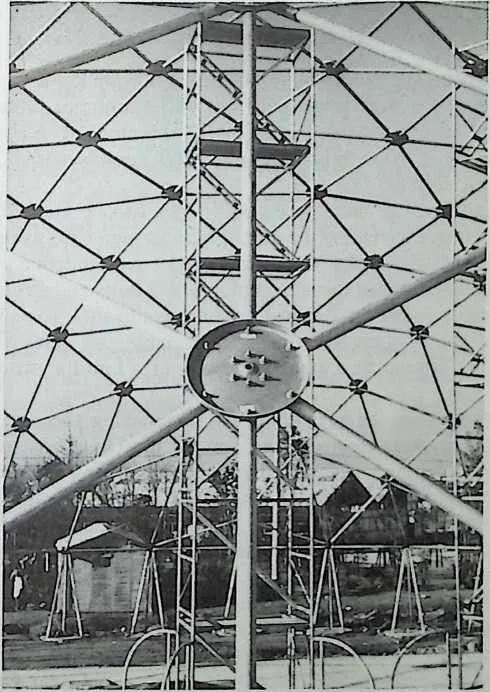
12 Fig. 14-1 The framework of the Afghan geodesic dome being erected.
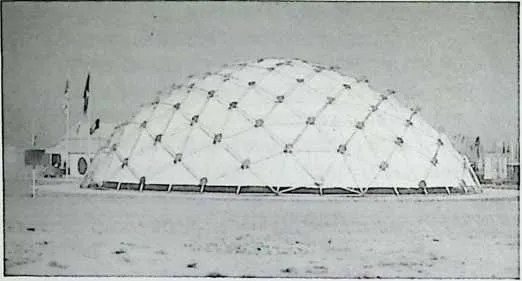
1415Fig. 14-2 The Afghan Trade Fair geodesic dome in place in Kabul.
16 high at the center and provided approximately 8000 square feet of display space. Its framework was fabricated from 480 aluminum tubes, each 3 inches in diameter and weighing a total of 9200 pounds. The actual cover was provided by a nylon skin weighing 1300 pounds which was sus-pended inside the frame.10
17 More significantly, that dome was designed to be erected by inex-perienced personnel, including the untrained workmen who were assigned to the project and who spoke no English. Under the guidance of Fuller’s engineer, those men began fastening color-coded hubs and struts together with no idea as to what the finished product would look like. However, within hours, the workers were quite comfortable and certain that they were, in fact, constructing a gigantic version of a familiar structure, the yurt.11
18 When completed, the huge dome was an amazing success. It was so strong that the workers created a problem for the United States govern-ment officials when they began sliding down the sides of the nylon skin for sport. Other Afghans were so impressed by the structure, that the dome itself was far more popular than the industrial exhibits it housed. It also attracted a much larger crowd than either the Russian or the Chinese exhibitions.12
19 Two Afghans who were particularly impressed by the United States’ giant yurt were the king of Afghanistan, Zahir Shah, and his cousin the prime minister, Lt. General Sardar Mohammad Duad Khan. In fact, those men asked to purchase the dome for their country, but their request was rebuffed by shortsighted United States officials who eventually had the relatively inexpensive dome dismantled and used as an exhibition pavilion in other countries around the World. At the time, the Russian government did provide the Afghan king and his cousin with a uniquely modem gift which advanced Russian influence in that country at a pivotal moment in Afghanistan’s history. Although they could not furnish something as novel as the geodesic dome, the Russians built the first single mile of paved road in Afghanistan, providing Afghan royalty with a small, but impressive, showcase for their growing fleet of automobiles as well as a clearly visible reminder of Russian ‘‘friendship.’’13
20 In 1948, the geodesic dome was far from the amazingly sophisticated structure it would become only a few years later. In fact, it consisted primarily of Bucky’s idea and an enormous pile of calculations he had formulated. Fuller was also developing and studying the geodesic dome using small models that he built and tested in the family’s Long Island apartment.
21 He was, however, eager to expand his understanding through the construction of larger, more practical projects. Thus, when he was invited to participate in the summer institute at the somewhat notorious Black Mountain College in the remote hills of North Carolina near Asheville, Fuller eagerly accepted. He had lectured at that radical institution the previous year and had been so popular that he was asked back for the entire summer of 1948.14
22 At the time, Black Mountain represented a uniquely innovative ex-periment in American education. Founded in 1933 by John Andrew Rice along with a small band of idealistic artists and scholars, the college had evolved into an educational commune where pure democracy had sup-planted the formal educational structure. The school had thrived for sever-al years, as both students and instructors built and inhabited many of the rustic structures which constituted the woodland campus.
23 In 1948, however, the institution was beginning to decline as a result of personality and ideological disagreements. Even so, Black Mountain’s summer institutes continued to attract bold intellectuals who were not afraid to experiment with and examine audacious new ideas, and Bucky fit that mold perfectly.
24 Anne accompanied him to Black Mountain, and although she did not care for its rustic lifestyle, both she and Bucky did enjoy the company of many culturally stimulating fellow instructors who became their friends for life. Their comrades at the college included Willem and Elaine de Kooning, Arthur Penn, Theodore Dreiser, John Cage, and Merce Cunningham.15
25 Because he so respected the wisdom of youth and scorned the tradi-
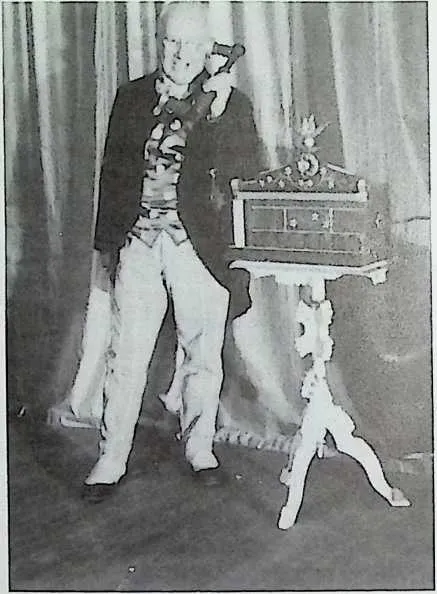
2728Fig. 14-3 Bucky in costume as Baron Medusa.
29 tions of formal education, Fuller loved the cooperative spirit that Black Mountain fostered between college-age students and instructors. He was delighted by the phenomenon of faculty and students’ sharing not only ideas but the everyday experiences of meals and play. He was also happy with the casual attire wom by both students and instructors. While it may be the norm today, at that time, both students and instructors at Black Mountain were often seen wearing a casual daytime uniform of overalls or blue jeans.16
30 Although Fuller’s focus for that summer was his most significant dome project up to that time, many of his fellow faculty members’ most vivid recollection of Bucky was not of his six-hour thinking-out-loud lectures or the large dome he and his students constructed, but of his part in the annual faculty play. The performance was a musical comedy en-
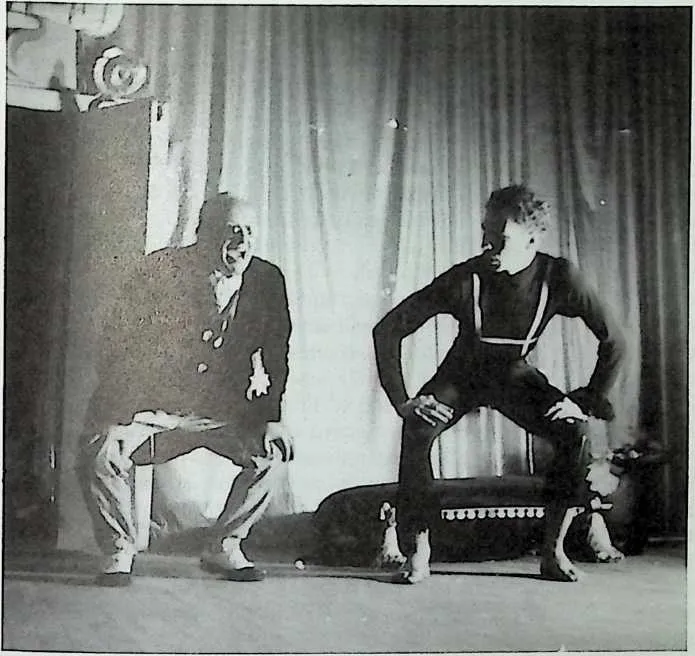
3233Fig. 14-4 Bucky (left) practicing with Merce Cunningham for The Ruse of Medusa.
34 titled The Ruse of Medusa, and somehow Bucky was persuaded to play the comic role of Baron Meduse. Initially, Fuller was disappointingly dull during rehearsals. Formal comedic acting was, after all, a new endeavor into which he had been coerced, and he felt uncomfortable playing a fool in front of a distinguished group of academics. He had quickly memorized his lines and could deliver them verbatim, but his traditional New England heritage and his belief that he should always think for himself impeded any emotion in those lines.17
35 Since Bucky did not feel that he could act and speak lines written by others, the play’s producers, John Cage and Merce Cunningham, called in Arthur Penn to function as ‘‘play doctor’’ and cure the situation. Through a series of conversations with Bucky, Penn was able to devise several improvisations which allowed Fuller to include his spontaneous thoughts in the play.18 When those scenes were included, Bucky blossomed into the joyful comic who had loved participating in impromptu shows at the Hewletts’ home years earlier. As a result of that change, he was magnifi-cent the night of the actual performance. Appearing in shoes with spats, baggy gray flannel pants, an oversized cutaway coat with polka-dot waist-coat, white socks, and a tall white top hat, Bucky personified the buffoon and, once again, demonstrated the childlike innocence which so endeared him to others.19
36 The majority of Fuller’s time and attention at Black Mountain were not, however, spent in such lighthearted buffoonery. When he was not delivering lengthy thinking-out-loud lectures, Bucky’s primary concentra-tion centered on furthering an entirely new form of architecture. In his examination of traditional construction, Fuller had discovered that most buildings focused on right-angle, squared configurations.
37 He understood that early human beings had developed that mode of construction without much thought by simply piling stone upon stone. Such a simplistic system was acceptable for small structures, but when architects continued mindlessly utilizing that same technique for large buildings, major problems arose. The primary issue created by simply stacking materials higher and higher is that taller walls require thicker and thicker base sections to support the upper walls. Some designers did attempt to circumvent that issue by using external buttressing to keep walls from simply crumbling under the weight of upper levels, but even buttressing limited the size.20
38 Fuller found that the compression force (i.e., pushing down) which caused such failure in heavy walls was always balanced by an equal amount of tensional force (i.e., pulling, which in buildings is reflected in the natural tendency of walls to arch outward) in the structure. In fact, he discovered that if the tension and compression are not perfectly balanced in a structure, the building will collapse. He also found that builders were not making use of the tensional forces available. In conventional struc-tures, the tension forces are not functionally employed. Those forces are, instead, relegated to the ground, where solidly built foundations hold the compressional members, be they stones or steel beams, from being thrust outward by tension. Always seeking maximum efficiency, Bucky at-tempted to employ tensional forces in construction. The result was geo-desic structures.21
39 Because Fuller could not afford even the crude mechanical multiplier machines available during the late 1940s and he was working with nothing but an adding machine, his first major dome required two years of calcula-tions. With the help of a young assistant, Donald Richter, Bucky was, however, able to complete those calculations. Thus, he brought most of the material needed to construct the first geodesic dome to Black Mountain in the summer of 1948.22
40 His vision was of a fifty-foot-diameter framework fabricated from lightweight aluminum, and operating on an austere budget, he had pur-chased a load of aluminum-alloy venetian-blind strips which he packed into the car for the trip down to the college. Over the course of that summer, Bucky was also able to procure other materials locally, but he was not completely satisfied with the dome’s constituent elements, which were neither custom-designed for the project nor of the newest materials. Still, with the help of his students, the revolutionary new dome was prepared for what was supposed to be a quick assembly in early Sep-tember, just as the summer session was coming to an end.23
41 The big day was dampened by a pouring rain. Nonetheless, Bucky and his team of assistants scurried around the field which had been chosen as the site of the event preparing the sections of their dome for final assembly while faculty and students stood under umbrellas watching in anticipation from a nearby hillside. When the critical moment arrived, the final bolts were fastened and tension was applied to the structure, causing it to transform from a flat pile of components into the World’s first large geodesic sphere. The spectators cheered, but their cheers lasted only an instant as the fragile dome almost immediately sagged in upon itself and collapsed, ending the project.24
42 Although he must have been disappointed that day, Bucky’s stoic New England character kept him from publicly acknowledging that emo-tion. Instead, he maintained that he had deliberately designed an ex-tremely weak structure in order to determine the critical point at which it would collapse and that he had learned a great deal from the experiment. Certainly, the lessons learned from that episode were valuable, and his somewhat egocentric rationale was by no means a blatant lie. However, had he really been attempting to find the point of destruction, Bucky would have proceeded, as he did in later years, to add weights to the completed framework until it broke down. What had actually happened was something he and Starling Burgess had years earlier agreed no design-er should ever allow to occur.
43 In his haste to test his calculations, Fuller had proceeded without the finances necessary to acquire the best materials.25 Because of the use of substandard components, the dome was doomed to failure, and a demon-stration of the geodesic dome’s practical strength was condemned to wait another year.
44 During that year, Fuller’s reputation as an eccentric genius grew, as did his invitations to lecture and teach about his architectural and design ideas. He was even asked to speak to the Graduate School of Design at his former alma mater, Harvard---from which he had been expelled twice. Bucky’s most significant engagement that year was at the Chicago In-stitute of Design, where he spent a great deal of time working with students to develop his ideas. It was with the assistance of those design students that Bucky built a number of more successful dome models, each of which was more structurally sound than the previous one.26
45 Then, when he was invited to return to Black Mountain College the following summer as dean of the Summer Institute, Fuller suggested that some of his best Chicago Institute design students and their faculty accom-pany him, so that they could demonstrate the true potential of geodesic domes.27
46 As he was now receiving an average fee of $1,000 per lecture, Black Mountain’s salary of a mere $800 for six weeks presented something of a hardship for the Fullers. However, when he assured Anne that he needed to spend the summer at Black Mountain, the financial question was quick-ly tabled. Having earned some substantial fees during the previous year, Bucky was also able to provide the best of materials for his second Black Mountain dome. The project was a fourteen-foot-diameter hemisphere constructed of the finest aluminum aircraft tubing and covered with a vinyl-plastic skin. Completely erected within days after his arrival, that dome remained a stable fixture of the campus throughout the summer. To further prove the efficiency of his design to somewhat skeptical fellow instructors and students, Bucky and eight of his assistants daringly hung from the structure’s framework like children on a playground immediately after its completion.28
47 That summer also resulted in another breakthrough artifact for Fuller. For years, he had been searching for Nature’s coordinate system, which he felt was embodied in the Energetic-Synergetic Geometry (i.e., geome-try dealing with relationships rather than simply forms such as lines) he had begun to formulate during his study of spherical geometry. He had, however, not yet been able to overcome the obstacle of modeling all his mathematical theories.29
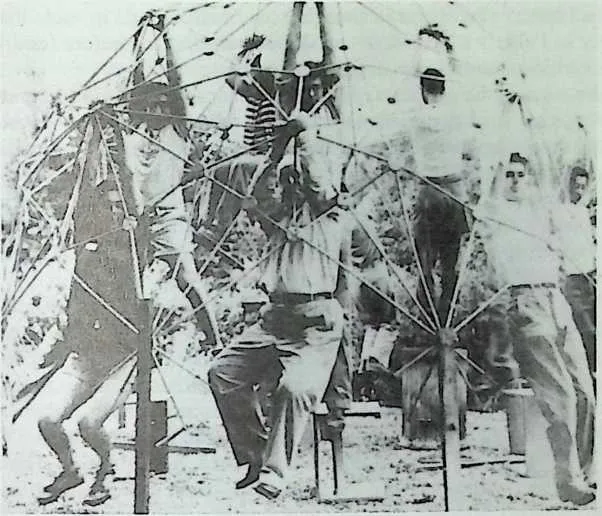
49 ■ig. 14-5 Fuller (center) and his assistants hanging from the Black Mountain geodesic dome ramework to demonstrate its strength.
50 Then, when a young sculpture student named Kenneth Snelson en-tered Bucky’s office one day with a unique new form of sculpture, Fuller could only stop and stare. He immediately knew that he was seeing a physical representation of his idea of employing continually integrated tension in a structure. Snelson’s sculpture was unique because it was built from solid struts connected by thin wires (similar to Fig. 5---2) in such a way that, as if by magic, no strut touched another.30
51 Embodied in Snelson’s work, Bucky recognized many principles of Nature which he had been studying, and Snelson soon became a model builder for Fuller. Although legend has it that Snelson simply created the sculpture in a moment of inspiration, in actuality the unusual configura-tion had been extremely well thought out. Snelson had, in fact, listened closely to Fuller’s Black Mountain discourses the year before, and those ideas had inspired his new design.31
52 Because of the unique way in which tension was totally integrated in that structure, Bucky combined the words tension and integrity to create a new word to describe it: tensegrity. Since they exemplify the properties of the geodesic structures with additional advantages, tensegrity structures would eventually become a primary element of Fuller’s work. Because no strut touches another, any blow striking a tensegrity structure is immedi-ately broken up and transferred throughout the entire framework, and any major damage at the point of contact is thereby inhibited.32
53 Even more amazing to most people who observe tensegrity structures is the way in which the struts, which are usually joined by thin, almost invisible wires, appear to be magically suspended in space. That phe-nomenon occurs because of the continuous tension which flows through the taut wires of the structure and not the compression members (i.e., struts) which provide the strength for most modem construction.33
54 Snelson’s work was admired by everyone that summer. His most amazing piece was a ten-foot-long tensegrity mast which could be held vertically or horizontally without even a quiver in the structure. It could also be twisted out of shape and would miraculously snap back to its original form when released.34
55 As the summer session progressed, Bucky and his concepts became the focus for most students. They found him to be a wellspring of ideas and hope for the future as well as a playful friend. His joyous, youthful attitude is exemplified in the recollection of one student of Bucky waving good-bye to his students with one bare foot out of the back of his open convertible as he drove away from Black Mountain for the last time.35
56 One of the primary reasons Bucky was able to succeed in his produc-tion of a stable geodesic dome during 1949 was the enduring support of the one person who unquestioningly believed in him regardless of the feelings of others. Anne constantly supported Bucky, and in 1949 she again demonstrated her loyalty in a most dramatic fashion. During their many long conversations, Bucky had mentioned that he felt certain he was on the verge of perfecting the geodesic dome, but that, as was usually the case, he was shackled by a lack of finances. At the time, Bucky was earning a good income from lecturing and teaching engagements, but everything not used to sustain his family was funneled into supporting the
57 317 innovative projects of the Fuller Research Institute, the name he had established to work under in 1946.36
58 Even with that concentration of funds and energy, progress in design-ing the dome simply was not rapid enough to satisfy him. Bucky wanted to advance development of the dome much faster, and he calculated that approximately $30,000 in financing was needed to expeditiously elevate the geodesic dome to a new level of sophistication.37
59 When Anne understood the details of her husband’s plight, she re-sponded without hesitation. She had just received another inheritance, and she suggested that she sell the stock she had acquired and ‘‘loan’’ the money to her husband. Thus, Anne sold $30,000 worth of stock in IBM and ‘‘reinvested’’ it in Bucky’s ideas.38
60 Although friends and relatives considered Anne’s action foolish, it paid off handsomely in both a contribution to humanity and helping to generate a sizable income for the Fuller family. With that money, Bucky was able to markedly advance his explorations into geodesics and to establish Geodesics, Inc., a company which supervised all man-ufacturing of and patent royalties from geodesic domes.39 Despite a lack of confidence among the general public, Fuller’s effort was rewarded financially when, within a few years of his inventing the geodesic dome, royalties from it generated most of his yearly income of over $1 million.40 As a direct result of the independence that Anne’s $30,000 investment provided Bucky, he maintained that income for much of the 1950s and continued to sustain an average annual income of at least $200,000 until his death in 1983.
61 Generating that income did not, however, become the focus of his life, and neither did the personal pleasures that such wealth could bring. Bucky indulged his passion for fast foreign cars, speedy sailboats, and providing friends and family with ‘‘needed’’ gifts for no apparent reason, but most of his income was quickly directed into developing the latest project which he felt would most benefit humanity.
62 The first practical large dome was built in 1950 by two of Bucky’s former students working under the auspices of the Canadian Division of Fuller Research. It consisted of a fifty-foot framework constructed in Montreal because the needed aluminum alloys were still under wartime rationing in the United States.41 The next major dome project was a much smaller 1951 model that was specifically designed to endure cold environ-ments, was built for the Arctic Institute, and was used extensively at Baffin Island, Labrador.42
63 During the early 1950s, Bucky also became aware of the commercial viability of his designs and felt that major corporations would soon want to enter the geodesic dome business. Realizing that without substantial protection his invention was vulnerable to being stolen by almost any large, well-financed corporation, Bucky decided to seek patents on the geodesic dome.43
64 His primary motive was, however, unique in that it was not financial. Rather, in his continuing effort to use himself in demonstrating the signifi-cance of individual human beings, Fuller wanted to be certain that his accomplishments as an individual were documented. Obtaining a patent was one reliable method of ensuring that the magnitude of his achieve-ment as an individual would not be swept aside in a wave of large-scale dome-building.44
65 Within years, Bucky’s intuition proved to be correct. Once he had succeeded in practically demonstrating the effectiveness of the geodesic dome, several major corporations attempted to circumvent the patent that he applied for in 1951 and was granted in 1954. Bucky had, however, obtained the services of the brilliant patent attorney who had helped him obtain a patent on the Dymaxion Map years earlier. That man, Donald Robertson, thoroughly understood Fuller’s predicament and produced such a superior patent that years later, when major corporations wanted to build domes, they had no choice but to pay a fee to and to acknowledge Fuller. Appreciating the importance of Robertson’s patent work in documenting the geodesic dome as his invention, Bucky would recount, ‘‘If I had not taken put patents, you would probably never have heard of me.’’45
66 With his impregnable patent, Fuller became the sole source of li-censes for anyone seeking to manufacture geodesic domes. In later years, some people would criticize his use of the patent process as contradicting his commitment to constant work on behalf of all humanity. When di-rectly questioned about that issue, Bucky would explain that he employed patents to document his demonstration of the power of individual human beings as opposed to that of organizations, but that, more importantly, he constantly backed up his words with action.46
67 Although he required large corporations to pay for the use of his geodesic dome patent, which most of them first attempted to circumvent, he never charged individuals who had no capital and were attempting to create new dome companies or simply to explore new dome ideas. When-ever he was approached by an individual with no money and dreams of building geodesic structures, Bucky invariably supported that person’s initiative and creativity by, at minimum, waving the license fee that anyone building domes was required by law to pay him. Generally, those dome builders were youthful idealists with a vision of a new type of society, and they felt, as Fuller did, that the geodesic dome was a key element of that dream. Thus, their work was extremely important to Fuller, and he sometimes went so far as to provide them with some financial aid for their endeavors.47
68 Even before the protection of his geodesic dome patent was granted, Fuller and his invention were elevated to international prominence when the first conspicuous commercial geodesic dome was produced. That structure was erected in 1953 as an answer to a Ford Motor Company problem believed to be insoluble. During 1952, Ford was in the process of preparing for its fiftieth anniversary celebration the following year, and Henry Ford II, grandson of Henry Ford and head of the company, decided he wanted to fulfill one of his grandfather’s dearest wishes as a tribute to the company’s founder. The senior Ford had always loved the round corporate headquarters building known as the Rotunda but had wanted its interior courtyard covered so that the space could be used during inclem-ent Detroit weather.
69 Unfortunately---but fortunately for Bucky---the building was fairly weak. It had originally been constructed to house the Ford exhibition at the Chicago World’s Fair of 1933, but Henry Ford had so loved the building that he had had it disassembled and shipped in pieces to Dear-born, where it was reconstructed. Having been designed as a temporary structure, the fragile Rotunda building could not possibly support the 160-ton weight that Ford’s engineers calculated a conventional steel-frame dome would require.48 Under such pressure, the building’s thin walls would have immediately collapsed.
70 Still, Henry Ford II was a determined person, and he wanted the courtyard covered. Consequently, Ford management and engineers con-tinued searching for an answer until someone suggested calling Buck-minster Fuller. By that time, Fuller’s work was drawing international attention, and although his geodesic dome had yet to be proven effective in an industrial project, desperate Ford officials decided they should at least solicit Bucky’s opinion.49 When he arrived at the Detroit airport, Fuller was greeted by a Ford executive in a large limousine, who treated him like royalty and quickly escorted him to the Rotunda building for an inspection. After a short examination of the ninety-three-foot opening requiring a dome, Ford management asked the critical question: Could Fuller build a dome to cover the courtyard? With no hesitation, Bucky answered that he certainly could, and the first commercial dome began to take shape.50
71 The Ford executives next began to question the specifications of Fuller’s plan. When they asked about weight, he made some calculations and answered that his dome would weigh approximately 8/2 tons, a far cry from their 160-ton estimate. Ford management also requested a cost esti-mate and advised Fuller that because of the upcoming anniversary celebra-tion, the dome had to be completed within the relatively short period of a few months. When Fuller’s price was well below Ford’s budget, and he agreed to construct the dome within the required time frame, he was awarded a contract.51
72 The agreement was signed in January of 1953, and Bucky immedi-ately began working to meet the April deadline.52 The somewhat dis-credited Ford engineers who had failed to develop a practical solution were, however, not at all certain of the obscure inventor’s fantastic claims and begin working on a contingency plan which would prevent further embarrassment. To protect their reputations further, those engineers se-cretly contracted another construction firm to hastily haul away any evi-
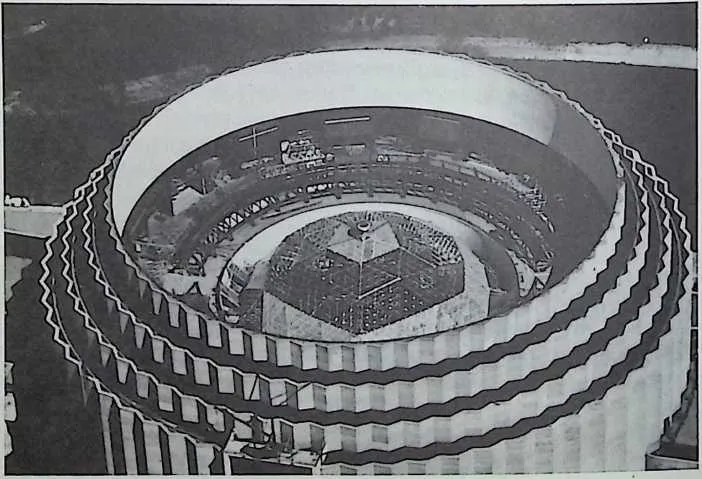
74 Fig. 14-6 The Ford dome under construction above the courtyard of the Rotunda Building.
75 dence of Fuller’s work when he failed.53 The Ford engineers were once again proven wrong when the dome was successfully completed in April, two days ahead of schedule.54
76 Actual construction of the dome was a marvel to behold. Reporters from around the World gathered to witness and recount the architectural effort as well as Ford’s anniversary celebration. Because the courtyard below the dome was to be used for an anniversary television special and business at Ford had to proceed normally, Fuller’s crew was provided with a small working area and instructed to keep disruptions to a minimum.55
77 Ford management was also concerned with the safety of both the dome workers and the people who might wander beneath the construction. They anticipated that problems would arise when Ford employees, televi-sion crews, reporters, and spectators gathered below to observe the con-struction workers climbing high overhead on the treacherous scaffolding, but once again Bucky surprised everyone. Instead of traditional scaffold-ing, he employed a strategy similar to the one he had developed years earlier for the quick assembly of the Dymaxion Deployment Units.56
78 Because the sections of the dome were preconstructed and then sus-pended from a central mast, no dangerous scaffolding was required. The construction team worked from a bridge erected across the top of the Rotunda courtyard. Like the Dymaxion Deployment Units, the Ford dome was then built from the top down while being hoisted higher and rotated each time a section was completed. The dome was assembled from nearly twenty thousand aluminum struts, each about three feet long and weighing only five ounces.57 Those sections were preassembled into octet-truss, equilateral-triangular sections approximately fifteen feet on a side. Since each small segment weighed only about four pounds and could be raised by a single person, no cranes or heavy machinery was required to hoist them to the bridge assembly area.58
79 Once on the working bridge, the identical sections were riveted into place on the outwardly growing framework until it covered the entire courtyard. Upon completion, the entire 8'/2-ton structure remained sus-pended on its mast, hovering slightly above the building itself until the mooring points were prepared. Then, it was gently lowered down onto the Rotunda building structure with no problem.59
80 To complete the project, clear Fiberglas ‘‘windows’’ were installed in the small triangular panels of the dome. Because Fuller had not yet developed or determined the best means of fastening those panels, they would eventually be a primary cause of the destruction of the dome and the building itself. Since it was the first large functional geodesic dome,
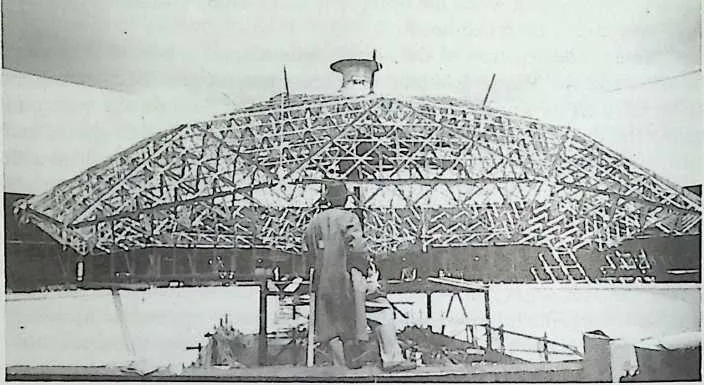
82 Fig. 14-7 The construction bridge used by workers to assemble the Ford dome. Working on the Ford dome as it rests suspended from its central mast high above the courtyard. The bridge on which workers assembled the sections to create the dome from the top down is seen in the foreground.
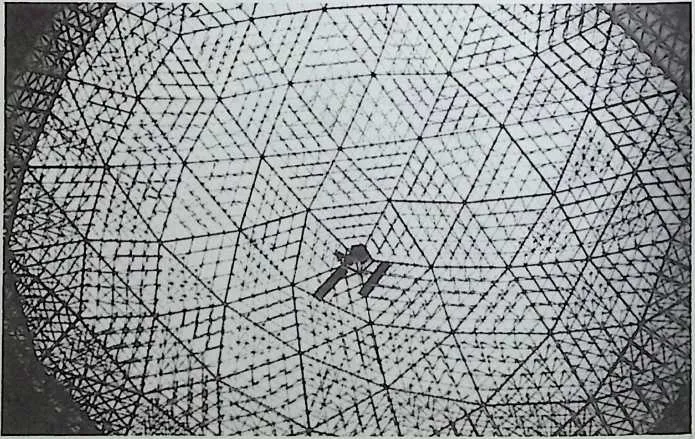
8485Fig. 14-8 Looking up at the Ford dome as it nears completion.
86 many aspects of the Ford dome were experimental. They had been tested in models, but how the dome and the materials utilized would withstand the forces of Michigan winters could be determined only by the test of time. The Rotunda building dome did perform successfully for several years before the elements began taking their toll and leaks between the Fiberglas and the aluminum began to occur. Still, with regular mainte-nance, that problem was not serious, and convening corporate events under the dome became a tradition. One of those events was the annual Ford Christmas gathering.60
87 In 1962, numerous leaks in the dome were noticed as the Christmas season approached, and a maintenance crew was dispatched one cold late-autumn day to repair the problem. The temperature was, however, too cold to permit proper heating of the tar they used for the repairs, and in a common practice, the workers added gasoline to thin the tar. They were warming the tar with a blowtorch when that potent mixture ignited during the repair process, and the building quickly caught fire. As the building had never been planned as a permanent structure, it was not long before the entire Rotunda was engulfed in flames which destroyed the first com-mercial geodesic dome, the singular structure that, more than any other, had catapulted Fuller to public fame.61
88 Following the Ford dome success, Bucky was flooded with offers. Chief among those invitations were requests to speak and teach at institu-tions where students and professors alike were hungry to learn about the amazing geodesic dome and the man who invented it.62 Although he attempted to satisfy as many of those requests as possible, Bucky’s pri-mary focus remained on further developing and learning about geodesics. Despite the fact that most of the projects which followed the Ford dome were for paying customers, they usually served to allow him to further his research while also solving his clients’ problems. During those times, Fuller experimented with materials such as plastics and plywood and even developed a practical dome made of paperboard.63
89 Although those first paperboard domes tended to wilt in wet environ-ments, Bucky felt that in the near future such structures could be coated with a layer of plastic which would support them in providing extremely efficient, inexpensive, yet comfortable housing. He so believed in the material that he designed and produced a series of paperboard domes which became even more efficient when he began printing assembly instructions directly on the sections as they rolled through the papermak-ing machinery.64
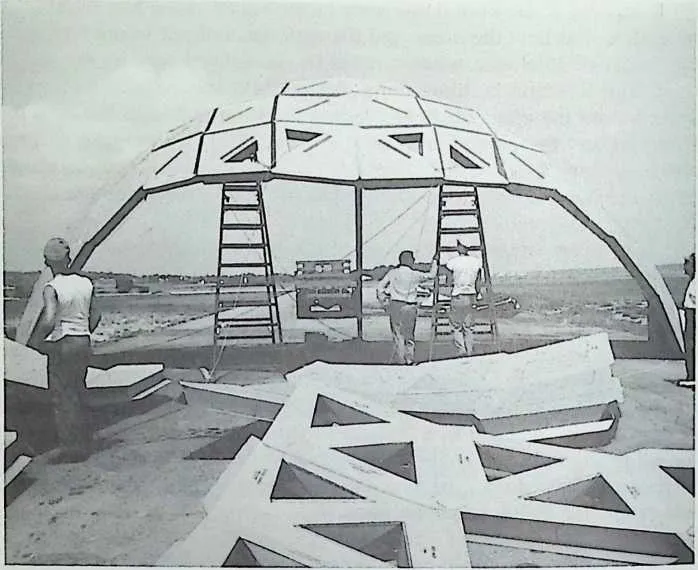
9192Fig. 14-9 A paperboard geodesic dome being erected.
93 Another unique dome designed by Fuller was the 1953 pneumatic model for use in extremely cold climates. That dome was constructed of two layers of strong vinyl skin quilted together to form a number of distinct sections which were filled with air to erect the dome. That innova-tion not only provided an insulating layer between the occupants and the outdoors, but because it eliminated a rigid framework, it also made the dome extremely portable and durable. The pneumatic dome was then successfully employed in scientific expeditions where people and equip-ment were airlifted to and lived upon the ice floes near the North Pole for weeks at a time.65
94 Fuller’s next major dome projects were the result of a rather strange alliance. Although he had supported the United States’ actions in both world wars, Bucky was a man of peace who truly believed that war would become obsolete in the near future when adequate resources to support all
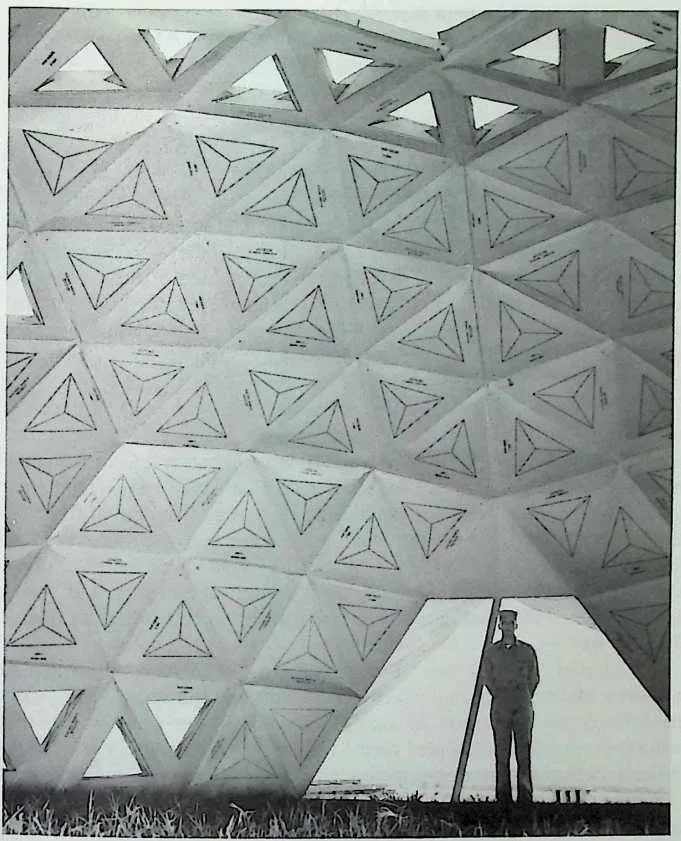
9697Fig. 14-10 The interior of the paperboard geodesic dome.
98 humanity were available. Still, he responded to almost anything presented to him which could be used to support the success of humanity. Hence, when the United States Marine Corps approached him for assistance, he viewed their request as simply another opportunity to test the practical application of principles and accepted the invitation. That association was
99 extremely beneficial to both partners, providing the marines with unique solutions to difficult problems of shelter and Bucky with testing oppor-tunities and income. Thus, the United States Marine Corps quickly be-came one of Bucky’s largest dome clients as well as his ally, providing resources and support for several new types of domes.66
100 The Defense Department was also generous in asserting its enormous purchasing power in support of Bucky’s protecting his patent against the large corporations which were attempting to circumvent his rights as an inventor. Whenever such a challenge occurred, Defense Department offi-cials simply informed the problem corporation that they would seriously consider stopping purchase of that company’s products if Fuller was not completely acknowledged and financially compensated for his dome pa-tent. That tactic, in conjunction with the extremely strong patent, proved successful in every instance and helped Bucky to remain involved in nearly every significant dome erected during the 1950s and 1960s.67
101 Fuller’s initial association with the marines was the consequence of yet another apparently unsolvable problem. For several years, the Marine Corps had sought a rapidly assemblable, lightweight structure which could be delivered by air and used for sheltering first-strike troops and their equipment at remote sites. The corps had invested a great deal of time and money in attempting to develop such a structure but had discovered no practical solutions until a Marine Corps officer read about the Ford dome and contacted Fuller. Within weeks, a working relationship was estab-lished, and in 1954, that association resulted in the fulfillment of one of Bucky’s fondest dreams.68
102 In January of that year, Bucky was invited to North Carolina to witness a Marine Corps helicopter easily airlift and transport a thirty-foot geodesic dome at a speed of nearly sixty knots. On January 29, that historic event was documented on the front page of The New York Times. Fuller’s 1927 vision of preassembled, air-deliverable homes and buildings had been proven practical, and although the idea had yet to be marketed commercially, the visionary Fuller realized that he had laid the ground-work for that potentiality.69
103 The United States Defense Department was also the client whose need resulted in the single most prolific large geodesic dome. Once again, that dome was developed from Fuller’s solving a problem believed to be unsol vable.
104 During the early 1950s, the Cold War politics between the United States and Russia elevated long-range missiles into a primary topic of concern for the American people. To protect the country from missiles routed over the North Polar regions, the United States Air Force proposed constructing an early-warning system across the far reaches of northern Canada. Approved by Congress, that system became known as the Distant Early Warning or DEW Line. It was to stretch for forty-five hundred miles along a route through the harsh regions of northern Canada just above the Arctic Circle.
105 In those days, when the total devastation of nuclear weapons was not
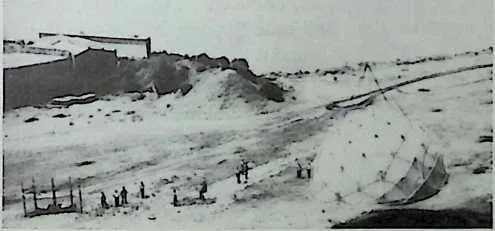
107108Fig. 14-11 A marine helicopter airlifting a geodesic dome.
109 understood, the air force plan was welcomed by concerned citizens, who felt it would provide a useful fifteen or twenty minutes’ warning of a surprise nuclear attack. Once the plan was accepted, the primary impedi-ment was not financial, but one of discovering a method for protecting delicate radar installations from the fierce Arctic environment without impairing their signals, as was the problem with metal structures. The protective structure also had to be lightweight, air-deliverable, and quick-ly erected in order to provide efficient protection in the hostile envi-ronment.
110 The air force had engaged a group of prominent MIT-based scientists and engineers to work on the problem, and their initial solution was a pneumatic, igloo-like vinyl structure which maintained its shape through compressed air. That idea did not, however, fare well in practical tests when hurricane-force Arctic winds quickly sucked the pressurized air out of the structure, causing its collapse.70
111 After considering other unsuccessful alternatives, the scientists began contemplating the merits of a possibility which had confronted many of them on a regular basis for years. Fuller had been lecturing and teaching at MIT since 1948, and with the assistance of students, he was continually erecting geodesic dome models around campus. In fact, he sometimes put up his structures in hallways and stairwells just to entice skeptical faculty and students into examining and experiencing the potential of geodesics and tensegrity.71
112 Yet, despite his enormous commercial success, Fuller and his ideas remained on the fringe of academic acceptability, and professors, who simply did not understand his newly discovered methods of construction, were not about to embrace or acknowledge the potential inherent in Bucky’s work. Fuller himself was not surprised by that reaction because it was similar to what he had experienced thirty years earlier when he attempted to implement the Stockade System of construction.
113 Then, as in 1954, he had found that engineers and others who worked within the limits of a prescribed set of rules and definitions were generally unwilling to stretch their imaginations in considering possibilities which they had not been taught during their formal training. With such a mind-set, those individuals would certainly not consider the possibility that something as peculiar as the geodesic dome or someone as eccentric as Buckminster Fuller would have a potential solution to a major defense problem.72
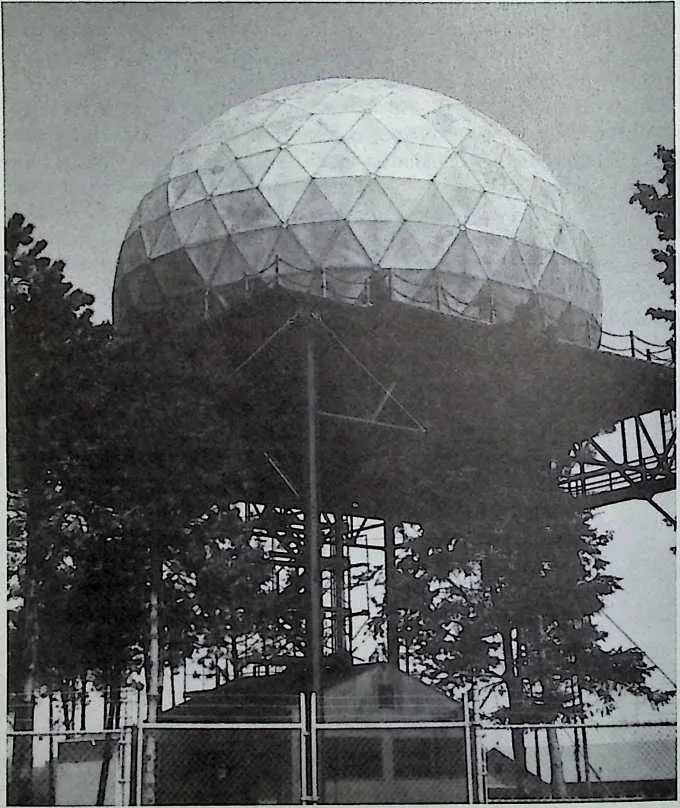
114 Still, the MIT scientists and engineers were confronted with a dead-line and no practical solutions. Consequently, they solicited Fuller’s opin-ion and were impressed enough to request his submission of a formal proposal. As usual, Bucky’s response was predicated upon the most mod-em ideas and materials. He proposed an almost spherical geodesic dome with both struts and skin fabricated from Fiberglas which later became known as a radome because it was designed to house radar.73
115 The radome was unique in that its skin and struts were fabricated in one-piece, triangular panels which were then easily assembled into the finished product. Although that structure became commonplace at air-ports, military installations, and other locations where radar is used, it was initially rejected by the scientists and engineers who felt it could not possibly withstand the harsh Arctic environment.74
116 Confident of his work, Bucky simply suggested testing a prototype, and that same year, a thirty-foot radome was built for experimentation. The skeptical scientists decided to first determine just how much pressure the dome could withstand before it crumbled, and because Mount Wash-ington in northern New Hampshire was known to have some of the stron-gest constant winds in North America, they selected it as the test site.75 Since other test structures erected on that mountain had customarily been destroyed within a matter of minutes, the scientists were ready with stop-watches to record the exact number of seconds the dome survived. They
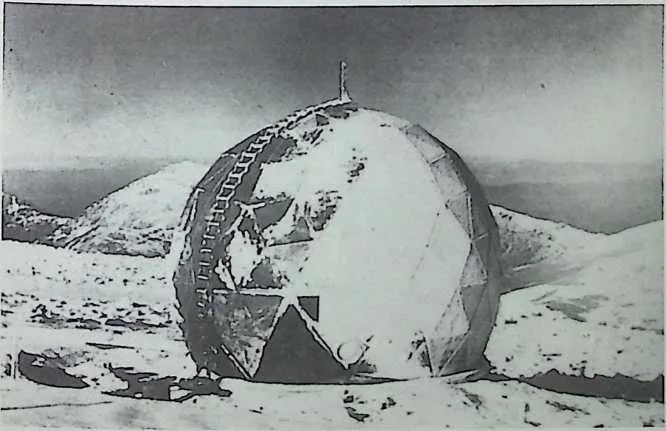
118119Fig. 14-12 A radome being tested on Mount Washington.
120 were, however, shocked to discover the radome standing several hours later, undamaged by nearly two-hundred-mile-per-hour winds.76
121 In fact, that dome remained on Mount Washington, oblivious of the strong winds, ice, snow, and cold, for nearly two years, until it was finally removed by the scientists. During the initial phases of their testing,
123 Fig. 14-13 A standard radome protecting a radar installation.
124 the scientists also learned that the geodesic dome’s shape was even more beneficial than expected, naturally shedding both ice and snow.77
125 Still, they were determined to discover exactly how much pressure a radome could withstand before it collapsed, and they devised a more rigorous test in which the center of a radome was connected by sturdy cables to a massive steel hook embedded in a gigantic cement piling buried deep in the Earth. A gauge to measure strain was installed along the cables, and increasing tension was applied in an effort to pull the dome down. A great deal of pressure was applied, but the steel hook was yanked out of the cement block before the dome collapsed. Even when more durable equipment was installed, the testing apparatus always gave out before the dome could be destroyed. Consequently, the radome’s ultimate strength was never measured.78
126 Following those tests, it was obvious that a radome could withstand any of the natural Arctic forces while permitting radar signals to pass through. Hence, production began in earnest, and since he received royal-ties from each of the thousands of radomes installed over the next few years, that single project greatly contributed to Fuller’s income, which skyrocketed to an annual sum of over $1 million during the early 1950s.79
127 Although the majority of that income was simply recycled to finance Bucky’s newest experimental projects, some did go to support his love of the best that society had to offer, including fine hotel rooms when he traveled, dining at the best restaurants, and the needs of his family and friends. Since the Fuller’s had only one living child, Allegra’s welfare was a constant focus for both Bucky and Anne.
128 Thus, when she decided to seek additional formal education at Ben-nington College after working with George Balanchine’s dance company, her parents supported her decision. Bucky was particularly pleased with Allegra’s choice of Bennington because of its somewhat controversial program, which encouraged students to spend a portion of their college career outside the formalized setting and to learn from practical experi-ence and the ‘‘real world.’’80
129 Allegra decided to devote some of her ‘‘out period’’ to a job at the International Film Foundation, where she could augment her love of dance theater with an understanding of a medium that could document dance. It was while working in the film industry that Allegra demonstrated the famous Fuller rebelliousness when, in an act similar to her mother’s decades earlier, she fell in love with and decided to marry a young director named Robert Snyder.81
130 Just as the impoverished Bucky had initially experienced rejection from Anne’s older aristocratic relatives, Allegra’s marriage to the Jewish ‘‘Hollywood movie type’’ was not greeted with great jubilation by her family.82 This was especially true of the sophisticated Anne, who, al-though claiming not to be anti-Semitic, had been raised in what had been the extremely anti-Semitic community of Lawrence, Long Island.83
131 The actual reason for the family’s initial rebuff of Snyder was, most likely, not his religion but his profession. To the traditional New England Fullers and Hewletts, Bob Snyder was simply one of those fast-lane Hollywood people who did not fit into their cultured existence and could certainly not maintain the lifelong, family-oriented marriage that members of their society were expected to perpetuate. Despite such objections, Allegra, like Anne and Bucky, made her own decision and married Snyder on June 30, 1951, with her father’s approval and her mother’s rather reluctant consent.84 Years later, the family members were all pleased to find themselves wrong about Snyder, as he and Allegra re-mained married and raised two children.
132 The first of those two children and Bucky’s first grandchild was Alexandra Fuller Snyder, born November 1, 1953. Two years later, on April 28, 1955, his only grandson, Jaime Lawrence Snyder, was bom. Coincidentally, two years after that birth, the Fuller artifact which may well be the most influential on young children’s lives began commercial production, just in time for use by Bucky’s own grandchildren. In 1957, small geodesic playdomes began making their way onto playgrounds around the World, providing children with opportunities to experience and enjoy the natural structure of a geodesic framework at an early age.