
16 World-Game Abundance
2©Although Fuller had devoted a sizable portion of his life to the examination of global resources including energy input and output, during the 1960s that issue became much more per-sonal. Having always maintained a vigorous lifestyle, he sud-denly noticed his level of energy decreasing and decided to see if anything could be done about that change.1
3 It was then that Bucky seriously considered his own body. The fairly affluent financial status he had attained since inventing the geodesic dome had contributed to his reaching a weight of nearly two hundred pounds, far too heavy for someone five feet six inches tall. Logically examining the situation, Bucky decided that either old age or his weight was slowing him down, and that if the problem was weight, he could still do something about it.2 With typical Fuller scientific exactness, he examined the issue of food and energy as it applied directly to himself and his weight and determined the most efficient method of losing weight while still meeting his energy needs. Bucky resolved that since the majority of the energy utilized on Earth originated from the Sun, he should attempt to acquire the most highly concentrated solar energy available to him as food.3
4 He understood that solar energy is transformed into vegetation through photosynthesis, and that animals, including humans, consume that vegetation to acquire the energy. Always seeking the most effective means of operation, Bucky decided that he would follow the process one-step further, resolving that he would be most effective if he ate more beef because cattle had eaten the vegetation and transformed solar energy into a more protein-concentrated food.4 Hence, he began adhering to a regular diet of beef even though that diet often caused consternation among many of the holistic, health-oriented individuals to whom he regularly spoke during the balance of his life.5
5 To those who would question his regimen of approximately one pound of steak at breakfast, lunch, and dinner, he would explain his rationale that lean beef provided maximum energy with a minimum of calories. The personal results Bucky attained by following that diet were difficult to dispute. When he began eating primarily thin strips of London broil augmented with salad and fruit three times a day, his weight dropped back down to 140 pounds, identical to when he was in his early twenties. He also found that his energy level increased dramatically.6
6 Contrary to one popular legend, Bucky’s diet was not restricted to beef and jello three times per day. Even though he tended to eat beef regularly from the mid-1960s on, he retained his spirit of experimentation and was willing to test almost any diet recommended to him.7 Still, he continued using whatever worked best, and the beef concentration proved most successful at maintaining his maximum energy and healthy weight.
7 Although he did apply his insights into resource management and distribution to his personal eating habits, Bucky’s primary use of such information was global. He had studied history in great depth, searching for the reason most humans operated from a context of scarcity rather than the true abundance which he perceived humanity was about to reach during the end of the 1960s.
8 In his examination, Fuller looked back as far as sufficient written records were available and found a pattern emerging from that period eight thousand years ago in Egypt. At that time, the average life span was twenty-one years, and leaders came into power during what we now call adolescence. One factor which contributed to the short life was the limited amount of life-supporting resources such as food, medicine, and even shelter. Average people were taught, and quickly believed, that life on Earth was simply a qualifying test for the great afterlife, where resources were abundant and the suffering they were enduring on Earth did not exist.8
9 One person who did not suffer in ancient Egypt was the pharaoh. As most people know, pharaohs were worshiped as gods or, at least, indi-viduals who had direct access to God. They were therefore provided with a lifestyle far superior to that of ordinary citizens. Pharaohs were endowed with the finest goods available in the hope that they would use their godly influence to provide better lives for the ordinary citizens over whom they ruled.9
10 Among the common people’s greatest hopes was that their beloved pharaoh could reach ‘‘the other side’’ following death so that he could take other citizens of Egypt with him to the land of plenty following then-deaths. Fuller found that the people of that era were told that in order to make the journey and organize things for them on the other side, their pharaoh needed many tools and resources. Consequently, the people built enormously fortified stone pyramids to protect the pharaoh and his re-quired resources from vandals after death.10
11 Because such monuments required massive amounts of resources and took years to complete, the pharaoh or his father (because the job often required an entire lifetime) would select the kingdom’s most inventive individual to design and oversee the project. Such a man might have become the Leonardo da Vinci of the time, but he frequently went un-noticed in history because all his talents were concentrated upon the single structure.11
12 Fuller found that those designer-planners had uncovered generalized principles such as leverage, which they applied to create greater efficiency throughout the project. They also tended to be aware of the poverty and the squalid living conditions which were devastating their workers and hampering the project.12
13 Fuller speculated that one such designer might have noticed that the banks of the Nile were lush with crops while only a short distance inland, his workers were dying of starvation. Again employing principles that would support the construction, that designer may have instructed some of his laborers to build irrigation ditches which soon resulted in a larger food supply, better fed workers, and hence, more efficient construction.13 What most people of the era may not have realized was that such innova-tion was the result of increased knowledge and was actually creating a better life on Earth for an increasing number of people prior to their crossing over to the afterlife.
14 If everything went according to plan, the pyramid was completed prior to the pharaoh’s death, and when that event occurred, the ‘‘lucky’’ designer-planner was executed and buried in that pyramid as a reward for doing an outstanding job. Supposedly, that burial was a great honor which quickly allowed him to reach the other side with the pharaoh. The problem with the Egyptian system was that each successive pharaoh required a lavish burial site, and a new, innovative designer-planner had to be found in every generation. Even though the previous designer had been buried, because the Egyptians had developed written records, a new designer could utilize his predecessors’ ideas. The effect of such constant innova-tion and the accumulation of knowledge was a new order in which re-sources were plentiful enough to permit the similar grand burial of high-ranking nobles, ensuring their reaching the afterlife. Bucky felt that that innovation marked the beginning of the Second Dynasty in Egypt as well as a significant shift in the development of humanity. In the ensuing years, the increasingly effective use of resources provided even more individuals with the splendid regal burials that ensured their entering the glorious afterlife.14
15 In nearly every society, Fuller found a similar belief that the suffer-ing of this life was a test for a magnificent afterlife and its abundance. He also discovered that because of increasing knowledge, each successive generation of humans was usually able to do more with fewer resources. In addition to more people’s being supported at higher standards of living, more individuals were also able to be fittingly prepared for the advantages of that afterlife.15
16 Bucky felt that the next great societal metamorphose in his the-oretical scenario occurred among the ancient Greeks and Romans who discovered that they had enough resources and knowledge to prepare their ruler and nobles as well as all the rich middle-class citizens for the after-life. During that period, huge numbers of slaves were used to construct large mausoleums for the wealthy middle class and the nobles.16
17 As knowledge compounded exponentially from one generation to the next, religious organizations, which had always been closely associated with government but had sought to maintain the greatest domination over individuals, split from government. They did, however, retain the power to determine who would be allowed into the glorious afterlife. During that period, prophets such as Buddha, Muhammad, and Christ began preach-ing a new concept: the ability of all people to reach the glorious afterlife if they followed a particular religion’s tenets. That idea was known as redemption, but in Fuller’s view it was nothing new or unusual. Rather, redemption was simply another demonstration that humanity’s knowledge was increasing and was providing the opportunity to do more with fewer resources. Proponents of redemption asserted that humanity had attained a level of development which provided the opportunity for everyone to reach the afterlife. Life on Earth remained a struggle for most people, but they could look forward to the afterlife if they followed the dictates of the church and its leaders.17
18 Following that transformation, organized religions began erecting enormous buildings for worship, in which average people could prepare themselves for the afterlife. They also coerced worshipers to bring re-sources to those houses of worship in support of the formalized church. The primary reason people were able to provide the church with resources was not some divine miracle but humanity’s continuing increase in knowl-edge, which allowed people to do more with less. Specifically, farmers had learned how to use simple tools and domesticated animals to expand the acreage they could cultivate, while craftspeople were inventing other tools which supported them in turning out more products.18
19 The concept of redemption signaled that the increase of production through expanding knowledge had reached a level at which the afterlife of everyone was ensured, and humanity’s focus shifted toward daily life on Earth. The plight of many people had improved over the centuries, but the majority continued to subsist on meager rations. In fact, even kings and nobility sometimes had to go without because of a poor harvest or a raid by a neighboring kingdom.19
20 Still, with the renewed focus on earthly existence, the first to be guaranteed life-supporting resources were monarchs. That privilege came to be known as the divine right of kings. Later, during the period when the Magna Carta was written, human efficiency in providing life support had increased so that sovereigns and nobility could be guaranteed sustenance. And, during the Victorian period, knowledge and production had com-pounded to such an extent that the physical needs of even a small but growing middle class could be ensured.20
21 The Victorian era brought Fuller’s brief explanation of historical perspective up to the time of his birth, and from that point on he relied on his personal experience as well as on what he learned from books to understand the changes of history. Bucky had seen that the innovations of modem technology had radically transformed his surroundings very quickly. He read and appreciated the ideas of industrial leaders like Henry Ford, who believed that mass-production technology would provide ade-quate means for supporting everyone on Earth.21 As a youth Bucky had witnessed the change that such technology had generated. He could recall neighborhood artisans painstakingly manufacturing goods such as fur-niture and clothing one piece at a time.22
22 He also remembered that because of the limited production, those goods were expensive and generally available only to the rich. There simply were not enough craftspeople to satisfy the needs of a rapidly growing New England population, even though that population was far less dense than that of the rest of the World. Bucky witnessed mass production dramatically alter that situation. The transition did not, how-ever, eliminate the need for craftspeople. In addition to maintaining the small-scale production of a limited number of products, many of them embraced the emerging new field of industrial technology. They con-tinued to support the tradition of expanding upon the knowledge of the past by becoming the designers and fabricators of the machine tools which were the mainstay of modem technological innovation.23
23 While studying traditional economic theories, Fuller also stumbled upon the philosophy of the sole person who he felt was used more than any other to justify the conditions of starvation and poverty from which major segments of society suffered while others lived in relative abun-dance. That man was the British economist Thomas Malthus, who lived during the late eighteenth and early nineteenth centuries, the height of the British Empire’s dominance of the sea and much of the Earth’s land-mass.24
24 Malthus was an economist and a professor at the East India Company College just outside London, the one institution charged with educating all the civil servants managing the British Empire’s global holdings. The East India Company College also became the sole repository for global infor-mation gathered by British citizens and civil servants around the World. His access to such a multitude of data made Malthus the first person to study a comprehensively complete inventory of the World’s vital and economic statistics.25 Using that data, in 1798 he wrote the classic work An Essay on the Principle of Population, which he revised in 1803. Those elaborate dissertations documented the fact that the human population was increasing far more rapidly than the relatively scarce production of life-supporting goods and services. From that data Malthus concluded that the scarcity of goods that people experienced would increase unless some-thing was done to curb the rising population.
25 Fuller found that, over the years, Malthus’s conclusions had become widely accepted and had been combined with the theory of evolution proposed by the famous British scientist Charles Darwin during the mid-nineteenth century. Darwin’s hypothesis was popularly reduced to ‘‘sur-vival of the fittest,’’ and when coupled with Malthus’s documentation of the increasing scarcity of resources and the expanding of population, it supported escalating competition for resources among rival sectors of the human population. The most evident such competition was among eco-nomic systems, principally socialism versus capitalism.26
26 Malthus had not, however, considered the synergistic consequences of combining new knowledge with resources. Still, because of his unique access to information, in the ensuing years most educated people con-tinued to utilize Malthus’s pessimistic perspective and ideas as a founda-tion for future predictions.27
27 Fuller recognized the flaw in that logic and argued that Malthus’s basic premise was incorrect. He believed, and later documented, that the ever-increasing technology which Malthus could not even imagine, much less utilize in his predictions, was creating an entirely new environment capable of supporting all humanity.28 Like Malthus’s ideas, Fuller’s theo-ry was also predicated on global resource information. However, Bucky’s information was far more comprehensive and clearly indicated that hu-manity’s constant addition of new knowledge to physical resources was producing a set of circumstances never before seen in recorded history. Such new knowledge would permit every individual and industry to do much more with the same resources and would consequently enable more people to be supported.29
28 Bucky clearly documented that the rate at which technology was increasing life-supporting production was much greater than the rate of population increase. Using the global resource inventory he had accumu-lated, Fuller also predicted that in 1970 humanity would reach a level at which every human being could be adequately supported while using only the resources available on Earth, if humanity shifted to concentrating on the production of life support rather than destructive weaponry.30
29 Fuller’s accumulation of data began in 1917 during his naval career. While reexamining his life in 1927, he christened his collection of infor-mation the ‘‘Inventory of World Resources, Human Trends and Needs.’’ Bucky’s mid-1930s work also helped support his insight into global re-sources. Working for Phelps Dodge Corporation from 1936 through 1938, he was required to create a comprehensive study of global resources and industrial trends in order to identify how Phelps Dodge’s primary product, copper, fitted into those trends.31
30 His position at Phelps Dodge provided Bucky with access to the most complete private and public economic records ever available. Realizing the significance of his economic insight and research, Fortune magazine requested Fuller’s assistance in compiling its tenth-anniversary issue for publication in February of 1940. Bucky accepted that invitation, and with the help of a staff specially hired for him by Fortune, he greatly increased his resource data and helped produce an issue which focused on the subject he suggested: a comprehensive inventory and comparative data study of World resources versus United States resources.32
31 That issue was one of the most successful in the history of Fortune, requiring three separate printings. In fact, Henry Luce, then chairman of the board of Fortune’s parent company TIME, Inc., later announced that the resource issue had produced a profit for the magazine and had moved it out of its habitual deficit situation.33
32 Following publication of that issue, Fuller accepted a position with the Board of Economic Warfare and later worked on production of the Dymaxion House. It was while working on the Dymaxion House in 1945 that he was again contacted by Fortune’s management concerning the data he and his staff had compiled earlier. In 1945, Fortune was transferring its operation to a new building and wanted to reduce its archive. Conse-quently, the magazine’s management offered Fuller all the resource files he and his staff had accumulated for the 1940 issue. With that acquisition, Bucky’s personal resource inventory became one of the most comprehen-sive in the World.34
33 Because he continued to update his information, Fuller was able to maintain an accurate accounting of global resources long before most people were even interested in issues such as starvation in Africa, the pollution of the environment, or the housing of the homeless. He was also able to utilize that data in determining past and future economic trends.
34 Fuller’s theories concerning economics were as sophisticated as his ideas on other topics, and they adhere to his belief that individuals rather than organizations possess the ultimate power to influence the develop-ment of humanity. He felt that, like all human beings, the people involved in the business community would be far more successful if they concen-trated on cooperation rather than competition and worked on projects which would be of long-term benefit to the most people rather than focus-ing upon short-term financial gains for a small number of shareholders.35 As a result of his accumulated data and experience, in the late 1940s Bucky began discussing a fictitious corporation which illustrated his fun-damental feelings about most business ventures. The hypothetical com-pany, Obnoxico, was first publicly mentioned in a 1947 response to a comment that he was not trying to earn a living because he was incapable of doing so. Always willing to respond to a challenge, Fuller replied that he was clever enough to make vast amounts of money in only a year with his mock company Obnoxico. He explained that Obnoxico would have only one function: to make money by exploiting the most sentimental weaknesses of humanity.36
35 To emphasize the direction he perceived the majority of businesses moving in in their quest for increasing profits, at a time long before items such as pet rocks and lava lamps became popular fads, Bucky mockingly proposed his own fad item. The primary product of his fictitious Obnoxico company required that on the last day a baby wore a diaper, parents carefully remove it from the child, repin it empty, and stuff it full of tissue paper to match the baby’s shape. The molded diaper was then to be packed and sent to Obnoxico, where it would be gold-or silverplated before being returned to the parents, who would fill the shiny, rigid diaper with fems and hang it from the rear window of their car.37
36 Once Bucky had announced his ludicrous product, many of his friends joined in and began suggesting other apparently ridiculous items. They also began sending him advertisements for new products whose primary or sole reason for existence seemed to be making money. Among the items he received notice of were plastic pebbles for the garden and the newly emerging plastic flowers.38
37 Bucky carried his scenario one step further and, only then, began to appreciate just how easily money could be made if one was willing to exploit the emotions and greed of fellow human beings. When he sug-gested that Obnoxico was considering opening stores to sell such items and that in exchange for contributing products, he would provide indi-viduals with shares of stock in the company, the entire joke quickly got out of hand. Once people sensed the possibility of making money from such an endeavor, greed and competition set in. He was besieged by new ideas, and it was clear that a majority of people who had learned of the impending next phase seriously wanted to participate in the corporate venture. At that point, he could easily have issued stock and made a fortune with what had begun as a simple joke.39
38 Fuller, however, had more important things to do with his time, and he continued to live by his assertion that an individual can ‘‘make money or make sense, the two are mutually exclusive.’ ’40 That statement has often been misinterpreted. Fuller did not feel that people should not make money. Rather, he believed that individuals should concentrate on pro-jects which made sense, and that both the people and the projects would then be supported financially. Thus, he continued to select projects which made sense to him, and in the process, he and his family were supported.
39 Bucky did, nonetheless, witness the rise of the Obnoxico stores he had proposed in the late 1940s. ‘‘Gift shops’’ filled with items that have little or no inherent value to society but a great deal of appeal to the emotions of a susceptible public have proliferated in shopping malls throughout the United States and are now spreading worldwide. Their primary purpose, like that of their merchandise, is to make money. Bucky was not opposed to the enjoyment of gifts and greeting cards. However, he did feel that an economy which wastes a sizable percentage of its production capacity on items such as toilet seats with dollar bills embed-ded in plastic or a multitude of stuffed animals while thousands of humans beings starve to death daily or live without adequate shelter does not yet possess the comprehensive perspective required for the success and sur-vival of humanity as a global species and is not supporting the true func-tion of humans on Earth.
40 Obnoxico was an extreme example of the waste which can occur when profits become the primary motive for action. Fuller was not op-posed to the institutions of organized commerce. He simply felt that the primary function of business and industry should be supporting the wel-fare of humanity and all life.41
41 He also believed that the large multinational corporations which emerged during the 1970s represented a significant hope for the expanded success of humanity. Because of his comprehensive perception, Fuller was cognizant that major companies which had established themselves in specific countries were quickly surmounting national boundaries to do business wherever they chose. He observed that those large corporations instantly communicated between locations in all nations and were not confined by obstacles such as visas, passports, or borders, as is true for individual human beings.42
42 Because of the global freedom they enjoyed, Fuller concluded that large corporations might well be unknowingly laying the groundwork for the future success of humanity. He expected a form of corporate global networks to come to the forefront of public attention and need at some time in the future when only such a comprehensive system, which was already in place, could solve seemingly out-of-control worldwide prob-lems such as pollution, the efficient allocation of resources, or energy requirements.43
43 In such an ‘‘emergence-by-emergency’’ scenario, large corporations might rapidly provide the efficient global solutions which would be possi-ble only within the context of a comprehensive worldwide awareness and operating strategy. However, before that could occur, the primary moti-vation of such corporations would have to shift from profits and toward the more comprehensive considerations which continually stirred Fuller to action.
44 Although the comprehensivist Fuller was always working on a multi-tude of projects at any one time, he tended to focus his work in specific areas for particular periods of time. The era of intensive geodesic dome exploration and invention which began in 1947 concluded in 1967 with the Montreal Expo dome.
45 At that time, much of Fuller’s attention shifted to creating a similar summary resolution for the enormous amount of work, insight, and infor-mation he had accumulated concerning global resources and energy. He was particularly interested in creating a conspicuous public presentation of global resources prior to 1970, the year he felt humanity would be able to do so much more with fewer resources that we could adequately support everyone living on Earth. He named that presentation ‘‘World Game’’ in contradistinction to the ‘‘war games’’ which military leaders had been playing out for centuries. Bucky himself had personally experienced the strategies of war games in great depth while serving in the U.S. Navy during World War I as well as while working on the Board of Economic Warfare during World War II.44
46 He had witnessed the massive amount of time and resources that military and government leaders devoted to destroying other human beings and their property, and he felt that, in the approaching era of abundance, a similar concentration should be directed toward life support or, as he called it, ‘‘livingry.’’ Livingry is the antithesis of weaponry.45
47 Since he traveled around the World on a regular basis each year, Bucky was aware of the global consciousness that more and more indi-viduals were displaying, and he wanted to formalize his resource invento-ry, making it more accessible to humankind. He was particularly con-cerned with providing unique new opportunities and ideas to young people and students, many of whom were involved in the campus rebellions of the 1960s.
48 With the consent of its administration, Fuller began utilizing the facilities of Southern Illinois University, where his headquarters was lo-cated, to establish World Game as a participatory conference-workshop. The first such conference occurred early in 1969 at the New York Studio School. The event was a prototype test in which Bucky supported twen-ty-six students in ‘‘playing the game’’ of attempting to determine the most effective means of employing the Earth’s resources to benefit the most humans.46
49 From that initial endeavor, Fuller and his assistants learned just how much effort producing effective World Game conferences required, and they regrouped for another presentation. Following his natural tendency of trying to provide more than most people could feasibly assimilate with little attention to the concerns of bureaucracies, Bucky reverted to his early 1960s concept of how the World Game should be presented. At that time, he had proposed a form of World Game to the United States govern-ment officials who had solicited his ideas for the Montreal Expo.
50 Within the Expo ’67 geodesic dome, he had planned to construct his optimum Geoscope. It was to be viewed by visitors entering the dome as simply a one-hundred-foot-diameter miniature Earth globe, but it would slowly change into the triangles of the icosahedron so that observers could appreciate the fact that no distortion occurred during that transformation. Those triangles were to unfold and flatten into a football-field-sized Dymaxion Map of the Earth covered with millions of tiny computer- controlled lights. That Map was to be employed in displaying all the World’s resources and events as well as in playing out possible scenarios for utilizing resources.47
51 Although the idea was rejected by the government officials, Bucky continued to insist that such a device was essential to the welfare of humanity. Accordingly, he initiated a plan to create that Geoscope at his SIU headquarters.48 After careful calculations, Bucky announced that the installation would cost approximately $30 million, and the fact that no practical financing plan existed did not cause him to hesitate for an in-stant. Confident that if he was doing what needed to be done, Universe would support his projects, Fuller organized and conducted the first bona fide World Game seminar at SIU in July of 1969 with the assistance of a young Ph.D. candidate, Edwin Schlossberg. Although that program was conducted without the aid of the magnificent Geoscope Bucky envisioned for the future, the participants did much more than simply listen to Fuller or examine his extensive archive of resource data during the two-week seminar.49
52 They were divided into research and design teams which focused on specific aspects of the increasingly efficient resource allocation Fuller defined as ephemeralization. Bucky often discussed the practical aspects of that phenomenon during his discourses on doing ever more with ever less weight, time, and energy while maintaining a specific level of perfor-mance.50 Thus, he inspired as well as educated team members and helped each of them to achieve a new level of enthusiasm and understanding. Those research and design teams were unique in that they worked in cooperative competition with one another. Although they were each com-peting to uncover the most efficient answers to the global problems posed, their solutions were all predicated on universal cooperation, which would eventually support the most effective solutions for all human beings.51
53 Energy was of primary concern to those first World Game ‘‘play-ers,’’ and it continued to be a critical component of all subsequent World Game sessions. Luckily, from its inception, World Game participants could rely on Bucky’s accumulated data and his insights into energy issues. One of the primary insights he shared during sessions was just how much available energy was wasted by human beings and how simply that inefficiency could be resolved. As always, Bucky’s focus was the process he described as ‘‘comprehensive, anticipatory design science.’’52
54 In the case of energy, he suggested that comprehensively examining usage would provide unique solutions. Specifically, Fuller found that scientists were developing more efficient forms of converting fuel into necessary services, but that those efficient methods were not reaching the general public rapidly because of the profit motive guiding most companies.53
55 Fuller often used engines to illustrate what he saw occurring. The internal combustion engine, which powers the majority of our auto-mobiles, is only 15 percent efficient. In other words, only 15 percent of the fuel pumped into a car’s gas tank is actually used to move the vehicle. More recently developed engines, however, are far more efficient and would be of great benefit to both consumer and, more importantly, to the environment. However, the massive commercial application of such en-gines would also require large amounts of investment capital, and the short-term profit for corporations would be reduced. For example, turbine engines are 30 percent efficient,, jet engines are 65 percent efficient, and modem fuel cells are 80 percent efficient, wasting only one fifth of their fuel.54
56 Fuller, who had become aware of that issue in the 1930s, had always been willing to share his findings with concerned individuals. But in an era when fossil fuel was believed to be almost unlimited, few people were interested in conservation measures or devising more efficient engines.55 Most people also tended to be initially unwilling to accept his notion of just how inefficiently we human beings, who believe ourselves to be so intelligent, are operating. After all, when Bucky proved that in 1980 all energy use in United States was only 5 percent efficient, that figure was also difficult for most people to accept.56 However, after an examination of the data that he and the World-Game participants had compiled, the truth of Bucky’s message became obvious, and the hope that his design science provided became much more attractive.
57 Fuller and the World Game provided thousands of individuals with a new understanding of energy possibilities and the continuing energy wastefulness of human beings. Few people considered occurrences as common as cars idling at stoplights and in traffic jams. Yet, when Bucky said that each such car, which has at least one hundred horsepower, represented the energy of a minimum of one hundred horses jumping up and down in place, human technological wastefulness became much more undeniable. As Bucky loved to suggest, it was as if the American popula-tion was constantly paying for a national stable of hundreds of millions of invisible horses performing a useless, invisible tap dance under the shin-ing hoods of their cars.57
58 The importance of energy became even more vivid when Fuller discussed the concept he christened energy slaves. That concept had great-ly assisted him in uncovering and illustrating just how rapidly humanity was approaching a level of prosperity at which everyone could be pro-vided with the necessities of life. Fuller created the concept of energy slaves in order to produce a standard for precisely measuring the rate at which the technological advantage of humanity was increasing. As a pragmatic scientist and engineer, he felt that such accurate measurement was essential to examining and planning the actions of humanity so that those endeavors would be most effective.58
59 Fuller utilized the standard created by the United States, the Swiss, and the German armies to make calculations which were predicated on the following logic. Those armies had determined that an average man could do approximately 150,000 foot pounds of work in an eight-hour day. That figure provided Bucky with the mathematical amount of ‘‘advantage’’ that a single person could generate during a specific period of time using only muscle.59
60 Prior to the invention of machinery or the harnessing of animals, the amount of work advantage available to one human being was precisely what he or she could produce with muscle, approximately 150,000 foot pounds in eight hours. In 1810, the United States was inhabited by ap-proximately one million families. One million actual slaves were also confined within the country for use as workers. Although most of those slaves were held by a minority of families, statistically the United States had an average of one human slave per family.60 During the eighteenth and nineteenth centuries, the industrial revolution allowed individual
61 human beings to begin realizing the advantage of mechanical devices, but the truly rich continued to employ human slaves or servants to support their seemingly lavish lifestyle.
62 In 1950, Fuller combined the concept of slaves working to enhance the lifestyle of human beings with the specific figure of 150,000 foot pounds of effort per day to create the standard amount of work that one machine would have to produce to be considered a mechanical or energy slave. He then calculated the total planetary energy being produced by the two main industrial sources (fossil fuel and waterpower) during one year and divided it by 150,000 foot pounds to determine that humanity had generated and used 85.5 billion energy slaves during 1950.61 Fuller also found that the distribution of those vitally important energy slaves was very geographically lopsided, dividing the ‘‘have’’ localities from the ‘‘have-nots.’’62
63 For example, the average inhabitant of North America had at his or her disposal 347 energy slaves, while residents of Asian countries aver-aged only 2 energy slaves per person and in Central America the figure was so small that he reported it as zero. When Fuller examined the relationship between standards of living and the number of energy slaves citizens had at their disposal, the correlation was obvious.63 Clearly, the greater the number of energy slaves, the better the quality of life. Further-more, Fuller concluded that the number of energy slaves available to individuals was not related to politics or national boundaries. The indus-trial revolution had advanced the quality of life similarly, though at differ-ent rates, in Germany, the United States, and the Soviet Union while not affecting most of the African nations until recently.64
64 Fuller believed that technology could not be dominated or controlled by any form of government, and that accordingly, it tends to affect geo-graphical areas uniformly. He also felt that technology can be communi-cated and used only by those who have studied and understood scientific disciplines, and he found that those people are rarely politicians.65
65 Fuller felt that politicians were of little use in the radically new environment he saw emerging as early as the 1950s because humanity’s problems were not political. Rather, he perceived the key question facing humankind to be how to get three times as many energy slaves working, and to get them working for all the families of the World. That radical perspective was also reflected in his ideas concerning ownership and resources. When he spoke to World Game participants as well as other people, Bucky would share his notion that ownership was illogical in our
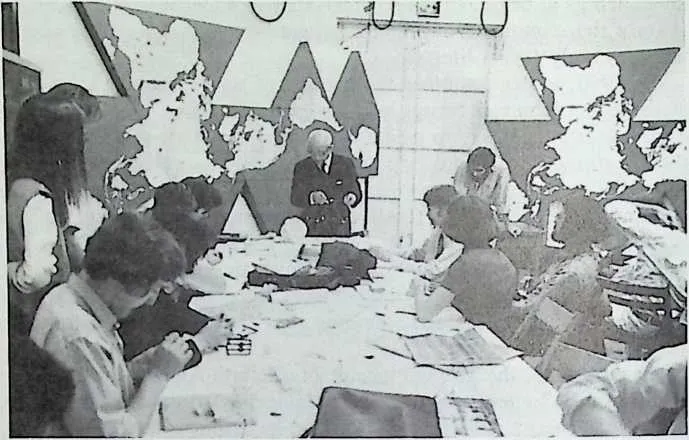
6768Fig. 16-1 Fuller working with World-Game participants.
69 emerging new society, and after examining the facts, many people began to agree with him.66
70 In Bucky’s view, what was needed to facilitate the creation of an environment of abundance and sufficiency for everyone was not the hoarding of resources which was so common, but a shift from an ownership-oriented economic system to a service-oriented system.67 A person need only observe one of the marinas from which Bucky often sailed during the last years of his life to understand the onerousness of ownership he perceived in nearly every aspect of modem society. At such marinas, hundreds of boats sit idle for days or weeks at a time and are generally used by their owners only on weekends or holidays. Those boats represent valuable squandered resources which could be housing thou-sands of people on a daily basis, but they are simply maintained as hoarded possessions of the rich.
71 When he addressed the first SIU World-Game seminar, Bucky used his experiences with automobiles to illustrate his feelings about owner-ship. He explained that he had owned fifty-five automobiles during his sixty years of driving, but that he no longer held title to even a single car. That dramatic shift in operating strategy was a direct result of his flying from city to city and requiring a car at each destination. In each location, Bucky, like so many travelers, would simply rent a car, and that experi-ence helped him to realize that, although the majority of those cars had been used by others prior to him, each rental car was, in fact, so well maintained that he almost felt he had been given a new car in every city.68
72 Bucky also discovered that he was delighted to be relieved of the burden of automobile maintenance as well as to participate in a system in which other individuals could use that same ‘‘transportation resource’’ when he did not need it.69 Such a notion may appear absurd to those of us who, like Bucky, were taught that acquiring goods is necessary to prove oneself a valuable and worthwhile citizen; however, within a cosmic context of abundance, sharing resources so that they are the most effi-ciently employed is logical, natural, and necessary.
73 Fuller’s audiences would sometimes argue that they were willing to share transportation with others, but that they would not be willing to share more intimate possessions such as homes or beds with fellow human beings. In answering those comments, Bucky would simply share his global travel experiences. He explained that he was constantly check-ing into hotels, where he would be provided with a room that had been used by many other fellow human beings over the years, yet appeared almost new to him. He observed that no one ever complained about sharing beds or rooms in hotels, which sought to maximize their efficien-cy by filling as many rooms as possible with whoever needed them at a given moment. Such examples illustrate Bucky’s concept that one signifi-cant method of increasing the life support available to humanity is to maximize the use of the available resources. They also provide insight into his hypothesis that such a behavioral and perspective shift will trans-form society from a product to a service orientation. Rather than buying items like cars and houses, people will lease a transportation or housing resource only when and where that resource is needed, just as telephone service is purchased only as it is needed.70
74 Although many people now own their telephones, they do not own the cables which run from one location to another. Instead, they rent time on those cables when they need it. In a society predicated upon the absolute abundance that Fuller proved to exist, people would carry that process even further. When individuals operate from the knowledge that there are adequate resources to support everyone on Earth, payment for the use of resources will simply become obsolete.71
75 On a global scale, Fuller’s strategy of contributing to the welfare of all humanity through a more effective, cooperative use of the available resources is clearly illustrated in the worldwide energy network he pre-sented at the 1969 World-Game seminar. Having studied the history of energy production in great detail, Fuller understood that from the days of the first waterwheel, transmission of the energy produced had been a major problem. Even in factories constructed on riverbanks to exploit the power of rushing water, as the distance between machinery and power sources increased, the amount of energy lost in transmission multiplied greatly. That factor became much more evident following the practical application of electricity. Originally, transmission efficiency was so poor that power plants could serve sites located only within miles; however, in the early twentieth century, scientists discovered methods which allowed effective transmission of electricity as far as 350 miles. That innovation permitted local electrical generating plants not only to provide power to more distant sites, but also to connect with one another and share power.72
76 Engineers soon found that sharing power and electrical production capacities greatly increased efficiency because individual generating plants were usually designed to meet peak production needs, which oc-curred for only a few hours each day. Consequently, during most of a twenty-four-hour day, a plant’s capacity was not fully utilized, or in the case of facilities such as water-powered plants which could not be stopped, electricity simply went unused.73
77 By applying 350-mile partnership links, distant electrical plants could send their excess production to other localities during times of less demand. A transmitting area would later be compensated with power from the receiving facility when the demand pattern was reversed. That phe-nomenon was particularly effective if localities spanned time zones creat-ing greater differences in demand patterns.74 For example, the afternoon peak demand caused by industrial production, weather conditions, and the increased activity of people during the daylight hours differs by three hours between cities in the eastern and western time zones. Accordingly, when a 3 p.m. peak demand occurs on the West Coast, it is 6 p.m. in the East, and demand is decreasing. That same type of extreme demand variation was also exploited when areas displaying extremely different weather patterns were connected. Thus, using new technology, engineers constructively employed available, yet previously underutilized, resources and capacity.
78 Bucky became extremely interested in that potential during the 1950s, when more-with-less technological design increased the practical delivery capacity of electrical systems from 350 to 1500 miles. Always searching for the most effective means of supporting the most human beings, Fuller quickly realized that the new transmission technology pre-sented a potential for humankind far beyond anything previously consid-ered.75 With such expanded electrical transmission, distant countries and entire continents could share excess electrical production with far re-moved communities. More significantly, the discrepancy between day and night power requirements could be exploited.
79 Specifically, Fuller hypothesized that if the Earth’s entire population could be connected through a gigantic cooperative electrical network, the nighttime power-production capacity, which is generally underutilized, could be transmitted to the daytime side of our Planet where it was needed.76 By creating such a communal exchange, vast amounts of re-sources would be conserved as power plants would be fully utilized on a twenty-four-hour basis. With such increased efficiency, the cost of power would fall, as would the need to exploit more resources in building addi-tional power plants.
80 Upon hearing Fuller discuss the merits of that possibility, most au-diences questioned how such a cooperative network could be established. Always seeking solutions to future problems, Bucky was prepared for the challenge. His examination of World geography and subsequent invention of the Dymaxion Map had provided him with the needed global knowl-edge as well as a format to display planetary solutions.77 He would exhibit
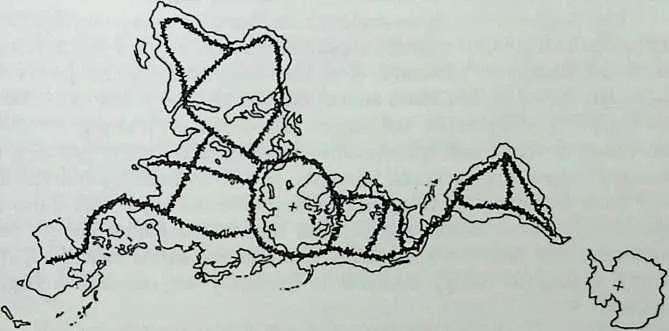
82 Fig. 16-2 Fuller’s route for the global energy grid which would cooperatively connect most of the World’s electrical production facilities, thereby dramatically enhancing the efficiency of global energy production.
83 a Dymaxion Map on which all the locally existing energy networks were displayed, along with another such map on which the most logical ultra-high-frequency transmission lines were shown. In his capacity as global design scientist, Fuller had drawn those lines without regard to national boundaries as seen in Fig. 16-2.78
84 He did, however, appreciate the issues which such a cooperative effort would generate and was willing to discuss the feasibility of his revolutionary idea with the very people he felt were becoming in-creasingly outmoded: politicians. One such discussion occurred during the mid-1970s between Bucky and his friend Canadian Prime Minister Tru-deau. After examining the plan in detail, Trudeau wholeheartedly en-dorsed it. In fact, he was so enthusiastic about the proposal that he took a copy of it to General Secretary Brezhnev of the Soviet Union. Later, Trudeau reported back to Fuller that after having their scientists and engineers examine the plan, the Soviets also endorsed it, although only informally.79
85 Formality, however, is another issue. One of the key elements of the electrical grid network would be a direct connection between the United States and the Soviet Union via the Bering Strait. Such a hookup was, and continues to be, one of the most politically sensitive components of the plan. Even though pragmatic scientists, engineers, and economists on both sides agree that the connection would benefit everyone involved, political implications continue to overshadow what could be one of the most productive projects in the history of humankind.80
86 This deadlock once again demonstrates Bucky’s conviction that pol-iticians and all political systems impede rather than support the develop-ment and success of humanity. It is also demonstrating the power of individual initiative. In nations around the World, concerned individuals are beginning to appreciate and support this endeavor, and a grass-roots movement to create such a cooperative network is gradually growing in size and stature. Engineers and scientists, as well as ordinary individuals who have examined the facts, are coming forth to argue that those in positions of power should consider and support the global energy net-work, and that, should it be installed, that network would synergistically nearly double the energy available to humanity the moment it began operation.81
87 Energy was not, however, the only focus of the World Game. Bucky’s inventory divided all the socially abundant resources into eight primary categories so that the participants could more easily work with them. As usual, Fuller’s comprehensive perspective is reflected in the somewhat cryptic phraseology of his categories:
- 1.
- Reliably operative and subconsciously sustaining, effectively available twen-ty-four hours a day, anywhere in Universe.---Gravity and love.
- 2.
- Available only within ten miles of the surface of the Earth in sufficient quantity to conduct sound.---The complex of atmospheric gasses whose Sun-induced expansion on the sunny side and shadow-induced contraction on the shaded side of Earth together produce winds and waves.
- 3.
- Available in sufficient quantity to sustain human life only within two miles above the Earth’s spherical surface.---Oxygen.
- 4.
- Available aboard Earth only during the day.---Sunlight.
- 5.
- Not everywhere or at all times available.---Water, food, clothing, shelter, vision, initiative, friendliness.
- 6.
- Only partially available for individual human consumption and also required for industrial production.---Water.
- 7.
- Not publicly available because used entirely by industry.---Helium.
- 8.
- Not available to industry because used entirely by scientific laboratories.--- Moon rocks.82
88 Although these unique groupings were pragmatically utilized by World Game participants to determine the most effective planning sce-narios, their primary purpose was not just for use in World Game semi-nars. Fuller created the categories to help pinpoint scarce resources and maintain a precise inventory of their location for the benefit of all humanity.
89 He felt that exacting computer inventories would provide the only means of accurately establishing which resources were rare, their relative degree of scarcity, and how much of a resource was needed for what purpose and at what location. He also realized that a single resource might be scarce at one location and abundant at another, necessitating policies unique to specific sites.83
90 For instance, oxygen is abundant at sea level, yet above eleven thousand feet it is quite scarce and has to be obtained from compressed tanks for breathing. Dealing with other resources in a similar manner would however, be unwise and impractical according to his calcula-tions.84
91 Helium is a gas which is scarce everywhere on Earth but possesses properties which make it uniquely valuable in specific industrial applica-tions. Although compressing the World’s entire helium stockpile into billions of small bottles and distributing one to each inhabitant of Earth would disperse it equally, only a tiny minority of people would have any idea how to utilize their helium, and the resource would be wasted.85
92 Fuller’s World Game was predicated upon constantly maintaining an accurate inventory of all scarce resources and providing the exact amount of a resource needed for a life-supporting task to the site where it was required. He envisioned that job being accomplished through the use of computers, and he realized that humankind was rapidly approaching a level of technological effectiveness which would make such an inventory possible. He also appreciated the fact that such a program would require a global cooperation among governments never before witnessed in the recorded history of humanity.86
93 Bucky did not, however, believe that the generally self-centered bureaucratic governments or the people who controlled them would be willing to subjugate their perceived requirements to those of the entire population of Earth simply because everyone would prosper in the long run. Rather, he felt that the global problems of humanity would continue to increase until they became so gigantic that they could be handled only by massive emergency measures which would be demanded by grass-roots movements of individuals.87 In the midst of such an emergency, the true significance of the World Game would emerge, and government leaders would be forced to submit to the solutions it could provide.
94 The World Game, or some form of global resource management similar to it, could then be established to support the best interests of all humanity within a cosmic context of abundance. Clearly, a program as potent as the World Game would not divert resources to something as destructive and adverse to life support as weaponry or the military. With livingry rather than weaponry as the underlying focus of planning, other serious issues relevant to modem society would become more obvious and of higher priority.
95 Having developed a tremendous interest and expertise in the area of construction, Fuller devoted a great deal of the World Game to shelter. During the 1960s and 1970s, long before homelessness became a public issue, he once again addressed the problem. This time, rather than invent another unique house, Bucky spoke of resource allocation in a truly abun-dant society. At World Game sessions and in other forums, he related his cosmic perspective of the dramatic shift of 1970, when, according to his calculations, because of technological innovation, humanity reached a moment of being able to support the entire population of the Planet. Fuller often expounded on the senselessness of people’s having to work just to earn a living or, more appropriately, to work to earn ‘‘the right to live’’ in the period of abundance he felt humanity had entered. Instead, he argued that individuals should simply do whatever they wanted to do. Having observed human nature for decades, Bucky was certain that given such freedom, individuals would ultimately opt for doing what needed to be done out of a desire to contribute to society as well as to fulfill their individual missions here on Earth.88
96 Fuller’s analysis suggested that a tremendous amount of resources would become available for housing following the 1970 transformation to abundance and global management. In his scenario of abundance, when people were no longer forced to spend many hours working at jobs which did not produce any life support, all the beautiful new office buildings with their modem plumbing and heating could be converted to housing. For years Bucky had been appalled that such modem structures were left empty during the night hours while homeless people roamed the streets without a place to sleep or were sheltered in substandard slums, and he believed that resource reallocation within a context of abundance would greatly support resolution of that issue forever.89
97 The World Game was created to facilitate the transition of humanity from the context of scarcity, which has always plagued us, to a new level of prosperity in which everyone can be supported sufficiently. Bucky felt that it required only the proper moment of implementation.
98 Perhaps the World Game will never be formally introduced to the general public on a large scale. It will, however, have served its purpose as the spark of an idea which required a gestation period prior to becoming formally manifest. In any event, Bucky’s World Game is far from over. Issues such as global starvation and homelessness have come to the fore-front of public attention, and Bucky’s World Game lives on in the budding programs developed to eradicate such problems.