
8 A Car Is Born
2eAt nineteen feet in length, the Dymaxion Vehicle was com-parable to a Cadillac of the day but longer than an average modem car (fifteen to seventeen feet). The Dymaxion Vehicle was, however, much faster and more efficient than any ot er car ot its era or most modem automobiles, carrying a maximum of eleven passengers comfortably and averaging nearly 30 miles per gallon o gas oline while attaining speeds in excess of 120 miles per hour.1 u er s team achieved those amazing performance records using stock pre> action parts wherever possible and engines from major manufacturers, ost o those parts were, nonetheless, modified for Bucky s purposes.2
3 Only when a component was so radical that no stock component a ever been fabricated did the team forge a part from scratch. That process was evident in the designing and manufacturing of the unique ee structure, hinged chassis with its large holes to reduce weight.3 unng that era, only racing cars utilized such a sophisticated technology to essen their weight, and the hinged components of Fuller s Vehicle were matchless.
4 The effectiveness of the Dymaxion crew’s work and Fuller’s design was exemplified by the Vehicle’s speed. The most powerful engine ever installed in it was a modified Ford V-8, which produced only ninety horsepower. Yet, to reach the speed that the Vehicle could attain, a conventional 1933 sedan would have required three hundred horsepower of force.4
5 Because the Vehicle received an enormous amount of publicity, huge crowds formed when it was driven on public streets or displayed. Bucky was also frequently invited to demonstrate it, and he accepted whenever possible.5 At one such exhibition, he opened the season of a stadium in the Bronx, New York, where midget cars raced. The track’s owners invited Bucky to drive a few laps around the track during intermission, and he was delighted to have the luxury of an entire race track to himself. Being a gracious host who loved to show off the wonders of his invention, Bucky returned the favor by inviting several of the stadium officials to accompany him while he circled their track.
6 Everyone in the Vehicle sensed that Fuller was driving at his favorite pace: fast; however, because of the extremely comfortable ride, they did not feel they were traveling at an unsafe speed. In fact, his passengers commented on how well the Dymaxion Vehicle handled and on the smoothness of the ride. Nonetheless, when the Vehicle came to a stop in front of the grandstand, all the riders were astonished to learn that they had broken the track record by nearly 50 percent.6
7 That accomplishment amazed the officials because their rear-wheel-drive racing cars were always skidding around the track, yet the Dymax-ion Vehicle broke the speed record without skidding once. When Fuller explained that the lack of sliding was a result of the Vehicle’s advanced design and front-wheel drive, the officials became even more interested in his ideas. The fans were also amazed because, in establishing the new record, everyone in the Vehicle looked and acted like tourists taking a spin in the country rather than serious racers.7
8 Like many other aspects of its design, the Vehicle’s steering was also unique. Rather than using conventional rods, internal connections were made with stainless steel cables running from the driver’s steering wheel in the front to a post which turned the single steering tire in the rear. Those cables passed through ball-bearing guides built to extremely precise stan-dards. Bucky’s and Burgess’s sailing experience proved invaluable in devising and fabricating those and other radically experimental compo-nents, which were adaptations of the best racing sailboat technology and materials. Burgess had invented similar parts for sailing ships, and his expertise helped Fuller to equip the Dymaxion Vehicle with some of the most remarkably elegant parts ever seen on an automobile.8
9 Among the less obvious innovations that Fuller and his staff intro-duced were a rearview periscope on the roof to compensate for the lack of a rear window and to provide the driver with a broad perspective of everything behind him. The rear engine compartment was also innovative, providing easy access to every section of the engine as well as the Vehi-cle’s other mechanical components. In fact, when the engine compartment door was opened, the engine appeared to be sitting up on a workbench, ready to be examined and easily repaired.9
10 As with any experimental project, problems had to be worked out, and the entire team was perpetually improving and upgrading the Vehicle. Initially, maneuvering it through strong crosswinds was particularly diffi-cult because the streamlined design caused the Vehicle to be prone to turning into the wind. Although the steering system was extremely tight and would maintain the operator’s chosen course, that natural tendency of turning into the wind transferred the impact of wind forces onto other areas, such as the tires. At times that pressure created such a large distor-tion in the tires that the Vehicle was extremely difficult to steer. In faction a windy day, driving the first Dymaxion Vehicle was said to be like flying a light plane.10 It was during one such windy test drive that Fuller realized the Dymaxion Vehicle was not an invention which could be made avail-able to the general public without significant improvements.11
11 Even though he and his associates continued instituting modifications which diminished that and other problems, Fuller did not completely resolve the issue until years later. Thus, in an effort to prevent accidents, only individuals trained by Fuller or one of his staff were allowed to drive the Vehicle for extensive periods or during inclement weather.12
12 Despite its flaws, once the prototype was successfully demonstrated, the Dymaxion Vehicle was acknowledged as an amazing automobile. Still, most people did not believe that it could one day be transformed into a flying machine. Most conspicuous among the skeptics was Starling Bur-gess. He believed that Bucky’s jet-stilt-propulsion idea could create enough lift for hovering at low altitudes above relatively flat surfaces such as water, but that such jets would never provide the constant power required for high-altitude flight.13
13 With each new ground test, Fuller, on the other hand, became more and more certain that the vehicle could be modified to fly. He felt that future technology would provide the jet flight capabilities he had envi-sioned, but he realized that the requisite technology would not be avail-able for at least twenty-five years and would probably be developed at great expense by governments for military deployment.14
14 Since that time, governments have produced the jet engines Buc y envisioned during the late 1920s. The United States military even fabri-cated small, portable rocket jets which can be attached to the wings o planes to assist in takeoff. Those jets operate as stilts by providing ad i-tional lift, and they have been instrumental in helping stranded planes to take off from harsh polar regions. Further development has resulted in even smaller jet packs which individuals wear on their backs and fly using hand-held controls.
15 The United States Marine Corps also conducted experimentation that resulted in a prototype jet flying transport similar to the Dymaxion Vehi-cle. Unfortunately, they made the mistake of not focusing the thrust of their jets to converge above the center of gravity of the vehicle, and it tended to roll over. Although that was a minor issue that Fuller had anticipated in 1932, it was a major stumbling block for the Marines, and they terminated their project.
16 Nevertheless, their work and the achievements of other individuals and institutions clearly indicate that Fuller’s concept of wingless jet flight is workable. In fact, one futuristic portrait of a flying transport predicted to replace the automobile in the next century hangs at the Air and Space Museum in Washington, DC. That painting depicts a flying vehicle al-most identical to Fuller’s Dymaxion Vehicle except that it is to be pro-pelled by small jet engines on either side, just as Bucky prophesied.
17 When the first Dymaxion Vehicle was completed, Fuller hosted a huge celebration attended by numerous dignitaries. Among the guests were the distinguished aviators Amelia Earhart and Sir Kingsford Smith, as well as many of Fuller’s artist friends from New York, including Diego Rivera. As a result of the publicity he had received, Earhart and Fuller had met and become friends, and she respected the Dymaxion Vehicle as well as his idea of transforming it into an Omni-Medium transport. Following the unveiling and a test drive, Earhart felt confident enough about the Vehicle’s quality and significance to request a favor of Bucky.15
18 She asked to use the Dymaxion Vehicle as her official car during a celebration in which she was to receive the Gold Medal of the National Geographic Society. Although that request might appear audacious, Ear-hart’s motivation was completely supportive of Bucky’s work. She sensed that by utilizing his Vehicle at her official functions in Washington, DC, she would generate more interest in and support for Fuller’s ideas and work. After listening to the scheme, Bucky agreed, and the Vehicle was soon on its way to Washington.16
19 Earhart’s strategy was a resounding success. She had been invited to stay at the White House by Mrs. Roosevelt, and the Dymaxion Vehicle was again showcased in the national spotlight for several days. Fuller was extremely grateful for her support, and as they grew to be even closer
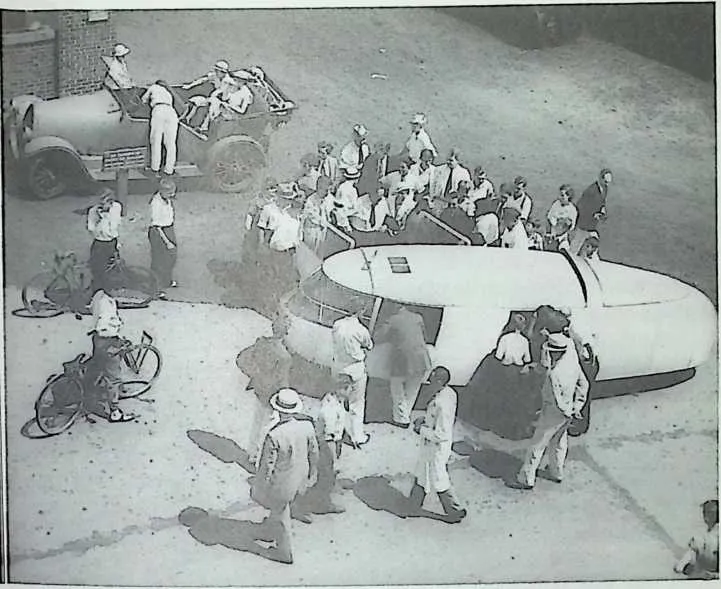
21 IFig. 8-1 The 1933 public unveiling of the first Vehicle. The car in the 'S*
22 ccontemporary Franklin. The man holding his coat and standing between t e tthe far side is the artist Diego Rivera.
23 1 friends, he found that despite her fame she was an extremely humble (person who perpetually supported worthwhile causes and Pe°P e’
24 Although the Washington, DC spectacle catapulted both Fuller ana tthe Vehicle into greater prominence, its most remembered exposure oc ccurred at the Chicago World’s Fair of 1933 and 1934. In 193 , e air s (producers were eager to exhibit a full-size prototype of the ymaxion IHouse, which still retained its exotic ‘‘House-on-a-Pole design, ecause this ideas were unique, most of the components for such an en eayor would have had to be fabricated from scratch, and Fuller ca cu ate ccost of building the House to be far more than he could afford or gamer ffrom investors. , t , ..
25 When confronted by the economic reality that Buc y presen e > EFair’s producers also declined to finance that construction an suoges e
26 174
2728he display a scale model of the Dymaxion House. At that time, Fuller had just spent more than a year building working prototypes of the Dymaxion Vehicle and did not feel that simply displaying a small model would be worthwhile or would efficiently utilize his time. He was also obligated to continue working at the Bridgeport plant, where his crew was nearing completion on the second Dymaxion Vehicle, which was progressing on a financial shoestring. 18
29The Fair s producers were so certain that even a model of Bucky’s ouse would support their primary goal of attracting more people that they initiated fabrication of a scale model for exhibition. With a model of •SPymaxi?n House on display, Fuller could not help becoming involved with the Fair and began speaking there whenever possible. ™
30At the time, a group of Englishmen were considering purchase of the second Dymaxion Vehicle, which was on the verge of being scrapped for lack of funds. The English group dispatched a British aviation expert, Colonel William Francis Forbes-Sempill, to inspect the original Vehicle. rorbes-Sempill traveled from England on the Graf Zeppelin's special voyage to the Chicago World’s Fair, and he was accompanied by another expert, the Air Minister of France.20
31Bucky was asked to provide the original Vehicle for their use and examination at the World’s Fair, and he quickly began making prepara-tions. By that time the first Vehicle had been sold to Gulf Oil and was managed by Al Williams, a man who had been the Navy’s premier test pi ot and had retired to assume the position of sales manager for Gulf.21 Williams himself vigorously supported Fuller’s work and often acknowl-e ge t e Dymaxion Vehicle as ‘‘aviation’s greatest contribution to the automobile industry. ’’22
32One of Gulf s best-selling products was aviation fuel, and the com-pany produced air shows to promote its fuel. Williams convinced the management at Gulf that purchasing the Dymaxion Vehicle and featuring it as t e official race car at all Gulf’s air shows would greatly enhance t eir promotions. The Dymaxion Vehicle was a solid investment for Gulf management, increasing attendance at their events, just as had been true wherever it was displayed.23
33Learning of the British expert’s upcoming visit, Bucky telephoned his friend Al Williams, who immediately assigned a former race-car driv-er named Turner to drive the Vehicle to Chicago for inspection. Turner arrived in 'Chicago just as the Graf Zeppelin was making its brief stop at the World s Fair to drop off passengers prior to departing for the nearest
34 mooring facilities in Akron, Ohio.24 He then acted as chauffeur and guide for the two men during their visit.25
35 Their World’s Fair tour was an enormous success, and the two men enjoyed traveling in and inspecting the Dymaxion Vehicle. They also found themselves becoming part of the spectacle which the Dymaxion Vehicle created wherever it appeared. Then, a few days after their arrival, an unexpected message arrived late one evening informing all passengers that the Graf Zeppelin was returning to England immediately, and that those who wished to return on that voyage should be prepared to leave early the following morning. Thus, Turner and the Vehicle were sum-moned for a final quick trip to the airport at seven o’clock the following morning.26
36 The next information Fuller received about the Dymaxion Vehicle was in the following day’s newspapers. Typical headlines read, ‘‘Freak Car Rolls Over, Kills Race Driver, Injures Dignitaries’ ’ and ‘‘Three-Wheeled Car Kills Driver.’’ The New York Times reported, ‘‘The machine skidded, turned turtle and rolled over several times. Police say it appar-ently struck a ‘wave’ in the road.’’27
37 At the time, Bucky was in Bridgeport working on the second Dymax-ion Vehicle and immediately called a trusted friend and fellow engineer in Chicago, asking the man to begin investigating the accident. Bucky also flew to Chicago to conduct his own inquiry. There he found that the accident had occurred almost directly in front of the main gate of the World’s Fair, and that the Dymaxion Vehicle had been quickly removed from the scene and hidden at a remote storage area.28 Although he was intimately involved with the Vehicle, none of the authorities cooperated with him in even locating the Vehicle. When he finally did find and meticulously examine it with the help of other engineers, Fuller could find no systems or parts which could have malfunctioned to cause the acci-dent.29 Accordingly, he continued his investigation.
38 In reading accident reports and speaking with eyewitnesses, he dis-covered that the Dymaxion Vehicle had rolled over, puncturing the button-down convertible top and killing Turner, who was fastened in his seat by a seat belt. The French Air Minister had not been wearing his seat belt and was thrown through the lacerated top, landing on his feet with barely a scratch. Colonel Forbes-Sempill had been sitting next to the driver and was taken to the hospital in critical condition. When Forbes-Semphill’s condi-tion improved, Fuller visited him, hoping that the gentleman could offer some insight into what had occurred. During one of those visits Bucky was asked to wait while the Colonel received a call wishing him a speedy recovery from his good friend, the King of England.™
39 As the accident quickly escalated into a major news item and an international scandal, Fuller felt increasingly guilty that his Vehicle had supposedly killed one person and seriously injured another. Forbes-Sem-pill did eventually recover so that he could testify at the coroner’s inquest, which was required because someone had died.31 That inquest, however, could not be conducted until the Colonel regained his health two months after the accident, and by that time, the incident was no longer a sensa-tional news item.32
40 Forbes-Sempill and the French Air Minister both testified that the Dymaxion Vehicle had been traveling down the highway when another driver pulled alongside them so his passengers could get a closer look at the strange Vehicle. During Fuller’s early public test drives, he had fre-quently encountered such spectators and had found them to be the most hazardous aspect of driving the Vehicle on public roads.33 He was often confronted by the frightening situation of cars pulling alongside him, with the driver eyeing the Dymaxion Vehicle rather than the road ahead.
41 Because Turner was a professional driver and realized that his Vehi-cle was much faster than anything else on the road, he had accelerated to escape the gawkers. The other driver simply followed alongside, continu-ing his harassment. When Turner changed lanes, the other car continued its pursuit. Finally, the other driver moved so close that his car hit the tail of the Dymaxion Vehicle, causing Turner to lose control and the Vehicle to roll over. As fate would have it, the other car was owned by an influential South Chicago parks commissioner, and his car had been il-legally and expeditiously removed from the scene before any reporters arrived. During the coroner’s inquest, the fact that a collision and not a freak rollover had occurred was discovered and exposed.34
42 The coroner ruled mutual responsibility for the accident, and no fault was assigned to either vehicle or driver. He also declared that the accident was not the result of the Dymaxion Vehicle’s malfunctioning or being poorly designed. Still, two months had passed, and the Vehicle had re-ceived an enormous amount of negative publicity during that period. Since the resulting assignment of no fault was not a sensational story like the accident itself, the final resolution received very little media coverage. 35
43 Al Williams spoke candidly to Fuller and expressed his feeling that Bucky had an obligation to inform the general public that the Dymaxion Vehicle was soundly designed and not at fault in the accident. Williams suggested that since the media were no longer interested in the story, the best method of apprising the public of the truth was the construction of another Vehicle which would generate sufficient positive attention to eliminate the negative image. Thus, public relations became the predomi-nant motivation for building the third Dymaxion Vehicle.36
44 The following year, Bucky did accept a formal invitation to exhibit and demonstrate the latest Dymaxion Vehicle at the 1934 edition of the Chicago World’s Fair. Because of its maneuverability, one of his demon-strations consisted of having the Vehicle ‘‘dance’’ a zigzagging maneu-ver, which was referred to as a ‘‘waltz,’’ down the main street of the Fair. Twice each day, Fuller would also drive the Vehicle through the entire fairgrounds, completing his route at a pageant entitled ‘‘The Wings of a Century,’’ which portrayed Chicago’s history as a great railroad center.37 During the program, actual railroad locomotives and trains passed directly in front of the grandstand on special tracks, but the grand finale of the show featured one small car. Bucky would enter the arena driving the Dymaxion Vehicle at high speed from one side of the grandstand, quickly slow down to fifteen miles per hour, and execute his famous 180-degree turn.38
45 The stunt was particularly thrilling because the audience had been primed by news stories of the previous year’s accident. When they saw the suspect Dymaxion Car spinning around, most of the crowd was certain that it would flip over as it had during the accident. Having performed the maneuver hundreds of times, Fuller knew it to be perfectly safe, but he was willing to give the folks a show in order to demonstrate the safety and effectiveness of his unique Vehicle and to eliminate some of the earlier negative publicity. In fact, the Vehicle’s steering was so tight and exact-ing that Fuller could actually release the steering wheel and the Vehicle would continue the turn without his assistance.39
46 During his second year at the World’s Fair, the Vehicle regained its reputation as a masterpiece of modem technology and aroused the interest of some influential individuals, including Henry Ford. Shortly after Ford witnessed Bucky’s performance, he called Fuller at the Bridgeport plant to extend a 70 percent discount on anything Ford Motor Company manufac-tured which could be used on the project. Ford’s offer was an enormous aid to the financially burdened Fuller, and his team immediately began using Ford parts and engines whenever possible.40
47 Fuller’s original intention had been to build one prototype Dymaxion Vehicle for testing and then shut down the operation. He had initiated production of the second Vehicle so his workers would finish the first one and because the English group was interested in purchasing it. Following the 1933 accident, no one was interested in purchasing the completed second Vehicle, and Fuller was quickly running out of money.41 Still, he began work on the third Vehicle to remove the negative stigma spawned by the accident. Because of low funds and the workers’ fear of losing their jobs, that proved to be a very difficult undertaking.
48 Only another unrelated event kept production of that third Vehicle on schedule. When Bucky’s mother died that year, her estate was divided among her children, and he received a small inheritance, which he used to cover production costs for the third Vehicle. Each time he was nearly out of cash, Fuller would hastily sell some of the stocks or bonds he had inherited.42 His brother and sisters were extremely cooperative in support-ing those transactions, but the bank, which was coadministrator of his mother’s will, invariably caused frustrating delays.43
49 As with almost all his experiences, Fuller attempted to learn from his difficult dealings with that bank, and in those dealings his growing mis-trust of profit-oriented corporations was again bolstered. He believed that banks were conspiring to manipulate prices, thereby increasing their profit from the sale of securities at the expense of their customers.
50 As Fuller perceived that deception and his victimization by banks, such manipulation occurred because banks were continuously receiving large orders to buy and sell stocks and bonds from trust funds. The management of several banks would then manipulate prices by agreeing to withhold those large orders until a predetermined moment, when the price would rise or fall because of their combined transactions. Those banks would also assemble the buy and sell orders from small customers for specific stocks and bonds, and would use those collected orders to in-crease the strength of their position when they made the large transactions. The action of those bankers resulted in considerable delays when Fuller needed to sell small amounts of stock.44 Such delays combined with the Depression to create major production problems, and in one instance, Fuller’s financial situation was so tenuous that the local sheriff visited him at the plant.45
51 Bucky was in debt to several Bridgeport merchants, and the sheriff warned him that his creditors believed he might leave town or close the plant without satisfying his debts. Such behavior had become routine during the Depression, and businesspeople quickly demanded payment on outstanding debts at the least indication of possible failure. Having no intention of defrauding his creditors, Fuller was very cooperative and allowed the sheriff to examine his financial records so that he could vouch for the fact that funds were forthcoming and bills would be paid.46
52 At that time, the third Dymaxion Vehicle was nearing completion, and Bucky was attempting to gradually lay off his staff and shut down the operation. The workers, however, were not cooperating with that process and were again doing everything they could to sustain production and retain their jobs. Fuller also owned all the inexpensively purchased machinery used in production, and suddenly the plant windows were being broken and the machinery was being vandalized. Bucky had only leased the building, but he had no idea what to do with the equipment, which, because of the Depression, no one was interested in purchasing at any price.47
53 Having taken the initiative to speak with Fuller’s staff before visiting him, the sheriff advised Bucky that his crew truly feared for their jobs and were not going to allow the operation to be shut down. He then suggested that the only way to close the operation gracefully was to have him conduct an official sheriff’s auction, liquidating all assets and closing the plant. After carefully considering all his options, Bucky agreed to the plan. The sheriff’s sale allowed Fuller to complete the project with dignity, having produced three Dymaxion Vehicles, and without declaring bankruptcy. Although that was not the way Bucky had envisioned completion of the project, it was the best alternative available at that moment, and he left Bridgeport with no debt and having learned a great many lessons.48
54 With his work on the Dymaxion Vehicle, Fuller bolstered his belief that cars represent much more than a mode of transportation. He regarded cars, like so much of his environment, as tools. His experience in closing the Dymaxion Vehicle plant caused him to reevaluate his use of all types of tools in relationship to his strategy of acting as an individual and taking initiatives on behalf of all humanity.49
55 Although he was always true to the essence of that strategy, Bucky adjusted it whenever he encountered something not working at maximum efficiency. One such lesson occurred with the Dymaxion Vehicle. After completing production, Fuller realized that purchased equipment was a burden. Accordingly, he resolved to limit his possessions and to avoid owning equipment whenever possible.50
56 During the early 1920s, his company owned most of the machinery in the five Stockade Systems construction factories, but that machinery was simply transferred when the entire operation was sold to another corporation.51 That experience did, however, forge the foundation of
57 Fuller’s understanding of the complexities and problems inherent in ownership, and that understanding was intensified with the closure of Dymaxion Vehicle production.52
58 Following the Dymaxion Vehicle project, Fuller’s first choice was to lease tools and equipment whenever possible. That revised strategy pro-vided him with greater freedom, and he was, consequently, able to shift from one field to another more expeditiously and with greater ease. Fol-lowing that change in strategy, Bucky was never forced to continue work on a project which he felt had been efficiently taken as far as possible simply because he owned the tools or the facility to produce a particular item. The peril of ownership was a major lesson of the Dymaxion Vehicle operation, a lesson which supported Bucky’s success in other enterprises over the years.53
59 Once the Dymaxion plant had closed, a great many people called to console Fuller. When the first of those friends offered their regrets that his automobile operation had failed, Bucky was truly surprised, and he ques-tioned them. When a friend would politely allude to Fuller’s inability to mass-produce the car commercially, Bucky would once again explain that his intention had been to develop and construct a prototype Vehicle for testing particular principles and not to enter the commercial automobile business. In his inimitable, candid style, which often shielded some disap-pointment at not having succeeded in the public eye, he would further recount that, regardless of other people’s perceptions, he had succeeded in his mission.54
60 In truth, Fuller had, in a few short years, achieved much more than most individuals could have hoped to accomplish. He had built his Vehi-cle, and in testing principles with the Dymaxion Vehicle, he had obtained insight into numerous areas, including manufacturing, business, produc-tion materials, and aviation. He had also contributed to the whole of humanity by developing and promoting many discoveries which advanced automobile engineering and manufacturing.
61 For example, shortly after Fuller’s work, most auto manufacturers began streamlining their cars, and many years later, American auto manu-facturers began implementing front-wheel drive.55 Fuller felt that those innovations, like all ideas, required a gestation period between the time they were first considered and their commercial implementation, and, by bringing innovations into public awareness, the Dymaxion Vehicle had initiated that gestation process.5^
62 Although Fuller maintained the idealistic stance that he had never wanted to commercially produce the Dymaxion Car, other sentiments were conspicuous. Bucky did, in fact, receive and respond to overtures from every major American automobile manufacturer. In working with companies which claimed interest in mass production of his Vehicle, Fuller was able to acquire a great deal of insight into the automobile industry, and that insight once again reinforced his belief that businesses were interested in profit at any expense.57
63 The most significant of his interactions were with Chrysler, Packard, and Studebaker. The investment group of Hayden Stone owned Curtiss-Wright Aeronautical as well as both the Studebaker and the Pierce Arrow automobile companies, but Pierce Arrow had succumbed to the Depres-sion, leaving its production facilities in Buffalo, New York, idle. Hayden Stone management believed those facilities would be ideal for production of the Dymaxion Car, which they wanted to rename the Curtiss-Wright Dymaxion Car. Their plan was to use Curtiss-Wright’s knowledge of advanced aircraft technology in conjunction with Fuller’s designs to pro-duce the most advanced car on the road.58
64 The management at Curtiss-Wright felt that the aircraft industry had adapted and utilized automobile production technology for many years, and that the Dymaxion Car provided a unique opportunity for the auto-mobile industry to exploit the latest aircraft-industry technology. Their plan was to continuously upgrade the Car so it was always revolutionary and to market it as the premier model of the Studebaker line.59
65 Fuller had almost reached an agreement permitting Hayden Stone to produce the Dymaxion Car commercially when a seemingly unconnected and unexpected issue resulted in the termination of their plans. During the early years of aviation, Curtiss-Wright had felt that the creation of airports would stimulate sales of the planes they were manufacturing, and the company began producing both airplanes and airports at the same time. As a result of that effort, at the onset of the Depression, Curtiss-Wright owned small airports across the country. President Roosevelt’s New Deal administrators felt that upgrading those airports would be an excellent job-producing government project, and the United States government entered into a tentative agreement to purchase all of Curtiss-Wright’s airports as one facet of its effort to stimulate the economy.
66 Curtiss-Wright planned to invest the capital it had received from that sale in the development and production of the Curtiss-Wright Dymaxion Car, but for an unknown reason, the negotiations became deadlocked, the final agreement was never approved, and Curtiss-Wright terminated the Dymaxion Car project due to lack of funds. At the time, Curtiss-Wright’s justification for terminating the proposed enterprise appeared reasonable and in no way connected to the Dymaxion Car itself. However, when Walter Chrysler explained to Bucky why the Dymaxion Car could never be commercially manufactured, Fuller felt those deadlocked negotiations were probably more than mere coincidence.60
67 Walter Chrysler, founder and president of the Chrysler Corporation as well as an elder statesman of the automobile industry, was a man with interests similar to Fuller’s. He was captivated by modem, streamlined cars, and following the Dymaxion Car’s successful demonstrations, he too expressed interest in commercially manufacturing it. Chrysler was so fascinated with modem innovation that he had initiated the development of Chrysler Corporation’s somewhat streamlined Airflow, which was in-troduced just one year after Fuller first exhibited the Dymaxion Vehicle. Although no information had been shared by the designers of the two vehicles, detailed comparisons of the Dymaxion Vehicle and the Airflow soon followed.
68 The most publicized encounter between the two cars occurred in the heart of New York City in 1934. At that time, automobile shows were important events where new models were vigorously sold and promoted. Chrysler Corporation planned to unveil the Airflow at one of the country’s largest auto shows, scheduled for the Grand Central Palace in New York City. Because the company was mounting an enormous advertising cam-paign for the Airflow, they leased the most expensive display position at the show.61
69 With the Depression continuing to dominate the American economy, many smaller manufacturers still could not even afford to rent a space for displaying their automobiles, and the show’s producers offered Fuller free exhibition space for his Dymaxion Vehicle. Since he had been provided with display areas and had successfully exhibited the Dymaxion Vehicle at similar events, the promoters were certain that Bucky’s Car would not only fill one of their empty booths but would also help attract larger crowds. When the management at Chrysler Corporation learned that Full-er’s streamlined Vehicle would be exhibited at no cost, they were furious and threatened to withdraw from the show, leaving the producers with no choice but to withdraw their invitation to Fuller.62
70 Having encountered similar treatment on other occasions, Bucky understood their predicament and simply continued with his work. The event did, however, generate several stories in the New York newspapers, and as fate would have it, the police commissioner of New York City, General Ryan, read about the incident. General Ryan had seen and been impressed with the Dymaxion Vehicle at another exhibit and invited Full-er to park his Vehicle in front of the Grand Central Palace during the show.63 Thus, with the approval of New York City’s police commis-sioner, Bucky and his Vehicle were prominently displayed, at no charge to spectators, directly in front of the auto show, where they literally stole the spotlight from the exhibition.64 Throughout the show’s entire run, more people were consistently gathered around the Dymaxion Vehicle than at any exhibit inside.65
71 Upon hearing of that incident, Walter Chrysler personally invited Bucky to drive the Dymaxion Vehicle out to his estate on Long Island for complete examination.66 Bucky accepted Chrysler’s invitation, and after a test ride and a detailed inspection, Chrysler confided that the Dymaxion Vehicle was the type of car he had attempted to manufacture years earlier.67 Chrysler went on to explain that he had envisioned producing a tech-nologically advanced automobile, but that by the time the gigantic bureau-cracy at Chrysler Corporation was finished with his ideas, the car barely resembled his initial concept. That car was, however, eventually produced and marketed as the Airflow. Although the Airflow was an exceptional
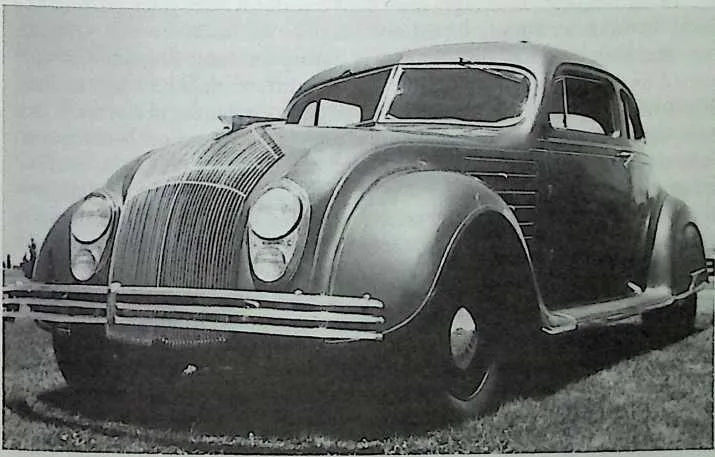
7374Fig. 8-2 The 1934 Chrysler Airflow.
75 vehicle for the time, it was so removed from his original, revolutionary dream that even Walter Chrysler conceded he did not like it.68
76 Mr. Chrysler was delighted to discover that Bucky had produced a car so advanced yet so similar to the one he had attempted to manufacture. During their conversations, he explained the excessive corporate system of checks and balances to Bucky, emphasizing how that system obstructed creative inventors.
77 Chrysler recounted that even as founder and chief executive he could not persuade his corporation to work on an idea which could not be guaranteed financially successful. He believed that radical concepts, such as the Dymaxion Vehicle, were much too risky for corporate executives, whose primary objective was maintaining a profitable organization rather than producing the best possible product. Chrysler also indicated he felt that if Bucky avoided the burdens of a huge organization such as his, Fuller could actually produce the Dymaxion Car commercially. In fact, Chrysler was so impressed with Fuller’s Vehicle and certain of its poten-tial that, following their first meeting, he often asked Bucky to take members of his staff and board of directors for rides in the Dymaxion Vehicle so they could experience the type of car he had attempted to produce.69
78 In subsequent meetings and conversations, Chrysler also asked Bucky to work with him on cost comparisons between the two vehicles. They had both produced prototype cars during the same era, and Chrysler wanted to determine cost and effectiveness differentials between an indi-vidual developing a prototype and a large corporation performing that same task. The two men found that Chrysler Corporation had required three times longer and four times more money to produce the Airflow prototype than Fuller had needed to produce the Dymaxion Vehicle pro-totype. In addition, Walter Chrysler considered the Chrysler Corporation prototype to be an ineffective, compromised car, whereas both men agreed Fuller’s Vehicle was an ideal, modem car.70
79 Walter Chrysler was profoundly impressed by Fuller’s demonstration of how much more effective one individual could be than an entire gigan-tic bureaucracy. After receiving that praise, Fuller went on to speak and write about the possibilities of individual achievement with a newfound confidence predicated on his firsthand experience with the Dymaxion Vehicle and the commendation of a highly influential corporate executive.
80 Fuller’s interactions with Walter Chrysler also provided him with many valuable insights into the automobile industry. Chrysler was the person who explained why major manufacturers would never produce the Dymaxion Car commercially, and his prediction was ultimately fulfilled as each of the major automobile companies considered and rejected pro-duction of the Dymaxion Car. Walter Chrysler warned Bucky that because most used cars were sold several times and remained in the marketplace for many years, sales of used cars outnumbered sales of new cars by approximately five to one. The abundance of used cars in the marketplace was especially hard on dealers, who were forced to accept them in trade and were usually inundated with used cars.71
81 That glut proved to be a tremendous burden on the American econo-my because most unsold cars were purchased and retained under agree-ments with financial institutions and were, therefore, actually owned by bankers until sold. Bankers believed that if the newest cars were too technologically advanced and desirable, no one would want the inferior used cars they owned. Those cars would then be drastically devalued, and such a devaluation would create massive losses for the financial institu-tions.72
82 Exceptionally advanced new cars would also generate financial prob-lems for bankers and other businesspeople by remaining in service much longer, wearing out fewer parts and consuming less fuel. A tech-nologically superior, highly desirable vehicle, such as Fuller’s Dymaxion Car, simply could not be tolerated within the structure of the automobile market. Consequently, Mr. Chrysler believed that influential individuals worked diligently to ensure that superior vehicles would never be pro-duced commercially.73
83 Walter Chrysler further explained that he felt that automobile com-pany executives may have genuinely wanted to produce the Dymaxion Car, but that they were subject to the influence of bankers and stock-holders who would never allow management to jeopardize the automobile market by producing such a superior vehicle. New car models were, at times, improved through engineering developments, but such innovations occurred over the course of many years so that they would not affect the value of used cars. Both Chrysler and Fuller agreed that the major modifi-cations proclaimed by manufacturers from year to year were (as they still are) primarily superficial alterations in appearance which excite customers about apparently new models without costly retooling of manufacturing plants or the devaluation of the cars on the road or in the marketplace.74
84 The two men also agreed that major technological advances devel-oped within other industries had been withheld from immediate imple-mentation in the automobile industry in an effort to maintain a stable economy and to keep powerful individuals secure in their positions.75 Had employing advanced technology for the benefit of humanity been a pri-ority for those people controlling the economy, the Dymaxion Car would have been perfected and mass-produced and would now be regarded as a relic of the past rather than a vision of the future.
85 Although only three prototype Dymaxion Vehicles were produced during the early 1930s, the Dymaxion Car concept did emerge again for a short period during 1943. At that time, Fuller was working as Director of Mechanical Engineering for the Board of Economic Warfare in Wash-ington, DC, and he was contacted by the famous industrialist Henry J. Kaiser. The two men had met earlier, and Kaiser had been impressed with Bucky’s innovative ideas and design skills.76
86 One of Kaiser’s enterprises was producing and marketing the Kaiser automobile. Kaiser’s company was one of several mid-sized auto manu-facturers which sought to overtake the larger companies by producing a revolutionary new car, and Henry Kaiser invited Bucky to design such a car for him.77 Like most industrialists, Henry Kaiser was looking forward to the end of World War II and the shift of American industry from munitions to peacetime goods. Kaiser, like so many others, felt that cars would be in great demand when servicemen returned home, and he want-ed to be ready with a car that would carry four passengers comfortably, accelerate very rapidly, get excellent mileage, and be much less expensive than anything else on the market.
87 After discussing the exact requirements with Kaiser, Bucky agreed that he could design such a vehicle, but because of his responsibilities with the Board of Economic Warfare, he could work on the project only during his spare time. Both Kaiser and Fuller’s boss agreed to that plan, and Fuller initiated an amazingly rapid design program. Because of the war, competent engineers were scarce, but Bucky persuaded an engineer friend of his, Walter Sanders, to work on the project.78 Sanders’s archi-tectural partner was also recruited to help with the project, but the three men had to work within the confines of the busy schedules and the New York location of Sanders and his friend.7’
88 Never one to let circumstances deter him, Bucky convinced the two men to work on the new car design in the evening after putting in a full day at the office. When they agreed to his scheme, Bucky found himself in the awkward position of having a day job in Washington, DC, and evening work scheduled for New York City. Thus, he began taking the 5 p.m. train to New York, working all night with his partners and riding the first morning train back to Washington. With such a hectic schedule, the only opportunity for sleep was during his train rides, and for a solid month, Bucky slept only on the train.80
89 Because Fuller had spent several years producing the original Dymaxion Vehicles and had continued to consider refinements after the project had been concluded, the work progressed quickly. Accordingly, at the end of only one month, the three men had actually completed a full set of engineering drawings as well as a scale model of the new car.81
90 Their design remedied a significant flaw in the design of the original Dymaxion Vehicles by mirroring a phenomenon Bucky had observed within Nature following the completion of the first Vehicles. His new car adapted a movement pattern he found in the swimming of the horseshoe crab. Horseshoe crabs are equipped with a broad, crescent-shaped tail which is assisted in delicate balancing situations by a secondary long tail. Using that dual tail configuration, horseshoe crabs swim easily across streams and travel particularly well in powerful crosscurrents too strong for many other creatures. Their tails are specifically designed for maneu-vering in such turbulent situations. In fact, the navigational problems crabs encounter traveling across strong currents are relatively far more treacherous than those found while traveling through wind currents on land or in the air because water is far denser and does not yield as readily as air.82
91 During the initial stages of the first Dymaxion Vehicle project, Fuller had not been extremely concerned about crosscurrents because the Dymaxion Vehicle passed through air, which is less resistant than water. As mentioned earlier, only after numerous experimental outings did he discover that because of its streamlined shape, wind currents influenced his radical design more than they affected traditionally shaped auto-mobiles. Specifically, strong winds sometimes caused the tail to lift slightly. Later, Fuller speculated that the horseshoe crab configuration, with its combined broad and narrow rear sections, could eliminate that instability problem, and he utilized such an innovation in the Kaiser car design.
92 His new design employed a rear steering tire but was markedly different from earlier models in that the rear tire was mounted on a beam which could be extended from the back to lengthen the Vehicle. That process provided much greater stability at high speeds, and when the Vehicle slowed down, the rear tire beam would retract to provide im-proved maneuverability.83
93 In addition, Fuller arranged each of the Vehicle’s three wheels to be powered by a separate, low-horsepower (fifteen to twenty-five horse-power), lightweight (less than five pounds each) engine, which he was to create later. Each of those three revolutionary engines was to be coupled with one wheel by a variable fluid-drive system, and the Vehicle’s speed would be governed by altering the amount of fluid in the coupling assem-bly rather than by controlling the output of the engines. Fuller estimated that such a system would be so efficient that it would require that only one of the three engines be running to maintain highway cruising speeds while delivering forty to fifty miles per gallon of gasoline.84
94 The updated Dymaxion Car was to be outfitted with a single seven-foot-wide seat which could comfortably accommodate four passengers plus the driver and could be converted into a large bed if a person wanted to sleep in the car. Fuller calculated the weight of the Car to be as little as 620 pounds and no heavier than 960 pounds. It would also have been much more economical to mass-produce than anything on the market.85
95 Once his work was completed, Bucky called Henry Kaiser, who suggested he make a complete presentation at a suite in New York’s Waldorf Hotel. At that meeting, Mr. Kaiser and his top engineers exam-ined Fuller’s work, and after cautious inspection by all the parties, Kaiser decided to produce Fuller’s design. He then asked Bucky how much he wanted to be paid for his services, and Fuller’s financial naivete and innocent trust of his fellow human beings suddenly reappeared. Bucky asked only that the costs which he had incurred be paid, an amount of only $2500. As Bucky did not include anything for himself in that figure, Henry Kaiser generously suggested that Fuller simply be included as a partner in the endeavor and be paid a share of the profits.86
96 The two men agreed to those terms as well as a development strategy in which Kaiser’s engineers would begin working within weeks on a prototype at his West Coast plant under Bucky’s supervision. Fuller’s supervisor at the Board of Economic Welfare also believed the project could be valuable to society and agreed to give Fuller a leave of absence to work on the project.87
97 With everything in place for his trip west, Bucky waited for the details from Kaiser’s management; however, days quickly turned into weeks and then months with no calls or letters from Kaiser. Fuller at-tempted to phone Henry Kaiser several times during that period, but the industrialist would not answer or return his calls. When Bucky began to receive queries from Kaiser engineers concerning various aspects of his design and heard rumors of a new car being developed by Kaiser, he became extremely distraught.
98 Finally, after months of waiting, one of Henry Kaiser s assistants explained that after the industrialist approved a project, he usually turned it over to his representatives and seldom paid much attention to it. Months after that explanation, Bucky had given up hope that the new car would be produced, when he learned that he had, in fact, been deceived. Rather than bringing Bucky out to supervise the creation of a revolutionary new vehicle, the Kaiser organization had hired a former Chevrolet engineer named Alexander Taub to supervise the project.88
99 Taub did not understand Fuller’s radical ideas, and one of his first decisions was to install a six-hundred-pound engine into Fuller’s design. That engine weighed more than Fuller had calculated for the entire car although it replaced the three small engines Fuller had designed to weigh only a few pounds each. Following that news, Fuller heard nothing about the project until after the war, when an article about Kaiser’s attempt to build a radically new vehicle was published. The article stated that Kaiser had tried to build a Dymaxion Car designed by Fuller, but that the design had proved inferior when a test driver lost control of the car and hit a tree. The article went on to explain that after that accident, Kaiser’s engineers had scrapped the revolutionary project and had returned to the production of conventional cars. Although the inaccurate information in that article infuriated Bucky, he was already busy with other endeavors and resigned himself to the fact that nothing more could be done about that project. Thus, it became another valuable learning experience.89
100 Even the termination of the first Dymaxion Car project had been less of a blow to Fuller than his betrayal at the hands of Henry Kaiser. Follow-ing closure of the Dymaxion Vehicle manufacturing plant in 1934, Bucky decided it was time to move his family and himself back to New York City. Anne and Allegra had moved from Long Island to an apartment just outside Bridgeport the previous year, and Allegra had been enrolled in a local school. However, in 1934 Bucky insisted that her innate intellect should be protected from the problems of rigid school systems that he had encountered. He felt that his daughter should be enrolled in a more open school in which free thought was the norm. After some discussion, Anne agreed, and they began preparations for a move to New York so that Allegra could enter the progressive Dalton School.90
101 The New York that Fuller returned to was far different from the one which he had left less than two years earlier. The Depression had created great fear among the population, as people sought to maintain a decent lifestyle for themselves and their families. Rather than the openness of a mixing pot of cultural sharing, Bucky found that divisions were the rule as small neighborhood groups banded together for economic survival, and ‘‘outsiders’’ were not welcome. That same mood pervaded the national and international scene as military powers began to muster forces in preparation for war. Among the nations struggling for power were Ger-many, Italy, Great Britain, and Communist Russia under Stalin. Although no one was certain which side Russia would support in a war, most Americans feared the ‘‘communists.’’
102 Yet during the unrest of the Depression, a fringe of liberal Americans perceived socialism as a cure and joined the Communist Party. A number of those new Communists had been Bucky’s chums at Romany Marie’s years earlier, and they were now under government surveillance. Fuller realized that even people like himself might come under suspicion if they were observed in public with the Communist sympathizers, and more importantly, that he would be questioned about his friends if he was seen with them. Not wanting to create trouble for his friends, his family, or himself, Bucky, like so many others, simply decided that Romany Ma-rie’s was off limits. That attitude spelled the end of Romany Marie’s as his Bohemian headquarters and left him without the camaraderie he so loved.91
103104Although he had changed many of his habits, Bucky still continued to drink, socialize, and party with friends. Not being able to do so at Romany Marie’s, he sought a new hangout and soon found it in the ‘‘Three Hours for Lunch Club,’’ which met regularly for long luncheon discussions. Bucky felt that the Three Hours for Lunch Club was a much safer place to congregate because it was simply an informal aggregation of famous and aspiring writers.92
105Fuller had devoted two years to the production of the Dymaxion Vehicle and was in the process of shifting gears. His next undertaking would be a continuation of his years of silence. He was about to write his first bona fide book, and the ‘‘Club’’ provided him with a social as well as a literary environment in which to share ideas. It was also the place where he met a man who would become one of his best friends and supporters, the famous author, Christopher Morley.93