
6 Inventions Abound
2©Fuller’s insight into human behavior guided him to follow a strategy of developing artifacts (i.e., inventions) which altered human environments. The intended result of his artifacts was elimination of the negative human behaviors which he be-lieved were responsible for most problems.1 In other words, he sought to alter the environment in positive ways rather than attempting to reform people’s behaviors. The production of artifacts also created inventions upon which public interest could focus, and that interest provided Bucky with an audience eager for more information about the issues on which his inventions focused. For instance, his Dymaxion House generated an au-dience interested in the problem of shelter.
3 To support his artifact-development strategy, Bucky attempted to find an advantage which he as an individual held over large corporations and organizations. His 1927 predicament of being penniless while observ-ing problems which needed attention provided him with a great impetus for discovering that advantage. Fuller was quite surprised to find that his advantage as an individual lay in the very behavior other people had always warned him to avoid: thinking.2 In a flash of insight, he realized that a single human being is far more powerful than any bureaucracy, government, or industry because bureaucracies and organizations cannot think.3
4 The fact that only individual human beings can think, and therefore function autonomously, immediately became a mainstay of Fuller’s oper-ation. He, like all individuals, did not need anyone else’s approval to think or act. If a person observes a situation which needs immediate attention, he or she can respond instantly.
5 Fuller also realized that individual human beings benefit greatly from our ability to make quick decisions, whereas organizations require meet-ings, reports, votes, and so on prior to making a decision. In most in-stances, one person, such as a corporate CEO, ultimately takes responsi-bility for a decision, but that decision may be weeks or months in coming. And should the decision result in problems, the responsible individual usually hides behind a corporation rather than accepting the conse-quences. Fuller would later frequently recount that when a ship is in danger of crashing, only an individual can make the instantaneous deci-sions necessary to save it, and as Spaceship Earth comes ever closer to the brink of disaster on many fronts, individuals and not organizations will provide the required solutions and quick decisions.4
6 Following his 1927 period of introspection, Bucky realized that he was an ideal individual to test the principles he uncovered and demon-strate just what a lone, average, healthy human being with ordinary fac-ulties could accomplish when he did not conform to the common belief that earning a living was important. He had been raised during a period of enormous innovation and had witnessed a dramatic increase in informa-tion. Technology had spawned rapid advances which were filtering down to benefit the lives of ordinary people, and nowhere were the benefits of technical advance more evident than in the eastern United States where Bucky had lived most of his life.
7 It became clear to him that someone had to step forth and test new possible ways of living, and the insight he had acquired through extensive trial-and-error experience since birth convinced him that he was the ideal candidate for the task.5 As he silently examined the history of the human species, Fuller also came to theorize that humanity was at a critical juncture of evolution in which our access to knowledge was expanding so rapidly that the metaphysical, pattern-integrity aspect of each of us was becoming increasingly aware of the needs of our fellow inhabitants of Spaceship Earth. He believed that the time had come for people to begin functioning in a more consciously cooperative manner, and an average individual with no financial resources who was willing to be the test subject in a lifelong experiment of contribution, faith, and survival was required.6
8 At that time, Fuller also initiated his strategy of focusing on in-ventions to test new lifestyle possibilities. Since he had accumulated a great deal of experience in the field of housing and felt compelled to alleviate the housing problems which he blamed for his first daughter’s death, Bucky first focused his inventive mind on the issue of shelter. Specifically, he worked at perfecting the futuristic ‘‘dwelling machine,’’ which he christened the 4D (i.e., Fourth Dimension) House, shown in Fig. 6-27
9 Always one to consider the largest possible scale of problems, Fuller did not simply attempt to build a better house. Instead, he studied the designs and pattern integrities he found everywhere in Nature and began applying them to a practical human requirement.8 He also examined the broad issue of controlling human environments and how people’s well-being could be advanced through the implementation of better environ-mental controls.9 That focus produced several unique early inventions and laid the foundation for his future work with larger structures designed to house thousands of people as well as his most well-known structure, the geodesic dome.
10 Fuller realized that to be most effective, he had to ultimately convert his revolutionary ideas into tangible objects which could be examined by others, but he had no resources to build models. Thus, he started by translating his thoughts into drawings. Because they graphically reflected the depth and uniqueness of his ideas, Bucky’s drawings were also per-ceived as radical when he began showing them to interested individuals during the latter part of 1928.10 In fact, his work was so revolutionary that, even after more than half a century, the housing industry has not implemented most of the technological advances Fuller considered critical as early as the late 1920s.
11 For instance, Bucky envisioned a person being able to open doors and windows or activate mechanisms with a simple movement of the hand. He believed that such a device would not be a novelty, but, rather, means of alleviating unnecessary work within the home and providing more freedom and happiness for its occupants. Following the installation of such a device, Bucky envisioned a person carrying a small child or an armful of groceries no longer having to struggle with door handles, and, thus, life would become just that much more enjoyable and efficient. Bucky was so enamored of the potential value of such an invention that he wrote to his brother Wolcott, who worked as an engineer for General Electric, asking him about the possibility of creating a mechanism which activated motors when a beam of light was broken.11
12 Wolcott had become a pragmatic engineer working within the con-fines of a huge corporation, and he wrote back in an exasperated tone that no such device was even being considered by modem engineers. He went on to chastise Bucky for his constant fantasizing and wrote, ‘‘Bucky, I love you dearly. But can’t you make it easier on your relatives and friends by not including preposterous ideas.’’12
13 Within less than a year, Wolcott began to appreciate his brother’s insight when Bucky’s idea was introduced at G. E. He sent the following telegram to Bucky: ‘‘YOU CAN NOW OPEN YOUR DOOR BY WAV-ING YOUR HAND AFTER ALL STOP WE HAVE DEVELOPED PHO-TOELECTRIC CELL AND RELAY STOP SEVENTY TWO DOLLARS FOR THE SET. ’’13
14 Fuller was confronted with similar reactions when he met with en-gineers from the fledgling Aluminum Corporation of America (Alcoa) to show them drawings of the 4D buildings he proposed constructing out of the lightweight, efficient aluminum alloys he believed would be devel-oped in the very near future. One of those skeptical engineers simply laughed at the ideas and told Bucky quite coldly that he was too young to realize that aluminum was not used in buildings but was used only in items like percolators, pots, ashtrays, and souvenirs.14
15 When Fuller asked if the engineers were working on manufacturing stronger aluminum which could be used in the construction of buildings, they replied that only two types of aluminum existed: soft and softer. Those engineers were also surprised by the accuracy of Fuller’s vision when, five years later, the first hard aluminum alloys became available and movement toward using lightweight aluminum in construction began.15
16 Bucky worked on in silent allegiance to his ideas and the well-being of all humanity throughout 1928. Despite frequent ridicule from family, friends, and ‘‘experts’’ who felt that they knew how he should live his life, he was usually willing to show his unique drawings to anyone who expressed an interest. Those drawings portrayed not only radical housing concepts, but a revolutionary method of viewing the entire environment, especially Earth.16 Fuller felt that in order to operate effectively in the largest context, he should consider the entire Planet and search for large patterns operating throughout Universe when examining any issue. He also believed that in order to work with the entire Earth, he had to be able to view as much of it as possible on a single sheet of paper with no visible distortion.
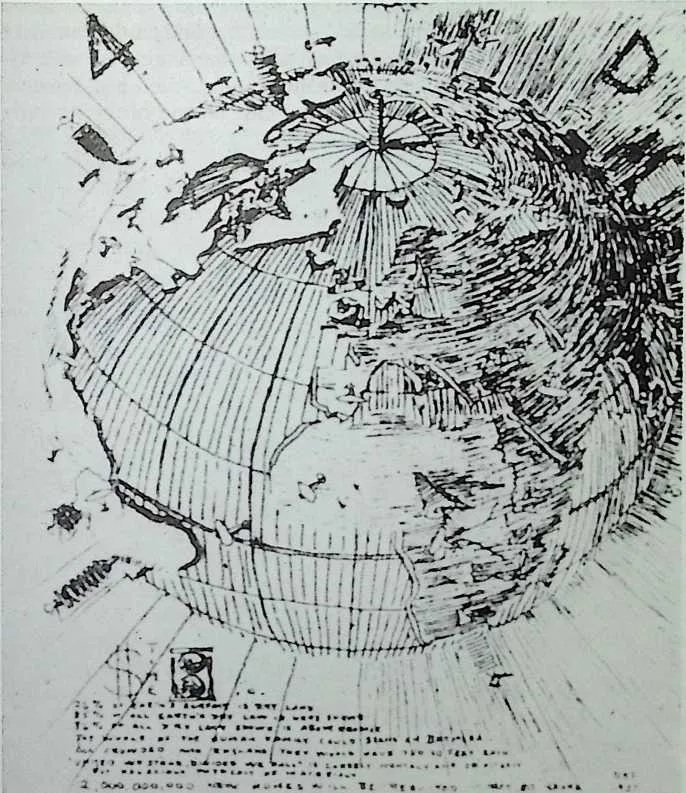
1718Because of that belief, Bucky embarked upon another seemingly impossible task, producing an undistorted World map. The first artifact he
created in that quest, which would continue for nearly twenty years, was his 1928 drawing of the ‘‘Air-Ocean World Town Plan.’’17
19 Because Bucky sought to show as much of the Earth’s landmasses as possible in a single drawing of a spherical Earth globe with no visible distortion, he spent hundreds of hours determining the exact position on a
21 I
2223Fig. 6-1 Fuller’s One Town, Air-Ocean World illustration.
24 globe from which the most land can be viewed. Like most of his work, that formidable task also became a learning experience as Bucky used it to acquire a true ‘‘feel’’ for the Earth as a solitary spherical Planet rather than a divided amalgamation of nations and regions.18
25 Eventually, he determined that a position directly above the French Riviera provided the single view from which the most land was visible. Since he was fascinated with interrelationships and the development of modem business, Bucky quickly noted that a great many of the wealthiest tycoons chose to vacation at the same location that he had determined to be at the center of the most visible landmass. In other words, the men who sought to control the World through financial domination had somehow selected the center of the most visible landmass as one of their primary recreation sites.19 Although this may appear to be an unrelated coin-cidence to most of us, to Fuller it was another indication of the complete interconnectedness of all Universe and every human action.
26 In addition to displaying a great deal of Earth’s land, Fuller also rendered his illustration with his image of future travel. In 1927 air travel was in its infancy. Lindbergh had just crossed the Atlantic, but the few commercial airline flights were regarded as exotic attractions for wealthy adventurers rather than practical travel options. For instance, regular flights across the English Channel and between Florida and Cuba existed, but most travelers used slower, less expensive ships for those journeys.
27 Although even the visionary Fuller did not forecast the massive, instantaneous expansion of aviation which would occur as a direct result of World War II, he did envision a network of global air travel which he embodied in the Air-Ocean World Town Plan. Fuller’s air travel ideas were quite practical for flight at that time, utilizing many medium-range flights to carry passengers around the World rather than the long-range flights which connect continents today. On his illustrated map, planes were depicted completing segmented trips between distant locations such as the United States and Europe by utilizing stopovers. For example, during the United States-Europe journey, passengers would spend the night at a halfway point somewhere in remote Greenland.20 Realizing that the locations of such stopover sites would be dictated by distance rather than facilities, Fuller also devised and illustrated a series of easily erected intermediary ‘‘ports.’’ At those remote but necessary locations, pas-sengers could rest while planes were repaired and refueled.21
28 Because of his extensive experience in the construction industry, Bucky knew that the type of building he required for remote locations such as the Amazon in Brazil, the Sahara, and remote reaches of Green-land, did not exist. The structures he envisioned had to be quickly erecta-ble, easy to maintain, and nearly autonomous. Since the projected stop-over sites were generally uninhabited, access to the supplies required to sustain life would not be easily available. Food and fuel would have to be flown in or produced locally with equipment flown into the site. Accord-ingly, Fuller was one of the first people to design buildings employing the revolutionary technology of solar and wind power.22
29 A more conspicuous problem was establishing an adequate shelter without bringing in hundreds of workers and the supplies to support them
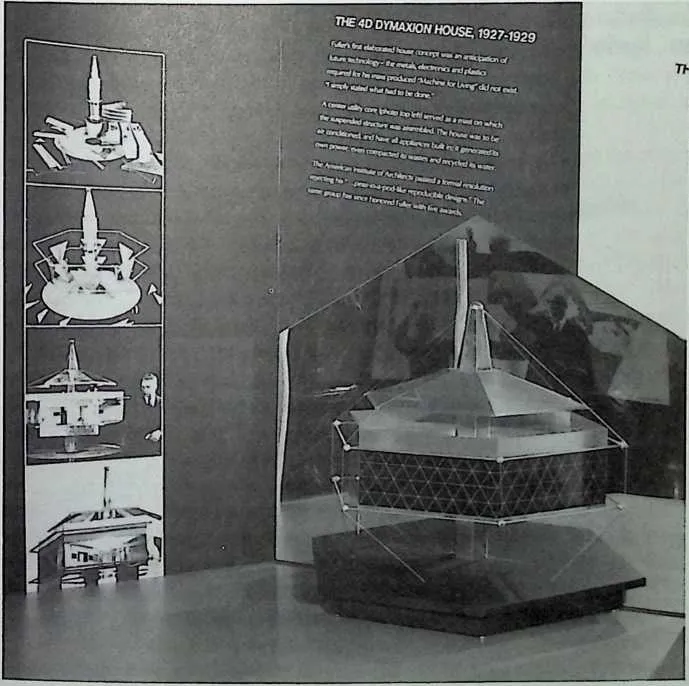
31 Fig. 6-2 4D House model displayed during a 1973 exhibition. Photographs of the original model being assembled and displayed are shown on the left.
32 for months of construction in harsh climates. Bucky perceived that ‘‘prob-lem’’ as an opportunity to again study the single issue which most fasci-nated him and which he felt provided the best opportunities to advance revolutionary new ideas.23 Hence, environmental control---shelter and housing---became a significant component of his global air-travel network.
33 By including environmental control as a part of that vision, Fuller was also able to integrate the autonomous housing ideas he had been considering for years into a ‘‘practical’’ application. He strongly believed that adequate housing was an innate human right, and that modem tech-nology should be applied to providing sound housing for every inhabitant of Earth. In looking to create an autonomous shelter for his remote landing sites, Fuller simply applied his single-family housing ideas to larger build-ings. Bucky’s basic concept was the 4D House, which quickly became
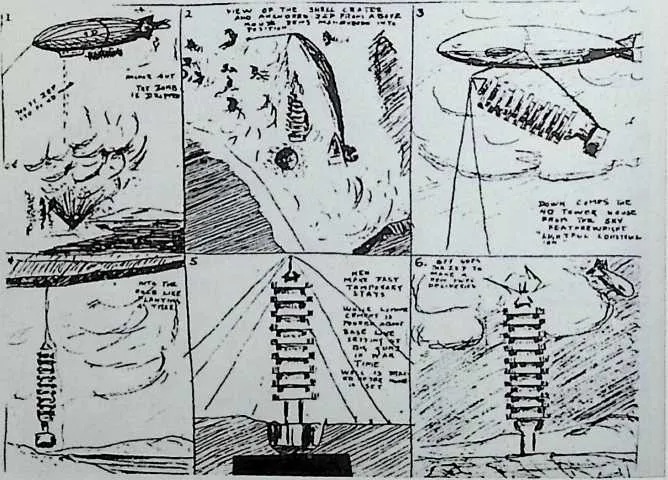
35 Fig. 6-3 Fuller’s plan for delivering and installing a ten-deck, preconstructed building in remote locations. Panel 1: The zeppelin carrying the building drops a bomb. Panels 2-4: The building is lowered into the hole created by the bomb. Panels 5-6: Workers temporarily secure the building with wires and fill in the crater around the foundation for permanent installation.
36 127 known as the ‘‘House on a Pole’’ because the living area was to be suspended from cables attached to a central mast. For housing at remote sites, he expanded that idea from a single dwelling to a ten-deck tower apartment which could be easily constructed on its side in a factory and delivered by air to any location.24
37 As Fuller felt that a designer was responsible for all aspects of a project, he spent many hours creating a practical, yet ingenious, technique for erecting those ten-story buildings. First, the structure would be built horizontally in a large factory, in a manner similar to the way modem aircraft are produced. The completed building would include an attached foundation structure which was to be lowered into the ground to anchor the tower. Once the enormous unit and all its plumbing and wiring was finished, it would be attached to the underside of that era’s most practical means of transporting huge items by air, a dirigible (rigid blimp).25 The dirigible would then fly to a predetermined site, where its crew would drop a bomb, instantly excavating a crater large enough to accommodate the building’s foundation.26
38 The base of the building would then be lowered, so that the structure was vertical, and the foundation would be eased into the bomb crater. Next, workers would secure the tower with temporary support cables from its apex to the ground. Pouring concrete around the base of the already operational structure was to be the final step in the simple procedure, which Fuller estimated would require less than a single day. Always relying on Nature for his best ideas, Fuller frequently compared that process to the planting of a tree.27
39 To demonstrate the practicality of global air travel, he drew several of those ‘‘planted’’ structures on his illustrated World map, along with small aircraft traveling between the remote sites and large cities. Even though his concept was rendered obsolete by long-distance air travel, at the time it was so realistic, yet radical and futuristic, that Fuller’s illus-trated map and ideas concerning such a possibility were reprinted in several magazines during the next few years as he became more publicly known.
40 Because he understood that improving global transportation and communication were advancing humanity toward a single World society, Fuller began referring to his illustrated map as the ‘‘One Town World’’ perspective. He continued refining and expanding that global perception, and in 1951 he coined a new descriptive phrase for it, ‘‘Spaceship Earth.’’28
41 To clarify his perspective of the relationship between human beings
42 to their environment, the caption on Fuller’s 1928 illustration-map read as follows:
434426% of earth’s surface is dry land. 85% of all earth’s dry land shown is above equator. The whole of the human family could stand on Bermuda. All crowded into England they would have 750 sq. feet each. ‘‘United we stand divided we fall’’ is correct mentally and spiritually but falla-cious physically or materially. Two billion new homes will be required in 80 years.29
45 In working to support individual families, Bucky sought to alleviate the massive housing problem he perceived on the horizon through another of his 1928 inventions, the single-family 4D House. The result of his diligent work on that project was a number of intricate drawings incorpo-rating sophisticated solutions to the issue and demonstrating the futuristic nature of his thinking. For instance, Bucky envisioned and designed a method of suspending the entire House from a central mast which con-tained the plumbing and the equipment for generating power as well as for distributing air, light, heat, and so on. The ‘‘rooms’’ of the house were actually sections independently hung from the mast so that they could be interchanged or removed and replaced when more advanced ‘‘units’’ were produced.30
46 The beds were to be pneumatic (i.e., air beds) so they could be inflated to a particular firmness. Rather than the usual types of rooms, Fuller envisioned a ‘‘catch-up-with-life’’ or utility room containing a laundry unit where clothes could be completely cleaned and dried within three minutes. That room would also accommodate all the amenities of a modem kitchen, including a dishwashing system which washed and dried dirty dishes and returned them to shelves.
47 The area which most interested him, however, was the ‘‘go-ahead-with-life’’ room, in which he planned to provide the residents with every-thing they needed for ongoing self-education. The area included a radio, the soon-to-become-practical television, maps, globes, revolving book shelves, drawing boards, typewriters, and other materials for learning.31 Although such a room may not appear very innovative in light of modem computer and communication technology, it was well ahead of its time and would have provided even the best scholars with more resources than most had available in their homes or offices.
48 Many people felt that the most remarkable aspect of the 4D House was Fuller’s estimate of its cost. At the time, an average American auto-mobile cost twenty-two cents per pound. Always searching for the most efficient means of production, Bucky resolved that his House was as much a machine as an automobile and should be mass-produced in a similar manner. Utilizing automobile standards, Fuller calculated the cost of a fully furnished, two-bedroom 4D House with appliances at twenty-five cents per pound.32 With a total weight of six thousand pounds, the com-plete price was to be $1,500, which translates to approximately $11,000 in modem dollars. For that price a family would be provided with nearly two thousand square feet of living space. Certainly, $11,000 would be a bargain price for any home today and even in 1928, when an average unfurnished home sold for $8,000, a completely equipped $1,500 house was perceived as beyond belief.
49 The 4D house was also designed to be autonomous and transportable. Once it was purchased, a family would never have to sell one house and buy another. No matter where they chose to reside, they could simply call a 4D House moving firm and have their home air-delivered to even the most remote site within a matter of days.
50 Conservation was always a key to Fuller’s philosophy, and no re-sources were wasted within the 4D house. Water was to be filtered and recycled, and rain was captured from the roof for future use. Solid waste was to be packaged and sent to be recycled at central processing plants. Power was to be derived from solar and wind energy gathered and stored in the mast.33
51 Although he had purposefully resolved never to publicize his efforts or his mission, word of Bucky’s eccentric ideas and monastic lifestyle soon spread, and he was frequently visited by interested observers. Since Bucky had not yet decided to speak, Anne was forced to speak with visitors, and she soon became Bucky’s spokesperson. He did, however, permit most of them to view his drawings. Late in 1928, those drawings along with explanations became the subject of a major illustrated article in the Chicago Evening Post, and some of Fuller’s 4D work was also pub-lished in the magazine Architecture that same year.34
52 The publicity from those extensive articles and other smaller ones attracted other inquisitive individuals, including a few who were intrigued enough to offer Fuller a small amount of financial assistance. With that patronage, he formed the 4D Company using a post-office-box mailing address and appointing himself as president. The first major action taken by 4D was to begin securing patents on the 4D House so that it would be protected for future production.35
53 In addition to his drawings, Fuller had also completed an enormous amount of writing during his years of silence. His work included more than two thousand pages of a book which focused on the future of human-ity and the function of human beings. It also dealt with shelter: the importance of developing mass-produced housing and utilizing the newest technology in housing.
54 In 1928, Bucky began editing that writing into a shorter format, and after weeks of work, the two thousand pages were reduced to a fifty-page booklet entitled 4D Time Lock. Fuller then presented the booklet to a group of eighteen members of the American Institute of Architects (AIA) whom he and his father-in-law had selected because of their reputation as open-minded, ffeethinking individuals. Those men praised Fuller’s work and skill as well as the 4D structures included in the booklet.36
55 The AIA’s ‘‘leaders’’ were not, however, so quick to accept Fuller. Still, Bucky sought to make his ideas as available to the public as possi-ble, and because his father-in-law was a prominent architect, Bucky asked him to offer the newly acquired 4D patents to the American Institute of Architects as a gift. Although some people construed Fuller’s motivation as self-aggrandizing, nothing could have been further from the truth. At the time, he believed that if he gave his revolutionary new ideas to a large organization which was extremely interested and involved in construction, those ideas would be disseminated to the public much more rapidly.37
56 Fuller’s gift was summarily rejected by the AIA’s board of directors, and he soon learned that his supposition that larger organizations are more willing and able to distribute new ideas was the antithesis of the truth. After examining his concepts, AIA’s board resolved that Fuller threatened their very profession and issued the following statement: ‘‘The American Institute of Architects is opposed to any kind of house designs that are manufactured like-as-peas-in-a-pod. ’’ 38
57 Because of their traditionally entrenched viewpoint, the board mem-bers felt that mass production would eliminate designers and architects rather than generate more opportunities for their members and all human-ity, as Fuller suggested. Forty years later, in 1968, that same organization awarded the celebrated designer and architect Buckminster Fuller (who had received no formal architectural training) their first architectural de-sign award for his Montreal Expo ’67 Geodesic Dome.39 Ironically, that design was also engineered to be inexpensively mass-produced.
58 Not one to be dissuaded by the criticism of those who did not under-stand or respect his unique ideas, Fuller used his own money to self-publish and distribute 4D Time Lock. He then sent copies to dozens of prominent individuals who he felt were influential in determining the
59 course of human development. Among those recipients were his friend Vincent Astor; Bertrand Russell; Harvard’s president, Lawrence Lowell; and Henry Ford.40
60 From that distinguished aggregation, Fuller received what would be the first of thousands of reactions to his writing, all of which were similar. Over the years, readers have invariably been enthusiastic about the con-tent of his writing. However, because of his intricate style, several of those reading 4D Time Lock responded that they were certain Fuller’s works contained unique ideas, but they could not detect them concealed within his complex language. In the booklet, Fuller displayed many of his drawings along with his belief that the housing industry had to become more mass-production oriented. He also continued his harsh criticism of big business and banking interests, which he felt were responsible for most of humanity’s economic problems.
61 In addition to writing and producing drawings, Fuller initiated the development of a more tangible representation of his ideas. With the help of a group of architectural students and the finances of the newly formed 4D Company, Bucky began work on a scale model of the 4D House. That model was completed in 1929, just as Fuller decided that he had some-thing worthwhile to say and resumed speaking publicly.41 However, from that time on, he carefully watched his words to be certain that every word was as effective, truthful, and positive as possible. Despite that discipline and his constant attention to language, most people still had difficulty understanding the nuances of Fuller’s highly complex ideas when he shared them.
62 Since a great deal had been written about him and his eccentric behavior during the previous year, Bucky began receiving speaking invi-tations. Among his engagements were speaking at the City Club of Chi-cago and the Chicago Home Owners Exhibition, where his 4D House model was being displayed. Such exhibits of the model resulted in more opportunities, including an offer from the huge Marshall Field department store.
63 Marshall Field was preparing to open a display of ‘‘modem’’ fur-niture imported from Paris, and its advertising and public relations depart-ment was searching for an advanced technology gimmick to legitimize the new line of furniture.42 Fuller’s futuristic House appeared perfectly fitted to their needs, and the public relations manager, Waldo Warren, asked Bucky to display his 4D House model next to the imported furniture. In an effort to draw even more potential customers into the store, Mr. Warren also invited Bucky to speak on the virtues of his design several times each day, and the naturally talkative Bucky, who now felt he had something important to say, quickly accepted.43
64 While formulating a promotional campaign for their exhibition, Mr. Warren and his associates were somewhat dissatisfied with the 4D desig-nation for Fuller’s ‘‘house of the future,’’ as it was to be publicized. The publicity-conscious advertising people felt that the house should have a more dynamic, catchy title, and they hired a ‘‘wordsmith’’ to work with Bucky in creating a new name for the dwelling. Although the process of professionally creating the name for a product or a company is common today, it was rare in the late 1920s, and even though he liked the 4D title he had selected, Fuller was willing to try something new. Hence, he entered into the process with excitement and enthusiasm.44
65 Bucky first described the philosophy behind the House to the word-smith, who wrote down the key sentences of his description. From those sentences, he extracted the most expressive phrases, from which he gleaned meaningful words, and from those words he found expressive syllables. Using those word fragments, the wordsmith fabricated a series of four-syllable ‘‘words.’’
66 Fuller then eliminated words he did not like from the list, leaving Dymaxion, which combined syllables from the words dynamic, maximum, and the scientific term ion.45 Marshall Field’s executives were so enthusi-astic about the term Dymaxion and the success of the exhibition that when it closed, they copyrighted Dymaxion in Fuller’s name. Bucky was also delighted with his new word, and he adapted it as his trademark. Thus, most of Fuller’s future inventions became ‘‘Dymaxion artifacts.’’46
67 The 1929 Marshall Field display of Fuller’s Dymaxion House and his burgeoning celebrity status provided Bucky with a new confidence in himself and his mission. That attitude resulted in his decision to move his small family back to New York following their annual summer trip to Bear Island.
68 Although his years of silent contemplation had provided Bucky with a sense of purpose, he had yet to change many of the reckless habits of his past. Feeling a powerful need to respond to an unremitting series of invitations, he made certain that Anne and Allegra were securely settled in a pleasant little house not far from her family on Long Island and set forth on an almost vagabond existence of travel, which he would maintain to some degree for the balance of his life.
69 With his model Dymaxion House disassembled in a huge suitcase, Bucky would travel wherever he was invited, and when not on the road he could usually be found hanging out with other artists and intellectuals in the Greenwich Village section of New York.47 His lecture schedule was filled with large and small venues, including Princeton University School of Architecture, Carnegie Institute of Technology, Yale University Archi-tectural School, and the Chicago Arts Club, but his most in-depth talks were at tiny Romany Marie’s tavern and restaurant in Greenwich Village, where he was a regular customer.48
70 It was there that Fuller met another aspiring young artist who would become his lifelong friend, the Japanese sculptor Isamu Noguchi. Noguchi’s fame, like Bucky’s, was just starting to surface during the fall of 1929 when the two men met. And, like most of America, they were suddenly caught in the throes of the Great Depression. Neither Fuller nor any of his fellow ‘‘starving artist’’ friends lost great amounts of money when the stock market crashed, but jobs quickly became scarce and fund-ing for nonessential items such as lectures and works of art became almost nonexistent.49
71 Always cunning, the somewhat homeless Bucky took to sleeping wherever he could. The floors of friends’ apartments, artists’ studios, and even lecture halls following an address became his bedroom until he had to move on.50 Fortunately, during his two years of seclusion, Bucky had developed a more natural rhythm of sleep which did not depend upon darkness or the time of night or day. He had examined the sleep patterns of animals, especially the dogs and cats living around the Fullers’ Chicago apartment, and found that animals did not wait until night to sleep. Dogs and cats simply slept when they were tired and appeared to require far fewer hours than human beings, who were usually conditioned to sleep only at night.51
72 Always willing to experiment with a new possibility, Bucky began sleeping in a similar pattern. Whenever he was tired, he would simply lie down or close his eyes for a short nap, and he soon found that once his body had adapted to that unique system, the sleep he required was reduced to only a few hours every twenty-four hours. Accordingly, he was able to work and study many more hours and was rarely tired.52 That ability was particularly handy during those last months of 1929 when Fuller, Noguchi, and many of their friends had to regularly scramble for food and shelter.
73 The Depression also affected his friend Romany Marie, and she was forced to move her establishment from Washington Square to Eighth Street just west of the old Whitney Museum. Romany Marie loved Bucky’s sense of design and radical ideas, and even though she could not afford to pay him anything, she asked him to design her new tavern and restaurant. She did promise that as payment she would give him a full meal every day as long as she was alive and in the restaurant business.53
74 During the Depression era, Romany Marie’s offer was quite lucrative to the impoverished Fuller. He was also open to any prospect which permitted him to demonstrate practical applications of his ideas and use his mechanical aptitude. Consequently, Bucky began work on the restau-rant. He selected a strikingly modem motif in which bright colors were illuminated by powerful bulbs placed inside huge aluminum cones. When he could not locate reasonably priced furniture to match the decor, the adroit Fuller simply designed and built the furnishings himself. The result of his efforts was a thoroughly modernistic restaurant which became an even more popular watering hole for the New York artistic crowd.54
75 With his open invitation for a daily meal and lack of finances, Bucky was a regular at Romany Marie’s. Still, as a gentleman concerned about the welfare of his friend, he did not eat there every day. Rather, he followed a methodical schedule of stopping by the restaurant for a meal only every other day. Bucky did, however, seem to appear at the cafe nearly every day to partake of the conversation, and he soon became a regular fixture at Romany Marie’s. In fact, Fuller’s incessant dissertations on diverse topics became so well known that many patrons came just to listen to them.55
76 Although Bucky found living from day to day somewhat difficult, he was motivated enough by his mission to forsake many creature comforts. Then, in a typical fit of Fulleresque inspiration, he discovered an ‘‘ideal’’ living arrangement for himself. As he was constantly seeking out the latest industrial technology, Bucky became very intrigued by a new type of warehouse under construction in Manhattan: the Lehigh Building, which was located over the Lehigh Railroad freight yards on West 26th Street. It occupied two complete city blocks and rose twenty stories high. In order to facilitate the rapid flow of goods, elevators were designed to lift fully loaded trucks to any floor. With that unique innovation, tenants could have cargoes delivered directly to their space in the warehouse with no inefficient loading and unloading at crowded loading docks.56
77 That remarkable facility was completed just as the Depression began, and it was largely empty when Bucky toured it. Upon reaching the ware-house roof, he was astounded by the panoramic view, which stretched from New York harbor on the south to the Hudson River in the west, and he decided that the roof of the building would be an exciting place to live. Examining the flat two-square-block roof, Fuller found only two struc-tures other than the huge tanks which supplied water to the building. One of those structures housed the massive elevator machinery, and beside it was a large, empty storeroom, which Bucky immediately decided would become his future home. Within days, he had convinced the rental agent to cut a window into the storeroom and rent it to him for a paltry thirty dollars per month.57
78 Although Bucky’s new home was ideally isolated for the raucous parties he and his artistic friends held almost nightly, it did present some conspicuous drawbacks. First, the elevator machinery was located next to Fuller’s storeroom-apartment, and it generated tremendous noise. More important, when that noise stopped for the day at five o’clock, the only access to his lofty abode was walking twenty-one flights of stairs.58
79 Still, many of Bucky’s friends were willing to endure that trek in order to attend his outrageous parties. With a concrete ‘‘yard’’ the size of two football fields and no complaining neighbors, those parties were usually loud and raucous. For example, one night Fuller and friends invited a troupe of African drummers who had been performing at the Natural History Museum to join in the rooftop festivities, and they played well into the night with no complaints from anyone.59
80 By the summer of 1930, Bucky had learned to live on his wits and a tiny amount of money. Most of what he earned went to support Anne and Allegra, who continued living on Long Island and were visited by Bucky on weekends whenever possible. He believed that he had freed himself from the constraints of working at a job to earn a living until what he regarded as a nearly perfect employment opportunity presented itself.
81 Officials of the American Standard Sanitary Manufacturing Com-pany, a large producer of plumbing fixtures, had read articles about Full-er’s Dymaxion House and noticed that the bathrooms were to be mass-produced as a single unit. The idea of selling an entire bathroom rather than individual fixtures appealed to the management at Standard Sanitary, and they offered Fuller a research position designing the prototype bathroom he envisioned. Although that position was a regular job, Fuller viewed it as an opportunity to research and work on an issue which he believed was of profound significance, plumbing. Thus, he accepted the offer.60
82 Being a comprehensivist, the curious Fuller could not simply design a bathroom. Rather, when he began working at American Standard, he embarked on a sweeping examination of human sanitation which provided him with an appreciation of the enormous influence that plumbing has on humanity.61 While studying plumbing and its relationship to other aspects of the environment, Fuller was able to progress beyond mere pipes and fixtures to consider the complete process of human cleansing and waste disposal. As early as the early 1930s, he calculated that people were extremely wasteful in squandering several gallons of pure water with each flush which disposed of only a small amount of human waste.62
83 Although a great many people today appreciate the magnitude of this problem, at that time clean water was viewed as an inexhaustible re-source, and the issue of flush toilets was of little interest. Fuller deter-mined that a great many life-supporting resources could be conserved and many benefits provided for all humanity by merely changing people’s wasteful flushing practices. He also recognized that the plumbing industry itself posed a multitude of problems he could tackle and transform into opportunities for contributing to humanity.
84 While working for American Standard and examining plumbing comprehensively, Fuller also discovered the primitive nature of sanitation technology. He was astounded to find that a single man had designed all the toilet bowls manufactured in the United States. He also established that no one working within the industry was aware of the origins of the toilet bowl’s design and construction and that those unchanging design and construction techniques were almost never questioned.63
85 Always curious about technology and manufacturing, Fuller visited the man who was designing the toilet bowls and discovered that that man had acquired his craft from ceramic workers in England and had trans-ferred their antiquated methods across the Atlantic intact. Bucky also found that major corporations like Standard Sanitary and Kohler regularly dispatched officials to the man’s simple, one-room workshop in Toledo, Ohio, in search of production designs and information.64
86 He was amazed to discover sophisticated modem corporations ren-dering unquestioning allegiance to such archaic manufacturing tech-niques, designs, and materials. No one, from the consumer to the manu-facturer, seemed to question the fact that during a period in which aircraft engineers were developing more efficient materials and designs on a regular basis, bathroom fixtures were, and generally still are, being fabri-cated from heavy, yet fragile ceramics and outdated designs.65
87 Upon further examination of the field of plumbing, Fuller found that the tolerances employed in the manufacture of toilet bowls were extremely large. If manufacturers could maintain a range within one-quarter inch in the dimension of an opening, they felt they were doing a competent job.66
88 Such measurements were adequate because, unlike metal fabrication, ceramic work cannot be precisely controlled, and heavy ceramic material is very difficult to work with. Although plumbing manufacturing toler-ances were acceptable to most people, Fuller compared them to other industrial standards of that era, and he was not satisfied. It was a simple matter for Bucky to calculate that if an automobile or airplane were built to similar specifications, parts would be constantly rattling around, ma-chinery would regularly fail, and very few cars or planes would be fabri-cated soundly enough to be operational.67
89 Fuller also resolved that exploiting enormous amounts of precious resources for the inefficient production of heavy ceramic bathroom fix-tures was illogical and unnecessary. To pragmatically demonstrate a more efficient solution to that problem, he invented a lightweight stainless-steel toilet bowl similar to the ones now used in jet airplanes. Fuller’s design could also be inexpensively manufactured in two halves using modem metal stamping technology. When applied to plumbing, such readily available technology resulted in a high-quality precision product which required far fewer resources than ceramic toilet bowls.68
90 Bucky then expanded upon his toilet bowl idea and designed a self-contained, mass-producible bathroom which employed the most advanced technology available. That revolutionary unit was a technological master-piece; however, Standard Sanitary did not have the foresight to establish and demonstrate the benefits of such a product to the public prior to its completion.69 Consequently, when the plumber’s union learned that Full-er’s bathroom could be installed with four simple connections in a matter of minutes and would replace all the individual pipes and connections which constituted the majority of their work, they castigated the project in their trade papers. As plumbers were Standard Sanitary’s principal cus-tomers, the union’s reaction brought an immediate response. Within days, Standard Sanitary’s management abruptly terminated Fuller’s project, hid his prototype unit in a subcellar warehouse, and hoped that the union’s hostility would quickly fade.70
91 Although Bucky had devoted six months of intense effort to the project, he was not disheartened. He felt that he had learned a great deal about a major issue which was not being considered by anyone and that his insight would be useful in the future. Bucky’s intuition proved correct, when less than six years later he was invited to tackle the sanitation problem again, and he completed the development and production of his mass-produced Dymaxion Bathroom under the auspices of Phelps. Dodge Corporation.71
92 Bucky did experience one unfortunate consequence of his work with Standard Sanitary. Always the genial host, he had invited some of his fellow employees to the ongoing parties at his rooftop apartment.72 His boss, the head of the research department, was particularly impressed with the residence, and in 1931 Bucky returned from a lecture tour to find himself evicted. The research manager had secretly contacted Bucky’s landlord and offered him a much higher rent for the space, but the two conspirators had to wait for Bucky to break his lease obligations. The 1931 lecture trip provided the opportunity as, with his usual disregard for financial matters, Bucky had forgotten to pay the rent in advance as promised, and upon returning he found his ideal space had been rented to his former boss.73 Once again Bucky was without a home and dependent on his wits to negotiate the perils of daily life on the street.
93 With typical Fuller timing, Bucky had embarked upon his newest endeavor the previous year while he still enjoyed the luxury of a some-what permanent residence and a regular salary. Although he had no expe-rience in the field of publishing, Bucky felt that he needed a vehicle in which to formalize his ideas for the public, especially those individuals involved in architecture and construction. Never one to start off small, his first endeavor at publishing was the taking over of an entire magazine.74
94 The two Levenson brothers of Philadelphia had been publishing a relatively new architectural magazine named T Square, which was subsi-dized by George Howe, a wealthy architect. The publishing firm of Charles Scribner’s Sons also produced an architectural magazine with that same name, and they held the copyright to the title. When Scribner’s learned about the Levensons’ periodical, they immediately demanded that the Levensons stop using the name T Square. Unwilling to become in-volved in legal issues, Howe removed his financial support, and the magazine was about to discontinue publication when the Levensons con-tacted Fuller.75
95 In a typical Fulleresque flash of idealism, Bucky decided that the magazine would provide an excellent forum for his latest ideas on con-struction and would help him to prod the architectural community out of their archaic resistance to technology. Without the slightest hesitation, Bucky resolved to cash in all his insurance policies and become publisher of the magazine, which he renamed Shelter. His first act as publisher would be regarded as suicidal by any businessperson. In the midst of the Great Depression, he canceled all the advertising being run in Shelter.16 Bucky later made the following comment, reflecting on the integrity of his action as well as his total lack of financial concern:
9697I felt compromised because your advertising contracts required that you come out on a certain fixed date and I said, ‘‘Anybody publishing on a deadline is obviously being forced; he is doing it to make money, and he is not coming out only when he needs to. I put my magazine on a spontaneous basis. It would come out when we had something to say, and when we were ready to say it and say it right.’’77
98 Bucky’s second major publishing decision was even more controver-sial than banning advertising. To cover his expenses, he raised the price of a single copy of Shelter to an outrageous two dollars and promised sub-scribers that, although he would not publish on a regular basis, they would receive as many issues as they paid for in advance. Two dollars may not appear expensive today, but during the Depression, when a few cents would buy a loaf of bread, it was an enormous sum, akin to charging twenty dollars for a copy of a modem magazine.78
99 Still, Shelter succeeded. That success was based largely on Bucky’s dedicated enthusiasm and unique editorial content. By November of 1932, the magazine’s average circulation had reached 2500 copies, and it was producing adequate receipts to sustain itself. Fuller was able to create that miracle by editing the entire publication himself, while receiving little or no financial compensation. He also persuaded other bright young men who were eager to use the magazine as a forum for new ideas to write articles with little or no financial recompense. For example, the first issue featured the aspiring young architect Phillip Johnson as the ‘‘guest editor. ’’79
100 Each issue focused on a single theme which Fuller felt was signifi-cant, and true to his word, Bucky would not publish any issue until he felt that it encompassed the latest thinking on a particular subject. For in-stance, Shelter's second issue concentrated on environmental controls and contained graphic photographs of black smoke pouring out of East Coast factories to emphasize the danger that pollution was creating.80 Even though most readers were confused by the strange new word ecology presented in that issue, some people realized that they were being pro-vided with insight into the future, and readers began to seek more from Shelter's mysterious editor.81
101 The magazine’s editor was mysterious because, even though he edit-ed Shelter and wrote many of its articles, Fuller’s name never appeared in print. Having learned just how jealousy and competition tend to hinder the thinking and openness to new ideas of creative people, including archi-tects, designers, and artists, Bucky decided to remain anonymous. Rather than claim any of the ideas as his, he would simply refer to himself as ‘‘4D,’’ an unnamed person or group who presented the ideas.82
102 Although unorthodox, his strategy succeeded until Bucky encoun-tered one factor which would continue to dictate the course of his life: his love of change and action. Writing about ideas was certainly one mode of contributing to humanity; however, given a choice, Bucky would invari-ably select a more ambitious, active mode of operation which allowed him to participate directly with his fellow human beings.83
103 Following that passion, in the autumn of 1932, he decided to close down Shelter. His primary motivation stemmed from his belief that Frank-lin Roosevelt was going to be elected President of the United States and that his New Deal administration would provide a rejuvenated atmosphere in which liberal ideas and the people who embraced them would flourish.84
104 After making that decision, Fuller informed his subscribers that he was going to put all his ideas and information which had not yet been published into one final gigantic issue and cease publication.85 Since Shelter was on the verge of becoming a very profitable operation, Bucky’s decision surprised most people. Those who knew him, however, realized that he was not motivated by financial gain, and within that context such a decision was logical. Although Bucky was able to publish that final issue and close Shelter with no outstanding debts, he did not recover any of the money he had invested in the project, and as 1933 dawned, he found himself again homeless and without financial resources.86 This time he was also without the cushion of his insurance policies.
105 Bucky continued to develop and employ the characteristics which had supported his constant exploration and ability to ‘‘thrive’’ throughout the previous several years. His mental dexterity and creativity, as well as his controversial but charismatic personality, were his primary assets, and he continued to utilize them during his frequent visits to Romany Marie’s, where he would talk for hours on end. It was there that he perfected a speaking technique which he had begun to formulate during his years of silence. The one person with whom he had continued to speak at length during his self-imposed silence was his infant daughter Allegra.87
106 As noted earlier, Fuller was convinced that infants are born with a great deal of intellect. In fact, Bucky believed that infants naturally know more than adults, and he decided to honor that intelligence by always speaking spontaneously to Allegra as if she were a wise adult. The result of that resolution was Fuller’s developing a form of consciously ‘‘thinking out loud’’ for his daughter during the sporadic times he was with her. No matter how complex the thought, Bucky was constantly sharing his ideas with Allegra without censorship or concern for her apparent ability or inability to understand. Later, when he began to speak to others, Fuller maintained his discipline of ‘‘thinking out loud’’ rather than delivering a set of preconceived ideas and well-planned words.88 At Romany Marie’s, those spurts of spontaneous thought were well received by a fascinated clientele.
107 Romany Marie herself was descended from a long line of Russian Gypsy mystics, and a group of mystical types gathered around her. One of the most well known of those individuals was the guru Gurdjieff, who was a frequent visitor to the cafe, where he and Bucky were known to get into some fascinating discussions.89 After observing the operation of Gurdjieff and other guru-leaders, Fuller noticed that he himself was beginning to attract a coterie of ‘‘followers’’ who accepted his words as gospel. As he would later recount, ‘‘I found myself being followed by an increasing number of human beings, particularly women, who were beginning to make me into some kind of messiah. I became a cult, and that was exactly what I did not want to be.’’90
108 Bucky wanted each individual to think for himself or herself and not to blindly accept the beliefs of others. In order to dissuade those who sought to unquestioningly accept his ideas and who refused to think for themselves, he made a New Year’s resolution that as of January 1, 1933, he would go out of his way to discourage followers. He felt that the easiest way to keep such people from deifying him was to become as unappealing as possible.91
109 Although that rationale was logical in Bucky’s mind, it also con-cealed some of the rougher facets of his personality. He loved outrageous behavior, be it taking a position on behalf of all humanity or standing out as the loudest person at a party. Claiming that his rowdy behavior was predetermined to keep people from following him may well have been his way of justifying behavior he felt compelled to exhibit but of which he was often later ashamed.
110 Having lived in a raucous freewheeling manner for a good portion of his life, outlandish behavior, whether planned or not, was not a difficult assignment for Fuller. Not everyone avoided him, however. The insights he expounded in his talks and in Shelter were recognized as unique and deserving of further evaluation by many people. Accordingly, he con-tinued to receive offers constantly. One such offer would consume the next few years of his life as he shifted his focus to an idea he had first considered in detail during his years of silence: the ‘‘zoommobile.’’92