
2 Experiential Education
2A great deal of Fuller’s own formal and informal education M was predicated upon experimenting with and discovering the elegant simplicity of universal patterns he found in mathemat-ics. Bucky’s love of geometry, in particular, began with his kindergarten exposure to the construction tools of dried peas and tooth-picks and continued through Milton Academy and Harvard. It did not, however, stop when he left Harvard.
3 As an apprentice at the Sherbrooke textile mill, he was intimately involved with geometry. Although his Canadian experience was supposed
4 to provide a lesson in acceptable conduct and the results of rebelling against the system, Bucky found it to be a practical apprenticeship rather than a punishment. At the mill, he continued examining the shapes and
5 patterns which so fascinated him, and, in the process, he was able to solve many of the problems he encountered.1 In fact, he was able to employ his geometrical insights to improve upon designs which had been used satis-factorily for decades.
6 Fuller also continued to examine and reexamine the natural geo-metric patterns and shapes he first discovered on Bear Island. He felt that all of Nature was predicated upon a geometric coordinating system which, if discovered, could be of great benefit to humanity. Consequently, Bucky set out to uncover it. Over the years, that quest for Nature’s coordinating system became one of his principle missions. His early ideas percolated with his exploration and, by the late forties, he felt he had discovered many of the fundamental elements of that system, which he called Energetic/Synergetic Geometry.2 Later, he abbreviated the title of his new discipline to Synergetic Geometry (also known as Synergetic Mathemat-ics'), and in the late seventies, he was able to compile all his findings on the subject into two massive volumes, Synergetics and Synergetics 2.
7 Although detailed and complex, those books reflect Fuller’s love of simplifying phenomena so that they could be easily understood by every-one. Within the Synergetics volumes Fuller employed two techniques which he had discovered were extremely helpful in explaining his ideas: the construction and display of actual models and the use of narrative story-like examples. He felt that one of the best methods of understanding both the physical and metaphysical phenomena which he felt dominated all Universe and the principles that control those phenomena was the construction and display of models.3 He also found that geometry pro-vided an excellent vehicle for experimentation with basic shapes as well as the development of models, and that geometric models and principles could be applied to other, more specific areas.4
8 Over the years, Fuller would present thousands of lectures and dis-plays using geometric models as a basis for more detailed explanation. Invariably, he discovered that his audiences, like most people, had ig-nored or abused the immense possibilities geometry provides because they had been led to believe mathematics and science were arduous disciplines relegated to a small band of specially trained individuals. Bucky also found that many people’s formal education distorted the context of science and mathematics to such a degree that those areas were clouded and removed from the realm of everyday human experience.5 He discovered that most of us examine and understand phenomena which we personally experience, and that the more we encounter those phenomena the better we comprehend them. Yet, although we humans are inundated with the products and innovations of science and mathematics, our education tends to hamper most of us from appreciating the foundation of those results.6
9 Today, a majority of people are exposed to formal science and math-ematics only in schools, which generally focus on abstract principles that tend to confuse students rather than enlighten them. Furthermore, the relationships between those principles and everyday individual experi-ences are ordinarily not explored.
10 Fuller’s own formal education did little to train him in the exploration process which supported his work so successfully over the years. Al-though the content of his formal education was different from that of today’s children, its context was very similar to the specialized training provided for most modem children. Later in life, remembrances of his restrictive educational experience continually reminded Bucky of just how debilitating our educational system can be for curious young minds.
11 He felt that, like almost all human organizations, including govern-ments, industries, and religions, the primary function of the educational system is self-perpetuation and acquisition of fame, fortune, and power for the people who control it. Rather than contributing to the wisdom and well-being of everyone, he believed organizations attempt to indoctrinate individuals into accepting traditional dogma, restrict the perspective of members, and influence individuals to believe rather than think for themselves.7
12 After only a few years of exposure to that educational system, an individual becomes very confused. Then, true learning and independent thinking become even more difficult. Fuller often related a personal exam-ple which vividly illustrates such confusion. He would recount how he had been taught fractions using a technique similar to the one still em-ployed in many schools today, and how that basic instruction created problems in his advanced mathematical education.8
13 One of Bucky’s first teachers explained that although fractions were numbers, they represented a portion of either a single item or a group of identical items, and therefore, a fraction had to contain the same items on the top and the bottom. The teacher continued by emphasizing the fact that a fraction with dissimilar elements, such as elephants on the top and peas on the bottom, was illogical and unworkable. Because it was consistent with his personal experience, requiring elephants or any other item on both the top and bottom of a fraction seemed logical to young Bucky. Thus, he accepted the axiom, but years later that axiom confused him when he began studying another aspect of mathematics: trigonometry.9
14 In learning trigonometry, he was instructed that the sine and the cosine both represent ratios (known as fractions) between the length of a triangle’s edge and the degrees in the arc of one of its angles. Although Fuller could not initially pinpoint his discomfort with that dictum, he felt uneasy about it, and he soon discovered that the concept of sine and cosine appeared to be illogical when compared tp both his experience and his earlier study of mathematics.10
15 Bucky specifically recalled his previous wqrk with fractions and the fact that they could not accommodate elephants (edge lengths) on the top and peas (degrees of angles) on the bottom. When he questioned his teachers about that seeming disparity, they agreed that ratios were in fact fractions and that sine and cosine represented unequal elements on the top and the bottom. They also directed him to overlook that apparent contra-diction and accept their authoritarian contention that such ratios were reasonable.11
16 Fuller’s childhood query illustrates a primary reason why, even to-day, many students find trigonometry difficult. Although few people then or now have been able to pinpoint their difficulties with trigonometry, Fuller felt that problems arise as a result of attempting to equate seemingly dissimilar elements within ratios. Because of his insatiable curiosity, Full-er was not satisfied by his teachers’ edicts and explanations, and he continued in his personal quest to understand the logic of mathematics.12
17 Years later, Bucky found that his teachers were, in fact, correct in their dictum that sine and cosine were reasonable ratios, when he dis-covered an explanation which corroborated his teachers’ mandate without contradicting his earlier lessons or personal experience. In that discovery, Fuller once again realized the importance of examining large systems rather than minor, special-case instances. In trigonometry, the larger sys-tem is spherical trigonometry which includes plane trigonometry.13
18 While studying spherical trigonometry, Fuller discovered that the edge
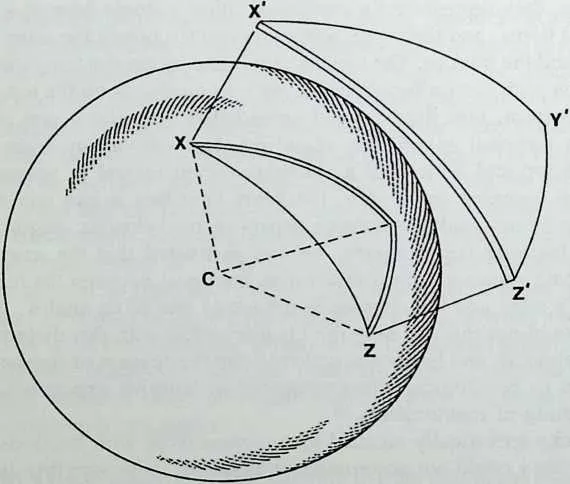
20 Fig. 2-1 Sine and cosine are actually relationships between the angles formed by lines from the center of the sphere (C) and the vertices of the spherical triangle (X,Y,Z) rather than between the edges of the triangle and its angles. For better perspective, the section of the sphere which is the spherical triangle is shown removed from the sphere itself (labeled X', Y', and Z').
21 of a triangle drawn on a sphere (XZ) is also the arc of the angle formed at the center of the sphere (C) by lines joining that center point to the ends of the triangle’s edge (lines CX and CZ). With that understanding, he determined that the sine and cosine ratios actually denote relationships between the center angle and the surface angle of a triangle drawn on a sphere rather than between the edges and the angles of flat triangles, as most students are taught. Such a ratio of angles to angles was completely logical to Fuller, and it again reminded him of the importance of searching for the largest perspective possible in every aspect of his work.14
22 Fuller’s lifelong examination of human educational systems led him to the conclusion that trigonometry, like the majority of formal education, does not respect students’ feelings or their sense of what is natural and logical. Authoritarian teachers expect their students to accept definitions such as sines and cosines without question or thought, even though such information appears to contradict rules taught earlier, or the child’s innate understanding of Nature’s orderliness.15
23 Educators with the most honorable of intentions stifle rather than stimulate children’s minds, just as their own minds and creative thinking processes were obstructed by the dogma of former generations. Fuller felt that even though phenomena can be reduced to an array of disconnected elements, by doing just that our educational system tends to discount the significance of the relationships between elements. Because they provide the essential operating material for human minds, those relationships are indispensable to human beings.16
24 As both a student and a teacher, Fuller later felt that modem educa-tion should concentrate on the significance of an individual’s experience and the relationships inherent within those experiences.17 By shifting the educational system toward such a focus, society could provide students with much more than an array of unrelated and seemingly useless facts. Children could then graduate into the ‘‘cold, hard world’’ wi± an under-standing of principles and how principles are applied, and those realiza-tions could be adapted to many different practical situations.
25 Provided with such an appreciation of general principles, individuals could more easily think for themselves as well as apply their formal and informal education to the tasks of daily life. People would also be able to examine isolated elements of their environment within a context of lucid whole systems that relate to one another, just as Fuller did once he had overcome the limitations of his formal education.
26 Through years of examination Bucky concluded that the teaching of abstract scientific principles in ways which contradict the direct experi-ence of individuals was a significant problem.18 Nowhere did he find that phenomenon more conspicuous than throughout the field of geometry, and he sought to help alleviate the problem by frequently speaking about the relationship between personal experience and geometry.19
27 One of his favorite narratives addresses that problem directly using three elements which were consistently involved in Fuller’s life: triangles, children, and geometry. At some point during almost every one of his lectures, Bucky would recount the absurdity of teaching children that a triangle is a shape which always appears on something the teacher desig-nates as a ‘‘flat plane.’’20 Always the curious experientialist, Bucky dearly wanted to see or feel just one such flat plane, and he consistently questioned teachers and experts about that issue. Even though, as a boy, he realized that no one could ever show him the single component which geometry teachers predicated so much of their work upon, by questioning, he continued to challenge people to reconsider their position.21
28 As he examined the situation, Fuller discovered that years of inaccu-rate instruction in plane geometry led people to assume that triangles occur naturally in this condition, even though a two-dimensional ‘‘flat plane’’ simply does not exist. Through years of trial and error, Fuller found that he could not even conjure up a flat plane in his imagination. Every time he attempted the process, his image always contained some depth because it could not be created any other way. He found that although of some limited use as a concept, discussing ‘‘flat triangles’’ as if they were tangible spawned more problems than it solved.22
29 From experience, Bucky also learned that although the two-dimen-sional triangles studied so intently in schools do not occur naturally within Universe, triangles are a fundamental component of all structures. The natural triangles which provide the foundation for structures are, however, never two-dimensional and rarely occur in the ‘‘flat’’ configuration stud-ied by children. Instead, most indigenous triangles are spherical.23
30 Spherical triangles are triangles whose three sides constitute arcs of a sphere rather than straight lines (Fig. 2-1). Because those naturally occur-ring spherical triangles are primarily tiny segments of much larger struc-tures such as trees or rocks, humans rarely observe them. Even when specialists studying microscopic objects or sections of organic material have uncovered spherical triangles (as was the case with the shells of viruses), they generally have not translated their knowledge into practical
31 information which can be taught to children and applied to the problems of humankind.
32 Fuller examined our educational system in great detail throughout his lifetime and found that even in the 1980s children were still being taught the same geometric concepts of shape he had been exposed to at the turn of the century. He felt that geometry and other subjects taught as abstract courses tend to indoctrinate children into a system which supports spe-cialization.24 That system also induces individuals to invalidate their per-sonal experiences and believe themselves to be remote and removed from other individuals, societies, and Nature. Once he had attained a compre-hensive appreciation of most subjects studied in schools, Fuller set out to share his insights with interested individuals.
33 In speaking about the inadequacies of our educational system, Fuller would explain that in their first formal exposure to geometric shapes, children are taught that a triangle is an area bound by a closed line of three edges and three angles.25 Similarly, a square is defined as an area bound by a closed line of four equal edges and four equal angles. Most shapes used in elementary geometry are likewise defined as areas bordered by connected lines, and those definitions support the indoctrination of indi-viduals into a system which views only the inner area of a shape as being that figure. Fuller elaborated upon that observation to conclude that peo-ple educated within such a system would perceive only the inner area of any boundary or limitation to be important.26
34 Humanly conceived systems (i.e., cultures, religions, societies, and so on) categorize everything outside the borders of ‘‘our group or lo-cality’’ as separate from and less significant than the ‘‘us’’ who reside within the border. Whether the limiting system is a family, city, sports team, corporation, or anything else, Fuller felt that such divisive systems have been utilized throughout history to obstruct new organizations of individuals and maintain the status quo of power within the hands of a few. He also felt that such systems indoctrinate people into the current ‘‘you or me’’ mentality which threatens the very existence of all Earth.27
35 Since he had been ostracized from social groups as a youth, Bucky had a direct, personal experience of that separation, and his remembrance of that feeling contributed to his philosophical inclination. Having known the trauma of being relegated to the outside, Fuller sought ways to spare others from the pain of similar castigation. Even within something as fundamental as elementary geometry, he found children being exposed to propaganda which could eventually influence them to oppose other human beings for being different or outside the accepted boundaries of a particu-lar group.
36 Fuller did find that the individuals perceived as different were rarely ostracized from a particular society because they championed revolution-ary new ideas or thought for themselves. Rather, they tended to be viewed as outsiders because of commonly held beliefs which were predicated upon antiquated guidelines. Even society’s worst villains, like the people judging them, remained within relative limits imposed and defined by leaders and ancestors.28
37 Bucky believed that the few true radicals who attempted to live well outside those limits did realize, as he did, that such restrictions were the product of earlier generations who had experienced an entirely different set of circumstances. The environment of those previous eras then dictated boundaries for future generations and were held to be important by de-scendants, even though circumstances had usually changed radically.29
38 For example, during the early stages of the industrial revolution, most people believed that the natural environment was unlimited and was therefore the perfect disposal site for industrial waste. That belief, al-though untrue for any generation, was championed primarily by indus-trialists, who realized that dumping waste into rivers or other convenient locations was far less costly than recycling or determining if a substance was harmful. Such views have been ‘‘sold’’ to the general public for decades, and only in recent years, when the results of those greed-oriented actions has become more and more obvious, have some individuals begun to truly rebel against the power of the enormous bureaucracies which created the problem.
39 Still, even the most radical environmentalists tend to attempt work-ing within the limits of the societal system in which they live. They further try to influence governments rather than realizing that the systems which created the problem are predicated on conditions which no longer exist. Therefore, the systems themselves are obsolete. Despite years of making little or no progress in influencing the system or the powers who dominate it, individuals who have been strongly indoctrinated into a particular society remain convinced that the system can work for the greater good of its members. They refuse to realize that any traditional system is, and will most likely continue to be, strongly biased in favor of the gigantic indus-trialists, lawyers, and financial manipulators who dominate most institutions.30
40 Although those conventional systems and the actions they supported were appropriate during earlier times when basic resources were scarce, Fuller felt that they were simply of no use to modem individuals and were, in fact, more of a hindrance than an aid in solving the problems which confront our global society.31 He was particularly distressed by our educa-tional system because it is predicated on specialization and divisiveness, which he believed are counterproductive in modem society. Even during the 1930s, Fuller was convinced that a fully cooperative era was dawning in which one individual’s well-being could not be fulfilled until every person on Earth was provided with the necessities of life.32
41 At the time, Fuller also determined that the ‘‘you and me’’ era which is now becoming a key element of modem society would become a genuine possibility in the early 1970s. He announced that approaching transformation after he had documented that the advances of technology were producing a situation in which the resources on Earth would become sufficient to sustain every human being. The date he prognosticated for that change was 1970.33 Following the realization of that predicted shift, Fuller felt educational systems, as well as most people’s traditional be-liefs, would became even more outmoded than ever before.34
42 In considering societally administered formal education and geome-try as taught in schools, Fuller found the system to be extremely restrictive and not aligned with Nature’s procedures or his personal experience.35 For instance, his experiential focus led Fuller to appreciate the importance of the simple fact that a triangle, or any other figure, must be represented upon some substance. Even an imaginary triangle is envisioned scratched on the ground or drawn on some material as basic as paper or as sophisti-cated as a computer screen. No matter how resolute an individual is in attempting to create or imagine a concept (be it a triangle, love, or any-thing else), the human brain will always envision a specific experience or item.36 Neither children nor adults can relate to the conceptual examples of ideal shapes used in elementary geometry classes without translating those examples into special-case instances. Human beings require finite, tangible illustrations for effective learning, but because a plane cannot be experienced or depicted, such examples are impossible within the realm of traditional plane geometry.
43 After years of being frustrated by the conventional educational sys-tem, Fuller set out to discover the experiential geometry employed throughout Nature. He theorized that because Nature’s operation is tangi-ble, it has to function within the confines of a limited, yet viable, coordi-nating system, and that understanding Nature’s coordinating system could be of enormous benefit to humanity as well as to his work.37
44 He felt that once people understood the simple efficiency of Nature’s system, they could consciously apply its principles to numerous and var-ied aspects of life, be they design, disease control, or education. Bucky believed that when people truly understood and appreciated Nature’s ways, human behavior would enter into a process of mirroring Nature’s operation of perfect harmony and maximum efficiency.38
45 He felt able to vigorously pursue and uncover the essence of Nature’s coordinate system because of his ability to understand a fundamental relationship between the human brain and the human mind. Fuller defined human brains as biological organs which relate only to specific finite experiences and, consequently, which always provide a particular exam-ple when information is requested.39
46 Human minds, on the other hand, he defined as unlimited meta-physical phenomena which search for relationships between specific ex-amples and uncover the generalized principles upon which phenomena are predicated. An individual’s mind does communicate and work in conjunc-tion with his or her brain.40 In the triangle scenario, the person’s mind scans the various triangle images presented by the brain in search of relationships and may eventually uncover the common mathematics which describe the generic shape ‘‘triangle.’’
47 With an understanding of those mathematical principles, the indi-vidual’s mind can further elaborate upon relationships and apply the gen-eral knowledge discovered to other experiences of triangles. However, even though an individual may understand a principle independent of limitations such as size, color, or time frame, that principle is still forever visualized with explicit characteristics. In the case of a triangle, it always appears with dimensions, texture, location, and so on.
48 Fuller observed that throughout history many philosophers and thinkers have attempted to modify the human thought and visualization processes and have failed. Consequently, he theorized that minds deal only with concepts and relationships, and that brains accept and under-stand only specific instances and items.41 Like many curious individuals before him, he came to this realization only after years of unsuccessfully attempting to function in an idealistic, conceptual mode. Once he clearly worked out the operational relationship between mind and brain and the fact that human beings can function only within the limits of tangible components, Fuller shifted his focus to specific inventions and procedures from which he could extract generalized principles.42 By working in that manner, he was able to operate more effectively while developing models and inventions which could be displayed and appreciated by others.
49 Fuller felt that every human being is born with an innate understand-ing of the relationship between brain and mind as well as a natural feeling for and attraction to the most effective modes of human operation.43 As a result of those characteristics, young children are constantly learning by employing a system which has always been part of the human experience: trial-and-error experimentation. Such experimentation is predicated upon special-case instances which humans eventually generalize in order to understand their environment even more completely. Children’s natural mode of operation leads them to test specific phenomena, such as fire, only once or twice before learning the universal sensation ‘‘bum.’’ The traditional educational system, however, induces children into believing they should discontinue experimentation and accept the ‘‘wisdom’’ of their elders and the abstract, remote concepts taught in schools.44
50 Bucky found that, like himself, most young children have difficulty adapting to the predigested education imposed upon them, and that they question the specifics of conceptual illustrations taught as truth. He also discovered that over time, innate curiosity is usually socialized out of children as they are compelled to unquestioningly adapt to society’s rigid systems, standards, and ideals.45
51 He often illustrated the problems inherent within our system by using the familiar triangle. He would recount a scenario in which an adult asked a young child to draw a triangle and received the response, ‘‘Where?’’ This is the query of an operational experientialist accustomed to dealing in specific conditions and elements.46
52 To facilitate the child’s own experimentation, she is asked to draw her triangle on the ground, and when the figure is complete, the knowl-edgeable adult, who operates experientially as Fuller did, tells the child she has, in fact, drawn four triangles. Since the girl has, like most people, been trained within the bounds of our restrictive educational system, she believes her three connected lines in the earth constitute only one triangle, and she asks for an explanation. It is at this point that the child is faced with the formidable prospect of considering the situation from an ex-panded perspective which encompasses a much larger system of opera-tion. That system is the surface of the Earth.47
53 By drawing a triangle on the spherical surface of the Earth, she divided that surface into three areas: the small area within the three lines,
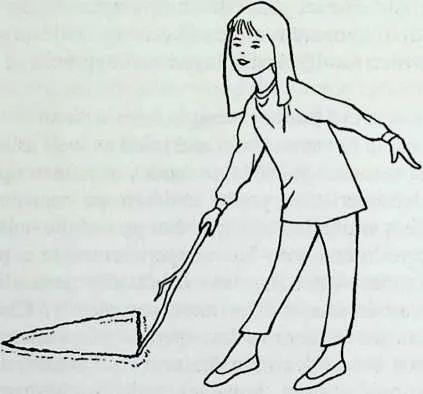
55 Fig. 2-2 Drawing a seemingly insignificant triangle in the dirt.
56 the even smaller area on which the lines are drawn, and the enormous area outside the three lines.48 Because our traditional definition of shapes deals only with bounded areas, the minor area on which the lines are drawn is not considered. The other two sections constitute the majority of the Earth’s surface-, and they divide it into two sectors.49
57 To clarify the situation, the adult suggests that the girl study the Earth’s equator circle, which also divides its surface into two major sec-tors, the Northern and Southern Hemispheres. Those sections are of equal area, but if the imaginary circle known as the equator is shifted farther north, the southern area becomes larger while the northern area becomes smaller.
58 As a further aid to understanding the system of operation, the child is asked to reproduce her triangle on the surface of an Earth globe using a large rubber band stretched between three pushpins stuck into the globe. By relocating the pins, she can shift the lines and points of her triangle to move it in a manner similar to the way the equator line was shifted north or south. Using this simple technique, the child can change the orientation as well as the size and shape of the triangle.
59 Obviously, such a triangle is much larger in comparison to the model Earth globe than was the original triangle when compared to the actual Earth. Still, both are triangles on the surface of Earth. Employing the globe, the girl can create a triangle which covers whole continents, and she begins to see that her triangle does, in fact, divide the entire surface of the Earth into two distinct areas.
60 Because it is an area bound by a closed line of three edges and three angles, the territory inside the three lines clearly fits the definition of a triangle. Nothing in that definition limits the size of the angles or the curvature of the sides. Consequently, even though the area viewed as ‘‘outside’’ the three curved lines, which delineate the first triangle, is bounded by much larger angles, it still conforms to the definition of a triangle (i.e., an area bounded by a closed line of three edges and three angles).50
61 After considering this explanation, the child realizes that she did, in fact, create at least two distinct triangles on the Earth’s surface, even though neither is flat. Both triangles are spherical, and one is tiny while the other is huge. Because of the enormous size of the larger triangle’s three angles, it is unfamiliar and not readily recognized by most people. The large ‘‘outer’’ triangle does not conform to the image of a triangle presented in most schools, and people rarely notice it.51 Nevertheless, that immense triangle does conform to the definition and is as much a triangle as is the area inside the three lines.
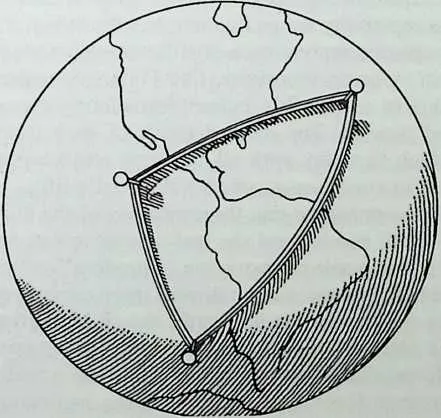
63 Fig. 2-3 Any triangle on the Earth’s surface divides it into at least two distinct triangles, as illustrated by a rubber band on an Earth globe.
64 By experimenting with her rubber band and pins on the globe, the child experientially learns about the concept of spherical triangles. She may also begin to appreciate the fact that she has been educated within a system that promotes a specialized, myopic view of reality. Further exam-ination of that system and her beliefs may even lead the child to under-stand how seldom she considers her entire environment.
65 Fuller felt that most people are deeply rooted in a similar predica-ment, and he perpetually sought to dislodge himself from that narrow view and mode of operation. He supported his quest with constant experi-mentation and evaluation, which permitted him to move beyond the limits of traditional education and the unquestioning acceptance of the ‘‘wisdom’’ presented by the educational system and the leaders who sustain it.52 He was able to function successfully in that radical manner because he truly believed he was striving toward a new harmony with all Universe, and that within such a harmonious operation he would be able to function much more effectively and efficiently. He also felt that all people must eventually move beyond the restrictions of formal education and become truly aware of their environment and the restrictions they impose upon themselves and their concept of reality.53
66 Fuller believed people had to start recognizing the fact that those human beings, experiences, and phenomena outside humanly established boundaries of acceptability are as important as those within them.54 Such a universal acceptance represents a significant step toward becoming a comprehensivist. A comprehensivist, like Fuller, considers as many as-pects of a situation as possible before formulating the most effective conclusions and actions. The desired result of such thoroughness is a condition in which harmony with all Universe and support of humanity become intrinsic in every aspect of an individual’s life.
67 Bucky often commented that the confusion of the child who drew a triangle on the Earth and learned she had actually created more than one triangle was a direct result of restrictive, ‘‘modem’’ education. He also understood that her response was predicated upon societal conditioning.55
68 In drawing the triangle on the Earth, the child inadvertently altered and divided the entire Planet. Having conducted this experiment several times, Bucky found that when confronted with such a realization, a child erroneously assumes some type of wrongdoing has occurred and feels guilty. He also discovered that a child confronted by that circumstance invariably apologizes and explains that she had no intention of creating a problem or causing harm. Fuller believed that such an unwarranted reac-tion is primarily a consequence of the child’s interaction with adults.56
69 Because most people are fearful of mistakes, that apologetic reaction is typical among both children and adults who have been led to believe that mistakes are bad. Bucky concluded that our fear of mistakes is so overwhelming that most people concentrate on caution and safety rather than breaking new ground and taking risks.
70 Fuller believed that the humanly devised concept of mistakes is erroneous.57 What most people consider mistakes are mistakes only in the eyes of the beholder. Fuller viewed that concept in an entirely different light. He understood that although people sometimes take actions which do not produce the sought-after effects, still lessons can be learned from any action, including ones regarded as mistakes.58
71 Because they are less ‘‘socialized,’’ young children generally pos-sess a healthier attitude toward criticism, and that attitude is evident in the scenario of the child drawing the triangle on the ground. When the girl understands that she has created two triangles, she learns from her experi-ence, and, rather than chastising herself, she asks about the other two triangles of the four she has been told were created.
72 Fuller regarded such inquiries as invitations to support the develop-ment of another human being, and he responded whenever possible.5^ In fact, he was known to spend hours explaining ideas to a single interested individual while other matters, perceived as more important by his col-leagues, were held in abeyance. When a query came from a truly interested person, Fuller knew that any concepts introduced would be eagerly exam-ined, and he positively exploited such opportunities to their fullest.
73 In the triangle-in-the-dirt scenario, the relevant concepts he sought to illuminate were concave and convex. Although concave and convex al-ways occur jointly, they are very different from one another. A lens possesses a concave and convex side, and in experimenting with those two facets their different characteristics are apparent.60
74 When light passes through a lens and exits from the concave side, it is focused and concentrated, a phenomenon illustrated by a magnifying glass on a sunny day concentrating sunlight and burning a hole in a piece of paper. The focal qualities of concave lenses are also utilized in eye-glasses, which help focus visual images more clearly within the eye. Eyeglasses mirror the normal function of the eye’s natural lens and aid people with impaired eye lenses by refocusing images. The convex side of a lens has exactly the reverse effect. Light exiting through it is diffused and scattered, a phenomenon illustrated in crystal prisms, which split normally invisible sunlight into a rainbow of colors.61
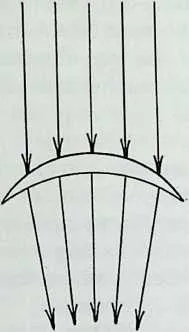
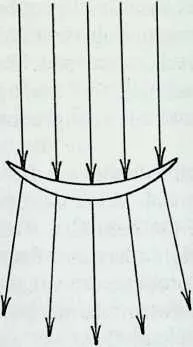
76 Fig. 2-4 Concave (left) and convex (right) always exist simultaneously even though concave focuses energy, such as light, while convex diffuses energy.
77 Once the child grasps the distinction between concave and convex and sees that her triangle was drawn on a spherical surface which has both a concave and a convex side, the second set of triangles begins to appear to her. She understands that both her large and small spherical triangles are, in fact, convex when considered from the usual position, but that when observed from within the sphere, the concave aspects of those same two shapes emerge.62
78 Within even the simple act of drawing a triangle in the dirt, an orderly pattern begins to become evident. Whenever a person tries to draw one triangle, four triangles always appear. That unique pattern and its significance is much more evident to those who, as Fuller did, consciously search out relationships and an inclusive perspective. Fuller uncovered that phenomenon and its importance early in his examination of geometry and triangles, and he was able to utilize it in the invention and develop-ment of structures throughout his life.63
79 This pattern of four occurs because drawing a triangle in the dirt is predicated upon a fundamental ‘‘foumess’’ operating throughout Uni-verse. The conspicuous foumess which became a fundamental element of Bucky’s life and work is also seen in the four sides of a tetrahedron. Once he understood just how important the foumess of the tetrahedron is in Nature’s construction, he began mirroring that element in his designs and inventions.64
80 He found that because humans operate within a tangible rather than a conceptual environment, the minimum number of triangles which can be drawn is always four.65 This occurs because no surface is perfectly flat, and any triangle drawn upon a curved surface has to possess an inner and outer pair of concave triangles as well as an inner and outer pair of convex triangles.
81 Over the years, Fuller devoted a great deal of time to examining the fields of mathematics, science, and human behavior as well as their inter-relationships. When he combined these three areas, Bucky found that most people rarely consider the mathematics and principles which govern all Universe because they believe themselves not to be significantly af-fected by seemingly abstract mathematics and principles.
82 Fuller felt that no creature is excluded from the timeless straightfor-ward authority of the simple, yet highly sophisticated, eternal mathe-matical precepts, and he devoted a great deal of time to understanding those principles so he could operate more effectively within the confines of our environment. Through years of observation, he discovered that some people believe themselves to be exempt from natural laws because they live primarily within humanly manufactured surroundings.66 Large cities provide them with a false confidence that humans, and not the fundamental laws of Nature, control everything, including the destiny and environment of individuals.
83 Spending a considerable amount of time isolated from Nature fur-nishes such people with the illusion that humans can dominate Nature. Fuller, on the other hand, was certain that all human actions must conform to natural laws and principles. There was no doubt in his mind that as long as human beings continue to operate within the limitations of the physical environment, we cannot escape Nature or its principles.
84 In fact, we humans are constantly employing Nature’s generalized principles to formulate distinctions and better understand ourselves and our environment.67 Within the context of that type of operation, Fuller perceived learning as much about Nature’s principles as possible to be a logical action. He, therefore, wisely predicated his operational strategy on doing just that and was able to employ that strategy in acquiring an understanding and insight known to few human beings.68